There is
no doubt that people who collect orchids are somewhat obsessive. They see a new
plant in an exhibit or read about it and begin to think –What if I could get one of
those?- And that is precisely how orchid collections grow, mostly a few plants
at a time.
To me, one
of my most memorable plants in terms of mystery and obsession is Sophronitis
Coccinea, a species from Brazil. It always comes up when you are either first
learning about orchids or later teaching others about them. You see, Sophronitis
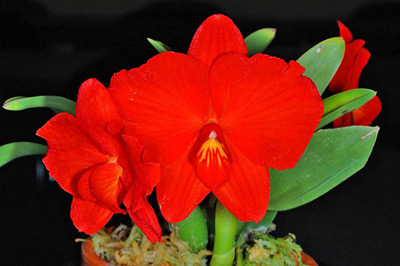
Coccinea happens to be the only true “red” orchid of the Cattleya type in nature. The
problem is, that its flowers are tiny, an inch or slightly bigger in size. Thus,
there have been many efforts to use Sophronitis Coccinea in hybridization to
bring out the red, but attempting to have the flowers be bigger. This has led
to hundreds of red hybrids, many of them in small flower sizes that have come to be known as
MiniCatts.
I too fell
in for the mystery of Sophronitis Coccinea when I first learned about it when I
was first learning and reading about orchids in the mid eighties. It seemed so
incredible, the only “true” red orchid, but tiny. I would look at the pictures
and try to imagine how big they were. Then, sometime around 1986 or 1987 I went
to a conference in Brazil,
specifically in Rio de Janeiro.
Somebody
had told me that in the back of the Ipanema region of Rio,
famous for the song about the girl from there, there was a small market where I could buy orchids on the
weekend. If my memory serves me right, the market was actually called the
Leblon market or known as such. I set out walking towards that market my first
morning there and found it without any problem. To my disappointment, it was
very commercial, mostly hybrids which are not my favorites, except for…dozens
of plants of Sophronitis Coccinea collected in the Tijuca forest in the mountains
behind Rio de Janeiro,
something which I learned later in another trip.
I was
enchanted by the delicacy and beauty of the flowers. They were small, but not as
small I had imagined and they had an incredible beautiful color and texture. They
also cost very little, so I bought one. The plants were small, just a single
clump of leaves with one or at most two flowers. Later in the trip, I went to a
commercial grower (Floralia)
and I bought something like four or five different varieties of Sophronitis,
none a red as Coccinea, but all in the orange-red category.
Unfortunately,
I did not quite understand that they were not Cattleyas and they did not grow
well in Catlleya-like conditions. They all died and I simply decided I could
not grow them. In fact the key to growing them was right there staring in my
face, in the clouded forest of the Tijuca
Forest where the plants
grew in the wild, but it would take me a long time before I understood it
clearly.
Many years
later, I went to Hawaii
and by chance there was an orchid exhibit at a Mall. It was a small exhibit but
there were truly wonderful things. But the most wonderful one was a large
“specimen” plant of Sophronitis Coccinea that had maybe 30 or 40 flowers. I was
enchanted by the beauty of the plant with all of its flowers and my interest in
going back to growing them was reignited.
By chance,
I went to a Conference in San Diego
and went to see a commercial grower which had many species. In one wall he had
many Sophronitis plants and I asked how they grew so well (even if they did not
have many flowers). He explained what now seems obvious: These plants grow in
clouded forests where they get regular showers many times a day, thus the usual
treatment of Cattleya, watering once every couple of days simply does not work;
you need to water them many times a day. What he did was to have a rubber hose
with water pressure during the day only. He would make pinholes in the hose
right above the plants in such a way that it would drip on top of the plants continuously
during the day, but the roots would dry at night. (This obviously does not
necessarily happen in the wild, but wet roots at night may promote root rut)
I filed
this information and decided that next time I found someone selling Sophronitis
plants I would acquire them. My plan was simple, since I have a misting system
in my orchid room, I would place them right below the misters, which turn on
frequently during the day, but are off at night when the humidity of Caracas is sufficient. I
first came across a Sophronitis Cernua which I had read was easy to grow and
flower and I have posted images
of here. And it worked! The plants thrived and today my original Sophronitis
Cernua has become many plants, it grows and grows and last week I won third
prize with one plant with about eight flowers.
Once the
Soph. Cernua worked, it was time to start looking for Coccinea. I got a plant
and learned that it would be a slower grower because it likes it cooler than it
ever gets here in Caracas.
The plant progressed and has flowered once. But at some point between when I
got it and when it first flowered I went to an exhibit and saw an amazing and incredible
sight: A mutation of Sophronitis Coccinea called Aurea (or flava in some books)
which made the flower be yellow, completely yellow, instead of red. If I thought
the red one was beautiful, this one was simply spectacular! But I knew of nobody
who sold or owned one. And my search began.
Most people
told me that I had to go to Japan
to get one. Amazing no? You have to go to Japan to get a Brazilian orchid plant;
I guess there are some very obsessive people there. Taking advantage of the Internet
I wrote to a few people that were said to sell simply Sophronitis plants or
even have yellow varieties. But I had no luck.
A couple
of years later, I was googling for images of orchids and I found one and there
was an email associated with the picture. I wrote to the owner and he said that
he did have some, but right now he had none for sale. He asked that I write to
him in six months or so and he might either have some or be close to having it.
I made a note to myself (Those that know me realize how unlike me that would be)
and six months later I emailed again. The answer came back: I will have them in
a couple of months, write again. And I did.
Thus, I
came to own my first Sophronitis Coccinea Aurea. At this point the question was
simply will it grow well or not? And it does. In fact, it grows better than the
regular “red” variety. Last week I was playing around in my orchid room and
noticed a little yellow bud in the plant. Since them I have been checking it
two or three times a day. This morning it was open! It was simply bliss and in
some sense a beautiful ending to the obsession and it was worth it!
And here
it is below, my wonderful first flower of Sophronitis Coccinea var. Aurea. The
picture may be premature (I will take others and post others later), it seems
like the flower has not fully opened and I got home when it was getting dark,
so the lighting was not the best to take a picture. But hey, isn’t it absolutely
beautiful!


 The Devil's Excrement