Archive for the 'Uncategorized' Category

Random Thoughts About Blogs, Venezuela and a Government Caught in Political Asymptotic Slavery

February 2, 2014

It has been one of those weeks in Venezuela where nothing happens and that is what worries you: How long can the Government continue without making decisions or making half-assed ones, expecting that nothing will happen? But at the same time, Government officials and supporters say the darndest things and you wonder what type of thought process goes through their minds.

And in a country with little significant news to talk about, Quico of Caracas Chronicles, all of a sudden decides to call it quits, sailing into the sunset and deciding that he no longer has the intensity to continue writing about Venezuela. And in some sense, I envy him, because the idea of not writing the blog any longer, comes back frequently into my mind like a boomerang, but while I am writing less, I somehow can not cut that cord off. I am not ready yet. Kudos to him that could write for eleven years and give up. But somehow I can’t.

I wish good luck to him and those that will carry the torch for him now.

When I originally started writing these pages in the summer of 2002, my goal was to tell the world how absurd Venezuela was becoming and how the Chavez Government was using gray areas to subvert democracy and law and order. A few months later, if my memory is correct, Quico began his chronicles, a welcomed relief in my mind, as the intensity at the time was hard to keep up with. More sources, more coverage. Soon afterwards, Daniel showed up with his views and a bit later Alek Boyd started vcrisis. I did not know any of them, but over time, I met all personally and we became a sort of loose conglomerate of telling the world what was happening in Venezuela in English. Alek later looked for other horizons within the Venezuela theme, but Quico, with more coauthors, Daniel and I, kept going and I believe we did achieve a level of originality and credibility not found in the regular media, each in its own style and focus

Quico will be missed, with his sarcastic and provocative style which promotes thought and discussion. He leaves Juan and Gustavo, who will reveal a new look and collaborators, but as good as they are and can be, it will be a different era. We are all getting old, I guess. Time to move on…

For some…

But not for me. When I began this blog, I always envisioned the day when Chávez would disappear from the scene and I would write The End and that would be it for the Devil and the night job I never searched for when I started. Well, Chávez went away and THE END can not be written yet, because the absurd revolution is thriving in its inconsistencies and irresponsibilities, which are still around and amplified. And somehow, it is hard to see the end to all the insanity and absurdities, but I hope one day I can write something like a final chapter.

Physicists like to give name to theories. When I was a Physics student, asymptotic freedom was in vogue, later the name asymptotic slavery was also coined for the property of some superconductors.  Somehow, I have felt for a while that Chavismo is trapped in something we could call political asymptotic slavery.

Because Chavismo made a number of decisions years ago, that it thought it could one day change, but the longer it waits, it becomes asymptotically impossible to change things. As time goes by, Chavismo has become a slave to this decisions long ago. It can no longer backtrack. It is trapped, a slave to its own inconsistencies.

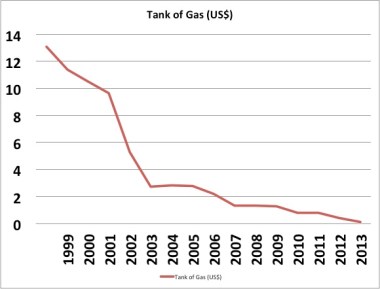
Let me give you an example: Gas prices. Even before Hugo Chávez became President, he asked then President Caldera not to continue increasing the price of gas as planned. So, let’s look at the price of a large tank of gasoline in US $ in Venezuela from 1998 to today at the non-official rate of exchange at the close of the year. I use a tank of gas, assuming it is 80 liters or 21 gallons, because if I used a gallon, it would be hard to show the price in US$:
GAS

In 1998, right before Chávez came to power a tank of 80 liters of gasoline, or about 21 gallons, cost about 13.5 US$ in Bolivars. Chávez decided to freeze the price of gas to preserve his popularity. By now, that same tank of gas costs 11 cents of a US$. (NOT A TYPO) Asymptotically, this is simply zero, gas is free in Venezuela, and is one of the many ways in which Chavismo is trapped. Raising it to two dollars, that is bringing it back to the equivalent of seven years ago, represents a factor of twenty increase. It would be political suicide to do so. But raising it to what it was when Chavez got to power would be a factor of 122, 12,000% give or take a percent here or there. Madness. Hard to get out of this trap. Slaves of their own ignorance.

Or take the money supply in Bolívars, the so called M2, the monetary liquidity in circulation:

M2

When Chávez got to power, M2 was Bs. 10 billion in today’s “Bolivares Fuertes”. This is practically zero in the scale of the above graph. Today, it is 121 times larger, there are 121 times more Bolívars in circulation than when Chávez got to power . It is growing paraboliccaly, exponentially. Given that reserves are barely more than that fateful day, it is any wonder that the Bolívar has depreciated so much. (Curiously, it is another factor of about 120, scaling perfectly with the growth in M2. When Chávez got to power the exchange rate was Bs. 0.563, today the unmentionable rate is slightly above 120 times that. And Merentes in his aberrant ignorance says he has seen no evidence that increasing M2 affects inflation!)

We could call this inflationary slavery, another physics name. By now, they can’t slow down, they are trapped in their inflationary economy and fear getting out of it. There is no way to absorb that much money to stop inflation, there is no way for them to live without creating more and more money

The problem is that Chavismo thought they could ride their luck up. And luck they had and they seem to forget it whenever they talk about the bad old days. This is the yearly average price of the Venezuelan oil basket since Chavez came to power:

OIL

When Chávez came to power. the average price of oil the previous year was 8.08 dollars per barrel. Between that time and 2006, that average grew by a factor of ten, something somehow lost when Chavismo looks at its lack of accomplishments. Last year it was US$ 97 per barrel, but that was down like two dollars from 2012.

Chavismo thought this would go on forever, until it did not. Thus, Venezuela which had debt of US$ 35 billion (combined PDVSA and the Republic) when Chávez came to power, began borrowing by issuing bonds.

Today, the debt in bonds is about US$ 35 billion for the Republic and another US$ 43 billion for PDVSA.

But the Government realized that appetite for Venezuelan bonds was not infinite, so they borrowed about US$ 20 billion from the Chinese, to be paid in oil, so that the cash flow from that oil went to pay those loans.

Then one day, the Chinese said Wú (No) to any more loans. Thus PDVSA started not paying its suppliers. Later, it was its partners in oil projects that did not get paid. When that was not enough, Cadivi stopped paying for imports already in the country. And when that was not enough, PDVSA started borrowing from the Central Bank and the Treasury.

It all adds up and these are all of the country´s debts today:

PDVSA bonds US$43 billion

Republic bonds US$ 35 billion

China US$ 20 billion

Debt with private sector US$ 42 billion

Debt with Central Bank and Treasury US$ 105 billion (in Bolivars)

A cool US$ 245 billion, a factor of seven increase since when Chávez got to power.

And despite all of these policies, the Minister in charge of the Economy says today that there are shortages in “only” forty of the basic products. Well, in 1998, there could be shortages of one product, maybe two, but not chronic shortages of forty products. After all that debt, a factor of 12 increase in the price of oil, 120 in the number of Bolívars in circulation, you would think things would be at least as bad (or as good?) as in 1998, before this funky “revolution” came to power.

But they are not and they will survive one more year by taking money away from anybody left standing. (Banks?)

Everything Chavismo does now is talk about a future they will somehow build. They could not do it with money and they now will attempt to do with without money.

Yeah, sure…

And that is THE END that I want to be able to write about. I am not sure how this ends. I am not sure about the end of this tragedy (tragicomedy?). But after all this effort, I do want to be able to write about how asymptotic slavery was resolved, how the whole thing unraveled.

And unravel it will someday.

And I will not miss a beat of it.

Note added: I have received a number of private questions about the debt above. First of all, not all of its is dollar denominated, thus, it can be devalued. That would be the case of the debt of PDVSA with the Treasury and the Central Bank. Also, with the dividends included in the private sector debt , about US$ 14.3 billion. But additionally, there is debt in Bs. issued by the Government. The last number I have is US$ 66 billion, it is probably higher today.

Prison Sentences In Venezuela’s New “Just Prices” Bill

January 27, 2014

 price_controls-work-e1389636862818

Daniel has given you a neat angle on the new ¨Bill for Just Prices¨, which implies that if Jeff Bezos ever set foot in Venezuela he would have to go to jail. But Mr. Bezos is very unlikely to set foot on this country. But I want you to give you a slight different angle, the consequences for those that live in Venezuela. What they will face under the new Law. Now, I am not a lawyer, nor do I want to bore you with the details of the new Bill. I just want to point out how absurd, even medieval and fascist the whole Bill is.

Thus, I will concentrate on the prison sentences that local people will supposedly get for violating the Bill and the reasons for it:

–Take for example Article 51, which says more or less: “Those who sell goods or services at prices above those fixed or determined by the SUNDDE (The Superintendency created in the Bill to supervise everyone) will be sanctioned with prison terms of between eight and ten years.

The Bill is actually quite ambiguous, it is one thing for the price to be “determined” than for it to be “fixed”. The SUNDDE can “determine” at any time that your price was excessive. This will create a legion of of SUNDDE employees looking to determine prices so they can ask for a bribe.

Now, just to make sure, the Bill details what it means to say “Those who sell”. It is not only the owners, but also the administrators of companies that would be responsible under this new regime of threats and terror that is about to begin in Venezuela. In fact, I expect many owners to say “Forget it!” and just close shop, the same way I expect many Managers to say “Forget it!” and resign to their positions once they figure out what it entails under the new Bill.

But contrast Art. 51 above with Article 57, for example, which says: “Those who buy basic products in order to make money, to resell them at prices higher than those established by SUNDDE will be sanctioned with between 200 and 10,000 tributary units. Note the difference? If you make or sell something and violate the regulations, you get eight to ten years of jail, but if you are just a reseller (Mostly street vendors, I presume) you will have to pay between Bs. 21,400 and Bs. 1,070,000 (US$ 1,893 and US$ 94,690 at the new newfangled Sicad rate. Thus, you can extortion everyone, the penalty is just different, oligarchs get eight to ten, aspiring capitalists who are part of the “people” get to pay a fine (or a bribe!)

–It gets better. Article 55 says “Those that carry out actions or incur in omission that directly or indirectly affect the production, imports, gathering, transportation, distribution or commercialization of goods will be sanctioned with ten to twelve years of jail.

Subtle, no? Imagine you engage in a protest, block traffic: Ten to twelve years because you affected distribution or transportation. Or suppose you supported that protest, then you indirectly helped those guys. See it? This gives the Government carte blanche for jailing people. And they will!

— Article 58. Those that “condition” the sale of regulated goods or services by SUNDEE will be sanctioned with prison between two and six years.

Of course, it will be up to this new super bureaucracy, the SUNDEE, to determine what this conditioning means. You rent a store to someone and put in that they have to paint the store, not you, well, tough, you go to jail. Think about it, contracts will not be able to have any condition whatsoever or else! No soup for you! And jail too!

–Finally, there is an article that says that those that get involved with contraband (out f the country, of course) will be punished with jail sentences between 10 and 14 years.

Jeez! I wonder where they will be able to find new personnel for the National Guard. Unless, of course, the military s exempt from this. Which could happen, this is, after all, a revolution.

There you have it, It will be so easy to go to jail, so easy to charge you and convict you, that I ask: Would you work for a company or start a company that would be subject to this Bill?

No way Jose, as The Village Voice used to say.

The Bill, of course, has dozens of other nuances and penalties, I just thought I would highlight the worst ones. If you find comparable ones, please note in the comments.

And inflation? Will surely be higher in 2014 than in 2013, new Bill or not.

Venezuelan Government Devalues Currency

January 25, 2014

Billetes

After promisiing that it would not devalue, the Venezuelan Government not only implemented a devaluation equivalent to a 22.2% devaluation, but also established a fairly restrictive foreign currency budget, doubling Sicad auctions to US$ 220 million per week and reducing the travel and remittance quotas that individuals had access to. While promising to honor debt obligation in the form of bonds issued by Pdvsa and the Republic, the Government simply said it had no foreign currency to pay the US$ 8.4 billion debt between CADIVI and the private sector from imports made in 2013, which if true will have a drastic impact on local companies.

The announcements were made by the Vice President for Economic Affairs Rafael Ramirez, who said that there will be a budget for foreign currency of US$ 42.7 billion in 2014 (Imports in 2012 were US$ 75 billion and 2013 should be above US$ 65 billion). Of these, US$ 11.4 billion would be for weekly Sicad auctions of foreign currency at Bs. 11.3 per US$ in the amount of US$ 220 million plus US$ 5 billion for travel (Yes, the numbers do not add up!) US$ 30 billion would be left at the Bs. 6.3 per US$ rate for “essentials”, which include food, health, industry, education and pensions. Thus, the weighted average, if the Government sticks to the budget will be Bs. 7.6 per US$, for a 22.2% devaluation, even if Ramirez insisted that this was not a devaluation.

This is a very restrictive foreign currency budget and allocation, which at first sight suggests the Government is keeping some foreign currency for its own purposes and suggests the private sector will have even more difficulties in 2014 and shortages should intensify. The devaluation was much less than expected as most analysts were expecting the reverse weighting, with 70% at the higher Bs. 11.3 per US$ rate. Instead 72.3% will be at the old rate of Bs. 6.3 per US$. Wall St. voted down the adjustment pushing debt prices down sharply on concerns about the country’s ability to pay in the future, despite the promises.

Thus, the Government does very little to remove economic distortions, leaving a huge arbitrage between the official rate and the black market rate, which promotes contraband and finding ways, legal or not, to obtain CADIVI or Sicad foreign currency.

The Government did reduce travel, internet and remittance quotas which were all moved to the rate of the last Sicad auction. For remittances, the Government will require a tax filing, which most workers in the informal sector do not do, but I am sure they will come up to speed fast, filing so they can continue having access to the three US$ 166 monthly remittances for close relatives.

While one Government official said that debt with airlines would be paid (It stands at over US$ 3 billion now), Ramirez’ statement about private sector debt prompted the few airlines that were selling tickets to stop doing so. This confrontation could en up badly if the Government tells them to pack up or shut up, which is their usual style.

Ramirez also mentioned the word “permuta” (swap) which many took to mean a swap market a la 2003-2010 would be revived. I would say forget it, the Government can not allow a free market to function without a strong devaluation, nor does it have the dollars to supply such a market. At best, the Government could open a highly regulated and controlled market at Bs. 17 or so if things got tight. (They will)

All in all, another blow to the private sector, to the Venezuelan economy and to the so called Bolívar fuerte or strong Bolívar which has been battered since its creation barely five years ago in January 2008, when the exchange rate was Bs. 2.7 per US$.

We suspect that the Sicad rate would slide during the year and that slowly during the year more and more items will be moved to the higher Sicad rate. The Government will call it whatever it likes, but it will simply be more stealth devaluations of the currency as the year moves on. And so will move the unmentionable rate to higher levels together with inflation as the destruction of the Venezuelan economy by the revolution marches on.

Policy Paralysis in Venezuela

January 20, 2014

BeD6lQ3CEAAQvBR

The more I think about Maduro’s “announcements” and speech last week, the more I think the whole thing was incredibly inconsequential and very little was truly announced that day. No matter what interpretation anyone wants to give it, what Maduro did was roughly repeat what was said last May, a couple of weeks after he was sworn in as President of Venezuela.

For example, Maduro announced that Cadivi would be eliminated and a new institution, the Centro Nacional de Comercio Exterior (Cencoex) would take over for it. But do you really think this will be a major change? Cencoex will have new stationary, there will be signs on the door and a new website, but the rest will all remain the same. After all, Maduro wants tighter control over who gets the foreign currency, which implies that controls will remain in place and the seventeen steps required today by Cadivi, will become twenty some under Cencoex. If not more.

In fact, the Vice President confirmed this when he said that “The paperwork will remain the same until we make new announcements”, which simply says, we have no clue what to do anymore than we did in May 2013, we just know this is not working this way.

And yes, a new Minister of Finance was appointed, this time a General and an active one at that. As if a General would somehow figure out what others have not been able to. And this General is no Economist, maintaining a long tradition of having someone who is not trained in Economics or Finance for the position. Which obviously shows.

And I repeat, he is military, as if did not have enough military presence in the Cabinet as it was.

And Nelson Merentes, a Mathematician who has created a reputation as being a “pragmatist” goes back to the Venezuelan Central Bank, where his pragmatism led to the artificial  creation of money to the tune of 60% -plus per year, which has lead to the glorious levels of inflation we have.

And some people actually think it is good that he is going back to the Central Bank. It must be a collective death wish of some sort.

Meanwhile, we were told that Sicad would become more important as a mechanism to obtain foreign currency. That the auctions would be dynamized and more companies and people would have access to this mechanism.

Except that is precisely what was said last May/june by Merentes and Ramirez, the latter the other “pragmatist” in the Cabinet. And we have to wonder what makes Ramirez a “pragmatist”, since he has done very little for the economy, pragmatic or otherwise, since he became  Vice-President for Economic Affairs, and very little that can be considered pragmatic. Oh yeah! he made a couple of pragmatic decisions in PDVSA before, but you have to remember that PDVSA is the goose that lays the golden eggs to sustain the revolution, but the revolution is all about ideology, not pragmatism. So, keep the eggs coming so that we can cummunalize Venezuela, if such a word exists, which I doubt.

And once again we were threatened with a modification of the Foreign Exchange Illicit Bill, something as recurring as comets in the past, but now returns so frequently that they have become artificial satellites and pure BS at that. And every time this changes are mentioned, the optimists think some form of market exchange is coming soon, while Chavismo knows that no such animal will exist again as long as they are in power. But people are gullible enough to think that Giordani is on his way out and the revolution will become softer. Sure, as soon as you can say Elvis Amoroso backwards one hundred times in a row and drunk.

In fact, there were so few announcements in the State of the Union speech that the easy part, moving students dollars, travel and the like to he Sicad rate was not even announced. That is how improvised the whole thing was.

And while everyone and the New York Times seems to think that the gasoline price increase is coming, Maduro did not even mention the subject last week and by the time the whole subject is discussed and processed by the Government, what we will have is an increase which is unlikely to match 2014’s inflation in Venezuela, implying that Maduro will simply be running in place by the end of the year.

Because what is happening is simply policy paralysis, influenced in part by fear. Any distortion that is removed will have a political cost in the country, while the way the distortion is removed erodes Maduro’s standing within a Government divided by ideologies, all of them extreme left wing.

Which requires in the end, bringing in more military, active and retired, murderers and coupsters, in a macabre dance of incompetence, to compensate the absence of the one almighty leader.

But in the end, it is all about ideology. Don’t be fooled. The Government will assume any role that they think can be better performed by them. Foreign currency will be channeled through the Government. Imports via State companies and friendly Bolibourgeois, so that the shortages have no way to go but up. And more military will be placed in charge.

Perhaps nothing summarizes this more than the title of Ecoanalitica’s report in reference to Maduro’s speech: “How to make a 360 degree turn”.

And indeed it was, use all the cliches, back to the future, deja vu all over again and the like. Maduro went back to May, losing what is likely to be his only opportunity in the next few years to make an economic adjustment that would have a lasting effect. By the time the distortions become even more dramatic in mid-2014, Maduro and his team will be thinking about the Parliamentary elections in 2015, inducing policy lethargy and the appeal to extremely unorthodox policies and methods to allow the Government to survive until then.

But while the radical wing led by Minister Giordani remains in place, nothing will change. Chavismo/Madurismo will be trapped in its distortions and its inability to execute what is needed to have things improve. Till then, more of the same.

Maduro: Stay The Course!

January 15, 2014

smileWhat are these guys smiling at?

Lots of expectations today. Rumors of positive change. Bonds moving up. Maybe, just maybe, Maduro was about to change the course of the Bolivarian revolution. There was talk of a fairly competent oil manager becoming President of PDVSA. Of Ramirez moving to Finance, which would have been a bummer. Of Merentes being shipped back to the Central Bank. In the end, the last one was the only one that became true. Ramirez stays where he is and Merentes is replaced by Rodolfo Marco Torres. Pardon me, General Rodolfo Marco Torres.

As for devaluations and distortions in the economy, not much to report. Maduro did say that travelers will have to go to Sicad or better said, use the Sicad rate for their travels. But he did announce that Cadivi will be eliminated, which many interpreted as the elimination of Cadivi for the private sector, and the Government keeping the Bs. 6.3 per US$ rate to itself.

The path is clear: For the Government, extremely cheap dollars, for everyone else, not even Mastercard, only black market.

As For Minister Marco Torres. What can I say? He does have experience in the Government’s financial sector, but not the type I would boast about. When he was a Colonel, he was in Fonden (uups!), was Treasurer at a very touchy time (oh baby!) and then he was moved sideways to Banco de Venezuela and Minister for Public Banks (I think it happened in that specific order, but who cares, really?). Now he is moved to a new Joint Ministry of Finance AND Minister for Public Banks. The revolution has all these supermen with no training that can do the job or two or three people at once.

And yes, there were other announcements, like they are going to go after speculators and crooks. (Seriously!) Or that they will merge the Superintendecy fo Price Controls and the Consumer Protection agency. (Saman is out once again!).

And yes, Nelson Merentes returns to the Venezuelan Central Bank, where he expanded monetary liquidity at such high pace, that inflation is now in the mid fifties. I guess he is being rewarded for his accomplishments, and sent back to keep up the good work, after his failure in Finance.

But in the end, what Nicolas Maduro is saying is that the revolution will stay the course. That he fails to understand the distortions and dangers to the economy. That between ideology and fear, he can’t even begin to attempt to solve the problems of the Venezuelan economy. I have heard of a few people that talked to Maduro this week or last week about the problems. He heard them all politely, but nothing of what was said is reflected in this speech.

In some sense, this is what Maduro has done in the nine months since he was elected (perhaps?) President. He can not make choices. He has not listened. He has tried to please everyone in his unholy Bolivarian coalition. From Marxists to military, from Socialists to enchufados, from radicals to pragmatists, from Communists to Cubans. He has been unable to make decisions, And he continues and will continue to do so, as long as the Bs. 6.3 per dollar rate is feasible or doable. The private sector seems to be relegated to mostly Sicad or the black market. Maduro thinks the State can do anything. Run everything.

That is the model of the revolution. And as I suggested earlier, there will be no collapse this year. But I can say Maduro’s style suggests that the deterioration will accelerate much faster than it needs to. Inflation will be up this year (85%?). So will the black market rate (double?). GDP will contract (-3%?). Shortages will increase. (35%?) The only thing I can say I am sorry about is that I used the title “Clueless in Miraflores” in the previous post.

It would have been even more perfect for this one!

Nicolas Maduro: Clueless in Miraflores

January 12, 2014

Vice

In the traditional structure of a Government, the Vice-Minister or Under Secretary plays a key role in that he or she runs the Ministry or Department, while the Minister or Secretary, a more political appointment, takes care of the political side, going to public functions and the like. In Venezuela, it used to be the same, the Vice-Minister was a more managerial, less political person, who would run the day to day administrative aspects, while the Minister attended functions, Cabinet meetings and the like. The Vice-Minister also took the place of the Minister when the Minister was away. Under the Vice Minister, there were the “Directores”, who ran each area of the Ministry. Obviously, Vice-Ministers have more perks than “Directores”, higher salaries, cars, body guards and the like.

When Chávez came to power, he began “inventing” Vice-Ministries, mostly to reward buddies who had done something for him, but could not be named Ministers or Vice-Ministers at the moment. I clearly remember when Merentes lost the race for President (Rector) of Universidad Central de Venezuela His grand ambition) and I heard he had been named Vice-Minister of Finance, which made me wonder who would run the Ministry in the absence of the fairly competent person who was Vice-Minister. But there was no problem, Merentes was actually appointed to a new Vice-Ministry, created by Chávez just to thank him for services rendered. Later, when Maduro became Minister of Foreign Affairs, he created three Vice-Ministries, each in charge of different regions of the world. The funny things is, in time, his close friend and confidant Temir Porras, now disappeared from the Government, began covering two of the three, as Maduro trusted him and could not find someone else to fill the third Vice-Ministry.

And now, in a clear sign of how clueless Maduro is about management and how to run a Government, he creates 111 new Vice-Ministers to accompany the thirty Ministers that accompany in his Cabinet. The hilarious thing is that the decree creating these new positions (Decree 730) actually says that this “optimizes” the structure of Government, not once, but twice.

Just imagine, now some Ministries will have as many as six Vice-Ministers, who will have to be coordinated by the Minister, the same guy who will have to spend half his day listening to Maduro, attending formal occasions and going to other meetings and functions outside the Ministry. The Vice-Ministers will be fighting for territory and budget and none of them will be in charge of administration, legal department and many others. Just not very efficient or “optimizing”

Even worse, each of these guys will spend the first month finding an office, getting bodyguards, cars and support staff for the new position. But hey! Everything is working so well in Venezuela that there is really no urgency to do things. Like there is a two month backlog at the Puerto Cabello dock, but there is now no wheat flower, so bread rationing has begun.

Wonder which Vice-Ministers (it overlaps many) are in charge of solving those two problems.

You can have fun reading the list of Vice-Ministers. You will be happy to know that the Vice-Ministry for the Supreme Social Happiness of the People (1.3) survives this restructuring. Or you may wonder why we need a Vice-Minister for Economic Cooperation in Foreign Relations (3.1), if we have one for each region of the world. Or how the four Vice-Ministries in Planning separate their responsibilities (5.1-5,4). Or what Socialist Industries (8.1) are all about. And what exactly does a Vice-Minister for International Tourism (9.2) do? Travel? And really, the Postal Service (20.3) is part of Science and Technology?

But nothing, absolutely nothing, will prepare you for the new Vice-Ministry for Social Networks (21.5). What does this person do? Create more failed “socialist” social networks?  Surf all day? Tweet all day? Monitor and spy on the “people” who use social networks? Block us?

We will soon find out.

But the message is clear: Maduro is so clueless, that he thinks somehow things will work better if each Minister has more and more Vice-Ministers under him or her, as if the number of people at high level can help solve problems, instead of people with the required knowledge. Or if they are chosen not for the loyalty but for their abilities.

But I am sure many of these new positions will be filled with current or former military officers, insuring that nothing will be done better or “optimized”, so the record of Chavismo remains unblemished in its inability to run and manage the country. They wll do exactly the oppite.

Maduro is simply, Clueless in Miraflores.

The Destruction Of Venezuelan Institutionality

January 7, 2014

rebuilding_walls_large1

Institutionality. Such an easy word. But so easy to destroy, so difficult to build up. And therein lies the biggest conundrum facing Venezuelans in the future, whether in a year (not likely), or five (probable) or even later (Can God be so mean to us?), we can attempt to rebuild what has been destroyed by Chavismo. Because it is easy to think anything will be better than this, but when you face an avalanche of crime or economic distortions, you need more than change, you need the required institutionality to create the appropriate culture at each institution, whether part of the Government or of the decentralized Government.

And that is the problem. The sad thing about the loss of institutionality at the Venezuelan Central Bank, is not the clowns at the top, it is the technical professionals that will be hardest to find when (and if!) things change. Because while the exodus at the monetary authority may just be beginning, it has had a long run elsewhere in the country under Chavismo. How do you convince a former Intevep researcher working in Canada to come back?. Where do you find a Venezuelan Professional policeman (with a capital P) willing to come back from abroad and face the myriad of problems our cities face? Or medical doctors? Or Judges?

That is the problem. Chavismo has managed to destroy institutionality at all levels. From the Electoral Board, to Cantv, to PDVSA, to the Comptrollers office, to the Judiciary, those still inside have given up, left or sold their souls to the revolution in exchange for money.

The tough part will not be changing the Government, it will be rebuilding it. Like the picture above, it will take many bricks and many guarantees for people to want to help. As the saying goes: Once burned, twice shy. While some will be willing to come back and help rebuild, many will think they already paid their dues and are not wiling to come back at low salaries and with few guarantees to build an uncertain future.

And uncertain it will be, because unless Chavismo steps over the line badly, once out, they will try to claim they are democrats and they will fight you every day. They will blame crime, low scientific production and even PDVSA’s failure, on the opposition, the economic war, the US or whatever.

Which leads me to the origin of this post. While the murder of a former Miss Venezuela last night, her husband next to her killed in the robbery and their four year old girl surviving the episode is terrorific, this has become daily life for most Venezuelans. By now, a couple of dozen more similar homicides have taken place since this incident last night. Except you don’t know about their lives, whether they were valedictorian, or studying for their Ph.D. or simply  completing high school or university, all useful for a country like Venezuela. Or winners of the Miss Joropo contest…

Except that the destruction of institutionality is such, that the successful ones, the ones that can come up with a plan to fight crime, develop technology or fixed the complex problems associated with health care, are all abroad, developing the same dreams they had, but paid in foreign currency and with their kids going to wonderful schools.

Do you really think many will come back?

And that is the tragedy. Chavsimo thought that the most incompetent, undereducated, corrupt group of Venezuelans, the military, could do everything. And in the process the military got rid of those that had the know-how, the experience and the ability to fix the problems. And unless you get rid of the same military, it will be an uphill battle to get rid of these former, current and active military officers, that have no clue as to how to run anything. And they will try to keep their positions.

The reality is that the sharper Chavismo’s drop, the better the chances at change and institutionality being restored and rebuilt. Unfortunately, the country’s down fall, unless oil prices drop precipitously, is likely to be just a muddle through, with the usual suspects surviving and managing to live another day.

The only positive note I can give you, is that the radical wing of Chavismo is trying to push everyone out, guaranteeing that little is done to fix economic distortions and accelerating the so called collapse of the economy, increasing the chances for a change for the better.

But if Venezuela continues its slow motion downfall, it any not be until at least five years from now, that some form of institutionality can be rebuilt, except the country will not count with the brightest and the best, but with whatever is left. A different picture form what was available before Chavismo came to power.

A long road ahead for recovery. Likely too long for someone my age. Restoring institutionality may take the same thirty or forty years that it took to sort of build it up. Meanwhile the world moves forward, thinking about technology, ideas, know how, globalization and the like. Which Chavismo barely even thinks about.

And on that note, I end this post for the New Year, apologizing for the somber tone, but somehow hopeful that I am completely wrong.

Venezuelan Central Bank Joins The Dark Side

December 31, 2013

bcv

While not wholly unexpected, yesterday’s bimonthly inflation report was a disgrace, which signals a change in the institutionality that the Venezuela Central Bank had managed to maintain during the last fifteen years under Chavismo. In some sense, the surprise was that it did not happen before, that for better or for worse, the technical side of the Central Bank had managed to prevail somehow in demanding that the data be fudged as little as possible.

And the data for November for November and December was a terrible 4.8% for Venezuela’s CPI in November and a “projected” 2.2% for December that the monetary authority takes to signal a change in direction and a slowing of inflation. Never mind the dreadful 7.5% for Food and Beverages in November, nor the 56% inflation for the year, nor the hiding of the fact (in a graph in page 2) that the scarcity index was at the high for the year.

But whether the data is believable or not is irrelevant. It is the language of the communique, the irresponsibility of it all that is simply unbelievable. The institution most responsible for the current levels, via its lonas to PDVSA, of inflation passes the buck, blaming the economic war and politics and failing to assume its mandate as being responsible for controlling prices.At the same time, it sucks up to Maduro, by suggesting that the supposed improvement in the numebrs for Decemebr is thanks to the actions of the Government on Commerce.

But it is the ideology and the politics of the language that is shameful, that reduces the Central Bank to a tool of the Government, as the Central Bank suggests that some nebulous sectors of the opposition took advantage of Chavez’ death to “artificially deteriorate economic variables” as an “authentic economic war” was waged on the population, which was only stopped by the “Government’s offensive” in November.

But there is no mention of the irresponsible lending to PDVSA and other Government institutions, nor of the dramatic and doubly irresponsible growth in monetary liquidity, nor of the continuous deficit spending by the Government, nor of the decimation of the productive sector and the total failure of the Government in its attempt to substitute it.

The whole report is simply a disgrace, a shameful yielding to politics and ideology and a refusal to admit the crass errors of the mediocre economists (and other strange professions) that today occupy the Board of the Venezuelan Central Bank.

It was the day that the Central Bank joined the dark side, after fifteen years of attempting to avoid submitting to the political pressures of Hugo Chávez, they now become servile to his fake substitute.

Who will the blame when the numbers deteriorate once again in 2014 in violation of the mandate given to them by the Constitution? How will they hide the upcoming scarcity and even higher levels of inflation? Or will they also blame the coming devaluation on these mysterious forces that are nowhere but in the midst of the Government and the sadly dependent Central Bank?

Another tragedy in Venezuelan history and a disgraceful chapter in the history of what was once a very professional Central Bank.

Added: BTW, Maduro was almost right on the magnitude of inflation, he suggested -5%, but he got the sign wrong, the magnitude almost right. Shows how clueless he is.

What Will Happen In Venezuela In 2014?

December 29, 2013

Collapse2

Now that I have your attention with that provocative title, I will give you my answer to that question right away and then I will try to justify it: I don’t think there will be economic collapse, dramatic social unrest or anything of the sort. I think that Venezuela under Chavismo will continued to plod along, drifting lower, as conditions get worse and worse, but I don’t think there will be some sort of dramatic collapse of the economy that will lead to some form of political instability.

My reasoning is simple, very few times in history do economies collapse in predictable fashion, nor do I think Venezuela is at an extreme. Yes, things are bad, but the Government has a number of degrees of freedom to act if necessary and it enjoys a level of popularity such that there is ways to go before its popularity is down to levels that could create sufficient social unrest for anything to happen.

Think about this year (2013): The Government had a shortage of dollars all year, it devalued to Bs. 6.3 from Bs. 4.3 per US$, Chávez died and was replaced by nebish Maduro, the Government spent like there was no tomorrow, inflation went up 100% from 25+% to 50+%, the unmentionable rate increased by a factor of 3.7 (It started the year at Bs. 17.4 per US$), scarcity went up from 20% to unknown and in the end, Chavismo actually got more votes than the opposition, with over 50% popularity in the Mayoral election.

Venezuela has The Devil’s Excrement, for better or for worse, we know the flow of foreign currency can sustain the types of distortions that the Venezuelan economy has enjoyed the last few years with total inaction. At some point,  things will unravel. but I believe this will happen only after the Government devalues sharply, which it does not seem ready to do and/or attempts to fix some of the distortions in the economy.

Because it is precisely the fact that it has not tried to fix these distortions that will allow the Government to make some adjustments. It can reign in spending, it can cut Petrocaribe and Cuba, it can devalue, it can increase the price of gas, sell the gold, mortgage more of the future than it has take over the banking system to issue even more local debt, issue more foreign debt and many other measures, before its popularity goes below 40%. Think Mugabe, for example, he had gizillion inflation and even held on to power.

Oh yeah, things will get worse and people will be unhappy, nobody enjoys 75%-80% inflation like we will see in the first half of 2014, but the Government will blame Obama, Capriles, Economic War or even Martians for the problems. And given the control f the media they will sell it yet again, once or twice more, but it will not be enough at some point. But this is not close, oil needs to weaken, some measures taken and maybe, just maybe something will happen. But I doubt it will be in 2014 and I doubt it will be dramatic.

Of course, the longer they plod along, the bigger the distortions and the sharper the eventual collapse, but we are not there yet.

Oil is indeed the Devil’s Excrement. Just watch!

Merry Christmas Everybody!

December 24, 2013

IMG_4147

As you know, I am not the most optimistic about Venezuela at this time, which sometimes makes it hard to sit down and write. Thus, as I was thinking about what image to post for the holidays, I had mixed feelings about posting something without a reality check on what is happening in Venezuela. Then, my brother sent me this image and I thought it was perfect, a somewhat cynical view at the type of Christmas Venezuelans are being forced to have. But despite all, Christmas has to be celebrated.

It is a time of the year to be thankful, to be with family and enjoy the holidays. I wish you all a very Merry Christmas wherever you may be. That Santa Claus or the Wise Men bring you what you want (hopefully not what is in the picture) and you spend some happy times with your family, forgetting about all the problems.

Thank you for coming back and putting up with my writings and my rants. I am humbled to have such a loyal readership and hope you keep enjoying it.

Merry Christmas everybody!

From the Devil Himself.