Archive for the 'Uncategorized' Category

Maduro’s Sudden Moves

October 9, 2013

bicimaduro

Anyone that thinks they understand the sudden moves made by Nicolas Maduro during the last few weeks, should wait a while, because I don’t think the full picture is clear yet. What I do think is clear is two things: Maduro is not happy the way things are going, he knows his Government is not working well and the importance of Nelson Merentes has been substantially diminished.

In fact, Merentes’ slide seemed to begin earlier than two days ago, when in a puzzling move, Maduro failed to include him in his bombastically-named “Organo Supeiror para la Defensa de la Economia (OSDE)” , which was created on the last day of September and is presided by a General, whose power has been increasing, but despite its name, failed to include Merentes. This discrepancy was noted at the time, but nobody knew exactly what it really meant.

Merentes is clearly paying for his lack of accomplishments. The man that was supposed to be the “pragmatic” member of Maduro’s Caibent, was not energetic enough to push his agenda and the more ideologically minded members of the Cabinet managed to slow down all of his initiatives and Merentes has essentially nothing to show for his almost six months in the Ministry of Finance.

The second sudden move, was the removal of Maduro’s confidant Temir Porras from both the development bank Bandes and the development fund Fonden. Porras was a new figure in the economic side of the Government and had been reported to be Maduro’s sounding board on economic and financial matters. But faster that you could say Temir, he was pushed out last week with no explanation. And there is still no clear idea of what happened there, even if some suggests that Porras was removed due to Maduro’s displeasure with the French intelligent services pulling off the operation that allowed them to catch the drug in the Air France plane. Reportedly Porras’ inability to know about this forced him out. Others suggest that Porras’ team convinced Maduro that the Chinese would lend him the US$ 5 billion in cash, which did not happen.

Then this week, Merentes was removed as Vice President for the Economy, a position that is now occupied by the Minister f Energy and Mines and President of PDVSA Rafael Ramirez.  This position is not that important, but there is a “Revolutionary” Cabinet above the crowded Cabinet, which is composed of six Vice Presidents. This supra-Cabinet meets more often with Maduro and is supposed to have a coordinating role.

It turns out that Ramirez was already part of this supra-Cabinet, so whether it has a meaning or not that he replaces Merentes is not that clear. Ramirez was previously the Vice President for Territorial Development, a position now occupied by General Hebert Garcia (More on him later)

Ramirez being the new Vice-President for the Economy may not be so bad as many think. He is considered to be part of the more ideological and radical branch of the Government, but he has shown in the past that he can be quite pragmatic. In fact, the only area where there have been some positive signs since Maduro took over has been in PDVSA’s flexibility, which has been led by Ramirez. Ramirez may actually be more capable of convincing the radicals that some change is needed.

The problem is that Ramirez is no economist and the change needed is more than a foreign exchange system, like Merentes seemed to think. What is needed is a larger adjustment of the economy and its variables, before distortions gets further out of hand. Ramirez will certainly not deliver that.

Caracas is full of rumors and among them, the possibility that Ramirez may also be moved sideways is one of them. PDVSA is where the money is and some Madurista groups may be trying to get closer to the honey pot and the Royal Family having a bigger influence there.

As for General Hebert Garcia, he now occupies three positions, the one in the supra-Cabinet, the President of Mision Vivienda and the President of OSDE, signifying that Maduro trusts him and he is the point military man to organize the economy and reduce shortages and build housing. Sounds like a tall order for a single person, let alone a Venezuelan General. But as PMB comments today, there seems to be this belief in Chavista circles that the military can organize things despite fifteen years of proving the contrary.

So, stay tuned, Maduro may yet make other moves pronto, which will allow us to better understand the ones he has made, excluding how he fell from that bicycle.

In Venezuela, Country Of Controls, Cash Is King

October 7, 2013

ESPAÑA-EUROS-296x200

Nothing can illustrate better the lawlessness, irresponsibility and lack of equality that currently rules Venezuela that this item from the international news, accompanied by this item today.

First, we hear that the official (funcionario) from the National Institute for Sports (IND) was not involved in money laundering. It was not money laundering, because the guy was authorized. Never mind the law, whether Bulgarian or Venezuelan laws. Because in both countries, you have to declare cash above a certain amount.

According to this website, you have to declare above 8,000 leva in Bulgaria, whether you are importing or exporting them. That is about 4,000 euro if you were wondering. So, if Mr. Funcionario Official was carrying euro 407,000, he was money laundering, violating Bulgarian law, whether the Embassy likes it or not.

But incredibly, these “funcionarios” from the Bulgarian Embassy forget that we live in Venezuela, where you have to declare over US$ 10,000 when you leave the country. If you don’t, you were also money laundering.

A country where anyone, anyone “normal” of course, has to fill out and hand in folders to Cadivi, to obtain approval. We are talking about all sorts of forms, filled out individually, to get no more, that is the regulation, than US$ 3,000 in your credit card for travel abroad. Legally, there are no exceptions to these rules. It’s the law of the land. Except Chavismo seems to believe that the law only applies to everyone else. Particularly for non-Chavistas.

But really, do you trust a “funcionario” to carry that much cash in a country where nobody can carry cash in foreign currency? Who supervises handing out the cash? Spending it? Really, please….

How much cash did Maduro’s delegation carry in China? No wonder they wanted to get out of the airplane in Vancouver and go shopping after their sudden departure in Beijing…

But really. Think about it. In the country of controls, where to get even small nominal amounts, you have to submit folders, prove you are alive, got to the bank two or three times, get a ticket, get receipts, use only your credit card, except for small cash amounts, but some flunky is given over half a million euros to “carry”, like a drug mule, through the Maiquetia airport, the airport where you can get drugs out, only if you are exporting over a Ton a time, but not smaller amounts.

Same as with cash.

But just like you can not export drugs, it is illegal to export large amounts of cash, even if you are a Chavista. Except it seems as if cash is king for Chavistas. Remember Antonini? He was also above the law.

But somehow for Chavismo, it is one thing to be a member of PSUV, a Chavista, or you and me. This Government is all about discrimination. This Government is all about creating two classes of people. It is about having laws that apply to others, but not to you. Because they are the all powerful Government.

Except Bulgaria is not Venezuela, the same way that Argentina was not Venezuela, even if Antonini’s plane was chartered by PDVSA.

And these are the cases in which they get caught, imagine how many there are where nothing happens. Nobody gets caught. A million euros, two million euros? For Chavismo, the sky is the limit.

I mean, the country does not even have a Comptroller, just some flunky who is a member of PSUV and nobody knows her name. (I think it is a she). Becuase Chavismo does not one to appoint anyone who is not loyal to them.

Nobody is watching, Bolichicos y Bolichicas, take advantage of it.

Meanwhile, pendejos y pendejas (Buddies of mine). Fill out your forms. Hand in your folders. Travel. Spend you money wisely and legally. Hand in your receipts. Get ready to be suspended. Remember you are second class, even if you comply, they may still jail you. You are guilty until proven innocent.

You are just not a Chavista, sorry!

Venezuelan Bonds Drop. More to come?

October 5, 2013

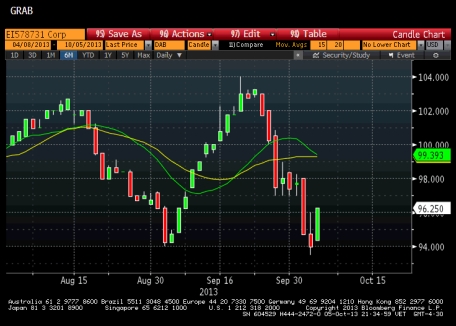
Venezuelan and PDVSA bonds have not done well lately. While there was a nice rally in September, up to the US Federal Reserve announcing that it was not ready to reduce tapering, after that, they did not well, with a bounce on Friday due mostly to JP Morgan reiterating  its overweight rating on the bonds,in a report entitled something something like “Venezuela: Bending, but not Breaking.

The graph for PDVSA 2022 is shown below:

That was quite a drop, almost 10 points since September 20th., except for Friday’s bounce.

bonos1

Why has this happened? Essentially all news coming out of Caracas is negative. There is nothing positive happening and Maduro has been in power almost six months and very little has been done on economic policy. In fact, there has been total policy paralysis on economic matters since April.

In April, I suggested that investors reduce their position in Venezuela and PDVSA for the simple fact that bonds had gone up because “change” was expected, but as long as Giordani remained in the Cabinet, it was difficult to envision this change.

But for foreign investors signs are even worse, everything coming out of Caracas seems to be negative:

-There is total policy paralysis

-Sidetur bonds defaulted, the first time in 14 years the Chavista Government has allowed this to happen.

-Liquid international reserves are low. There is money in parallel funds,but people don’t know how much. Is Maduro willing or commited to pay as much as Chávez?

-PDVSA has failed to increase oil production significantly. Even more ominous, Lukoil and Petronas have decide to leave the partnerships they joined recently in thePetrocarabobo and Junin 6 fields.

-A new foreign exchange system, called Sicad was set up, but has failed to deliver foreign currency. No auctions have been held in four weeks in what was supposed to be a system that would regularly offer foreign currency to companies.

-The ICSID Court ruled against Venezuela in the ConocoPhillips case, which will eventually have a financial obligation attached. Given the uncertainty over the full amount, this implies an additional financial commitment in the future for the country.

-President Maduro went to China and while he failed to obtain a US$ 5 billion loan in cash, he did extend the Heavy Chinese Venezuela fund with a US$ 5 billion loan. This loan is an extension, which will allow Venezuela to buy Chinese goods in exchange for oil, constraining PDVSA’s cash flow from oil sales.

-The non-payment for the delivery of three oil tankers raises questions as to why PDVSA is holding back payment when the amounts involved are not significant.

-Investors are increasingly concerned that the Government will have to resort to issuance in the near future, if it wants to create any form of new foreign exchange market as resources to supply this market are limited at this time.

-The Government intervened paper product maker Manpa, sending another negative signal to markets. While the intervention is supposedly temporary, President Maduro has suggested a number of irregularities were found and the intervention will be extended.

-Meanwhile, President Maduro continues to blame the private sector for inflation and shortages.

-And oil could drop further now than Iran is talking to the US Government.

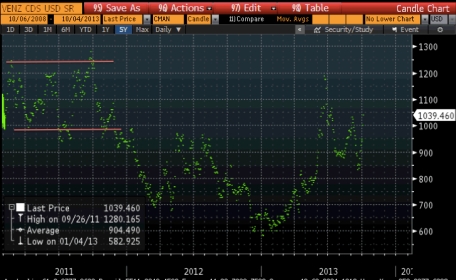
But in our opinion, all that is happening is that Venezuelan bonds are sort of resetting their expectations. While I do not expect the government or PDVSA to default or restructure in the next two years, one has to think back to what happened in 2011 when Hugo Chavez got sick. At that time, bonds were trading at a spread of 1,000 to 1,200 basis points to US treasuries, as shown in the curve below:

bonos2

This is a plot of the country risk since 2011, expressed in basis points. As you can see, right before Chávez got sick, the price to insure Venezuela bonds for 5 years was oscillating between 1,000 basis points (19%) and 1,200 basis points (12%). The country risk (the price paid by people to insure Venezuela against default, dropped as low as 600 basis points, as people were betting that once Hugo was gone, there would be change in the way the country was run. However, since Maduro took over over five months ago, little has happened and people are getting concerned. The spread r country risk reached 1,030 on Friday.

Some people are so concerned that they think Venezuela or PDVSA will default soon. I don’t think this is the case. However, looking at the plot above, you can see that the credit risk spread can easily (or should?) go back to 1,200 basis points. Thus, this resetting of the curve is not something I am willing to ride out. Bonds will likely have further to drop.

Thus, I am telling people to simply lighten up on their Venezuela positions. Bonds could easily drop 10 more points, something most investors would have a hard time riding out.

In fact, just as Chávez was sick because of his health, I think Cristina is politically sick in Argentina and investors will bet that things will change down there and bonds from that country will rally sharply in the next couple of years. Even if nothing changes in the end in Argentina, just like in Venezuela.

Opposition Deputy Blasts Chavistas Deputies On Discussion On US Diplomats

October 2, 2013

Americo Da Grazia, the opposition Deputy from Bolivar State, the same one that was pushed down the stairs of the National Assembly a few months ago by a group of Chavista Deputies, gave this excellent speech during the discussion to approve a resolution backing Maduro’s decision to expel three US diplomats. Da Grazia is a member of Causa R, the Guayana socialist party associated with the union movement.

For those that do not speak Spanish, Da Grazia starts by showing his birth certificate and saying he is Venezuelan and where he was born. He then recalls the murder of a Causa R leader last weekend. He then says among other things:

-What a pity that this assembly refuses to discuss Venezuela’s problems.

-Pity you don’t care about what Venezuelans care about.

-We are not lackeys of the gringo empire, but we are also not lackeys of the Chinese empire. But you just gave away the Las Cristinas gold mine to the Chinese empire while on your knees. Shame on you!

-You also gave Guyana (the country) the disputed territory.

-You dont say anything or discuss anything about the Sidor strike, the Ferrominera strike or the miners that are in jail.

-Because of you electricity consumption is back to the 80’s in Guayana because you ruined the electric infrastructure. And you don’t talk about it.

-How many of you know that in Guayana there is not asingle hospital that can provide chemotherapy or radiotherapy treatment to cancer patients. single hospital that provides chemotherapy or radiotherapy to cancer patients, but then you want to discuss this “pendejada”.

-He then says ironically that he just told his daughter not to go to the market, because thanks to kicking out the americans, there will be no shortages, there will be toilet paper and the dollar will go down in price.

-He then calls them stupid and imbeciles.

-He then calls for a democratic solution to Venezuela’s political problem.

-He then mentions all the positions, CNE, Comptroller that need to be elected and says they are illegitimate.

A Chavista Deputy then answers him with ideological BS.

Hat Tip: Damian Pratt who made the effort to place the video in youtube

If The Revolutionary System Is Too Complicated, Add Another Layer!

September 27, 2013

finger

For a group of people that is incapable of managing even the simplest systems, Chavismo has proven quite adept at establishing controls systems for everything. It is truly amazing how they can be so creative and inventive to establish very complicated systems to monitor and control, but are incapable of managing a simple supply chain for example, for an arepera.

Yesterday, I was praising Chavismo in private, because for the first time, they were actually going to remove some layers of controls for imports, removing certain steps to request certificates necessary for any import request, as well as extending the validity of current certificates until December 31st.

But my joy lasted a very short time, when I learned today about the new invention of the CADIVI “creativity” department to stop the “raspaito” of credit cards without traveling. As you know, people are buying airline tickets, requesting the CADIVI dollars for travel and not using them (This requires folders, going to the bank, wasting half a day, going online many times, etc..). They take their credit card, send it with someone or have someone use it for them and voila, they exchange those dollars bought at Bs. 6.3 per US$ and sell it at a huge profit at six times that rate in the unmentionable market. With the difference, the price of the ticket is almost irrelevant.

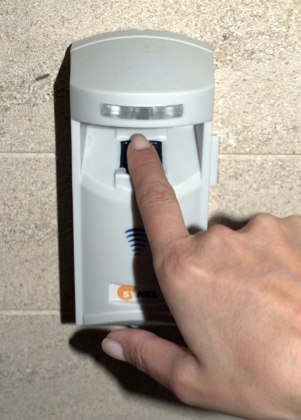
Well, given the truculent mind of Chavista officials, here is what they are planning to do to stop “raspaitos”: They will set up fingerprint units at all international exit points of the country in airports, ports, roads. Then, as you exit immigration, you will activate your credit card with your fingerprint. The system will be connected to the national credit card system. In this fashion, the theory goes, only people that actually leave the country will have their credit card activated.

Except…

-What if the system is down when you leave?

-What if there is no electricity that day?

-What if the connection is down?

-There is no law stopping you from leaving the country and immediately going thru immigration, missing your flight and activating the card in the process.

and so many others…

And, of course, there will be a cost to implementing this whole thing, but who cares, we will have Patria and fingerprint systems and they will feel good about it!

Another Ton Of Coke, Right Under The Bolivarian Revolution’s Eyes

September 22, 2013

pariscocaine

A few weeks ago, a good friend was traveling to Europe, when he was stopped right after Maiquetia immigration and interrogated by some officials. When it was determined that he was only going for a few days, the questions got more direct and unnerving, as they were directly suggesting that he may be carrying drugs on him. Unfortunately, in the world of digital communications, he was carrying no papers about his meeting and did not have on him his ID from work.

He was asked if he minded having an X-Ray done, which he clearly didn’t. At that point, he was moved to a room with other “suspects” and taken away from the airport to some form of dispensary run by Cubans near Catia La Mar. By now, the whole process was quite unnerving, as it was already past the departure time of the airplane and he was far from the airport and did not know if he would miss his flight or not. An X-ray was done, obviously showing nothing and he and the others were returned to the airport to catch their flight, which was delayed two hours because of them.

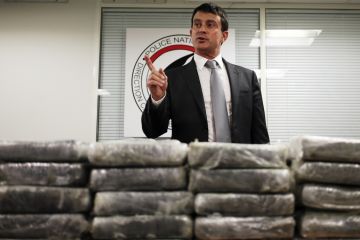
This story comes to mind, because French authorities revealed this week, that 1,3 Tons of cocaine were found in an Air France airplane arriving from Maiquetia. The stash was found in 30 suitcases, which cnn describes a “colorful” and which did not belong to any of the passengers on the plane.

Imagine this, in an airport where individuals are x-rayed to see if they have drugs in their stomachs, 30 suitcases full of cocaine, worth close to a quarter billion dollars are “sneaked in” on to the airplane. This requires the cooperation of the authorities, of Air France employees, of the National Guard and of the same people that basically harassed my friend.

But that is not the problem. The problem is that this find, proves how rotten Venezuela is when, in a facility controlled by the military, anyone can move one Ton of drugs and succeed. To give you scale, this is the largest drug catch in Frances’ history. This factoid alone should raise concerns about how screwed up Venezuela is.

Another Ton Of Coke, Right Under The Bolivarian Revolution’s Eyes

So far, there has been no statement from the Minister of the Interior and Justice. The Prosecutor’s office opened an investigation and faster that you can say “Maduro is in China”, they detained three National Guardsmen: Two Sargents and one Lieutenant. Sure, quite believable that these three lowly Guardsmen put together an operation worth a quarter billion dollars. This in a country that has a few Generals in the DEA’s watch or is it black list?

Meanwhile the French took ten days to reveal the that they caught the drug, before making their own detentions. Interesting, no?

And Maduro says he wants an Enabling Bill to fight corruption, when his own military and his own security is immersed with drug traffickers to the hilt, as shown by this case. The delay in making any announcements in itself suggests that they were scrambling to see how to react publicly. In any other country, the Airport would be intervened and its Head removed, until the investigation was completed. But General Graterol, Director of the airport is high ranking, as well as close to Diosdado, very powerful. In one of those crazy things that only happen in the revolution, he is not only Director of the Airport, but President of airline Conviasa.  They can barely do one job well, and they are given two.

But think about it: A Ton of cocaine not only was loaded in Maiquetia, but how did it get there frm wherever it came from? Too much complicity, at very high levels.

Like Maletagate, Illaramendi, Bandes, Corpoelec, etc, etc, etc, the case will blow over with time, nothing will happen, the case will be shelved, forgotten in the myriad cases of corruption of the revolution, many of them which hit too close to power and too close for comfort.

Funny how most of these cases are always discovered, investigated and announced abroad, no?

The Devil’s Excrement At Work: The Chinese Fund, Suvinca And Cheap Imported Cars

September 19, 2013

Suvinca

A few months ago, I heard a strange tale of cheap Chinese cars being imported to Venezuela and sold for incredibly low prices. When I asked on limitations, I was told there were none, the organization they were telling me about could buy as many cars as it wanted. Just put a small down payment down per car and voilá, a few months later and upon delivery, you would pay the balance. To give you an idea of the prices, the down payment was less than Bs. 10,000 (US$ 1,587 at the official rate or US$ 244 at the parallel rate of exchange) and upon delivery you paid the balance, with the total cost being around Bs. 100,000, or US$ 15,870 at the official rate of exchange or US$ 2,440 at the parallel rate. Yes, less than US$ 3,000.

The whole thing sounded very fishy. I immediately thought it was some sort of scam via CADIVI, whereby someone was getting dollars at the official rate of exchange to bring these cars to Venezuela. But it sounded strange, why would the Government give official dollars to some scammer, rather than giving it to the car companies that generate work in the country?

After making a few inquiries, I tracked down the story behind the cars. In some sense, it is not a scam, it is somewhat legit. But in another it is an amazing example of how Chavismo has lost sight of what developing a country is all about. Moreover it is simply The Devil’s Excrement at work: Oil generates such wealth, that those in charge can’t think on how to use that wealth productively and instead waste it “doing good” to a  few, without generating any wealth or well being for the “people”.

Most of you have probably never heard of Suvinca. Suvinca is a company owned by the Ministry of Commerce, which is an acronym to the name “Venezuelan Industrial Supplies”. Suvinca is supposed to procure “the access to raw materials, inputs, capital goods, intermediate and finished, with the purpose of deepening the endogenous development of the country”

A noble goal indeed. But somehow, something was lost in translation. Or by the limited brains of the Revolutionary management. Because it turns out that Suvinca has access to the loans from the Chinese Funds. One of those loans, was partly in in the Chinese currency Yuan (70 billion Yuan if I recall correctly, almost US$ 10 billion at the time). Well, the money from these Chinese Funds is supposed to go roughly (my words) to:

“Projects within the National Development Program, that have high social impact, improve the standard of living, generate employment and consolidate some sectors which are considered a priority.”

Well, it turns out that Suvinca uses intermediary companies in the US, of all places, to import cars made in China, some made by US companies in China exclusively for that market, and which are paid with the Yuans from the loan from the Chinese Fund. Suvinca then turns around and sells these cars to chosen groups of individuals, at ridiculously low prices, since those Yuan are calculated at the official rate of exchange.

Thus, Venezuela’s “development” money. The same money that is borrowed from the Chinese, instead of being used to buy machinery, factories, equipment, as everyone envisioned, is being used to import Chinese cars. That’s it!

That’s what someone in the Chavismo stratosphere considers “development”

How low our country has fallen…

In fact, if you look through the news section of Suvinca, this “procurement” company, seems to do anything but what it was mandated to do. It sells cars, school supplies, produce in markets. But mostly, it sells cars, cheap Chinese imported cars, paid by the loan, as you can see if you go down the list of “news”.

It is all about cars, importing them and selling them to buddies. Many quite well off, actually, like my friend.

Thus, we get a loan to import stuff, undercutting local producers who went more than a year without Cadivi giving them much and likely importing many cars that are not even supposed to come to Venezuela and for which there are no spare parts or support.

It’s The Devil’s Excrement at work, as implemented by brainless bureaucrats, whose only qualification to preside those institutions, is loyalty and ideology to the brainless revolution.

And President Maduro? In China, getting another one of these “development” loans.

The Right Diagnosis For Venezuela, The Wrong Hands to Fix Things.

September 17, 2013

fixit

Suppose I wrote in this blog the following about the Venezuelan economy:

“The problems to be solved (in Venezuela) are related to endemic inflation and a productive system that has not responded to the stimulus of government spending, while rentism has deepened the country’s dependence on oil. It can be characterized by inflation above thousand percentage points in the 14-year rule of Chavismo, with food prices rising 1760% in the same period, the highest figure in all of Latin America, with clear signs of acceleration, as May inflation reached 6%, highest in a month, than in a full  year anywhere in Latin America. Production has only grown by 10% in 14 years, the lowest in the region, except for Haiti. The rate of industrialization in this government continued to decline, reaching 13.9% last year, when it had reached 20% in 1986, and non-oil exports went from being 40% of the total, to only 4% in 14 years. The fiscal situation is severe, reaching 15% of GDP, with problems to finance social spending, with oil production in a very problematic situation, despite high oil prices, and the Government has resorted to the Central Bank printing money in order to finance itself.

The causes of the situation have to do with increasing the size of the centralized state inherited from the Fourth Republic, which was unable be transformed from the top and has absorbed in its corruption a large fraction of the Government’s execution. In addition, social spending and production incentives have become inflation, not production, in the presence of a regime and import policies that have harmed the development of production, especially by the issuance of paper money by the Venezuelan Central Bank.”

And suppose then that among the solutions I proposed here that the Government talk to the productive sector to establish clear rules, remove the Board of the Central Bank, reform the tax system, create a monetary stabilization fund, implement a transition plan so that everything that is imported is made in Venezuela and within seven months allow the currency to float freely.

I am sure that more than one Chavista would read that and accuse me of being a capitalist, an ignorant and who knows what else. Because anyone that writes the above is simply saying that Chavismo has failed miserably. No?

Right diagnosis. Wrong hands to fix it.

Except that I did not write that. With small changes, just to make a point, the above was written by a group of Bolivarian professionals, under the title ¿Que Hacer?. led by former Minister of Planning Felipe Perez and contained in the fourth version of a very long document, which is exquisite in its diagnoses of the economic failure of Chavismo, but, in my opinion, fails miserably on the solutions, as it proposes as a solution to the execution problem of the Government  to turn control to communal power.

I had read the first revision a few months ago, but this one is much more detailed. What is shows is that someone that knows economics knows how screwed up the last fourteen years have been. What I find amazing is that in the face of that critique, anyone thinks that Chavismo deserves another chance to screw up. So, if you speak Spanish and have patience go read it, the details on the diagnoses of the economic problems are pretty, pretty good.

What’s Up With Merentes’ Proposed “New” And “Improved” Currency Swap System?

September 12, 2013

swapFor the last two weeks the Government has begun talking about the possibility of reviving the swap (permuta) market, given that Sicad has been a gigantic failure, in that it has done nothing to lower the parallel black exchange rate and the Government has discovered all sorts of scams in it, aided from within.

So, are we to believe this talk about a new foreign exchange swap market, where people will be able to go and buy foreign currency at prices determined by free market forces and without any limitation?

Well, call me skeptical, dubious and  incredulous. I just don’t think so.

Not under the current conditions of limited foreign currency, excess monetary liquidity (and growing!) and artificially low official exchange rate.

Just as a reminder about swaps, when the Government imposed exchange controls in 2003, it banned the use of Brady bonds as a foreign exchange mechanism, which was the parallel mechanism in the Caldera exchange controls in the 90’s.

But then a clever guy, realized that the permuta (swap), whereby you can exchange an object for another, was an instrument which is part of Venezuela’s Codigo de Comercio (Commercial Code) and had nothing to do with securities. Thus, you were forbidden to buy or sell dollars, but you were not forbidden from swapping your house in Caracas for one in Madrid, or a chocolate ice cream for a vanilla ice cream, like the picture above, or more importantly a dollar denominated bond for a Bolivar denominated bond, at a rate determined by you.

And thus the permuta or swap market was born.

Almost three years later, the Government gave its Seal of Approval to the permuta market, when it approved the Foreign Exchange Illicits Bill,in which the Government, recognizing the need for a escape valve, exempted securities explicitly in the Bill. Before this, there was no punishment for the swaps, after this, the Government was acknowledging that it was legal.

The market boomed, until May 2010, when Chávez, upset over how much the swap or parallel rate had gone up, decided to intervene that market, which was mostly supplied by Government dollars, and in the process, jailed a dozen brokers and intervened and shut down some 48 brokerage houses.

So now, the Government wants to revive this relief valve, but it is clear that it does not want the rate to be public or to go up. Furthermore, it wants official rates, those of Cadivi and Sicad to be lower than they should be. When they launched Sicad, there were all sorts of expectations that the Government would make that exchange rate higher and instead, the Government sold the dollars lower.

But suppose the Government overcomes this, decides it does not care at what price dollars go. Well, the problem is that I don’t think they have the foreign currency to supply this new market so that it does not go up.

Let me explain…

When the Government stopped the swap market in 2010, multi-nationals had not been given any foreign currency to repatriate dividends at the official rate of exchange for three years. It has now been six. These companies have lots of Bolivars just sitting there losing value, day after day. The moment the Government creates a legal foreign exchange parallel market, these companies are going to want to go to it and buy dollars. At almost any price.

Add to that the many Venezuelans that have savings. The many companies that would see such a market as a way of reactivating their business. The arbitrage between the official rate and the parallel rate.

And what you have is a lot of pent up demand to buy dollars.

But the Government has given signals that it does not want to give dollars to the private sector. It has given signals that it does not have as much money in parallel funds as it did in 2010. To top it all off, it would be very costly for the Government to issue debt, as it did in 2009 and 2010 to sell bonds to ease off demand in the parallel market.

Thus, I believe that if the Government really created a legal parallel market, the black (now) parallel rate (then) would move up. Strongly.

And thus my skepticism…

But let’s suppose I am wrong. The Government has realized that things are getting worse. It does not mind if the rate goes up. It is willing to sell lots of dollars into the new swap market.

What will happen?

Well, let’s do the following Gedanken experiment:

Let’s assume that the conditions in 2010, prior to the shutdown of the swap market, were “equilibrium” conditions. That is, the swap market, which was roughly a free market, provided a good measure of supply and demand, in the context of the exchange controls, which kept the official rate at Bs. 4.3 per US$. All the Bolivars that did not get US$ at Bs. 4.3, went to the swap market for imports.

What would be the equivalent Gedanken “equilibirum” be today?

Well, let’s use May 1st. 2010 as the reference date for that moment. On that date, international reserves stood at US$ 28.2 billion and M2, monetary liquidity stood at Bs 238 billion, so that the “intrinsic” exchange rate stood at Bs. 8.3 per US$. That is if you compare how many Bolivars there were for each dollars in reserves, there are Bs. 8.3 per US$, fairly close to the swap exchange rate of Bs. 8 at the time the swap market was closed.

If we do the same today, international reserves sit at US$ 22.17 billion, while monetary liquidity sits at Bs. 912.9 billion, so that the same “intrinsic” value is at Bs. 41.18.

Thus, going back to our Gedanken experiment, if we think that the conditions in 2010 were those of an ideal equilibrium, with a fixed official rate of exchange at Bs. 4.3 per US$, what should be that same rate today, to make conditions in terms of M2, international reserves and the official rate of exchange identically the same to those of May 2010?

The answer is that the official rate of exchange should be today at Bs. 22 per US$! ((4.3/8)xBlack Rate)

And therein lies the problem. By holding the official rate so low, the Government has created an artificial system, in which any item that gets officials dollars is so cheap, compared the huge amount of Bolivars that have been created at a rate of 65% increase per year and the inflation rate of over 20% per year for the last three years, that everyone wants to buy it.

Thus, if the Government created this fantastic new swap market, all you can buy, and absolutely legal, it would have to devalue to Bs. 22 or near that, in order for conditions to be similar to those of 2010.

Except that things are worse:

-The Government has fewer dollars.

-Pent up demand is much higher.

-The Government could issue much less to in bonds to supply the new market

-The Government is not ready to devalue to Bs. 22, nor does it want the unmentionable parallel rate to be higher than it is.

This, my friends is why I am such a skeptic of all these announcements about the newfangled swap market.

Thus, I think the Government will set up a controlled, regulated, limited, maximum, minimum, rules, regulated “market” at a rate much lower than the current black rate, which in the end will do nothing to stop the other rate from rising. Maybe, just maybe, after this new market fails, will the Government will be ready to implement something more realistic.

And this would require both a sharp devaluation and a slow down in the growth of monetary liquidity.

Thus, I find nothing in these announcements that makes me excited.

Waiting For Venezuela To Bottom

September 8, 2013

bottomless_pit

Many people seem to think that Venezuela is or may be close to some sort of economic bottom. That the current economic situation is unsustainable. That things are about to crack up somehow due to the economy. Collapse, explode or implotion.

Well, think again..

Countries are like the shares of a bad company. they keep going down and down, and too many people think it can’t go lower and they buy more, but it continues to go down.

I think Venezuela is the same. Things continue to deteriorate, shortages, blackouts, inflation, crisis after crisis and conflicts, crime and constant devaluation.

Guess what? That is the story of the last fourteen years, but the bottom may be far into the future.

First of all, think Zimbabwe. If country’s economic crisis hit a bottom and political change would follow, then Mugabe would have been a goner long ago. Instead, there is Robert Gabriel Mugabe, plodding along, year after year. In the middle, the country has seen a variety of things, from hyperinflation, to sanctions, to austerity, with plenty of elections all the time. And Mugabe is still “it”, leading and ruling the country, like Chavismo owns ours. Except Chavez died.

But Mugabe does not have the pipeline of dollars that Chavismo has, nor the leeway to adjust and change in order to plod along along longer. In fact, I suspect that Mugabe has more smarts to adapt and change politically and that is about it.

Think about it, Chavismo has the barrel of oil at US$ 107, give or take some cents, almost as high as it has ever been. It also has a gazillion barrels of oil (and gas, and gold, and iron) underground that it can lease, lend, promise and/or mortgage, in order to achieve its means.

Yes, thing are not well, but an adjustment here, an adjustment there, and quicker that you can say devaluation or default, for that matter, things could improve rather quickly.

And they have. Really. Things are worse now in terms of dollar availability, for example, but at 21% scarcity levels, we are far from the 49% levels of 2007, or the electricity rationing of the 2010 crisis. Think about it.

And oil is as high as it has been in the last five years for example. That means that even if the parallel funds have less in them, they probably have at least US$ 16 billion to muddle through until things get very tight. And if PDVSA needs money, the Central Bank can increase lending to it, by 50%, rather than 28% like in the last year. Crazy? Yes. Inflationary? Yes. But when you have no scruples, the show must go on! As long as you can keep it going.

You are worried that there is a shortage of dollars? Well, let me remind you this is a revolution. And the reality is, that there is a shortage of foreign currency for the private sector which imported US$ 38.7 billion in 2007, but only received US$ 26 billion last year. That is a 32.8% drop. But guess what? The Government in the meantime, has gone from importing “only” US$ 19.7 billion in 2007 to importing US$ 34.3 billion in 2012, that is “only” a  74% increase.

So, you “feel” the lack of foreign currency, because you get essentially 33% less, but the Government has almost doubled what it imports and the Central Bank said those imports went up 25% in the first half of 2103. Yes, their imports are inefficient, overpriced, full of graft and the like, but they have the money, you don’t. Feels bad, but is reality…

This is, after all, a revolution…Remember?

And lest you think that they don’t know they are in trouble, let me tell you three stories:

-Financing for Petrocaribe has almost ground to a halt this year. Yes, according to Central Bank numbers, last year financing to oil exports to Petrocaribe grew by US$ 7 billion. This year? A small increase of about US$ 300 million, according to the Venezuelan Central Bank. That means more money from oil for the Government, more foreign currency for other things.

-Many importers have received in June and July more new foreign currency from Cadivi than what they had received in the last twelve months.  Where is the money coming from? I don’t know. It may be coming from lower Government imports, or it may be coming from funds that used to go to shell companies that never imported anything under the “old” Cadivi management.

-The Government had to import gasoline with the Amuay fire, by now, most repairs have been completed. That means more dollars for PDVSA, as imports of gasoline go down.

And there are more economic tools that could be used. Devaluation, for example. Increase the price of gas from free to free by 200% or 300% higher. Sell dollars at a much higher rate for Sicad. Or if push comes to shove, no dollars, really critical, do you really think these guys are incapable of default? Think again.

But that is far in the future, we are not even close to that.

For now, if you are waiting for Venezuela’s bottom, look again. It’s not close. Going back to my stock analogy, buy Facebook shares ($FB). That one did hit the bottom. And it is going up…

Because about the only thing that Venezuela has hit bottom yet, is on the leadership. Maduro is really near bottom, he is no Chavez, but oil and oil prices and some reasonable decisions could keep him there for a long time, let’s say, all of his six years.

Countries do not reach economic bottoms, only political ones. And that is what the opposition has to work on. The opposition will likely get more votes in December than Chavismo. But Chavismo is likely to get more Mayors than the opposition.

And that, my friend, would not be a sign of a bottom. Chavismo would sell it, through the State controlled media, as a huge victory. And it would be.

So, if you are waiting for Venezuela’s bottom, this is likely not it.

It is after all called the Devil’s Excrement. A true curse. More than you could have ever imagined.