Archive for the 'Uncategorized' Category

Chávez Reportedly In Venezuela

February 18, 2013

734125_562824443727669_1399148568_n

Through his Twitter account, silent for the last two months, President Chávez himself said he arrived in Venezuela in stealth mode and will be at the Military Hospital in Caracas.

Was this all planned: Devaluation, swearing in, resignation, elections in 30 days?

Would make sense…

The Perverse Entrapment Of Foreign Exchange Controls For Both The Government And Multinationals

February 17, 2013

20130214_TALC1_1_1_F1_1

Being a multinational in Venezuela is not easy. The numbers are outstanding, the sales and/or return on equity are fabulous and you are the envy of the region.

Except…

It has been five years since the Chavez Government last allowed you to repatriate earnings. Since then, those fantastic earnings have followed a roller coaster ride. You used to register them at the request of your accountant at the parallel swap rate, which was banned in May 2010, while it was hovering above Bs. 8 per US$. At that moment your earnings were actually revalued to the Sitme rate of Bs. 5.3, only to be devalued last week to Bs. 6.3, as SITME was disappeared and only the official rate exists now.

But wait, the rate exists, but companies have had no access to it for repatriation for the last five years. Thus, they are “virtual” earnings, virtual revenues, virtual returns on equity, they only exist in your books, but can not be transferred to your home office, let alone distributable to your shareholders. They only exist in local currency. And no end in sight.

You may wonder if your business is even real!

And as the Venezuelan officials had the lack of courtesy of making the announcements while markets were open (Revolutionaries don’t believe in markets), shares of Colgate, P&G, BBVA, Telefonica, Unilever and others dropped. Some like Colgate, said how much this would cost them, US$ 120 million in a one time charge, while Merck said it would cost the company US$ 200 million in income. P&G says between US$ 200 and 275 million and I imagine Telefonica knows it’s about half a billion euros, but prefers to say it later.

CADIVI has accumulated US$ 2.8 billion in requests for dividend repatriation and there is an estimated US$ 13  billion total repressed in local currency (at Bs. 4.3 per US$). But after five years, most multinationals are learning that saying “We are here for the long term” sounds tough and audacious, until it feels that this is the long term and you have lived through the whole thing. And it ain’t over…

So, they are trapped, apparently forever.

But the irony is, their trap has by now also become the Government’s trap.

You see, one of the main reason the Government can not create any sort of alternative, parallel, whatever you wanna call it, market, is that currently, all of these multinationals register those dollars at Bs. 6.3 (as of two days ago). This means that they lost 15.9% of their dollar earnings this week. (Only that much, because their accountants probably forced them before to register the Bolivars at the highest “legal”rate of Bs. 5.3 per US$)

But if the Government allowed any sort of floating market, that went to the levels of the black one, these companies would lose say 73.5% of their earnings at Bs. 20 per US$. And if the Government allows any form of parallel real market, that is what accountants will tell these companies they have to do and use. And if they are forced to take this huge loss, hey! they might as well go to the market, buy the foreign currency and take the money home. At least it will be real foreign currency and in their pockets!

But that will only push the new rate higher, as all these companies scramble to buy!

Which is the real reason the swap market rose sharply in 2010 before the Government shut it down. Companies began realizing that their earnings were being devalued day after day, so they mostly decided they might as well take the money home, because it became clear there would be no Government autorized repatriation. When the Government shut down the market, they actually had to revalue from around Bs. 8 to Bs. 5.3. Their numbers looked great all of a sudden! But they were all in Bolivars.

But for the Government, it became a trap. Before, the swap rate would slide in time, companies would adjust, buy what they could, and manage.

But any approval for an “alternative” market implies a huge amount of money that would look to buy after almost three years of being frozen out of any form of dividend repatriation. The new rate would soar, would set prices and the spiral would continue.

A virtuous or vicious circle or spiral for both the Government and multinationals. A trap. Except companies only care about their bottom line and the Government about staying in power. So the Government keeps digging deeper, until the hole will reach the other end of the planet.

The Gran Inquisitor by Miguel Angel Santos

February 15, 2013

20130201_TALC1_1_1_F1

On Friday, Miguel Angel Santos, who is a Professor at Caracas’ business school IESA, wrote this wonderful article in El Universal in response to the interview of Minister of Finance and Planning Jorge Giordani. In it, he shows how Giordani uses superficial arguments to explain why the Government is doing certain things, while not being self-critical of all of the blunders the Chavernment has made in economic and monetary policy. I would only add to the article, that I wish the interviewer had asked Giordani, how much were oil exports and private exports fourteen years ago, and how the latter has collapsed due to Government policies, while the former increased due to exogenous causes. Enjoy, and thanks to Miguel Angel for letting me publish it here.

The Grand Inquisitor by Miguel Angel Santos

The Grand Inquisitor sits in front of the reporter from the Venezuelan News Agency (AVN). Long ago he decided not to face the opposition media. Over the years, not only has he been running out of ideas, but also out of patience and tolerance with those who think differently. “The private sector produces US$ 3 billion a year and demands US$ 30 billion.” If that is the demand: why was it necessary to devalue? According to the BCV, our oil exports totaled in 2012 US$ 92.23 billion. What is the problem of allocating one-third to private imports? The Grand Inquisitor knows what the problem is, but the AVN reporter will not ask him about that.

“They say we are bleeding PDVSA because we devote a large portion of the proceeds to social programs.” But in reality, what is bleeding PDVSA is, on the one hand, which it is being forced to pay royalties for more than a million barrels a day that it produces and does not charge for (those that go to Petrocaribe and the Chinese Fund) and on the other, the contributions to Fonden. To the latter, PDVSA has handed over more than US$ 50 billion, which together with the contributions from the BCV total over one hundred billion dollars. What has been done with that money? What has happened to Fonden and the Chinese Fund? Is the Grand Inquisitor ready to be accountable, to show in detail how much went in, what was specifically done and how much remains in it? “We live the insatiability of the dollar, a kind of dollarized nymphomania “. Is there a larger greed, a bigger ” dollarized nymphomania” than that of the government itself?

The Grand Inquisitor lambastes Venezuelans because they do not to leave their money in bolivars, earning interest rates which in no case reach even half of inflation. Because that is how, with the loss of the value of everyone’s savings, the revolution finances itself. Nor does the sanctimonious tartufo make any reference to the fact that since the implementation of exchange controls, the government has placed in circulation 3,650% more in coins and bills (44% annually). “If we eliminate Cadivi and let everything float freely, reserves would not last three days.” With the amount of money that he has printed and the panic that is fully and widely distributed here daily, we have no doubt about this. There is no mention of the connection between these monetary ravings, inflation and devaluation?

Instead, he resorts to the mortification of the flesh, “it can not justified that people gorge on junk food … that is why there is so much obesity.” It is curious that he used this example of obesity in a derogatory manner (for us) and didactic (for the government): “They question that we use the word adjustment. Cretins! If a guy is a hundred kilos overweight, he better get fit or he may get a stroke or a heart attack.” This is true: An 18% deficit, financed by printing banknotes, puts any economy in the neighborhood of a heart attack. “If this is a “paquetazo” where are the privatizations?”. The monk asks this question in a country where the most precious right, the defense of life, was privatized a while back. So have Healthcare and Education. If he has any doubts, he could ask his colleagues in the Cabinet which school do they send their kids to, or to which clinics they take their relatives to.

His Twitter: @ Miguelsantos12

Students Chain Themselves In Front Of Cuban Embassy In Caracas And Other Stories

February 14, 2013

Today there were protests by Venezuelan students in front of the Cuban Embassy in Caracas. The National Guard decided to repress and seven students were jailed (later freed). Some students went to where the others were being held, while twenty six of them chained themselves in front of the Cuban Embassy, where there is a sot of Mexican stand off at this time.

BDHP3XdCcAESP5h.jpg_large

Meanwhile, the Government no longer knows how to explain the devaluation. Maduro says that it is a speculative attack by the private sector, in a country with draconian foreign exchange controls. Jaua says that the “people” were not benefiting from the “cheap” dollars. Giordani says that they have screwed up all along, that SITME was “genetically perverted”, that Venezuelans have a “dollarized nymphomania” and he knows all about the tricks to get CADIVI dollars illegal but has done nothing about it. Merentes gives Globovision a rambling non-sensical interview. (As a former scientist, I loved (cringed?) at his statement that scientists never rule out anything. Really Nelson?)

Meanwhile, Jaua cancels his visit to Peru to go to Cuba in the middle of rumors that Chavez is back in intensive care, while Marquina (@Marquina04)  says “La razón de la falla respiratoria es sin duda las metástasis a nivel pulmonar e invasión del drenaje linfático” (The reason for the respiratory failure is without any doubt the metastasis at the lung level and invasion of the lymphatic fluid”

A normal day elsewhere in Venezuela. Historian Napoleon Pisani, a fellow bloggerwas killed in a robbery at a museum, while a former national water polo champion was killed in a robbery.

Something seems to be reaching boiling point in Caracas.

Some, Mostly Depressing Thoughts, After The Venezuelan Devaluation

February 10, 2013

So far, reactions to the announced devaluation have been somewhat depressing from both the Government side and sadly so, from the opposition side.

From the Government side, the outright defense of the devaluation as something “good” rather than needed and the implication that this is somehow the fault of the opposition has been truly laughable. Some statements have actually been pathetic, like pseudo Foreign Minister Jaua who said that “It’s a way of protecting the dollars of the Venezuelan “pueblo” from the speculative attack of the Venezuelan bourgeois”. Hey Elias! If this is so, why not devalue to Bs. 20? He also said this would increase Venezuelan exports, as if the current currency had all of a sudden made the country competitive, or even worse, as if Venezuela’s non-oil exports were of any significance to the economy at Bs. 4.3, 6.3 or for that matter Bs. 8.

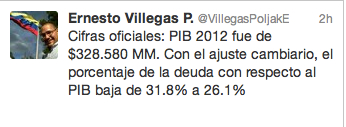
But the Minister of Information was even worse, suggesting the country’s economic parameters “improved” thanks to the devaluation and among others, saying the Debt to GDP ratio went down significantly, because the Bolivar denominated debt went down with respect to the dollar GDP. Unfortunately, he failed to realize that GDP is measured in Bs, not in US$ as per his tweet. He adjusted the numerator in Debt/GDP, but held GDP constant in US$:

VillegasHow convenient! That US$ 328 billion number comes from dividing the GDP in Bs.  by Bs. 4.3. While the GDP will not go down by the full amount of the devaluation (neither will the debt in Bs. stay constant all year!) the argument is really terrible.  Mr. Villegas has rather quickly lost his image as a “serious” person.

But I have also been disappointed by the reaction of many opposition politicians and even economists, criticizing the devaluation itself and not its causes. The impact of the devaluation should have been presented as a consequence of the policies followed by Giordani and his combo. Yes, the devaluation is terrible for the people, but they made it sound as if it could be avoided. In fact, very few politicians noted that it is probably not enough and we will likely see another one before the end of the year. The best comments, in my opinion, were those from the opposition that noted Chavismo accused Capriles of planning a devaluation if he was elected, only to have Chavismo do exactly that.

But that we are becoming a country of beggars was demonstrated by those that oppose Chavismo who were crying because they will now have to travel at Bs. 6.3 per US$, order from Amazon at a more expensive prices and not have access to SITME at Bs. 5.3. Don’t people realize how absurd all of these things are? Only those that are actually well off have the money to travel and thus have access to this foreign currency, to say nothing of those that could manage to get a single dollar from SITME. These were (and are!) ridiculous subsidies that simply sustain the distortions of the Venezuelan economy.

And I will point out to those that think the Government will create a new foreign exchange market sometime in the future, that I think this is highly unlikely. This was all a victory for Giordani and his ideology. The same way he shut down the swap system in 2010, he is now shutting down the SITME, which provided a highly ineffective and inefficient escape valve for importers and manufacturers.

But Giordani believes that by creating this new entity with the bombastic name of “Superior Entity for the Optimization of the Foreign Exchange System” he will somehow direct the foreign currency to the right areas. This will be nothing more than another bottleneck in the Goldeberesque foreign exchange system that has been constructed by adding complication to complication, over the last ten years. Just think this new Über-Cadivi will be composed of the Minister of Planning AND Finance, The President of PDVSA AND Minister of Energy and Oil and the President of the Venezuelan Central Bank. As if they did not have anything to do.

Anyone that thinks such a system can work, has never managed anything productive.

In fact, what is likely to happen is that there will be more delays now, leading to even more shortages. Somehow these  guys think, or want us to think, that their 20/20 system, 20% inflation, 20% shortages, represents a successful  and “shielded” economy. And, of course, reducing inflation, according to Giordani is very “complex”, in a planet where the large majority of countries have managed to reduce inflation to single digits for the last ten years.

Because now, the Government will have to start thinking about salary increases to compensate for the devaluation. Later, they will ha to figure out how to pay for them and the inflationary spiral will feed on its own, because in the end, all that was done was devalue. Nothing else.

But as long as the opposition politicians don’t try to educate the population and have such differences among them, maybe Chavismo will be able to sell once again these nutty concepts to the people. The only thing working on the opposition’s favor may be that Chavez’ absence may suggest to the people that these new leaders of Chavismo have no clue as to what they are doing, in contrast to their deity, who could do now wrong. Despite Chavez’ six devaluations and 1000%-plus inflation in the last fourteen years.

Government Devalues to Bs. 6.3 per US$, Too Little, A Little Late

February 9, 2013

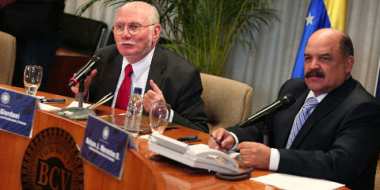
giordani-merentes82-660x330

An so it came. The much predicted, expected, delayed and surprising devaluation arrived today. Reportedly, this was ready before Chavez’ illness, postponed until after his return, who nobody thought would take so long. And then, as all sources were saying nothing would be done, boom, Friday before Carnival, the Government devalues the currency 46.5% to Bs. 6.3 per US$ (more correctly 32%)

And there is more…

Because at the same press conference, the Government announced the elimination of the Central Bank’s SITME foreign exchange system. The same one hailed by the Central Bank’s President at its creation as being so “good”, it could last 100 years. It never made it to its third anniversary.

And when Merentes said that it made no sense to have the country issue new debt to supply SITME, one did not know whether to laugh or cry. Because the Government issued over US$ 10 billion in debt in the last two years only for that: To maintain an absurd and artificial foreign exchange system with cheap dollars at Bs. 5.3.

And today’s decision has to be related to today’s CPI announcement for January. Despite all the controls, threats and new institutions created to insure prices don’t go up, the January CPI came in at 3.3% (22% for the last 12 months), with the all important Food and Beverages coming in at 5.3%. In December, Food and Beverages was 5.7%, keep it at 5% per month and we are talking an annualized value of 80% per year for the group that poo people spend 80% of their income on.

And even worse, the scarcity index went from 16% to 20%-plus, as Venezuelans hoard and buy whatever they can get in basic staples. (Luxury goods are available, mostly through SITME, so maybe wine, foie and caviar hoarding will begin now)

But all the 46.5% devaluation does, is to provide a little bit of fiscal relief for a little while. The problem is that it still leaves a fiscal gap that is too large, which is likely to require another devaluation later in the year. Because this devaluation only covers about 60% of the expected deficit. At least another Bolivar in devaluation is needed now, which will only make a devaluation later much larger.

I see Bs. 8 by the end of the year.

Because in the end, the problem is not that the Government devalued by 46.5%, the problem is that the gap between the official rate and the black market illegal rate, went from 318%, to 272%, making arbitrage still very attractive and making prices of goods imported at the official rate of exchange too attractive to pass up. And the black rate sets many prices today.

Because in the end a devaluation is not a policy, it is the result of bad policy, and if it is not accompanied by a bunch of other measures, all it does it postpone the adjustments.

And when the President of the Central Bank announced that SITME was eliminated and there will be no alternative to it, what he was doing is insuring that the black market rate never goes down. Because SITME accounted for US$ 10 billion in imports last year and ALL of that will move to the black market, implying more inflation and a higher rate for that price which can not be mentioned in these pages.

Thus, ten years and four days after establishing exchange controls, the Chavez Government devalued once more. It has been a long road. First, it devalued in February of 2012, when the “band” was moved from Bs. 773 to Bs 980 (old Bs.). Then came the real controls and the price was fixed at Bs. 1,600 (old Bs.), then 1,900, the Bs. 2,150, which created the “strong” (jaja) Bolivar. Then Bs. 2.65, then Bs. 4.3 and now Bs. 6.3 per US$.

Some record no? Seven devaluations in fourteen years.

And Merentes and Giordani still suggest things are peachy, the economy is strong and we have to be more “efficient” (with US$ 15 billion in fake imports)

Oh yes! I forgot, part of the problem will be fixed with the creation of a new control body, above CADIVI, which will be an office to “Optimize the use of Foreign Currency”.

Merentes also announced that accounts in dollars in Venezuela will now be able to receive dollars from anywhere. I am still wondering about this one. These accounts were created to receive dollars from Sitme, now Sitme is eliminated, so that they will allow money to come from everywhere ,for those demented enough to have dollars in Venezuela’s revolutionary banking system.

Things that make you got uhhh???

But both Giordani and Merentes actually even managed to smile during their surprise announcement. In the end, it is the poor, the “people” who suffer most from devaluation and inflation and neither of them is in that group. And they really don’t seem to care

And you had to laugh when Giordani said that economics is hard. It’s hard when you know so little and do so many idiotic things.

About the only “good” news to come from this, is that the country’s bonds will go up next week, not only because a devaluation improves the country’s ability to pay, but because the elimination of SITME also means there will be no more idiotic issuance of bonds to supply that market.

But the bad news, is that these announcements reflect that Giordani is still in control of economic policy. Which means more ideology, less pragmatism and more distortions.

And Maduro said he backs all these measures, which must have Diosdado smiling…

He must be the only one…

The Mystery Check For Bs. 300 Million Found In The Hands Of A Former Iranian Minister Of Finance

February 7, 2013

German customs

When reader Arco posted this link as a comment, saying (or translating it): “On the border of Holland and Germany in Dusseldorf, a man from Iran was arrested for having a check for 300.000.000 Bsf (54 million euro) from Banco Venezuela in his suitcase. He could not explain why or for whom he had so much money. He risks a fine of more than a million euro. Check is confiscated.”, I found the news so strange, that I not only went to the web, but contacted Caracas’s two largest newspapers to see if they knew anything about it.

But they didn’t.

Then reader Gold, translated a story in Die Welt and I decided to Tweet it, to see if I could get more info on this mysterious matter. Soon afterwards, El Universal published a note, then El Nuevo Herald and soon afterwards, the Iranian Embassy in Caracas tried unsuccessfully to explain the thing away.

Which made it even more intriguing.

Think about it: An Iranian man arrives in Germany from Turkey, fails to report that he is carrying more than 10,000 euros in financial instruments, a check for Bs. 300 million (more than US$ 60 million at the official rate of exchange) is found in his briefcase and he seems to care little if the check is taken from him.

What is wrong with this picture?

1) A check in Bolivars is useless, unless you are in Venezuela, due to the absolute exchange controls the country “enjoys”

2) Why do you need to bring it from Iran, to anywhere? Why not declare it, given that most countries just want to know that you are carrying it, they seldom do much about it. Why take the risk?

3) Why doesn’t he care?

Easy. First of all, this was not just a “man”. This was Tahmasb Mazaheri, a true insider in post revolution Iran, former member of the Iranian Central Bank, former Minister of the Economy and Financial Matters.

Except that the Iranian Embassy in Caracas, says it is not the same Tahmasb Mazaheri, but somebody else. Then Russian webpage Russia Today, reports that the “true” Mazaheri denies having been detained:

Iran

except that the Iranian Ambassador comes out and says that there was no irregularity in the check and that the man was indeed the former Minister, who is an adviser to the Kaystor company of Venezuela, who is participating in the “Gran Mision Vivienda” by building 10,000 housing units and recently receiving a new contract for an additional 10,000.

Even aporrea.org, got into the act, saying this is much ado about nothing (can’t find post now) and this is Iran’s heroic aid to Venezuela in building housing.

Then,the local Kaystor company (located in Parque Cristal, Los Palos Grandes) says that the important Tahmasb Mazaheri, has been an advisor to Kaystor for the last year and has been visiting the country every two or three months. That having Mr. Tahmasb Mazaheri carry the check is the same as any “messenger” and there is no irregularity, because the check can not be cashed anywhere but in Venezuela.

Except that the laws are the laws and if you have more than 10,000 euros in cash or financial instruments, you have to declare it in Germany and Mr. Tahmasb Mazaheri, was carrying US$ 69 million at the official rate of Bs. 4.3 per $, US$ 56.6 million at the Sitme rate of Bs. 5.3 per US$ and “only” 16.66 million at what I am told the unnamed black market rate is at today.

Thus, we are told that this is Mision Vivienda money, which we don’t know why the checks have to be written in Teheran and carried by such an expensive messenger.

Except that then we learn in El Mundo (by subscription), that Kayson de Venezuela appears in the Sistema Nacional de Contrataciones as “empresa en proceso de descapitalización”, loosely translated as “Company in the process of losing its capital”, i.e. bankrupt.

kayson

and none other than the fascist persecutor of corruption, Diosdado Cabello, says that Kayson built 10,000 housing units and has been hired to build another 7,000, despite being “en proceso de descapitalizacion”.  Diosdado’s explanation agrees with the Iranian’s Ambassador explanation. Even more curious by now…

Which gets curioser (does this word exist? I just needed to use it) when you find from El Nuevo Herald, that the man who was not Minister, but was, who was not caught in Germany, but was, is also a member of the Board of Directors of Venezuela’s Banco Internacional de Desarrollo, an affiliate of the Export-Import Bank of Iran, sanctioned by US authorities in 2008 for providing Iran’s Minister of Defense for ways to bypass sanctions against that country.

So, what is going on here? Well, I don’t know, but I can guess. The biggest business in Venezuela today is arbitrage. Ecoanalitica reported on Monday, that fully 40% (Or US$ 8.7 billion) of last year´s public imports were fictitious, just fake, and that US$ 6.6 billion of private imports were also fake, for a total of US$ 15.6 billion or 28% of the total in fake imports.

What does fake means? It means over billing, it means empty boxes imported as if they were full, it means worthless stuff imported and left abandoned at the ports, it means many other things. (Diosdado: If you are so worried about corruption, you may want to look at this, this is REAL money we are talking about!)

But there are also lots of fake financial transactions that take advantage of the same arbitrage. From here on, I am just guessing: The contract to build the houses is an Iran-Venezuela Government-to-Government deal. The Iranian Minister of XXX comes to Venezuela and signs a deal to build YYY housing units for Bs. ZZZZ billion and appoints a company to execute the contract. Venezuela transfers the ZZZZ billion, in US$, at the official rate of exchange of Bs. 4.3 per US$, to whatever account in the world the Iranians want or need. A fraction, is exchanged at the black market rate and sold to someone in Venezuela to get Bs. for the execution of the project, with the remainder, which today is like 75% of the contract, being used by Iran for whatever purposes it needs “clean” money. Except that the guy who signs the Bolivar checks is a big shot in Teheran, who signs the check and sends it over with his high class messenger to give it to the company that supposedly will build the houses.

There are many variations and possibilities, but I bet my guess is not that far from the essentials of the arbitrage underlying this. Venezuela and Iran are involved in arbitrage and laundering via the excuse of building houses, which in the end is not even that relevant.

And therein lies the need to send a check via Germany, drawn in Bolivars via a local bank…

Watch Out For The Rise Of Fascism In Venezuela

February 6, 2013

Cabello_05feb

I have been trying not to write posts when I read some news of something happening in Venezuela and rather try to think about things longer, but I can’t fail to mention the fascist show that Diosdado Cabello presided over in the National Assembly yesterday.

The contents are almost irrelevant. To raise all of that fuzz about Primero Justicia and corruption in that party, only to end up accusing unknown members of even other parties and involving amounts that would not even be sufficient to pay for any of the watches Diosdado wears every day, is simply and absolutely ridiculous.

But what worries me, is the style that is being used. The power of the State media is used to raise issues days in advance, creating a supposed scandal, but giving no details about it. Then, when the moment comes, Diosdado becomes more like a Judge, using illegally obtained phone conversations, checks and papers and, before he is done, he is already issuing a guilty verdict, when nothing has been investigated or demonstrated.

These are corruption cases supposedly involving a few thousand dollar,s on the same day that one of the most serious economic firms in the country denounces that more than US$ 15 billion in fake imports took place in Venezuela in 2012 and on the same session that the Assembly refused to even discuss the Bs. 300 million check found in the hands of a former Iranian Finance Minister (More on both of these tomorrow)

But this seems to be the style of the new rulers of Venezuela, Nicolas Maduro and Diosdado Cabello. Both are increasingly fascist and intolerant, making accusations out of thin air and each acting like the top man, both campaigning and speaking aggressively at every turn. They are “united”, but each has taken his own way, holding court, politicking, but neither doing their job, as the country drifts with nobody in charge.

And to me this indicates a level of insecurity that bodes badly for the country. As Chavez’ silence has now extended to 58 days, there is no clear leader, Maduro and Cabello are both jockeying for power, by trying to imitate their former boss (Maduro aggressive, Cabello back in military garb), whom they know will never return to give a speech, let alone to power.

And it is only going to get worse from here. These guys are willing to run over anyone to preserve power. And to do that, they don´t mind buying out or indicting Deputies, so that Chavismo can have the two thirds majority it needs to name the Comptroller, Justices of the Supreme Court and members of the Electoral Board.

This will only get worse, as the two leading figures in Chavismo try to out-fascistize each other. And once their all mighty deity is gone, it will become a free for all, “gangland style”, with others, mostly former military that hail from Tachira and Zulia,  getting involved. The all out fight within Chavismo will likely become like April 11th. but in slow motion. Everyone jockeying for position, everyone trying to come out on top and nobody knowing who is friend or foe, except for the tribe that needs to be eliminated: that of the opposition.

The opposition should try to stay out of it, except the attacks will be relentless and increase in their intensity and levels of fascist provocation, like the sorry spectacle at the National Assembly yesterday. But expect jailings, wiretaps, accusations and limitations in the ability of the opposition to set up a viable candidacy.

Things will get much, much worse, before they get any better. So, watch your back and be careful…

Nothing To Celebrate In Venezuela, Twenty One and Fourteen Years Later

February 4, 2013

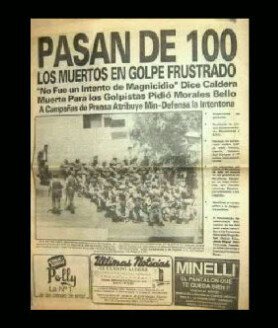
BCRMnafCMAAvD2g.jpg_large

Chavismo was celebrating today 21 years of the bloody coup in which some irresponsible military officers led innocent soldiers into an adventure which ended up with the killing of innocent soldiers and civilians that day and to fourteen years of backwardness for Venezuela. And to this day, these people without scruples, who are not democrats, continue to defend their one-way vision of the world, like fascist General Alcala Cordones in Sunday´s El Nacional, when he appeals to “ethics” to justify the coup in 1992 and says without any qualms:

“The interest that are behind each action justify them or not..”

There you have it, a complete empty philosophy in one sentence, if I think it ,or do it, it is fine, because I am right and special, if others think it or do it, it is wrong, because they are against me”

And thus, General Alcala Cordones, who I have the honor of having been tear gassed by, by him and his fascist comrades long ago in Mariperez, says with a straight face there is no corruption in Venezuela (please hold the laughter!) and everything about this “revolution” has been positive. That is how much self-criticism  and retrospection there is in this brain-dead revolution. “Everything” has been positive in the most corrupt period in Venezuela’s history, fourteen years in which sovereignty has been sold off to Cuba and other “friendly” countries, fourteen years in which homicides have quintupled out of indifference and incompetence, fourteen years in which Venezuela has been thrown back into the sure road to under-development, in which despite the biggest oil bonanza in the country´s history, poverty has barely budged and mismanagement has distorted the economy, to the point that the road back will be tough, if not impossible.

Not that things were peachy before. By 1992, I had become pessimistic about the ability of our political system to invest in education, science and technology to really push Venezuela into the future, the XXth. century at the time, and we are already into the next one. What I never imagined was that what was in store for us, was orders of magnitude worse, degrading our educational system and destroying what little good science and technology we had. To me, what happened at PDVSA’s science and technology institute INTEVEP, was simply scientific genocide and IVIC, Venezuela’s formerly world renowned science institute has been reduced to almost memories and lots of revolutionary BS.

And then we come to what most PSF’s and religious Chavistas fail to understand. Oil exports in US dollars have gone up by a factor of six per capita in the fourteen years since Chavez took over. Yes, six times bigger. Think about it, for every barrel of oil  per citizen, Venezuela is getting six times more dollars than before. That is a lot of money. Despite that, Chavistas still have a hard time arguing that Chavez has been good for even the most basic measure of the the “people’s” success: Poverty.

I remember how the same Chavistas used to argue that “poverty” was just an index. That the “improvements” in poverty were just cosmetic changes in the numbers. But they arrived and became exquisite numerologists, taking the game to a new level of sophistication and lies. Poverty is indeed more than just numbers. But that is a game where Chavismo loses right off the bat, because, as Luis Pedro España shows in his book, Chavismo has been a failure in terms of infrastructure, nutrition, hygiene and even health, when you take into account that Barrio Adentro paid attention to first contact primary health care, while ignoring the more important secondary aspects which existed in the Venezuelans hospitals.

But Chavismo quickly learned to play with numbers. Poverty is numerically determined by how many people are above the poverty level. This level is determined by comparing the “income” of a typical family with the basic “basket” of goods. Up to the year 2000, this basic “basket” was calculated by the Venezuelan Central Bank. At the time, the National Institute for Statistics (INE) decided to start calculating its own basic basket, basically because the Central Bank was being too independent. (Read Realistic!)

Change the denominator and things will look so much better.

It also decided at the time, to “add” the benefit of Chavez’ “Misiones”. Fair enough, but up to 1998, there were Government benefits called something else, such as the “almuerzo escolar” and the “vaso de leche”, and even the “modulos de los barrios”, which were not given any weight in the “poverty” index.

So, the Government claims that the level of poverty is 32% today, versus 49% when it got to power. But it uses INE’s basic basket of Bs. 1,835 per family of 5.2 people, while CENDAS calculates that same basket for five is currently at over double that at Bs. 3,887. On top io that there is the added “Misiones” value. Try to normalize all that, and you get that today’s poverty level is likely to be above 50%, despite the FACTOR OF SIX INCREASE IN INCOME PER CAPITA IN US DOLLARS from oil that the Government has enjoyed.

It is immaterial whether it is 45% or 55%, the point is that Chavismo had a chance to really change things. Really redistribute the oil windfall. But it did not. It has to fake the numbers.

Which is why Diosdado has to wrap himself around military and patriotic symbols today, because he knows that they have accomplished nothing beyond elevating Hugo Chavez to the category of a new deity, which neither him nor fake VP Maduro can aspire to. Thus, he has to display symbols, including, dressing like a military officer, which he is not, and stealing those from the opposition in the form of Capriles’ hat:

cb445

Trying to recreate or imitate their former boss, which has been missing in action for over 55 days, without a tweet, a beep or a whimper.

Which simply shows that there is nothing to celebrate, nothing to show for all their “work”, except their own attempt to be admired and exalted beyond their worth and abilities. Abilities which they may have had or developed, but their deity forced them to conceal behind his charisma and forbid them to even attempt to rise above him. And thus, today they find themselves sunk in the same mediocrity, with nothing to celebrate twenty years after they first failed and fourteen years of continuous failure, where only the symbols and the symbolism have succeeded and after sinking Venezuela in the most perverse road to failure that anyone could have imagined.

Economic Announcements By Venezuelan Government Not That Significant So Far

January 29, 2013

Giordani

So, Maduro came back with a bunch of economic decisions purportedly signed by Hugo Chavez personally, and the questionable Vice-President suggested that there would be changes in the gold “structure”. Rumors began circulating that the Government would propose a “new” foreign exchange mechanism using its gold production, but it sounded impractical to me, the main reason being that Venezuela’s gold production currently is below US$ 500 million  a year, indicating any novel mechanism would have little impact.

But instead, the Minister of Oil and Energy and President of PDVSA announced the new measures and so far, they are not that impressive if no others are coming:

-The Government will change the windfall profit tax, such that the trigger point is no longer US$ 70 per barrel, but US$ 80 per barrel. What this means is that PDVSA will be able to keep more of the foreign currency it gets for selling the oil abroad. Before when the trigger point reached US$ 70 per barrel, the extra foreign currency would go to Chavez’ petty cash fund Fonden, from which the money was spent with no transparency whatsoever. Now, this is increased such that if oil prices stay the same, Fonden will receive US$ 2.9 billion less in 2013, of which US$ 2.4 billion will end up in the Venezuelan Central Bank and the Treasury will receive an additional US$ 383 million. Of these US$ 2.4 billion will have to be sold to the Central Bank.

Thus, this is nothing but shifting funds from one pocket to the other, giving PDVSA more (needs less financing now), strengthening the international reserves and the flow via CADIVI. Given PDVSA’s and the Central Bank’s needs, this is not that much of a measure. in terms of size.

-Ramirez also said that they had notified the beneficiaries of Petrocaribe’s largesse, whereby Chavez gives oil to certain countries in Latin America and the Caribbean with grace periods, only 50% upfront, and twenty years to pay the balance at a very low interest rate, that the terms will be changed.

But Ramirez said little about which terms will be changed. Last time there was an emergency, the Government only changed how much money upfront had to be paid by 10%. Since we have not heard an outcry from those receiving the almost free oil, it is hard to imagine that the terms are being changed significantly. This will improve a little the flow of dollars to the Central Bank.

-PDVSA will now be in control of the country’s gold via la Corporacion Venezolana de Mineria (CVM) which will exploit all of the mining of gold in the country. This is another change of many in gold legislation, restructuring and the like in the last 14 years. As Damian Prat notes in his book (previous post) the Chavez Government has not carried out ANY new projects in Guayana that it started to completion, in the last fourteen years. In fact, during Chavez’ years, gold production has fallen from about 10 Tons a year to somewhere between 3 and 4 Tons. Even if they recovered production to the old levels (which will take time), it would be worth about US$ 600 million more at best.

-Ramirez also announced that PDVSA would not issue new dollar bonds because it would be “too expensive”. Funny, he issued bonds up to roughly 300 basis points (3%) above what we would have to pay today, but now it would be expensive. This would be good news, if PDVSA would not acquire more dollar debt. However, Ramirez has denied new bonds were coming before and they were announced only a few days afterwards. The market clearly did not believe him, as investors pushed the prices of bonds down yesterday when the announcement was made.

Nothing about devaluation, paying CADIVI debt, new foreign exchange mechanisms. Maybe they are coming. But the measures announced so far are of little significance.

Stay tuned…