Archive for the 'Uncategorized' Category

Writing The Devil Is Enough Of An Occupation

November 7, 2012

In December 2009, I wrote a post entitled “Disclaimer: Being a devil and a diablo is more than enough” and used the same drawing above. In it, I tried to put to rest rumors that I wrote or helped write not one, but two other blogs about Venezuela.

Today, I have to reiterate the same words, because for reasons that are irrelevant to this post, I have been accused again (twice this time) of writing the blog Venepiramides (I will not even hyperlink to it at this point). Essentially, I was not aware that once again it had become “common knowledge” that I had something to do with that.

Thus, I reiterate here publicly that I, Miguel Octavio, write about Venezuela in this blog alone and do not contribute, write, collaborate, or have anything to do with Venepiramides. I also have an abandoned blog (exdiablo) in which I attempted to translate the contents of this blog and two other halfhearted efforts at showing my orchids and interesting stock charts. All these blogs are now listed on the left as “All Blogs by Miguel Octavio” (descriptions included). Those are my only blogs, the only ones I write or dabble with.

Is that clear enough?

Now, after trying to understand the reasons why people arrive at this conclusion, I have found very little that makes sense. Yes, that other blog runs an RSS Feed of my blog (and eight others), I can’t stop that without stopping all RRS Feed subscriptions (500 or so) to the Devil. I do link to it, that blog wrote about Stanford in its beginnings, a topic that was interesting to me at the time. I will remove this link sometime soon.

But after reviewing everything and having independent people review the facts, the styles, content, I can only reach one conclusion: The person linking me to Venepiramides, is the same one behind that blog, who has created this generalized opinion in order to divert attention from him (her?). There is no other justification for it.

In closing, some random thoughts: First, why would I start a second blog, seven years after starting this fairly successful one, (winner best LA and Caribbean blog ’06, quoted in WSJ, FT, Dow Jones, Bloomberg, invited by the President of the US to talk about blogs), to start another blog, in Spanish (where I had not been successful with exdiablo) and devoted only to Ponzi schemes initially? More importantly why would I want to slow down now in this very successful blog (The Devil), to work on the other one (a post a day), which is much less successful? Second, I have seldom asked favors from my readers, but if you do see some reason to think the two blogs are related or connected (or if you have a good reason to show they are not!), please let me know in the comments. I just don’t see it and want to understand why people actually believe it and go as far as contacting me about it!

Thank You!

Lying As A Way Of Life In The Chavez Revolution

November 5, 2012

Lying has become a way of life in the Chavez revolution. Last weekend I saw a few that would make Pinocchio feel almost honest:

-The first one was Venezuela’s representative to the Interamerican Human Rights Commission German Saltron who said that it was totally false that there was overcrowding in Venezuelan jails and that the Government fed all of the prisoners. Maybe he has not seen the video I posted, or read the article about how the prisoners run the San Antonio prison in Margarita Island. And just to add to the lies and exaggeration, he claimed the Chavez Government inherited this problem, without mentioning the tripling of the number of yearly homicides since 1998 or the more than doubling of the prison population since then. In fact, homicides went down during Caldera’s Presidency, not my favorite Presidential term before Chavez, but that happens tobe a fact.

-And then came Minister of Planning and Finance Jorge Giordanu who in a rare interview in El Mundo (by subscrpition only) said a few hard to swallow ones. The first one was that taking money out of the international reserves and into Fonden “made sense”, because of the very low yields around the world. Of course, he did not mention that this practice was begun in 2004, when yields had not fallen. In fact, they started going down sharply  after the 2007-2008 financial crisis. Thus, this was simply looking in the rear view mirror to justify what they had done.

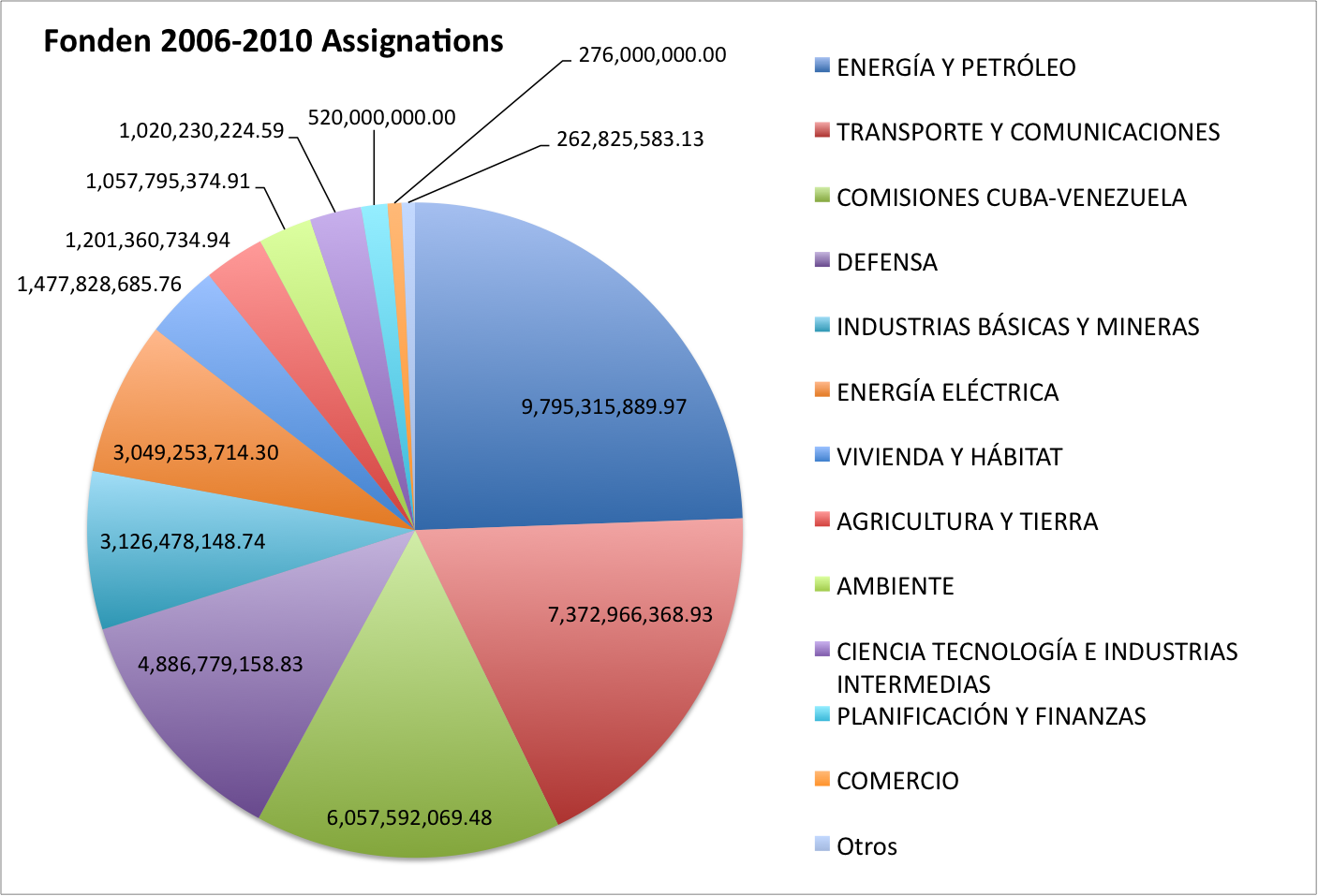
But then, Giordani began talking about the new financial institutionality of the country and how the money from the international reserves is now “invested” for the people. well, I don’t have the latest distribution on expenditures, but Quico did a very nice pie chart a while back (2006-201) showing that at that point the largest percentage of Fonden money went to oil and energy, followed by transportation, the Cuba-Venezuela commission and Defense in the first four places. A full 60% went to these four areas, of which only one, Transportation, can truly be considered investing for the people. For the people of Cuba maybe, but that is another matter, no? And the numbers don’t seem to have changed much since 2010, according to this article in El Universal.

Oh yeah! He also said there would be no devaluation in 2013. Yeah! Sure!

Such are the lying ways of the revolution.

Sidetur Takeover: Lawlessness and Disorder In Revolutionary Venezuela

October 31, 2012

Two years ago, in November 2010, the Venezuelan Government issued a decree expropriating three of Sidetur’s steel processing plants. Sidetur is a steel company which predates Sidor, which makes steel products and processes steel since the 1940’s. Somehow, the company managed to hold off the take over of the three plants for two years, negotiating a price for the expropriation, as mandated by the Constitution, which says such expropriations can only be made after compensation.

And then On Monday of this week, the Minister for Industries took over:

-Sidetur’s six (not three) industrial plants.

-Sidetur’s fifteen scrap processing plants

-The company’s offices

-They company’s money, which was quickly transferred to the Complejo Siderurgico Nacional S.A., the Government’s steel company, including salaries, severance pay and operating funds.

Thus, these guys don’t even follow their own recent decrees, let alone that piece of paper called the Constitution, which they wrote at will. Even before they finish the negotiations, they do something different and violate the laws many times. One wonders if anyone is in charge, or if this was just another independent Chavez bureaucrat, with lots of initiative.

The case is complex. the company had bonds* in US$ that mature in 2016, but which have a clause that says that the holders can demand payment if there is a change in control and what happened this week, was definitely a change of control. The bond is only US$ 75 million, but the Ministry better come up with the money to pay for it, the same way he said today the Government would pay fair price for Sidetur. (Fair price calculated by him I imagine!)

Th sad part is that Sidetur is likely to go the way of Sidor or Tavsa, which barely produce, or don’t produce anything, by now after being in the Government’s hands for a couple of years. It is more than production, there is know how for example, the new “owners” started firing people the same day they arrived. There is years of experience and invaluable human resources that will likely emigrate. But don’t worry, the Government already changed Sidetur’s website to have the name of its company on it, I bet it will remain there even when the company ceases to operate or produce.

Maybe I was wrong, maybe it is justified that Venezuela pay twice what Bolivia pays for its bonds, this is revolutionary lawlessness and disorder at its best.

Do you really think that by next year Chavez will not have taken over the whole banking system and finance the Government’s deficit with the depositor’s money? I think they will do it. You may also wonder if the action has something to do with the fact that Sivensa, Sidetur’s owner, is majority owned and controlled by the family of one of the opposition candidates in the primaries? (Hint: The only female one).

Such are the ways of the random disordered revolution.

Makes you wonder: Who is next?

*I actually own some

The Cynical Posturing Of The Electoral Board

October 28, 2012

As you may or not know, during the audits of the electoral “notebooks” for the Gubernatorial elections, the opposition discovered that 108 voters were moved from one voting center to the other. In particular, this includes the six candidates for Governor who Chávez anointed with his finger, despite the fact that they do not reside in the State where they are running for Governor. It also includes their relatives and even more curiously, the current Vice-President of the country who ran to register in Carabobo State when Chávez said he would be the candidate there, way back at the beginning of the year, but now does not want the hassle of having to go vote there since he is now the VP.

You see, according to Venezuela’s electoral rules, the electoral registry was open only until April 16th. and the recent Presidential election and the upcoming one, would take place using that registry. It can not be changed, altered, modified, spindled or mutilated. That is why Maduro had to run, he wanted to register so that he would be voting in the State that Chávez had selected for him, until the autocrat changed his mind.

The explanation by CNE’ s Director Socorro Hernandez (shown above) is simply pitiful and a disgrace. Clearly in Venezuela under the autocrat Hugo Chávez some citizens have more rights than others. Said Socorro: “We had to make the changes so that the candidates of PSUV and its teams could exercize their right to vote…so they could go and vote with their mothers, with their family…”

Jeez, Ms. Hernandez seems to have a very short and biased memory, she did not seem to be worried about the right to vote of thousands of people that were arbitrarily moved to vote from Miami to New Orleans, a distance which is from two to ten times larger than that which will separate her PSUV buddies from their voting center. The CNE, including the cynical Ms. Hernandez, never even attempted to find an alternate location to hold the vote in Miami, so that each and everyone of the more than 20,000 voters could “exercize their right to vote”. The same right that Ms. Hernandez posturing this week wants to defend with such an intensity for her buddies of PSUV.

And her posturing is demonstrated precisely because Vice-President Maduro was also allowed to move his registry back to Caracas from Valencia. Maduro was never a candidate. Period. Chávez said he would be a candidate but changed his mind before the deadline came. So, Maduro was moved just because…because the law does not exist for Chavismo, Maduro does not want to take a helicopter and go vote in Valencia, please sign here. Listo! All set!

But heaven forbid that an opposition candidate, relative, cousin or whatever wants similar treatment! In that case, they would shout with outrage at the request. Only Chavistas may apply. Chavistas are first class citizens, the rest are…garbage, not even second class citizens. So much for equality under the Bolivarian revolution!

And I don’t think is a maneuver to discourage voting. If it were, the CNE would have come out immediately and justified the moves the first day. No, this was just a sneaky move, thinking, as usual, that nobody was watching and nobody would notice. But to their credit, the opposition auditors found out very fast and the Chavistas were caught red handed. The posturing came later.

And Socorro looked like the veritable jerk she is.

Looking at the December Elections

October 22, 2012

Given that I believe that it was the high turnout that decided the recent Presidential election in Chavez’ favor, it is important to consider what may or not happen in the upcoming Gubernatorial elections.

The high turnout tells me the following:

-Chavismo has a voting majority. (We lost big time!)

-This majority votes and can only be mobilized when Chavez is directly involved in the election. (2006,2009,2012)

-The opposition, with limited resources, does well in all other elections (2007,2010)

Thus, there is reason to be hopeful in the upcoming election. On the plus side:

-Some of Chavez’ picks will find resistance among the electorate

-Some regional leaderships for the opposition are strong

On the negative side:

-The unity behind the opposition is strained

-The opposition voters are discouraged, they thought they had a chance and now they don’t know what to think

-The confusion between abuse of power and fraud does not help, neither does questioning the presence of witnesses in the last election.

The last point is particularly important. The opposition has 90%+ of the Actas printed by the voting machines. This proves we had ample coverage by witnesses. It was not 100%, but it was 90%+, over 20 points better than it was ever done.

What is the complaint? That the opposition does not have the results of the audits too. But you have not heard anyone complaining that some audits showed a big discrepancy, have you? In fact, I have not heard any witness say publicly there was even a discrepancy, so that the discussion seems to be very ethereal.

Clearly, Chavismo will try to use the same strategy as it did on October 7th. But will it devote the same resources? Will people go out as much as they do for their beloved autocrat?

History says no, but at the same time it seemed that history said that abstention could not be lower than the 25% in 2006.

But it was. A similar miscalculation of 5 percentage points and the results will be quite different in the Gubernatorial elections.

But what is clear, is that if the opposition is discouraged, then our chances truly drop rapidly. Right now, talking to people here in Caracas, people seem very discouraged. Hopefully, they will change before December. But more importantly, the leadership in the opposition will not be responsible for keeping people away from the polls, like they have seemed to be trying in the last few days.

How The Venezuelan Presidential Vote Was Won

October 19, 2012

Steps to make sure an all powerful Government easily wins an election

Step 1: Create a Database with over 2.5 million people

The whole process begins with creating a direct aid program that will impact the largest number of people possible. It does not matter if your record in that area is dismal. Just over promise, there is no time for people to know whether you will deliver or not.

The name of the database: Mision Vivienda

It’s simple, massively publicize a program aimed at building homes for the Venezuelan poor. Each home has a multiplying effect, as the typical home in Venezuela has between four and five people living in it. Never mind that over 2.5 million people register for it and you have built less than 500,000 housing units in 14 years in Government. Just have people fill out the following form, with every detail about them that you can think of:

Yes, have them place even their Twitter handle, salary, job, detailed address, conditions of the home. This is 1984 on steroids, let Big Daddy know everything about you. Don’ bother with telling us if you are registered to vote, we will find out right here:

By going there, we will find out if you registered to vote and if you did not, we will go to your house and get you and take you to register. We not only get you to register, we also tell you at the same time that we know where you are. While we are there, we may even examine your house, just to make sure your data is true, or so we say. Close to a million homes of the more than 2.5 million people who registered were visited.

Step 2. On Election Day, in the afternoon, show up and ask: Have you voted?

Call it Operacion Remate, have a lot of cash ready, even military vehicles, tell people you will pay, you will take them. And make sure the person showing up, if possible, was the same person that took them to register in the Electoral registry or that went to inspect their house to “check” if they were “eligible” for the dream Mision Vivienda home.

Hope springs eternal. That is the main driver of the database.

And this works because of Abstention, with a capital “A”:

Recall my earlier plot:

(By the way, if you click twice on graphs you can see them in the original version)

Let me explain this graph again. The columns represent groups or strata of 2.5 million voters from the Parliamentary election from the most pro-opposition (on the left) strata to the most pro-Chavez one (on the right). In the first column on the left you can see the opposition obtained 80% of the vote, with 27% abstention and obtained 1.046 million more votes than Chavismo. As you can see, as you move to the right, Chavismo does better, even if abstention goes up. The increase in abstention is progressive until it drops from group 6 to group 7 from 39% to 36%. Thus, the more Chavista voting centers had much more abstention in 2010 (high 30%’s) than the extreme opposition (high 27%). That is a huge difference, given that 5% of the votes is close to one million votes.

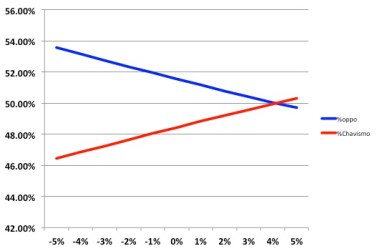
This is what led me to model what would have happened in 2010 if abstention had been lower and asked myself: How much lower did it have to be in order to move the 2010 results to a tie? The answer scared me, it was only 4% in an election with 32% abstention. Most pollsters were saying abstention wold be 27-28%, thus I concluded that abstention would have to be below 25% for Capriles to lose, but except for one pollster that I don’t follow (who claimed abstention would be in the single digits), nobody was suggesting it could be that low and in any case in 2006 abstention was 25%, there was no reason to think it would or could be lower than that.

I did not count on the Mision Vivienda database or the Chavista plan to use it so extensively. Neither did the pollsters. To me, pollsters had to get three numbers right, the difference between the votes of the two candidates, the abstention and a good guess as to how their undecided would split. No pollster got more than the first number right and given that the second one was so important for the first one, as we will see, it is essentially meaningless that they got it right.

Because in the end, abstention was 19.3%, some 8 points lower than any pollster or analyst had predicted. That is all of 1.6 million votes! and as you can see in the chart above, that only favors Chavismo, as we are talking up to a 20% higher turnout in areas where Chavismo won handily in 2010, like 63%/37% in the “red”column in the above chart or 17% in the crimson column to the right, where Chavismo won by a 76% to 24% vote.

The Results

But it was even worse than that. Much worse. Turns out the  ¨undecided¨ were not really afraid to say that they were going to vote for Capriles, as most analysts (and pollsters!) interpreted, many of them were apparently worried about saying they were going to vote for Chavez, as the opposition did grow around them and they could feel it! Thus, it seems as if those large numbers of undecided went evenly or maybe even in larger fractions for Chavez than for Capriles.

Let’s first look at abstention levels in the seven groups of voters in 2006, 20010 and 2012:

The top curve was the regional election, where the opposition won. The one in the middle was the 2006 Presidential election and the green solid line at the bottom was this Presidential election. See the difference? IT IS HUGE! In 2010 we won, basically because Chavismo did not go and vote, while we did. Period. No other interpretation possible. This time around we showed up, but they outdid us in the increases in voters at all levels. Note also that abstention in groups six and seven on the right above are similar, evidence that there was less “phantom” voting that in the regional elections, as the opposition had witnesses in more than 90% of the voting places, as evidenced by the fact that it has the Actas from them and that the opposition did better in Chavista states.

The fact that the lower abstention hurt the opposition across the board can be seen in the following slide, which shows that the opposition lost ground in all seven layers of the first plot.
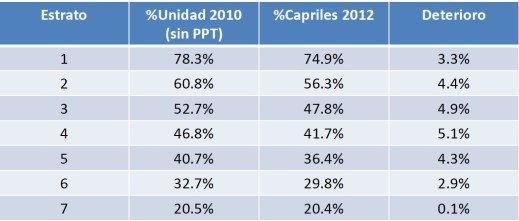
The second column shows the percentage of votes Capriles got in each of the seven strata of 2.5 million voters, the third Chavez and the last column shows how much the opposition lost ground, percentage-wise, in each of the seven segments of the population. Note that even in Strata 1, where the opposition won by almost 80% in the regional elections, our numbers actually went down by 3.3%. In fact, it was at the lowest levels, strata 7, where we lost the least ground, which may be related to having more witnesses coverage in those areas and fewer “phantom” voters.

Another way to look at how we lost ground between the two elections is to look at the growth of the votes in terms of percentages, for each strata for both sides, as shown in the next slide. This is simply the percentage growth in the number of votes for each layer and each side:

As you can see, that is how good the Chavista mobilization was, even in the most pro-opposition centers, they more than doubled our increase. In fact, we only matched their increase in the number of votes at the lowest level. (Where we still got whipped!) Think about it, even where we are a majority, Chavismo increased their votes more than us. Sad, but true.

You can see the evolution of the difference for each strata from 2006, to 2010 and then 2012:

As you can see, in the 2010 regional elections, we got more votes in strata #1,#2 and#3. However, this time around we only won in the first two strata, #1 and #2.

So, is there any good news?

Some. This is how the opposition has grown steadily since 2006:

This graph shows the votes in 2006 in blue and the growth over that in 2010 and now in 2012. As you can see growth since 2006 has been significant in traditional Chavista areas, even if more work needs to be done. The black line shows the percentage growth. Special note to Lara, where Falcon has delivered the state to the opposition and did a great job in the Presidential election.

Perhaps you can see it better in the following plot by looking at how Chavismo has grown (or not!) since 2006:

But for the time being, watch out, if Chavismo and Chávez manage to use the Misión Vivienda database in the December Gubernatorial election in full strength, it will be a tough road ahead for the opposition. My bet is they will focus in specific states and the opposition may end up doing better than expected come December. But I tend to be an optimist.

(data from Comando Venezuela)

From The Heart (Or Dark?) Of Venezuela´s Democracy

October 15, 2012

These are images of intelligence police detaining reporters from Argentina who came to Venezuela to report on the election. It is in Spanish, but the story is here and here or here (last one in Spanish). Documents and videos were “expropriated”, PC drives copied. Of course, his charges are minor for a democracy: That Venezuela´s intelligence services spied on candidate Capriles? Of course! He was the opposition candidate! What else would Chavez order?

Next jerk that says there is freedom of speech and the press in Venezuela gets erased and banned!

Mision Vivienda Was Not About Building Homes, It Was A Database For Getting Out The Vote

October 14, 2012

Well, at least Capriles “gets it” and understands that Mision Vivienda was not about building homes, or promising a home, but about constructing the perfect database to get the vote out on Oct. 7th. And it worked, when you registered for Mision Vivienda, you had to give out a very detailed address of where you lived. And you can bet that database will be used again in December and whenever. Someone that advises this Government knows the powers of these databases, from the Tascon/Chavez fascist list to now Mision Vivienda.

Said Capriles in today’s interview in El Universal:

“They have a brutal structure, honestly. On Sunday we saw it, in terms of the structure and the power of the Government. Everything! Which we had never seen used like this, they threw the house out the window (They spared no expense) and they obtained 55% of the vote. I don’t want to use this an excuse, but everyone that was in the Misión Vivienda, those that were in the misiones, they were all called, one by one. I had the voting lines checked and they were all PSUV voters. All of them! With the “Finish off” operation between 5 and 7 in the evening, they went door to door to get the people out to vote. ”

People want to talk about fraud, but it was all about abuse of power and organization. An organization that the opposition did not have the equivalent of in terms of size and or funding. The headline says it all, Capriles also said “A lot of campaigning without Capriles was needed” and that is not what happened. Many parties did not participate fully in campaigning or driving out their voters. Rather than be negative and say who did not, of those that participated in the primary, only Leopoldo Lopez went all out and of those running for Governor in December, Henri Falcón in Lara State did the best job, Parties did a good job in Merida, Tachira and Carabobo. The rest, not a great job, a half hearted effort, including most of the candidates in the Presidential primary, save for Diego Arria, who kept stomping around.

In 2006, abstention was 25%, this time around it was below 20%, that is close to one million more voters than in the 2006 election. Any pollster that said they got that right, is simply lying, because these people were mostly Chavistas. Preliminary numbers indicate that for each additional opposition voter in this lower abstention level, there were five pro-Chavez votes. Yes, five to one, some 900,000 votes for Chavez and only 200,000 for Capriles. Any pollster that was expecting 27% abstention, missed almost one million votes net in favor of Chavez, that is 7% more votes that they missed in Chavez’ favor. Because abstention would have favored the opposition. Jorge Rodriguez, Chavez’ campaign coordinator, even suggested in Rangel’s program today, that the opposition played the abstention card. And lost.

Maybe that is why Capriles decided to go back to Miranda. he may be safe there for a few years, but he needs to be elected Governor first. That Chavista machinery could elect just about anyone as President or even Governor, if they decided to use it fully. Sad, but true.

The Devil, The Future, The Past and The Present

October 11, 2012

I started this blog ten years and two months ago. It was a curiosity, but it just seemed to grow and grow and soon it became a night job (I tend to write and post at night). In the first few years, I would post over seven times a week. There was so much to write about. Lately I have slowed down. During the last year, I have posted slightly more than four posts a week. Essentially, it takes a lot of energy and focus to keep the pace up. Moreover, lately if I got the feeling that a post was a repeat topic even if it was “news”, I would skip it.

Well, while I will write about the recent election and the upcoming election, I think I will slow it down a little bit for a while. I just can’t see keeping up the pace for another six years. I know I will not stop, I like writing and the exchange of ideas. But I have lately abandoned my orchids blog (No post since May!) to say nothing of my truly abandoned technical analysis blog. ( A post in May?) I would truly like to revive the first one and see if I can post regularly on the second one. Forget the Devil in Spanish, nobody reads it, the market for Spanish blogs does not seem to work, ask CC or me.

I know the regional elections will make me post and Chavez’ Government dealing with the distortions in the economy next year should be interesting to talk about. But I really plan to slow down. There will be no translation of posts, no posts during vacations and no reproduction of other posts. No boring financial posts where people don’t comment.

So, I will start with this post, in which I will discuss many things, rather than a single topic, just to keep my new election resolution.

Back to the Results

I will go back to analyze Sunday’s results at some point. For now, I will like to emphasize the following graph which I published a couple of weeks ago:

In this graph, I modeled the 2010 Parliamentary elections and asked: If I shift abstention in the more Chavista centers, by how much do I need to change it to make the votes a tie in 2010 when abstention was 32%. I was scared by the answer. It was just 4%. To me this meant that if abstention was below 25%, we were doomed. However, all of the reputable pollsters were saying abstention would be around 27 to 28%. Thus, I was not worried, particularly since abstention in Chavista centers was more than 35% on average in the Parliamentary election. Thus, 25% seemed sooo far away.

But it wasn’t. Chavista money and machinery got the voters to go and vote and abstention was below 20%. Even in the pro-opposition centers, the increase in opposition votes was compensated by Chavista votes. One to one.  Thus, we had no gain from 2010, but they did, they had an increase of almost 16% in turnout. And we were killed, wiped out. Yes, we improved by over 2 million votes, that is the positive.  They only got 600-plus thousand more votes, but they killed us. Please understand the impact of abstention on the recent vote. To me, it is the whole story.

Capriles running for Governor

I don’t like the idea. The “people” elected Ocariz as the candidate in a primary. Ocariz should be it, the people have spoken.I know there is a problem in Sucre, but Sucre is the problem, not Miranda. Capriles should be the leader of the opposition. He should continue going around the country, this time campaigning for all the candidates for Governor, working for unity. He should be above the fray, ready to run for President if the need arose in the next few years.

To begin with, there is the risk that he could lose. Yeah! Laugh at me! Jaua beating Capriles!… Chavez did. And a demoralized or not fully unified opposition may not go out and vote on December 16th., but Chavismo may use the same PSUV lists and Mision Vivienda lists it used last Sunday to screw us.

Think about it!

Better have the man that represented us holding that coalition together. saying he is a democrat and Ocariz was elected in a democratic primary. It was not a conditional selection, it was not “You are voting for Carlos Ocariz, unless Chávez beats Capriles in October” that people voted for. That is democracy. To me, the February primary was a turning point in Venezuela’s politics. on’t go back on it.We can’t be short-sighted and pragmatic. We have to respect the result and the law (Article 67 of the Venezuelan Constitution)

Sure, some opposition parties and people did not help Capriles. He should go out and help them, that is what leadership is about. All out! Capriles going around Venezuela as if he was still the candidate.

I know you all disagree with me, but there it is!

Maduro as the Vice-President

Well, the successor has finally been chosen. Why it took so long is hard to figure out. But Maduro was the best choice in terms of keeping the people happy. There is no other interpretation in my mind: Chávez will start promoting Maduro as his successor from now on. I will only change my mind if the consanguinity limitation is changed in the Constitution.

Nicolas Maduro is liked by all but the military side of the Chavista Government and he talks to them. He has a good image and polls well. Have Chávez start saying he is great and his successor and Chavismo will have a reasonable candidate to go with the formidable machinery and deep pockets. Moreover, Maduro even talks to the opposition, he is less radical than Jaua and a moderate. His only drawback is that the only position he has ever run for is Metro union President. But he makes sense. I never bought the argument Capriles beat Diosdado in Miranda and that shows how good he is No, Diosdado was weak. The proof was that Capriles barely beat Diosdado in Miranda. Think about it!

So, stay focused, don’t get mad, get even and vote and organize in December. It is the only way.

Postmorten Of The Venezuelan Election

October 9, 2012

(How I felt Monday morning)

And so we lost…

An effective and efficient operative to bring out the vote, led to the highest turnout of recent elections and a surprisingly large Chávez win. But turnout was not the whole story, even if it was very significant and Chavismo reverted the trend that opposition voters have less abstention than Chavista voters.

The story is told by the facts: Capriles won the large cities, but lost the states where they were located, proving again that the rural vote is hard to get for the opposition. And despite the blackouts, the inflation, the lack of delivery and Chávez’ cancer, the people were still willing to risk another term with Hugo. Capriles did a valiant effort, but in so many of those rural areas, the media is tightly controlled by the Government, making it difficult to turn around the Government’s message that Capriles is a right wing Dictator in the making. And a majunche!

And the abuse of power was definitely a factor. Cháez had unlimited resources, plus a myriad dirty tricks up his sleeve, from null votes, to shutting down the Miami consulate, to the Unidad Democratica change in candidate, every bit counted, even if it looks today that all of the abuses were largely unnecessary.

Chávez grew his votes from 2006 8%, while the opposition managed a 33% gain. All of this despite a 66% increase in the price of oil during the intervening six years. For all the PSF talk about improving conditions, the truth is that the improvements in the standard of living of the poor since 2006 can barely be seen in monetary terms, despite the growth in the Government’s wealth. And if marginal increases in purchasing power were meager, infrastructure, crime and health care deteriorated.

But Chávez gives hope. Chávez enchants people. Chávez makes symbols more important than realities. I guess if you have not lived in the squalor most people live in in Venezuela, this is all hard to understand. I certainly don’t, I just know that this is not the way out of the problems. An economic adjustment will come sooner rather than later. Maybe oil will go to $200 a barrel and save the day once again for Mr. Chávez. But all of the distortions are in place.  Ready to explode. This is the new oil windfall economics for countries with irresponsible Governments. Look at Iran’s economy, it gives you economic deja vu how similar things are there and here. Both will blow up, some day…

And those that are looking now for Chávez’ demise, should just wait a week or two. With the mandate obtained in the Presidential election, Chávez is likely to seek a Constitutional amendment such that the Vice-President becomes the President in the first four years after Jan. 10th. 2013, changing the current Constitution, which requires an immediate general election for President. Maybe easier, Chávez will just change the article about blood relations, so that his brother can become VP and the Chávez dynasty will have been born.

A note on pollsters. They did a terrible job. the worst since I began following some of them. I can’t buy a prediction on the difference that was correct, when the undecided was one and a half times that difference. Consultores 21 really blew it this time, for the first time since I have been following them. Datos was doing a good job until its last flash report in which the trend had reversed. In some sense to me, Varianzas was the best pollster, saying Chávez would win by 2%, with 2% undecided.

Now comes the tough part, holding the MUD together. They hopefully will stick together until December for the election of Governors. Capriles did a magnificent job, improved his speech and captured the imagination of 45% of the Venezuelan population. But it was not enough.  We now have the elections for Governors in early December and the referendum on the same day could be the biggest threat to a good performance by the opposition. Capriles shoudl not even think about running for Miranda, he shoudl be above the fray for now, he is the leader of the opposition. It is clear that Chavistas vote for Chávez the idol, not for complex ideas or regional PSUV candidates. The referendum will be all about the idol and he could take the Governors to victory on his coattails.

I hope I am wrong.