Archive for the 'Uncategorized' Category

Venezuelan Inflation: Structural or Self-Generated?

March 23, 2011

We were told by Minister of Planning and Finance Giordani, who has been in this Government over ten of the last twelve years, that Venezuela’s inflation problem was “structural” and in the never changing strategy of blaming the “previous” Government for everything, he accused the IVth. Republic of this problem. I guess twelve years is not enough in his mind to solve this problem, ignoring the fact that in those twelve years, the most insidious influence on inflation, that of the world, almost magically vanished, with most countries not only having single digit CPI’s, but many in the low single digits.

As a famous true and real economist said, inflation is simply a monetary phenomenon. Such a simple concept that is so poorly understood in inflationary and populism-ruled countries like ours. You see, if this were not true, Governments could just spend and make everyone rich. Life would be as simple as Chavez and Giordani want it to be.

But money does not imply wealth. Money is how we exchange things. We went from barter to money, to create a neutral way of transacting. In the beginning of commerce, you had one good and exchanged it for another or for a service. Too many mangoes on the trees and nobody wanted to give you anything for a mango, too much supply. By the end of mango season, you could probably get a lot for it, not enough supply and probably some demand.

But I digress…

If the Government “creates” too much money, without the underlying productivity or supply of goods and services increasing, the money will lose value, there will be inflation and it will be worth less. So, that is what Central bBank’s are supposed to do, try to fine tune the amount of money to balance it out with the supply of goods and services.

Thus, if you want to see why there is inflation, you have to look first at monetary liquidity, the so called M2, which measures all of the money available out in an economy. This number is supposed to be made public weekly by the Venezuelan Central Bank under “Agregados Monetarios” here. Lately, there is some delay to have this number published, but more ominously we no longer see its components, it has been over a year since we can see what is increasing faster in all the parts of M2. I will not bore you with the technicalities.

When you look at M2 since Hugo Chavez became President, the picture is quite scary at first and at second sight, as seen in the plot below:

As you can see, since Chavez became President and Giordani Minister of Planning (He has been in the Board of the Central Bank ever since he was named the first time in 2001 or 2002) M2 has gone from Bs. 8.9 billion to Bs. 302 billion. That is an increase of a factor of 33! Or there is 3,200% more money floating around in the Venezuelan economy, than there was when Chavez became President. (This is all Bolivares Fuertes BTW)

Clearly, someone has not been doing their fine tuning job and to call it a “structural” problem is cynical at best and as we will see, simply an outright lie.

Because in the graph above you can see that for at least the first three or four years of the Chavez Government, the growth in M2 was slower than it became at around 2003-2004.

But when a number changes so much in time and at such different rates, it is better to change the scale of M2 to a logarithmic scale. Why? Because with a log scale, all changes of say a factor of ten are the same. If a variable goes up from 1 to 10, it will look the same as when it goes from ten to one hundred, a ten fold increase. The changes look the same, not like in the above curve, where the change from Bs. 10 billion to Bs. 100 billion can barely be discerned and it is the largest and fastest in the plot.

In a logarithmic scale, M2 looks like this:

You can see in the above graph that there are three very different periods in this plot. First, there is one slope from 1998 to 2002, then from 2002 to about 2007, M2 grows much faster and then it slows down to something that looks more like the first stage, even if with a higher slope.

Basically, in the first stage M2 increased by about 66% in four years, in the second one, it increased by about 666% in five years and in the latest one, it has increased by 162% in four years.

These are really bad, awful numbers, simply because the Venezuelan economy has not grown at a comparable rate during any of this periods. In fact, the increase in M2 during the first four years is larger than the growth of the economy in all of the twelve years of Hugo Chavez. Certainly this means that inflation is induced by this mismanagement of monetary liquidity, there is simply too much money chasing basically the same goods.

There is nothing structural about this, it is structurally unstable to allow M2 to grow this way, except there are elections, of course.

Even worse, all of this money has almost the same backing in foreign currency than it did in 1998. In 1998, when Chavez came to power, there were almost US$ 18 billion in international reserves, today there are US$ 26 billion, barely a 44% increase when the number of Bolivars has changed by a factor of 3200%. This says that when Chavez got to power, there was a half a Bolivar per US$ in reserves (roughly), while today there are eleven Bs. for each dollar in international reserves. Oh yeah! Modern economists believe in “fiat currencies” . But that concept stops working in the face of such irresponsible economic policies. People stop believing in the “fiat” part, they tell their Governments: “Show me the money!” In Venezuela, there has been little “fiat” since 1982.

And the reason reserves are so low, is that some Chavista economists created the concept of “excess reserves”, allowing Chavez to withdraw every year some billions of dollars so that he can spend this as petty cash and without control. We are talking about US$ 64 billion so far removed from reserves. If they were at the Central Bank, inflation would be lower as that bank would have a cushion to control M2, imports, capital flight, etc. as needed. To date, it has so little room for maneuver, so much that it even carries those US$64 billion in its balance sheet (most of them have been spent!), to avoid showing that it is bankrupt. But that is another story.

Finally, if you look at month to month yearly inflation, you can see why the “structural” argument holds no water:
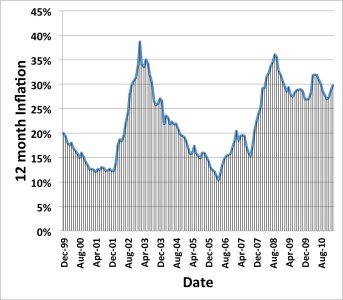
Between when Chavez took over and Dec. 2001, twelve month inflation was actually going down! This happened for two reasons: M2 was being controlled and extra income from oil was being saved in the Economic Stabilization Fund (FIEM). But then, oil went down, and none other than Jorge Giordani decided it was time to use the FIEM, which was drawn down very fast. So fast, that in February 2002, Chavez had to allow the “devaluation” of the currency, which up to that point was only allowed to trade within some bands set by the Government. It was a “light” form of exchange controls, and as expected, it failed to work.

After that, the one to one correspondence between inflation in time and M2 breaks down because of exchange and price controls. Initially, M2 was allowed to increase like crazy, all those bolivars were chasing dollars and inflation jumped up as the currency and devaluation expectations devalued sharply the currency in a country with so many imports. Then in January 2003, the Government began to totally control the exchange rate, introduced price controls, all of which drove inflation down for a while.

Why?

Because at the beginning the Government became very stingy with its dollars, refused to allow price increases and like exchange and price controls everywhere, there is an initial positive effect, but it always breaks down. Markets are like that!

Holding the currency constant delays inflation adjustments. That is why inflation first went down and even as the Government reduced the increase in M2 in 2007, inflation has not gone down, because prices and the exchange rate were held back by artificial controls.

But in 2006, the increase in M2 was so large that all the positive effects of controls disappeared and inflation began to grow. And the Government decided to not allow M2 to increase as fast, but inflation did not go down.

Why?

Because it did not allow for devaluations, holding back the currency, subsidizing everything and eventually, even that became unsustainable. Thus, even though M2 has not increased as fast, inflation is at the same levels because the Government has to adjust prices and the currency periodically when things get really tough.

Now, that is really structural!

It is built into the absurd system of controls that Giordani, who is not an economist, has built around this Government. And as long as the controls are in place, inflation will not go down for the simple reason that there will be periodic devaluations, periodic price adjustments (This week it was wheat and bread) and the risk of higher inflation is probably higher than that of lower inflation.

Thus, it is all self-generated and is becoming structural, but by structures that were not in place twelve years ago. This is not a chicken and an egg problem. Giordani laid the egg and Chavez allowed him to do it and out of it came this weird chicken who nobody can control.

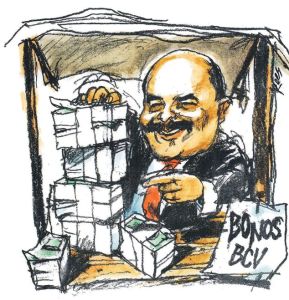
And if nothing is done, which will be the case as long as Giordani is where he is, inflation, the worst tax on the poor, as the cartoon shows, will remain as high as it is today, if not worse.
SEC charges MK funds with Ponzi Activity

March 7, 2011

Last week I wrote about the PDVSA Pension Funds and its activities investing in some fund run by Francisco Illaramendi, wondering what the relationship between PDVSA, its pension funds and the Illaramendi funds was and asking aloud whether the Government or PDVSA would ever investigate or answer these questions.

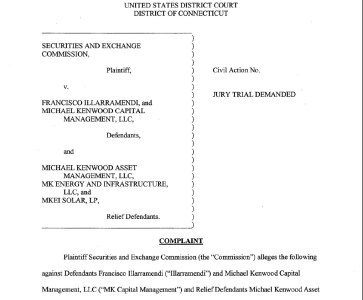
Well, today, the US Securities and Exchange Commission filed an amendment complaint in the case, which increases the need for answers from both PDVSA and the Venezuelan Government in the case.

The SEC now accuses the Funds of misappropiation and misuse of investors assets, saying that Illaramendi and MK Capital Magement have used both Funds as vehicles for Ponzi activity, paying off old investors with new investors money. According to the SEC, the US$ 540 million held in the Short Term Liquidity fund, where PDVSA’s Pension Fund had 90% of its assets, were actually “substantially less” because funds were used to pay off investors in the MK Venezuela Fund.

The SEC further charges that Illaramendi attempted to hide the missing assets by providing the Commission staff with a false letter from an accountant in Venezuela to verify the existence of at least US$ 275 million. According to the SEC, these assets do not exist.

The complaint charges that the liabilities of the funds “vastly exceed the actual assets held by the funds”. The funds had supposedly experienced investment losses and the “gap” is as much as hundreds of million of dollars.

Besides these new accusations, the SEC extends the accusations of investment in private equity transactions, including lending to ventures without documentation.

The SEC also says it interviewed a “Pension Fund” Executive. The Pension fund Excutive said did not know about the loans.

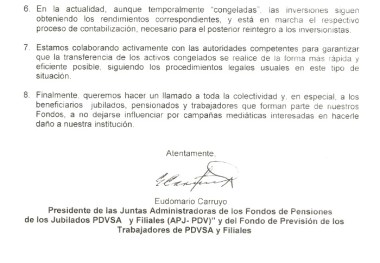
A Pension Fund or a PDVSA Executive? Didn’t Rafael Ramirez say PDVSA had nothing to do with running these Pension Funds in the National Assembly? In the memo below, saying the investments were fine to pensioners, it is signed by none other than PDVDA’s “Internal Director of Finance” who signs here as President of the Pension Funds. Note also the suggestion that this is a “mediatic” campaign in point 8

These charges against the funds and Illaramendi raise the same questions as last week, except magnify the need for PDVSA and the Chavez Government to explain who was involved and who authorized investing pension money in these funds and how was this handled.

Will we hear something this time, or much like the Antonini suitcase, it will  all be buried once again?

Note Added: No sooner (minutes) after posting this, Setty tells us that Illaramendi has pleaded guilty. Will he reveal his PDVSA collaborators?

Ten Questions to the Board of the Venezuelan Central Bank

March 2, 2011

Two years ago, I wrote a careful post on the health of the Venezuelan Central Bank entitled: Central Bank Musings: Printing Money and going bankrupt. I spent a few days working on it because I wanted to explain to the non-expert what the balance sheet of a Central Bank looks like. I remember this quite well, because I was sitting on another story, the Stanford Bank story, as Alex Dalmady had written his now famous “Duck tales”, but I kept putting it off to devote time to my Central Bank post which barely generated a beep, while the Stanford story was one of the biggest ones ever covered by this blog. But the story of the financial state of the Venezuelan Central Bank, may one day be bigger.

Some of you may want to look back at that post now, because things are much worse than they were then. That is why a group of 26 Economists a week ago published this open letter to the Board of the Venezuelan Central Bank (BCV), asking ten very simple questions:

1.- Can you explain how it is possible that an asset that has been transferred from the BCV to Development Fund (Fonden), in this case US$ 39 billion in international reserves, continues to be reflected simultaneously in the balance sheet of both the BCV and Fonden as an asset? Is this consistent with the generally accepted  accounting rules?

2.- Could you make public the detailed methodology in the calculation of what you call “an adequate level of international reserves”?

3.- Why is it that the BCV has stopped publishing, for more than a year now, the table with the monetary base according to its different sources, where one would be able to appreciate the main factors of primary money creation by the BCV?

4.- Since 2004, there has been an item in the equity of the BCV denominated “adequate level of international reserves” which subtracts Bs. 9.186 billion (US$ 2.136 billion) to the overall equity. At the close of December 31st. there is in the assets of the BCV an account denominated “diverse assets in national currency” (Note 12 in the balance sheet) under the concept “adequate level of reserves” for Bs. 61.155 billion (US$ 14.222 billion). Shouldn’t this account be subtracted from the equity of the BCV in order to be coherent?

5.- Article 5 of the Central Bank law establishes that “the fundamental objective of the Venezuelan Central Bank is to achieve price stability and preserve the value of the currency”. Since the primary obligation of the BCV is the control of inflation, how do you explain that we have the world’s highest level of inflation?

6.- Can you explain why the backing of monetary issuance (International Reserves/M2) has deteriorated by 111%? Such backing was US$ 0.10 for each Bolivar in 2010, when in 1999 it was US$ 1.21 for each Bs.

7.- On July 20th. 2005, the account “Funds transferred to Fonden” was created in the amount of Bs. 12.453 billion (US$ 2.896 billion), which according to Note 11 of the balance sheet of the BCV had to be amortized by creating voluntary reserves. Why is it that after five years, this has yet to be amortized?

8.- What is the  content of of the item “Diverse assets in national currency”, noted in Note 12 of the balance sheet of the BCV? What are these so called financial instruments in the amount of Bs. 15.05 billion (US$ 3.5 billion)?

9.- What was the economic cost of the monetary reconversion?

10.- What have been the benefits to the citizens of the creation of the strong Bolivar, since its introduction on January 1st. 2008?

The country demands sincere answers

Griping About the Students Hunger Strike

February 28, 2011


I did not write much about the hunger strike by the students. I was in the middle of moving, thus I had many distractions. By now, the hunger strike is over, the Government capitulated and it was supposed to be a victory by the opposition.

Well, not to me.

The reason is that I think countries can only function under the rule of law and the student’s victory required bypassing the rule of law. If we complain because Chavez and his Government do what they want with the judicial system, having them bypass the rule of law in order to satisfy the demands of the students leaves a bitter taste in my mouth.

When in hours after the agreement, the Prosecutors office released the elected Deputy in order to comply with the agrement with the students, the rule of law was bypasssed. The “victory” ratified what we say, there is no judicial independence, Chavez and his Government, not Judges, decide who goes to jail, who stays in jail and who is freed.

This can’t be good going forward. We are accepting the autocracy.

And since I am on the subject of the hunger strike by the students, I found the behavior of the pro-Chavez students, holding a barbecue right in front of where the striking students were, absolutely disrespectful and tasteless. I hope the balding student that led the barbecue display is removed from the The Government’s payroll or PSUV’s payroll. Next time, at least find some real students.

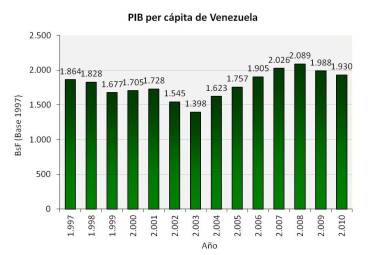
Despite the oil windfall GDP per capita is only up 3.5% over the last twelve years in Venezuela

February 27, 2011

And from the website algodeeconomia.com, a very simple graph; using BCV data, GDP per capita in constant Bs. , since 1998. Over half a trillion dollars in oil income and all you can show for it is an improvement of 3.5% in twelve years. It is not even worth calculating how much that is per year: Tiny.

The Devil Does Not Live Here Anymore

February 21, 2011

Thirty three years ago I came back to Venezuela fresh from a Ph.D. in Physics from well-known US University. It was an exciting time, Venezuela was moving forward, we all felt we were ready to take the country to the next stage of development, you could get research funding and lots of people were either leaving to study abroad or coming back with degrees in many fields. The first few years were exciting, things went well, I came back to Venezuela to work in a lab which already had good equipment and I was able to get more, got grants in Venezuela and abroad, my career took off. I also helped start an engineering research institute.

Then came “El Viernes Negro” (Black Friday), when the country’s economy had its first large devaluation in decades. This was February 18th. 1983. Within months the Venezuelan currency had lost almost 60% of its value, things got more difficult. It was a sign of things to come.

Things began to oscillate a lot. There were good years and bad years. Not much new funding. I was working in a field that required ever more sophisticated equipment, lots of running expenses. It was hard to stay at the edge, but I gave it my best try for quite a while.

Then politics got in the way. Technical employees where I worked began demanding the same perks as researchers, without being willing to assume all of the duties and responsibilities. Then there was a tough strike and I decided I had to either leave the country to do Physics or switch fields. Staying in the country, where my extended family resided, was important to me. I stayed. I was then consulting for a small local broker on how to construct indexes for markets, they had actually started by offering me a job. I decided to give it a try, see how things developed, maybe there would be improvements at the Institute where I had worked since I was 18 years old. It was downhill at that place from there, by now the revolution has insured that what was once one of the top scientific institutes in Latin America, has slid down into an irreversible path to complete mediocrity.

The new job went well. There were ups and downs, but the ups were always exhilarating, I learned so much new stuff along the way. We did lots of things, all of them quite well and with professionalism. Then last year Chavez decided to blame someone for his economic mismanagement and targeted one of the companies of the group that I worked for. It was the equivalent of our “farm” being illegally taken over by the Government.

It was time to go.

Thus, this weekend I moved with my family to another country. I will go back periodically for work reasons, but my main residence will be elsewhere. There were two main reasons for this tough decision, one that came from the mind, not the heart: Crime and the absence of the rule of law. I stared at both of these in the face and it is something I don’t wish on anyone. You feel like you are not playing on a level field. If the crooks don’t get you, the other “crooks” will and you have no way to defend yourself. There are no instances, no appeals, you have no rights. Time to leave.

And so it goes…it’s called self-preservation.

The blog will continue. I started this eight and a half years ago and will continue to document the absurdity of it all, as long as it continues. I think Quico, Alex, Daniel and I have played an important role over the years in telling the story of Chavez outside the country. That job is mostly done. But as blogs have lost some sex appeal, there are lots of stories still to tell about what is going in Venezuela, which can not be Tweeted or Facebooked. Clearly, not being on the ground will deny me some of the insights one gets from being there. But I will go back regularly and hope to compensate partially with it. I hope to sustain the quality, if I don’t, let me know (In private, of course 🙂 )

So, the Devil will continue to be around. I won many battles in my dear Venezuela during the last three decades, but I lost the overall war. Time to move on with some sorrow.

But, in the end…

Semper diabolus vincit

Brisas de Oriente: When Anarchy and Chaos Become Routine in Venezuela

February 19, 2011

Yesterday, there was an eight hour protest near Los Teques, right outside Caracas. Neighbors of the Brisas de Oriente barrio, a barrio that sits on the ridge of a hill, right next to the Panamerican Highway, near Km. 21, right before Los Teques, blocked the road for eight hours. This wasn’ t even huge news, they are part of the routine anarchic and chaotic life these days in Venezuela, while an indifferent and indolent Government claims everything is fine. These people were mad, that the police and the National Guard did not even dare to stop them from blocking the traffic for such a long time. I estimate this affected some 100,000 people, who simply could not move on the highway during that time or chose to stay home, rather than try to find a way to get down to Caracas to work or go to school.

To most Venezuelans the name Brisas de Oriente means very little, but many people that live in or near Caracas have actually been at the entrance of that barrio: the barrio grew out of a food stop on the highway. First came the food stop, then a news stand, then someone built a very simple house, almost but not quite a rancho, behind it and before you knew it, Brisas de Oriente was born. By now, Brisas de Oriente is a long road along the ridge and down, from which other roads, a minority of them unpaved, branch out in between the dense concentration of rudimentary houses, the further you go out, the closer they are to a “rancho” or shack, while the closer to the road you are, the closer to the now famous food store that goes by the name of Los Golfeados de Los Teques, the more developed the houses are.

The people that live in Brisas de Oriente are poor, but they most likely have one or two people that work at home, kids that go to school and even the university. A well constructed house in the barrio costs around five to ten thousand US dollars. Rentals are about 50 dollars a month.

For years, residents of Brisas de Oriente have known that you have to arrive before 10 PM and leave after 6 AM to go to work. In between the “malandros” (hoodlums) take control of the barrio and either rob you outright or charge a fee just to be allowed to go by the spot where they are hanging out. So, you better have an alternate place to sleep if you don’t want to get mugged when you get home late or have to leave early.

Lately, however, crime has taken a turn for the worse. From no murders five years ago, the number of homicides has picked up at a fast pace. The crooks have gotten younger, they are now mostly underage and armed with loaded guns, while their style has changed. This week two residents of Brisas de Oriente were murdered in two separate incidents. A total of sixteen have been killed so far this year. This is what led to the protests.

When the protests began, the police did little, some of them even live there and are victims themselves, all part of an anarchy that just grows by the day. And so do the protests and to the media it becomes almost normal and simply boring. Ask the Minister of the Interior and he will likely spew out some made up statistics about how he has reduced crime in the last six months, despite the fact that each year the number of murders beats the record from the prior. And Government media does not show the protest and the non-Government media minimizes it too for fear of retribution from the Government.

And there is no policy response from the Government, they would not know where to start. And chaos and anarchy just grow, much like crime around the country. Probably at the same rate.

You may wonder how I know about Brisas de Oriente. For almost 20 years I lived not two kilometers away from it, had breakfast at Los Golfeados daily and got to know and even work with a number of its residents. The barrio was heavily pro-Chavez until 2006 and by now, according to my friends, it has become mostly opposition, except they could care little about politics now. They only worry about survival.

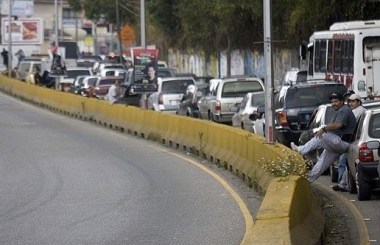
Chavez Becomes Blameless on Wasteful Gasoline Use in Venezuela. His Solution: Rationing!

February 15, 2011

Yesterday, I sincerely could not believe the Dictator when he started talking and pontificating about the problem with cheap gasoline in Venezuela. “You are filling your tank with the cheapest gasoline in the world” said the President, speaking with his scolding tone, as if saying “you bad guys have been doing this behind my back”. Then, as if his inauguration was just last week, rather than twelve years ago, Chavez told us in his pedagogical tone, that the Government subsidizes 90% of the price of gasoline, a topic we have covered many times.

Wow! When did he find this out?

Because for twelve years, Hugo Chavez has done very little to change the price of gasoline. In fact, he forced Former President Rafael Caldera in 1997 NOT to increase the price of gasoline to take advantage of that populist stance.

In 2000, his cronies at PDVSA cancelled the natural gas car program for vehicles, which was rapidly expanding and they have now tried to revive without much success (Surprise!)

And it was Chavez himself in Alo presidente the fact that he had not built major roads, because that would only attract more people to cities.

And it was also Chavez who sent oil and gasoline to Iran, London, Petrocaribe, Cuba, Argentina, Central America and Uruguay, the latter a country with a much higher standard of living than Venezuela.

But rather than eliminate these subsidies and/or increase the prce of gasoline, Chavez solution is very simple:

Gasoline rationing. The Government will force us to consume in 2011 100,000 barrels less a day than in 2010.

What’s next? Rationing sand? Because after all, we have had water and electricity rationing, food shortages and now gasoline rationing, all once abundant in Venezuela.

But it is the paradox of Venezuela, Chavez, the revolution and gasoline. After twelve years of inaction, he puts his angelic and pedagogic face and blames us for his incompetence. Even managing to scold us. We should feel guilty. But not him. Like the cartoon above, Chavez is well meaning, generous and smart.

It is the Venezuelan people who are simply very dumb, to continue to put up with Chavez’ charade. The “Yo no fui” parade of his own incompetence.

Bolivarian Bond Arbitrage for Dummies

February 13, 2011

I- The Question

I have been getting some emails asking about why it is that the PDVSA bond issued last week, the so called PDVSA 2022, has a price that is so much below the identical Global 2022 Venezuela bond issued by the Republic last summer.

II.-Bonds in general

But to understand why this is relevant, let me start at the beginning: Typically, when a country or a company issues a bond, it has a price and a yield to maturity which depends on the perceived “risk” associated with the issuer. Such a bond is simply a promise that I will pay the annual payments, the coupon, and at maturity, the day the bond ends, you will get 100% of the nominal or face value of the bond.

III.- Venezuela’s bonds and risk

Venezuela currently is perceived as being high risk, in fact, very high risk. There are two reasons for that, one is simply political, the feeling that one day Hugo may wake up and decide not to pay the country’s debt. The second one is that Venezuela has been issuing more and more debt and at some point this can’t go on, the country has to pay at maturity, as well as the increasing annual or coupon payments to the bond holders, which are already near US$ 5 billion per year.

As this risk has increased over the last few years, this coupon has gotten higher, meaning that the country or PDVSA has to pay more to convince someone to buy your bond. As an example, in 2009, PDVSA issued bonds maturing in 2014,2015 and 2016 with coupons around 5%. That means that if you hold $100,000 of the bond PDVSA has to pay you $5,000 per year and then at maturity give you back your money.

IV.- How Venezuela issues bonds

This is where things get complicated. Because of exchange controls, these bonds are not issued internationally, where they would trade very close to each other, but instead are sold to Venezuelan individuals or companies for Bs. That is, you pay so many Bolivars for each dollar face value of the bond at Bs. 4.3 per US$, but you know based of the coupon, that the bond will not trade at 100%, but at a lower value.

Why?

Because Venezuela would have to pay coupons of 14-16% for the bond to trade near 100% if issued in US$ directly. Instead, what the Government or PDVSA do, is to set a lower coupon, knowing that the bond will trade below 100%. Thus, if you are a Venezuelan and you pay say Bs. 4,300 per $1,000 of a bond that should trade around 70%, you buy it, sell the bond for 70% of its face value (You get $700) and then you are simply buying dollars at Bs. (4,300/700) or Bs. 6.14 per US$.

Since exchange controls are so strict now, people love these bond issues, because other than what the foreign exchange control office sells you at Bs. 4.3, there is no way for an individual to buy dollars as it is completely illegal to do so since last May. The same applies to companies. If the Government does not give them dollars for imports, they have to either use their own money or simply stop importing, it is illegal to buy foreign currency other than from the Government.

V.- The Venezuela Global 2022 bond

Last summer, Venezuela issued a bond maturing in 2022 (It actually matures in three parts, one third in each of 2020, 2021 and 2022) with a coupon of 12.75%. This is a very high coupon, very few companies or countries in the world issue at such high coupons. Even worse, these bonds trade at a discount in order to equilibrate with what investors expect from Venezuela. Last week, for example, this Global 2022 bond, as it is called, was trading at 88% of its face value just before PDVSA announced its bond. At that price it was yielding around 15.3%. The difference between coupon and yield is that coupon is what you get paid every year over the face value, yield to maturity is what your annual return will be if you keep the bond until it matures.

VI.- The PDVSA 2022 bond

And here is where the Bolivarian arbitrage and the topic of this post begins. You see, this week PDVSA announced an issue of a bond also maturing in 2022, also having a coupon of 12.75% and also having maturity in three parts in 2020,2021, 2022. That means the two bonds are identical. Given that PDVSA and Venezuela are so inter twinned, you would think they should have very similar prices and very similar yields. Right? Well, yes and no, because of all of the artificialities in the Venezuelan economy due to the controls, at the beginning of the trading of a bonds this does not happen. In time they will be very close, but it will take time.

In fact, last Thursday when the PDVSA 2022 began trading, it was being sold at 74% of its face value, while the Global 2022, essentially the same risk, same yield, same coupon, was trading at 86.4%, a full 12.4 points above the new PDVSA 2022 issue. Illogical. right?

VII.- The Bolivarian Arbitrage

You would think these two prices would become the same immediately, but they don’t. This is the Bolivarian Arbitrage, the subject of this post and the question I have been getting from readers: Why are they different, why doesn’t the gap close immediately? How can it make sense for Venezuela to be yielding 15.7% (same coupon, higher price of 86.4%), while an identical bond from PDVSA yields almost 19% (same coupon, lower price of 74%)? Aren’t markets “efficient”?

The answer is that this exists because of the dynamics of the bond sales by the Government and the banks. Eventually, the difference will close, but it will take time. Here is why:

Companies don’t want to buy the bonds, they want to get the dollars when they get the bonds and sell them. So, they go to a local bank and say: I will place an order with you, of say US$ 50 million, if you can guarantee a price for each dollar such that no matter what amount I get, the price will not change.

For the bank this is not easy. The client could be assigned zero of the bonds or it could be assigned the 50 million, the rules are never clear and vary from bond to bond. So, suppose that the bank expects the new bond to have a fair value of 82%, that means that each dollar costs (Bs. 4.3/0.82)=Bs. 5.24, but the company wants a guaranteed price, so you say I will pay you 70% for the bond, no matter how much you are assigned. This means, for the company, that the dollars will cost Bs. 6.14. This is a great deal in a country where there are no dollars to be had, so if your objective is to get dollars cheap, you are not very sensitive to the price, between not having access to any dollars or paying Bs 6.14 per US$, it is still a bargain. In fact, I bet most companies would pay even higher values, if they could get all they wanted.

VII.-Why the Government wants to sell cheap dollars

And here is another distortion. The Government knows that people would pay more, but it does not want to sell the dollars at a more expensive price (offering a lower coupon) because it wants to keep inflation down. Thus, it prefers to give away the dollars cheap, than to have the political risk of higher inflation. (Although in the end it is not as important for inflation as the Government thinks, it is mostly financing capital flight)

VII.- How local banks affect the international markets

But now, the bank has a problem. If six customers show up, each asking for a US$ 50 million guarantee of purchase, then the bank has undertaken US$ 300 million of risk, which could be dangerous. So, the bank measures how much risk it can take and starts selling these bonds in the international markets at say 74%, like the first day of the PDVSA 2022. It guarantees it will make a four point profit and lowers the size of its risk.

What is the risk? Well, the bank could have the opposite problem, that all customers are given nothing and then it has to go buy the bonds that it promised to deliver. Or that prices will go down because oil goes down or too many bonds hitting the market.

The problem is that these are huge issues for the markets, US$ 3 billion. To give you an idea, two weeks ago Petrobras issued the largest corporate bond in Brazilian history, a US$ 6 billion issue. PDVSA has issued US$ 9.15 billion since last November! Thus, there is an over supply of PDVSA bonds and when the bank tries to sell US$ 100 million, there are only buyers at a low price, if there is no bargain, there are no big buyers.In time, prices will go up as the bonds leaving Venezuela are absorbed by the international markets.

This is the Bolivarian Arbitrage, another artifact of the distortions and complicated schemes the Government has built in around the exchange controls and the large and frequent issuance of bonds. These type of arbitrage has allowed many people in the past few years to make a lot of money, it was just not as obvious to the average person because the bonds were never identical like this time.

VIII.- Making money with the Bolivarian Arbitrage

Let me give you an example. Suppose you had a Venezuela 2010 bond in 2009 which you bought at 70-75% in the middle of the world financial crisis. In August of 2009, that bond was back up at 94% when PDVSA announced a Petrobono 2011 with no coupon. This 2011 bond came out at around 64%, you could have sold the 2010 and bought the Petrobono 2011. Then, PDVSA issued the PDVSA 2014, which was sold at around 56% when the Petrobono was already at 82%. Then, you could have sold the PDVSA 2014 at around 63% to buy the Global 2022 at 76%. In that sequence, ignoring interest, you would have made over 100% profit in less than two years and now you are ready to make some more money again, switching to the PDVSA 2022.

IX.- The risk of playing this game.

The risk, obviously is that one day you will not get paid if Venezuela decides not to pay and the bond will drop to around 30-35% of its face value, the so called recovery value. (That is why some people buy the long dated bond, which trade around 45%) You will lose a lot of money, in fact, you will lose all your gains. Of course, everyone assumes they are so smart that if that ever happens or comes close to happening, they will have no Venezuelan bonds in their portfolio by then. They did not expect Russia to default in the 90’s or Argentina in the new century. They both did.

Of course, that is what markets are about. Some think oil is going to soar. Others that the Government will change. Many that Venezuela can do this for a few years without defaulting. Everyone has a different opinion on it.

In the meantime, they will continue riding the Bolivarian Arbitrage.

X.- Why this is so crazy.

But this whole thing is absolutely crazy and it should not be this way. Venezuela’s risk premium is high because of the constant  supply of bonds to the market and the non-transparent way in which things are done. If the Government set up a road map every year telling markets exactly how much it will issue and in roughly which part of the year, the risk premium would go down, the debt would not be as costly. Instead, after telling investors for weeks there would be no issuance in the first few months of the year, PDVSA surprised them with this bond. A road show abroad by the Government once in a while to explain its finances, would also not hurt either.

Additionally, there is no justification for the overvaluation of the currency in these sales. Venezuela has high inflation because monetary liquidity keeps going up and up while productivity goes down and down. It is the classic inflationary set up. But instead of attacking the real causes of inflation, the Government decides to sell these dollars cheap to those that have access to them. It is in the end a subsidy to the well to do and to foreign investors, who are as happy as can be investing in yields that are impossible to find anywhere else in the world.

But it is a crazy scam that will one day come back and get us. It is the Bolivarian Arbitrage.

Another Puzzling Bond Issue, this time by PDVSA

February 9, 2011

Once again, Venezuela, this time via its oil company PDVSA, gets ready to issue a bond which puzzles markets. As investors were asking for more transparency, more order and fewer surprises in the country’s issuance, PDVSA did exactly the opposite, announcing the sale of a US$ 3 billion issue to be sold via the banking system and with identical characteristics to the Venezuela Global 2022 bond issued by the Republic last August.

There are many puzzles:

-Why make it identical to the existing sovereign bond?

-Why pay a coupon of 12.75% when it would have sold equally well at a lower coupon? In fact, the Global 2022 was issued at a time last August that the yield curve was much higher than it is today.

-Why issue something so unexpected, after sending different signals to investors that are asking for more clarity?

In fact, even though the prospectus says the issue has been approved by the Superintendent of Securities, that office had approved other issues with different characteristics in the last few weeks, but not this one. This also leaves the puzzle as to why after all the publicity surrounding the Public Exchange, this is not being issued there, given that it has become Chavez’ pet project.

PDVSA had been sending very different signals in the last few weeks. In private it was telling investors it would issue the US$ 3.15 billion that it sold to the Central Bank and its pension funds, plus another US$ 3 billion through the Public Exchange. Then, high level insiders at PDVSA were saying, it would issue around US$ 2 billion in the second half pf 2011.

Well, so much of talking to officials to get real and transparent information. Instead, PDVSA issues an identical bond to an existing one, eliminating even the uncertainty of where the new bond (and the old one for that matter) should trade.

You see, The Government issued and identical bond, with a coupon of 12.75% and equal amortizations in 2020, 2021 and 2022, last August. This bond came out last summer at a time that Venezuela was yielding much more than it is now. In fact, when that bond first came out, its price was 78% and it had slowly risen to 88% (88.4% today) as Venezuela’s bond prices improved over the last few months.

Currently, the only dollars people have some access to is the SITME dollars at the Venezuelan Central Bank. Lots of rules, scarcity and all that, but that is the only one you can get at a price of Bs. 5.3 per US$. This is the reference price for everyone.

So, if the PDVSA bond is sold at 100%, with a 12.75% and identical conditions as the Global 2022, if it were to trade at 88%, it would mean you are buying dollars at a price of Bs. 4.88 per US$ (Bs. 4.3/0.88, that is you pay 4.3 for each dollar of bond, but when you turn around and sell the bond you only get 88 cents for each dollar)

But those that get the bonds (rules for this are not known until the bond is assigned) would be willing to sell at 81%, where you are basically buying dollars at the same rate as the SITME rate, the only available rate in the country to mere mortals: Bs. 5.3 per US$.

The result? The Global 2022 will start dropping in price, as investors sell it to buy the lower priced bond with a higher yield to maturity. Because, while there are differences in yields between some Venezuelan and PDVSA bonds, all of these have technical explanations, such as the fact that the 2014, 2015 and 2016 were issued under local law and the PDVSA 2017 has too much supply and more coming from the Venezuelan Central Bank.But as a general rule there is no much difference between the two yields to maturity.

For example,  the PDVSA 2027 and Global 2027 yield roughly the same, thus one would ot expect the PDVSA 2022 and the Global 2022 to have a yield to maturity that is not too different.

But they will be different for a number of reasons. First, there will be more supply of the PDVSA 2022 initially, it will be lower, you are buying dollars for more Bolivars. Second, the Global 2022 will drop but not trade identically to the PDVSA 2022.

For any Venezuelan getting their hands on the PDVSA 2022, it will be cheap. They will be cheap at Bs. 4.88, at Bs. 5.3 and even higher. Since there is scarcity and the parallel market is illegal, people will be happy to buy these bonds and thsu these dollars even at higher prices.

But the Government, somehow and mysteriously, does not want to take advantage of this, selling the dollars higher and getting more Bs. for them.

Why?

Is it capitalistic populism?

No idea. Another puzzling issue by Venezuela, this time around by our friends at PDVSA.