Archive for the 'Uncategorized' Category

First Margarita non-expert Venezuelan CPI. Make your own!

June 30, 2010

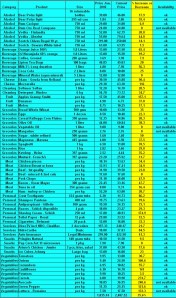
Reader Island Canuck has been keeping tabs on prices on that island for the first six months of the year and comes today to report an increase of 35.6%, you may agree or not with his choices, but he did the work.

Let me tell you what impresses me the most about the increases: The fact that so many local products have gone up the most. Look at the Avocados, onions tomatoes, lettuce and green peppers. Spaghetti? For God’s sake, it’s all made here. I can understand the apples, but water? Or Orange Juice.

The puzzle: How come imported microwave popcorn is flat?

In any case, make up yourown index using the data and tell us how it fared. Simply pick a basket, your taste, then calculate the increase in the first six months and tell us the result.

Kudos Island Canuck.


Another look at how Chavismo tries to “manage” food imports and distribution

June 27, 2010

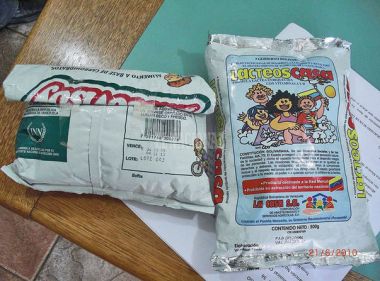
(Milk packages with expired dates on them)

Both El Nacional (page A-6 by subscription) and El Universal have articles today about the failure of the Government’s food import policy. The amazing thing is that some of the data used by both newspapers  is taken right our of reports by the Government, and in the case of PDVAL it is from a recent PDVAl report.

According to the PDVAL report, in 2008 PDVAL imported 597,000 Tons of food, which triples its distribution capacity. Thus, the 120,000 Tons of spoiled food represents about 20% of what was imported in 2008, not an insignificant amount as the Dictator would like you to believe.

According to the report, the amount of food purchased was not decided by PDVAL, but was an order by Cenbal, the National Center For Feeding Balance, an organization I have never heard of, but which reports to the Vice-Presidency of the country. Cenbal is composed of representatives from the Ministry of Agriculture, Commerce, and you guessed it, Cuban advisors, who now seem to have shifted from advising on how to produce food on how to import it.

Cenbal itself imported, via various mechanisms a total of 1.7 million Tons of food. The idea, was to import the food to guarantee supply and even sell it to the private sector, something that was never done. The report also says that it was the Cubans that advised PDVAL on how much to buy, the scheduling and the permissions needed for items. Most of the food imported via PDVSA’s Bariven import company was bought via competitive bidding, except when it was purchased using Government to Government agreements. (Think Argentina and China)

The report says that the bottleneck for all these imports was simply the ports which were unprepared for this magnitude of imports .Similarly, it blames the tax office, the lack of storage facilities and the delays in obtaining permits for the problems. So much for trying to blame the private sector!

Clearly the Government’s strategy was to import so much food to guarantee that there would be no shortages, but nobody was taking into account how much could actually be brought in into the country within a time period and the Government’s buerocracy was itself to blame for the problems.

The article in El Universal looks at the evolution of food imports and food production in the last few years. It concludes we have gone from importing 70 dollars per inhabitant a year to US$ 392 per inhabitant per year, which represents the need of importing US$ 14.3 billion per year in food. Thus, all of the BS about sovereignty, endogenous development and the like was Mr. Chavez BS.

Then the article gives examples, such as the fact that the country imports 90% of the black beans we eat, half the meat and  70% of the rice. Up to 2003, Venezuela was self-sufficient in meat, importing about 1% of its needs, but then the Chavez administration began regulating prices and local producers could not compete with the cheap Government imports.In 1998, Venezuela produced 407,000 Tons of meat, which is now down to 269,000 Tons with imports reaching 395,000 Tons.

In milk, the story is not too different. In 1998, 67% was local production, today 67% is imported. In 2008 and 2009, imports were over 100% of consumption, which also explains some of the problems with the putrid food.

While all this happens, report El Nacional, the Comptroller, contradicts himself day after day. First he said that he was investigating the food imports for the last two years. Then he said he was doing t, but did not know that some of the food was going bad, but it turns out that in his own report t the National Assembly, the Comptroller reports the containers of spoiled or expired food. It turns out that it is  cheaper to buy food about to expire and that may be part of the problem. The Comptroller reports even food packages with two expiration dates in the same package, suggesting tampering.

There you have it, Chavez knows how incompetent and inefficient his Government is that he manages the country trying to import too much, distributing too much and spening too much in the hope that there wll not be shortages and his popularity does not decline.

But in the end we have the same story: waste, corruption and inefficiency dominate and we Venezuelans pay for the Dictator’s follies.

A radical shift to the radical left in Venezuela

June 25, 2010

Believe it or not, within the robolution some people think there is a “right” and a “left”, the “right” belonging to those that want a little more pragmatism and less ideology for the sake of the survival of the robolution (with an “o”), while the left is composed by the more Pol Potian leaders, whose idea of socialism is averaging down everyone, until we are all as poor and as obedient to the “process” as can be.

It is not a very well-defined line. The more radical wing is actually more honest or should I say less corrupt, less touched by scandals, while the “right wingers” are also pragmatic when it comes to their life styles and allowing others to stick their hands in the till. They have discovered the good life and heck, they enjoy it.

The leader of the Pol-Potians is of course, Jorge Giordani, “The Monk”, who has been Planning Minister forever, where he has accomplished failure after failure in his planning and economic policies. But his honesty and chemistry with the All Mighty leader has allowed Giordani’s incompetence to flourish. Giordani took a gigantic leap forward when he was finally upgraded to Ministry of Finance, a position in which his decisions can directly and immediately screw up the Venezuelan economy and lead to the type of destruction on which XXIst. Century Socialism, whatever that may mean, can be built upon.

But a new powerful leader has emerged in the midst of all this, current Vice President Elias Jaua, the Ph.D. in Sociology who has presided over the not so successful land and agricultural policies of the Chavez era. After two million hectares under his control Jaua seems to have realized that he could not get more than 5% of them to produce and the real power is not in the land like Pol Pot and Mao dreamed of, but in the robolution the power is with the imports, that’s where the money is, so let’s go after it.

Some claim it was actually Jaua who started leaking all of the information about the food going bad all around the country as a means to get a strong hold on PDVSA’s subsidiary PDVAL, as well as the companies nationalized by Chavez in the last two years in the food production sector. If true, the plan worked out perfect as PDVAL is now directly under the umbrella of the Vice-Presidency and the food companies are part of the Minister for Feeding, another Jaua subsidiary.

In a perverse sense, this is good news for Venezuela. The food import and distribution is completely removed from PDVSA’s daily activities, which will allow its management to concentrate in the most important business in the land: Oil. PDVSA should have never been involved with PDVAL, but Chavez’ belief that PDVSA’s weakened management and almost infinite resources would solve the problem and Ramirez’ thinking that being in charge of the biggest exporter and the biggest importer in the land would make him untouchable, forced PDVSA into an undesirable and unwanted business.

But this is also bad news, as Jaua and his cohorts are full of ideology and have little managerial expertise to undertake the task that they have brought upon themselves. They may think that by being honest (less corrupt?) they can manage the food import and distribution business more efficiently, but they also belong to the Chavista strain that believes that anyone can do anything, even if eleven years of failures proves otherwise.

And besides the lack of management, there will be the lack of the ample resources (read cash) that PDVSA had and which can move mountains whenever it is necessary. No secret budget can even approach the levels of funds and agility available to PDVSA, something that Ramirez is certainly going to shield now from Jaua’s desires.

And it is a bad moment for this to happen. With the private sector now strangled, if the new PDVAL runs into troubles with the flow of imports, the shortages will be even more dramatic, completing the circle of good news/bad news for our dear country.

In some sense, Ramirez has to go now for Jaua to be successful in his new enterprise, but somehow the Minister of Energy and Oil is a true survivor, a man of many secrets and many suitcases, which so far have averted his demise.

But there is only one survivor, for now, in the robolution, and his name is Hugo Chavez. Ask Diosdado Cabello and his cohorts, six of which were swiftly removed from the Cabinet simultaneously with the PDVAL grab in the name of the Parliamentary elections. Or ask former Vice-President Carrizales who stood up for the military in the face of a Cuban invasion in key military positions and was quickly replaced by the quiet sociologist with the name that always seems short a consonant.

They are all gone for now, but they may return like comets, much like Diosdado has reappeared whenever things were not working well. Ideology imports little food and feeds few mouths and every time Chavez has shifted to the Pol-Potians he has eventually found the need to bring back the “right” to straighten out the mess.

For now, you can assume the worst case scenario, think Banks, think Globo, think Pol Pot, the total destruction of a system in the name of a nebulous idea which is still a work in progress eleven years after Chavez’ ascension to power. Only a quick deterioration could shift the balance of power at this time.

And Chavez needs a magician to stop the unraveling of the Venezuelan economy, which may lead to the resurgence of the radical “right” and the cycle would begin once again.

A look at the foreign currency that the Venezuelan Government may have in 2010t

June 20, 2010

One of the mysteries this year is why the Government has been so stingy with the exchange control office CADIVI as well as its decision not to supply more foreign currency to any alternative market, despite higher oil prices.

That is why I was mesmerized by the following Barclays graph which was published this week. In this graph Barclays plots for each of the last six years, how much CADIVI gave out to importers, how much the parallel market traded and how much the Government issued in bonds.

The first surprise, because I had not looked at the totals for a while, was that the swap market was larger than CADIVI last year. What this means is simply that PDVSA preferred to change at the highers swap market rate than at the Bs. 2.15 per $ rate which prevailed last year. This is because in the end the Government via the Treasury, Fonden or whatever  other mechanism was the main provider of foreign currency to the swap market. Thus, in the end it is the Government that provides both markets.
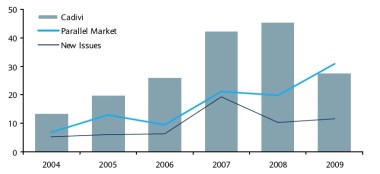
Thus, in some sense, it is better to look at the total CADIVI+SWAP market+Bonds and subtract the bonds to get an idea of what the last few years were like. I plot that in the next graph together with the price of Venezuela’s oil basket (sort of assuming production is constant, which it is not)
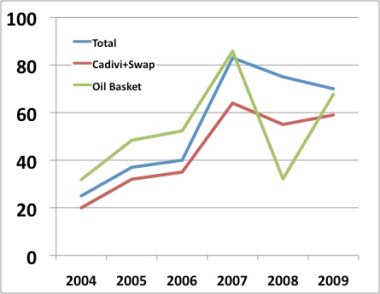
In the above graph, the green line is the average price for the Venezuelan oil basket for the year in US dollars, while the blue line is the total amount of US$ dollars (in billions) given to importers by CADIVI and/or purchased in the swap market plus bonds issued, which in the end measures the number of dollars to which the Government had access on any given year. The red line simply subtracts the issuance of bonds from that total, it is a measure of the deficit of foreign currency the Government had, which forced it to resort to issue bonds.

Let’s look at this graph historically. In 2004, the oil basket was US$ 31.85 and the Government “had” some US$ 25 billion of which it had to issue US$ 5 billion in bonds. The total amount for 2004,2005 and 2006, scaled reasonably with the oil price, in all three years the Government issued US$ 5 billion in bonds to complement its needs, “using” US$ 25 billion, 37 (up 50% from 2004) billion and US$ 40 billion (up 8% from 2005), as oil went from US$ 31.85, to US$ 48.36 (up 51.8% from 2004)  and US$ 52.31 (up 8% from 2005) per barrel in the same years.Basically the increases were almost identical from year to year.

Then, in 2007, oil prices jumped by 64%, but the Government needed US$ 83 billion, a 107.5% increase in foreign currency in 2007 over the previous year, including US$ 19 billion in financing.

And here is where things get murky. In 2008, with oil dropping 62.5%, the Government used up US$ 75 billion, barely 9.6% below 2007, despite the dramatic drop in oil prices. How could this be?

Well, the only possibility is that the Government used funds from the development funds Fonden, taken from international reserves, and other savings in foreign currency to fund part of the needs for 2008.

And it did the same thing in 2009!

Thus, from 2007-2009, the Government “used” 75% more foreign currency than in 2006, but the average oil price in those three years was only up 29%.

And then we come to 2010, this year the average price of the oil basket is running roughly at the level of last year, in 2009 it was 67.7 dollars on average, so far this year it has been US$ 70.26, less than a 3% increase. Except that it is going to be quite difficult to issue new bonds, subtract US$ 11 billion from last year and there will not be as much in Fonden as there was in 2009.  In fact, Fonden began 2009 with US$ 19 billion and this year at no point has it had more than US$ 9 or 10 billion. Thus, the “Total” in the graph for 2010 will have to be around US$ 50 billion, once you subtract no new issues, half the money (likely more) in Fonden.

Finally, PDVSA has higher cash flow needs, thus the number may be even smaller, as international reserves have been dropping, even with lower CADIVI outflows, which implies PDVSA is handing out less money to the Central Bank.

What this all means is that there will much less money for imports, which will only be complicated by the banning of the swap market, which used to provide an alternative to the official market for importers needing items to complete their manufacturing and/or buying spare parts.This will translate into shortages which I am surprised has not intensified as of yet. Most manufacturers/importers say that they typically have about six weeks of inventory. which means we should start seeing the impact of these foreign currency problems in less than a month.

(Note: Some of the money from the bond offerings flowed back into the swap market, thus I may be double counting somewhat, but this changes little the conclusions)
When an opinion becomes “close to a crime” and the real crimes go unpunished in Venezuela

June 17, 2010

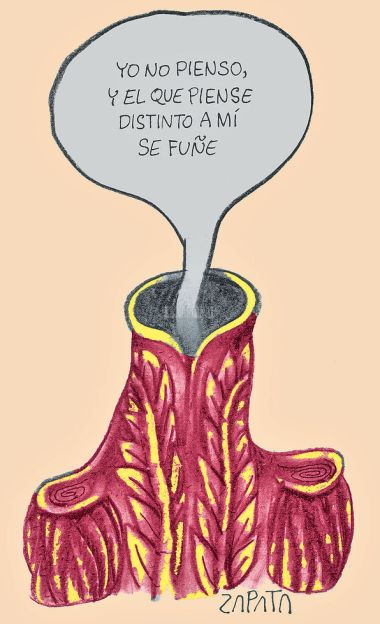
(I don’t think and anyone that thinks differently than me is screwed!)

In another displayed of intolerance, Hugo Chavez reacted violently to the statements by the President of the Medical Federation, Douglas Leon Natera, who was extremely critical of the graduates of the Integral Medical Community program, to whom Chavez went personally to give them their diplomas.

Natera says that this program does not create the replacement to medical doctors as Chavez and the Government would like you to believe. According to Natera and others, these graduates are part of an improvised program with Cuban teachers who are not even doctors and little practical experience. The training is apparently done with movies and pictures an the trainees don’t see real patients and practice as doctors usually are trained. The Government plans to now insert these improvised medical trainees into hospitals as if they were fully trained Doctors. Of course, Chavez told them never to treat an oligarch in a new twist to the hippocratic oath that these graduates lack anyway.

Chavez reaction? Oh, very simple, he qualified Natera’s well founded opinion, based on technical elements as “close to a crime” as Natera’s statements, according to the all powerful Dictator, are close to a crime, because they “create alarm in the population”.

Of course, the deaths from mistreatment and improvisation in the country’s Government hospitals do not “create alarm” and nobody is responsible because no one in this Government assumes any responsibility for its errors, starting with the autocrat himself.

But Mr. Natera should watch out for himself, you can be sure the Prosecutor already opened an investigation into his “almost crime”, while those crimes committed by these fake doctors, while illegally practicing medicine will go unnoticed and unpunished.

What else is new!

Hugo in the Sky with Diamonds

June 16, 2010

How many cars can you build on 300,000 dollars a month?

June 9, 2010

Little to say, the band system is from Bs. 4.2 to Bs. 5.4 per dollar. Banks reportedly will sell 40 milln $ a day. Limits will be $5,000 per year per person, $300,000 per month for each company.

You can bet all orders will be done at Bs. 5.4…and most Venezuelans will ask fir the 5k yearly at these prices. You don’t even have to travel to get it! This seems unsustainable.

The bigger question is how many cars can you build with 300,000 dollars a month?

Or paper bags?

Or elevators?

Or cell phones?

The cynical words of the brainless defenders of the Venezuelan Bolivarian robolution

June 8, 2010


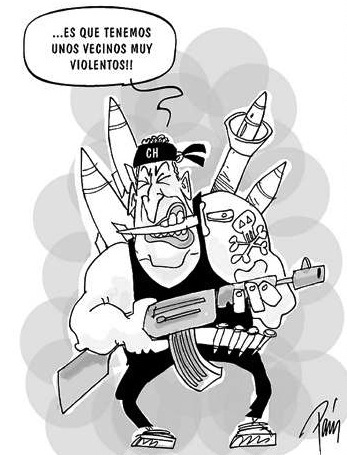
(We have very violent neighbors)

Heard around the inconsistent and cynical revolution:

Francisco Arias Cardenas (Vice-Minister for Latin-America and the Caribbean): “I reject coup d’etats to overthrow Constitutional Governments”

Well said Pancho, but can you explain to us why you led a coup against a Constitutionally elected Government in 1992? What made that justified?

Roy Chaderton(Venezuelan Ambassador to the OAS): “Venezuela rejects an arms race, militarism and war”

Well said Roy, but can you explain why Venezuela has been on a spending spree buying weapons? Or why it is that this is the most militaristic Government in the country’ modern history, presided by a guy who likes to dress up at any excuse with full military garb and weapons? Or threaten us, Venezuelans who oppose him with violence and weapons at every turn? Or how about the fact that your leader is the only Latin-American leader to threaten war or intervention in Latin America since he got elected? Roy, has your mind been stumped so badly or you just don’t want to come back and live here anymore?

Aristobulo Isturiz, former everything, including being simpatico: “The revolution is saving the country?

Jeez, Aristobulo, where should I start? From cynics like you? No

From crime? No.

From corruption? No

From the whims of Chavez? No

From Dictatorship? No

From the robolution? No

From destroying production? No

From Incompetence? No

From Ignorance? No

From selling the country? No

Ari? Should I continue or have you had enough?

Wait! Wait! From our food going putrid, because the Government just does not care? No

Carlos Escarra, Deputy of National Assembly (PSUV): “We will continue investigating the rotten food”

Carlos, Carlos, don’t exaggerate, Chavez already has exonerated Ramirez, who is in charge and you will never dare touch him unless Hugo says go ahead. Pulido may be charged, but it will not go beyond that, look at the attitude of the Presidentica of PDVAL already:

“There is a dirty war against PDVAL”

No Carlos, there is no dirty war against PDVAL, there is a putrid leadership, putrid food, putrid attitude, putrid Deputies, putrid Justice system, putrid management, putrid acceptance of a Dictatorship and a putrid revolution at heart who cares little about Venezuelans and lots about the Dictator from Sabaneta. Your brain, like Roy’s must have a short circuit or an illness, you were once considered intelligence and smart. But you lost it all, including the respect of your friends and family.

The trio that is barking up Chavez’ tree

June 2, 2010

It has been interesting to watch, at least to me, how different the opposition to Chavez has been by a trio of politicians, two old guard and one new guard, who have confronted Chavez head on rather than mincing words and trying to be somewhat civilized.

The first one was Diego Arria, when his farm Las Carolinas was intervened and expropriated. He not only explained why the seizure was illegal, but by confronting Chavez he managed to get the President to admit he ordered it, to which Arria simply called him a thief. Arria seemed to score more points publicly with this bickering, that the MUD, la Mesa and the table combined in the last three months. The Government tried to accuse Arria of suggesting Chavez should be overthrown, but Arria had been extremely careful, as a good diplomat has to be in the language he used, making the Government look somewhat silly.

A similar case has been that of Oswaldo Alvarez Paz, almost out of politics and aspiring to little, but chosen somewhat by Chavez and his Government as a target. Alvarez Paz was jailed for some statements he made on TV and let free a month ago. Since then, Alvarez Paz has been confronting and irritating Chavez every chance he gets. He has said repeatedly we have to “after Chavez” always being careful to say that this means we have to get rid of him in 2012. This irked Chavez, who on Sunday said Alvarez Paz was being disrespectful of the military and the Prosecutor and should not be allowed  to go “around talking so much”.

To which Alvarez Paz replied that Chavez was abusing his power and that in the end he would have to be accountable to international courts, as well as divine justice, becoming in the end a great debtor to history. Chavez is likely to snap back to this, somewhat Alvarez Paz really get to him.

Finally, Henri Falcon has been less frontal, but he is increasing his direct attacks on President Chavez. When he spun off from the revolution, he said he still believed in it, but thought changes were needed. Now that Chavez has simply dismissed the relevance of Falcon’s party PPT, Falcon has become quite aggressive. His latest bark up Chavez tree was to say that it was becoming increasingly difficult to believe the President and that the Consejo Federal de Gobierno was an ambush to non-PSUV Governors, joining the chorus with Henrique Capriles Radonsky. Falcon’s advantage is that he is extremely popular and the people that follow Chavez know him well. When he starts talking like that, people listen and worry. Hopefully Falcon, whom I don’t like much, will continue to be loud and feisty, it will pay dividends for him.

For too long opposition politicians have believed that they confronting Chavez head on was barking up the wrong tree. These guys show that this is precisely what you have to do, day after day. It is dangerous, but it seems to be effective as in the case of these three courageous Venezuelans.

The New Foreign Exchange Market at the Venezuelan Central Bank

May 30, 2010

According to the Venezuelan Central Bank, the new parallel market in which dollar bonds will be traded within a price band at that bank, will begin operating next week. In tune with the revolution, the system will be implement by that evil/capitalist/gringo company called Bloomberg. I doubt the new system will be in place before the end of next week, it is not only the platform that matters, but also the regulations which go from how to order at your bank, to how the band system will exactly work. Since brokers are banned from this, the banks have to train personnel, print forms and learn how to run the system. I think it will be at least another week before this is implemented and trading begins.

Which means that three weeks would have gone by without any access to foreign currency other than Cadivi, the foreign exchange control office. Since Cadivi is quite stingy, that means inventories are being drawn down fast and there will be accumulated demand in the parallel system when it opens. How much? Well, if the old, and now banned, swap system used to trade 80-100 million $ a day that means there will be 1.2 billion to 1.5 billion dollars ready to buy, not a small amount.

Thus, the question is who will supply this money to the buyers. Minister Giordani has said the Government will not do it, that the money will have to come from the US$ 40 billion in Pdvsa and Venezuela bonds that the Government has issued. Except that not only are these bonds largely in the hands of foreigners that want or need no Bolivars, but they are all trading below their face value, roughly at 65% of their face or nominal value on average, so what’s out there is less than US$ 26 billion in actual, real dollars, which is what matters to this fx market.

Chavez has threatened to force local banks to sell their bonds for Bolivars, Analysts estimate this is somewhere between 10 and 17 billion dollars, with the Government saying it is US$ 11 billion, but these numbers are guesstimates based on calculations of the limit on dollars that banks can hold, as established by the Government.

A much simpler and precise estimate is to look at how much banks had in Venezuela and PDVSA bonds as of Dec. 31st. last year, a number that should not have changed much since then. That tabulation gives a much lower number of at most US$ 5 billion in nominal or face value, which corresponds to a cash dollar value of only US$ 3.4 billion give or take one hundred million for each.

That is not much. In fact, that is barely the needs of the parallel market for five to six weeks, of which three have already gone by. Which means that even if the Government forces banks to sell their bonds for Bolivars it is barely a scratch on the surface and in two months, this new market will need a new source of funds or a different structure.

Which implies that problems will continue for the foreseeable future and the Government will, once again, have to improvise a “new, new” system before September.

Not pretty at all.