Archive for the 'Venezuela' Category

Important Dates To Keep Up With, Given All The Rumors Flying Around Venezuela

December 4, 2012

20121204_TALC1_24_1_F1

Lots of rumors floating around in Venezuela about you know who’s health and all sorts of conspiracies. To keep things straight and feed fuel to the fire, here is Article 233 of the Venezuelan Constitution:

Artículo 233. Serán faltas absolutas del Presidente o Presidenta de la República: la muerte, su renuncia, la destitución decretada por sentencia del Tribunal Supremo de Justicia, la incapacidad física o mental permanente certificada por una junta médica designada por el Tribunal Supremo de Justicia y con aprobación de la Asamblea Nacional, el abandono del cargo, declarado éste por la Asamblea Nacional, así como la revocatoria popular de su mandato.

Cuando se produzca la falta absoluta del Presidente electo o Presidenta electa antes de tomar posesión, se procederá a una nueva elección universal, directa y secreto dentro de los treinta días consecutivos siguientes. Mientras se elige y toma posesión el nuevo Presidente o Presidenta, se encargará de la Presidencia de la República el Presidente o Presidenta de la Asamblea Nacional.

Cuando se produzca la falta absoluta del Presidente o Presidenta de la República durante los primeros cuatro años del período constitucional, se procederá a una nueva elección universal y directa dentro de los treinta días consecutivos siguientes. Mientras se elige y toma posesión el nuevo Presidente o Presidenta, se encargará de la Presidencia de la República el Vicepresidente Ejecutivo o Vicepresidenta Ejecutiva.

En los casos anteriores, el nuevo Presidente o Presidenta completará el período constitucional correspondiente.

Si la falta absoluta se produce durante los últimos dos años del período constitucional, el Vicepresidente Ejecutivo o Vicepresidenta Ejecutiva asumirá la Presidencia de la República hasta completar el mismo.

I will not translate it all, but the article first defines the absolute absence of the President and then it says:

-When the absolute absence takes place in the first four years of the term, elections need to take place within thirty days.

-When the absolute absence is that of the President-elect, then there has to be an election for President within the next thirty days. While this election takes place and the new President takes over office, the President of the National Assembly takes office.

However…

the last sentence says that if the absence takes place in the last two years of the term, the Vice-President gets to complete the term.

Thus, people interpret, if something happened to Chávez today, Maduro would finish the term, but the President of The National Assembly would take power after January 10th. if no new President had been elected.

Thus, these are the relevant and significant upcoming dates in Venezuela, given all the rumors:

December 16th. Elections for Governor. Any “event” before that date will create lots of uncertainty and complications. But Chávez’ absence before it, will likely raise doubts in the electorate. Do you really think there is a sympathy vote if Chávez is not part of the election? Do you really think El Aissami has a chance without Chávez publicly endorsing him and telling us he is the best thing since Pepsi Cola? (Ok, Chinotto will do, but is he?)

December 17th. We are likely to be still counting votes on that day in some States, but this day is quite significant. First of all, it is a holiday (Note added: Turns out it isn’t…). Second, it is the day that none other than Liberator Simón Bolívar died. But it is also a day in Venezuelan’s lore: Lore has it that Dictator Juan Vicente Gomez died afew  days earlier, but his collaborators kept the fact hidden so that he would die on the same exact day as hero Simón Bolívar. The conjecture is this may happen again, more so because of the elections the previous day.

-January 5th. Well, nobody ever reads Article 219 of the Venezuelan Constitution, but it clearly says it is the day in which the National Assembly first meets for the year. But more importantly, it is also the day that it chooses the President of the Assembly for the year. Even if only for five days, some people may not be too comfortable having Diosdado there, so they may find someone else they trust more if they have inside knowledge of what is going on. Far Fetched? Just think, whoever may be named (see next important date) may become President in only five days, even if only temporary. Thus, the choice has to be a careful one, no?

January 10th. The Constitution also establishes this date (Article 231) as the one in which the President gets sworn in. Which means that even if Chávez has avoided naming a replacement, he has to show up that day if he does not want his absolute absence to be declared. And given Article 233 above, it will be the President of the Assembly who becomes President that day if Chávez fails to show up. Thus, there are two schools of thought: He will not and/or the treatment he is receiving in Cuba is simply to make sure that he does show up. Either way, this the most important day.

So, mark all of these days in your calendar. You can also mark down December 28th., our equivalent of April Fools, but then again, nothing that is said that day can be taken seriously, no?
The Puzzling Case Of Chávez Naming A Temporary Replacement For His VP

December 2, 2012

20121201_TALC1_9_1_F1

Given the total disregard for formalities and the letter of the law of the Bolivarian Goverment, people are still puzzling over Chávez even bothering to name a temporary replacement for Vice-President Nicolas Maduro, during the Foreign Minister’s two day absence to be present at the Unasur meeting in Lima. Given that Chávez has never even bothered to name his own replacement, even when he has been in intensive care, why did he bothered with such a minutia in the whole scheme of things? And the choice of the Minister for Electricity Hector Navarro was even more surprising, given his minor role in the overall scheme of things, even if he has proven to be a loyal ally of the Venezuelan President.

To some, this is simply Chávez sending a message that he is still very much in charge. Some think it was even extravagant, given that it should have been Maduro who named his own successor and not the Venezuelan President.

Others suggest that this was actually an act of paranoia, guaranteeing that the Presidency would not fall into the wrong hands should something happen to Chávez while Maduro was away. In fact, some even think that this indicates or even proves that all is not well with the Venezuelan President, if he has to worry about such convoluted scenarios.

But the remarkable thing is that the act would never hold water legally in any scenario, however convoluted it may be. The decree was signed by Chávez in Caracas, on a day that it was well known that Chávez was already in Cuba, from where it is simply illegal for him to issue the decree. Thus, even if a worst case scenario occurred, it would have been difficult to show the legality of the whole thing.

By now, the whole question is moot, Maduro is already back and order has been restored into this possible bifurcation into chaos. But the head scratching continues over the rationale behind the act.

With Afiuni’s Case, Chavez’ Revolution Shows Lack Of Compassion And Scruples

November 24, 2012

You all know the horror story that Judge Afuini’s life has become ever since she decided to apply the letter of the law to Eligio Cedeño and let him go because he had been jailed without a trial for longer than Venezuelan law says you should. She was jailed on direct orders from Chávez on national TV even before there were formal charges against her. Since then, her trial has been delayed over and over. Despite her health problems, she was denied home detention until the situation became untenable and the UN, European Union and the Interamerican Human Rights Commission have asked the Venezuelan Government for her release to no avail.

What was not known to the public, but the Government and the UN were informed of, was that Judge Afiuni was tortured and raped while initially incarcerated at INOF in Los Teques. This was only publicly revealed this week, as a book was published with Afiuni’s story. The story is no surprise, Venezuela’s penitentiary system has become a terror story of how human beings are treated with less respect than animals at the country’s jails. What is sad is that Afiuni also had to suffer this additional violation of her rights as a human being to satisfy Chavez’ whims and that despite her suffering, nobody in the Chavez Government showed any form of compassion towards her.

But it gets worse.while the Minister for Women says that it has to be investigated and “if true” her rights have to be guaranteed (about time!), the former Head of INOF who goes by the name of Isabel Gonzalez tries to turn it around against Afiuni and says (without any support) that she will sue Afuini, because it is all false and her accusations violate human dignity”. They also now deny that the accusation was presented to the UN, which her lawyer clearly says was done and today Maria Corina Machado publicly scolds Chavez, because he knew the reality of what had happened to Afiuni.

That is the story of Chavismo, a lack of scruples, a lack of compassion and an ability to turn around any charges on the accuser, the persecuted and the abused. A complete inability to assume responsibility for anything, while trampling with people’s rights openly. Come on! Are we to believe that at INOF no woman has been raped or abused before? But these incompetent Government officials come out and hold a press conference as if they ran a perfect system, ready to pile on to Afiuni once more, without qualms and moral doubts.

It just seems that Venezuelan sinks deeper into a lawless and amoral state as time goes on. Where is the People’s Ombudsman when this happens? Where is the Prosecutor? What does this whole thing say about the venerable and amoral Hugo Chávez? The horror continues as I write. Forty thousand plus Venezuelans live in squalor in Venezuelan jails, abused, raped, tortured, without food, while the President of the “people” looks the other way, ignoring a problem too complex for anyone in his administration to even attempt to solve it.

But as Hugo himself,said on the occasion of a couple of hundred deaths in Venezuela because of his irresponsible Government, the “show” must go on, that is all that matters in the Chavez revolution.

Truly depressing…

Added: And now INOF sets up a media show with some interns denying this was possible.

Chavez’ Guarico Candidate: Nice Guys Do Finish First In Venezuela

November 19, 2012

While a lot has been written about Chavez’ “Dedocracy”* and his choice for Governors, I am surprised how little has been said about Chavez’ choice for Guarico State, Ramon Rodriguez Chacin, shown smiling for the first time ever above. Here is a case a candidate who fits the image of the perfect Chavista citizen that the revolution has promised to create in the future, a truly “nice” guy, tolerant, democratic, honest, above reproach. I mean, it is really hard to find anything to complain about in this choice. we find all the criticism simply jealousy, without foundation.

Why complain if he is not from Guarico? Born in Anzoategui, he has never lived in Guarico, but we are sure that he will learn fast and will even visit the State regularly once he is elected. He roamed the Llanos of Venezuela carrying out secret counter intelligence and military operations, so he knows his way around Guarico.

While many think that Rodriguez Chacin first came to public light for his heroic participation in the November 1992 coup attempt against Carlos Andres Perez, his earlier claim to fame was his leadership role in the El Amparo Massacre, where fourteen people died. Rodriguez Chacin was accused of being part of those that participated in the massacre and even formally accused, but once Chavez got to power, the case was never considered again.

And when Chavez won in 1998, Rodriguez Chacin was appointed to an intelligence agency and later, in 2002 became Minister of the Interior and Justice (nice, no?), where he could make sure that his case never resurfaced again.

Rodriguez Chacin was discovered to have two Venezuelan ID cards, his own, and another one in the name of Jose Montenegro. Montenegro had opened an account in Banesco and other banks and Congress investigated it, since it was Rodriguez Chacin’s picture on the cedula opening the account. There were a number of accounts opened by “Montenegro” and they had fairly sizable withdrawals and deposits regularly. The real Montenegro was actually quite worried about it. Never heard from him again.

Rodriguez Chacin became Minister of the Interior and Justice in 2002 and then again in January 2008, but was there less than nine months, just three weeks before the US Office of Foreign Assets Control (OFAC) ungratefully declared him as a “significant narcotics trafficker” under the Kingpin Act. It was rumored at the time that the US Government had given the Chavez Government advance notice of this and that led to his removal.

Later, Rodriguez Chacin’s name surfaced quite frequently in the captured computer at a FARC camp in Ecuador. Among the exchanges there was a generous offer (Told you he was a nice guy!) of a “loan” for US$ 250 million to the FARC guerrillas to buy weapons, which Rodriguez Chacin referred to as “don’t think of it as a loan, think of it as solidarity”. See what a nice guy he is? There was also an email in which Rodriguez Chacin was asking the FARC to train Venezuela’s military in guerrilla tactics, just in case the US invaded Venezuela.

He was also in charge of the humanitarian operation “Operacion Enmanuel” to retrieve three persons kidnapped by the FARC in a negotiation in which Chavez tried to get Ingrid Betancourt out of Colombia, but had to settle for Clara Rojas and her son born in captivity. Because of Chavez desire to promote his role in this, camera crews from Chavez’ Telesur accompanied Rodriguez Chacin in the rescue and he was taped during the exchange, expressing his solidarity to the guerrillas in no uncertain terms:

Rodriguez Chacin says in the video: In the name of President Chavez…we are watching your struggle. Maintain your spirits and you can count on us”. See the niceness coming through again?

For all his help, his record in all these dubious activities and having no experience running for office, running a municipality, let alone a State, President Chavez used his “Dedocracy”* to name him as PSUV’s candidate to be Governor of Guarico State, a State where Chavez won by 30%, insuring that even Rodriguez Chacin can win there.

And proving once again, that in Chavez’ revolution, nice guys like Rodriguez Chacin, do finish first.

*Democracy by Chavez’ finger

Writing The Devil Is Enough Of An Occupation

November 7, 2012

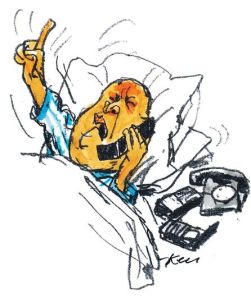
In December 2009, I wrote a post entitled “Disclaimer: Being a devil and a diablo is more than enough” and used the same drawing above. In it, I tried to put to rest rumors that I wrote or helped write not one, but two other blogs about Venezuela.

Today, I have to reiterate the same words, because for reasons that are irrelevant to this post, I have been accused again (twice this time) of writing the blog Venepiramides (I will not even hyperlink to it at this point). Essentially, I was not aware that once again it had become “common knowledge” that I had something to do with that.

Thus, I reiterate here publicly that I, Miguel Octavio, write about Venezuela in this blog alone and do not contribute, write, collaborate, or have anything to do with Venepiramides. I also have an abandoned blog (exdiablo) in which I attempted to translate the contents of this blog and two other halfhearted efforts at showing my orchids and interesting stock charts. All these blogs are now listed on the left as “All Blogs by Miguel Octavio” (descriptions included). Those are my only blogs, the only ones I write or dabble with.

Is that clear enough?

Now, after trying to understand the reasons why people arrive at this conclusion, I have found very little that makes sense. Yes, that other blog runs an RSS Feed of my blog (and eight others), I can’t stop that without stopping all RRS Feed subscriptions (500 or so) to the Devil. I do link to it, that blog wrote about Stanford in its beginnings, a topic that was interesting to me at the time. I will remove this link sometime soon.

But after reviewing everything and having independent people review the facts, the styles, content, I can only reach one conclusion: The person linking me to Venepiramides, is the same one behind that blog, who has created this generalized opinion in order to divert attention from him (her?). There is no other justification for it.

In closing, some random thoughts: First, why would I start a second blog, seven years after starting this fairly successful one, (winner best LA and Caribbean blog ’06, quoted in WSJ, FT, Dow Jones, Bloomberg, invited by the President of the US to talk about blogs), to start another blog, in Spanish (where I had not been successful with exdiablo) and devoted only to Ponzi schemes initially? More importantly why would I want to slow down now in this very successful blog (The Devil), to work on the other one (a post a day), which is much less successful? Second, I have seldom asked favors from my readers, but if you do see some reason to think the two blogs are related or connected (or if you have a good reason to show they are not!), please let me know in the comments. I just don’t see it and want to understand why people actually believe it and go as far as contacting me about it!

Thank You!

Bolivia vs. Venezuela’s Debt: What Are Investors Smoking (or Chewing)?

October 24, 2012

This week, Bolivia sold a ten year bond in the amount of US$500 million to foreign investors.

The yield?

Just under 5%, precisely 4.875%, Venezuela’s 2022 bond yields 11.2% to maturity, more than twice as much*

While Bolivia certainly has certain economic variables than are better than Venezuela’s, such as lower debt to GDP ratio (about 30%) , US$ 10 billion in international reserves which is about 20 months of imports for that country and a lower fiscal deficit, it also has a long history of defaults, a Government with a rich history of expropriations and nationalizations and an unproven track record in terms of willingness to pay.

Thus, while Bolivia enjoys a credit rating of BB-, just one notch above Venezuela’s B+, which should imply a lower yield, given the uncertainties, I would have thought investors would have demanded at least 1% or 2% more yield. Instead, the issue was oversubscribed by a factor of almost ten and the yield is like that of countries that are more respectful of private property rights and the law, like the Dominican Republic.

To me, this suggests that investors are overly punishing Venezuela for the lack of transparency in its numbers, its large fiscal deficit and the lack of growth in its oil production and therefore exports. Because even while Chávez could easily announce tomorrow that he will no longer pay the country’s debt,  during the last fourteen years, he has shown that willingness to pay in the bad moments, even if he has also stepped over private property rights as much as Bolivia.

Thus, either these investors were smoking (or chewing?) some coca leaves and the bonds should drop in value (higher yield) once the hangover is over, or Venezuela’s bonds should move up significantly over the next few weeks or months and narrow the gap in yield to maturity, and thus country risk, between the two countries. Simply put, in a world without yield, Venezuela having to pay double what Bolivia does for similar bonds* seems somewhat illogical.

But what do I know?

*The two bonds are not identical, the Venezuela 2022 matures in three equal parts in 2020, 2021 and 2022, but all Venezuelan global bonds maturing around 2022 yield more than twice what Bolivia does.

Looking at the December Elections

October 22, 2012

Given that I believe that it was the high turnout that decided the recent Presidential election in Chavez’ favor, it is important to consider what may or not happen in the upcoming Gubernatorial elections.

The high turnout tells me the following:

-Chavismo has a voting majority. (We lost big time!)

-This majority votes and can only be mobilized when Chavez is directly involved in the election. (2006,2009,2012)

-The opposition, with limited resources, does well in all other elections (2007,2010)

Thus, there is reason to be hopeful in the upcoming election. On the plus side:

-Some of Chavez’ picks will find resistance among the electorate

-Some regional leaderships for the opposition are strong

On the negative side:

-The unity behind the opposition is strained

-The opposition voters are discouraged, they thought they had a chance and now they don’t know what to think

-The confusion between abuse of power and fraud does not help, neither does questioning the presence of witnesses in the last election.

The last point is particularly important. The opposition has 90%+ of the Actas printed by the voting machines. This proves we had ample coverage by witnesses. It was not 100%, but it was 90%+, over 20 points better than it was ever done.

What is the complaint? That the opposition does not have the results of the audits too. But you have not heard anyone complaining that some audits showed a big discrepancy, have you? In fact, I have not heard any witness say publicly there was even a discrepancy, so that the discussion seems to be very ethereal.

Clearly, Chavismo will try to use the same strategy as it did on October 7th. But will it devote the same resources? Will people go out as much as they do for their beloved autocrat?

History says no, but at the same time it seemed that history said that abstention could not be lower than the 25% in 2006.

But it was. A similar miscalculation of 5 percentage points and the results will be quite different in the Gubernatorial elections.

But what is clear, is that if the opposition is discouraged, then our chances truly drop rapidly. Right now, talking to people here in Caracas, people seem very discouraged. Hopefully, they will change before December. But more importantly, the leadership in the opposition will not be responsible for keeping people away from the polls, like they have seemed to be trying in the last few days.

Postmorten Of The Venezuelan Election

October 9, 2012

(How I felt Monday morning)

And so we lost…

An effective and efficient operative to bring out the vote, led to the highest turnout of recent elections and a surprisingly large Chávez win. But turnout was not the whole story, even if it was very significant and Chavismo reverted the trend that opposition voters have less abstention than Chavista voters.

The story is told by the facts: Capriles won the large cities, but lost the states where they were located, proving again that the rural vote is hard to get for the opposition. And despite the blackouts, the inflation, the lack of delivery and Chávez’ cancer, the people were still willing to risk another term with Hugo. Capriles did a valiant effort, but in so many of those rural areas, the media is tightly controlled by the Government, making it difficult to turn around the Government’s message that Capriles is a right wing Dictator in the making. And a majunche!

And the abuse of power was definitely a factor. Cháez had unlimited resources, plus a myriad dirty tricks up his sleeve, from null votes, to shutting down the Miami consulate, to the Unidad Democratica change in candidate, every bit counted, even if it looks today that all of the abuses were largely unnecessary.

Chávez grew his votes from 2006 8%, while the opposition managed a 33% gain. All of this despite a 66% increase in the price of oil during the intervening six years. For all the PSF talk about improving conditions, the truth is that the improvements in the standard of living of the poor since 2006 can barely be seen in monetary terms, despite the growth in the Government’s wealth. And if marginal increases in purchasing power were meager, infrastructure, crime and health care deteriorated.

But Chávez gives hope. Chávez enchants people. Chávez makes symbols more important than realities. I guess if you have not lived in the squalor most people live in in Venezuela, this is all hard to understand. I certainly don’t, I just know that this is not the way out of the problems. An economic adjustment will come sooner rather than later. Maybe oil will go to $200 a barrel and save the day once again for Mr. Chávez. But all of the distortions are in place.  Ready to explode. This is the new oil windfall economics for countries with irresponsible Governments. Look at Iran’s economy, it gives you economic deja vu how similar things are there and here. Both will blow up, some day…

And those that are looking now for Chávez’ demise, should just wait a week or two. With the mandate obtained in the Presidential election, Chávez is likely to seek a Constitutional amendment such that the Vice-President becomes the President in the first four years after Jan. 10th. 2013, changing the current Constitution, which requires an immediate general election for President. Maybe easier, Chávez will just change the article about blood relations, so that his brother can become VP and the Chávez dynasty will have been born.

A note on pollsters. They did a terrible job. the worst since I began following some of them. I can’t buy a prediction on the difference that was correct, when the undecided was one and a half times that difference. Consultores 21 really blew it this time, for the first time since I have been following them. Datos was doing a good job until its last flash report in which the trend had reversed. In some sense to me, Varianzas was the best pollster, saying Chávez would win by 2%, with 2% undecided.

Now comes the tough part, holding the MUD together. They hopefully will stick together until December for the election of Governors. Capriles did a magnificent job, improved his speech and captured the imagination of 45% of the Venezuelan population. But it was not enough.  We now have the elections for Governors in early December and the referendum on the same day could be the biggest threat to a good performance by the opposition. Capriles shoudl not even think about running for Miranda, he shoudl be above the fray for now, he is the leader of the opposition. It is clear that Chavistas vote for Chávez the idol, not for complex ideas or regional PSUV candidates. The referendum will be all about the idol and he could take the Governors to victory on his coattails.

I hope I am wrong.

Hugo Chávez Reelected With More Than One Million Votes

October 7, 2012

President Hugo Chávez has just been reelected as President of Venezuela by more than one million votes. According to the Electoral Board, these are the results with  90% of the vote counted, 19.9% abstention:
Hugo Chávez Frías                             54.42%       7.444.082 votes

Henrique Capriles Radonzky         44.97%       6.151.594 votes

I am in no mood to analyze, abstention was incredibly low, I understand Zulia went badly,  it was when that State started coming in that the difference began opening up. Abstention is simply incredible, never had been that low. Remember this graph? It had a lot to do with it, but it was not the full story.

Electoral Tourism In Caracas

October 7, 2012

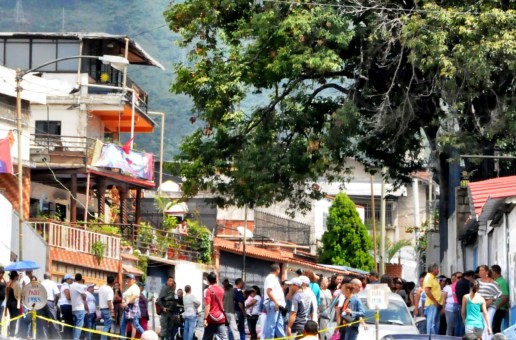
As is customary on election days, I went around the city first thing in the morning. It was not as successful as other times, First, I was alone, so driving and taking pictures at the same time made it difficult. But the biggest  problem is a new custom to block a few streets surrounding the electoral centers. It used to be one block, but somehow this time around they extended it to three or four blocks. This makes it difficult for older people to get to the voting center and more so for the handicapped. I tried to get close to voting centers in Catia and downtown, but it was difficult, no place to park and pictures from afar. This one was about as close as I got to small centers:

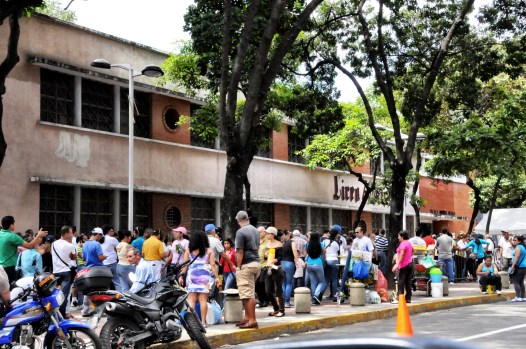
All places I saw had huge lines, in Liceo Gustavo Herrera, the line went out to the street and then all the way back to the Sambil shopping center, about five to six blocks. At Liceo Andres Bello, this is a small subset of the lines I saw:

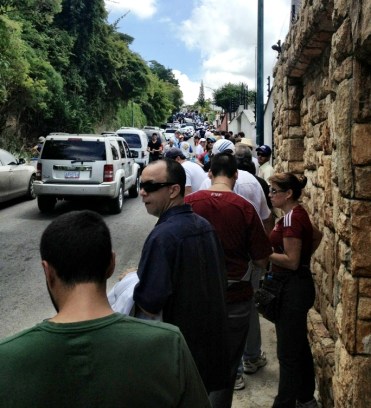
A good friend sent a picture of the line ahead of her, as you can see there seems to be no end to it:

The biggest problem seems to be with null votes occurring whenever the voter fails to wait for the full picture of the candidate to appear on the screen after selecting it in the touch sensitive pad. Apparently, if the full picture has not appeared and you press select, the vote is null and you can not go back. This is creating problems for both sides as both campaign spokesmen have warned voters on TV about this glitch in the “best voting system in the world” (Message for Jimmy and Jennifer). Another problem is the “information point” at the beginning where you are checked to see if you vote in that center. After that, theer are no lines. Supposedly the only function of that position is to know how many voters have voted.

The only dissonant note was that of the Minister of Defense who came on TV and talked about “intelligence” reports which suggest that “armed irregular groups” were planning to disrupt the process in the afternoon and began warning them that they would not be allowed to act and the Armed Forces were ready to stop them. With such calm and peace in the process this was unnecessary.

Oh yeah, three voters swallowed their ballots after casting their votes and they were jailed. No kidding!!!

Chávez has yet to vote, with reporters waiting at his voting center since early morning. They initially said it was customary for Chávez to vote between 10 and 11 AM, but it is now 12:30 PM and he has not voted.

The weather has been mild so far. Caracas had a bright morning but clouds are beginning to show up and the rains are likely to come in the afternoon. The Devil has not voted, I saw long lines were I vote, will go in a little bit.

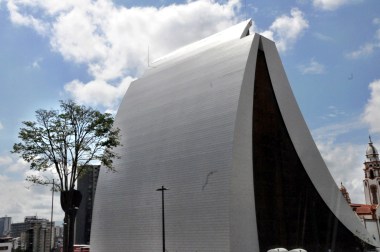
While I was downtown, I got trapped in the maze of streets that were closed, spinning around over and over looking for a way out. I was not alone, there was lots of traffic in this sort of infinite loop. So, I did some tourism. I had not seen the new (and ugly) Simon Bolivar mausoleum:

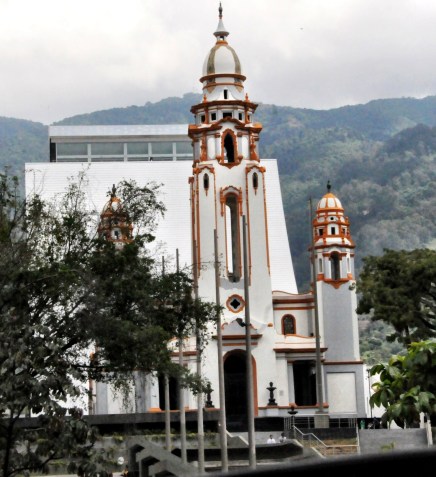
which you can see is next to the Panteon Nacinal where Bolivar is buried and which did look nice and clean:

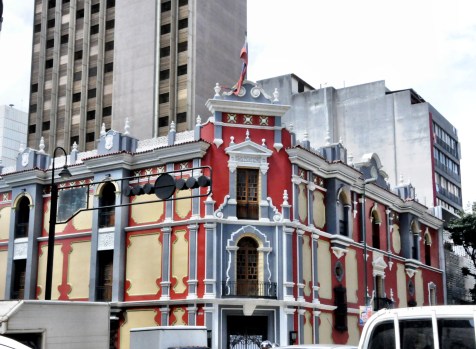
so did this building in Avenida Urdaneta, I am not sure the colors are the original ones, but it looked nice:

and I certainly liked this mural in a corner on the wall of a house in a barrio near La Pastora, very colorful:

As I was trying to get out of the maze of the traffic, I realized I was very low on gas, like really low, I managed to get out and by sheer luck there was a gas station, but they only had low octane gasoline. I purchased 10 liters of the lower 91 octane stuff, just to make sure I would get home. I paid all of Bs. 0.70 for this,  16 cents US$ at the official rate of exchange, around 6 cents at the rate you can’t talk about.