Archive for the 'Venezuela' Category

Of conspiracies and superficiality

July 12, 2004

Yesterday in his Sunday address President Hugo Chávez, besides suggesting that English was the language of the devil, made the accusation that the program presented by the opposition called “Consensus Pais” (Consensus Country) was financed by Bush’s Government’s via the National Endowment for Democracy to the tune of US$ 316,000


The error in the accusation is that the project that received the financing is a project that has been around for quite a while called “Construyendo Consenso” (Building Consensus) which has been carried out by CEDICE the Center for the diffusion of economic knowledge since 2002. In CEDICE’s website you can find the description of the project which is not exactly an economic plan, but a project to aid the private sector in responding to Government initiatives and assist Government officials and organizations in initiatives that promote a market economy:


Consensus Building: Private Sector Formulation of Public Policy
In order to provide the directors and officers of the chambers and associations affiliated to the top entrepreneurial entity with theoretical practical support for the development of strategies and effective techniques of responses to proposals of public policies made by other sectors, and for the making of own proposals, and assist legislators, governors and other organizations in the proposal and approval of laws and rules promoting the market economy in a democratic society. This program is supported by the International Center for the Private Enterprise (CIPE).
Many have been implemented so far; Seminars, Cost/Benefit Analysis and/or Proposals on the Organic Law of Agricultural Development and Feeding Security, Social Security (package of Laws), Telecommunications Bill and rules of the main municipalities in tax matters, Bulletin on Legislative Trends, for analysis of national parliamentary activity.


What probably confused the self-confessed “discoverers” of this financing Eva Golinger and Jeremy Bigfoot is that Diego Urbaneja, who participates in CEDICE as a representative from the Coordinadora Democrática, was the Coordinator for the opposition plan and was likely behind the use of the word “Consensus” in the title. As far as I can tell, that word and the overlap in some people that participated in CEDICE’s project and the proposal by the opposition. Urbaneja said the same today to the press. That the opposition would choose someone who has participated in that project should not be a surprise, after all, it did require a lot of consensus building to reach a consensus for the “Consenso País” project presented by the opposition. That CEDICE would also like to help in a project like that is clear from its mission statement on its webpage:


“To become the most influential institution of economic thinking in the country”


The rest is superficial research and conspiracy building for electoral purposes. The truth is, that the “Consenso Pais” project can not be attacked for its content, because it is simply a list of priorities that everyone, pro and against Chávez would agree with. You can agree or disagree with what are the main priorities or not, but not with the issues and goals themselves. In fact, most of these issues and goals are the same ones that Chávez campaigned on in 1998, but has failed to act effectively in ant of them. Where the two sides certainly do not agree is that CEDICE and the opposition want to promote a free market economy and Chávez and his friends do not. If that is the basis of the conspiracy, then it certainly exists! And the Devil’s Excrement is part of it! And many of its readers too!


Finally, the discussion is silly anyway. Receiving funds from abroad for legal activities is perfectly legal and not as Chavez implies is an act of treason. What was not legal, was for Chavez to receive US$ 1.5 million for his Presidential campaign from a foreign bank and not declare. To this day those funds remain unaccounted for, but the obscene profits of those same banks in these five years, the last year at the official rate of exchange, are there for everyone to see.


What is not legal today either, is for the Government to fund the political campaign to save Hugo Chavez permanence in the Presidency and his administration is spending daily amounts higher than the one for the CEDICE project to promote the “NO” vote in the upcoming recall. But for almighty and unethical Chávez, that is not a relevant issue.

New York Times article on people regsitering to vote in New York

July 11, 2004

Almost missed this article entitled “Moved by Homeland’s political strife, Venezuelans sign up to vote” in the New York Times about Venezuelans registering to vote in New York for the upcoming recall referendum. The article was in the “New York Region” Section of the paper. How about this statement in it by a Consulate “official”:


“The Venezuelan national elections council has not yet decided whether the votes of nonresidents will be counted, according to the consulate’s office.”


This guy is really well informed, no?

The spookiness of 2021……days?

July 10, 2004

Chavez always says that he will leave in 2021, which has no basis in our Constitution. Everyone thinks is 2021 the year, but could it be days? Well, he began his first term on Feb. 2nd. 1999. If he is revoked on August 15th. he will have been in power for exactly 2021 days. Spooky, no?

A real poll

July 10, 2004

Interpret it in anyway you want and however way you want. This week the first round of election to select the new Rector (President) of the Universidad del Zulia (LUZ) was held. There were three candidates, one pro-Government, two anti-Government. The two anti-Government candidates won with 77% of the vote.


It is true that the University does not have the cross section of the population and is not exactly representative; however, this represents a shift of some 28% of the votes from pro-Chavez candidates to anti-Chavez candidates.


Both Professors and students vote in elections for President of public universities in Venezuela. Abstention was low among Professors (30%) and high among students (60%).Universidad de El Zulia had been traditionally controlled by Movimiento al Socialismo (MAS) party, a left leaning political part which supported Chavez in the 1998 and 2001 elections, but has since split form Chavez and is one of the main opposition parties.  With this vote elections in the three largest universities in the country UCV, LUZ and ULA have been won by opposition candidates. Public Universities in Venezuela are anything but right wing or oligarchic, so try to explain this to a pro-Chavez left winger from abroad.

Chavez can run if recalled according to upcoming decisions as leaked by a good source

July 10, 2004

No sooner had I written about whether Chavez could or not run that the President of the Venezuelan Supreme Court Ivan Rincon says today in an interview in El Nacional page A-2 (by subscription) that a decision is already written by the Constitutional Hall which allows Chavez to run., Rincon says that there is nothing that explicitly forbids Chavez from running in the Constitution so it is a very simple case. Thus, the President of the Court leaks the decision even before it is approved.


Well, this is the bizarre logic of this bizarre country. The Constitution explicitly says in Art. 233 that the election after the recall of the mandate will be to elect a “new” President to complete the term of the revoked President. Well, that word “new” to me is pretty clear, Chavez would obviously not be a “new” President to complete his won mandate. But what can I say, what do I know anyway? Clearly, the Court will do what Chavez wants. Except that Chavez can be defeated twice and he will be.


I also find another aspect of Rincon’s interview disturbing. This must be the only country in the world where decisions by the Supreme Court are known, announced and in some cases, distributed via the Internet days and weeks before the decisions are made. You would think that these guys would at least attempt to maintain an image of propriety, but I guess their ethics and principles have deteriorated so much that they do not even think there may be something wrong with what they are doing.


For completeness, since I am talking about the Venezuelan Supreme Court, this week the Court pensioned off three of its members, all anti-Chavez and they were replaced by all pro-Chavez Justices who were alternates of the Court. In this manner and with a single stroke, the Government now has a majority in the Court and all of the Halls but the Civil Hall, the less political one. This simple act, makes the new Supreme Court bill unnecessary, so don’t be surprised if all of a sudden the Constitutional Hall rules that the bill as approved by the National Assembly is unconstitutional. Amazing that they did not think of this clever subterfuge earlier. I am sure that whoever thought of it will be handsomely rewarded.

Aug. 15th.: Just another step?

July 10, 2004

I have been saying that people have built up their expectations too high about the meaning of the recall referendum on Aug. 15th. Some think August 15th. is a magic date: We vote, wait for the outcome, game over either way and that’s it. Well, it is and it isn’t.


If Chavez wins, for those like me that do not like Chavez and what he stands for, it means he will have two more years to control more and more of the state and do more damage to the economy. But if he loses, it will only be another step in a long road to get rid of him, but it may not be the final step. This point was proven yesterday; when Chavez himself said in Argentina that if he loses on Aug. 15th. he will run again thirty days later to replace himself and complete his term.


To me Chavez revealed his strategy in this statement. He will risk the recall because he thinks he can win or lose by so little that he could beat any candidate or candidates in an election thirty days later. Maybe he can. I actually believe his strategy will be to finance a third candidate that may distract 8-10% of the opposition vote, allowing him to win.  The only question is whether he can find such a figure, whether the opposition voters will be confused or not, and finally, and more importantly, whether Chavez will lose or not by less than 8-10% in the recall vote.


There is still confusion as to whether Chavez can or not run again if he is recalled. Some lawyers say the decision on June 15th. is not clear enough. I guess that is why I am not a lawyer, because it seems fairly clear to me.


Let’s examine it:


First the decision contains Art. 233 of the Constitution with the part that the recall is an absolute absence emphasized in black letters. Immediately after quoting Art. 233, it says:


“According to the regulation thus transcribed, the recall of the mandate given to the President of the Republic, according to the mechanism contemplated in Art. 72 of the Constitution would generate the absolute absence of the official, which will be filled according to….”


Then it looks at the mechanisms and concludes (I will insert in Spanish and English so that there are no nuances in the translation):


“Visto lo anterior, esta Sala observa que la revocatoria popular del mandato del Presidente de la República, de conformidad con los artículos 72 y 233 de la Constitución de la República Bolivariana de Venezuela, acarrea su falta absoluta en el cargo y, por ende, su separación definitiva del mismo por el período correspondiente.”


Which I would translate as:


“Given the above, this Hall observes that the popular recall of the mandate of the President of the Republic, according to articles 72 and 233 of the Constitution of the Bolivarian Republic of Venezuela, implies the absolute absence in the position and thus, the definitive separation of the official for the corresponding period”


After this, the decision does clarify that Chavez may run in 2006 and is not explicitly restricted from doing so like Deputies to the National Assembly.


I would appreciate any “legal eagle” readers that can clarify where the confusion is still present since to me the phrase “definitive separation of the official for the corresponding period” seems quiet definitive, no?


In the end, this will not be cleared up before the recall and the response by the Coordinadora Democratica by Pompeyo Marquez is the correct one. Marquez simply replied that if Chavez runs, he would have to be defeated twice. That’s good, don’t make an issue of whether he can or not run, let the Court decide whenever it does and just tell him he will be defeated. If the SI vote wins in August 15th. by a nice margin, it will probably be temerary for Chavez to risk running again so soon after a bad defeat.

Shameless Propaganda…

July 8, 2004

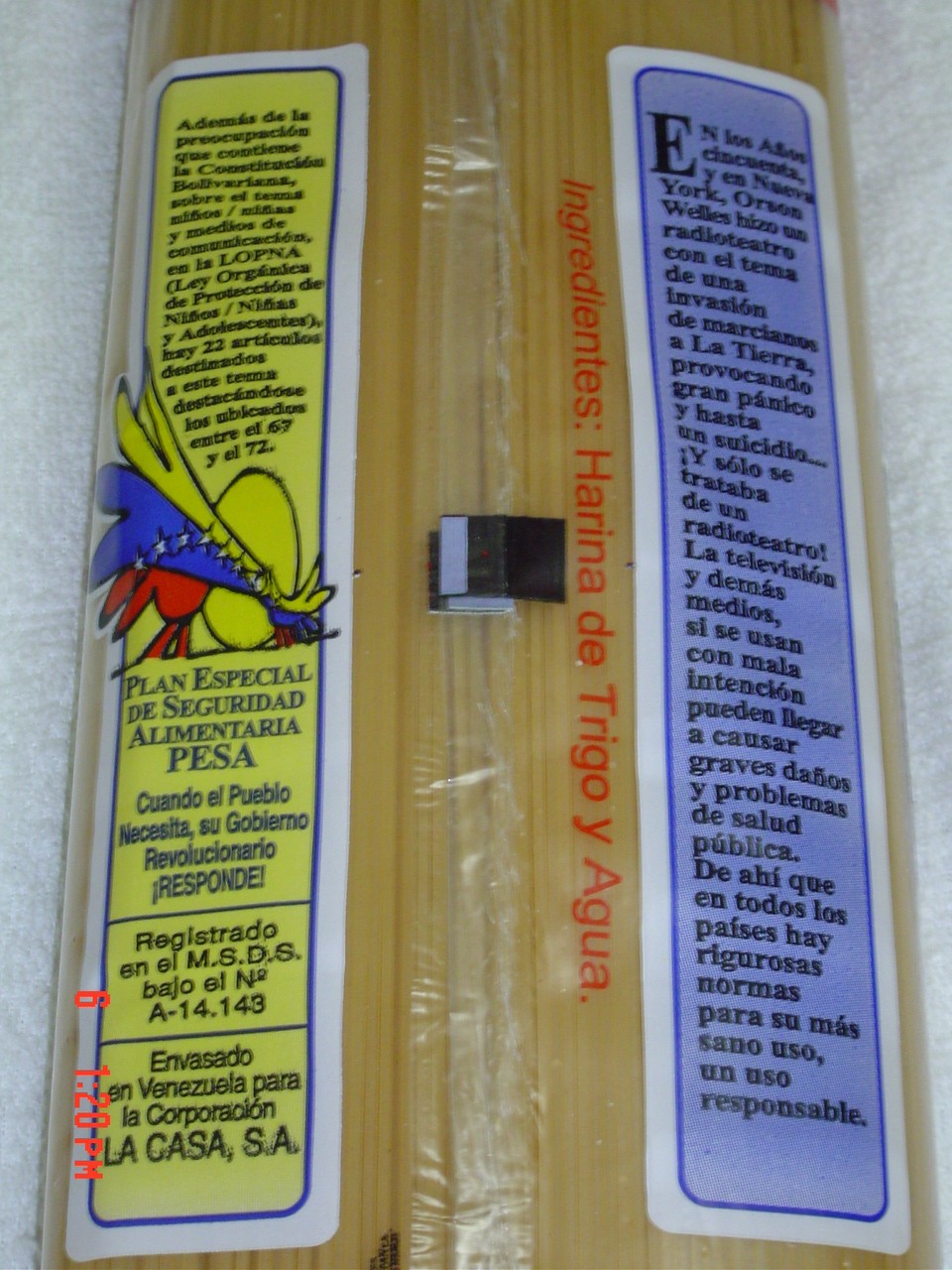
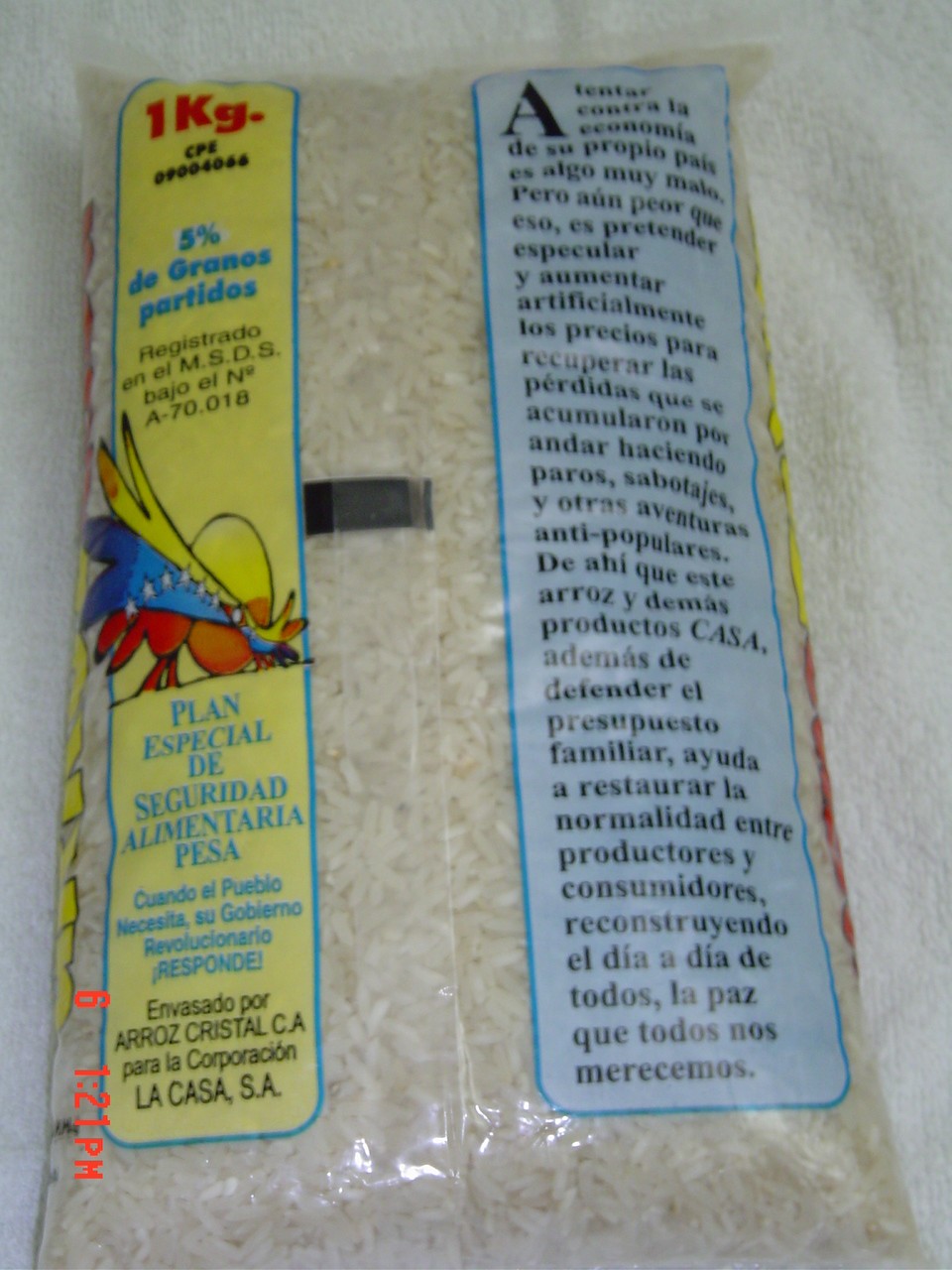
Urru.org has taken the trouble of putting up pictures of the packages of foodstuffs sold at the Mercal markets where the Government sells products for the masses cheaper than at supermarkets. Of course, prices are only slightly cheaper than supermarkets, despite the fact that they have a subsidy, they pay no customs and military workers move a lot of the stuff around. So, somebody is making a nice piece of change from (or for?) the revolution, which I can’t prove. But piggy backing on the Government’s funding are these pieces of revolutionary propaganda are these texts which I find appalling:


On the pasta package: “In the fifties, in New York, Orson Welles made a radio theater with the theme of a Martian invasion to Earth, provoking great panic and even a suicide…Amd it was only radio theater!. TV and all of the other media, if used with bad intentions may cause grave damage and public health problems. That is why all countries have rigorous regulations for its healthiest use, a responsible step.”


On the rice package: “Attacking your own economy is bad. But it is worse to pretend to speculate and increase prices artificially to recover losses that were incurred during strikes and boycotts and other non-popular adventures. That is why this rice and other products from CASA besides defending the family budget, help restore normalcy among producers and consumers, rebuilding the day by day for all of us and the peace that we all deserve”


What’s next, Chavez the benevolent explaining why the opposition cheated in the recall petition?


Shameless…

Chavez shows he is unethical and sneaky (vivo)

July 7, 2004

It was truly sickening to watch how Chavez manipulated the celebration of Independence Day to gain political advantage. During the customary July 5th. parade, Chavez had the military reenact the Battle of Santa Ines, his rallying cry for the upcoming recall referendum. The battle of Santa Ines is not celebrated on July 5th. It was another “viveza” (sneakiness) by Chavez. We will se a lot of this in the upcoming weeks as Chavez violates the rules for the campaign. Yesterday, all of the TV stations were forced (chained in Spanish) to carry out the parade, Chavez could not pass this up, to take advantage of his power as President for political gain. But Petkoff said it better than I can in this section of his Editorial in today’s’ Tal Cual:


“The 5th. of July has no political color, it identifies all of us, Chavistas and antichavistas, as Venezuelans. When the armed forces march on this day, they do it for all of us, they represent all of us.


Yesterday, the grotesque reenactment of the Battle of Santa Ines in the middle of the parade, the presence of hundred of activists with red t-shirts on the military vehicles, the logo “NO” on one of them configured a very pitiful moment in the history of the country’s armed forces. The most sacred date was adulterated, violated by Chávez using it in the framework of electoral campaigning. Yesterday the Armed Forces were made to look like the army of a party. It was used as a tool of division, of provocation and insult towards a large segment of the population. Rangel had warned us:” All of the weight of the state will be launched towards the electoral campaign”. Well, yesterday the launched the armed forces into that tournament.”

Recalling the not so easy and tortous path to the recall referendum

July 6, 2004

Argelia Rios in today El Universal echoes the Vice-President’s words a few days ago that “the opposition will kick the table before August 15th.” This is not the first time the Vice-President has made the prophecy that the opposition will step outside the democratic path, in fact, ever since the signing of the agreement to find a solution to the Venezuelan crisis, Rangel has repeatedly predicted it, to no avail. In fact, what I found most interesting about Rios’ article was the summary of obstacles that the opposition has had to overcome to get to the recall referendum, which I thought was worth reproducing here in condensed version and in my own words:


-The previous Electoral Board was precluded from considering any requests for referenda by the Supreme Court.


-The Chavez controlled National Assembly delayed naming the Electoral Board. In fact, it never did.


-The selection of an Electoral Board which supposedly had two members for each side and Carrasquero as the “equilibrium” card. What a joke!


-The decision by the CNE to take over the petition process for the recall referendum, converting it into an electoral process in itself.


-Regulating the petition process to make it complicated, arbitrary and difficult.


-Barring the right to sign the petition by Venezuelans abroad.


-Limiting the role of international observers.


-Forcing the use of currency paper to gather signatures for security purposes, despite which the Government claimed fraud.


-There were “errors” committed in training the witnesses for the petition drive.


-The number of days for the petition drive were arbitrarily limited to four.


-The interpretation of the regulations for the signatures which allowed with one stroke the invalidation of 350,000 signatures, suing a surreal catalogue of “causes”.


-The elimination of 800,000 signatures, which forced a new “ratification” process for those signatures that had the same calligraphy.


-The inequality in the application of the regulations between the process to gather signatures to recall Chavez and those to recall Deputies.


Then came the ratification in which we witnessed:


-Regulations were issued to guarantee that it would be impossible to have the opposition ratify the signatures.


-The database was manipulated.


The Electoral Registry was manipulated to guarantee that thousands of people would not be able to ratify their signatures.


-The new interpretation that people could withdraw their signatures because they changed their minds, but those that wanted their signatures added could not.


-The complex design of the forms and the process.


And now we face:


-A new automatic process using a new company, in a process that has a simple Yes and No vote which hardly justifies using machines.


-All contracts have been assigned in discretionary fashion by the CNE, which is controlled by the Government.


-Now, machines to capture fingerprints are purchased six weeks before the process with the sudden “rumor” that this will make the vote not secret.


-The pretension of converting international observers into deaf mutes.


-The existence of a parallel CNE where the three pro-Chavez Directors meet and show up to the meeting with the two other Directors with everything decide according to the wishes of the maximum leaders of the process.


-The sudden need to have new polling centers.


-The sudden rush to hand out national ID cards and have foreigners become citizens.


-The obstacles placed on Venezuelans abroad to register to vote.


-The sudden pensioning off or leaves granted top dozens of CNE workers with expertise.


-The inability to fulfill the schedule which threatens the date for the recall vote.


-The rejection of the live audit of the electronic and paper votes.


And I add


-The sudden departure of two CNE Directors for two days to attend propaganda events organized by the Government in the US, in which the two CNE Directors talked about the balanced and fair job they have done. Why didn’t they invite the non-Chavista members of the CNE? Too afraid of the truth?.


After all this, what does Rangel have in mind to push the opposition into refusing to continue the process? You have to wonder and worry.

Recalling the not so easy and tortous path to the recall referendum

July 6, 2004

Argelia Rios in today El Universal echoes the Vice-President’s words a few days ago that “the opposition will kick the table before August 15th.” This is not the first time the Vice-President has made the prophecy that the opposition will step outside the democratic path, in fact, ever since the signing of the agreement to find a solution to the Venezuelan crisis, Rangel has repeatedly predicted it, to no avail. In fact, what I found most interesting about Rios’ article was the summary of obstacles that the opposition has had to overcome to get to the recall referendum, which I thought was worth reproducing here in condensed version and in my own words:


-The previous Electoral Board was precluded from considering any requests for referenda by the Supreme Court.


-The Chavez controlled National Assembly delayed naming the Electoral Board. In fact, it never did.


-The selection of an Electoral Board which supposedly had two members for each side and Carrasquero as the “equilibrium” card. What a joke!


-The decision by the CNE to take over the petition process for the recall referendum, converting it into an electoral process in itself.


-Regulating the petition process to make it complicated, arbitrary and difficult.


-Barring the right to sign the petition by Venezuelans abroad.


-Limiting the role of international observers.


-Forcing the use of currency paper to gather signatures for security purposes, despite which the Government claimed fraud.


-There were “errors” committed in training the witnesses for the petition drive.


-The number of days for the petition drive were arbitrarily limited to four.


-The interpretation of the regulations for the signatures which allowed with one stroke the invalidation of 350,000 signatures, suing a surreal catalogue of “causes”.


-The elimination of 800,000 signatures, which forced a new “ratification” process for those signatures that had the same calligraphy.


-The inequality in the application of the regulations between the process to gather signatures to recall Chavez and those to recall Deputies.


Then came the ratification in which we witnessed:


-Regulations were issued to guarantee that it would be impossible to have the opposition ratify the signatures.


-The database was manipulated.


The Electoral Registry was manipulated to guarantee that thousands of people would not be able to ratify their signatures.


-The new interpretation that people could withdraw their signatures because they changed their minds, but those that wanted their signatures added could not.


-The complex design of the forms and the process.


And now we face:


-A new automatic process using a new company, in a process that has a simple Yes and No vote which hardly justifies using machines.


-All contracts have been assigned in discretionary fashion by the CNE, which is controlled by the Government.


-Now, machines to capture fingerprints are purchased six weeks before the process with the sudden “rumor” that this will make the vote not secret.


-The pretension of converting international observers into deaf mutes.


-The existence of a parallel CNE where the three pro-Chavez Directors meet and show up to the meeting with the two other Directors with everything decide according to the wishes of the maximum leaders of the process.


-The sudden need to have new polling centers.


-The sudden rush to hand out national ID cards and have foreigners become citizens.


-The obstacles placed on Venezuelans abroad to register to vote.


-The sudden pensioning off or leaves granted top dozens of CNE workers with expertise.


-The inability to fulfill the schedule which threatens the date for the recall vote.


-The rejection of the live audit of the electronic and paper votes.


And I add


-The sudden departure of two CNE Directors for two days to attend propaganda events organized by the Government in the US, in which the two CNE Directors talked about the balanced and fair job they have done. Why didn’t they invite the non-Chavista members of the CNE? Too afraid of the truth?.


After all this, what does Rangel have in mind to push the opposition into refusing to continue the process? You have to wonder and worry.