Archive for the 'Venezuela' Category

The strange case of Joaquin Perez Becerra, the Man Chavez Personally Extradited to Colombia

May 4, 2011

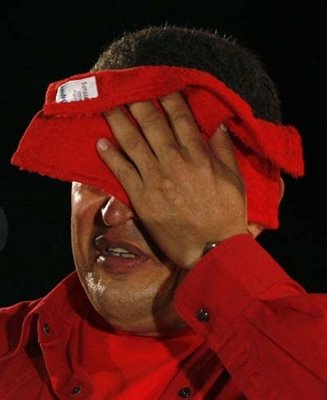
(Perez Becerra, right, wearing his reporters uniform)

I find the case of Joaquin Perez Becerra truly fascinating. Seldom have we seen pro-Chavez groups so incensed over an act by their hero and the contradictions on the case are truly fascinating.

Perez Becerra has been involved with the FARC for thirty years. He is now a reporter involved with Annacol, who has been living in Sweden since 1993, where he was accepted as a refugee and later acquired the Swedish nationality. When Rodrigo Granda, the Foreign Minister of the FARC,  is captured in Venezuela in 2004, Perez Becerra took over many of his roles, as was later discovered when Raul Reyes’ computers were captured.

Apparently Perez Becerra was coming to an emergency meeting of the FARC leadership and Colombian intelligence warned Venezuelan authorities of his arrival from Frankfurt. Later, the President of Colombia Juan Manuel Santos said that he had asked Chavez to capture Becerra, who was flying under an alias. using that magic (or is it Makled-magic?) leverage that Santos seems to have over Chavez lately, was captured as he arrived in Venezuela and faster than you can say Joaquin Perez Becerra, was deported to Colombia, without formal procedures. Even worse, his dual nationality made it questionable whether he could or should be readily extradited to the country where he was being persecuted, which allowed him to qualify in Sweden as a political refugee which led to his new nationality.

Remarkably, Venezuela’s Communist Party and 35 other organizations revealed that Perez Becerra had been a frequent visitor to Venezuela in the past two or three years, denouncing the illegality of Chavez’ action and even leading to street protests over the issue. (Jeez, where have they been all these years!)

Even worse, a Representative from Chavez’ political party PSUV, questions the motivation of the Communist Party, some leaders of which actually suggested that Venezuela can no longer be a safe harbor for revolutionaries. Nice going guys!

Chavez, as usual, assumed his “Yo no fui” attitude (Who, me?) saying that this was Perez Becerra’s fault, knowing that there was a “red alert” warrant for his arrest. Hugo, could it be because he was doing this routinely before you found your “best new friend” Santos? (BTW Hugo, is it true, as reported, that Perez Becerra had a Venezuelan natioanal ID card?)

By now, lots of groups are mad at Hugo. Articles not only in Aporrea, recriminating Hugo for his decision, but even Chavez’ pet project Telesur published an opinion article on the topic.

Sweden demanded an explanation and while Chavez was calling Perez Becerra as being only “accused”, the extreme left parties referred to him as a “journalist”.

Even the FARC complained to Chavez over the extradition.

The problems seems to be that Perez Becerra is associated with the Colombian communist party and is not a Bolivarian figure, thus Communist members have been instructed to complain and explain how Hugo could have been caught doing this, how he was trapped, how he had no choice.

Yadda Yadda Yadda

Hugo does whatever he pleases and right now, Juan Manuel is the man! Santos asks, Hugo complies…

But no Makled yet…go figure

Chavez’ Extra Pocket Money From New Decree

April 25, 2011

In the previous post, I said that the new decree issued by the Government would give Chavez about US$ 11 billion in extra pocket money, but I failed to take into account the fact that he was already harvesting some of the money, since there was a previous decree that gave Fonden 50% of all the revenues above $70 per barrel when oil is below $100, plus 60% of the amount in excess of $100, when oil goes above $100.

Below a graph:

in which I show on the left the difference between the old “tax” (Red Line) and the new “tax” (purple line), with scale on the left. These are dollars for each barrel of oil that go directly to Fonden.

Using the scale on the right, the green line then shows the extra revenues the Government will receive from this new “tax”, assuming exports of 1.6 million barrels of oil a day, where I mean the new extra money, not what the Government was receiving before. Thus, around US$ 105 per barrel it is about half a billion US$, half of what I had calculated. If oil goes to $150, it will be almost US$ 23 billion.

I also note that according to Carlos Vecchio, the new decree does not follow the Enabling Bill and violates the Constitution. Chavez would have had to create specific fund in order for this to be legal.

Hugo Chavez Issues Illegal Decree To Increase Discretionary Funds

April 22, 2011

Taking advantage that the whole country was on vacation on Thursday, Hugo Chavez piled one illegality over the other to issue a decree to increase the availability of discretionary funds for his spending. The illegal decree creates a special contribution by PDVSA which will go directly to the development fund, whenever oil prices are very high like they are now.

According to the decree,when oil prices are above US$ 70 per barrel, but less than US$ 90, 80% of that difference will go directly to the fund. If prices are between US$ 90 and US$ 100, this will be 90% and if prices are, like they are today, above US$ 100, 95% of the excess will go directly to the Development Fund. This fund is a discretionary fund which is managed with little or no transparency according to the President’s whims and wishes.

The decree is doubly illegal, since it is based on the illegal Enabling Bill granted Chavez in the dying hours of the old National Assembly, which gave the President the power to legislate beyond the term of the Deputies that approved and in violation of the legal mandate the people had given the new Deputies of the National Assembly in September. Chavez would not have had the required 2/3 majority in the new Assembly to obtain these powers.

But to add one illegality on top of the other, the Enabling Powers were given to Chavez to deal with the housing emergency, thus, creating this special contribution to a general fund which is managed with little transparency can not be legal even if the Enabling Bill were legal. But Hugo never cared for such details before.The only way the decree would be legal would be if the funds went directly to deal with the housing crisis, which will not be the case under its structure.

According to Chavez this decree insures that more of the money goes “directly to the people”, but in reality they go more directly to him and his ability to use funds without control, supervision and under his total discretion. Chavez called oil prices exorbitant, which is somewhat ironic given that he has always said that US$ 100 was the fair price for a barrel of oil,

The decree will add to the lack of transparency in the country’s numbers. The current mystery is why international reserves have dropped in 2011 with oil prices increasing significantly when compared to last year. Outflows via the foreign exchange control office CADIVI have increased only marginally, suggesting that PDVSA is either paying supliers, not handing over as much foreign currency to the Venezuelan Central Bank or giving it directly to the development fund Fonden. Such lack of transparency is a partial explanation for the country and PDVSA’s bonds enjoying such a risk premium, as Hugo Chavez continues to manage the country’s finances at will and without much control from other institutions.

Venezuela and Venezuelans lose in the end, as this misdirects funds and keeps straining PDVSA’s cash flow. If you believe oil exports are at 1.6 million barrels a day and assume oil prices will average from here till the end of the year $105 per barrel, this will give the development fund some US$ 11.5 billion for Hugo to spend at will.

Video: Chavez Admitting He Told Lucas Rincon He Would Resign In April 2002

April 16, 2011

This little known video from April 15th. 2002 shows how much the truth was distorted. In it Chavez says he told Lucas Rincon “I have accepted abandoning the position(of President) if conditions are met…”

So, he was resigning, the conditions were met, nobody was harmed or hurt…

Changing history is Chavez’ main expertise…

Inadequate Management Everywhere Under Chavismo

April 15, 2011


Imagine you owned a bank or were a shareholder of it or had deposits in it and the Federal Reserve Bank said of your bank:

“Your Bank and its Agencies have to cease and desist from its unsafe and unsound banking practices in the United States, including, among other practices, operating for an extended period with negative or insufficient capital, failing to have adequate management at the Agencies, failing to exercise adequate risk management at the Agencies, and failing to adequately oversee the Agencies”

Doesn’t that sound like the bank from Hell?

On top of that, the Federal Reserve gieve,s you a fine of US$ 1.8 million dollars as established by law and further orders that Your Bank not accept any deposits or give out any loans until you fix all of the above.

Moreover, the Federal Reserve gives Your Bank 180 day to provide audited financial statements by a reputable international firm.

What would you think? How would you feel?

Well, this is exactly what happened today to the US branch of Banco Industrial de Venezuela, the Government-owned and run bank that has gone bankrupt twice during the Chavez administration and was intervened by its owner, the Government, in 2008.

Funny, those that did this, friends of the robolution, are not in jail.

Chavista management at its best?

Nice, no?

Good, Bad and Old in Venezuela: Things that make you go Ughh?

April 4, 2011

-The Venezuelan Supreme Court accepted the request to give priority to the case of Bolibourgeois banker Ricardo Fernandez Barruecos at the request of the Prosecutor.

Funny how all these cases close to Hugo get priority…

-Good News, Bad News: There will be no water rationing

but we want to make sure we have them sometime in the future

-According to El Nacional, the shortages of diapers and sanitary napkins persists, which means is only good to be a young man in Venezuela these days…

Bad News, Good News: The Bad: Chavez leads in a poll…

The Good: Jesse Chacon leads the pollster…

-Carlos Escarra was almost deported from the US for refusing to remove his shoes, which he claimed violated his human rights…

Why does he insist in going to the US to have his rights violated when it is so easy to have it happen here in his own backyard? Was he shopping again?

-Bad News, Bad news: Walter Molano, never a fan of the revolution:

“Subordination of bondholders by the Chinese loans-for-oil deals are making Ven bonds increasingly risky”

“investing in Venezuelan bonds may be as desperate as Chavez’s quest for a fourth term in office.”

I prefer the risky part to the desperate part…

-Old money versus new money: Deputy Earle Herrera explains that the US$ 10 million to Uruguay is old money, not new money.

Oh, you mean we gave so much to Uruguay when oil was only $50 dollars a barrel and not $100 like now? Was that also the time when we bought 12,000 houses from them? Is Deputy Herrera living in one of the twelve built?

-Is this news?: “Plan against the electric crisis failed

Really? How could it? A Ministry was created, a person with no clue or experience was put in charge of it. As little money as possible was spent. The wrong technology was purchased where investments were made. It rained all year.

Really (again), how could this have happened? Don’t worry, we will force you to use less

-But there is good news, really:

The Government built 200 housing units in Merida, only 1.999.800 to go

The Caracas Stock Exchange was stable today, no index changed in price and all of US$ 55,000 (at the official rate) was traded.

The economy must be ready to really move on…

The Devils Excrement circa 1535

April 3, 2011

Friend @chegoyo, sent me this interesting historical tidbit about what may be the earliest use of the term “Devil’s Manure” in history.

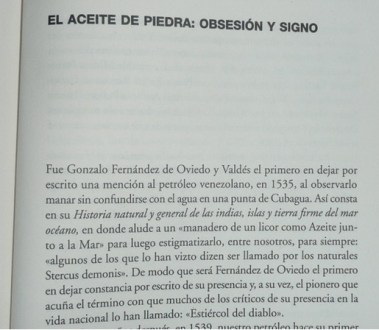
It is a page from “Colony and Republic” of Rafael Arraiz. The Chapter is entitled “Stone Oil: Obssesion and sign” and it says:

“It was Gonazlo Fernandez de Oviedo y Valdes the first one to leave a written mention of Venezuelan oil in 1535, when he say it sprout without mixing with oil in a side of the island of Cubagua. It is written in his “Natural and General History of the Indias and the mainland of the Ocean Sea” in which he talks about a “source of a licquor like oil next to the sea” to later stigmatize it, among us, forever “some who have seen it say the locals call it Stercus Demonis” (Devil’s Manure)Thus, Fernandez de Oviedo was the first one to leave written record of its presence and at the same time, the pioneer that coined the term that many critics of national life have called it “The Devil’s Manure””

There you have it for history and the record, Perez Alfonso popularized the term, but the natives had it down pat earlier on.

Venezuela No Longer to Certify Oil Export and Production Numbers

March 30, 2011

Just when Venezuela needs to send positive signals to world markets, as it intends to sell more and more debt internationally, the Venezuelan Government and PDVSA do exactly the opposite and decide to cancel the contract with the independent auditor Inspectorate that was hired two years ago to try to convince the world that Venezuela’s production and export numbers as reported by OPEC and the IEA are wrong. Both of these institutions have been reporting that Venezuela’s official oil numbers are significantly above those obtained by them from their independent analysis.

Neither PDVSA nor the Ministry of Energy and Oil gave much of an explanation for the cancellation of the contract. The auditing company is closing its offices in Venezuela.

What this will do is create further uncertainties in the country’s numbers which will not aid in reducing the so called credit risk of Venezuela at a time that the country needs to issue more and more debt. This means that issuance of the country’s debt will be more costly that the country’s numbers justify. Last week, Knight Securities suggested that the country’s handling of official news and statistics and the lack of a clear spokesman for the country on financial matters is making it more expensive for the country to issue debt. In a report entitled “The Monk’s exorcism boosts our faith in Venezuela” the company suggests it costs Venezuela 200 to 300 bps because of the way information is managed by Minister Giordani.

In the same report, PDVSA said that exports in February were 16% lower than those in January and this week international reserves at the Venezuelan Central Bank dropped to their lowest level since 2007, despite the Venezuelan oil basket averaging over US$ 100 per barrel last week.

Violence, Games And The Military: Consistency Is Not Chavismo’s Strongest Point

March 28, 2011

Last week, a decree was published making military education mandatory starting in first grade. Under the “Comprehensive Military Education Plan”, kids will learn about defending the coutnry and will be trained for war.

Under this plan, outside the sphere of “military spaces,” Venezuelan children will be trained for war from the start of their formal education, in first grade, until completion of their university education, and that this will be compulsory. And to top it all off, the teachers will be members of Chavez’ paramilitary militia, which have little training beyond how to use weapons.

So, picture first grade and onwards little kids, learning to use weapons and war “strategy” as part of their early brain washing by this militaristic, autocratic, pseud-socialistic Government.

But wait!

Isn’t this the same Government that does not allow these same young kids to purchase and play violent video games, particularly those involving war and weapons? You mean to tell me that these kids are mature enough to train about killing real people, real human beings, with real weapons, but at night they are only suppose to play Pac Man so that their young minds don’t get distorted?

This Bill that bans violent video games actually punishes the manufacturing, distribution, selling, rental, exhibition and use of such video games, giving discretionary as well as punitive power to the authorities. In fact, people regularly have their games confiscated at customs. (I am sure the kids of the custom agents have a nice collection)

So, picture the scene: Hey kid, stop playing that violent war game, go grab your FAL and let’s do some target practice killing enemies of the revolution.

Clearly Chavismo’s ideological consistency is not among its strongest points…If there are any.

Venezuelan Inflation: Structural or Self-Generated?

March 23, 2011

We were told by Minister of Planning and Finance Giordani, who has been in this Government over ten of the last twelve years, that Venezuela’s inflation problem was “structural” and in the never changing strategy of blaming the “previous” Government for everything, he accused the IVth. Republic of this problem. I guess twelve years is not enough in his mind to solve this problem, ignoring the fact that in those twelve years, the most insidious influence on inflation, that of the world, almost magically vanished, with most countries not only having single digit CPI’s, but many in the low single digits.

As a famous true and real economist said, inflation is simply a monetary phenomenon. Such a simple concept that is so poorly understood in inflationary and populism-ruled countries like ours. You see, if this were not true, Governments could just spend and make everyone rich. Life would be as simple as Chavez and Giordani want it to be.

But money does not imply wealth. Money is how we exchange things. We went from barter to money, to create a neutral way of transacting. In the beginning of commerce, you had one good and exchanged it for another or for a service. Too many mangoes on the trees and nobody wanted to give you anything for a mango, too much supply. By the end of mango season, you could probably get a lot for it, not enough supply and probably some demand.

But I digress…

If the Government “creates” too much money, without the underlying productivity or supply of goods and services increasing, the money will lose value, there will be inflation and it will be worth less. So, that is what Central bBank’s are supposed to do, try to fine tune the amount of money to balance it out with the supply of goods and services.

Thus, if you want to see why there is inflation, you have to look first at monetary liquidity, the so called M2, which measures all of the money available out in an economy. This number is supposed to be made public weekly by the Venezuelan Central Bank under “Agregados Monetarios” here. Lately, there is some delay to have this number published, but more ominously we no longer see its components, it has been over a year since we can see what is increasing faster in all the parts of M2. I will not bore you with the technicalities.

When you look at M2 since Hugo Chavez became President, the picture is quite scary at first and at second sight, as seen in the plot below:

As you can see, since Chavez became President and Giordani Minister of Planning (He has been in the Board of the Central Bank ever since he was named the first time in 2001 or 2002) M2 has gone from Bs. 8.9 billion to Bs. 302 billion. That is an increase of a factor of 33! Or there is 3,200% more money floating around in the Venezuelan economy, than there was when Chavez became President. (This is all Bolivares Fuertes BTW)

Clearly, someone has not been doing their fine tuning job and to call it a “structural” problem is cynical at best and as we will see, simply an outright lie.

Because in the graph above you can see that for at least the first three or four years of the Chavez Government, the growth in M2 was slower than it became at around 2003-2004.

But when a number changes so much in time and at such different rates, it is better to change the scale of M2 to a logarithmic scale. Why? Because with a log scale, all changes of say a factor of ten are the same. If a variable goes up from 1 to 10, it will look the same as when it goes from ten to one hundred, a ten fold increase. The changes look the same, not like in the above curve, where the change from Bs. 10 billion to Bs. 100 billion can barely be discerned and it is the largest and fastest in the plot.

In a logarithmic scale, M2 looks like this:

You can see in the above graph that there are three very different periods in this plot. First, there is one slope from 1998 to 2002, then from 2002 to about 2007, M2 grows much faster and then it slows down to something that looks more like the first stage, even if with a higher slope.

Basically, in the first stage M2 increased by about 66% in four years, in the second one, it increased by about 666% in five years and in the latest one, it has increased by 162% in four years.

These are really bad, awful numbers, simply because the Venezuelan economy has not grown at a comparable rate during any of this periods. In fact, the increase in M2 during the first four years is larger than the growth of the economy in all of the twelve years of Hugo Chavez. Certainly this means that inflation is induced by this mismanagement of monetary liquidity, there is simply too much money chasing basically the same goods.

There is nothing structural about this, it is structurally unstable to allow M2 to grow this way, except there are elections, of course.

Even worse, all of this money has almost the same backing in foreign currency than it did in 1998. In 1998, when Chavez came to power, there were almost US$ 18 billion in international reserves, today there are US$ 26 billion, barely a 44% increase when the number of Bolivars has changed by a factor of 3200%. This says that when Chavez got to power, there was a half a Bolivar per US$ in reserves (roughly), while today there are eleven Bs. for each dollar in international reserves. Oh yeah! Modern economists believe in “fiat currencies” . But that concept stops working in the face of such irresponsible economic policies. People stop believing in the “fiat” part, they tell their Governments: “Show me the money!” In Venezuela, there has been little “fiat” since 1982.

And the reason reserves are so low, is that some Chavista economists created the concept of “excess reserves”, allowing Chavez to withdraw every year some billions of dollars so that he can spend this as petty cash and without control. We are talking about US$ 64 billion so far removed from reserves. If they were at the Central Bank, inflation would be lower as that bank would have a cushion to control M2, imports, capital flight, etc. as needed. To date, it has so little room for maneuver, so much that it even carries those US$64 billion in its balance sheet (most of them have been spent!), to avoid showing that it is bankrupt. But that is another story.

Finally, if you look at month to month yearly inflation, you can see why the “structural” argument holds no water:
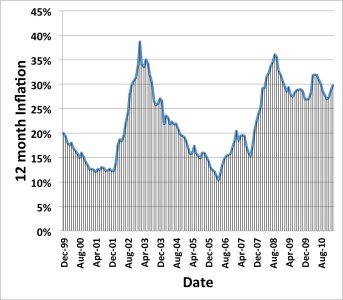
Between when Chavez took over and Dec. 2001, twelve month inflation was actually going down! This happened for two reasons: M2 was being controlled and extra income from oil was being saved in the Economic Stabilization Fund (FIEM). But then, oil went down, and none other than Jorge Giordani decided it was time to use the FIEM, which was drawn down very fast. So fast, that in February 2002, Chavez had to allow the “devaluation” of the currency, which up to that point was only allowed to trade within some bands set by the Government. It was a “light” form of exchange controls, and as expected, it failed to work.

After that, the one to one correspondence between inflation in time and M2 breaks down because of exchange and price controls. Initially, M2 was allowed to increase like crazy, all those bolivars were chasing dollars and inflation jumped up as the currency and devaluation expectations devalued sharply the currency in a country with so many imports. Then in January 2003, the Government began to totally control the exchange rate, introduced price controls, all of which drove inflation down for a while.

Why?

Because at the beginning the Government became very stingy with its dollars, refused to allow price increases and like exchange and price controls everywhere, there is an initial positive effect, but it always breaks down. Markets are like that!

Holding the currency constant delays inflation adjustments. That is why inflation first went down and even as the Government reduced the increase in M2 in 2007, inflation has not gone down, because prices and the exchange rate were held back by artificial controls.

But in 2006, the increase in M2 was so large that all the positive effects of controls disappeared and inflation began to grow. And the Government decided to not allow M2 to increase as fast, but inflation did not go down.

Why?

Because it did not allow for devaluations, holding back the currency, subsidizing everything and eventually, even that became unsustainable. Thus, even though M2 has not increased as fast, inflation is at the same levels because the Government has to adjust prices and the currency periodically when things get really tough.

Now, that is really structural!

It is built into the absurd system of controls that Giordani, who is not an economist, has built around this Government. And as long as the controls are in place, inflation will not go down for the simple reason that there will be periodic devaluations, periodic price adjustments (This week it was wheat and bread) and the risk of higher inflation is probably higher than that of lower inflation.

Thus, it is all self-generated and is becoming structural, but by structures that were not in place twelve years ago. This is not a chicken and an egg problem. Giordani laid the egg and Chavez allowed him to do it and out of it came this weird chicken who nobody can control.

And if nothing is done, which will be the case as long as Giordani is where he is, inflation, the worst tax on the poor, as the cartoon shows, will remain as high as it is today, if not worse.