Archive for the 'Venezuela' Category

Clueless Management Style

November 10, 2009

no-clue-2x

I had heard this story, but did not know the particulars to write about it, but Petkoff in Tal Cual tells all the details in today’s paper:

On October 30th. Hugo Chávez named General José Rafael Guerra Baudett, who is retired, as President of Aluminum company Alucasa, part fo the CVG empire, a company in which the State owns 75% of the shares.

General Guerra was honest and responsible and told Chávez that he knew nothing about Aluminum nor had any experiene in running a company like that. Chávze told him that if he could command 11,000 men in tHe border, how could he be scared of “having” 600 workers in Alucasa.  The General took the job.

There you have it, Chávez’ clueless management style in a nutshell.

And people wonder why things don’t work in Veenzuela…

The true measure of Venezuela’s water and electricity problems

November 8, 2009

donkey

While Hugo Chavez was worrying today about a US invasion, he should ahve really be paying attention to the problems of the country. Because two or three months ago there was little mention of water and electricity problems by him and his Government and all of a sudden they have taken center stage and they represent a sign of things to come.

Because these problems are not isolated, but represent the result of eleven years of mismanagement and incompetence. Take electric problems as an example. When Chavez got to power, there was a plan. Whether good or bad is besides the problem.Two large dams were going to be built. One was finished four years later than expected and the other one is still under construction.

The second is Tocoma, a dam that would have generated 14% of the electric needs of the country. This project is being financed by the IDB, but delays have made the project much more expensive, not only because times is money, but also because fixing the currency at Bs. 2.15 per US$, combined with 30% inflation has made cost simply soar.

At the root of the delays are the constant changes in management of the electric sector. While Rafael Ramirez has been Minister of Energy and Oil since 2003, there has been a string of Generals presiding over Edelca, CADAFE and Corpoelec. Corpoelec was a typical unnecessary step, it was simply a copy of CADAFE, a holding company for all electric companies underneath. But nobody told Chavez about it. And even worse, there were no economies of scale. Corpoelec was created and additional structures were formed. And now we have the Ministry for Electric Power or whatever it is it is called.

And part of the problem for Corpoelec, was that rather than being concerned with planning, funding, financing, investment, it had to worry about all of the companies that Chavez was nationalizing. Who would run them? Who to appoint? And more military was called in, as if that guaranteed anything.

But imagine now the funding problem at the Tococa dam. You get US$ 750 million to build it, but there are delays as General after General goes through the Presidency of Cadafe. The project has two parts, the turbines and equipment that is bought abroad and local costs. Unfortunately. local costs increase by local inflation, so any delays add to the cost of the project like you would not believe. And on top of that, the currency has been held constant for five years.

Take, for example, an engineer in the project. He cost you Bs. 2,150 a month five years ago, but you have given him or her, 25% salary increases every year. Except that those Bs. 2,150 five years ago, were $1,000 from IDB, but now have to be $3,015 from the same source and the project was not completed. And now, despite the huge windfall, Venezuela is going back to much hated IDB to get more. Mismanagement, overvaluation and inflation are coming back to haunt Hugo, but he does not seem to know it.

Because the problem is even more complex than that. While new infrastructure is being delayed, old infrastructure can barely be maintained, because electricity rates across the board have been held constant for seven years. This implies two things: First, electric companies have not kept up their revenues with inflation. This means they have to ask the Government for more or cost costs. You can bet they decided to implement cuts. Second, the few that pay (I count myself among them for both water and electricity) pay so little, that there is little incentive to save (I do collect all rain water to water my orchids). In the end, it is like a vicious circle, every policy is aimed at making sure that the whole system will collapse.

And when I say “everything”, I mean everything. Gas (oline) is being subsidized, it is a huge subsidy, if PDVSA did not have to fund it, it would not have had to issue any debt this year. Chavez nationalized a bunch of companies, including Sidor, which will have losses of US$ 410 million this year. Not only did he have to pay US$ 1.4 billion for it, but the company ahs to come up with the money to finish the year, satisfy unions and the like.

It’s the same everywhere, housing, ditto, health care, ditto, mining, ditto, all mired in a sea of mismanagement, lack of funding and investment and ideological BS that will force a collapse one day.

So, while many of us were expecting the symptoms of the collapse elsewhere (in the financial system), they are sprouting everywhere else, in the real economy for once. Not the usual way things collapse in Venezuela.

But sadly, the truth is that there is nothing, other than the fact that Chavez has increased awareness of the plight of the poor, that has improved in the last eleven years under Hugo. So, rather than worry about an implausible US invasion, he should be paying attention to real problems, from no maternity wards, to no water, to no electricity. Everything is simply malfunctioning and I see no way out, other than a huge spike in oil prices.

The fanatics, the hard core cheerleaders of Chavez and his fake revolution always say that we have been predicting disaster for the last eleven years. They forget that Chavez was forced in February 2002 to allow the currency to float freely and devalue sharply  and that oil prices have saved the day ever since. But water and electricity rationing are the symptoms and not the cause. The crisis has arrived, the water and electricity problems are just an indication, a true measure,  of the country’s problems.  Attacking them today (It’s funny to hear Ramirez talking about increasing electric rates after seven years of neglect) will not solve the problem as long as the economy is mismanaged. Overvaluation, inflation and only worrying about the swap rate are the real problems, while Hugo worries about a US invasion an his 100 year war and blaming the opposition and Colombia  for the problems of his revolution.

What revolution?

Chacumbele electrocutes himself by Teodoro Petkoff

November 6, 2009

20091106_TALC1_1_1_F1

With the electricity crisis Chacumbele is getting a little nutty. When supposedly he wants to get to the bottom of things, he makes absurd decisions,  which can only aggravate the problem.

With the creation of the Ministry of Electricity Chacumbele does not know he has stirred up a hornet’s nest.  Rafael Ramirez, Minister of Petroleum and Energy, got really pissed upon hearing of the matter and, quite beside himself, demanded that the new minister will not be given water. In addition, he mocked Angel Rodriguez (the new Minister) mercilessly.

In the midst of this disaster, the Boards of Edelca and Cadafe have yet to meet with the new Minister and all is on stand by at the headquarters of Cadafe, in El Marqués, where the new ministry will function. Moreover, the military, who thought they had secured the electric area as their hunting ground (in all senses), have been displaced, even if  Chacumbele asked General Hipólito Izquierdo to “stay around”.

Izquierdo has yet to turn over the position to unionist Rodriguez.

In turn, Izquierdo complains about being the victim of “injustice” because both he and Gen. Machado, the former president of Edelca, had warned for years about the catastrophe that was approaching if nothing was done. He says Chacumbele  never paid him any attention. Entre tanto, Su Excelencia, Meanwhile, His Excellency, the reincarnation of Simón Bolívar, each day has a more absurd idea on how to confront the crisis he created.

With forced jokes he wants to minimize the dramatism of the crisis, but what his wisecracks have produced is ill-tempered sulking jokes by a lot of people that voted for him and that have suddenly discovered what an incapable guy the man has turned out to be.

Law and order: What happens when you close the border

November 4, 2009

frontera1

Venezuela’s Electricity and Water supply: Not a pretty picture

November 1, 2009

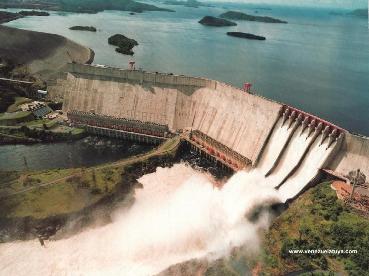
guri3

I have been trying to write about the country’s electricity and water problems for a while, but have not done it because the whole things has so many edges that to describe all of the problems would take a post so long that you would all be bored to death. But in some sense, the problems that have surfaced now, have been around for years and the fact that they have exploded now is simply coincidental. I have not been able to pin down exactly why everything happened all at once. Chavez blames the water problems for El Niño, but while there is evidence that the phenomenon has started, it can not be blamed for what is happening.

Problems with Venezuela’s water and electricity’s supplies are not new. When Chavez came to power, the Caldera Government was thinking of privatizing some of the regional electric power companies for the simple reason that the investments required with oil at around US$ 12 per barrel were beyond the capability of the country’s Government.

Chavez clearly disagreed with this even as he was not using the word socialism at the time. And he stopped the nationalizations, while simultaneously freezing rates for water and electric services. This immediately limited the ability of the water and electricity companies to fund new projects and do maintenance. No new major electric power plants have been built in the 11 years of the Chavez era. Instead smaller plants were built, most of which contribute little to the country’s power grid, because they were built without taking into consideration the ability to connect and transmit the power.

Pictures of Planta Centro, a 2,000 MW plant that s now rated at 430 MW and currently producing only 130 MW have been circulating for a couple of years, but is only now that people are paying attention.

And then there is the incredible story of Venezuela buying power plants from Cuba. These are small plants of up to 40 MW, great for Cuba which does not have the modern interconnected power grid, but not as useful  in Venezuela. Cuba does not make these plants, they buy them from Sweden or Spain and reexport them to Venezuela at an outrageous price of about $1,400 per KW, compared to $500 for a large power plant, unless Venezuela is buying that from Spain. Oh, I forgot, the 300 small power plants purchased from Cuba are currently not operating because of problems with the filters with Venezuela’s diesel.

In the middle, when oil prices were high, Chavez rather than invest money in new power plants went out and nationalized all private power generation companies, spending over US$ 2 billion in buying fully functional electric companies, rather than patching up Planta Centro or Guri.

And according to Caracas Gringo, Guri, Venezuela’s largest hydroelectric power plant is a mess, with seven of its twenty turbines out of service. There are also landslides all around the dam, and the engineers are feeling the heat to bring the turbines on line before they are ready.

One of the problems is that Chavez has named, time after time, retired or active military to lead these electric power companies, all of which had no prior experience in the electricity genration or transmission business. To top it all off, Chavez now creates an additional bureaucracy, creating the Ministry for Electric Power on top of Corpoelec (which Chavez created in 2007), the company which was supposed to consolidate all of the country’s electric power, transmission and generation. However, no cost efficiencies ahve been achieved as each of the regional companies still runs independently, with its own Board and independent structure, including bodyguards and perks for the Executives. And the firts Minister for Electric Power has no experience in the area, as he is a former oil worker who is totally loyal to Chavez and his revolution.

The situation is no different in water, where rates have been frozen in another one of Chavez’ perverse subsidies to the rich (The poor mostly do not pay for their water, if they have it).Which is the reason why Venezuelans use more water than they should, besides the fact that there is a very leaky distribution system due to the lack of investment. (There is an article on the water system in El Nacional’s Siete Dias section today, by subscription).

Take Caracas as an example. It is fed by three dams, all below Caracas’s altitude, which thus requires electricity to pump up the water. These three systems were built in 1962, 1968 and 1998, in the terror days of the incompetent IVth Republic, but this Government was too busy spending on studying Giordani’s folly, the Orinoco-Apure axis, to do anything in the last eleven years. Remarkably, 2008 was the year with the lowest rate of investment, a year with the biggest oil windfall in the country’s history.

Unfortunately, this is a problem that affects us all and has no easy solution in time. What Venezuelans face in the next few years is more blackouts and water shortages. We now have water rationing such that the water will last until May, when rains are supposed to begin again. But the calculation is precise: There will be no water if rains come in June or July, which is always a possibility.

Curiously, this is the second time in Chavez Government that water levels have been low. It happened in 2002 and then rains came and the Government forgot the problems.

Many companies now have emergency power plants just in case. Even condo buildings have begun buying them, it is a big business to import and install them. Funny thing is that two years ago, as part of the nationalization of the electric industry, Chavez also nationalized those companies that were offering industrial concerns their own power independence. The same thing that Chavez now is asking even shopping centers to have.  But he probably forgot what he did already.

When I was a kid, water problems were the rule of the day. Electricity was not, because I lived in Caracas and the private Electricidad de Caracas always provided us with power. The water problems went away as the IVth. Republic spent and built what was required.

But now, Electricidad de Caracas has been nationalized and water problems are back. Unfortunately this means that the upcoming years will be bad as our standard of living declines as water and electricity rationing becomes the rule of the day.

It’s called underdevelopment and is all part of the Devils’ Excrement.

Central Bank Bill changes: Two last minute changes made it better, made it worse

October 30, 2009

lncl

A few days ago I wrote about the changes to the Central Bank’s Bill which were approved by the National Assembly in its first discussion of the Bill. It was truly scary and irresponsible. Perhaps the most irresponsible part was the fact that the Central Bank could use as part of its international reserves securities issued “by public entities”. This meant that the Central Bank could buy bonds from any Government entity such as PDVSA or CVG and count it as part of the Central Bank’s reserves.

But something happened, someone intervened and good sense prevailed and magically in the version of the Bill that I received tonight, which I have reasons to believe is the truth (The Assembly’s web page is down) the term “foreign” was added to “public entities” and the whole thing was stopped. This was the good news.

At the same time, about the only  good thing in the Bill was removed. In the version approved in the first discussion, the Central Bank was tasked with establishing an “adequate” level of international reserves every six months and was ordered to transfer to Fonden(or the entity designated by the Government) within fifteen days after the end of the semester any excess. But, it also stated in the version approved then, that Fonden would have to return funds in reserves fell below this “adequate” level. This last part was removed from the second and final version. This was the bad news.

The Bill is still not very good, as it allows the Central Bank to finance the Government and its decentralized entities and also allows the Central Bank to lend money to Government entities which give it as guarantee Government paper. This is all inflationary, artificial and simply accelerates the monetary bubble being pumped up in Venezuela.

Thus, as far as I understand it tonight (another gnome could still change this version approved by the Assembly before it becomes law) here are the most relevant changes approved that will allow the Central Bank to finance the Government in the upcoming months:

—The Central Bank will be allowed to lend, receiving as guarantee securities issued by the Republic or any of its decentralized entities, as well as “related instruments”. Moreover, the Central Bank could establish special conditions in terms of maturities and interest rates when these activities derive from programs which the Government has established as having priority in agriculture, manufacturing, construction, foodstuffs or projects which will generate exports, as well as those destined to the manufacturing of gold coinage. As such, the terms will be determined according to the nature of the sector or project and should have sufficient guarantee, according to the Board of the BCV, which can be a real guarantee over the goods that are part of the programs.

The same will be true of the BCV discounting Bills, promissory notes and other securities coming from the same programs. These programs will have an annual budget from the Venezuelan Central Bank.

—The Central Bank will be able to buy securities from PDVSA in the primary market in exchange for local currency, but it can only buy securities denominated in foreign currency in the secondary markets.

—The Central Bank will present the Executive Branch a study every semester of the estimation of what is the adequate level of international reserves. The Central Bank will transfer any excess reserves to the entity designated, no later than fifteen days after the end of the semester.

This is still bad, particularly the first point. The Central Bank will still be allowed to buy PDVSA securities and any others issued by Government entities, but since it can not count them against reserves it will have to be ore careful than in the original version.

However, the inflationary possibilities of having the Central Bank lend against Government paper are simply endless.

So, this was simply a case of good news and bad news, or bad news or good news, whichever way you want to take it.

Reader question, interesting comparisons on the US and Venezuela’s money printing

October 29, 2009

dollar_toilet-from-chuck-penzi

A reader asked the following in the comments, which led to an answer and then to this post:

Miguel,
What is your take on the US printing money to finance the debt and new politically driven hand-out type projects like never before (maybe WWII exception)? Do you see the possibility for a Weimar or Zimbabwe type hyperinflation in the US or is the overall debt expressed as a % of GDP manageable?
I realize that Venezuela’s only meaningful collateral is oil and the country therefore is extremely vulnerable unless oil prices will be on a sustained upward trend.
The US on the other hand has, at least still for now, a wealth generating economic system second to none and with it an arsenal of weapons at it’s disposal to break the inflationary spiral.

It is a very good question, because I do worry about all of the money printing in the US and what is long term impact will be. So, here is my looong answer (short one is in the comments of that post):

First of all, there is a very basic difference: In the US, authorities are very worried about all of the money printed in the last two years, while in Venezuela all of the money printing gimmicks do not seem to concern the Minister of Finance, the Minister of Planning or the President of the Venezuelan Central Bank. They all say that inflation here is “structural”, without realizing that they have created the perverse inflationary structure.

Ask yourself a simple question: If in 2001 inflation was at 11%, what “structure” took it to take it to the current 27%? Who did it?

Well, it was the Chavez Government and the “structure” is simply the uncontrolled growth in monetary liquidity (M2) in the absence of higher productivity and/or higher international reserves. (Milton Fridman said it succinctly: Inflation is a monetary phenomenon)

Back to the question.

In the US there was a financial crisis. This required emergency measures by the US Government of issuing debt and “printing money”. M2, which measures how much money is out there in an economy,  increased in the US in the last two years from US$ 7.2 trillion to US$ 8.3 trillion during the crisis, that is a 15.2% increase in the last two years. It also is about 7.8% of GDP.

This is unprecedented and a source of concern. By creating such a huge amount of new money, there will be inflation down the line, even if today the concern is avoiding deflation. When the US economy recovers, this will certainly generate inflation, but as I said above, the good part is that the authorities know about it and are willing to do something (hopefully!)

Well, in Venezuela, according to Chief Economist Chavez, we have yet to feel the economic crisis (not true, but let’s believe him for a minute).The same measure, M2, the amount of money out there in the Venezuelan economy has gone up by 83% from US$ 62 billion to US$ 113 billion. This is 16.8% of the Venezuelan GDP. Thus, the increase in M2 in Venezuela is FOUR times that of the use and the percentage increase as a fraction of GDP is more than Twice as much. Not good, no? And I am worried about both countries!

Except that Venezuela’s GDP is measured at Bs. 2.15 per US$ because the Government pegs the official rate at that value. In reality (hard currency) GDP is much lower, thus the increase as a fraction of GDP is even much bigger than it appears at first sight.

Thus, if you are worried about money printing in the US, in Venezuela we are running the presses full time! And Chavez says there is no crisis.

In terms of debt, US debt is running at around US$ 12 trillion versus a US$ 14 trillion GDP or 85% of GDP: In Venezuela debt is running at around US$ 90 billion and GDP is at 200 billion, so it looks “better”. However, GDP is measured at Bs. 2.15 per US$ and over half of the debt is denominated in US$, so the comparison is not correct as if the Government devalued to say Bs. 4.3 per $, then GDP would be halved. In fact, the “weighted average” of the economy is clearly above Bs. 3.5 if not Bs. 4 per dollar.

And therein lies a huge difference. If the US Government “devalues” its currency, things become more expensive for Americans if imported, but the US produces most of what it needs. By allowing the dollar to slide, the US exports more and becomes more competitive.

In Venezuela, this is not the case. If the Government devalues, the dollar denominated debt does not change in price, it gets more expensive! Moreover, Venezuela is not very competitive and imports too much, thus, devaluing its debt is not as effective as in the US and will be felt more by Venezuelans.

But even worse, US debt has increased by US$ 1.2 trillion during the last year to help the crisis. That is exactly an increase of 10%. Well, Venezuela’s debt has increased this year in Bolivars by 43% (From Bs.30 billion to Bs. 43 billion) and in foreign currency by US$ 11.5 billion or 30.7% in US$ and counting…. (There is a difference in that I am not taking into account the Chinese fund on all of this)

Thus, the changes in debt in crisis laden USA are about a quarter of those here. Thus, if there is going to be inflation in the US, imagine what will happen here.

But even worse, the Chavez Government keeps coming up with creative ways of funding its wild spending, such as the now direct financing of PDVSA and soon to come CVG (see previous post).

So, if you are worried about the US, you should be absolutely scared about our prospects. Money Printing in Venezuela has reached unprecedented levels. The ratio of M2 to reserves is at 4, an unprecedented value which says the “equilibrium” exchange rate is at Bs. 8 per US$.

Yes, I do worry, I live here!

Chavez approves CVG issue, will they really do it?

October 28, 2009

big+bubble-1600x1200

The Chavez Government has been threatening to bring to market a bond issue by Corporacion Venezuelana de Guayana. All  the work was done, balance sheets for the company were cooked up for the last three years and a credit rating was sought. And that was the problem, the rating was so low that it would be nuts to bring it to market because CVG would have to pay a huge yield to get the deal done.

But as part of the cookbook to make sure Venezuela’s economy is destroyed, the National Assembly approved two weeks ago that the Central Bank can buy bonds issued by Venezuelan corporations. This is not the law yet, but will soon be, after all, Chavez controls how the National Assembly breathes.

Thus, today we got the announcement that Chief Economist Chavez approved the bond issue. Read: BCV will buy it!

Think about the possibilities and the implications:

–It is sold to the BCV in exchange for Bs. Thus, BCV prints a bunch of Bs. to buy it. CVG turns around and buys US$ at Bs. 2.15 per $ to buy stuff abroad. Reserves don’t go down, the BCV has the bonds!

–It is sold for $. Reserves don’t go down, because the BCV has the bonds, CVG spends the US$ and/or brings some back to pay unions.

–Reserves are at around US$ 33 billion, but of that not all of that can be used, there are drawing rights, gold and other instruments. Add to them the CVG bond, which they will be unable to sell.

–Come December Chavez will ask for US$ 8 billion for his Fonden. The money for Fonden will come out of the cash, not the instruments, so that BCV’s reserves will become even more illiquid.

Will they really do this? You bet they will. They have done US$ 11.3 billion in $ denominated bonds this year and US$ 9 billion in local bonds, they will do this one and next year’s budget calls for an additional US$ 14 billion in debt. These guys’ irresponsibility has no limits. This is a bubble, we all know it is being inflated, but we don’t know when it will explode.

But it will.

Nonlinear Development by Rafael Rangel Aldao

October 26, 2009

francois

Francois Franceschi: As criollo as arepas

Nonlinear Development by Rafael Rangel Aldao

The kid from Maracay, Francois Franceschi, As criollo as arepas

No country appreciates pertinent science like Israel.  It is key to the greatest ecological and political tension in the world: war and the desert.

That was the way it was in 1933 when Dr. Chaim Weizmann (CW) conceived the idea of an institute in the town of Rehovot, and even in 1949, starting year of the famous Weizmann Institute (IW).

. The new nation, led by the same CW, has a worldview vision based on pure science such as chemistry, biochemistry, optics, electronics, bacteriology, biophysics, polymers, isotopes, and applied mathematics. . Neither war, nor desert.

Not surprisingly, then, that twenty years later, in 1969, a graduate of IW published in Nature, stuff about the structure of collagen, or striated muscle, little relevant to the defense of Israel. A decade later, the lady is set on another distant abstraction, the cellular protein factory, the ribosome. The woman, from Israel, creates an international network of researchers, including a boy from USB (Simon Bolivar University) who in the eighties began his scientific career in Maracay, with Flor Herrera, at BIOMED, Núcleo Aragua UC, near Commercial Batah.  From La Morita to Berlin and Hamburg.

In 2000-2001, Ada Yonath and her team deciphered the structure of the ribosome, with a curious detail. Of four key articles, three, have as a principal author, in Cell, Nature and EMBO-J,respectively Flor’s pride, the kid from Maracay Francois Francheschi, as criollo as an arepa. The finding, wins the Nobel Prize in Chemistry 2009, to Ada Yonath, Thomas Steitz and Venkatraman Ramakrishnan, who independently explained how proteins are made.

Half of all antibiotics target the ribosome, Ah, relevance! That is why, François, leaves Europe and academia for the United States in 2002 as chief technology officer of Nobel Steitz and his company Rib-X. In recent years, they created new ribosomal antibiotics for the rich and for the poor,  for Israelis and for Palestinians, among others.

Former Minister of Finance accused of mega corruption, what will the Comptroller say now?

October 26, 2009

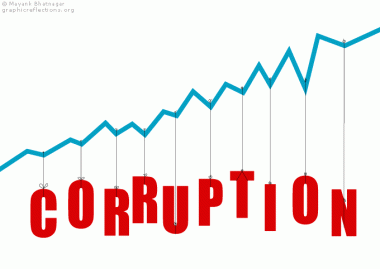
corruptionWhile I don’t particularly like Isamel Garcia of Podemos, he simply stuck his guns with Chavez for too long, you have to give him his due for doing what others are afraid of. In a little noted act last Friday, Garcia went to the Prosecutors Office with the leader of his party Podemos in the National Assembly to denounce (There is a more detailed article in Saturday’s El Nacional on page A-2, by subscription) a billion dollar corruption scheme by former Minister of Finance Rafael Isea.

You have read about this before in my blog, but as far as I can remember this is the first time a formal accusation is made. Essentially, Isea purchased “structured notes” of foreign bonds abroad and then sold them to local brokers (One of which was his main adviser and is part of the accusation, he was adviser and recipient at the same time)

According to the accusation, Isea spent between US$ 7 and 10 billion in purchasing these notes with dollars at Bs. 2.15 per $ which were then sold to local brokers at a higher price, but below the swap market price. These notes were used to lower the swap rate during the first semester of 2008, but it ended up being a waste of time, as the rate rose sharply again later. But the intermediaries made a lot of money and it is rumored that Isea made so much money that he purchased a number of radio stations that allowed him to become Governor of Aragua State in the Fall of 2008.

I wonder what the Comptroller Russian the Ruffian will say now, he always says that there are no “formal” accusations of corruption.

I wonder if a 10 billion dollar accusation will wake him up from his stupor.

Kudos to Garcia, he still has to work harder for me to like him…