Archive for the 'Venezuela' Category

Venezuelan Government Implements Stealth Devaluation of 44.2% For The Private Sector

January 8, 2014

photo(4)

44% chopped off the Bolivar, at least for the private sector. Note cut is to scale 🙂

Just a short note on the fact that the Venezuelan Government just implemented a stealth devaluation by inviting to a Sicad auction (where the price is almost twice the official rate of exchange) for the following items:

-Automotive Sector

-Food Industry: Corn flour, wheat flour, corn oil, rice, pastas and cereals.

-Paper, carton and wood

-Health Sector and raw materials for the pharmaceutical sector and vitamins, including ophthalmology.

Clearly, the Government does not want to announce a devaluation which shows there is some fear. The problem is that if companies imports at Bs. 11.3, the Sicad rate raw materials for regulated and controlled items, these prices have to be raised. The same with pharmaceuticals, etc.

Of course, we don’t know if it is that the Government plans to devalue later, will keep importing for itself at Bs. 6.3 per US$, what will happen with Sicad, if all imports will be done at Bs. 11.3 per US$ etc. But for now, this is simply a devaluation of  44.2% for the private sector, which will make inflation soar again.

But the distortions remain in place.

What Will Happen In Venezuela In 2014?

December 29, 2013

Collapse2

Now that I have your attention with that provocative title, I will give you my answer to that question right away and then I will try to justify it: I don’t think there will be economic collapse, dramatic social unrest or anything of the sort. I think that Venezuela under Chavismo will continued to plod along, drifting lower, as conditions get worse and worse, but I don’t think there will be some sort of dramatic collapse of the economy that will lead to some form of political instability.

My reasoning is simple, very few times in history do economies collapse in predictable fashion, nor do I think Venezuela is at an extreme. Yes, things are bad, but the Government has a number of degrees of freedom to act if necessary and it enjoys a level of popularity such that there is ways to go before its popularity is down to levels that could create sufficient social unrest for anything to happen.

Think about this year (2013): The Government had a shortage of dollars all year, it devalued to Bs. 6.3 from Bs. 4.3 per US$, Chávez died and was replaced by nebish Maduro, the Government spent like there was no tomorrow, inflation went up 100% from 25+% to 50+%, the unmentionable rate increased by a factor of 3.7 (It started the year at Bs. 17.4 per US$), scarcity went up from 20% to unknown and in the end, Chavismo actually got more votes than the opposition, with over 50% popularity in the Mayoral election.

Venezuela has The Devil’s Excrement, for better or for worse, we know the flow of foreign currency can sustain the types of distortions that the Venezuelan economy has enjoyed the last few years with total inaction. At some point,  things will unravel. but I believe this will happen only after the Government devalues sharply, which it does not seem ready to do and/or attempts to fix some of the distortions in the economy.

Because it is precisely the fact that it has not tried to fix these distortions that will allow the Government to make some adjustments. It can reign in spending, it can cut Petrocaribe and Cuba, it can devalue, it can increase the price of gas, sell the gold, mortgage more of the future than it has take over the banking system to issue even more local debt, issue more foreign debt and many other measures, before its popularity goes below 40%. Think Mugabe, for example, he had gizillion inflation and even held on to power.

Oh yeah, things will get worse and people will be unhappy, nobody enjoys 75%-80% inflation like we will see in the first half of 2014, but the Government will blame Obama, Capriles, Economic War or even Martians for the problems. And given the control f the media they will sell it yet again, once or twice more, but it will not be enough at some point. But this is not close, oil needs to weaken, some measures taken and maybe, just maybe something will happen. But I doubt it will be in 2014 and I doubt it will be dramatic.

Of course, the longer they plod along, the bigger the distortions and the sharper the eventual collapse, but we are not there yet.

Oil is indeed the Devil’s Excrement. Just watch!

Merry Christmas Everybody!

December 24, 2013

IMG_4147

As you know, I am not the most optimistic about Venezuela at this time, which sometimes makes it hard to sit down and write. Thus, as I was thinking about what image to post for the holidays, I had mixed feelings about posting something without a reality check on what is happening in Venezuela. Then, my brother sent me this image and I thought it was perfect, a somewhat cynical view at the type of Christmas Venezuelans are being forced to have. But despite all, Christmas has to be celebrated.

It is a time of the year to be thankful, to be with family and enjoy the holidays. I wish you all a very Merry Christmas wherever you may be. That Santa Claus or the Wise Men bring you what you want (hopefully not what is in the picture) and you spend some happy times with your family, forgetting about all the problems.

Thank you for coming back and putting up with my writings and my rants. I am humbled to have such a loyal readership and hope you keep enjoying it.

Merry Christmas everybody!

From the Devil Himself.

Virtual Profits In Venezuela

December 22, 2013

FunnyMoney

This week, Ford Motors said that it expects to lose US$ 350 million in Venezuela with the upcoming devaluation, which they believe will take the Bolivar from Bs. 6.3 per US$ to around Bs. 12. Basically Ford has investments in Venezuela valued at around US$ 802 million plus the Government owes them a few hundred million in Cadivi imports, which could eventually be paid at the higher rate of the new official devaluation, which people think will be around Bs. 12. Thus, Ford expects that in 2014 it will not make money in Latin America, only because of Venezuela.

Which shows how difficult it has become to do business in Venezuela, when you book  “virtual” profits one year, only to see them disappear the next, together with the loss in value of your assets. Last year, Ford took a US$ 186 million hit when the Government devalued to Bs. 6.3. For years, multinationals have been saying they are in Venezuela for the long run, but most of them never imagined it would “long” would take all this time. And there is no end in sight for earning this virtual, “funny” money.

Essentially, companies have not been given foreign currency to repatriate dividends since 2007, when the Bolivar was officially at Bs. 2.7 per US$, but at least until May 2010, companies could buy foreign currency at their own risk via the parallel swap market. Today that market, which is illegal,  is almost a factor of 10 higher than it was in May 2010.

Thus, companies are trapped, their earnings get diluted by the devaluation, their assets lose value and the Government fails to pay them for imports of parts and goods sold at the lower rate before the evaluation. It’s funny money, almost like Monopoly money.

Except that things may actually be or get even worse than Ford expects, depending on “how” the Government devalues. Essentially, Ford has little visibility going forward, because not even the Government knows what it will do with the devaluation, least of all the companies in the country.

In fact, according to the latest rumors and information, the Government may be planning to set up an even more complicated system, in which there will be two Cadivi rates (Bs. 6.3 and bs. 12) plus the Sicad rate (Bs. 17-18). What this means, is that whether companies take the hit at Bs. 12 or the higher Sicad rate, will depend on the detailed wording of the decrees. If, for example, there is no mention of dividends at the higher Cadivi rate, then companies will have to do their accounting at the Sicad rate, because now that rate will be public, like Sitme used to be. (Up to now the Government had kept the Sicad rate secret, so that accounting was all done at Bs. 6.3, but when Sitme existed, if you had no access to Cadivi dollars, you had to do your accounting at the Bs. 5.3 Sicad rate)

This means that they could lose even more than they think

Thus, Ford, or any other company has no clue today as to the size of the hit they will have to take with the devaluation which is likely to take place in the next couple of weeks at the latest.

Which shows how hard it is to do business in Venezuela under the current environment. Companies have no way of hedging their profits, which lose value in a country with 50%-plus devaluation. They can’t plan, they have little clue about 2014 and there are only seven days left in 2013.

If, as rumored, the Bs. 6.3 per US$ Cadivi rate is left only for food and medicines, at least companies in these two sectors will not take a hit (por ahora!) like what happened last year. Those are the only guys feeling better.

There are dozens of multinational companies in this situation and every year it gets worse, as the numbers of BolĂ­vars they have grows, but there is no way out.

And they keep waiting for the long run to end…

The Venezuelan Opposition Blunders Criticizing The Gasoline Price Increase

December 18, 2013

gas49.76 Liters (13 gallons) for Bs. 3.5 , that is US$ 0.55 at the official rate for a full tank, or US$ 0.055 at the parallel exchange rate. (4.2 cents per gallon at the official rate or 0.42 cents per gallon at the parallel rate)

I think the opposition is making a huge blunder criticizing the gasoline price increase and it shows its inability to evaluate how it reacts first before going forward. In the particular case of the gasoline price increase, which has now been opposed by at least, Henrique Capriles, Julio Borges, Leopoldo Lopez (The only winner in the recent election) and Maria Corina Machado, I think they should have waited for the full proposal before jumping the gun, rather than reacting viscerally to the announcement.

First of all, the announcement is incomplete, we don’t know what the new price will be and who it will apply to. The Vice-President suggested that it will not apply to public transportation and freight trucks, but we don’t know yet. Moreover, while the President of PDVSA has suggested that the new price for a liter of gasoline will be Bs. 2.8, there has been no formal announcement, what he had was a slide that showed at what price PDVSA breaks even in selling gasoline.

Second, if the opposition should believe in something is in that the current price is simply absurd (see picture above) and should be careful in opposing it today, when it may have to be in favor of it in a few years. It makes no sense to sell gasoline at a loss, it makes no sense to oppose the price increase if you believe in having a rational economic system and that the subsidizing of everything has to stop, particularly such a regressive subsidy.

Third, tying it to the Cuban or Petrocaribe subsidy makes it a very complex issue that most people will not understand and it is not true that the gasoline  given to these countries is “free” either, as most of them have suggested. Petrocaribe countries pay 50% within 60 days of delivery and the remainder with a loan that makes no sense, but that is a different matter. And while Cuba does not pay with money, it pays the gasoline with services. These services are paid at absurd prices, yes, but again, if you start lying and saying half-truths you are behaving the same way we criticize the Government for behaving.

Fourth, the Petrocaribe subsidy has actually been reduced in 2013, as clearly explained in this article in El Nacional, so the Government is actually doing something about that too. So, check your facts before you speak should be an important rule.

And finally, the opposition should be careful with anything proposed by a Government that has been so clever at manipulating public opinion and getting its way. While everyone thinks back to El Caracazo when talking about gasoline price increases and its consequences, people seem to forget that a very unpopular President, Rafael Caldera, actually increased the price of gas by about 800% in 1996, with little political consequence, as it sold the idea well and people understood it was needed. I don’t believe for a moment that the Government is being naive in proposing this price increase. They must have polls that show that people would support it and are ready to make the subject even more popular. Even to the point of having a referendum on the subject and beating the opposition (again!)

So, I think the statements made were wrong. The opposition should have waited for the details and oppose the details, but not the very logical and sensible gasoline price increase. Not doing so is simply cheap politics of the worst kind. The same way, it should say it backs it, but it also backs better terms for Venezuelan in the Petrocaribe and Cuba deals.

What the opposition is showing is that it has no solid proposal of any kind, it just reacts and opposes what the Government says. Maybe that is part of the reason why a large segment of the population does not trust it.

El “Cambiazo”: Reality Check For Those Who Think Bolivars Are Worth Less

December 17, 2013

cambiazo

For those who think that our currency is worth less, here is how distortions can make BolĂ­vars be worth actually more. Yes, in the ultimate arbitrage (or inverse arbotrage?) opportunity, you can sell Bs. 1 million for Bs. 1.1 at the border, you hand in bills and the foreign exchange houses in Cucuta give you an instant transfer of your Bs. 1.1 into your Venezuelan bank account. This transaction called the “Cambiazo”, has been the rage at the border in the last few weeks.

The reason for this? Simple, Colombians going to Venezuela to buy goods need currency, bills, they don’t want to use their Colombian credit cards, which register operations at the official rate of exchange. As the black rate has soared, the incentive to go and buy goods in Venezuela has increased to the point that there is actually a shortage of bills at the border, creating this new arbitrage which remarkably makes the BolĂ­var actually stronger. Since the difference between the official rate of exchange and the black rate is a factor of ten, then goods are still cheap, even if the merchant is making a 200% profit and you pay 10% more for the Bolivars.

Another market solution by inventive Venezuelans and Colombians to a problem created by the excessive controls in Venezuela. Sort of like reverse arbitrage. Is this a first instrument of its kind in the world?

The Details Of Sunday’s Venezuelan Municipal Election Results Are Ugly For The Opposition

December 12, 2013

totals

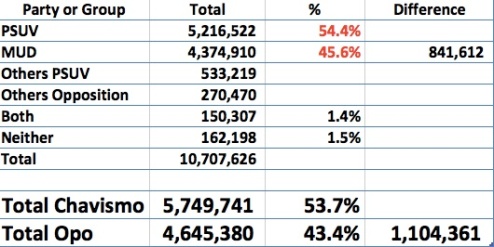
While people are still trying to show that the municipal elections were somehow a victory for the opposition, the more the results are analyzed, the worse it actually looks for the opposition. I had tried to analyze the results of the election to look at local parties which ran independent candidates and separate the votes according to the leanings of those parties. But since the CNE  site is blocked outside Venezuela, it is very difficult to do. Someone was helping me locally, but then today Eugenio Martinez did an even better (more precise) job in El Universal, as he even had two additional categories, candidates supported by both sides (bizarro country) and really independent candidates with no ties to either side.

The results are shown in the table above. The first two lines are the Lucena-style results, in which you only take into account the votes for PSUV and the votes for the MUD, which makes it look like PSUV got 54.4% of the vote and the MUD 45.6%. (Both in red).

The opposition had a different interpretation, which was to add ALL votes not for the MUD or PSUV to the opposition, which made it look fairly close, with a slight advantage to the opposition.

But the reality is that, as Martinez shows, of those additional votes, about 533,000 correspond to candidates who are part of Polo Patriotico, but were in municipalities where the votes were divided. Similarly, about 270,000 were for parties which are part of the opposition, but ran separate candidates from the MUD. Finally, about 300,000 votes can not be accredited to anyone, because the candidates were either supported by both sides or neither.

What the totals say is that the results up to yesterday, are quite close to the Lucena-style results with PSUV and its allies obtaining 53.7% of the total vote and the MUD and its allies 43.4% for a total difference of 1.1 million votes between the two sides.

This means that the results are even worse that they looked initially, as the opposition lost by about 8% of the vote, compared to the minimal difference (if any) of the April Presidential election. Thus, about the only positive thing you can say is that the opposition managed to win the more “emblematic” races, including most large cities, but losing Maracay, Distrito Libertador and Sotillo (Puerto la Cruz), as well as the “in your face” opposition victory in Barinas.

Chavismo on the other hand won the popular vote handily, won nineteen of twenty three states and only lost 26 cities when compared to the 2008 election. Maduro can also say that he is now more legitimate than he ever was and Capriles lost the plebiscite.

By now, even one Mayor elected within the MUD has already switched sides in Aragua, while the opposition lost one Deputy in the National Assembly because both the principal and his alternate were elected as Mayors in Zulia State.

Meanwhile, both sides are claiming victory with Maduro even saying his candidate won in Lagunillas (??). But what is true is that the Daka offensive, the so called “Cadakazo” worked, it changed public opinion overnight. And the opposition had no time or did not have time to react. Thus the loss. And it is a big loss.

And in the best Chavista (and Venezuelan!) fashion, to celebrate his victory, Maduro decides to give Venezuelan a “gift” by cancelling school all of next week with return to classes on Jan. 6th. Makes sense, the last thing Chavismo needs is an educated voter. Maybe they would start to understand what the populist game is all about.

Three I “forgots”: 1) I think we may have a referendum on the gasoline price increase, that would really divide the opposition, Capriles already came out against it.  2) Government discovers 40% of companies given CADIVI are fake, but it is someone else’s fault. 3) Apparently inflation in Novemeber was imaginary= i, because the number is already three days late.

Both Sides Lost In The Venezuelan Municipal Elections

December 9, 2013

460x

No matter how you look at it, no matter how you interpret it or want to interpret it, yesterday’s results in the Venezuelan Municipal election were not a victory for the opposition. Far from it. They may not have been a victory for Chavismo either, but the results were far from what the opposition had expected a few weeks ago and while there were some sweet victories like Valencia, Barinas (Triple sweet and Divine Justice on the day of Loyalty to Chávez), Barquisimeto, the AlcaldĂ­a Mayor and others, squeaking by in Maracaibo was not in the plans and can not be considered to be a victory. Neither can be narrowing margins in some of the large city municipalities where it has traditionally won.

Consider this: Maduro has been President for eight months. Eight months of absolute inaction. Maduro has little charisma, speaks badly, even if he has improved his delivery. During his brief tenure in office, inflation has double to 50%, the parallel rate has been allowed to double, shortages and lines have increased significantly and the opposition could not even increase its percentage of the votes from the April Presidential election…

Of course the opposition improved from the previous Municipal elections. Of course it had to do better, but this was no victory. It was not a victory for Chavismo either, but despite the deterioration of the country, the disappearance of the maximum leader and  a nebish President, all the opposition did was preserve its spaces, gaining very little.

Of course the Government abused its power over the media, used all sorts of tricks to buy votes, including a brilliant maneuver to make it look like inflation is the private sector’s fault. But prior to that, a maneuver which was actually badly timed, I saw little attack on the Government’s economic policies, little coordination on the part of the opposition in finding a topic and sticking to it. The opposition simply did not take advantage of the Government’s many weaknesses.

Both sides lost in these elections, but this means that Chavismo continues to have the upper hand. In fact, while I do not expect it to happen, it even has the chance to attempt to straighten out the economy. Imagine what would happen if the Government brought inflation down! It will not happen, Maduro is not going to see the light, but the virtual tie on Sunday gives the Maduro Government some range of action to devalue sharply, for example, or as suggested by the VP today, to increase the price of gasoline. Measures that are insufficient to fix all the problems, but that could help the sustainability of the Government long term.

Except that Chavismo is trapped in its ideology, as much as the opposition in its inability to mount an attack it. Thus, after a brief period of some rational policies, I expect Chavismo to step on the accelerator of its radicalization, just because it will be desperate. As desperate as it felt in October when it declared war on commerce. Just because it has no other plan. It will make up another war, a war that the “people” will sympathize with, catching the opposition flat footed once again.

And yes, things are going to deteriorate even further, but I think this election proves that it may not be enough to aid the opposition’s cause. The opposition can not be reactive, it has to proactive, have a plan, some form of ideology beyond wanting to get rid of Chavismo and the danger it represents to Venezuela’s economy and its people. It has to let its leaders lead and not have stale politicians telling people what they think.

About the only positive thing you can say about it is that the opposition continues to dominate the cities. In Venezuela, small cities decide elections, but big cities is where people organize against the Government when they are unhappy and disgruntled. The only question is whether the opposition will take advantage of it, or will someone else do it for them.

Maybe Maduro actually won yesterday, even if he expected more. He could have fumbled the whole thing…but he didn’t.

Municipal Elections Report, With Irregular Updates

December 8, 2013

Ba-yCpmIgAImSr5One person, one vote, Not sure what this group voting is. The Commissars checking purity?

It is close to 6:30 PM in Caracas and the cat and mouse game of whether to close voting centers or not has begun. I was never clear whether this matters or not, but seems to be repeated every tie.

Once again, the Government violated the law all day, with Maduro openly campaigning for some of his candidates and using political slogans. The First Ladyness did the same. What else is new?

Abstention is high as expected, which creates uncertainty on both sides, as it becomes difficult to tell where your candidates are doing well, as abstention can be heterogeneous. However, abstention can also be asymmetrical , which is what both Chavismo and the opposition fear at this time. The MUD knows the numbers look good for them in their traditional areas, but where the races are up in the air, there is uncertainty.

Maduro suggested results would be “tight”, could this be a warning that results will not be available until late?

PSUV Motorcycle gangs begin to drive around some cities including Caracas. Not clear what is their plan.

Ba_wqVCCYAAVkMk

Stay tuned.

Did Maduro Really Say That?

November 26, 2013

“…Those merchants that you know are as much victims of capitalism which speculate and steal like we do”

I used the words “rambling” and “incoherent” in my previous post. Other blamed the weed in the comments. Who knows!

Personally, I think it was a problem just with delivery, what he meant to say was that the merchants are as much victims as “us” Chavistas.

Which shows that he can’t concieve that any merchant can be a Chavista.