Archive for the 'Venezuela' Category

Duddy’s Surprise! Back to Caracas and is not a Stephen King movie!

June 24, 2009

t_abn_29_10_2007_cartas_credenciales_duddy_01_143

Imagine the scene somewhere in Maine last night, former Ambassador to Venezuela Patrick Duddy is sitting there eating some clams, some nice yellow corn on the cob and a nice boiled lobster with drawn butter, wondering with his friends where he will be sent next.

As he serves some more of that nice Chalone Chardonnay from California, he is wondering whether he will get Argentina next. Sounds cool, may give him a chance to learn more about those nice Malbecs from Mendoza. Chile would be nice too, interesting politics going on there, good cultural life, country doing well. Colombia is not his top choice. Complicated country with Uribe not running again, the FARC  and Chavez next door.  After Caracas and Chavez, Duddy deserves a break. After he behaved so well, the ultimate diplomat till the end, Chavez ended up kicking him out on one of his temper tantrums.

It’s a nice Maine summer evening, sun setting late, water calm, a little chilly to be eating outside, but hell, it’s summer and the Red Sox are leading the Nationals in the background, pass the corn.

Phone rings. It’s DC, maybe Hillary decided where she wants to send me. Hello! He hears the words normalization, Chavez, Venezuela, Barack wants it, back to Caracas. Seems like a nightmare. Simply unreal. He tries to wake up, thinking this is a Stephen King novel, King actually lives down the street and he knows him, but not even good old Steve would send me back down to Caracas!

Hello! Hello! as Hillary tells him he did such a great job, dignity, professional, all of those nice words, coming from the lips of Bill’s wife’s mouth. There is no going back, I am going back! Have to put up with Maduro again, visit Chavez, listen to boring Ali, the long speeches, the traffic, start reading again the Devil, Daniel and Quico, what a nightmare!

Give me some more lobster and please, lots more of that nice white wine!

Well, I could eat a nice arepa again. Just trying to see the bright side.

Pdvsa bond coming? Last chance for cheap foreign currency!!!

June 23, 2009

If it were not absurd enough that PDVSA was thinking of issuing US$ 2 billion in bonds, today’s rumour du jour was that the bond was coming and it was going to be for US$ 3 billion, just  to make things even more entertaining.

Now, it will be easy to sell US$ 3 billion of this supposed bond to Venezuelans, that’s the simple part, the tough road ahead is for all of these Venezuelans to be able in turn to sell the bond abroad to international investors, if that is what is coming as rumored locally and strongly today.

Let me try to explain the problem. Venezuela has some US$ 24 billion in bonds already trading in the international markets and PDVSA has another US$ 7.5 billion.

Who buys these bonds?

Mostly international funds interested in either making money by collecting the interest payments from the bonds or by speculating that the price of the bond will go up in the near future. These funds are limited in size and number because Venezuela does not have a good credit rating. Venezuela’s rating is currently at BB- while PDVSA’s is at B+. This says if things get tighter PDVSA will have a hard time paying.

In this market, prices are set by supply and demand. If there are lots of sellers, prices go down and viceversa. Additionally, it is not an infinite market, the market is right now somewhere between US$ 50 and US$ 100 million each day.

Currently Venezuelan bonds are yielding around 12-16% depending on when they mature, i.e. when they have to be paid. Let’s take a simple example, the shortest Venezuelan bond, the 2010, has a coupon of 5.375% per year, that is, you get paid twice a year half of that on the amount you hold.

Let’s say you have 100,000 dollars, you get US$ 5,375 per year in two installments on August 7th. and February 7th. and the bond matures (ends or has to be paid by Venezuela) on August 7th. 2010. Currently that bond costs around 93% of its nominal value, which means to buy $100,000 of the bond, you pay 93,000 dollars.

Thus, if you buy it tomorrow, between now and its maturity there are around a year and 40 days of interest. But in addition you will get 100,000 dollars at maturity, for your 93,000 dollars investment. That means you will make around US$ 7,000 for the increase in price and another 5,375 dollars plus 40 additional days which is like another 500 bucks. So, you get a total of roughly 12,875 dollars on your 93,000 investment or around 12.7% annualized.

So, now PDVSA will issue a  two year bond, supposedly a zero coupon, i.e. it pays no interest but just appreciates in value to 100% at maturity. Based on when the Venezuelan bonds are trading today, it should yield 15%. That is, roughly it should sell in an ideal world at 70%, so that it gives you 15% a year, since you will gain 30% in two years.

Thus, the Government will sell you the bond at around 190% at Bs. 2.15 per US$. This means that if you order US$ 100,000 (and are lucky enough to get it), you pay Bs. 419,000  (195% x 2.15) for each US$ 100,000, then if you can turn around and sell it for 70,000 dollars, then each dollar you get cost you (419,000/70,000)=Bs. 5.98 for each dollar you got.

However, this is the real world. If the Government sells US$ 3 billion that corresponds to the volume (additional volume at that!) that is done by the market each 30 days, so it would take at least a month and half in terms of working days to absorb the full amount, if everyone in Venezuela turned around and sold them Thus, there is too much supply and not enough demand. Which means that the equilibrium price will not be 70% but lower, or the yield to maturity will be higher.

But suppose you are a fund that owns the 2014 Venezuela bond which yields 16% and all of a sudden the 2011 “new” PDVSA bond yields 18%, you quickly sell the 2014 and buy the new Pdvsa bond. But if too many people do this, the price of the 2014 Venezuela bond will then also go down in price.

Get the picture? By selling US$ 3 billion of the two year 2011 zero coupon, the bond itself will likely yield more than the typical Venezuelan bond due to the over supply, which will make people sell all the other bonds to buy the new one.

Now, under normal circumstances that would be ok, except that Venezuela’s yield is quite high already!

Now, the interesting part, is that if the PDVSA bond 2011 dropped below 65% of its price, or a yield of 17%, it would be cheaper for you to buy the foreign currency in the swap market on Thursday at Bs. 6.4 per US$,  than pay Bs. 419 thousand for 100,000 dollars of the bond which will sell at 65%.( (Bs 419,000/65,000)=6.44 per US$)

It seems to me to be a little close for comfort. So, my recommendation is that when conditions are announced, you do the math and likely the best option available would be to just go and buy the dollars in the swap market, this may be the last chance to buy foreign currency so cheap at Bs. 6.4 per US$ or lower.

The strange thing is that PDVSA does not need dollars, it needs Bs. which it will get. But why they want to sell a bond in dollars is what I do not quite understand. Why not sell and indexed bond in Bs.? After all, even if the swap market goes down with this new dollar bond, it will be only very temporary and people will forget that it even wnet down, let alone lower prices of products.

As usual, there has to be a trick somewhere. What it is may not be known, if at all, until the bond and its characteristics are announced. Or it may be that the conditions to sell you the bond are such that there is some specific and particular way for someone to make a few million bucks from the bond.

They don’t call it the robolution for nothing!!!

Has Chavez been told how tight things are getting?

June 22, 2009

Even with increased oil prices, things are not well in revolutionary Venezuela. The only question is whether anyone has told Chavez about it. My feeling is nobody has, because he continues acting as if everything is fine, as his Government continues to get into contradictions which simply can not be explained.

Take for example Chavez gloating yesterday that while the capitalist world was losing, jobs he was creating them in the thousands, but unemployment, which ended 2008 at 6% is now at 7.7%, so even the Government’s magic fake statistical institute can not push it down, as the country has lost some 120,000 jobs in 2008.

And after General Motors announced that it was shutting down for three months because it was not receiving foreign currency from the Government, some genius in the administration decided to blame it on GM’s bankruptcy in the US, saying the flow is normal. The truth is that none of the automakers has received much these year in terms of real dollars. They get the approvals from CADIVI, but after the autoparts are here, no payment is made. The result? CADIVI owes the auto and autoparts companies of this world some US$ 3 billion. These are cars have mostly been sold and at the official rate of exchange to wit.

But just to prove the lie, and the veracity of both points above, the Government rushed today to announce that it would give automakers and autoparts companies US$ 2 billion in 2009, not even enough to cover the outstanding debt, but they think (hopefully, cross your fingers) that car companies will not start firing people right and left.

And then, as Chavez nationalizes a Japanese hot iron briquette company and he bickers with the Japanese partners of the Aluminum complex to the point that they are leaving the country and he owes Japanese Toyo company a bunch of money, it looks like the Japanese may not be here to stay. In fact, the loan that Chavez sent Rafael Ramirez to Japan for, seems to be in peril and maybe some US$ 33.5 billion which Chavez claimed he had gotten from that country too (I donit believe that figure for one minute). And if Nippon Export and Insurance stops insuring investments in Venezuela, you can kiss the whole kimono and pachinko goodbye.

The truth is that things are bad and getting worse. The question is whether Chavez has any inkling about what is going on. I hear the pharmaceutical sector is not getting foreign currency, that Brazil’s Bndes has not approved the loan nor received the paperwork required from this side to have it approved, that Brazilian companies are owed US$ 2 billion, car companies US 2 billion, airlines US$ 1 billion, local banks US$ 600 million, PDVSA owes the companies it did not take over a few billion and owes the Government a few billion in taxes.

And the second half is only going to be worse. Companies that have been holding off in firing are doing it. Spending will slow down, imports are already down sharply, inflation is the pits (Coca Cola from Bs 2,000 to 3,500 so far this year, to give you a very important indicator) and the only plan the Government seems to have is…

to have PDVSA issue US$ 2 billion in bonds…

which I think is absolutely crazy. It will do nothing for the swap market, it will kill the country’s yield curve and unless the bonds are sold really cheap to Venezuelans (like 20% below the swap rate), people participating may lose money by the time they manage to sell their paper in the international markets.

At this point Chavez has only one terrible choice: devalue. The problem is that doing it just that does little except temporarily balance the fiscal picture, but creates huge inflation and likely shortages. Not pretty, no? But it is the natural result of not making any decisions and postponing some tough ones. No country can go on forever and ever owing everyone money and that is what Chavez has been doing so far this year. And it is unclear what his cohorts have promised, but things must have looked really bad for Chavez to bring back Jorge Giordani and his Garcia Marquez block of ice on the form of economic rules he invented ten years ago and have not served Chavez well, but are as inopportune today as they were in 1998, 2000 and 2002. Because Giordani’s pseudo-voodo economics have not ridiculed him because oil prices have always managed to climb beyond anyone’s imagination.

But he is back on the helm of idiotic and revolutionary economic policy, ready to produce a crash that will make the world economy look healthy in comparison. In the next six months the Venezuelan economy will shrink, conservatevily speaking, by 5% and the Chavez administration will have gone through all of the savings in Fonden. Thus, unless oil hits $100 a barrel again before then, imports in 2010 could collapse to US$ 20 billion and people will be asking for Chavez (not Giordani’s) head.

Does he know this? Does he even have an inkling? is he being told anything..

I seriously doubt it.

Musings on Venezuela and its analogy to what is going on in Iran

June 21, 2009

Venezuela is living a sort of suspended animation. Only a few months ago, suggesting that there would be no devaluation by July would have seemed nuts, but here we are less than ten days from July 1st. and as I expected, the “official” rate of exchange remains at Bs. 2.15 per US$. The worst part is, that the longer it is held fixed, the bigger the explosion will be in the end.

As Chavez hopes for a recovery of oil prices, the truth is that nothing will save him by now. Oh yes, oil prices are up to US$ 70 per barrel, but the average price of the Venezuelan oil basket, so far this year, is roughly at US$ 50 per barrel, a level impossible for the Venezuelan economy to be sustainable for the remainder of the year.

What is likely to happen, is that the economy will shrink dramatically in the second half of the year and that demand will simply collapse. As importers go to the swap market (even pharmaceutical companies are not getting US$ at Bs. 2.15), prices will jump so much that people will not be able to buy stuff (and will get unhappy!) and even if Chavez does not want you to buy imported diapers, even his factory is likely to find problems to produce his much touted Bolivarian shit absorbers.

And even now, it seems like under ignorant Giordani’s tutelage, Chavez refuses to devalue, setting up the country for an even bigger devaluation later in the year.

But rather than paying attention to these problems, the Government continues on its confrontational road, worrying about survival via politics, rather than trying to patch up this almost unpatchable economy.

And reading the political end of things in the daily news is simply too much. Here is a Government trying (what for?) to look democratic, and the Supreme Court has just validated prior censorship and given the Minister of Infrastructure the power to exercize it. If he does not like and ad or an opinion, he can simply shut down the TV station, radio station or blog for that matter, even if Art. 62 of the Constitution gives everyone the right to say whatever you want. But I guess Chavez is beyond the Constitution by now. He used to show it all the time, the”best Constitution in the world” he used to call it. I guess those were the days even for those that objected his Constitution but believe it is there to be respected by all.

And then I read about the Organic Bill for National Security, which declares (Article 47) all basic industries as “security zones”. Funny, security zones have been out of fashion since 2002-2003, when the Government decided to declare security zones around any place it did not want opposition protests around. So now, all large unions in the country are simply screwed, they can’t protest where they work! It must be that unions are by now controlled by the right wing in Venezuela. Whatever that may be.

The funny thing is that if you think Chavez is left wing, how about Pablo Medina accusing Chavez today of giving the country away to foreign powers! According to this member of the opposition (Yes, somehow, he is supposed to be on my side, even if I have yet to find where I belong!), Chavez gave up our claim to part of Guyana, gave away part of the Orinoco oil belt to Brazil, the island of La Orchila to the Russians and he did not give Colombia the Gulf of Venezuela because people found out about it!

To add to this confusion, today I learn that the President of PDVSA, Mr. “I decide everything”, went to the Prosecutors office to ask that the former President of PDVSA Gustavo Roosen, be charged for giving away the Boscan field without opening up the process for bidding!!!

Jeez, Mr. Ramirez could have fooled me! Isn’t he the one that has rewritten contracts, giving them away, signed a loan guaranteed by the heavy crude in the Orinoco and gave at least a half a dozen areas in that belt to friendly countries, all without consulting with anyone?

It must be that he can’t accuse himself or something like that.

Meanwhile, Chavez keeps saying that he will continue taking away from the oligarchy what they have taken from the “people”, but he says little about what his cohorts are taking away from the people or the oligarchy and creating a new oligarchy, the “Bolibourgeois”.

Because I find it fascinating that while Chavez is nationalizing banks and creating Bolivarian insurance companies, those close to him keep buying banks and insurance companies and paying through the nose for it. Has it occurred to Chavez that these guys may have plans that do not include him? Maybe when he says someone wants to kill him, he is looking in the wrong direction.

Thus, it gets harder and harder to understand Venezuela, so I better follow Iran much closer than I am, after all, it is much simpler to understand what is going on there.

Let me make it a simple analogy to Venezuela. If Iran were Venezuela, what is happening there would be that a Chavista candidate beat a dissident Chavista candidate (while the opposition was not allowed to run) and the dissident candidate does not want to accept the results of the Electoral Board. Almost the same, except there is no opposition, no?

Allen Stanford and others indicted in the US

June 20, 2009

Yesterday, the SEC finally charged Allen Stanford for his role in the supposed Ponzi scheme and he surrundered to the authorities in the afternoon. The SEC also charged others in the case including the financial regulator of Antigua where Stanford Intrenational bank was based.

You can read the full complaint to the Court here.

The SEC named as defendants Allen Stanford, James Davis who was the CFO of the Stanford Group, Laura Pendergest-Holt who was the Chief Investment Office of the Group, Gilberto Lopez and Mark Kuhrt, Chief accountant and global Comptroller for the Group and Leroy King, the Head of Antigua’s financial regulator.

The SEC accuses Stanford of fraud in the sale of the CD’s and the description which was made of their investment philosohpy. He is also accused of using the money from the deposits for his personal use.

Including a foreign regulator in the indictment was quite surprising and unusual. The SEC accuses King of receiving bribes and perks from Stanford in exchange for obstructing the SEC’s investigations and not auditing the books of Stanford International Bank. He is even accused of sending the SEC a letter dictated by Stanford.

The SEC also charges that Stanford’s mutual fund program was fraudulent, with funds picked after the fact to tout the program’s retuns.

It took a few months but the SEC finally went after Stanford who is now in jail, but the proceedings are certain to be long and drawn out with charges and countercharges.

Stay tuned…

The robolution is stealing Venezuela

June 18, 2009

Politically, Chavez has slowly taken away spaces from Venezuelans over the last ten years. One way or the other, institutions have fallen under the control of Chavez and his cronies and even those gained in elections by the opposition are threatened and ripped off by the Government, as roughly half of the Venezuelan population has lost its political rights.

At the same time, the revolution has stolen more and more spaces of the economy by having the Government take over companies, factories and whatever are of influence Hugo Chavez feels should be under the influence of the State.

But there is an even more pernicious take over taking place, that of the limited spaces of the Venezuelan economy where the private sector still plays a role. But this limited and remaining space is slowly being taken over by the robolutionaries, the so called boli-bourgeois, those than have enriched themselves under the shadow of the revolution and now are on a spending spree, buying out, fairly or not, whatever they can get their hands on in order to “clean” their ill-gotten fortunes.

When I began writing posts about the corruption levels going on in the robolution, many, including anti-Chavez people were skeptical of what I was saying. Fortunately, there were cases such as Maletagate, which revealed the lavish spending habits by the nouveau rich of the revolution, as well as the origin of their wealth under the silent shadow of Hugo Chavez and his fanatics.

But if there was silence on some of those cases of corruption, despite the fact that they were blatant and obvious, there is an even more dangerous process taking place: The buyout of ongoing companies by robolutionaries that under no circumstance could possibly justify the origin of the funds used to buy these institutions.

I have mentioned how a number of banks have mysteriously been purchased by unknown people, such as the case of Banco Bolivar, Confederado and Banpro. I have also mentioned the expansion of Bankinvest under the watchful supervision of Jesse Chacon’s brother, who according to this well documented post had no known employment until a few years ago. But today we hear that they also purchased Seguros La Previsora for US$ 185 million and the Chavistas that are irked by the smallest movement of Globovision and its owners, say absolutely nothing. The Comptroller, the same ruffian that disqualified Leopoldo Lopez politically because he used (with approval) money from one part of the budget on another, but found Merentes innocent when he borrowed hundreds of millions of dollars unnecessarily in a year in which Venezuela had a fiscal surplus, somehow says nothing. Mr. Ruffian: Where did these people with no known economic activity find the half a billion dollars spent in acquiring respectable businesses in the last two or three yeras?

And will the Insurance Superintendent approve with the same complacency as the Superintendent of Banks approves that of banks, the purchase of La Previsora?

Strange how regulations were speedily and expediently issued so that any transfer of property of a media outlet, TV or radio, has to be approved by the Government first, but banks and insurance companies are traded like baseball cards with the complicity of the authorities in those fields. In some cases the “new” owners are very obscure, have no banking experience as required by law, or are not even announced.

And one has to wonder if the Maldonado family, the former owner of La Previsora sold because they wanted to sell or they were made an offer “they could not refuse” as in the case of one of those banks that was magically sold after one of its owners was kidnapped a couple of years ago.

In the end, there is a slow take over of the private sector by the new oligarchs. They have more money than the old oligarchy ever dreamed of, which means that in the end they will outlast Chavez and his empty revolutionary project. They will move into the best neighborhoods in the East of Caracas and they will make sure to be ready for the “transition”, whether in two or twenty years, when they will be able to exercise power with their money and become the new elite, albeit one that never worked one day for it.

Thus, the robolution is stealing Venezuelan outright. It is the ultimate arbitrage: Get free money dealing with the Government so that you can buy legitimate businesses than in a few years everybody will have forgotten how you ended up buying them. Hope that Chavez never decides to take you over, but even then you are likely to come out ahead.

And, of course. Stay quiet. Don’t ruffle feathers. Go to Alo president if invited. Don’t meet with active military should anyone think you are conspiring. Just live and let live. Say socialism every time you talk to your employees. Mention your last meeting with Chavez when you meet with your workers. Steal and let steal, while your name and family gain the sudden prominence of the new robolutionaries, which in time will become the new oligarchs.

And there are new commissions to be charged everyday, insuring that the robolution steals Venezuela from the Venezuelans.

Venezuela rejects campaign against Iranian institutions

June 16, 2009

12713990iran2 copy

Even as Grand Ayatollah Hossein Ali Montazeri and Ali Khamenei were hedging their bets in the face of massive demonstrations, the Government of the Bolivarian Republic of Venezuela (i.e. Hugo Chavez) congratulated the Iranian people for the extraordinary day (ripoff?) last Friday.

At the same time, the Venezuelan Government (i.e. Huguito) manifested its (his) most firm rejection to the feroucious and unfounded campaign of discredit that from abroad (???) has been unleashed against Iranian institutions. Venezuela denounced this interference in Iranian affairs (by million of Iranians?) and asks for the immediate end to these activities.

Well, it took three days, but it happened in the end according to the expected script. The only thing missing was mention of the Venezuelan opposition as being part of the interference (Sadly, they have not said anything). You have to wonder where the Venezuelan Government thinks the millions of protesters came from and how come the deaths always occur in opposition demonstrations and not in those in favor of ruling President Mahmoud Ahmadinejad (sound familiar?).

But I guess Chavez is seeing himself in that mirror, the crowds are no different than those of April 2002: a majority of women and young people. The big difference is that they don’t seem to stop protesting even when they are shot at. Chavez managed to stop protests in 2002 when he ordered his people to shoot at the demonstrators in April 2002, except he did not count with having to resign. Luckily for him, we had the military making decisions and somehow stupid Carmona ended up on top and Chavez managed to come back.

But using Chavista logic, the millions in Iranian streets are just destabilizers that should be shot at and scared to death until they stay home. Such is the regard this Government has for freedom and human rights.

Maybe Venezuelans will watch what is happening in Iran closely and realize that when your rights are in play, you have to take all possible risks to defend them and next time we will not leave the streets, or the media, or our rights flailing in the wind.

Venezuelan Government blocks private constructions and public elections, just because…

June 15, 2009

Because of the uncertainty, investment in construction has been down for practically all of the ten years that Chavez has been in power in Venezuela. To top it all off, Government housing programs have also suffered of the mismanagement and corruption such that Chavez with his windfall of oil income has been incapable of matching even the achievements in building housing of the Caldera years, when oil income was low and inflation was rampant.

The result is that housing prices have shot through the roof due to scarcity. Try to buy an office or an apartment and prices are really high, they average US$ 2,000 per square meters for housing in Caracas and US$ 3,500  a square meter for office space in the East of Caracas.

With inflation nearing 40%, builders have resorted to selling housing projects with the initial offering price adjusted with inflation, according to the Government’s CPI which clearly underestimates the real CPI through the use of regulated items. This has been a good solution for young couples, as they can not come up with the full amount to move in into a new place and in this way they can contribute to their project and later, when the building is finished they can get a mortgage for the final amount.

In the last year, I have heard more and more people appealing to this mode of financing as the only way for them to have access to their dream home.

But now the Government wants to make sure than fewer homes are built as it forbid this mode of selling and building housing and issued a decree banning the methodology. Even more remarkably, the decree makes it illegal retroactively, something which is simply illegal.

But illegal is for Venezuelans these days just a word in the dictionary. Diosdado Cabello, who was a failure as Governor of Miranda in building practically anything, and the voters punished him for it, suggested that this be approved and Chavez resoundly backed it in his Sunday Alo Presidente program, threatening to “intervene” companies that charge the IPC. It is once more a case, of the Government “ni lava, ni presta la batea” (Does not do the wash, nor does it lend the tray to wash with)

But there is no recourse. If you go to the Courts you will be defeated, witness the recent decision to suspend all elections because the National Assembly is contemplating a new Electoral Bill. This Bill is in the works, but what if it is not approved? Or it is postponed like dozens of Bills regularly are at the committee level?A law is just a project, a Bill, until it is finally approved, no? Do the leaders of other independent powers have “special” knowledge that this Electoral Bill will be approved in speedy fashion? Curious, no?

But for the Electoral Board and even the Supreme Court it does not matter, we can not have elections until the new Bill is in place. Imagine if it is never approved, no more voting, democracy in a state of suspended animation. This does not seem to be the case, but they could do it, which only proves how absurd the whole thing is. In fact, no elections may be better than farcical ones in the end.

It really does not matter, this ceased to be a democracy long ago, I just wished we had half the guts that Iranians seem to have.

iranelex

The revolution never ceases to amaze…

June 14, 2009

Sometimes, one is amazed at the ability of the revolution to invent new concepts or justify the unjustifiable. This week was no exception and while each of these items may not make a post, all combined provide a glimpse at the empty revolution:

—While President Chavez continues preaching that his Government will be austere even if oil prices go up, reality says otherwise, even acknowledging that in the past his Government wasted too much money. But Chavez says that and we learn that the Venezuelan National Assembly has already approved extra spending of US$ 6 billion over what was approved in the budget for 2008, which included an across the board 6.5% cut with a US% 66 billion budget.

—And how about discrimination in the revolution? According to the President of Caracas’s subway system, the new line 5 of the subway will have two of its stations cut, because “they benefit” the oligarchs”. Now, I could understand this if there was a Country Club station, but one of those cut is the Bello Campo station, which certainly brings the definition of oligarch to a new low level.

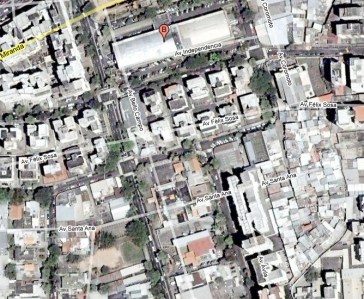
Here is a view of Bello Campo from Google maps:

bellocampo

Not only it is at best a lower middle class area, but notice the barrio on the right composed of two barrios, La Cruz and Bello Campo, not precisely oligarchs. It would also be located near the Gustavo Herrera high school a public high school. So, I am not sure Mr. Farias knows much about where the oligarchy lives. Maybe he was just looking for an excuse, like no money. Funny, there is always money for weapons and the like.

(The guy was removed for saying this on June 16th. will the stations be restored?)

—And I guess participatory democracy only works if Chavez agrees with it, because after the neighbors of La Candelaria voted in favor of the Sambil Mall that Chavez wanted to expropriate, the thug himself said last week that the Mall was “not going to be” , because “it was a monster of capitalism”. Chavez acknowledged that HE made that decision, despite the fact that the mall had received all of the required permits from the municipality.

—Which only makes you wonder what will happen if Chavez’ plan to take over land in the Chacao municipality is defeated in today’s vote. The municipality was going to build a Civic Center, but Chavez PSUV party had something else in mind, so the matter was put to vote today. Lines were very long for the vote in favor of using the land of the old Chacao market for a Civic Center which would become part of a new area in Chacao together with the New Chacao Free Market. This market is a new modern building (I don’t particularly like it, but it is a huge improvement over the old). Results are not in, but expect the Center to be approved by a large majority. (early reports are that it passed with 90% of the votes. Correction Monday morning: the Civic Center was approved 20,604 to 140…let’s see what the Government’s excuse is now!)

—And proving once again that he is a Dictator, Chavez warned today newly elected Governor of Tachira State Perez Vivas, that he will end up in Peru like Manuel Rosales. Thus, if you are succesful in an election Chavez will either find something to accuse you of and run you out of the country, or he will take away all of your responsabilities a la Ledezma. Some democracy, no?

As Government ponders PDVSA bond, S&P downgrades PDVSA

June 12, 2009

For the last six weeks, there have been rumors that PDVSA was ready to issue some US$ 2 billlion in bonds expiring in 2012 and 2014. But then, Chavez announced the nationalization of PDVSA services companies and the country’s and PDVSA’s bonds dropped sharply, postponing the issuing.

Rumors resurfaced as credit conditions improved around the world and local newspapers reported that last weekend Chavez actually approved the bonds and there would be an announcement soon. All of these rumors have helped contain the parallel swap rate, despite the fact that many people, including me, thought this was unnecessary and dangerous. Unnecessary, because if PDVSA needs money, it should be able to issue a local bond that would soak up local liquidity in Bolivars and not a dollar bond, which could turn out to be more expensive down the line. Because what PDVSA needs is Bolivars to pay suppliers and its local expenses, not dollars.

Unnecessary, because these issues have turned out to be only a psychological tool to keep the market down, but once they come to market, it is atomized so much among thousands of local investors, that the companies that need dollars for imports don’t get much and they have to go back to the swap market and push the rate down.

But this was also unnecessary, because I do not believe that international markets can absorb US$ 2 billion of additional PDVSA debt. While world markets have improved, this would create an oversupply which would have the same effect that the US$ 7.5 billion PDVSA 2007 issue had on the whole market for Venezuela’s debt. It brought the whole curve down, punishing down prices for months.

But rumors continued despite the skepticism and press reports that even some Cabinet Ministers were opposed and that the National Assembly did not want it to be a wasted effort.

But the possibility of the bond coming to market was likely short-circuited today when S&P downgraded PDVSA’s ratings from BB- to B+ (BB means the company/country may be facing conditions which may lead to the company having inadequate capacity to meet its obligations, while B means that it is more vulnerable than BB and that adverse conditions will impair the company’s ability to pay).

To make the downgrade more intriguing, S&P downgraded PDVSA, but reiterated its rating of BB- on Venezuela. While I disagree with some of the things said by S&P in its press release, particularly on the differentiation between the country and the company, this really thows a monkey wrench in the Government’s plans to issue bonds.

First, these are the main three reasons cited by S&P for the downgrade:

— PDVSA’s liquidity tightened due to the decline in oil prices at the  end of 2008 and continued tax payments to the government.
— In our opinion, there is heightened uncertainty regarding the  company’s willingness to meet its contractual obligations with some of its  suppliers.
— The negative outlook reflects what we believe to be heightened  uncertainty regarding PDVSA’s liquidity and its willingness to meet its  obligations with suppliers, as well as the negative outlook on Venezuela.

First, some of you may wonder about the timing, but clearly S&P was waiting for the audited financials to come out before it issued its opinion. Thus, while lower oil prices could have been used as an argument, S&P clearly waited for the full numbers which came out last week.

S&P argues that PDVSA’s  financial information is problem, it argues: “its more aggressive financial policy, and the continued delays in  the release of its financial information” . Well, I am not sure the country’s numbers are much better, but S&P gives them more credibility. It also suggests: “The ratings assigned to PDVSA also reflect the inconsistencies observed  in its reported production figures versus those from other sources”

What I can not agree with is S&P’s argument that somehow PDVSA would act independently of the Government and in the words of S&P: “Given our expectation that  the company could prioritize transfers to the government before debt payments  in a distress scenario.”

Sorry, I don’t buy that. In fact, PDVSA owns CITGO in the US, making it more unlikely (in my mind) to decide to pay for its debts than the country.

But S&P’s ratings confirm some of the uncertainty that the publication of its financials has created, as reported in the previous post, as well as the fact that the company is badly run, deciding not to pay suppliers and facing a cash crunch, which is dangerous because in the words of S&P: “We believe that PDVSA’s cash position has  decreased significantly during the last few months and that it has minimal  committed credit facilities available

Thus, the stretching of PDVSA’s resources and the irresponsible way in which it is being mismanaged will now not only make it more expensive to obtain financing, but will interfere with the plans of both PDVSA and the Government.

Remarkably, Ramirez and Chavez continue nationalizing companies and assigning tasks to PDVSA that have nothing to do with its mandate. Chavez even boasted when he was in Brazil that he had plenty of money to continue nationalizing those companies that his Government considered “strategic” to its objectives. Well, maybe he is not being told the truth…

Well, if the goose has no liquidity, and the wild spree of wealth destruction continues, Chavez may find that the money he spent in propping up his popularity with his right hand, may have been wasted by the irresponsible way he has been running the country with his other one.