Gradual Versus Sudden Policy Change: Controls and Inflation

October 24, 2011

Continuing my unpopular posture on the need to remove exchange controls essentially immediately after taking office (If elected), today I look back at two similar unpopular measures and their impact on inflation (I wish I could measure the impact on corruption, but I can’t)

First, we look at inflation rate right before, during and after the 300% devaluation of CAP II:

Right before CAP took office inflation was running at 5% a month, they devalued increased the price of gasoline and obviously there was a huge jump, but by the end of the year inflation was below 2% per month.

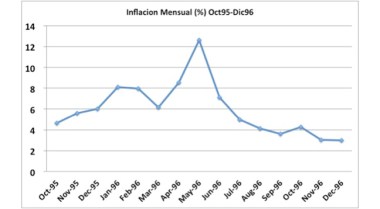
If we look at Caldera’s devaluation:

which was much smaller (89%, from Bs. 290 to Bs. 530), inflation was running at around 8% right before Caldera named Petkoff and the currency was devalued on April 22nd. Once again there was a peak of inflation, but by the end of the year, inflation was just above 2%. Why didn’t it drop more? Simple, Caldera did not adjust the price of gasoline all at once, but did it quarterly over a year.

Thus, I reason, the new President will be riding high in popularity, bite the bullet, take the big hit on inflation (Take measures to mitigate the impact) and then in a few months you will be hailing how inflation has been brought down dramatically. And it will…And people will feel it.

Doing things gradually means living with the higher inflation and allowing corruption, arbitrage and all that to continue. We are not talking small time corruption, we are talking corruption to the core, big stuff, billions of dollars that can be used efficiently to generate jobs and make peoples lives better. There is an incredible opportunity cost in all of the distortions surrounding controls.


Hyperbole heard around the Bolivarian revolution…

October 23, 2011

-General Prosecutor Luis Artega Diaz: “The World Attacks us!!”

My, My aren’t we paranoid these days!

Vice-President Jaua: Private insurance is a business (invented) by the IVth. Republic so that the people don’t trust the public health system

That’s why during Chavismo, public workers became privately insured like never before in the history of Venezuela, overloading private hospitals!

BTW Elias, why isn’t Hugo trusting that same system?

PSUV leader Blanca Eekhout: “Muammar Al Gaddafi is turned into a martyr of the Libyan people. We know that with the courage that characterizes these people, the fight has just begun…his revolution gave (the Libyan people) the highest level of social Justice and human development index.

Blanca, the man is not only dead, but nobody is fighting for him anymore. Maybe you have not heard of Lockerbie and maybe, just maybe, imagine if your martyr had spent the US$ 200 billion he had stashed away on the 6,5 million Lybians, just think, almost $30,000 per person, waiting for? Do you guys even think about what you say?

The three medical stooges: And just to make sure we understand that Chavez is fine, a Bone Doctor, a tripa Doctor and an ofthalmologist come out and tell us Hugo is fine, because they know.

What are we to believe? His eyes are fine, his bones are fine and it has nothing to do with his digestive system? No oncologist? No urologist? No Cuban Doctor? BTW, where have you guys been since June? What compelled you to say something now, rather than, for example, June 20th to June 24h, when your patient was in intensive care? Were you there taking care of him? Why did Navarrete raise such a fuzz? And Chirinos was lying? You seem to be nine years late on that denial. Really weird…

-Hugo: “I will govern until I die.”

Well, I just don’t like that much uncertainty…


Friends of CIDH compare Hugo Chavez’ Supreme Court to Fujimori’s Military Courts

October 21, 2011

You know I am no friend of the Carter Center after its action in Venezuela in the 2004 recall vote, but you have to love this press release issued by the Carter Center entitled “Declaration of the Friends of the Inter-American Democratic Charter on the Venezuelan Decision Regrading the Ruling  of the Inter-American Court of Human Rights”. The declaration is signed, among many others by Cesar Gaviria, Jorge Castaneda, Andres Pastrana, Sergio Ramirez, Alejandro Toledo and Jimmy Carter. The bold face on the part about the military Courts of Fujimori is mine. Can it be clearer than this?:

“We, the undersigned, regret the announcement of the Venezuelan Supreme Court that it will not be feasible to comply with the decisions of the Inter-American Court of Human Rights in the case of Leopoldo Lopez vs. Venezuela issued on September 1, 2011.   The Inter-American Court together with the Inter-American Commission of Human Rights constitute a human rights system that serves as a model for the world.  Based in the American Convention on Human Rights, the system is an achievement of Latin American and Caribbean states (neither Canada nor the United States have ratified) that should be jealously protected by all.

We note with concern that to our knowledge, with the exception of the military courts rulings during the Fujimori regime, this is the only country in the hemisphere where the merits rulings of the Inter-American Court of Human Rights have been rejected by the Supreme Court in expressly declaring them non-binding and unenforceable.

The failure to comply with the findings of the Court by a signatory state under the jurisdiction of the Court, and departing from its international obligations as dictated by the American Convention, threatens not only the Court itself but also the collective defense of human rights in the hemisphere.”


The Doctor Speaks Out on Hugo Chavez’ Health and His Intentions

October 21, 2011

Last week there was a lot of fuzz over an interview with Dr. Salvador Navarrete in a Mexican magazine in which the Doctor said that Chavez’ life expectancy was limited and gave lots of details about Chavez’ past health, when supposedly he had been part pf the medical team taking care of the Venezuelan President. Most of the analysis focused on the veracity of the interview and whether the doctor was or not unethical in revealing information about his former patient. There were also reports that the Doctor had been taken to the intelligence service SEBIN for an interview.

Well, today Dr. Navarrete has published an open letter in Tal Cual, in which says he has left the country. In his letter, Dr. Navarrete says among other things:

“I was thinking about the ethical dilemma which represents to watch over the health of the most important person in our country, at a time that he has been diagnosed with a malignant illness and the lack of foresight in the face of a possible absence, whether temporal or definitive, in the handling of the Nation due to a lack of a clear medical communique about his current condition”

“I am concerned that the President and his political surroundings do not know the magnitude of his illness due to the complete secretiveness with which it has been handled. The consequences of a fatal ending and the importance both to his organization as well as the groups that back him, as well as the political groups that oppose him, were the reason that made me tackle such a delicate subject”

“The analysis of the current condition of the President is based on official information that in some cases has been issued by the President himself and is nothing more that a clinical exercise that can be completed by any medical professional to reach a diagnosis and a presumed prognosis, which is never definitive”

Clearly Dr. Navarrete did not have access to the President on this subject, but claims to be making an educated medical guess on the President’s health based on the information he has. He clearly believes that this is not being handled correctly by Chavez and his entourage, believing that if the President’s condition worsened it could create an undesirable situation in the country and within his political movement.

This whole thing and his interrogation lead us once again to the question of the secrecy that has been maintained on this issue. What is the need for this secrecy? Is the matter of the Doctor speaking out , a matter for the intelligence services? Why did he feel he had to leave the country, despite being an important member of PSUV and a founder of Chavez MVR movement?

Nothing new in all this, just another bizarre episode in the already abnormal every day life in revolutionary Venezuela.


In Memorian: And Gadaffi Did Not Use Bolivar’s Sword to Defend Himself?

October 20, 2011


Why The Incoming Venezuela President Should Remove Exchange Controls Fast

October 19, 2011

Over in Caracas Chronicles, I have been having this discussion with Juan N. about exchange controls and their possible removal. Basically, one of the candidates, Henrique Capriles, said twice in one week, that he would not remove exchange controls. In particular, he told El Mundo something like: “En este momento, no estan dadas las condiciones para remover el control de cambios” (At this time, conditions are not given for the removal of exchange controls)

I did not like this statement for a number of reasons. First of all, there are so many specific proposals he could make, why choose this topic to be specific, in the absence of others. On top of that, thing could be better or worse i January 2012, the fact that his mind is set worries me.  Second, because keeping exchange controls is the easy way out, the typical trap of “I will remove them slowly”, “I will remove them later” and their many variations. But in the end it is a trap. There are so many political consequences to removing exchange controls, that they become impossible to remove after a while. But I think they should be like the proverbial band-aid removal: Do it all at once, fast and speedy.

There is never an ideal moment to remove exchange controls.

Rather than continue the discussion with Juan over there, then let me outline my thoughts here for all to argue and destroy what I say. I am, after all, not an economist.

My first argument for the removal of exchange controls is very simple: Exchange controls represent today the biggest source of corruption and graft there is in the country. A whole system of approvals has been set up and we have no idea why some requests in CADIVI are approved and others are not. To say nothing of bond offerings with huge profit margins, CADIVI cupos, “remesas” to family members and the like all of which generate an industry of people benefiting at the expense of the remainder of Venezuelans. Arbitrage has become a way of life in Venezuela, if you can get at it.

Doing away with controls will wipe all of this insanity. Instantly.

But there is more. When you go to a store and buy a computer, for example, that company probably obtained dollars at Bs. 4.3 per dollar, but you have no clue if they did. In your mind, you are thinking about prices in the context of that now non-existing exchange rate which was forbidden a year and a half ago. Or think about what happens when you get a bottle of wine: How do you differentiate between the wine imported by that large company, which is given no CADIVI dollars or that imported by the small company which needs less than US$ 300,000 a year and can thus bring things in via the Central Bank’s SITME system at Bs.5.3.

The fact that you can’t tell at what price the dollar was purchased at from the Government,  turns into obscene profits for someone, whether the wine seller, the laptop seller, the camera seller or the whatever seller. By keeping exchange controls, you keep these so called arbitrage opportunities all over the economy.

There is a vast sector of the economy that lives off this arbitrage. You think you are getting a great deal buying something and the seller is making a mint, because the dollars were bought at Bs. 4.3 (CADIVI), Bs. 5.3 (SITME) or they were obtained at around Bs. 6 from one of the Bs./US$ local bond issues. Some food even importers bring in the food, over bill and don’t even bother to sell the food, with the over billing they already made a lot of money.

All of that has to go.

Think for a moment, you are assuming the Presidency of a State that has been destroyed. There are no checks and balances. No controls. If you keep the current system in place: Who are you going to trust to control the myriad requirements, steps, approvals and the like that are built into the system? It is simply impossible, you are trying to play a game you can’t possibly win.

Then there is the problem of competition. It is very difficult for local industry to compete with 30% inflation year after year, with imported products at the official rate of exchange. Thus, by allowing for the differential, you favor foreign producers. Think chicken producers, for example, in 2002 with the dollar at Bs. 1.6, a Venezuela chicken producer competed with that dollar. Since then, assume 25% inflation per year, if he could compete then, his costs are now, if we adjust them for inflation, at Bs. 11.9 per US$, while imported chickens are being brought in at Bs. 4.3 per US$. This guy can’t possibly compete with this. This happens everywhere, this is why local production has been destroyed over the last few years.

The problem in removing controls is three fold: Where will the exchange rate go, where will the inflation rate go and will international reserves be depleted. Let’s take them one at a time:

The Exchange Rate

The number of Bolivars available in the Venezuelan Economy is well known. Go to the BCV’s Indicadores page, go to Agregados Monetarios and download the Liquidez Monetaria spreadsheet, the latest number says M2 is Bs. 364 billion. Since International Reserves are at US$ 30.4 billion, then if the first day ALL Bolivars were exchanged for dollars, you would have to set the rate at Bs. 11.98 (Funny how close that comes to the chicken rate above, no?)

That’s the upper limit, the maximum rate which it could possibly go to if all Bs. fleed the country day one.

But the Government has many mechanisms to control this. First, 14% of all the deposits in the banking system are in the BCV, say the banks can’t get them for three months. Second, 35% of all deposits or so (Haven’t seen the numbers recently) are “official deposits”, prohibit all Government institution without Cabinet approval from buying dollars. See that rate coming down fast already?

In fact, if 50% of the goods are imported at Bs. 5 and 50% at whatever the forbidden rate is, the average is not Bs. 11.9, but something like Bs. 6.5 or Bs. 7.

Given that the Chavez Government just went from Bs. 2.6 to Bs. 4.6, is that jump so huge in order to eliminate, corruption, arbitrages and distortions? Or to help create a healthier economy?

I think not. The benefits outweigh the initial negative impact of the measure.

Inflation

Yes, that is where the problem is. You devalue, you create inflation. In fact, Giordani has been trapped in this labyrinth for a few years. He devalues, but he does not allow prices to rise and inflation just stays at an unacceptable level. Because he is simply delaying the adjustment. He (and Chavez) would be better off allowing a big jump in inflation and then prices would come down. Inflation only stays at 25-30% because increases are repressed.

In fact, this is what happened under Caldera, when he devalued from Bs. 290 per dollar to Bs. 530 per dollar in April 1996 (and the rate went quickly down to Bs. 460). Inflation in January 1996 was running at 8.11% per month with exchange controls in place. Controls were removed in April, inflation jumped to 12% in May, was 7.1% in June, but then dropped and none of the second six months of the year were above the first six. Inflation went down!

And it was not that different in 1989 when Carlos Andres Perez devalued from Bs. 14.5 to Bs. 45. Inflation was running at 6.8% in December before CAP even suggested he would devalue. Yes, it jumped to 21% in March and 13.5% in April, but after that it began dropping like a stone and closed the year at 1.33% for November and 1.74% in December 1989.

The problem is, of course, how to mitigate the impact of that devaluation on the people and the jump in inflation. There are two ways. One is to allow the currency to float for everything, but subsidize individual food items. The second is to take a big chunk of the money saved from direct aid to Cuba and give it to people directly. Say you take US$ 3 billion and give every Venezuelan with a cedula US$ 100 to compensate the peak in inflation in February and March 2012.

What happens to International reserves

There will be a drop. There is a lot of money repressed currently in the economy. Companies have not been able to repatriate dividends for years. There is pent up demand from individuals. But there will be savings also. The number of people traveling will go down*, it will no longer be the bargain it is at Bs. 4.3 per US$. The same with “remesas” and the large number of people who are studying abroad because it is cheap. But maybe you can create tax incentives so that companies don’t repatriate it all.

But parallel funds like Fonden will be gone, that should add to reserves about US$6-7 billion per year, so will savings from aid programs that never collect payments, to say nothing of Chavez’ largesse giving money away. Venezuela can also go to multilaterals and ask for money for specific projects. With the infrastructure decimated, there should be plenty of projects to get financing for. CAF pledged Peru’s elected President US$ 7 billion in loans, how much should Venezuela under a new Government get?

Just remember, in 1989, Venezuela pledged part of the gold to have cash in an emergency when exchange controls were removed. The loan was for all of US$ 100 million and was actually never needed. At the time liquid reserves were practically zero and the devaluation was from Bs. 14.5 to Bs. 45. Going from Bs. 4.3 to Bs. 9 initially should not be as painful this time around. And the rate will drop to below Bs. 8 fast, just watch.

And may be we can start building a healthy economy without distortions from there.

* Want to go to Europe cheap? If you have a friend in Caracas, have them buy a Miami/Madrid/Miami flight at Bs. 4.3 to the US$ with American/Iberia…

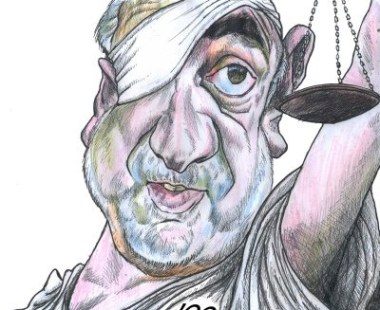
The Not So Blind Justice of the TSJ Decision on Leopoldo Lopez’s case

October 17, 2011


Well, I read the beginning and the end of the Supreme Court decision on the CIDH decision on Leopoldo Lopez and thought rationally, linearly, not with the twisted logic of the revolution. In this case, justice certainly was not blind, on the contrary, it was peeking all the way towards the future and covering all of the bases.

Or trying to…

When they were saying the decision can not be executed, they were saying Lopez has yet to be elected. They were saying he can run, be elected and then the TSJ will look into whether he can hold office or not. That is hypothetical.

Which is hogwash, as the CIDH explicitly said that his rights had been violated by banning him earlier. And he was banned. Period. Leopoldo Lopez was not able to run for Metropolitan Mayor. He is programmed  in the Electoral Board with a number which implies that he can not be a candidate. No two ways about that. What was said today is simply not the truth. The President of the Venezuelan Supreme Court simply lied. The decision is incorrect and not truthful. Lopez’ political rights have been violated by the State in Venezuela and the TSJ’s decision fails to address that point. As simple as that.

The rest of the legal  mumbo jumbo is simply covering their behinds and throwing confusion into the political campaign. Rather than disobeying the Court they go the typical Chavista way: The Gray Way. Can Lopez run? Yes, but maybe, just maybe, read between the lines, if he wins we may not accept his victory (I doubt it!)

But it does create confusion. It may split the opposition in pieces if they object LL registering to run. And I hope they don’t. I hope they allow him to run and back his running, time to turn Chavez’ weapons back at him. If LL wins, so be it, if he loses, so be it.

In fact, even Chavistas are confused, Cilia Flores backs the decision by the TSJ “not to allow Lopez to run” and the Comptroller in-charge, says that he can only hold office after the sanction ends, which is not what the decision says. Even Escarra says Lopez can not assume if he wins, which the President of the TSJ says the Court will have to rule when and if it happens.

And they cover their behind because, Lopez could lose in the primary and he could lose in the election even if he wins the primary. And if he wins the Presidential race, I am sure these Justices will allow him to take over. They also cover their behinds, or attempt to cover them, by not disobeying the CIDH decision, even if they are. But they confuse so much, it is not as if they were saying the Venezuelan Government will not follow the CIDH’s decision.

The strange thing is that I am not sure Chavez likes this decision. The TSJ was not really fully behind him on this. Lying or not, they did not defend Hugo’s position, they were very wishy washy (A sign Hugo is very sick?) Because Lopez could win it all and I think he would be unstoppable if he does. I just can’t imagine Lopez winning the election and the TSJ saying he can not take over.

I hope Chavez gets mad at them. Really mad. Because I see a crack in the TSJ’s decision. It is not 100% pure Hugo somehow. And LL could ask the full Court, rather than the Constitutional Hall to decide on it. But if I were him, I would leave it at that.

Note added: And the more the Comptroller in charge tries to explain, the more contradictions there are. By now, she is saying Lopez running would be fraud. Has she even read the decision? Can she read it? Who appointed here anyway?


Venezuelan Supreme Court Rules CIDH Sentence on Leopoldo Lopez Can Not Be Executed

October 17, 2011

In a twisty, legalese mumbo jumbo decision, the Venezuelan Supreme Court ruled that it can not execute the decision by the OAS Interamerican Human Rights Court (CIDH) on Leopoldo Lopez because, according to this temple of wisdom, Leopoldo Lopez has political rights, he can vote, he founded a political party and the like, but has this little matter of an  “adminisitrative ban” that “temporarily” prohibits him from holding office and this is simply a mechanism to guarantee “public ethics” (no joke!) and he can participate in political events.

I can not say I am surprised, but I was surprised that Chavez criticized the CIDH but not the decision, which gave me a glimmer of hope that they would let Leopoldo Lopez run.

Lopez now has to think carefully what he wants to do, the MUD has allowed him to register for the primary, but this will only create confusion given that the CNE will not let him register if he wins. He is now the kingmaker if he backs someone else. Any candidate can say that he/she will name Lopez as Vice-President, once elected he can receive a pardon.

More interestingly, the Chavez Government has once again decided to move step forward in severing its relations with the rest of the world. The fact that the Venezuelan Government went to the Court and fought there meant that it had to abide by the decision, there are no excuses now. Venezuela will now have problems in international organizations and Chavez will have to forget about Mercosur and will be severely criticized at the OAS.

Another step by the Dictator to violate the rights of Venezuelans. More abuse of power. Another sad day in Venezuela in a long string of them.


PDVSA Now Giving Away Gasoline to Gas Stations

October 16, 2011

Well, it had to happen, the price of gasoline has been frozen so long (13 years) that the margin PDVSA gives gas station owners is so tiny that over two months ago the company decided it was not even worth collecting the small difference. Thus, PDVSA is now giving away gasoline to gas station owners for free.

This is just another symbolic event in the economic idiocy of the Bolivarian revolution, a company that needs billions of dollars to invest in maintaining its level of production, gives over ten billion dollars of free gasoline each year.In this way the richer you are, the more of a subsidy you get. Talk about regressive.

We will no longer need to make calculations of how much the subsidy is, cost of opportunity and the like. It is rather simple, the subsidy now is everything, multiply 800,000 barrels a day, times the cost of a barrel in production or in the world markets and that is what this idiotic policy costs the company and all of us.

Next: PDVSA pays gas station owners to sell gasoline…


Plan Caracas 2020: There is Some Planning and Thinking in Venezuela

October 13, 2011

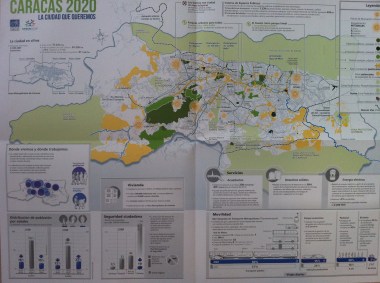
Last week I was in Caracas and a very good friend visited me, a well-known architect who works in the Alcaldia Metropolitana. He brought me a very nice gift, not so much for the gift itself , but because it gave me a sense of renewed optimism about the future. What he gave me was a copy of the Strategic Plan for Caracas 2020: The city we want to build.

This is the work of the Alcaldia Metropolitana, presided by Antonio Ledezma and the other municipalities, together with a whole bunch of volunteers. The material I got has two maps, today’s map of Caracas and the plan of what is required or the objectives for the city in 2020. This is the map I show above, it was a large map, so I took a picture with my phone to be able to show it to you.

The plan has general and specific goals. Some qualitative, some quantitative. Things it wants changed. Parks needed. Some things are ambitious, like removing private security to public streets.Others are controversial, like converting the golf courses in Country Club and Valle Arriba into parks.

But it is clear that people have been planning and thinking. Discussing things. Quite a change from what we have seen in the last twelve years.

I will not bore you with the details, but you can look up the website of Plan Caracas 2020, They have a Facebook page: PlanCaracas2020. They tweet: @plancaracas2020 or you can write to them if you like or don’t like something at plancaracas202@imutc. The text with the update of the plan is here.

The whole thing is like the fresh air Caracas needs, an organized group of people thinking and planning, experts and professionals in the relevant fields, not ignorant captains with no clue about what they are doing. Hopefully all Mayors of the municipalities of Caracas in 2013 will be from opposition parties, so that this plan can become a reality.