New PDVAL Head as clueless as his predecessors

June 26, 2010

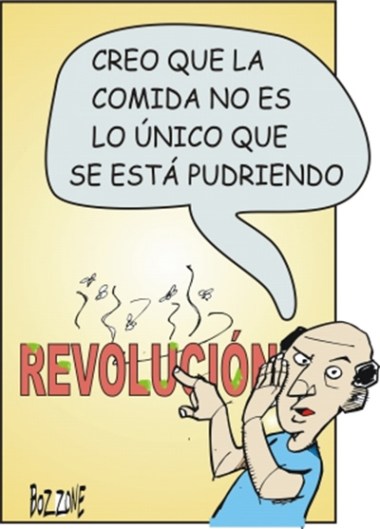
(I think that food is not the only thing that is going bad in Venezuela)

With over 120,000 Tons of food found either in a putrid state or expired over the last month, you would think that the new head of PDVAL, locally called Putreval, Colonel Carlos Osorio, would spend at least his first month in office looking at the logistics of how the food is brought into the country and how is distributed, to understand why so much food was left in storage and allowed to go bad.

Instead, the Colonel spends the day visiting a Polar facility and meeting the press to denounce that, lo and behold, they found all of 79 Tons of margarine at a Polar storage building. Imagine that! 79 Tons of a product, when the company he presides has allowed four orders of magnitude more of food to go bad over a few months!

I guess they don’t teach orders of magnitude in military school in Venezuela or the Colonel was transferred just when the subject was going to be covered in class.

But this simple example shows why this Government is so incompetent and ineffective. A guy on his first day on a job which requires managerial experience, that he clearly does not have, (otherwise he would not be a Colonel) rather than attempting to tackle the overwhelming task in front of him, chooses to devote his time attacking the private sector, using a miniscule amount of food as an excuse to accuse them of hoarding.

Miniscule, because Polar provides a large fraction of the margarine in the country under a variety of names, in a country of 26 million people, where 160,000 tubs of margarine are probably sold every week of the year and as the Polar representative explained, since Thursday was holiday, there was more material in storage than usual.

But the problem is clear, the Government spends all the time on propaganda, avoiding responsibility and trying to distract attention from the myriad of problems it has created with its incompetence.

And this simply indicates that Colonel Osorio will be another failure in his new position, as he will not have the support either of funding or logistics that PDVSA used to have PDVAL. He probably thinks the military will do a better job than PDVSA, but this example clearly shows this is unlikely to be the case. He is as clueless as his predecessors and throwing money and soldiers at the problem will not solve anything. You just need organization, management and hard work!

But that is too much to ask from anyone in this Government, which always finds time to spend on the less important things.

Meanwhile the Legislative Council of Monagas State decides to investigate Polar for the firing of one worker, the same week that Chavez freezes all collective bargaining agreements in the country, forbids salary increases and bonuses for any worker in the Venezuelan civil service. But all these workers do not appear to have any labor rights, but the Polar worker needs to be protected.

It is all smoke and mirrors, trying to hide the reality of the failure of the robolution in all fields of Government.But after eleven years, people are no longer fooled as easily, no jobs, inflation and shortages have become the main concerns of the population which is tired of a robolution that has failed to deliver.

A radical shift to the radical left in Venezuela

June 25, 2010

Believe it or not, within the robolution some people think there is a “right” and a “left”, the “right” belonging to those that want a little more pragmatism and less ideology for the sake of the survival of the robolution (with an “o”), while the left is composed by the more Pol Potian leaders, whose idea of socialism is averaging down everyone, until we are all as poor and as obedient to the “process” as can be.

It is not a very well-defined line. The more radical wing is actually more honest or should I say less corrupt, less touched by scandals, while the “right wingers” are also pragmatic when it comes to their life styles and allowing others to stick their hands in the till. They have discovered the good life and heck, they enjoy it.

The leader of the Pol-Potians is of course, Jorge Giordani, “The Monk”, who has been Planning Minister forever, where he has accomplished failure after failure in his planning and economic policies. But his honesty and chemistry with the All Mighty leader has allowed Giordani’s incompetence to flourish. Giordani took a gigantic leap forward when he was finally upgraded to Ministry of Finance, a position in which his decisions can directly and immediately screw up the Venezuelan economy and lead to the type of destruction on which XXIst. Century Socialism, whatever that may mean, can be built upon.

But a new powerful leader has emerged in the midst of all this, current Vice President Elias Jaua, the Ph.D. in Sociology who has presided over the not so successful land and agricultural policies of the Chavez era. After two million hectares under his control Jaua seems to have realized that he could not get more than 5% of them to produce and the real power is not in the land like Pol Pot and Mao dreamed of, but in the robolution the power is with the imports, that’s where the money is, so let’s go after it.

Some claim it was actually Jaua who started leaking all of the information about the food going bad all around the country as a means to get a strong hold on PDVSA’s subsidiary PDVAL, as well as the companies nationalized by Chavez in the last two years in the food production sector. If true, the plan worked out perfect as PDVAL is now directly under the umbrella of the Vice-Presidency and the food companies are part of the Minister for Feeding, another Jaua subsidiary.

In a perverse sense, this is good news for Venezuela. The food import and distribution is completely removed from PDVSA’s daily activities, which will allow its management to concentrate in the most important business in the land: Oil. PDVSA should have never been involved with PDVAL, but Chavez’ belief that PDVSA’s weakened management and almost infinite resources would solve the problem and Ramirez’ thinking that being in charge of the biggest exporter and the biggest importer in the land would make him untouchable, forced PDVSA into an undesirable and unwanted business.

But this is also bad news, as Jaua and his cohorts are full of ideology and have little managerial expertise to undertake the task that they have brought upon themselves. They may think that by being honest (less corrupt?) they can manage the food import and distribution business more efficiently, but they also belong to the Chavista strain that believes that anyone can do anything, even if eleven years of failures proves otherwise.

And besides the lack of management, there will be the lack of the ample resources (read cash) that PDVSA had and which can move mountains whenever it is necessary. No secret budget can even approach the levels of funds and agility available to PDVSA, something that Ramirez is certainly going to shield now from Jaua’s desires.

And it is a bad moment for this to happen. With the private sector now strangled, if the new PDVAL runs into troubles with the flow of imports, the shortages will be even more dramatic, completing the circle of good news/bad news for our dear country.

In some sense, Ramirez has to go now for Jaua to be successful in his new enterprise, but somehow the Minister of Energy and Oil is a true survivor, a man of many secrets and many suitcases, which so far have averted his demise.

But there is only one survivor, for now, in the robolution, and his name is Hugo Chavez. Ask Diosdado Cabello and his cohorts, six of which were swiftly removed from the Cabinet simultaneously with the PDVAL grab in the name of the Parliamentary elections. Or ask former Vice-President Carrizales who stood up for the military in the face of a Cuban invasion in key military positions and was quickly replaced by the quiet sociologist with the name that always seems short a consonant.

They are all gone for now, but they may return like comets, much like Diosdado has reappeared whenever things were not working well. Ideology imports little food and feeds few mouths and every time Chavez has shifted to the Pol-Potians he has eventually found the need to bring back the “right” to straighten out the mess.

For now, you can assume the worst case scenario, think Banks, think Globo, think Pol Pot, the total destruction of a system in the name of a nebulous idea which is still a work in progress eleven years after Chavez’ ascension to power. Only a quick deterioration could shift the balance of power at this time.

And Chavez needs a magician to stop the unraveling of the Venezuelan economy, which may lead to the resurgence of the radical “right” and the cycle would begin once again.


Not much news in the Teflon robolution in Venezuela

June 23, 2010

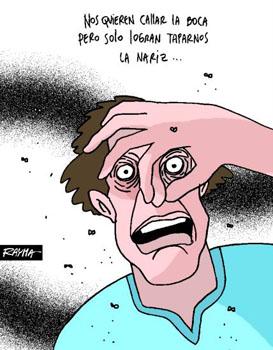
(They want to shut our mouths off, bit all they have managed is to shut our noses off)

Yes, not much stuff to blog about. The way things are going in Venezuela the word “news” requires something beyond imagination, because the “routine” just does not cut it here in Venezuela anymore. Chavez used to be a Teflon President, but we now seem to have a Teflon Government. Nothing sticks to it, nothing scandalizes, everything in the end is the opposition’s fault and/or absolutely irrelevant.

Take the by now 120,000 Tons of putrid food imported by the government. It turns out that the word “putrid” is just an exaggeration. It is just “expired” food, or some socialist concept like that. And by the way, it is mostly the private sectors fault, according to the Chief Mismanager, the President of PDVSA Rafael Ramirez According to this genius, who will go into history as the destroyer of PDVSA. the private sector is responsible for their putrid food, because they were in charge of the ships and the storage companies. Funny, the storage companies were nationalized long ago and in any case, if this were the problem, the Government would be finding lots of private sector spoiled food. Instead, every time they raid the private sector companies, they take the food away for hoarding, but somehow it is never spoiled, bad or whatever euphemism you want to find for a large fraction of what happens to the food brought in by the Government.

Oh, how come the Cubans who run the ports are exempt from fault? Oh, yes they are Cubans…

And then you wonder when the Comptroller surfaces and says that he started looking into the rotten food two years ago. Are you kidding me Clodosvaldo? That was 120,000 Tons ago! What have you done since then? Of course, Leopoldo Lopez used money for one purpose to pay a Chavez’ ordered salary increase, it only took you six months to ban him from running for office. I guess the PDVAL or PUTRIVAL guys can be elected for the next National Assembly, at least they will know where to look for the corruption.

Which brings me then to the “People’s Ombudswoman”, who always comes to the defense of the Teflon guys, but seems rather quiet on the subject of the possible poisoning of the population. She should be concerned, after all, the spoiled food was not meant for the oligarchs, but for those that vote for Hugo, or at least used to. What morals does this woman have? As Diego Arria told Chavez, I tell her: “See you in The Hague” and I include Clodosvaldo and his double pension in this too.

And speaking of those pensioned off, how about funny man Norman Puerta, the former and retired anti-drug czar of Venezuela, he was caught with a million dollars in that idyllic country, but it has nothing to do with drugs or anything illegal, it was just “a misunderstanding over the money he saved”, just  a million bucks of savings for a guy who made made maybe US$ 1,000-$2,000  a month. But you know, the people who work for the Chavez teflonic Government, particularly in the anti-drug sector, they lead spartan lives, after 11 years in power they can save a million bucks. I’s just discipline, even if you don’t believe the math. It would only take him 500 months to make that million, and that is only 41.6 years, Chavez should last that much if things keep rolling along the way they are.

And in the middle of all these irrelevant news, Chavez issues a decree saying that nobody, absolutely nobody, can negotiate a collective contract agreement without his authorization. Never mind that this has been the silent “rule of law” for the last five years. It is an intrinsic part of XXIst. Century Socialism, that unions are out and Chavez’s party PSUV is in. Thus, no negotiations, no salary increases, no unions. And some people still think this is a left wing revolution.Neither the workers, nor the people can revolt in Venezuela.

It is all about Hugo.

But thanks God these are quiet times, not much happening, not much to write. When something does happen, you can be sure I will report back to you beyond the banalities of the robolution like those described above.

In the meantime, I will do like the opposition leaders, work on my stuff, even if I don’t want to get elected.


A look at the foreign currency that the Venezuelan Government may have in 2010t

June 20, 2010

One of the mysteries this year is why the Government has been so stingy with the exchange control office CADIVI as well as its decision not to supply more foreign currency to any alternative market, despite higher oil prices.

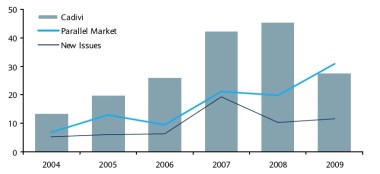
That is why I was mesmerized by the following Barclays graph which was published this week. In this graph Barclays plots for each of the last six years, how much CADIVI gave out to importers, how much the parallel market traded and how much the Government issued in bonds.

The first surprise, because I had not looked at the totals for a while, was that the swap market was larger than CADIVI last year. What this means is simply that PDVSA preferred to change at the highers swap market rate than at the Bs. 2.15 per $ rate which prevailed last year. This is because in the end the Government via the Treasury, Fonden or whatever  other mechanism was the main provider of foreign currency to the swap market. Thus, in the end it is the Government that provides both markets.

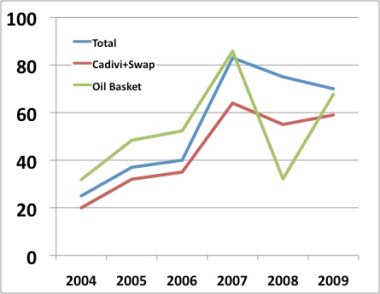
Thus, in some sense, it is better to look at the total CADIVI+SWAP market+Bonds and subtract the bonds to get an idea of what the last few years were like. I plot that in the next graph together with the price of Venezuela’s oil basket (sort of assuming production is constant, which it is not)

In the above graph, the green line is the average price for the Venezuelan oil basket for the year in US dollars, while the blue line is the total amount of US$ dollars (in billions) given to importers by CADIVI and/or purchased in the swap market plus bonds issued, which in the end measures the number of dollars to which the Government had access on any given year. The red line simply subtracts the issuance of bonds from that total, it is a measure of the deficit of foreign currency the Government had, which forced it to resort to issue bonds.

Let’s look at this graph historically. In 2004, the oil basket was US$ 31.85 and the Government “had” some US$ 25 billion of which it had to issue US$ 5 billion in bonds. The total amount for 2004,2005 and 2006, scaled reasonably with the oil price, in all three years the Government issued US$ 5 billion in bonds to complement its needs, “using” US$ 25 billion, 37 (up 50% from 2004) billion and US$ 40 billion (up 8% from 2005), as oil went from US$ 31.85, to US$ 48.36 (up 51.8% from 2004)  and US$ 52.31 (up 8% from 2005) per barrel in the same years.Basically the increases were almost identical from year to year.

Then, in 2007, oil prices jumped by 64%, but the Government needed US$ 83 billion, a 107.5% increase in foreign currency in 2007 over the previous year, including US$ 19 billion in financing.

And here is where things get murky. In 2008, with oil dropping 62.5%, the Government used up US$ 75 billion, barely 9.6% below 2007, despite the dramatic drop in oil prices. How could this be?

Well, the only possibility is that the Government used funds from the development funds Fonden, taken from international reserves, and other savings in foreign currency to fund part of the needs for 2008.

And it did the same thing in 2009!

Thus, from 2007-2009, the Government “used” 75% more foreign currency than in 2006, but the average oil price in those three years was only up 29%.

And then we come to 2010, this year the average price of the oil basket is running roughly at the level of last year, in 2009 it was 67.7 dollars on average, so far this year it has been US$ 70.26, less than a 3% increase. Except that it is going to be quite difficult to issue new bonds, subtract US$ 11 billion from last year and there will not be as much in Fonden as there was in 2009.  In fact, Fonden began 2009 with US$ 19 billion and this year at no point has it had more than US$ 9 or 10 billion. Thus, the “Total” in the graph for 2010 will have to be around US$ 50 billion, once you subtract no new issues, half the money (likely more) in Fonden.

Finally, PDVSA has higher cash flow needs, thus the number may be even smaller, as international reserves have been dropping, even with lower CADIVI outflows, which implies PDVSA is handing out less money to the Central Bank.

What this all means is that there will much less money for imports, which will only be complicated by the banning of the swap market, which used to provide an alternative to the official market for importers needing items to complete their manufacturing and/or buying spare parts.This will translate into shortages which I am surprised has not intensified as of yet. Most manufacturers/importers say that they typically have about six weeks of inventory. which means we should start seeing the impact of these foreign currency problems in less than a month.

(Note: Some of the money from the bond offerings flowed back into the swap market, thus I may be double counting somewhat, but this changes little the conclusions)


When an opinion becomes “close to a crime” and the real crimes go unpunished in Venezuela

June 17, 2010

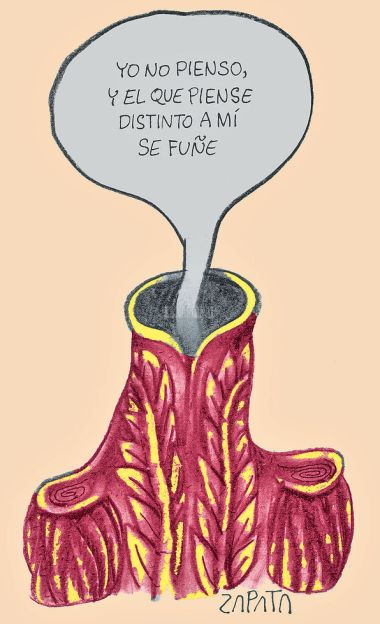
(I don’t think and anyone that thinks differently than me is screwed!)

In another displayed of intolerance, Hugo Chavez reacted violently to the statements by the President of the Medical Federation, Douglas Leon Natera, who was extremely critical of the graduates of the Integral Medical Community program, to whom Chavez went personally to give them their diplomas.

Natera says that this program does not create the replacement to medical doctors as Chavez and the Government would like you to believe. According to Natera and others, these graduates are part of an improvised program with Cuban teachers who are not even doctors and little practical experience. The training is apparently done with movies and pictures an the trainees don’t see real patients and practice as doctors usually are trained. The Government plans to now insert these improvised medical trainees into hospitals as if they were fully trained Doctors. Of course, Chavez told them never to treat an oligarch in a new twist to the hippocratic oath that these graduates lack anyway.

Chavez reaction? Oh, very simple, he qualified Natera’s well founded opinion, based on technical elements as “close to a crime” as Natera’s statements, according to the all powerful Dictator, are close to a crime, because they “create alarm in the population”.

Of course, the deaths from mistreatment and improvisation in the country’s Government hospitals do not “create alarm” and nobody is responsible because no one in this Government assumes any responsibility for its errors, starting with the autocrat himself.

But Mr. Natera should watch out for himself, you can be sure the Prosecutor already opened an investigation into his “almost crime”, while those crimes committed by these fake doctors, while illegally practicing medicine will go unnoticed and unpunished.

What else is new!


Venezuela’s rotten “humanitarian” aid to Haiti

June 16, 2010

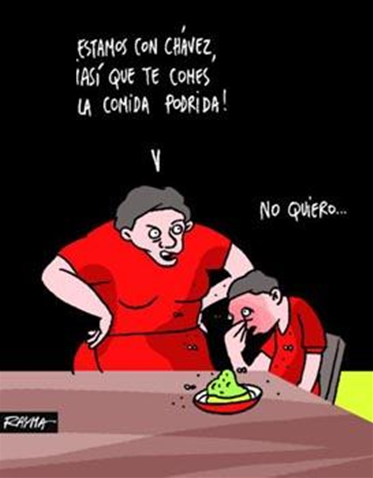
(We are with Chavez, you better eat the rotten food. Kid: I don’t want to)

When you think you have heard enough, the headline shows that the Dominican Republic sent back a Venezuelan ship with rotten food which Venezuela sent to Haiti as “humanitarian” aid. The ship arrived in Venezuela on June 6th. and has been sitting there with all of its 39 Tons of spoiled food.

Thus, this happened ten days ago and the Government knew about it, but has done nothing about it. Who was the “humanitarian” in Government that decided to do this gesture? Who organized this shipment? Who financed it? Who paid for the ship? Where did the food come from?

Those would be normal (and moral!) questions that in any country with checks and balances and the rule of law, the Government would be asking. This case has corruption, incompetence, misuse of funds and inhumanity all rolled into one. (And I suspect some discrimination too)

Instead we get total silence from Chavez on down. Where is the Comptroller? The Prosecutor? The People’s Defender? (Yes, Haitians should be protected from amoral Venezuelans). If Chavez were against corruption and felt for the people of Haiti and the people of Venezuela he should be calling for the jailing of whatever chain of command did this, whomever it may take down. Instead Chavez defends those responsible for 82,000 Tons of rotten food in Venezuela, calls it a “small” amount, with his total disregard for human life and dignity. And these people are ripping off Venezuela right and left.It’s all about corruption in the end.

Every time I think I have heard enough bizarre stories in Chavez-land, the incredible ability of the “robolution” surprises me once again.

It also shames me.


Hugo in the Sky with Diamonds

June 16, 2010

Banco Federal intervened, obviously political, long overdue

June 15, 2010

So, Banco Federal was intervened yesterday, years late, politically timely. Just think, the Government via the Depositors Guarantee Fund now owns 20% of its media nemesis Globovision.

But I am getting ahead of myself.

Banco Federal had been in trouble for a long time, anyone that can read a balance sheet knew that. It participated eagerly in the “structured note” fiasco, had to cover some of the losses (US$ 60 million if I recall correctly) but in the end accounting smoke and mirrors was insufficient.

With the intervention of the banks of the “bolibourgeois” last November and December, rumors spread about Federal, fueled by none other than Hugo Chavez, who mentioned repeatedly on nationwide TV the name of the owner of the bank, saying he would have not trouble intervening his bank if necessary.

But he did have a problem with doing just that. The clumsy initial steps in the intervention of  a dozen or so banks, led to rumors about Federal being in trouble and the Government began to worry about the whole system shaking, if it acted too rashly. Thus, a decision was made to postpone the inevitable, until things “improved”. But things never improved much. In fact, Banco Federal stopped publishing its monthly financials in the newspapers, let alone its 2009 financials, which were never published, as the law mandates. Enough to make you want to stay as far away from the bank as possible. The bank had a lot of illiquid investments in its balance sheets that most specialists know what it means: I am hiding huge losses in those investments, hoping there will be a brighter day.

But the brighter day never came. The Government reportedly even gave Federal money to prop it up, but it was a lost cause. It was just a matter of having the excuse to do it. Intervening it was long overdue.

The Government pressured Globovision and its main owner Guillermo Zuloaga and Ravell was let go, Zuloaga was threatened with the charge of hoarding cars and later of accusing Chavez of murdering people. The second charge was harder to prove, thus they went bank to the hoarding.

But Globovision never changed its editorial line. Thus, the next to the last step was taken: Take over Mezerhane’s bank, which owned 20% of Globovision, and they did.

If this does not do it, then the TV station itself will be next, but maybe the owners can now be persuaded that the Dictator means business, they did not seem to understand it before.

Globovision is the only TV media outlet whose outpost is not sanitized and sterilized prior to broadcasting. There can be dozens of protests in Venezuela in any given day and only Globovision shows it, the normalcy in the rest of the media is somewhat scary.Orwell would have been proud of Venevision and the rest.

Thus, the next to last political decision has now been made: Seize Banco Federal. Will Chavez dare to take the next step in the sequence before the September elections? Will he go first for the banks? For the food division of Polar? Or for Globovision?

All three would be the magical trifecta for the Dictator, but can he afford to do it?


Guidelines for BCV exchange market published

June 14, 2010

“Only” four days after the BCV foreign exchange began operating, the Central Bank published, not the regulations, but the “guidelines” for its operation.

What does this mean? A regulation fixes things and how they can be done, a guideline is a suggestion, an orientation. But I doubt you can ask to buy one dollar more than the “guidelines” sugeest.

It’s just revolutionary flexiblity, it may come in handy at some point (For them)

So, without much furrther ado, here is the final version of the “guidelines”:

-It only applies to Venezuelan companies or Venezuelan citizens, not to residents or foreign companies that operate here through a subsidiary for example.

-Companies will be able to buy up to US$50,000 per day and  no more than US$ 350,000 a month (cash value, not bond value), as long as: i) you are not in Lists 1 and 2 or ii) if you are in Lisst 1 and 2, that you have not received any money from CADIVI for the last 90 days and iii) To buy capital equipment.

-Individuals will be able to ask for US$ 1,000 a month and up to $ 6,000 a year in order to send to family members abroad.

-Individuals will be able to buy US$ 5,000 a year for: i) Studies abroad, ii) Travel abroad and iii) To pay for goods required to provide professional services.

-Up to $10,00 for special cases of health, cultural and sports nature.

That’s it, on your marks, set, go…place your order,  soon…


Central Bank foreign exchange market, Cadivi 2.0, begins functioning even before it is regulated

June 13, 2010

(BCV band system. Another devaluation!!!)

The new foreign exchange system went into “operation” on Wednesday, despite the fact that the regulations have yet to be issued, people have just seen some drafts for them, but this did not stop the Government from opening that “market” in order to stop the criticism that it was being delayed. Even today regulations have yet to be seen.

The draft of the regulations says that companies will only be able to ask for US$ 300,000 a month, but no more than US$5 50,000 a day, something many big manufacturers will laugh at. El Nacional said today that this amount would be raised to a million dollars, still insufficient, but definitely an improvement for medium size industries.

However, there are other limitations for this. A company will only be able to participate in this market if it does not qualify for the so called “Lists 1 and 2” of items that CADIVI has. If your product or raw material is in any of those lists, you will only be able to participate in that market if it has been 90 days since the last CADIVI approval.

Individuals will be able to buy up to $1,000 a month to send to relatives abroad and buy up to $5,000 a year for educational expenses or for travel expenses abroad.. Individuals may also request up to $10,000 a year for health, education, sports and cultural reasons, whatever this may mean.

The Government claims that trading was done in the amount of US$ 17 million or so the first day at the upper side of the range at Bs. 5.3 per US$ , who knows who participated in that market. One has to wonder how this could all work without regulations, how did those participating decide how much they could ask for if regulations did not exist?

Get your quota as soon as you can, it will never be cheaper than this. Ever.

Clearly, the whole system is CADIVI version 2.0, another restricted, difficult way to have access to foreign currency. Companies and individuals will learn in time how to use it, but it will be inefficient in providing fluidity to manufacturing and commerce in Venezuela. The now banned swap market provided such fluidity as anyone could buy even large amounts if the operation required it. This will no longer be the case.

Thus, another level of improvisation and control by this incapable and inefficient Government has been reached. This will result in shortages, inflation and lower economic activity, but Chavez himself says these are capitalistic concepts that are irrelevant in a socialist economy.

I wonder if the “people” agree with him when all sorts of things are missing from every day life.

Of course, it will never be the fault of the Government and Chavez’ cronies, there will always be someone else to blame. They are all doing a wonderful job with 30%+ inflation, -5%+ GDP contraction and wasting 10% of the food the Government imports. Who says they are not incredibly incompetent and that their XXIst. Century Socialism model is not a gigantic failure?

When will they notice it? When they can no longer steal enough?