

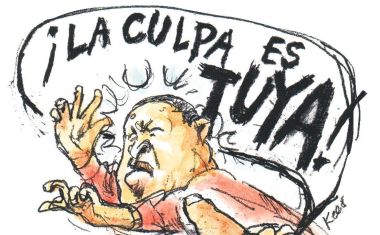
People do not need brainy and technical economic analysis. The huge queues at appliance stores were more than eloquent this weekend. Everyone knows that devaluation is synonymous with outrageous price increases, so the army of fire nts went out to buy what they could at old prices. We are veterans of devaluations. This is not our first Black Friday. We also know what’s coming: a cost of living increase that will make us sweat oil in order to cover our expenses.
Chavez has no excuses. It was his crazy economic policies that forced him to devalue. Devalue after five years of the greatest oil boom of the century, during which billions of dollars entered the country, but they were poorly managed. You can not hide behind an inherited fiscal crisis created by “previous administrations”. The two previous administrations are his and a bit of a third one too. He gave birth to his own fiscal problems.
He can not argue that he was left with no international reserves, because there are 35 billion of them. The economic downturn is yours-your own. The Great Charlatan was saying we were “shielded” from the international crisis. But the armor could not withstand the impact of National Destruction Plan put forward by Chacumbele. The Venezuelan economy fell 2.9% in 2009 but the world’s only by 1.1% and 1.8% in Latin America. Our economic performance was much worse than the global average and the average of the continent. All the nonsense that led to this brutal devaluation are therefore their exclusive brand. This devaluation is made in Miraflores. Inflation, recession and now devaluation, will bring more inflation and more recession.
Experts call this stagflation. Stagnation plus inflation. ¡What a beautiful revolution! They devalued late and did it badly. Why did do it then? They have not deceived anyoneN. The government needs the money and it will draw it from our pocket, driving into us the worst possible tax, inflation.
Each oil dollar will produce now Bs. 4.30 and not Bs. 2.15.
He doubles his revenues. More money to waste and to finance his campaign.
Additional pressures on prices. The fallacy that our minimum wage was the highest in Latin America became shit. St Bs. 2.15 it clearly was but not at the or 7 per dollar of the swap rate or the Bs. 4.30 we have now. We will have a year of strong wage pressures because the high cost of living, already intolerable, will be even worse. Costs more expensive, therefore, more fuel to inflation. But do not even dare tell the truth. Deceive the people with pure lies. Now tehy say thos is to stimulate exports. Please! Do you believe we are stupid? After eleven years of preaching “endogenous growth” (import substitution), suddenly they discover that what matters is to export, or “exogenous growth. The ineffable Professor Giordani says that they “seek to make Venezuela’s economy more competitive by promoting exports.” Too late baby!. Eleven years destroying the productive sector, with non-oil exports which last year barely reached a little over 3 billion dollars, and now we come with the story that the mere devaluation is going to take you out of the hole. This is not enough to overcome the disaster of exporting state enterprises ruined nor the private schools which are broke.
They allowed the currency to be overvalued to demential extremes , a typical manifestation of the rentist, and spent a wad of dollars to crush the parallel rate to no avail, and now Chacumbele lectures us on overcoming the “rentist economy”. Go to hell!
 The Devil's Excrement
January 12, 2010 at 8:32 pm
Miguel Octavio,
Can you please delete my username from this blog.
Thank you.
January 12, 2010 at 8:32 pm
I will leave. Thank you.
I apologize for any inconveniece caused over here.
I will not comment on this blog again.
January 12, 2010 at 8:20 pm
MO, I agree with island canuck, to me it seems as if Nicolaas is just self-promoting and trying to gain readership through your blog.
Anyway, your blog, your rules. Each of us are free to start our own.
January 12, 2010 at 8:17 pm
We call it spamming, putting your POV once is enough, repeat ad nauseum is spamming to obtain an audience or to get traffic thrown his way, or improve ones google ranking.
January 12, 2010 at 8:04 pm
Nicholas: I know that Venezuela has been declared to be under hyperinflation, I know about IAS 29 and what it means, but how does it help my blog to link to something the readers can’t read? The point is that you have bee repeating your arguments about hyperinflation, but I believe the readers are intelligent enough to understand them the first time around. I also agree with dollarization, so I am not sure what you mean about a different point of view or input, We are in complete and full agreement!!!!
January 12, 2010 at 8:01 pm
Miguel Octavio,
Feel free to delete all my comments on your blog if you want to. And my username too.
I get the impression that you don´t want any different input here.
You do not seem to tolerate different opinions.
January 12, 2010 at 7:51 pm
I deleted it because that link is useless unless you have a login and password and you have posted it a few times, it does not tell people much to do that and clutters the comments.
January 12, 2010 at 7:35 pm
Impartial,
I responded to your comment, but, my response was deleted. I don´t know whether this respose will also be deleted. My previous response was totally different to this one.
So, Impartial: you have now added a great deal of value, which I think most people on this blog support by stating:
“Venezuela has very high inflation but it still has some way to go to the real thing.”
So, let it be then: It has been agreed by majority general acceptance that Venezuela is not in hyperinflation.
I support democracy. So, I will accept your word for it that it is generally accepted on this blog that Venezuela is not yet in hyperinflation.
Venezuela is not in hyperinflation.
January 12, 2010 at 7:13 pm
Yeah, it’s getting very boring.
Actually I think he’s just promoting his own blog.
January 12, 2010 at 6:46 pm
The point has been made, but you dont have to post it in every article.
January 12, 2010 at 6:32 pm
Hey Nicolaas, you are pretty annoying with your definitions and accounting pronouncements. Hyperinflation is more than what you read in there. You must be new to this, fresh out of school. Venezuela has very high inflation but it still has some way to go to the real thing.
January 12, 2010 at 5:44 pm
Venezuela is in hyperinflation since November 2009. PricewaterhouseCoopers published that on 17 December 2009. Everbody in Venezuela is still in denial about that.
Hugo Chávez is playing with fire when he thinks he can abuse sovereignty to create a fantasy economy where he can half his national debt overnight by presidential decree. Sovereignty in the wrong hands is like casting perls before swine. Vide Zimbabwe.
Venezuealan companies now have to implement IAS 29. IAS 29 will make no difference and is not intended to make any difference to hyperinflation in a country. IAS 29 can be used to stabilize Venezuela´s entire non-monetary economy. Not by restating Historical Cost year end financial statement prepared in terms of the real value destroying HCA model at the end of 2010 at the year end CPI rate to make them “more useful”, but, by updating all non-monetary items in the country daily at the daily parallel rate.
That would include trade debtors and trade creditors which the International Accounting Standards Board and PricewaterhouseCoopers mistakenly classify as monetary items. They are constant real value non-monetary items and have to be updated daily at the parallel rate in Venezuela.
Implementing IAS 29 by applying the daily parallel rate is, in principle, the same as Brazil´s daily indexation for 30 years from 1964 to 1994. They had a stable and sometimes growing non-monetary economy with up to 2700% annual hyperinflation in their monetary economy. This gave Gustavo Franco and his team a chance to work out a way of how to kill their hyperinflation. It took them 10 years, but, they had a more or less stable non-monetary economy because of daily updating of many if not all non-monetary items at daily rates supplied by the government. If Brazil could do that for 30 year then Venezueal can do the same.
There is very little chance in this happening when Sir David Tweedie, the Chairman of the IASB, support the two very popular accounting fallacies, namely the very destructive stable measuring unit assumption and financial capital maintenance in nominal monetary units (which is impossible per se during inflation and deflation) as authorized and approved by the IASB in the Framework, Par 104 (a) twenty years ago. The Framework, Par 104 (a) states: “Financial capital maintenance can be measured in either nominal monetary units or units of constant purchasing power.”
The IASB thus authorized and approved the two very popular accounting fallacies and their only and perfect antidote in the exact same statement. The antidote is perfect during inflation, hyperinflation and deflation; the values may not be.
January 12, 2010 at 5:30 pm
For the people experiencing the black-outs, take care to disconnect all electric appliances that could malfunction when the electricity comes back, specially think on the risk of fire! (electric furnaces…).
January 12, 2010 at 5:01 pm
And tomorrow begins the (official) restriction of electricity. What will be the impact on economy?
January 12, 2010 at 2:18 pm
“Go to hell!” – probably a common/easy trip for him, as he is the “manager” of the devil’s excrement
January 12, 2010 at 4:36 am
and the first businesses accused of ‘speculation’ –
http://news.bbc.co.uk/1/hi/world/americas/8453570.stm
January 12, 2010 at 4:06 am
Teodoro,
Venezuela is in hyperinflation since November 2009.
Here is the link to the PricewaterhouseCoopers article published on 17 Dec 2009:
https://pwcinform.pwc.com/inform2/show?action=applyInformContentTerritory&id=0920175412162144
January 12, 2010 at 12:01 am
It’s hard to get used to it but socialism and populism does it again and again.
How Venezuelan socialism, populism and devaluation bankrupted my business back in 1984.
http://softwaretimes.com/files/how+to+bankrupt+a+business.html