Archive for January, 2010

One for the skeptics that the electric crisis is not all Chavez’ Government fault

January 13, 2010

Since people are still not clear about whether rain has anything to do with the water problem, here is a six year proof that it is ALL the Chavez’ Government fault:

1) 2003 report by Veneconomia entitled “Guri at the edge of collapse”.

Some highlights:

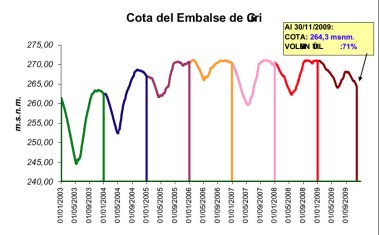
a) The water level was at 246.71 meters, last report it is at 264 meters, 18 meters above that “critical” level that required no rationing. Why?

b) On an equivalent date (end of the year) in 2003, the water level was a few meters lower as can be seen in this plot published by Corpoelec on Xmas:
c) The report says that experts suggest starting a savings and rationing program in 2001, it is now 2009

d) The article quantifies the delay in investments up to that point: BEFORE THE OIL BOOM.

2) In October 2009, THREE MONTHS AGO,  Caracas Gringo said in no uncertain terms:

“It matters because officials at the Guri hydropower plant/dam operated by Corpoelec subsidiary Edelca report that turbine unit No.2 – which is currently shut down for maintenance – vibrates abnormally when in operation.

The Edelca officials also report that the concrete spillway that funnels water into turbine unit No. 2 has suffered structural damage (“perforations”) about 93 meters above the turbine unit, which make it increasingly difficult to control the volume/flow of water running through the power generation turbine.

However, turbine unit No.2 is only one of seven turbine units currently out of service at Guri, which has 20 turbine units with a combined power generation capacity of 10,000 MW. The other turbine units offline at present include Nos. 5, 6, 8, 10, 12 and 16.

Regional newspaper Correo del Caroni reports that turbine unit No.8 is almost ready to be restarted.

But Edelca officials at Guri complain that Corpoelec’s insistence that the repairs be accelerated is creating a dangerously unsafe situation in the turbine hall.

One attempt to restart turbine unit No. 8 earlier in October had to be suspended when the turbine’s rotation speed red-lined.

Turbine unit No. 16 has unspecified operational/technical problems which Edelca officials decline to disclose, even off the record. But a union official at Guri tells Caracas Gringo that turbine unit No. 16 is also, like turbine unit No. 2, a prime candidate for a catastrophic failure.

The other inoperative turbine units – Nos. 5, 6, 10 and 12 – are in the process of being maintained/repaired and soon will be restarted, according to Edelca and Corpoelec managers.

But union officials at Guri warn that these inoperative units also have unspecified problems which technicians are having problems repairing.”

So, don’t let Chavez fool you, it is not El Niño and it is not the IVth., it is the ignorance, incompetence and negligence of Chavez and his own Government! And its shows day after day

And by canceling the rationing plan imposed yesterday in Caracas and firingthe very improvised Minister of Electricity tonight, the Venezuelan President is showing, once again, the level of incompetence and improvisation in his administration.

(And today Caracas Gringo is out with another article on Guri that is not exactly very positive)

Zero Coupon dollar Bolibanana “auction”

January 13, 2010

The revolution never ceases to amaze. Today mid-morning, more like late morning, Reuters reported (The Central Bank leaked?) that the Central Bank was ready to sell US$ 50 million today as part of its effort to lower the swap rate. Not ten minutes later, the same source says they want the swap rate to go to Bs. 5 per dollar and the Central Bank will “auction” three-month zero coupon bonds.

So far, so good, the Government and the Central Bank have a new strategy, more transparent than the way they used to intervene the swap market. Sound very interesting. Except…

—The bond needs a market, buyers want currency, not bonds

—How can they do it this fast? They should announce it and then give people the chance to call clients and the like. A few days and this may work.

And then, as fast as you can say “Zero Coupon”, an announcement comes, you have to place your orders between 3 PM and 4 PM, those that “win” the auction will have to pay by 9 AM tomorrow and the bonds will only have custody at the Venezuelan Central Bank, no custody abroad. And…

And…in the best innovative Bolivarian style (Or is it Bolibanana?) the “auction” will be at a fixed price.

Say what?

Why even call it an auction if  this is the sale of a bond at a price and the Central Bank will decide using its Bolivarian random number generator who got the bond and who didn’t.

I know the Bolivarians hate markets, but this s somehow ridiculous.

And here I have to get a little “technical” and explain the bond. Since there is no auction, the price is like a nice full lunch in Paris “prix fixe”, the bonds will be sold at 116.25% at an exchange rate of Bs. 4.3 per dollar.

So, with the swap rate near Bs. 6, the Central Bank will sell you a bond with no interest, payable on March 14th. at Bs. 4.3 x 1.1625=Bs. 4.99875 per $. That is a difference of “only” 20%. (Note that we now have four rates of exchange, Bs. 2.6, Bs. 4.3, Bs. 4.99 and the swap rate)

That is, if you sold 1,000 dollars in the swap market at Bs. 6, you received Bs. 6,000 and you could turn around and order $ 1,200 of the new bond that in three months will give you $1,200. A nice 20% profit in US$ if you can hold on to the bond for three months.

But you had to have the Bs. in the Central Bank by 8 AM tomorrow, which not everyone could. Despite this, the Central Bank, I am told, received orders for US$ 500 million.

Thus, if the idea was like the Reuters source indicated, to lower the swap rate to Bs. 5, probably when they saw the size of the orders, they probably went to get some of these, because it looks like a very tall order to really lower the swap rate that much.

Unless of course, this was simply rigged to help a few make a buck.

Nahh! you say.

Well, here is the very transparent “result” of the “auction”. Yeap, they offered $50 million, they sold $50 million. And all at the “prixe fix” of 116.25 per $100. Who got it? Oh! That is confidential, someone definitely did. Not me, but I do want some.

It was indeed a Zero Coupon Bolibanana”auction”

XXIst. Century Socialism finally arrives in Venezuela: Electricity rationing begins tomorrow!

January 12, 2010

After eleven years of failed policies, the Government of President Hugo Chavez will finally achieve what it has been unable to achieve in any other field: It will bring to all Venezuelan citizens a true feature of socialism in the form of electricity rationing. Yes, I know, dollars were rationed too before, but the poor have no access to them. Thus, for the first time the Government will impose a policy on all of the citizens which represents a worsening of their quality of life, certainly a very distinct characteristic of socialism and similar regimes. Somehow, they always end up imposing rationing of some sort.

Way to go Hugo!

And if the policy was not bad enough, it was announced an implemented with the same level of confusion, incompetence and improvisation that caused the electricity shortages, Daniel has a good summary of some of them, but I will describe some in more detail.

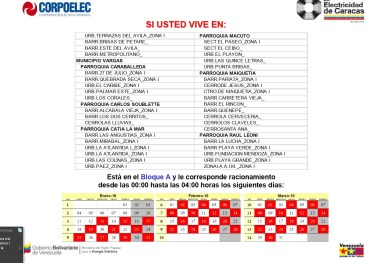
Basically, in Caracas (so far the rationing details have not been announced everywhere), every two days, wherever you live or work, there will be rationing for four hours in 4×6 chunks. You can download this complex document (see one page above, including the cynical Ahora Venezuela es de Todos sign), where you can see which Areas of Caracas correspond to each block. If you are in block A then you can find when your home or work will have the electricity shut off from midnight to 4 AM, from 4 AM to 8 AM and so forth.

Except that for each area, even to some streets, there are six zones for each residential or business area. That is if you are in Zone 1…

but wait, nowhere does it say how these zones are defined! That is, rationing begins tonight in about three hours, but nobody knows what their Zone number is. I have reviewed my electric Bill, no zone. I have tried to log in to the Corpoelec website, overwhelmed. Electricidad de Caracas website, also overwhelmed. Not ready for prime time, but coming very soon.

You’ve gotta love the robolution! Even when they deliver socialism, they do it inefficiently and incompetently!

But I digress..

Once again, the Government imposes a half-baked model. Since it is hard to know when somebody will or not be shutdown, there will be a lot of frustration and wasted time.

Let me give you a simple example: Suppose somebody wants to visit my office. We actually installed an emergency back up power plant eight months ago (We were certainly not surprised by all this, even if the Government was!). It can power us up for a total of 24 hours. However, if the person does know we are open, they will not show up. And even if they do, they may not want to walk up eight flights of stairs and then sit in my office without air conditioning for an hour or so.

But then look at it from our point of view, if our counterparts in our business are shut down, that in itself will hamper my business. How can I sell somebody something if they are not there? Because in fact, few of my counterparts had the foresight to get an emergency plant. In fact, we were originally told we could not install one in our building, but when the future looked clear to many last year, we were told to go ahead. (If we knew, why didn’t the Government know?)

And remember, the lag now is eight months to install an emergency power plant of any reasonable size. (I am also purchasing two Uninterrupted Power Supplies for my ADSL, WiFi and computers at home, if I am going to sit at home in the dark from 8 PM to 12 PM some nights, I might as well be surfing or blogging, no?)

I am just waiting for the Government to argue that this will not impact economic growth. Sure, fewer and more inefficient hours of work, have no impact in the economy. Tell me about Cinderella now!

And then we come to my biggest concern: Crime. You can be sure that criminals will be looking at the same maps to take advantage of the lack of police and security in whole areas that will now have no lights for four hours at a time:No lights, no alarms, no police, a sweet model indeed!For crime. Crime will go up, that is about the only prediction you can make.

Unfortunately, it will go up unevenly. This is where socialism will break down, poor areas will be hurt the most. Because they have more crime to begin with, because they have less security and because they are more exposed.

Because in the end my argument is false, absolutely spurious. Most of what Chavez and his Government does in the end hurts the poor more, not equally with the well to do, The devaluation hurt the well to do less, because those that can save at least managed to preserve some of their purchasing power in the form of savings in dollars. The poor don’t save. Or if they have a job, the purchasing power of the well to do will be restored in time, but the poor’s will take time to recover. It will take years now for the Government to even try to argue that the poor are better off in Venezuela under the robolution. This is the 2002 devaluation in steroids!. Crimes will get worse for everyone, but it will be worse for the poor. And inflation will affect the poor much more than it affects those that have jobs and purchasing power.

Short term, I actually think that this will piss people off more than the devaluation. This has an immediate effect on the quality of life of every single Venezuelan. The devaluation will show its ugly face slowly over the next two months.

Remarkably, it is hard to imagine anybody, anyone, doing a job that is worse than this. Everything, from economic, policy, to oil policy, energy policy , has been royally screwed up by the Chavez Government. Only the fact that oil prices soared had managed to mask the perverse effects of ignorance, incompetence and the full devotion to politics of Chavez’ Government.

Now that Socialism is here to stay, Venezuelans should brace themselves for many forms of shortages and rationing. If your lights go out at midnight where you live, turn on your flashlight and your laptop (keep fully charged!) and you will immediately know what is the number of the zone where you live!

Congratulations!

Chávez’s “socialism” is extinguishing Venezuela by Veneconomy

January 12, 2010

Chávez’s “socialism” is extinguishing Venezuela by Veneconomy

Like the emperor in the fairy tale, the Chávez administration now stands naked before the world and is finding it increasingly difficult to cover up the disaster it has created with its ill-named 21st Century Socialism.

In the first 12 days of 2010, it has had to resort to a drastic devaluation of the currency, announced on Friday, January 8, despite its reluctance to take this step for more than four years. And now, on Tuesday, January 12, it has had to make the electricity debacle official with the joint announcement by the Ministry for Electrical Energy and the affiliates of the state-owned National Electricity Corporation of a “special electricity rationing plan that will cover the entire country and will involve suspensions of the service for a maximum of four hours” in each region.

The arguments offered by the electricity authorities are incredible, to say the least, in a country that has recently enjoyed a prolonged period of high oil prices. The Minister for Electrical Energy claims that the announced blackout to which they will subject all regions of Venezuela at discretion seeks to “generate a process of saving and rationing that will make it possible to keep the country operating,” as failure to do so would result in the water in Guri falling to levels that could put the country in a very serious situation at the end of February. He also explained, quite shamelessly, that they are “trying to avoid” Guri Reservoir, on which 70% of the country’s electricity generation depends, falling to critical levels and generating a “countrywide blackout.”

What is even more serious –and important- is not merely that this critical situation in the supply of electricity is the result of more than ten years of lack of investment and planning and of having totally abandoned a coherent, sustained maintenance program, but the fact that the government persists in making last-ditch efforts, refusing to rectify the pernicious way in which it has been handling the country.

The Chávez administration is responsible for not having made, during these two long terms during which it has been controlling the entire state apparatus, the necessary investments to develop the country’s electricity generation, transmission, and distribution capacity, or at least to maintain it at 1999 levels.

On that issue, it is worth mentioning statements given this Monday to El Nacional by José Manuel Aller, a professor at Simón Bolívar University with PhD in electrical engineering, when he maintains that “lack of investment in the national energy system over the past ten years amounts to approximately $20 billion and some 20,000 megawatts.”

Worse still is the fact that, instead of assuming its responsibility in the debacle into which it has plunged the sector, the government insists on passing the buck and saying that the situation is due to the atmospheric phenomenon, El Niño, or to the population’s irresponsible consumption of electricity, ridiculous arguments that hold no water when one sees just one photo of the broken down turbines at Guri or at Planta Centro Power Station or reads the reports warning of the gravity of the situation that different specialists have been submitting for years. Today, the people of Venezuela are paying the price by being condemned to darkness and to a deteriorating standard of living.

The fact of the matter is –now revealed in all its glory and impossible to hide- that the project that Chávez has wanted to implement by force and against the wishes of the vast majority of Venezuelans has only brought failure after failure in all areas of development that are vital for the population.

It’s all your fault! by Teodoro Petkoff

January 11, 2010

People do not need  brainy and technical economic analysis. The huge queues at appliance stores were more than eloquent this weekend. Everyone knows that devaluation is synonymous with outrageous price increases, so the army of fire nts went out to buy what they could at old prices. We are veterans of devaluations. This is not our first Black Friday. We also know what’s coming: a cost of living increase that will make us sweat oil in order to cover our expenses.

Chavez has no excuses. It was his crazy economic policies that forced him to devalue. Devalue after five years of the greatest oil boom of the century, during which billions of dollars entered the country,  but they were poorly managed. You can not hide behind an inherited fiscal crisis created by “previous administrations”. The two previous administrations are his and a bit of a third one too. He gave birth to his own fiscal problems.

He can not argue that he was left with no international reserves, because there are 35 billion of them. The economic downturn is yours-your own. The Great Charlatan was saying we were “shielded” from the international crisis. But the armor could not withstand the impact of National Destruction Plan put forward by Chacumbele. The Venezuelan economy fell 2.9% in 2009 but the world’s only by 1.1% and 1.8% in Latin America. Our economic performance was much worse than the global average and the average of the continent. All the nonsense that led to this brutal devaluation are therefore their exclusive brand. This devaluation is made in Miraflores. Inflation, recession and now devaluation, will bring more inflation and more recession.

Experts call this stagflation. Stagnation plus inflation. ¡What a beautiful revolution! They devalued late and did it badly. Why did do it then? They have not deceived anyoneN. The government needs the money and it will draw it from our pocket, driving into us the worst possible tax, inflation.

Each oil dollar will produce now Bs. 4.30 and not Bs. 2.15.

He doubles his revenues. More money to waste and to finance his campaign.

Additional pressures on prices. The fallacy that our minimum wage was the highest in Latin America became shit.  St Bs.  2.15 it clearly was  but not at the  or 7 per dollar of the swap rate or the Bs.  4.30 we have now. We will have a year of strong wage pressures because the high cost of living, already intolerable, will be even worse. Costs more expensive, therefore, more fuel to inflation. But do not even dare tell the truth. Deceive the people with pure lies. Now tehy say thos is to  stimulate exports. Please! Do you believe we are stupid? After eleven years of preaching “endogenous growth” (import substitution), suddenly they discover that what matters is to export, or “exogenous growth. The ineffable Professor Giordani says that they “seek to make Venezuela’s economy more competitive by promoting exports.” Too late baby!. Eleven years destroying the productive sector, with non-oil exports which last year barely reached a little over 3 billion dollars, and now we come with the story that the mere devaluation is going to take you out of the hole. This is not enough to overcome the disaster of exporting state enterprises ruined nor the private schools which are broke.

They allowed the currency to be  overvalued to demential extremes , a typical manifestation of the rentist, and spent a wad of dollars to crush the parallel rate to no avail, and now Chacumbele lectures  us on overcoming the “rentist economy”. Go to hell!

Virtual Bolivarian reality doublespeak

January 11, 2010

Former Minister Rodrigo Cabezas and his virtual Bolivarian reality:

This can not be qualified as a devaluation, it is a monetary correction to correct things on the matter of imports

Oh, thanks Rodrigo, I feel much better now that I understand it…

Looking beyond the devaluation in Venezuela (Or trying…)

January 10, 2010

(In Spanish here)

As President Hugo Chavez seems to be having an epiphany that most of his economic policies of the last few years were wrong, I do wish someone would explain to him that taking US$ 7 billion from the international reserves simply works against him and insures that next year, he will be forced to devalue again.

Let me explain. Let us assume that oil holds up and PDVSA sells the Central Bank for example US$ 30 billion. PDVSA will get some Bs. 120 billion to spend. This means that monetary liquidity will grow by a similar amount more or less. That represents an increase of 50% in M2, i.e. even if this money does not multiply, like it will, but let’s keep the argument simple. This means that by December monetary liquidity will reach Bs. 360 billion. Assume that the Central Bank will save US$ 8 billion of the US$ 30 billion, international reserves will reach US$ 36 billion.

This means that for each 10 Bs. in circulation in Venezuela there will be one US$ in the Central Bank. In contrast, today, before Chavez removes the US$ 8 billion, the equivalent number is 6.55 Bs. per $ and in a month it will become Bs. 8.24 per $. Well, as you can see this represents too many Bolivars searching for too few dollars, much like today. There will be 50% (it is actually more, but who cares?) more Bs. in December than yesterday. This will drive inflation and devaluation, as simple as that.Nobody seems to have told Hugo, in contrast with Argentina, where a Court has voided a decree to use international reserves to pay debt and stopped the firing of the President of the Central Bank by Mrs. Kirchner over the issue. Gee, if Chavez had done that with reserves, Venezuela would have no international debt by now, but Argentineans realize it would debase the currency and create inflation, precisely what nobody seems to have explained to Hugo.

Meanwhile, the next few days are going to be filled with confusion. You have all seen reports that Venezuelans are out buying everything and they are. But beyond that, I have seen supermarkets with shelves empty of all imported things, even if they did not get dollars from the Government, like soap, or fancy cereals. And as an anecdote, all imported dog food disappeared from Friday to Saturday from the shelves, as the store simply decided to hide the stff until things get cleared up.

And there is a lot to clear up. First of all, what will be approved at the new Bs. 2.6 per $. For example, will veterinary medicines will be included or not? All foodstuffs? It will be days before we find out. The same with the second rate, where nobody really knows what will or not be included.

Beyond that, there is the problem of accounting. Currently, most companies had to register their foreign currency at Bs. 2.15 per $ (There were some exceptions, but I would bore you with that). On top of that there were rules for exporters, mostly that they had to exchange 95% of their foreign currency revenues at the official rate.

Well, now we have two official rates, so that the Government or the accounting board will have to tell companies what to do. We had a dual exchange system in the 80’s, the rules were complicated. Expect the same. Then, some companies with access to the second rate, could register things at the higher rate.

One thing I do expect is for the country’s debt to rally. There are two reasons for that: First, investors will feel the country’s ability to pay has improved. But more importantly, the Government will have many more Bolivars thanks to the devaluation, so that the deficit will be smaller and it will not be until the second semester that the Government may go back to the international markets and issue new debt. Because in the end this was the biggest fear of foreign investors, that the Chavez Government would continue endlessly issuing new debt, flooding the market with new issues that take time for the international markets to absorb them.

Then, there is the likely rise of the Caracas Stock Market. Why? A number of reasons. Even if a company will be affected by the devaluation, businesses have an intrinsic value, a paper plant, a steel plant or even a bank, cost money to set up and build. Thus, ongoing businesses are perceived as being a good hedge against inflation due to a devaluation. But there are other reasons, a plant has a value in dollars, you devalue, the plant still holds value in dollars, even if you can not move it. If you are an exporter (not many left in the Caracas Exchange) then you will get more Bs. for your exports.  Finally, many local banks hold Venezuela’s debt in US$ or the so called TICC’s, bonds whose face value and interest are indexed to the exchange rate. If this value increases from Bs. 2.15 to Bs. 4.3 (depending on what the Government says) some banks will have huge extraordinary profits in Bolivars in 2010, which should translate into nice dividends.

Inflation will be horrible in the next few months, the poor are going to feel it, just the basic foodstuffs will have to go up 20%, but there is a whole range of things that will come at the higher rate of Bs. 4.3 per US$. I do expect the swap rate to go down first, but in a few months it will be higher. Inflation is in the end a monetary phenomenon and there will be a huge monetary imbalance in Venezuela in the next few months. We will be lucky if GDP grows this year.

The sad part is that nothing has been learned from all this. Controls have never worked, because they end up exploding in your face at some point. Chavez has devalued five times. This is his second explosion (The other one was in February 2002). This one did not happen earlier because oil went sharply up in 2008. But the conditions that created are still in place. Some PSF’s have asked periodically about my dire economic predictions, here is the first explosion with more to come. Any gain in the purchasing power of the poor will be decimated over the next few months, but their surroundings, health, crime, electricity, housing, water are worse than when Chavez came to power in 1998. Eleven years and and a huge oil boom lost. As easy as that. That is the price of ignorance and doing things for politics sake. Venezuelans have seen this movie before, this time on steroids.

The problem is that nothing structurally is being done to change the system. The origin of the problems remain, it is the effects that are being attacked. When Carlos Andres Perez came into power he tried an all front attack, he failed politically, but there were real changes. When Caldera first came to power in 1994, he also attacked the effects rather than the causes. Once he realized the country was entering hyperinflation, he changed course, trying to minimize the State and rationalize things like pensions. Oil did not help him in his last two years.

Chavez needs oil and needs to attack the distortions, but will he? I doubt it, which will bring more of the same.

Chavez spewing out his wisdom on the economy today

January 10, 2010

Chavez really at it today with his wisdom:

There is a bank, I have all the reports, that is dangerously close… don’t blackmail me with that stuff that if your bank falls, the system is endangered”

How is that to create some more panic tomorrow? Who needs anyone else to create rumors and panic when Chavez does it alone?

I will expropriate those that speculate

This from a guy that just increased the price of 54% of all imports by 100%.

Airline tickets are not going to double in price

He should talk to Giordani who said that they would go up exactly by a factor of two

We got used to easy money

Chavez has discovered the Devil’s Excrement, it took him more than 50 years alive and 11 as President to make this huge discovery

“Everything is imported here”

(Can’t find link yet) Well, three or four years ago Chavez would threaten the local private sector precisely with importing things if they did not lower prices. And five years with 300% inflation for locals and the Government importing everything made local industry non-competitive and it is Chavez’ and his Government’s fault. He talks like he just got there and is learning the ropes.

We were imposed the model of producing oil and nothing else

Which you have emphasized. You shut down steel and aluminum but not oil to save electricity. Who imposed this model on Chavez for the last eleven years? Wasn’t this an all powerful “revolution” led by you?

Devaluation, the Bolivar Fuerte point of view, my point of view.

January 9, 2010

Ok, ok, I admit it. I have a self-centered sense of devaluation. When Chavez devalues I think of my loss, not that of the currency. What can I say, I live here. When Huguito says that it is going to cost me twice as much to travel (Confirmed by Jorge “No clue” Giordani) I erroneously think this is going to cost me double, not the poor Bolivar’s value has been cut by 50%. This is not like inflation, 100% inflation is 100% inflation, everything cost double, the Bolivar’ value has been cut in half.

The funny thing is that in Chavista doublespeak land, there was no devaluation, the price of the dollar was changed. I have news aporreos: The devaluation makes the Government look better, the devaluation of the Bolivar was from 2.15 to 2.6 per dollar, the Bolivar is worth 17.3 % less, but a dollar will cost 20.9% more Bolivars. The Government wants to use the best of both worlds, it says it changed the price, but it only devalued by 17.3%.

So, I apologize, the devaluation was not 63.7%, but 34%, but I will certainly need 63.7% more Bolivars to buy anything. Inflation in imported items will be 63.7%. When salaries are increased, that is also the number that needs to be used. If I travel, I need double the money. Bolivar Fuerte loses 50%, I get screwed 100%.

That is after all, rule number one of Economics, we are all self-centered  first. I thought of me, not of the Bolivar Fuerte, which is already weak.

Apologies, but can you lend me more than I asked for?

In Venezuela Hugo Chavez has his own economic Red Friday as he devalues the currency 63.7%

January 9, 2010

(In Spanish here)

As usual it was an irresponsible and perverse performance by Hugo Chavez. The President that likes to go on nationwide TV to announce the most trivial things, from phantom death threats against him to handing out fake loans to people, did not dare to do the same  to announce a dramatic devaluation which is a consequence of his own irresponsible policies. But he even dared to call Venezuela’s foreign exchange controls “efficient”, despite the fact that he was taking this dramatic step and that the exchange controls have been not only the biggest corruption racket in the country’s history, but also represented a perverse subsidy to the rich, via preferential rates for travel and the import of some luxury goods.

And as if the old system was not bad enough, Chavez announced a dual Government exchange rate, triple if you take into account the swap rate, devaluing the official rate of Bs. 2.15 per dollar to Bs. 2.6 per dollar, a 20.9% devaluation, which will be applied only to foodstuffs, medicines, machinery and certain remittances abroad. The remainder of imports will suffer a 100% devaluation to Bs. 4.3 per US$, including supposedly travel allowances and airline tickets, although this was not included in the formal announcement.

Based on last year’s imports of goods, this implies that 45.9% of the goods imported will have a price increase of 20.9%, while 54.1% will have a price increase of 100%, for a weighted average of 63.7% for the increase in price of all of the country’s imports. Thus, the inflationary impact of the devaluation will be very high, much higher than the irresponsible estimate by the Minister of Finance that this will only represent a 3-5% increase to the CPI. It is my understanding that technical people in the Ministry of Finance were not even asked to calculate the impact of the devaluation, another demonstration of the primitive nature of this administration.

And as if the devaluation itself was not the result of the irresponsible economic policies of the last few years, the Government guaranteed that this will be only the first of such announcements to come, as it announced that the Central Bank will transfer US$ 7 billion of the country’s international reserves to the development fund Fonden, leaving reserves at US$ 28 billion, while monetary liquidity stands at a record Bs. 236 billion. Just to give you some perspective, the last time the official rate was devalued in 2005, M2 stood at Bs. 46 billion and international reserves were at US$ 24 billion. Thus, at the time there were practically 2 Bolivars per dollar of international reserves with the official rate at Bs. 2.15 to the dollar, while today there are Bs. 8.42 to the dollar with the lowest official rate at Bs. 2.6. (Although the weighted average of imports stands at Bs. 3.51 per dollar)

This is simply unsustainable, you can not increase monetary liquidity (M2) by a factor of 5, while maintaining international reserves constants and expect inflation to go down or the exchange rate to be sustainable at current levels. The laws of economics can be stretched but not violated (or raped really).

Given that inflation was already going to top 30% in 2010 and if we assume that the import component of goods consumed in Venezuela is almost at 50%, then one would expect an additional 30% spike on inflation from the announced devaluation. Not a pretty picture. The impact of the devaluation may be slightly smaller on the poor quantitatively, because since most food imports are done at the lower rate, and the poor spend more of their income on food, they will feel it less, even if still a huge effect.

There is, of course, a third rate, the swap parallel rate, which people think will actually jump on Monday. The Government said it will intervene in that market and that the Central Bank will be allowed to do so. With PDVSA selling dollars at Bs. 4.3, there is less pressure on the oil company to sell dollars in the swap market. But Chavez also said something like “the Government will control (or monitor?) imports with dollars from company’s own resources”. This seems to suggest that the Government may be planning to limit imports that are not made with CADIVI dollars. Just the initial confusion on this issue may actually lower demand in the swap market initially. (But the policy would be suicidal as shortages would soar) Thus, I would epexct a drop at first and then the swap rate is likely to rise, not only because there are more Bolivars out there and less dollars, but because the Government has practically approved the swap rate as a third rate, when it says the Central Bank will intervene, which should give more confidence to those that are still hesitant to buy dollars aggressively at the swap rate.

But additionally, there is the effect of the sharp drop in demand induced by the 60-plus increase in the price of imports. For the first few months, this should relieve some of the pressure in the swap rate as importers are more cautious on how much to import and the consumer contracts.

Combine the effect of the devaluation with that of the banking crisis and the already high levels of inflation and economic contraction and you now have stagflation on steroids and a very difficult political year for the Government. Hugo Chavez who based his popularity on the delay of implementations of realistic economic policies during the Governments of the so called Fourth Republic, has met his own Red Friday. Unfortunately, he is once again attacking the consequences and not the origin of the problems. Even worse, he is exacerbating them once again by removing US$ 7 billion from international reserves.

While it is true that this improves the ability of Venezuela’s industry to export, such exports were down 50% last year and the inflationary impact of the measure itself may block any ability to compete. Recall that many of these exporters, like the Government’s industrial complex, are forced to sell their dollars at the official rate, now Bs. 2.6 per $, while enduring the high levels of inflation of the country.

Finally, about the only positive aspect that this creates is that the country’s debt is likely to enjoy a huge rally in the upcoming days, as foreign investors perceive that the ability of the country to fulfill its international commitments has improved dramatically with the devaluation. And it has indeed. With this devaluation, PDVSA and the Government will have much more Bolivars, which relieves the pressure on the dollars the Government has, as well as on the need to issue new debt, which is music to the eras of foreign investors. Most investors find Venezuela’s debt quite attractive at even higher levels than these, but it is the specter of the Government issuing new debt constantly that has kept them away from it in the recent past. This eases this concern, at least until the end of the year.

Not a pretty picture for the Government, particularly because this is only a short term solution. Once again, if oil prices do not go up significantly, a year from now, we may be witnessing a similar performance of a new adjustment to the exchange rate. Amazingly, it is incredible that these same measures were not undertaken in September so that their inflationary spike would have been felt last year and not in 2010, an electoral year. The Government now has more money in its hands, but the people will have less, by the end of the year the same distortions and needs of the Government of a month ago, will once again be present.