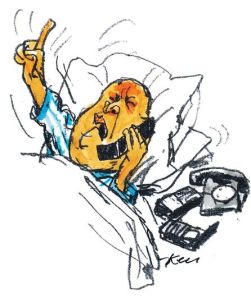
Lots of rumors floating around in Venezuela about you know who’s health and all sorts of conspiracies. To keep things straight and feed fuel to the fire, here is Article 233 of the Venezuelan Constitution:
Artículo 233. Serán faltas absolutas del Presidente o Presidenta de la República: la muerte, su renuncia, la destitución decretada por sentencia del Tribunal Supremo de Justicia, la incapacidad física o mental permanente certificada por una junta médica designada por el Tribunal Supremo de Justicia y con aprobación de la Asamblea Nacional, el abandono del cargo, declarado éste por la Asamblea Nacional, así como la revocatoria popular de su mandato.
Cuando se produzca la falta absoluta del Presidente electo o Presidenta electa antes de tomar posesión, se procederá a una nueva elección universal, directa y secreto dentro de los treinta días consecutivos siguientes. Mientras se elige y toma posesión el nuevo Presidente o Presidenta, se encargará de la Presidencia de la República el Presidente o Presidenta de la Asamblea Nacional.
Cuando se produzca la falta absoluta del Presidente o Presidenta de la República durante los primeros cuatro años del período constitucional, se procederá a una nueva elección universal y directa dentro de los treinta días consecutivos siguientes. Mientras se elige y toma posesión el nuevo Presidente o Presidenta, se encargará de la Presidencia de la República el Vicepresidente Ejecutivo o Vicepresidenta Ejecutiva.
En los casos anteriores, el nuevo Presidente o Presidenta completará el período constitucional correspondiente.
Si la falta absoluta se produce durante los últimos dos años del período constitucional, el Vicepresidente Ejecutivo o Vicepresidenta Ejecutiva asumirá la Presidencia de la República hasta completar el mismo.
I will not translate it all, but the article first defines the absolute absence of the President and then it says:
-When the absolute absence takes place in the first four years of the term, elections need to take place within thirty days.
-When the absolute absence is that of the President-elect, then there has to be an election for President within the next thirty days. While this election takes place and the new President takes over office, the President of the National Assembly takes office.
However…
the last sentence says that if the absence takes place in the last two years of the term, the Vice-President gets to complete the term.
Thus, people interpret, if something happened to Chávez today, Maduro would finish the term, but the President of The National Assembly would take power after January 10th. if no new President had been elected.
Thus, these are the relevant and significant upcoming dates in Venezuela, given all the rumors:
–December 16th. Elections for Governor. Any “event” before that date will create lots of uncertainty and complications. But Chávez’ absence before it, will likely raise doubts in the electorate. Do you really think there is a sympathy vote if Chávez is not part of the election? Do you really think El Aissami has a chance without Chávez publicly endorsing him and telling us he is the best thing since Pepsi Cola? (Ok, Chinotto will do, but is he?)
–December 17th. We are likely to be still counting votes on that day in some States, but this day is quite significant. First of all, it is a holiday (Note added: Turns out it isn’t…). Second, it is the day that none other than Liberator Simón Bolívar died. But it is also a day in Venezuelan’s lore: Lore has it that Dictator Juan Vicente Gomez died afew days earlier, but his collaborators kept the fact hidden so that he would die on the same exact day as hero Simón Bolívar. The conjecture is this may happen again, more so because of the elections the previous day.
-January 5th. Well, nobody ever reads Article 219 of the Venezuelan Constitution, but it clearly says it is the day in which the National Assembly first meets for the year. But more importantly, it is also the day that it chooses the President of the Assembly for the year. Even if only for five days, some people may not be too comfortable having Diosdado there, so they may find someone else they trust more if they have inside knowledge of what is going on. Far Fetched? Just think, whoever may be named (see next important date) may become President in only five days, even if only temporary. Thus, the choice has to be a careful one, no?
–January 10th. The Constitution also establishes this date (Article 231) as the one in which the President gets sworn in. Which means that even if Chávez has avoided naming a replacement, he has to show up that day if he does not want his absolute absence to be declared. And given Article 233 above, it will be the President of the Assembly who becomes President that day if Chávez fails to show up. Thus, there are two schools of thought: He will not and/or the treatment he is receiving in Cuba is simply to make sure that he does show up. Either way, this the most important day.
So, mark all of these days in your calendar. You can also mark down December 28th., our equivalent of April Fools, but then again, nothing that is said that day can be taken seriously, no?


 The Devil's Excrement