Archive for the 'Uncategorized' Category

Maduro’s Possible Hugo Moment Fading Fast

July 16, 2013

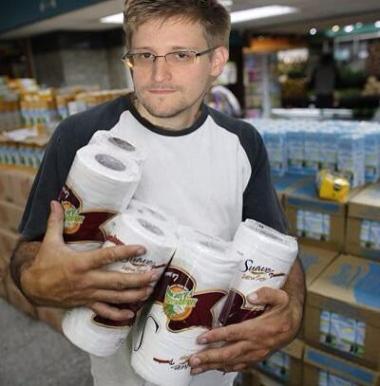
toilet

I am glad I was away when the whole Snowden affair blew up, as I think it is mostly irrelevant to the problems of Venezuela. My take on the reaction of the Venezuelan Government is simple: Maduro finally found something that could become his only Hugo moment since being elected, by giving Snowden asylum and doing his own in your face insult to the US. But the moment may not come to pass and Maduro’s offer will likely be forgotten as the possibility of Snowden coming to Venezuela seems to be fading fast. I think Nico did not think well of the consequences. No, not geopolitical consequences, but how damaging for him Snowden could become if he came to Venezuela.

But in the end, it points to Maduro’s rambling policies, where he acts tough one day, light the next, clearly under pressure from all sides. He visits only accepted countries, ignoring Hugo’s circle of terror friends since he became President. He names pragmatists to Finance, but leaves the dinosaur in Planning. He removes Chavez’ brother from Corpoelec, but brings him back shortly elsewhere. He brings back ultra radical Saman,the creator of the socialist areperas, but more importantly an absolute ignoramus on economic matters. He sends Jaua to have his Disneyland photo moment with John Kerry, only to destroy the picture by offering asylum to Snowden. The asylum may never happen, but any improvement in US-Venezuela relations got thrown overboard.  Maduro has been anything but consistent in his brief 90 days as President, but he did need his “smell like sulfur” Hugo moment and Snowden could have been it.

Except that if Snowden ever came to Venezuela, it would end up biting Maduro back for sure. To begin with, the international press would descend in Venezuela and dozens of articles about how the Venezuelan Government spies on its citizens would appear in the international press. Even a deaf and blind reporter from The Militant would learn about these cases and spread the word, making people wonder why the hell Snowden chose Venezuela for.

But in the end, it would be Snowden who would become the problem for the Government. The same international press would descend on him and ask him about his opinions about Venezuela. Snowden would hold press conferences and be on live international TV from Caracas and eventually the Venezuelan Government will simply say Nyet to all his political activities in favor of human rights, the lowest of rights on the Chavista totem pole of values. I am sure the shallow Mr. Snowden, shallow because the countries he chose are anything but icons of good behavior in spying and repressing their citizens, would not like to be silenced and the problems would begin. For Snowden, and for the current Venezuelan Government.

But other problems would surface even earlier, such as the fact that Mr. Snowden’s life in Venezuela is likely to be anything but the golden asylum he may be imagining. From not speaking the language, to crime, to shortages, Snowden is unlikely to find a place or a society where he would fit in, even if the Venezuelan Government were to offer to pay him to hack his way around the world. He would likely tire of living in Venezuela, which would force him to look for an alternative. But once here, no other country is likely to want to touch Snowden with a ten foot pole, so he would have to either stay put or go back to the States. And once in the States, he could talk freely about the wonderful world of Venezuelan human rights violations.

Thus, Maduro’s Hugo moment was not well thought out and now looks unlikely to happen. Meanwhile important matters continue unresolved, as his enemies from within carefully wait for the right moment to act.

And Snowden is still in Russia and seems further and further away from ever eating an arepa..

Let The Sicad Foreign Exchange Games Begin In Venezuela!

July 14, 2013

Rusicad

As you may have guessed, I have been away, biking in a very nice area of the world, which together with sightseeing and resting from the exercise, gave me little time to post. Which does not mean that I did not follow the news, despite spotty internet coverage in many places. And I am very happy that I avoided the Snowden drama, which I will post about at some point, but consider it to be mostly a distraction.  What I found more interesting, was that after only three months, the incompetent Venezuelan Government finally will start selling dollars into a new, and they claim, improved, SICAD system. It took only three months to create rules, limitations, allocations, quotas and the like, attempting to include almost everyone. I have been somewhat surprised at the positive reaction to this new system by many analysts, suggesting is a step forward and that the unmentionable rate will somehow go down.

But I am not impressed.

To begin with, the Government will sell US$ 200 million every two weeks in this new revitalized SICAD system. This comes out to about US$ 20 million per day, well below the US$ 40 million that used to be regularly sold per day in the old SITME system. The difference is that now there are some quotas and individuals will be allowed to participate (and more Bolivars in the system). Sitme was good about oiling the system in providing dollars to importers and in emergencies, but I really don’t think it eased the pressure in the black market very much.

As if this were not enough, there will be more participants. And I think this is the weak point of the system. With the control the Government will exert on the rate at which dollars are sold, the arbitrage between the SICAD rate and the black rate will be large and more and more individuals will register to participate and that number, much like what happened in the Bolivar/dollar bond system, will balloon in time as individuals try to take advantage of the system. If a family of four, for example, plans to travel, having each member participate creates a subsidy for the trip that can even be partially funded selling dollars in the other market.

The rules reportedly will be different for each auction, which simply creates too much guesswork for importers who really need the foreign currency to function. In the first auction Margarita and Paraguana will receive a quota, if this is not permanent, it may not do the job desired. But more importantly, companies have lots of pent up demand and now that a mechanism in which they can get what they need is available, they will all go to Sicad to complement their needs. Massively. Access to Sitme had more rules than the new Sicad does, so the demand side will be stronger.

The good news is that exporters will be able to sell their foreign currency in Sicad, which is definitely a very positive development. But one needs to be careful in estimating how much this will bring to Sicad, as exporters can keep part of their dollars, so that not all of their foreign currency will flow back. What is positive is that it increases the competitiveness of these exporters, a sector that has been affected severely by exchange controls and the overvaluation of the currency.

I think the unmentionable rate may slow down its increase with the expectations of the first of auction, but I really don’t think it will have a significant impact in bringing it down. The new Venezuelan foreign exchange market, under Sicad, will not be a true market. There are billions of Bolivars that will be chasing for those few dollars. With monetary liquidity about Bs. 851 billion, at Bs. 20, for example, there are US$ 42 billion in the system. Pent up demand is large, as for over six months, the only game in town has been Cadivi and to a lesser extent that other market. Thus, you have lots of demand with little supply comparatively speaking. The only way that other rate would go down, would be if the Government did not impose any limit on the price of the Sicad dollars, but as long as this is under control, it just will not happen.

So, a new era in foreign exchange games begins in Venezuela this week. The Government is likely to increase rules as it goes along (there are rules even at what times you may access the system depending on your cedula or tax number), they simply like to do this too much. And the players will all be ready to adapt, change course and develop strategies in order to get their foreign currency. We have seen this movie too many times in the last few years. Moreover, all of this will be done with no transparency, as to who gets the dollars and at what price, allowing once again for favoritism and graft.

As usual, some will make a lot of money, others will be frustrated and then the Government will reintroduce a new and improved Sicad again, as the problems are noted. They are just too predictable.

Venezuelans Are Trapped In Their Own Inconsistencies

July 2, 2013

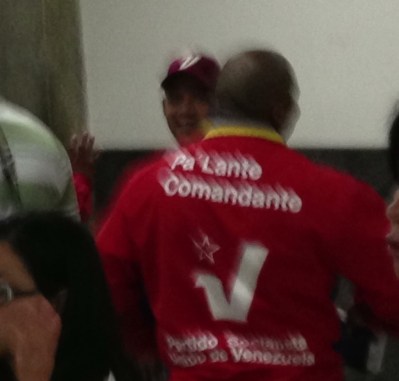
palante

As I was leaving Venezuela last week, this guy in the picture above in his Pa’lante Comandante and PSUV jacket, created quite a stir, as the immigration line was about 40 minutes long, but the jacket gave this new oligarch the privilege of bypassing everyone and be thru the whole process in about two minutes. Some people silently bitched about the whole thing, others were vocal, yet others were quite loud about it. Using Capriles’ phrase, they called him “enchufado”, plugged into the system to get his privileges.

But then, I had to open my mouth. There was a group of young guys, excitedly going to Miami for the first time in their lives. They were quite pissed at the Pa’lante gordo and I talked to them about it as I took the picture. But then, I created another stir, by reminding these young guys, that they are as privileged as the Pa’lante guy, even if to a lesser degree. (They get the ticket, but not the special line)

These guys took offense at this, so I explained: “You guys pay a cheap ticket, get a couple of thousand dollars at the official rate so that you can go out and party for a week or so, that seems quite a privilege in Venezuela, if those that can not afford it could see this line and understand, they would be as mad at you, as you are at the Pa’lante guy”

Well, I did not make much headway, to them traveling at Bs. 6.3 and their CADIVI dollars is essentially a right by now, the same way the poor think that they should be given a home by the Government and free food and appliances when election time comes up.

In fact, it seems as if Venezuelans are all trapped in their own inconsistencies.

The opposition does not dare say what they think, because they know they would not get elected if they did. But neither do Chavistas. Most of them understand how screwed up the revolution is, but they can’t say anything , for they risk their own future. It is hard to explain to opposition people that yes, the opposition is censored, but Chavismo/Madurismo is censored even more. Some in the opposition are not allowed to say what they want, but if you are Chavista and you say what you want, you are banned, recused, accused of treason and the like. So, all Chavistas stay silent, it is the Arepa muzzle at work. (Bozal de arepa)

And privileges are everywhere.

Nobody believes the gasoline subsidy can be removed. (I do!). But how can the price of gas have an impact on anything, when a bus costs 500,000 Bolivars and if you fill the tank up daily, you spend Bs. 10 per tank? That is one third or one quarter of an arepa per day. Make it five times more expensive and the owner of the bus would spend 15,000 Bolivars per year. That’s 3% of the cost of the bus. Are you kidding me? Raise it by a factor of twenty!

But everywhere you turn, there are privileges. I was talking to a Colombian that wants to leave the country, but he sends his parents $300 per month via Cadivi and another $600 to his kids. That is all of Bs. 5,400 he spends, but the family keeps only $300 and returns $600, that he readily exchanges for a net of (18,000-5,400)=13,600 Bolivars, more than he can make in a moth working in Venezuela or Colombia! This guy is really trapped!

And the whole education discussion in CCSC reveals the same. Why should CADIVI give anyone money to study undergraduate abroad? (Don’t get mad bro!) It’s absurd. And graduate work is even more absurd. That is a sure guarantee that the person will never return.

As for the University conflict. Yes, it is very valid, but so are a few dozen conflicts around the country. I mean, why would a Guayana worker complain if he gets his salary without working? He is also trapped. Or maybe he has more than one job, since he does not have to go to the other one to get paid.

Everywhere we look is the same. And if the Government, any Government, tried to rationalize anything, from gas to electricity prices, to Cadivi, to make pensions available only when you are 65, let alone make people work, that Government would have to face the consequences.

Venezuelans are trapped and I don’t see anyone “poniendole el cascabel al gato” however you may say that in English (Putting the bell on the cat???)

Venezuela: One Upgrade, One Downgrade And One Improved Outlook

June 18, 2013

While President Maduro has done nothing on the most pressing problems of the economy, in the last two weeks, the country received an upgrade in its status with the US, a downgrade from Standard and Poor’s and the Catholic Church seemed to give its blessing to Maduro and the country when Pope Francis met with the Venezuelan President., essentially seeing an improved outlook in relations with the country.

While Maduro is probably happy about the total, unfortunately for the average Venezuelan the only one of these that will affect his or her pocket is the downgrade from B+ to B by Standard and Poor’s. Yesterday morning, before the downgrade, Venezuela’s bonds were trading about at a 1% lower yield than today, which means that any new debt that is sure to come will cost around US$ 10 million more per year for each billion dollars issued.

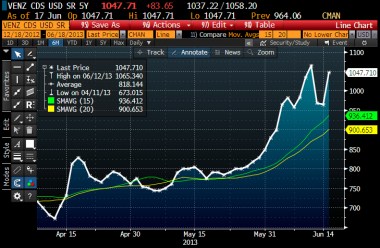
In fact, so far Maduro being elected has been quite costly for the country, as shown by the graph below:

cds-1

In the graph I show the value of the 5 year CDS, or the cost to insure against the country’s debt default, which is a measure of the so called “country risk” or “country premium”. As you can see, Maduro has been costly to the country since he came to power. Just by being elected the CDS jumped from about 673 basis points (6.73%) to about 830 bps (8.3%). Then, after the electoral noise went away, it was calm for a while, but then markets got impatient (and so did S&P) and started punishing Venezuelan bonds. A few days ago it got as high as 1065 (10.65%) basis points (which was also influenced by world jitters). Then it seemed to calm down dropping to 960 basis point, only to jump yesterday on the downgrade by S&P.

From the graph, it is hard to precisely separate world jitters from Maduro, but if we say the first jump was all Maduro and the recent downgrade was all Maduro, you have at least 250 basis point or about 2.5%due to him since assuming office, or roughly US$ 25 million more in interest payments per year for each billion dollar of bonds issued. In a US$ 3 billion issue, the likely amount of what this Government want to start its issuing would then cost (us Venezuelans) for ten years US$ 250 million.

But Maduro is probably relishing on the fact that the Pope met him, Kerry met Jaua and the FAO gave him the most stupid award possible given the current shortages and the level of inflation.

And when Maduro is gone, Venezuelans will be paying for his ignorance. Meanwhile Maduro is “celebrating” his tenth week as President without a single important economic measure being announced.

Which is precisely why S&P downgraded the country’s debt. Oh yeah! S&P did say that if economic policy became more “pragmatic” the outlook, which is negative, could improve.

Don’t hold your breath…

Nicolas, Really, What’s Up With The Hats?

June 16, 2013

Maduro1

Maduro2

Maduro3

Maduro5

Maduro6

Maduro8

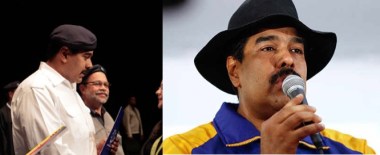
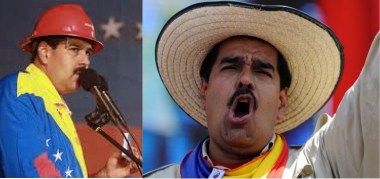
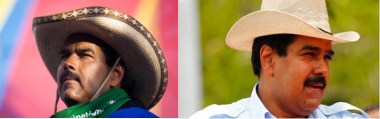
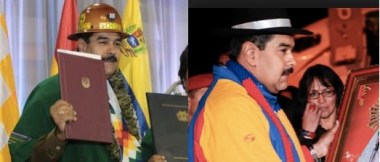
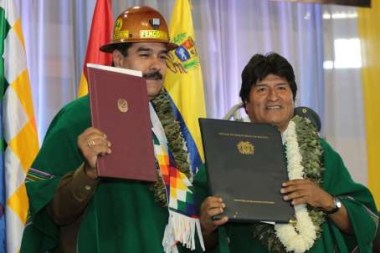
In his efforts to imitate Hugo, Nicolas Maduro can’t seem to resist putting on a hat. For someone whose head was always bare, it looks silly and most of the time he looks too contrived and unnatural. But he continues doing it.

Nicolas, you are no Hugo!

At Bandes, Wasting Money Is Just Their Way Of Doing Business

June 13, 2013

202949497_640

When Hugo Chavez started using the oil windfall to generate friends abroad, he thought Venezuela had infinite money. From coops to joint ventures with questionable partners, like Iran to Petrocaribe, money was thrown at many bottomless pits.

But the worst part is that there was no accountability, either before, during or after these ventures were carried out. Even more incredible, is how immune some of these organizations that have been in the middle of these deals seem to be to any investigation or accusation. But none more incredible that the two “development” related organizations, Fonden and Bandes. Fonden has been mentioned before, a billion dollar sink hole protected by Chávez and Giordani, but Bandes, which was actually in charge of many of the loans by the Chinese Government, including the oil for money credit lines, seems to be absolutely shielded and protected. In fact, its most recent President, has now been promoted to President of the Venezuelan Central Bank.

Way to go Maduro!

A few weeks ago, I reported on the US$ 66 million ripped off by Bandes officials via the trading of bonds, with as much as US$ 10 million lost in a single trade (world record?). Weeks have gone by and despite a sixth person jailed in the US yesterday and the opposition requesting an investigation, absolutely nothing has happened. Not a single investigation or question raised or asked. And the same people keep on running Bandes…

Who protects Bandes and its officials, past and present? It can’t be Chavez, he is no longer around. But the immunity continues.

I know US$ 66 million is pocket change for the bottomless pit of the revolution, but it just keeps adding up and Bandes seems to be always in the middle of things.

Take Bandes-Uruguay. In 2006, Bandes Venezuela purchased Bandes-Uruguay, which was bankrupt, for a scant US$ 10 million as reported in these same pages then. I was not too positive on the transaction:

“I like the business plan: Take over a bankrupt financial institution in a country you have no experience with and have it run by people with no financial experience. A recipe for financial disaster for spreading the goodwill of the revolution! More losses in the name of solidarity! Less money for Venezuelans!”

Wasn’t too far off the mark, no?

Even worse, the genius behind this investment is none other that then (and current!) Bank Superintendent Hernandez Behrens, the same guy who presided over the mini banking crisis of 2009 unscathed.

Bandes Uruguay lost money in 2007, 2008, 2009 and every year after that. So much, that it lost all of its capital. In 2010, I wrote a post again on the subject, this time because Venezuela was considering recapitalizing  Bandes Uruguay. Or Uruguay wanted Venezuela to throw some good money after bad. Which apparently was done once or twice, but now Chavez is dead. In the meantime, Bandes-Uruguay went from 35 branches to 24 and then to nine, as Bandes-Uruguay paid off hundreds of Uruguayans to take their severances and leave.

And Venezuela and Venezuelans (The people!) paid for this whole boondoggle…And Uruguay laughed all the way to the bank.

Well, it seems as this chapter has been at last closed, as oil went down and Venezuela did not want to capitalize Bandes-Uruguay any more.. So much for goodwill created in the name of the revolution.

The Uruguayan Senate approved now the absorption of 146 employees of Bandes-Uruguay to State owned banks, as well as absorbing nine branches of Bandes-Uruguay.

Meanwhile in Venezuela, Bandes gets away with not submitting financial statements, while handling billions in Chinese loans with no accountability. And any accusation against Bandes or its leaders is just ducked by the Prosecutor, the National Assembly or Maduro for that matter.

Which makes you wonder who used to protect those in Bandes? Who protects them now?

As a good friend (JG) said to me last week: Giordani is like a Catholic Archbishop, saying, yes I know that Bishop is a pedophile, but I am not.

Arrogant till the end…

Meanwhile at Bandes, wasting money is just their way of doing business, with OUR money.

Venezuela: From Magic Realism To Bizarro Country

June 12, 2013

mad

Venezuela has been the land of magic realism over the last fourteen years. Under the spell of Hugo Chávez, the country lost a decade of development under the guise of a revolutionary process, that brought little revolution anywhere, when you consider that the country enjoyed the biggest oil windfall in its history. Chávez could sell the people anything, an attempt on his life, borrowing at 12%, while lending at 2%, demonizing the opposition, recovering from cancer and even blaming nature for many of the problems he caused.

But over the last six months, Chávez’z successor has turned Chávez magic realism into a bizarre concoction that makes no sense. He managed an electoral audit that was not one. Maduro has been in power for over ten weeks, but has made no important decisions about the most pressing economic matters. He blames problems on things like consumption, as if his party was new in Government. He says the universities have received sufficient resources, but a Professor’s salary is near the minimum salary and since 2008 autonomous universities have not had any budget increase.

But things get really bizarre when important discussions are distracted by events such as:

-Jose Vicente Rangel, a former Minister of Defense and “reporter” saying the opposition has purchased 18 airplanes to attack Venezuela and that they are in Colombia. Of course, no mention of who, when, how, just like that, 18 planes, not 2 or 3, all of eighteen planes, bought with money that came from nobody knows who, to buy whatever. Maybe Rangel saw an Amazon purchase for 18 planes to fight Maduro’s drones.

-A Judge, Judge Afiuni, ordered incarcerated by Chávez, who has yet to be tried, but was raped in jail, has the Prosecutor ask the Court to change her prison for home and five days go by without the inhumane Court saying a beep and ordering that she be released. Whatever happened to compassion in Venezuela?

-A thousand cases of the H1N1 virus are not enough to have Venezuela’s Minister of Health worry, declare an emergency or anything like that. Never mind how contagious it is. Never mind the ignorance of the average Venezuelan on the subject. This is simply another plot to destabilize by the opposition. The country is even out of the vaccines, but don’t worry, toilet paper should be arriving soon.

-An obscure Director of the price control office is jailed for corruption in Venezuela, but the SEC charging that there was a massive kickback scheme at Bandes, which made that bank lose US$ 66 million, gets no reaction from any official in Venezuela. (The fourth person was jailed today in the US)No investigation, no questions asked. But Maduro still says he is going full blast against corruption. Sure Nico, I believe you. (Cross my fingers)

-In a country with excess lawyers. In a country where nobody in important positions seems to have experience in the area of the position, an engineer is named to supervise the Judicial system. Never mind he failed as Head of the electric company, his supposed specialty. Never mind there are thousands of Chavista/Madurista Judges, lawyers and the like. Choose failure, choose ignorance, choose a guy that failed. Oh! I forgot, he is Chavez’ brother Argenis.

-The Head of the Electoral Board comes out and says that the “audit” was perfect, not a single error. But after a reporter finds 90 dead voters in polling stations with 100% participation for October, the next day (June 3d) the CNE changes the records from October 7th., all of them, reducing, but not eliminating dead voters. But, says Ms. Tibisay, Venezuela’s electoral system is “shielded”.  Not from the dead, Tibi. BTW Tibi, we are still waiting for the fingerprint records from the SAI, which has turned out to be a useless system: It did not stop anybody from voting! Which is why they don’t want to give the opposition a copy.

Oh yeah! A guy named Kerry, who apparently holds an important position in the US Government, meets with Venezuela’s Foreign Minister Jaua, who grins at the meeting at Kerry, very much like Venezuelan kids do when they meet Mickey Mouse in Orlando.

Really, bizarro country, with a Capital B (not “V”), is getting harder and harder to understand it. All of this happens and not much of a reaction. Bizarro is, bizarro happens. Nothing happens.

As Economy Stalls, Inflation Heats Up and Maduro Seems Clueless

June 8, 2013

maduro_and_morales

Maduro badly imitating Chávez, what is he smiling about?

The week brought really bad news on the economic front, as the Venezuela Central Bank reported that the economy stalled in the first quarter, growing by a meager 0.7%, while inflation really heated up, increasing by 6.1% for the month of May (up from 4.3% in April). Both numbers were worse than expected by analysts and economists.

The internals of the inflation numbers were even worse. Twelve month inflation is now running at 35.2% (Inflation  for 2012 was 20.1%), while Food and Beverages went up by 10% in May, that group is now up 27.8% for the year and 49.9% in the last twelve months. Inflation is already up 19.4% for the year, compared to a devaluation of 31% in February. The scarcity index stood at 20.5% in May, barely budging from the same number in April. Even worse, many of the basic products currently under price controls, have yet to receive approval for price increases since the devaluation in February. Meanwhile, the black market rate has reached a new all time high.

To make all of this even more worrisome, is the fact that Maduro was sworn in nine weeks ago and he has yet to announce any significant change to economic policy. Soon after being sworn in, Maduro said that the Government would make the parallel rate fall and it is now 32.4% higher than when he won (sic) the election. And while investors and the private sector wait for announcements, Maduro makes non-announcements (Sicad was going to start again three weeks ago, there will be no devaluation)

But Maduro keeps saying things that may sound good to the “people”, but are either false or will make him look bad in the future. He said that what was coming was “the strengthening of our currency and our economy”, which at this point is an impossible target for the currency in 2013 and an iffy proposition for a growing GDP in 2013. Maduro also asked for applause for Minister of Finance Merentes “who is fixing our economy”, while in reality Merentes has shown that he does not have the power to guide economic policy, as he has yet to make a single change since being named Minister in April. (Even his road show to New York and London to talk to investors was cancelled soon after it was sort of announced). And Merentes may improve the foreign exchange system, but he is no economist and thus does not know the tools to attack the many distortions in place.

And Maduro may simply be clueless or have really bad advice. Yesterday he said that the reason inflation went up like this in May is because of “overheated consumption”, while the Government’s own numbers show that the growth in consumption slowed down between the fourth quarter of 2012 and the first quarter of 2013 from 7.1% to 3.1%. Maybe Maduro should be briefed on the effects of money printing and deficit monetization.

By now, in addition to the higher inflation and the stalling of the economy, the result of the Government’s inaction is that the bond issuance (likely directly in US$) that will certainly take place in the upcoming weeks, will be more costly than eight weeks ago. Between the fear of new issuance, the drop in US Treasuries and the lack of new policies, the prices of Venezuela and PDVSA bonds have been punished harshly in the last nine weeks. This means that before Maduro was elected, the benchmark Venezuela 2027 bond was yielding 9.18%, which last Thursday stood 11.48%, before dropping sharply on Friday to 10.88%. This means that any new issuance will be between 1.5% and 2% more costly than six or eight weeks ago. (US$ 45 to 60 million a year for the length of the issue of a US$ 3 billion bond)

About the only positive note is that Minister of Energy and Oil Rafael Ramirez has managed to sign some deals worth about US$ 9 billion with Rosfnet, China and Chevron, showing that he has more power than many. Except that none of what he did  implies cash flow any time soon, as the major chunks of all the deals are for expenses in PDVSA’s projects with these partners. The only one that implies money for PDVSA is a loan from Rosfnet to PDVSA of US$ 1.5 billion, capped at US$ 300 million per year for five years and so far, it is only a Memorandum of Understanding.  The other “loans”, are all going back to the “Giusti” model, where the purse strings are controlled and held by the partner and not PDVSA. Fourteen years of a revolution to end up in the same place.

At least, that new money will go in the long run for increased oil production, something the country needs, but the revolution has ignored for too long.

Raitioning in Venezuela’s Zulia State: Pure Ideology Of The Worst Kind

June 4, 2013

cubanrationbook

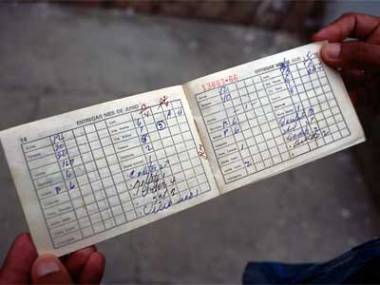
Cuban Rationing Book

You have to wonder what goes through the mind of someone like Zulia Governor Francisco Arias Cardenas. The once coup plotter with Hugo Chavez, who he later ran against, has seen fourteen years of controls fail and he decides that for his State, the best solution is: More controls.

In fact, is not even more controls, it is simply rationing. The idea to give everyone smart cards so that the Government can limit the availability of the twenty food products which have a regulated price, is as stupid, as the regulated price itself.

But these guys push controls relentlessly, despite the fact that not one control has worked in the last fourteen years:

Price controls? Venezuela has had 900% inflation since Chávez came to power fourteen years ago and shortages have been a problem for the last six years. The Central Bank now withholds information on shortages and rumor has it that the CPI jumped over 5% in May.

Exchange Controls? After imposing exchange controls in early 2003, which became even more rigid in 2010, the devaluation of the official rate of exchange has been from Bs. 0.573 when Chávez took power to Bs. 6.3 , “only” a 91% devaluation, give or take a decimal. But, of course, there is a second rate at almost five times the official rate, the true floating rate would be somewhere in between which would represent a 96-97% devaluation, but who is counting anymore? But note, that between 2003 and 2010, the currency devalued from around Bs. 2 to Bs. 8, a factor of four, but the more strict controls since 2013 have increased the black market rate by almost another factor of but in only three years.

Border Controls?: Products going through the borders are checked, creating long lines, so that the National Guard can check to see whether you are exporting product to Colombia which is ten times or so cheaper there. This limits trade, creates long lines, annoys people and…if you slip a few bills into the National Guards pockets, you can certainly get your stuff through anyway. Thus, it becomes another source of corruption, number 3,483 created by the complex system of controls and subsidies in place.

And all of these exquisite controls and interventions have led to less production. Venezuela was an exporter of coffee in 1998, today it imports coffee. In 1999, Venezuela imported very little meat, today it imports 59% of ts consumption. The Government has dramatically expanded its banking sector, but 90-plus percent of agricultural loans come from the private banking sector and the rest from Government owned banks. And so on…

So, this fool who was elected Governor of Zulia decides to create a rationing system to impose more controls on top of the controls.

There are so many things wrong with it, that I am not sure where to start:

-First of all, this costs money. Lots of it. The Governor will now spend money on software, computers, chips, cards, personnel, to impose another control on items which have price controls, because there are shortages. It will make supermarkets spend money in all this, which means the costs for the supermarkets will go up, costs that will be passed to the consumers on the prices of non-regulated items.

-But…you have to create rules. And arbitrage will come in. As soon as the rules are in effect, every single individual entitled to buy, for example, two kilos of sugar per week, will go and buy two kilos of sugar at the supermarket every week. And once there are too many kilos of sugar at his or her home, they will go and sell the sugar at the free market or to street vendors at many times the regulated price. And the same food will show up somewhere at a higher price.And since its scarce, someone will pay for it.

-This is not a very popular measure, so that Mr. Arias better watch his back, as he is doing something that will eventually become very unpopular. If you are going to impose unpopular measures, you might as well impose rational ones.

So, imagine the path that package of sugar has on its way to the true final consumer: First, there are exchange controls, so it will be purchased only after a dozen steps for the approval of the currency to buy sugar. This requires employees for the Government who supervise all the steps, as well as employees for the guy who is importing, who hires people just to satisfy the bureaucracy of CADIVI. Many of these steps, of course, have graft associated with it. Then, the “buyer” will try to get the cheapest quality sugar they can get to maximize profit, since the importer knows that he will have to pay even more on the way to the port. Graft at customs, graft at the dock, cheap products, and finally it gets to the price controlled supermarket, where Governor Arias now will control how much you can buy.

Idiotic is too nice a word to describe all this.

There is no logic for it, no justification for it and you simply create even more economic distortions.

Which one day will have to be unwound.

And these guys don’t look at models anywhere, except one place: Cuba. And despite the gigantic failure of that State, their minds are blocked from looking at Brazil, Chile, Peru, Asian countries, where things are working much better than in Cuba and/or Venezuela.

To me the whole thing is a mystery. At one point Arias Cardenas seemed to be a more pragmatic voice within Chavismo, he now has joined Chavismo in full force, no brains, no thinking, just pure ideology of the worst kind.

Venezuelan Military “Technology”: It’s All Kid’s Stuff

May 30, 2013

droncito

Yesterday Venezuelan President Maduro presented this “new” system of drones built under a cooperation agreement with Iran which was hailed as capable of “counter acting any threat…so that the Fatherland is never violated…evidence that Venezuela is advancing in technology for military purposes”

The presentation also included “the launching of a test of an unmanned flight”, which according to the article was hailed by Maduro as “the bases for our the aeronautical industry of the future that we must have”

Well, I am not sure who was fooling who here. It was either Iran fooling Venezuela or the military fooling (or laughing?) at Maduro. This project, under the cooperation agreement signed in 2006 with Iran, took seven years to do what any model airplane club or kid in Caracas could have done ten or twenty years ago.

Because what you see above, is nothing but a large model airplane, comparable to the largest ones that Venezuelan model airplanes fans and their associations build. And in Venezuela there are quite a few of them.

And the Iranian “technology” and what is the basis of our country’s future aeronautical industry can be purchased at Amazon or any RC hobby store for a couple of hundred bucks, as can be seen in the picture below, where we can see the so called “drone” and its radio control.

avioncito

and in the red circle, you can see the sophisticated technology, basis for our technological future, shown here blown up (even if fuzzy):

kbtoys3

which anyone that has ever seen fly or flown an RC model airplane can recognize is an off the shelf RC radio system available at any RC store, hobby store and even Amazon for about US$ 100. Something like this model, taken from this page:

1034655_large

There are so many models, it is difficult to determine exactly which model it is simply from the picture.But all we can say is that Venezuelan military and aeronautical “technology” is all simply kid’s stuff. The only question is who is ripping off who. Somehow, I think it was Maduro whose good faith and ignorance was take advantage of.

It is truly sad that a country that 40 or 50 years ago had frontier science and technology, has now such ignorant leaders, that they think that model airplanes, Chinese satellites and Portuguese computers have any thing to do with the technological and scientific future of the country.

The worst part is that the Bolivarian scientific “leadership” will simply remain quiet about all this.

What a pitiful revolution!