Observations focused on the problems of an underdeveloped country, Venezuela, with some serendipity about the world (orchids, techs, science, investments, politics) at large. A famous Venezuelan, Juan Pablo Perez Alfonzo, referred to oil as the devil's excrement. For countries, easy wealth appears indeed to be the sure path to failure. Venezuela might be a clear example of that.
And thus, in a complete change of strategy, Hugo Chavez defends the Constitution and picks the person he wants to be his successor. To me, this is a recommendation from the old man in Havana and his buddies and it may signify that either Chavez is very, very sick and the end is close, or it may mean that infighting got so bad, and it is known Chavez will only live a few months, that a decision had to be made on a succesor. Moreover, Maduro campaigning with Chavez alive, regularly speaking out for him, may be the way to insure the continuity of the revolution. Thus, if Chavez were to say that he is in no shape to assume the Presidency after Jan. 10th. , the campaign will begin and Chavez will be there to lead President Maduro to a win.
The easiest path, if the second scenario was correct, is to wait and have Chavez resign after he names Maduro VP on Jan. 10th. If he is in danger of dying soon, then the President of the Assembly would assume power, if Chavez did not manage to be sworn in on Jan. 10th. This second option is likely filled with more uncertainty for Chavismo.
It is hard to know which of the two scenarios is right. In this so called XXI st. century revolution, we have yet to hear a medical Doctor explain what ails Chavez. Such is the disregard for the people, knowledge and the truth by the revolution.
And I still think Capriles blew it when he took the low risk, low reward strategy of running for Governor of Miranda. Now he needs to win there big, very big, or he will look weak to be the Presidential candidate. He should have stayed above the fray, gluing together the opposition, campaigning all over the country and for everyone. Had he done that, he would be the no discussion, unanimous choice to be the opposition candidate. Now there has to be lots of discussions, while Chavismo already has its candidate.
Beyond that, it is anybody’s guess. With Chavez alive, Maduro is likely to stay the course of the revolution and the different factions are unlikely to show their differences in public. But once Chavez is gone, Maduro may decide to be his own man in order to survive and he could go either way. He could ally himself with the anti-cuban faction to have the support of the hard core military and slow down the revolution or he could side with the pro-cubans in the belief that this guarantees his ability to survive.
With so many institutions under total Chavez control, it is unclear which ones will side with whom. Clearly the military is the most important one, with the Supreme Court close behind.
Chavez was and is the glue that holds Chavismo together. Once he is gone, the two sides will be equally splintered and what happens then is truly hard to discern with clarity at this time.
A somber Hugo Chavez appeared on nationwide TV tonight and confirmed what most people had suspected: His cancer is back, he needs to return to Cuba tomorrow and he has been under a lot of pain and discomfort.
But perhaps the mos dramatic element of his speech, was that he essentially said VicePresident (and Foreign Minister) Nicolas Maduro will be his succesor, not only as far as the Constitution says, but he also designated Maduro as his succesor should there be the need for an election for President. He also said people should vote for Maduro if this election Were to take place.
While Chavez tried to explain that this was all a surprise, the timeline of events suggests this was not the case, as his dissapearance from public view clearly implied he left because the cancer was giving him discomfort.
Since we still dont know the nature of the cancer and the operation, it is unclear if it is a dangerous procedure. The key event will be whether Chavez can or not be present on Jan. 10th and be sworn in as President. If he can, we will have to wait until his health deteriorates again, which it wil,l as a cancer recurring like this is a very bad sign. If he does not, Maduro will assume the Presidency, name his Vice-president and will have to call elections before February 10th. There is also the outside chance that the operation will not go well. This case is more complicated because independent of Chavez’ desires, The President of the National Assembly will take over after Jan 10. if Chavez were unable to complete his term. Maduro can not hold both positions.
The country still does not know the full truth of what is going on. Unfortunately, Chavez’ absence is likely to delay important decisions on the economy. The impact on the upcoming Gubernatorial elections is much harder to determine at this time. Chavez has always been the big draw in elections, but the short time of a week, makes it difficult for the opposition to gain on the news.
Wow! I was shocked to read the international press today. Apparently, Hugo Chavez is not well. Something to do with his health. Look up Hugo Chávez in Google and the fact that Chávez is not going to Brazil, apparently induced some people to believe that this creates “speculation” and “fears” about his health.
Where have all these guys been?
Let’s see: The most outspoken, unstoppable, self-centered, ego-centric. ego-maniac. media-oriented, superficial, blabber mouth, show-off politician ever to hit Venezuela, all of a sudden:
Disappears from the media. As a matter of fact, his last “live”, “live” appearance was only 59 day ago when he held a press conference with real people present after being reelected. There have been some less “live” appearances since then. The last one was exactly 21 days ago. Except in all of them, he was seen only seated at the Cabinet table, with no outsiders present and even in his lengthiest broadcast, he spoke for less than a third or fourth of the average time of his usual ramblings.
And then, he just fails to make any of these “live”, controlled appearances since November 15th. and on November 27th. he surprisingly says he needs permission to be absent from the country “indefinitely”, in order to go to Cuba to get some sort of mumbo jumbo-hyperbaric-Cuban-tried-and-tested treatment for whatever ails him.
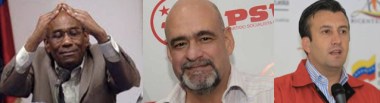
And all of this happens in the middle of a very significant political campaign for Governors, where his presence is essential, because he selected some people like these cone heads below, with his own mind and finger, to be Governors:
and somehow their campaigns are faltering because they are not from, nor do they live in the states that they are running for Governor (and the two on the right are sooo stiff!) and silly Venezuelans seem a little unhappy about that.
So, what makes these reporters think something is wrong with this guy’s health? How do they do their reporting? They call Miraflores and ask Maduro how Hugo is doing? Or do they call Raul in La Habana and ask (He probably knows more)?
Because the only basis these guys had for imagining that all was sort of ok with Hugo in the last few weeks, was the fact that some press guy in Itamarati, Brazil’s Foreign Office, said that Chavez had confirmed he would be present at Venezuela’s first ever Mercosur Summit as a full member, which starts tomorrow. What they failed to note, was that the “confirmation” was received twenty days ago, before Chávez had stopped his “live” appearances and two weeks before his now infamous request for an indefinitely leave for medical treatment in Cuba.
So, today, because he is a no show in Brazil, the international press seems to have deducted Chavez “may be” or is “feared” sick.
Way to go international press! (Except for my buddies at Bloomberg, who seem to be on top of things)
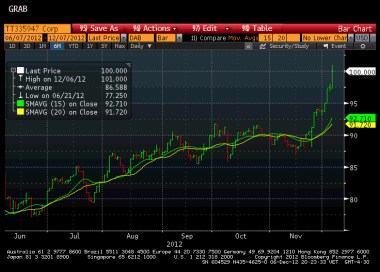
Meanwhile “markets” and “investors” seem to be more on top of it. Below, I show the “benchmark” Global 2027 bond and what it has done ever since Chavez took his “leave”. (Other bonds have done even better) This is the same one that Quico said he would not buy and he is not too dumb a fellow, but he could have made a bundle of yen with it, had he not unbookmarked the Devil on his Japanese sojourn:
As you can see, the price of the Venezuelan Global 2027 bond was just plodding along, drifting up and then right around Nov. 27th. (Funny, the day before Chavez’ announcement, actually!) the price of this bond starts moving up like crazy and goes up more than 10% since then, closing at 100% today for the first time since 2008.
Bonds usually don’t do this on rumors, only on facts!
So, these market guys seem to be on to something. Yes, they go up because Venezuela should yield sort of like the Ukraine, which would shoot the price of the bond up another 20 points or so. Except that things are not that linear in Venezuela. The road will be bumpy one.
To start with, the bet is that nobody can be as bad a Minister of Finance than Giordani. If Chavez leaves, a “real” economist will come in and will never do as bad as the current Minister of Finance.
Wanna bet?
Until Chávez named Jose Rojas Minister of Finance in 2000 or 2001 (and he was an economic statistician), the number of “real” economists that had held the position was less than the number of engineers, sociologists and mathematicians combined that have held the position in the last twenty years. Economists are considered to be like Astronomers (Or is it astrologists?) in Venezuelan political circles.
But I digress. Because even more dangerous, is the fact that the path, if Chavez is a no-show on Jan. 10th., is filled with uncertainties and possibilities. Just about everyone could be President on Jan. 10th. if Chavez no-shows (not me!), because the new President of the National Assembly will be selected on Jan. 5th. and Chavez and PSUV can truly name anyone they want to the position.
And yes, the Constitution is clear, elections have to be called within thirty days. But that’s all it says. Really. So, imagine new President Chavez (Adan)/Maduro/Jaua/Rodriguez/Cabello (Did I leave your name out?) on February 10th. calling for elections on say, December 10th. 2013 or 2014. Why not? I am sure the Chavista Supreme Court would go along with it, even if the opposition and all of its mud rejects it.
And BTW, dear international press, now Maduro is the pro-Cuba choice? Have you met or talked to Adan?
So, the road to riches, even if you are smarter than reporters from major international newspapers, is also filled with potholes going forward. The “easy money” will end the day we know the truth about the autocrat’s health, whether good or bad (which depends on which side you are on)
After that, it will be a rocky, stony, bumpy, potholy, spiny, filled with nails, path of uncertainty and the end is almost impossible to guess. My guess is Hugo is not well at this time. They may be trying to prop him up one more time so he can be sworn in on Jan. 10th. and the charade can continue. Or he may be close to done by now. I dont know. But I hope they don’t succeed.
Venezuela deserves better. And I will not miss him.
And now he reappears, talking poetry, calling himself Fidel’s flame (no comment) in a carefully controlled video. His arrival was not shown live, but he is back. The mystery deepens. Something was clearly not well, something happened. Now we have to watch how much he participates in the campaign
A few years ago, when Chavez announced that he would start a national airline again, I wrote a post criticizing the move as another waste of money in a country with limited resources and a lot of more important problems than having a flagship Government airline. My reasons were many, but it included the fact that the airline business is well known to be a very difficult one, as recurrently even the best run airlines in the world go bankrupt or close to it, when conditions are adverse. Add to that the history of Venezuelan airlines, both private and Government run, together with a bunch of inefficient military officers in charge and I could see this was a boondoggle Venezuela did not need. Many of the more pro-Chavez readers jumped on me, saying the country should have an airline and flying in it was more reasonably priced than private airlines.
But in time, Conviasa has shown to be an even bigger failure than I ever dreamed of. I never thought we would see so many accidents. Seven serious accidents in such a short life is unheard of in the world of airlines, no matter where they come from. This shows how this Government is so indifferent to the value of the life of its citizens. Then there is the fact that Conviasa bought a bunch of Brazilian Embraer planes for US$ 90 million, which somehow the Chinese buy for half as much according to Gustavo in the same link as above. And to top it all off, last April Venezuela was put on the no fly list by the European Community, a ban that was reiterated this week.
But rather than find out about how to get off the list, the Government blasts the European Union and criticizes more the fact that the ban is called a “black list” and thus racist, than the actual reasons for the ban. Even worse, in this Bolivarian revolution world, where profits don’t matter, Conviasa has been using airplanes from Santa Barbara Airlines (A Venezuelan private commercial airline) and ¡Fin de mundo! a US airline called Vision Airlines, in order to continue flying to countries in the European Union. If Conviasa was losing money before, imagine doing it having to pay someone else to do the job!
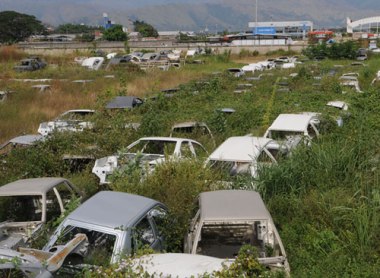
Economics is about optimizing scarce resources. In a relatively poor country like Venezuela, that optimization is even more important. The worst part, is that Conviasa is still flying, money is still being wasted, without any rationale for it. At least other Chavez boondoggles like Venirauto, stopped being much of a sinkhole. While supposedly the company is still functioning, here is a picture of some vehicles waiting to have the natural gas system installed before the cars are sold:
Lots of rumors floating around in Venezuela about you know who’s health and all sorts of conspiracies. To keep things straight and feed fuel to the fire, here is Article 233 of the Venezuelan Constitution:
Artículo 233.Serán faltas absolutas del Presidente o Presidenta de la República: la muerte, su renuncia, la destitución decretada por sentencia del Tribunal Supremo de Justicia, la incapacidad física o mental permanente certificada por una junta médica designada por el Tribunal Supremo de Justicia y con aprobación de la Asamblea Nacional, el abandono del cargo, declarado éste por la Asamblea Nacional, así como la revocatoria popular de su mandato.
Cuando se produzca la falta absoluta del Presidente electo o Presidenta electa antes de tomar posesión, se procederá a una nueva elección universal, directa y secreto dentro de los treinta días consecutivos siguientes. Mientras se elige y toma posesión el nuevo Presidente o Presidenta, se encargará de la Presidencia de la República el Presidente o Presidenta de la Asamblea Nacional.
Cuando se produzca la falta absoluta del Presidente o Presidenta de la República durante los primeros cuatro años del período constitucional, se procederá a una nueva elección universal y directa dentro de los treinta días consecutivos siguientes. Mientras se elige y toma posesión el nuevo Presidente o Presidenta, se encargará de la Presidencia de la República el Vicepresidente Ejecutivo o Vicepresidenta Ejecutiva.
En los casos anteriores, el nuevo Presidente o Presidenta completará el período constitucional correspondiente.
Si la falta absoluta se produce durante los últimos dos años del período constitucional, el Vicepresidente Ejecutivo o Vicepresidenta Ejecutiva asumirá la Presidencia de la República hasta completar el mismo.
I will not translate it all, but the article first defines the absolute absence of the President and then it says:
-When the absolute absence takes place in the first four years of the term, elections need to take place within thirty days.
-When the absolute absence is that of the President-elect, then there has to be an election for President within the next thirty days. While this election takes place and the new President takes over office, the President of the National Assembly takes office.
However…
the last sentence says that if the absence takes place in the last two years of the term, the Vice-President gets to complete the term.
Thus, people interpret, if something happened to Chávez today, Maduro would finish the term, but the President of The National Assembly would take power after January 10th. if no new President had been elected.
Thus, these are the relevant and significant upcoming dates in Venezuela, given all the rumors:
–December 16th. Elections for Governor. Any “event” before that date will create lots of uncertainty and complications. But Chávez’ absence before it, will likely raise doubts in the electorate. Do you really think there is a sympathy vote if Chávez is not part of the election? Do you really think El Aissami has a chance without Chávez publicly endorsing him and telling us he is the best thing since Pepsi Cola? (Ok, Chinotto will do, but is he?)
–December 17th. We are likely to be still counting votes on that day in some States, but this day is quite significant. First of all, it is a holiday (Note added: Turns out it isn’t…). Second, it is the day that none other than Liberator Simón Bolívar died. But it is also a day in Venezuelan’s lore: Lore has it that Dictator Juan Vicente Gomez died afew days earlier, but his collaborators kept the fact hidden so that he would die on the same exact day as hero Simón Bolívar. The conjecture is this may happen again, more so because of the elections the previous day.
-January 5th. Well, nobody ever reads Article 219 of the Venezuelan Constitution, but it clearly says it is the day in which the National Assembly first meets for the year. But more importantly, it is also the day that it chooses the President of the Assembly for the year. Even if only for five days, some people may not be too comfortable having Diosdado there, so they may find someone else they trust more if they have inside knowledge of what is going on. Far Fetched? Just think, whoever may be named (see next important date) may become President in only five days, even if only temporary. Thus, the choice has to be a careful one, no?
–January 10th. The Constitution also establishes this date (Article 231) as the one in which the President gets sworn in. Which means that even if Chávez has avoided naming a replacement, he has to show up that day if he does not want his absolute absence to be declared. And given Article 233 above, it will be the President of the Assembly who becomes President that day if Chávez fails to show up. Thus, there are two schools of thought: He will not and/or the treatment he is receiving in Cuba is simply to make sure that he does show up. Either way, this the most important day.
So, mark all of these days in your calendar. You can also mark down December 28th., our equivalent of April Fools, but then again, nothing that is said that day can be taken seriously, no?
Today, in surprising fashion, the Venezuelan National Assembly authorized President Hugo Chávez to seek treatment for his ailments in Cuba, under Article 235 of the Venezuelan Constitution which says that any absence of more than five days from the country has to be approved by the Assembly. This is different than a temporal absence, in which the Vice President replaces him. (Art. 234), which Chávez has refused to do ever since he started receiving treatment in Cuba for his mysterious ailment.
According to the letter sent by Chávez to the National Assembly, he will receive treatment in a hyperbaric chamber for “oxygenation”, a treatment which according to the American Cancer Society is used for treating bone damage caused during radiation treatment or to treat infections of soft tissue which are causing necrosis. Chávez has said that he has received chemotherapy, but has never formally acknolewdged being treated with radiation, although there are rumors that this was the first type of treatment he received when the cancer was first discovered.
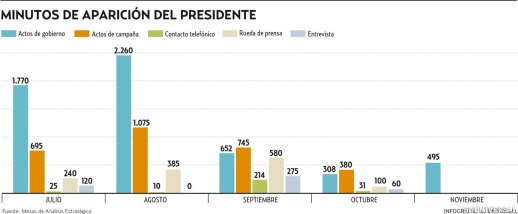
The timing is certainly unconventional, to say the least, as there will be important Gubernatorial elections on December 16th. So far Chávez has been absent for most of the campaign, reducing his appearances in public since he won the Oct. 7th. Presidential election, as can be seen in this graph published by El Universal today:
Notice that Chávez has been absent publicly since about fifteen days ago and now he makes no public appearance to request the leave or as he is leaving the country. Reportedly, he is unable to walk more than a couple of steps at this time. Additionally, the request to be absent from the country was approved at an ordinary session of the National Assembly to “celebrate” the 20th. anniversary of the second coup that took place in 1992 and not one scheduled for the approval sought..
There are two important considerations at this time. First, the President of the National Assembly Diosdado Cabello read the letter, but also announced Chávez would be here on Jan. 10th. to be sworn in as President, suggesting that he will not be here for the remainder of the campaign. This certainly will benefit the opposition, as Chávez personally will not be present to endorse his hand-picked candidates. Additionally, the electorate largely believed that Chávez had been cured from his cancer, with polls suggesting 80% of his voters believed the illness was not a factor to consider in the decision. This could benefit the opposition since the Oct. 7th. election proved once again that it is Chávez that gets out the votes and generates excitement in the Venezuelan voters.
But more importantly (or ominously) it creates a number of possible scenarios which could complicate things in the next few months, depending on whether Chávez ‘condition represents an acceleration of the cancer he is suffering. First of all, if there was an absolute absence of the President elect before he is sworn in, Article 233 of the Venezuelan Constitution says that the President of the National Assembly (Diosdado Cabello) will become President and elections would take place within 30 days. If the absence were to take place after Chávez is sworn in on January 10th. , then the Vice-President (Nicolas Maduro) would take his place and elections would also have to take place within 30 days. Note that Chávez would have to appear to be sworn in on Jan. 10th. in this scenario, as he has to name a new Vice-President after being sworn in.
For Chavismo, this creates a complex situation, in which the party would have to choose a candidate within days, something which would be traumatic, to say the least, unless Chávez personally designated a successor, something that so far he has refused to do during his year and a half sickness. The opposition, on the other hand, is likely to choose Henrique Capriles after his pereormance against Chávez in the recent Presidential race.
Venezuelan dollar bonds rose sharply when the news was announced today, with most issues reaching historical high values. Investors clearly were betting once again that change may be in the air in Venezuela and a more reasonable economic policy will be implemented, independent of the side that wins were Chávez to suddenly disappear from the Venezuelan political scene.
Yesterday, I was planning to write about Minister’s Giordani’s remarkable statement on the state TV station VTV, to the effect that in his opinion ““regalado” se debe acabar en el país, El gratis se acabó y el regalado se tiene que acabar”, which loosely translated says “giveaways have to end in this country. Free is over and giveaways have to end”. Then today, I read Gustavo’s piece and thought he had covered it, but that Giordani has the audacity to say what he said, requires that I rant about it, even if Gustavo covers it quite well.
I used to think that Giordani was intellectually honest, a misconception he dispelled long ago, but his latest statement is simply outrageous coming from him. Let’s start with the fact that this is the first time that he has made such a statement and that Giordani has been part of the Chávez administration for more than twelve of the last fourteen years. He has held no irrelevant positions, having been either Minister of Planning, yes Planning with a capital P, and now he holds the dual portfolios of Planning and Finance. During that time, he has also been on the Board of the Central Bank, for about twelve or thirteen of those years and on he Board of PDVSA for a couple of years. So, he can’t argue he did not participate in decisions.
As a way of background, Giordani was the leader of Chávez’ transition team and wherever he went he would say “We have different ideas”. And he (they) did. Caldera’s Government had been adjusting gasoline prices to the export price quarterly, which candidate Chávez requested be suspended until after the election. Prices have been held at the same level since them, making them essentially free today at less than $0.30 dollars per gas tank at the informal rate, or a buck at the official one.
Additionally, in the year 2000, the Chávez Government froze electric rates. They have been frozen since then, but the currency has gone from about Bs. 0.7 per US$ to Bs. 4.3 at the official rate or almost triple that at the parallel rate, so that electricity is also essentially free today, thanks to Chávez and I imagine the Planning Minister was part of this stupid decision, which is in part responsible for the huge electricity crisis the country has suffered over the last four years.
Also in the year 2000, exactly 12 years ago, the Chávez Government froze the basic unlimited residential telephone rate at Bs. 62 per month, about $15 at the official rate, or about $4 at the “unmentionable” rate. The rationale for this is even more Machiavellic, not only does it keep the price down, satisfying populist desires, but at the same time, it guarantees that 8% of the CPI will not increase.
Then, the Chávez Government created Mercal as a way of selling heavily subsidized food of all sorts, thus representing another giveaway sponsored, created and executed by Chávez and Giordani. Note that I am not personally against some subsidies in certain foodstuffs, but Mercal created subsidies for a large variety of products, many of which Venezuela does not even produce in sufficient quantity, requiring additionally that they be imported.
There are many more examples, like subsidizing the well to do with CADIVI dollars so that they can buy things online cheaper or travel cheaply. To say nothing of the bonds sold to the rich at a subsidized exchange rate. Yes, they stopped that a couple of years ago, after issuing some US$ 30 billion of them.
I could go on, but I am sure your get the idea: All of these distortions, absurdities, giveaways and free stuff were invented, created, implemented and executed while this sinister figure of Chavismo held some of the top positions in Government and without him ever publicly objecting to any of them. On the contrary, he has defended many of them and defended his almighty boss Hugo Chávez. After all, none of these policies follows any economic or social logic, their only objective is to guarantee that Chávez and his empty revolution stay in power, nothing more, nothing less. Because that has been the foundation of Chávez’ economic policies: Offer to give away, give away and promise to provide everything for free, that is in the end the only “socialism” that Chávez has proposed or offered. Without this, Chávez would have been long gone. That is all he is in the end, the prmise of free stuff.
But what is worse is that Giordani has imposed all sorts of other idiotic policies on the Venezuelan economy since 1998 that have led to sustained 20%-plus inflation, a destruction of the productive sector and the creation of half a dozen distortions that will be very costly to remove. If he fails to understand that his ideology has the consistency of tapioca on the free stuff, how can he get that he has really screwed up with the rest, given that he has no clue as to how an economy functions?
In the end, the “boy” from San Pedro Macoris has done terrible damage to Venezuela and its economy, but he will never recognize what an incompetent, dishonest and destructive politician he has been. Pity his family took that boat to Venezuela, his arrogance and ignorance will leave a heavy economic burden on all of us.
By now everyone knows the story, On October 21st. Hugo Chávez remotely inaugurated an ice cream factory in Falcón State, which was supposed to sell about 600,000 units a month under the name Coppelia. The project is one of those hairbrained hodgepodge projects that Chávez likes to waste money on: It is supposed to be a Cuban brand, but the whole thing was built and put together by an Argentinean company. It was hailed as another triumph of the revolution by the President, will all supplies being Venezuelan, except that three weeks after the opening, Chávez learned that the plant was not operating.
What happened? Chavez’ Government happened. First of all, there was a blackout (the plant is in Falcón, one of the worst states in terms of blackouts) and one of the processing machines was damaged. As usual, the turnkey plant was purchased without parts (or surge protectors!) and they now have to wait for them to come from Argentina (If there is money!). (I wonder how much they paid for the plant?) But to make matters worse, they also ran out of supplies to make the ice creams.
This is wholly expected. While the manager of the plant was hailed as someone who used to work at Lacteos Los Andes, that company was fully operational when the Chávez Government purchased it from its owner at an outrageous price. Thus, this guy had experience running an existing operation, but had never built one himself. Moreover, this was an order straight from the top, so he probably just figure he would just made do with what he had, so he built something, even if it was somewhat virtual, as an ice cream producing plant.
But to me the most interesting part of the story is that in part it was discovered by Chavez’ Secretary for the Presidency who now also has the pompous and silly title of “Minister for the follow up of the management of the Government”
Isn’t that what Ministers are supposed to do anyway? But most of Chavez’ Ministers are simply virtual Ministers anyway.
So, after fourteen years of naming incompetent managers and removing all of the checks and balances within the Venezuelan Government, Chávez has just realized that he has to somehow bring them back. But rather than give power to the office of the Comptroller, which remains under a temporary head since the last one died (and Chávez needs opposition input for naming the position) Chávez assigns the job to someone else who already is likely overloaded with work.
Chávez is likely to start a management school if things continue this way, once he realizes that the problem is the people that surround him (If he lives that long), because besides the fact that there are no checks and balances, the management team that surrounds him is simply atrocious, full of other virtual managers and Ministers. Witness the case of Hector Navarro, who has been a Minister of everything for the last fourteen years and whose only known accomplishment was to make the stupid suggestion to move Venezuela half and hour back from its proper time zone. To reward him for his incompetence in all his positions, Chávez named him as Minister of Electricity and President of the electric company Corpoelec, a position he has held for about a year. And Navarro holds a press conference to make the announcement that he has initiated an investigation of the same institution that he is head of, because…
They shut off his electricity and his bills are “irregular”!
Read this simply: Minister Navarro has no clue what is or not going on within he company he runs. Because he evens suggests that there are mafias that may be over or double billing him within Corpoelec. But apparently this genius of Chavista management would not have learned of the disaster that he presides over, if it were not for the accidental (was it?) shut off of his electricity.
The worst part is that the Minister tries to make a big deal of his outrage which all it does is prove how irresponsible and incompetent he really is. He is simply another virtual Minister and a terrible manager, as virtual as the Coppelia ice cream plant.
Maybe he should switch jobs with the Minister for the follow up of the management of the Government, at least she did her job with Coppelia!
Supposedly, this is simply a meeting to present Chávez with proposals for his new six year term. But, may I ask, why does it have the word “Constituent” in it?
And all of a sudden we hear Capriles say that “It makes no sense to insist with changes to the Constitution¨
Well Henrique, get ready for them, because that is exactly what is coming next year. And the sooner the better for Chavismo. And you my Dear readers, better wake up and realize that next year, Chavismo is likely to attempt another widespread change of the Constitution. (Same for MCM, soon communes will be in the Constitution)
People forget that you can only ask for such change once within a term, but that term ends in January and a new one begins. It is 2007 all over again, with communes and Vice-Presidential succession included. And this time, Chavismo is likely to ask the voters to give communal power, whatever that is supposed to imply and mean, Constitutional rank.
And what it probably means is that communal power will legislate, decide and execute everything. Sort of Governors, with legislative power and the money needed to get things done.
And the Governors and Mayors? Well, very well thank you, they will be bypassed and ignored and the opposition, however major or meager its victory’s in December, will be left holding the bag with little to show for it.
Oh yeah! Once we are there, Chavismo is likely to change how the President’s inability to serve is handled, including the the Vice-President will replace him for the remainder of the six year term and no elections will be held until 2019. This is really the key, what is truly important. Thus, in this way Chavismo guarantees that it will be in power, Hugo or no Hugo, until 2019.
Not bad, no?
And I am sure there will be others proposals to confuse people along the way and that is what will probably be discussed this weekend, what other junk can be included to make Chavismo stronger and weaken the opposition’s power, however weak it may already be. And Capriles and others don’t want to say what they know it is coming, so as not to discourage the electorate form voting in December. But the name and the words of this weekend’s Chavista gathering confirm everything I have been hearing in the last two weeks: Chavismo is looking to this Constituent process after the December regional elections, when it will simply wipe out however little the opposition may gain in the vote for Governors and insure its true hold in power given Chavez’ health problems.
Add the succession change in the Constitution and Chavismo has a lock in power in Venezuela for at least another six years. Whether you like it or not.
That those in the Chávez administration have no scruples to lie and deceive with every word is well known. What is amazing is how they can give numbers fully aware not that they are 10% or 20% off, but as much as a factor of two or three. In some sense, it would be better if they did like the do with epidemiology or crime statistics, juts don’t give out the numbers rather than assume that we are all so stupid that nobody will notice the huge inconsistencies in what they claim.
I bring all of this up, because the two biggest liars in the Government, Rafael Ramirez and Jorge Giordani went to the National Assembly this week and kept lying (and insulting). It is not clear to me if opposition Deputies were even given a chance to question this numbers, as the ever fascist Jorge Gordani, when an opposition Deputy suggested that a deficit of 18% was somewhat dangerous for the economic future of Venezuela, replied something like : ¨This people have yet to realize that they lost the election¨. As if democracy was the Dictatorship of the majority, where the minority can not even speak or has to shut up. But clearly, that is exactly what this fascistoid Chavistas believe what democracy is all about.
Ramirez testified or pontificated his numbers without any hesitation. First, he continued saying that Venezuela is producing 3.1 million barrels of oil a day, a number that neither OPEC, nor EIA, nor Ramirez’ confidential memos to Chávez agree with. This document clearly states that Venezuela was producing around 2.6 million barrels of oil at the time, when Ramirez was publicly saying the same official number of 3.1 million barrels.
But what is a 14.5% error among criminals and dishonest people after all? That’s really all it is.
But Ramirez really began lying when asked if it was true that 70% of the country’s gasoline was being imported. He called this accusation “false”, saying that only certain components for making gasoline are imported but, he clearly stated, internal gasoline consumption is 298 thousand barrels of gasoline a day.
Say what Rafael?
You mean to tell me that despite the number of cars doubling in the country since 2001. Despite the GDP growth claimed by your Government. Despite the fact that gasoline has gone from being cheap to being free in those eleven years. Despite all of that, internal gasoline consumption according to you has gone down 35%???
Really, you take us for such fools Rafael?
You see Rafael, PDVSA in 2001, while you were already Vice-Minister of Energy, Chávez was President and had changed the President of PDVSA twice, reported to the SEC on June 14th. 2002 in this document called the 20-F (fourth paragraph, page 15), that internal gasoline consumption at the time was all of 458 thousand barrels of oil a day.
How is that drop explained? A technological revolution? Shortages? Or simply mind blowing fake statistics?
I’ll take the latter.
In fact, estimates are that internal gasoline consumption is today around 800 thousand barrels a day, which if true would require imports to be not the 70% the Deputy suggested, but about 60%, not that far off. The Deputy must have some inside info.
Ramirez once again projected that by 2014 oil production will be up to 4 million barrels of oil a day. But if he fakes the real numbers, how can one believe his projections for anything? Remember his “Siembra Petrolera” program? I guess they never got beyond the slogan, because oil production has barely gone up and we were supposed to be near 4 million barrels a day by now anyway.
Finally, while by now you may not want to believe any number given out by Ramirez, he said that the country had used US$ 17.9 billion in oil exports to pay for US$ 38 billion in Chinese loans. That suggests we still owe US$ 20 billion to the Chinese, which added to the Republic’s US$ 93.6 billion in debt (both internal and external) and PDVSA’s 36 billion dollars in debt, gives the country a total debt of a cool US$ 149.6 billion, up US$ 106 billion since 2006, in the midst of the biggest oil windfall the country has ever enjoyed.
As a not so favorite President of mine used to say: “¿Donde están los reales?”
(The President of the Central Bank Nelson Merentes was also present, but all he said is that inflation will be in the single digits by 2014, the same projection two years down the line he has made in the last four years)



 The Devil's Excrement
