Archive for the 'Uncategorized' Category

Protecting The Votes in Venezuela Part I: The Evolution Of The Electoral Registry

August 13, 2012

Last week I was invited to the Comando Venezuela to see what they have been doing about insuring the votes for the opposition are counted in the Oct.7th. Presidential election and that only votes that should be counted are part of the results. The person I talked to has been involved with many of the statistical studies done up to now but you could say that his role today is that of auditing all processes going forward, insuring that things are done, that the quality of the work done is a good one and coming up with tests for all these processes.

As you walk through the halls of the comando, the walls are covered with maps of all states, showing critical voting centers, ranked according to their importance. These maps are more than decoration, while I waited to be met, twice people went up to them to talk or discuss some point about them.

The Comando Venezuela has been working on essentially three fronts to guarantee a clean election on October 7th., these three main areas have been the subject of a lot of work (there is some overlap):

1) The cleaningness of the Electoral Registry

2) The voting system and the new fingerprint system

3) Protecting the vote on October 7th.

In this first part, I will discuss their study of the evolution of the Electoral Registry since the 2010 National Assembly election and what this shows. You can find the presentation for this part here.

The first concern is how the electoral registry has evolved, whether it makes sense or not. Below is the table for the evolution since the last election (which the opposition won numerically).

Clearly, it makes sense that 86.6% of new voters registered are under 25. There has been a request from the CNE for more information about the newly registered people in the over 40 group, some 40 thousand voters, which has yet to be satisfied. However, for those that believe that the Electoral registry is a mystery of sorts, political parries receive monthly data about the newly registered voters and migrations.

The data of newly registered voters has been examined to see its consistency. For example, below you can see the distribution of new voters and changes in voting center distributed according to socio-economic level, showing that there are more new voters in the poorer strata of the population, which is consistent with birth rates 20 years ago. :

In terms of migrations, close to 1.7 million people requested a change in his or her voting center. A study was made of the patterns of these migrations, the summary is shown in the table below:

The data was found to be consistent in terms of migrations, most of them occurring between centers which are similar in terms of socio-economic characteristics. But more importantly, a random telephone poll found that 97% of those that had migrated, had requested the migration and those errors in the migrations (or those whose center had been closed) did not appear to have any political bias in terms of who they affected, that is, both pro-Government and position voters were affected by it. Finally, during the opposition primaries in February, the Electoral Registry was used and there was no evidence of involuntary migration affecting voters.

There are two problems that have yet to be cleared up in the Electoral Registry. First, there continues to be roughly 18 thousand id’s associated to 9 thousand people and dead people have not been removed sufficiently fast from it. Both these issues are being discussed with the CNE and particularly the first on is expected to be solved before October 7th.

The Catholic University has made a study of the registry and has found that it is consistent with the population. The only inconsistency is that of an over representation of the group above 70 years of age, which I already noted.

All in all, the Comando Venezuela believes that with adequate, well prepared witnesses at the tables, the areas of concern with the Electoral Registry can be minimized and the vote  affected by it in only minimal fashion. This is the main thrusts of point 3) in this discussion which I will try to present before the end of this week.
We’re Saved! Now We Have Hugo Chavez By Carlos M. Reymundo Roberts

August 10, 2012

We’re saved! Now we have Hugo Chavez By Carlos M. Reymundo Roberts in La Nacion

The U.S. government and legislators from that country demonstrated again this week their concern for the poor business climate in Argentina. They say we close borders, that we do not pay debts and are unreliable. I have a message for the White House and Capitol Hill. Don’t worry. Now everything will change: We just had Chavez join Mercosur!

I am convinced this will provoke a sigh of relief in all of you. Commander Hugo is synonymous with legal certainty, and even if he has expropriated thousands of businesses, properties and independent media, he has has done so up front and usually pays compensation (that’s the part of Bolivarian socialism that Cristina does not like)

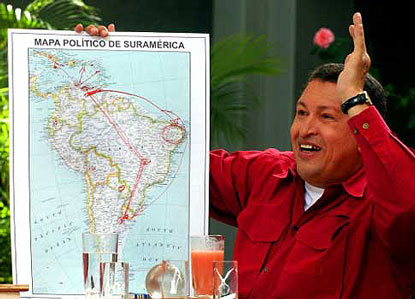
We Argentines are also happy. Now, at last, the great natural gas pipeline linking Caracas to Buenos Aires, which was announced during the presidency of Nestor (kirchner) will advance. The work is a bit delayed: let’s say, it has yet to be started. But when they start, hold yourself! They will advance at the same speed as the Banco del Sur, announced in 2007 and conceived as a South American International Monetary Fund. It’s a great idea, spectacular. Basically for now is just that: an idea. It will take shape and brin the Monetary Fund and the World Bank to its knees, even if for the Argentines, and especially for Kirchnerism, it may involve a great sacrifice: we propose that Boudou and Vandenbroele preside it, two entrepreneurs who surely at some point will become  known.

It makes me salivate thinking about the momentum that will be gained by other initiatives we have been announcing for years. Do you remember the regional common currency, the Sucre? Of all the projects this is the most advanced, with the only subtlety that for now the common currency is the US dollar. I think if we want to finally make this happen, the right person to handle it is-again-Boudou. I tell him he has to create a new currency, the guy goes and solves everything.

And the Railroad of the South (Tren del Sur)? We announced it with much fanfare on August 20, 2008 at the railway station of La Rinconada, Caracas. What a wonder: a train that was to unite that capital with Buenos Aires. “It’s a realizable utopia,” the then Ambassador of Argentina in Venezuela, Alicia Castro dared to say. Work began and ended on that day. People seem to prefer a different type of adventure tourism. But now that he is unemployed Schiavi could be entrusted to restart it. In any case, with the suggestion that the train arrives station Retiro, rather than station Once.

And the 600 gas stations that were to be installed here jointly by Enarsa and PDVSA? They only built two and I think they have disappeared. Again, the idea was excellent. Perhaps the problem was that financing was from Banco del Sur, the gas was going to come via the Gasoducto del Sur and the materials needed were going to be brought by the utopian train.

Enarsa and PDVSA also did not build a dam, as they had promised, and never finalized the project of creating joint ventures for the enhancement of natural gas for cars. This is fine. If you do everything at once, the people adopt bad habits. With the addition of Chavez to Mercosur other things are guaranteed. Airplanes that come from Venezuelan with dollar for the lady’s campaign will no longer have to undergo custom’s controls. Air Traffic will be more fluid.  For example, if the Boca Juniors team took four days to return from Caracas, in the future it will be no more than two or three days.

Another advantage: Chavez a few years ago lent us one billion dollars at a rate of 14%, which was considered abusive. For example, this is much higher than the one charged by the IMF. It was such a scandal that we never went back to ask him for a dollar. He was the last guy that threw some mangoes at us and we treated him like an usurer. Now that he is our partner (and the world continues not to lend us anything) we should apologize and re-finance ourselves with him It would be fair treatment: we tell him how much we want and he tells us at what rate. We should trust him. I don’t think it will be more than 20 percent.

On the other hand, the Lady already said it: Mercosur is now the fifth largest economy in the world. No matter that we live in a constant trade bout with Brazil, or that Uruguay accuses us of corruption in a dredging project in the Rio de La Plata and that we promoted the suspension of Paraguay to manage Venezuela’s entry into Mercosru via the back window. It does not matter if next year in Brazil people will be able to buy dollars even in tire stores, while here we want to turn into rubber those that buy dollars. What matters is what we want. Ti me the picture of Cristina, Dilma, Hugo and el Pepe together joining hands seems super tender. Let businessmen fight, let the people have fears, and let Governments kill each other: The Presidents will eat partridges.

Welcome then Commander Hugo Chavez of the Bolivarian Republic of Venezuela. Welcome to the natural gas pipeline, the bank, the train, the Sucre. The gas stations and the refinery. Welcome Antonini Wilson, the planes full of dollar bills and the transparent deals of the socialist Caribbean. And welcome, above all, a more democratic and respectful of human rights Mercosur, in which the assassins and rapists of our prisons could be rehabilitated campaigning for Hugo Chavez in Caracas.

(Note added: And now PDVSA says it will help Argentina exploit gas and oil deposits in the Falklands. Another empty promise)

Revolutionary Olympic Travel Expenses

August 9, 2012

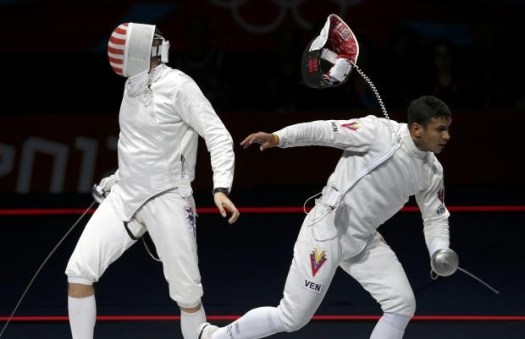
You have to love the revolutionary spirit of Chavez’ Government officials. While the fencing team, composed of six athletes and five trainers received 10,560 euros for their daily expenses while attending the Olympics and generating a gold medal, the document above shows how the “Sport Vice Minister for Performance” received all of 33 days of daily expenses to attend the Olympics in the amount of euros 10,368. We sure hope the Vice Minister did indeed improve someone’s performance while on vacation in London.

Of course, any regular Venezuelan who has to go to Europe for any reason, gets all of US$ 3,000 maximum for a trip, per year, to Europe at the official rate, no matter what the length of the trip may be or how noble the purpose may be. The Minister also gets some “extra” money, because clearly the regular stipend is insufficient to cover his travel expenses. regular people have no option to get any “extra”. The Minister also makes much more than a Full Professor at a Venezuelan University at Bs. 13,761 per month.

This are the new oligarchs, the ones that defend the revolution and its Supreme leader, el Saliente Presidente, for the simple reason that even if they admit the whole thing is a failure, the privileges they receive will disappear with its demise.

And the athletes? Who cares? They may not even be Chavistas!

Fairness In Venezuela’s Presidential Campaign

August 3, 2012

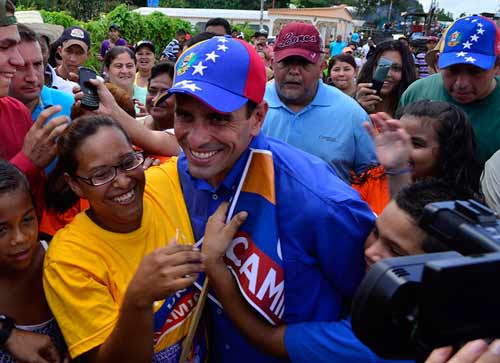
So, today the Chavez dominated Electoral Board, warned Capriles that he is violating electoral laws by wearing the following cap with the symbols of the country:

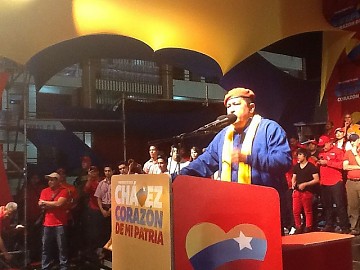
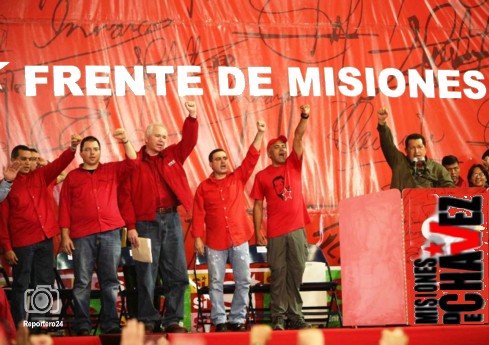
Funny, besides letting Chavez speak 4,000 hours in nationwide “cadenas”, where was the CNE when these pictures were taken during Chavez’ campaign?:

you see you can use the colors, but not the flag. So if you put the three colors of the flag in any geometrical pattern you want, add some stars (not 8), it is ok. But a little flag in a cap is illegal. Especially if you are the opposition candidate.

That is the level of fairness in the Venezuelan  Presidential election.

Venezuela’s Limardo Olympic Fairytale by Jonathan Liew

August 2, 2012
That we Venezuelans get excited about Ruben Limardo’s gold in London is not surprising, but reading this delightful account written by a non-Venezuelan is simply priceless. That someone can be so captivated by Ruben Limardo’s victory and story is truly a joy, I thought I would reproduce it (without permission) for all to enjoy. Thank you Mr. Liew, you made my day. And thanks MM for the tip! (And don’t miss Ruben Limardo’s picture in the London subway, wearing his gold medal)

London 2012 Olympics: how I was entranced by the wild Venezuelan Ruben Limardo

The wonderful thing about the Olympic Games is that every session of every day throws up a new hero to exalt. Some will be multiple champions, sporting greats or gallant losers. Some, on the other hand, simply charm the pants off you.

by Jonathan Liew

Everybody has their own moment of reverence at the Games, and mine came yesterday, courtesy of the Venezuelan épée fencer Ruben Limardo. I had never heard of Limardo.

Nor had the crowd, save for two dozen Venezuelan fans, cheering wildly for their man. He was no rank outsider, but nor was he expected to win a medal. Certainly not with Max Heinzer, the Swiss world No 2, lying in wait in the last 16.

The pair posed a stark contrast. Heinzer was technically flawless and tactically astute, waiting for his opponent to make the first move.

This is the surest way to win épée, which unlike sabre and foil, permits a point to be scored against any part of the body rather than just the torso.

Attempting an attack leaves you dangerously open to a counter-blow. Defence, therefore, is the key. Feinting a thrust to provoke a riposte is a frequent motif. It is what makes épée the most tactical and psychological of all the fencing disciplines.

Naturally, Heinzer knew all this. It would be unfair to say I took an instant dislike to him, but the way he fist-pumped after scoring a point had a distinct whiff of Federer-esque arrogance about it.

Twice, as Limardo lunged at him, he wriggled out of the way and then jabbed his opponent in the back.

This, though a legitimate tactic, seemed dishonourable. Later, I discovered that when you visit his personal website, it attempts to charge you for access. Ladies and gentlemen, we had a villain.

Limardo, just 5ft 9in and giving away a significant reach advantage, had one strategy only: attack.

While the other fighters in the Excel Arena — all matches up to and including the quarter-final stage are played four at a time — tiptoed cautiously up and down the piste, keeping the sword watchfully upright, Limardo leapt and lunged, rattling the épée, swishing it around, scanning Heinzer’s every twitch for a sign of what he was planning.

“It’s a sport of thinking,” says Asimina Tsellou, communications manager of the FIE governing body, whose job it is to sell the sport.

“You need to have a strategy. It’s not to do only with yourself. It’s not about training for four years and doing your best. No, here you have to understand the enemy. The hits. The strategy. You have to be in an enemy’s mind and understand his movement.”

The cerebral dimension of fencing cannot be overstated. What other sport awards “diplomas” to its champions and bestows the title of “professor” on its qualified coaches, as the British Academy of Fencing does?

Many former fencers go on to successful careers in business or academia.

Britain’s Corinna Lawrence, who lost in the women’s épée on Monday, is studying for a business degree at the Universityof Westminster.

Another British fencer, Sophie Williams, 21, is a product of Millfield School who took up the sport when she was 10. “I had a nine-year-old brother and I wanted to beat himin a sword fight,” she says.

“Luckily I’ve had a family who were supportive and drove me all overthe country.”

The criticism levelled at fencing is that it is elitist, unreachable to most due to the prohibitive cost of equipment and electronic scoring systems.

Williams admits that her parents gave her “a huge amount” of financial support, but adds: “No sport is cheap when you get to a certain level, when you’re flying all over the world. But there are great foundations now.”

Along with fellow Briton, Louise Bond-Williams, Williams lost in the first round of the women’s sabre, capping what has been a miserable Games on the piste for Britain.

Back in the stands, meanwhile, the Venezuelan fans were noisily celebrating Limardo’s 15-11 over Heinzer, joining his countryman Silvio Fernandez in the last eight.

You may have spotted where we are heading with this. How can Venezuela, with half the population and a third of the average incomeof Britain, produce two moreworld-class fencers than us?

Williams does not have an answer, but she does see progress. “It’s not an overnight process,” she says. “But we’ve made such improvements in the last year. Hopefully that will deliver medals in Rio.”

Limardo, meanwhile, is threatening to deliver a medal in London. At the start of the final round of his quarter-final against world champion Paolo Pizzo, of Italy, the score is locked at 12-12, first to 15 points. Pizzo takes a couple of steps back, Limardo a couple of steps forward.

He rattles the sword a little. Pizzo wavers for a millisecond: all the time Limardo needs to lunge forward and thrust his épée into Pizzo’s torso.

Victory follows seconds later. Limardo celebrates by sprinting dementedly around the arena, before dropping to his knees in front of the Venezuelan fans.

I have to leave for the Aquatic Centre before Limardo fights for the gold medal against Bartosz Piasecki. But during a short gap between swimming semi-finals, I manage to coax enough signal out of my phone to watch a live stream.

Limardo is magnificent. Giving away eight inches to his Norwegian opponent, he attacks with devastating speed and breathtaking agility. At 14-6, he wavers, losing four points in a row. Piasecki scents a sensational comeback. But Limardo wins the next, winning Venezuela’s first gold medal for 44 years.

As whoops ring out for Michael Jamieson and Ryan Lochte, I indulge in a small cheer of my own, celebrating this most unlikely of Olympic fairytales.

In Venezuela, There Is A Path and There Is Way

July 31, 2012

I went to Venezuela about two weeks ago and spent it meeting with a number of people. While I knew and know that it is an uphill battle to defeat Chavez, I must say what I heard and saw changed my mind quite drastically about the probability of change come October. In particular, I heard or saw at least two presentations of polls, which have different results, but from which I could reach my own conclusions.

Beyond that, the way the Government acts clearly shows that there is little confidence within the Government as to the possible outcome of the election. The recent CNE decisions against ONG’s and their campaigns and the massive use of state resources are but one example of this.

And to those that have not noticed, there was a union election in Ferrominera del Orinoco, the iron ore company owned by the Government, where the President of the union was reelected under the “Unity” banner by close to a 5%. And yes, while he was reelected, the path to the election was full of roadblocks and dirty tricks, the main one being hiring about 2,400 new workers to try to win it for the Government, as well as a one year delay to try to insure the PSUV slate would win.

But it was not to be. The same workers hired to load the election in PSUV’s favor, apparently decided they were not too happy somehow and the election went to the Unity candidate in what used to be Chavista territory and more importantly we are talking about a union election. Think about it, the rank and file of a union election held under the rule of the XXIst. Century Chavista Bolivarian revolution, was won by the opposition!

Going back to the poll numbers, I saw a presentation by a well known pollster, my favorite for too many reasons. Since I did not pay for it, I will not say the name, but it is in my mind the most accurate in recent years.

These are the highlights:

-To get it over with, because it is not the most important result, things were very close at the end of June. Within the error. That is the punch line.

-While crime is THE most important problem to a majority of voters, when deciding who to vote for, voters work with their pockets. It is inflation and their purchasing power which is most important when it comes to the decision of who to vote for.

-Confidence in Chavez is 9% better than confidence in Capriles. However, this numbers ahs not changed in six months. In 2006, confience in Chavez was 26% more than confidence on Manuel Rosales.

-51% of those polled like Chavez, 49% like Capriles. This is in response to “Is XX someone you like?”that is, not someone you would vote for. In 2006, the difference was 55% for Chavez, 40% for Rosales.

-Social and economic indicators are all even between the two candidates, however, Chavez’ have gone down or flat since December, Capriles’ have increased. They did go up the last three months of last year, but no more. In 2006, Chavez had at least a 15% advantage over opposition candidate Rosales.

-The fear that Capriles will cancel “Misiones” has gone from 60% last year to 42% at the end of June, which means Capriles’ message is getting through.

-50% of those registered in Mision Vivienda, expect a home before October. That is fully 25% of the population.

-85% of Chavista voters believe that Chavez is cured by now.

-The ratio of “Optimists” over “Pessimists” has remained flat to down since December.

The pollster discussed the variety of results between pollsters. He noted that the pro-Chavez votes is quite similar between “serious” pollsters. What is different is the number of undecided, which varies from 8% to as high as 23%. He suggested that it was the undecided that are leaning largely in favor of Capriles, which creates the differences.

The last argument is the only one that I fully did not buy. It is rare in polling to have the undecided split in such an asymmetrical way. Maybe the pollster wanted to be nice to his competitors, I just think that the other pollster are not asking the right questions. The pollster concluded by saying that Capriles’ trend was what you would like to see in an race: One candidate stuck, the other one rising, the structural race dramatically different from previous ones. Concluding, he said that a half million difference between Capriles and Chavez seemed to be quite reasonable at this time and with this data.

The other puzzle in all this, is the inconsistent policies of the Government: Why insist on the gasoline chip? Why the slowdown in Cadivi outflows? The first created fear, the second one could create shortages at the wrong time. The answer may be that not everyone in the Government is being realistic about the outcome.

So, I turn to my next worry: Will they concede? Looks tough at this time to answer this. These guys are no democrats. But I will give my thoughts on this in a post in the future.

In the meantime: There is a path, there is a way in Venezuela!

A Gringa in Venezuela’s Highest Court?

July 26, 2012

A while back, a trusted friend told me there was a foreigner in Venezuela’s Supreme Court, but this person could not prove it. Yesterday, this person sent me this article which says that someone has actually gone to the Prosecutors Office to accuse that Supreme Court Justice Evelyn Marrero Ortiz is not Venezuelan.

The article says that the Justice was born in Puerto Rico on February 22nd. 1942 and obtained the Venezuelan nationality in 1966 when she married a Venezuelan citizen whose name is irrelevant to this story. Thus, technically, if this can be verified and true, Justice Marrero is simply a US citizen, about the worst citizenship you can have if we are to believe Chavez’ revolutionary words.
The accusation further says that in the Judge’s papers at Universidad Central de Venezuela, it clearly says that she was born in Jayuya, Puerto Rico. According to Chavez’ own Constitution (Article 41) in order to be a member of the Venezuelan Supreme Court, you not only have to be Venezuelan by birth, but you can not have another nationality, which implies that you have to renounce to any other nationality you may have. Justice Marrero would not qualify for both reasons, even if she has renounced to the other nationality.

Personally, I would allow people born abroad but who have lived here all their lives to hold certain positions, including most Ministries. What astounds me is that these ultra nationalistic revolutionaries allow these blatant violations of their own Constitution to occur, without saying anything, while arguing sovereignty, self-determination  and other such BS for everything that happens around them. Just like they allow Cubans to run intelligence and security and have a say in military and identification matters and it is ok, because they are Cubans.

In fact, Minister of Planning and Finance Jorge Giordani, was accused of not complying with Article 41 in the first few years of Chavez’s tenure. At the time, it was argued that Giordani, who was born in San Pedro Macoris, Domenican Republic, held a position (Minister Planning) which was not the subject of Art. 41. Well, since they merged Planning and Finance, this is no longer the case, but given Chavez’ filial relationship with Giordani, nobody seems to want to bring this up either.

Again, I write this because I trust the person that gave me the info. You would at least think that the Justice herself would explain to us, whether she is not or not qualified to be part of the Venezuela Supreme Court. But as usual, there is simply silence.

But of all nationalities, I find it ironic that she is a gringa. Don’t Chavistas get paranoid that she could even work for the CIA, the NSA or the FBI?

What a joke this Government is!

When Foreigners are Treated Better than the “People” in Revolutionary Venezuela

July 17, 2012

The headline in today’s El Nacional was quite succint:

“Misiones have received an amount similar to Cuba’s subsidy”

Think about it. Suppose it is 50% off, the subsidy is only half of the US$ 44 billion that El Nacional calculates the Government has spent on the centerpiece of Chavez’ “accomplishments”, which is only an ill conceived bunch of irregular programs which are aimed at getting people to vote for him.

But the same? Are you kidding me?

Think again. Venezuela’s subsidies to Cuba, a country of 11-12 million inhabitants, are comparable to the miserable showcase of the revolution for the 28 million inhabitants of Venezuelans. This means Cubans get, per capita, triple the benefits, just because Chavez has this weird empathy with the bearded and incompetent Cuban Dictator.

That is all the oil windfall has done for the “people” in “revolutionary” Venezuela.

In any other country. any country with pride or self esteem, this would be a scandal. In Venezuela this is yet another headline to show that these revolutionaries have little pride, little regard for the so called sovereignty of Venezuelans, little regard for a country with poverty, malnutrition, a horrible health care system, black outs, shortages, 7.5 million people without housing.

But wait! These are the “people” Chavez is supposed to represent. care or, bla, bla bla…

Pure revolutionary BS!

Yes, Chavistas, PSF’s and the like, tell me one reason, just one, why this should be the way it is. Solidarity? Gimme a break. These guys are taritors. Chavez should be tried for being a traitor to his own people. And his collaborators should be jailed for giving away the country’s wealth and allowing Venezuelans to live in squalor for the benefit of some poor Cubans who we may have sympathy for, but who have little to do with our country.

Just a thought.

I think we should jail them if we ever get the chance. Call me anti-patriotic. All of them.

But I do. Jail them. No remorse. Just Justice!

Traitors!

No Venezuelan Candidate Can Top Reina Sequera’s Offering

July 10, 2012

In its never ending quest to offer the voters anything, candidate Reina Sequera, the candidate for the Poder Laboral party has made the ultimate populist promise:

“I promise to eliminate the poverty of all Venezuelans. This promise will materialize itself opening a personal bank account and deposit one million US$, amount which we consider should be sufficient for each poor person to get out of material poverty”

There you have it. Hard (Impossible?) to top this. Poverty killed instantly by distributing US$ 26,000,000,000,000 among all Venezuelans. (Please don’t quibble if the population is 26 or 29, or if she will hand out one third at a time, that is round off error). That is 2.6 x 10^13 dollars which will come from”all of the excess of wealth of the minerals that gives us our noble nature, whether you call it oil, iron or gold, etc.”

There you have it Venezuelans. Don’t miss your chance to become a millionaire come October. Elect Reina your President and why not, your Queen. She has over promised anyone and everyone. Never mind the 13 zeroes. Clearly, Hugo was unable to dream beyond dreams. Or beyond his arithmetic.

Go Reina!

Now, Why didn’t I think of this first?

The Mystery Of The Dysfunctional Optical Cable Venezuela Gave Cuba

July 10, 2012

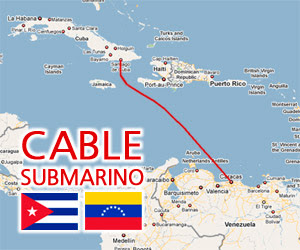
It was another one of those Huguito gifts to the Castro brothers, an undersea optical cable to communicate Venezuela with Cuba in order to improve communications in that island. The cable was quickly laid down by the Chinese contractors and Venezuela’s Minister of Science and Technology, Chavez’ son in law, hailed it as if his office had contributed more than just $68 million dollars or so to purchase it. He said it was “fully operational”. Another triumph of Venezuelan technology, sorry, funding.

But nobody has seen any evidence that it is working.

Something happened with the gift, which so far has apparently not transferred a single byte or bit. Apparently many Cuban Government officials involved in the project have been jailed and the base station purchased to connect to the cable is apparently not compatible with it. There are also charges that both Cuban and Venezuelan officials were involved in some hanky panky with phone cards to call the island.

Thus, another great gift by the autocrat goes to waste, another 70 million or so dollars belonging to Venezuelans goes down the drain. Who cares, really?  We have a pipeline of gizilion dollars coming in every day and Chavez thinks it is unlimited. I just wonder whether the corruption was imported into Cuba or into Venezuela. Maybe this time it was truly a joint project.

Hope the Cuban don’t export their cholera to us next…