Archive for the 'Uncategorized' Category

The Legend Of El Dorado, Turned Backwards

March 1, 2016

1621-map-by-Willem-BlaeuOne of the multiple maps pointing to the location of El Dorado

When I was an elementary school student, I always admired how the natives of South America invented and propagated the Legend of El Dorado in order to distract and mislead the Conquistadores. Not only did they succeed, but they did it for centuries, deceiving well learned and well educated men and inducing expeditions from Venezuela to Peru, looking for this mythical place of wealth and riches. The myth was developed so well, that there are many maps like the one above, purporting to indicate where El Dorado was located. Even Humboldt took some time away from his erudite pursuits to look for El Dorado in Guyana, to say nothing of Sir Walter Raleigh.

All of this comes to mind, because the saga of the Las Cristinas mine in Bolívar State, seems to be turning into a sort of Legend of El Dorado, except backwards, as the announcements surrounding the mine seemed oriented more towards dazzling and distracting the natives and expropriating foreigners, than about producing gold.

The story starts from what I understand, in the sixties, when the wife of one of the people that helped Jimmy Angel explore Venezuela’s Guyana region, obtained a mining concession to exploit Las Cristinas. The concession was the subject of numerous lawsuits, until the concession ran out.

From here, the story is clearer, Canada’s Placer Dome, signed an agreement with the Corporación Venezolana de Guayana (CVG) in 1990 or 1991, whereby Placer Dome would exploit the mine and give some percentage of the profits to CVG.

But then Crystallex, another Candian company claimed to have a concession to part of the mine, which stopped the project and later forced Placer Dome to sell rights to the mine for US$50, according to lore, when gold dropped in price to a company named Vanessa Ventures. The Government was not happy and expropriated Las Cristinas, giving it back to CVG.

Then in 2002, the Chávez Government awarded the mine to Crystallex and Vanessa sued the Government at the World’s Bank ICSID arbitration panel in Washington DC. But it was not until 2007 that Crystallex satisfied all of the requirements of the Government, including an Environmental Impact Statement and posting the bond required by CVG. But the Government denied the permit, despite all of the legal authorizations and approvals being present. Crystallex also sued in the World Bank’s ICSID arbitration Court.

In 2011, the Chávez Government nationalized the gold industry, prompting Rusoro, which exploited the El Callao mines and Gold Reserve, which had the rights to the Las Brisas mine to sue the Government at the ICSID.

In 2012, the Chávez Government assigned China’s CITIC to the rights to develop Las Cristinas (So much for reserving it for the Government two years earlier).

Don’t know what type of contracts or agreements were signed with the Chinese, if any.

As far as I know, the only company that produced any important amount of gold in all these years was Rusoro, which reportedly produced close to 100,000 ounces in 2010.

 So, much like the mythical El Dorado, Las Cristinas, El Callao, Las Brisas have all been but a myth, Venezuela has huge gold deposits, but other than illegal miners, and Rusoro for a while, not many ounces have come out it.

You can say that the politicians have turned it into a myth to defend sovereignty, promote the idea that Venezuela is rich and soon we will be even richer. Except that very little has happened.

And a new chapter in the myth was born last week, when, after Gold Reserve had won its suit at the ICSID and any Court in the world that was needed to enforce an award of US$ 740 million plus interest, that the Minister of Mines and President of PDVSA announced an MOU (Memorandum of Understanding, a piece of paper in which we agree to sign a contract, if we agree again later on the details) with Gold Reserve that apparently settles the case.

Or does it? Or did we just see a new El Dorado legend just being born?

Because this week, the Government issued a somewhat confusing MOU with Gold Reserve claiming:

-A joint venture with Gold Reserve (45%) and the Government (55%) will be created.

-The project “implies” and investment of US$ 5 billion in a win-win relationship

-The MOU puts and end to the legal situation at the ICSID.

-The investment in the project includes US$ 2 billion for the exploitation of the mine and US$ 2 billion in loans to the country, as well as the resources to get the company going.

Then the shares of Gold Reserve were suspended from trading, awaiting for the company’s interpretation of the agreement, which came out yesterday, in which the company said:

-They have signed an MOU with Venezuela that contemplates settlement, including payment and resolution, of the arbitral award of the ICSID.

-Venezuela would proceed with payment of the Award including accrued interest and enter transactional (settlement) and mixed company (“joint venture”) agreements, which are expected to be executed in approximately 60 days.

– It is anticipated that Venezuela, with the Company’s assistance, would work to complete the financing to fund the contemplated payments to the Company pursuant to the Award and for its mining data and $2 billion towards the anticipated capital costs of the Brisas-Cristinas Project. Upon payment, the Company will cease all legal activities related to the collection of the Award.

-The Brisas and Cristinas properties, together with the technical data with respect to the Brisas project owned by Gold Reserve, would be transferred to a Venezuelan mixed company, which is expected to be beneficially owned 55% by Venezuela and 45% by Gold Reserve

The differences are clear: First of all, Gold Reserve gets both Las Cristinas and Las Brisas, not just Las Brisas, which was the mine they sued for. Second, “Upon payment, the Company will cease all legal activities” and third, Gold Reserve will provide only “assistance” to obtain the funding. No more, no less.

But many people read all of this like a new El Dorado legend: Venezuela will get a US$ 2 billion loan, we have huge gold reserves, we are going to produce gold like crazy. And Gold Reserve will produce all this.

We shall see, but I doubt it.

A new El Dorado legend is born, but this time aimed at distracting mostly the locals, rather than the invaders…just like El Dorado, but turned backwards.

Note added on March 2nd.: The only way this could receive financing, in the absence of financials and an ongoing concern, is that Gold Reserve will “facilitate” transferring the 45% rights to the Chinese in exchange for US$ 2 billion loan to the Venezuelan Government and/or the project.

Not A Great Week In Venezuela…

February 27, 2016

Aristobulo

It was not a great week in Venezuela. While it is true that if you were a bondholder of Venezuela 2016 you were very happy to get paid on Friday, the average Venezuelan felt pretty lousy all week.

Monday was a day of darkness and protests. Darkness because during the day, the East of Caracas had a very serious black out which had lingering effects for days and that same evening, the West of Caracas suffered the same fate, including the Miraflores Presidential Palace. Someone sent me a picture (mostly black) claiming that was the darkened palace, which left me wondering whatever happened to the emergency power plant and if Maduro was actually there during the blackout. But I have not seen it anywhere else, except the news that the area was dark.

That evening, people took to the streets in Catia (West), Petare (East) and there was pot banging in Chacao (Middle). In the West and the East riots were over food lines and insecurity, but the Government made sure the “Pueblo” could not express itself by sending out the National Guard in Robocop suits to repress the protests.

The next day, the full Cabinet and the Vice-President went to the National Assembly to present the President’s Annual Report, called “Memoria y Cuenta” (Memory and Accounts) which is the subject of numerous jokes about No memory and tales (Cuentos)).

And that was indeed the way it was.

Vice-President Aristobulo Isturiz showed up in his best suit (Whatever happened to his red shirts?) to tell a tale of progress, democracy and prosperity in Venezuela. There were the usual mentions of “Economic War” causing the few problems the country has like inflation, but the Vice-President even stated that the country was “solvent” in 2015 despite the 20% of GDP deficit.

And he said nothing about food lines, health care and crime…

As Aristobulo told his tales, electricity workers were still trying to turn on the lights in the East of Caracas and as the session drew into a close, night was falling and Caracas was shutting down for the day. With Shopping Centers forced to close early (and open late), the people have no excuse to be out in the streets early. The only excuses they used to have, a little shopping, some last minute supermarket visit, are no longer valid. The recessionary effect of this measure will make the economy tank even more if rains do not begin early this spring.

Meanwhile, President Maduro continued turning on his Fourteen Engines of Production, holding daily Court on nationwide TV to turn on the “Fishing Engine”, the “Medicine Engine” or whatever. But wishing it will not make it so, as all of those invited to be part of each engine always complained about the lack of raw materials, dollars and parts to get the engine going.

But Maduro’s promise is that in 100 days the engines will be producing, forgetting that all “100-day” promises during seventeen years of Chavismo have failed miserably.

Meanwhile at the National Assembly, Chavista supporters got unruly, Ramos Allup got mad and tried to move them out, which they refused, which caused the session to be suspended. Such is the state of democracy in Venezuela. As if this was not enough, Maduro congratulated them for their victory, which stopped the discussion on a Bill called “Law for National Production” a strange legal instrument which some opposition Deputies think will somehow promote national production of goods and widgets.

Never have so many been so lost and confused…

The Bill is truly obnoxious, admitting, recognizing and accepting that there are exchange controls, price controls and even stating that there will be no privatizations in some areas of the economy.

Such is the mind set of opposition leaders after seventeen years of populism.

Then on Thursday the Government published a Memorandum of Understanding in which it settled with a tiny Canadian company called Gold Reserves which had been awarded US$ 740 million over the nationalization of the Las Cristinas gold concession. According to this fantastic (imaginative?) piece of paper, the tiny company (US$ 15 million in assets, US$ 45 million in debt and US$ 11 million in losses in the first nine months of 2015) will invest US$ 5 billion in Venezuela and lend US$ 2 billion to the country. Implied in the MOU is that this new gold company is payment in lieu of an actual cash payment to the company. At least there was no 100 day promise involved.

On Thursday, a protest on the healthcare crisis tried to reach the Ombudsman’s office, but in the distorted and bizarro world of Chavismo Democracy, this is not allowed. Thus, the Constitution allows protests, but the National Police and the National Guard don’t allow it. The Constitution has an instance for people to address their complaints, but this instance is not available if you try.

Only Chavismo…

Then on Friday, the anti-climatic payment of the 2016 Venezuela bond took place. Good for the bondholders, bad for people needing everything, as the debate starts anew on what will happen in October when PDVSA will have to make payments of over US$ 3.05 billion. So far, the Government has understood the political and financial implications of default, the question is at which point the political consequences of continuing to pay become more significant as unrest balloons out of control.

Stay tuned…

PCNI II: Cargo Ships In Puerto Cabello Drop Dramatically

February 19, 2016

ships

When I initiated the Puero Cabello Non-Baltic Index (PCNI) on Jan. 28th. my intention was to contribute some sanity to the claim that no ships were arriving to La Guaira by noting that Puerto Cabello was running about as usual with about 15 cargo ships or more in port on any given day (I only count cargo ships docked i the port, not tankers or others). At the same time, given that I was concerned about the possibility that in the near future imports could go down enough to be a concern, it was a way of monitoring how things were.

Unfortunately, only days after my first post, there was significant drop in cargo ships arriving in Puerto Cabello and even a couple of days of practically no ships in port as you can see in the graph above. From levels of 15 cargo ships in port, we are no running around 4 to 5 a day, a significant drop from the customary 15.

Given that I had no history, you may wonder if my series may simply be a seasonal effect, however, one of the readers of the blog sent me the series that he had from the first semester of last year and I can tell you that the average was above the level I started with and there were certainly no days as low as those that have been seen in the last two weeks.

This is a dramatic change and I would like to be optimistic in that there seems to be a pick up recently, but I have to wait for the data. In the meantime, sorry to be the bearer of bad news, but if the port was running above 15 ships per day last year on average and there was scarcity, things are indeed going to get worse soon in Venezuela…

(Just to make sure the methodology is clear: I go in http://www.marinetraffic.com once a day, the number of cargo ships docked in port may vary during the day by one or two, but have never seen it it change more than two and only once. I don’t know what the cargo ships are carrying)


Maduro’s Miniscule Adjustment

February 17, 2016

NM

Almost two years and ten months to the date of his election in 2013 and two months and 11 days after leading his party to an embarrassing defeat, Nicolas Maduro announced the first real economic measures of his almost three year old administration.

But the measures turned out to be miniscule…

In fact, what the Venezuelan President announced today was likely insufficient in April of 2013, when he was sworn in, when the parallel rate of exchange stood at Bs. 25 per US$, but may have had a bigger impact on the distortions in 2013 than it will have now. Chavismo continues to be trapped in its own distortion field, fearing adjusting the economy, but at the same time implementing a very meek adjustment which will likely be received badly by the population. If Maduro was going to take the blame for an adjustment, he should (and could!) have gone further than he did and the population would have not been able to measure the difference in impact on inflation and problems than this softer adjustment will have.

It took the Venezuelan President four hours of rambling to get to the real measures he proposed. He talked about the Economic War, created Productive (!!) Councils for each State in Venezuela and talked about a “new” Venezuela, as if Chavismo had recently been elected.

Some of the announcements had leaked, as Venezuela’s and PDVSA’s bonds, which had been strong in the morning, soared right before the speech, gaining as much as 12% in price for the day before the market closed, but before the detailed announcements had been made. Maybe it will be a matter of “buy on the leak, sell on the news”, now that the details have been revealed.

The first important announcement by Maduro was the first increase in the price of gasoline since Chávez was first elected in 1998. In fact, then candidate Chávez asked President Caldera to hold off on scheduled increases until after the election. Thus, the price of gasoline in Venezuela has stayed constant for over 17 years. While the rate of exchange has gone from Bs. 0.57 per US$ to Bs. 1,045 per US$, the price of gasoline had been kept constant at Bs. 0.097 per liter (US$ 0.000097 per liter or US$ 0.0004268 per gallon). So you get it, in this post in 2014, I filled my car in Caracas in 2014 with about 10 gallons of gas and paid the equivalent today of barely 4.2 cents in US$ for the ten gallons to fill up.

So, today Maduro increased the price of 95 octane gasoline from Bs. 0.097 per liter to Bs. 6 per liter, a 6,000-plus percent increase, but in the end:

Venezuela went today from having the cheapest gasoline in the world, to having the cheapest gasoline in the world.

How cheap? Well, if you consider a standard 14 gallon gas tank, at Bs. 6 per liter, you will be paying to fill up the tank a total of US$ 0.37 or all of 37 cents in US$. That is how cheap it will continue to be.

Obviously, this is a positive, but whatever positive there was in the announcement, was erased rather quickly with the announcement that the difference between the old and the new price will be placed in a “new” fund to support social programs. Thus, PDVSA will not benefit from the increase, the money will go into a non-transparent fund run by Maduro and the increase will likely be used in new expenditures, doing little to close the fiscal deficit.

And to top it all off, the 91 octane gasoline, was only increased to Bs. 1 per liter (one tenth of a cent). This gas has lead in it and currently 70% of the gasoline consumed in Venezuela is the higher  no-lead grade, since it is basically free. Thus, I see two problems: One, people may start using the cheaper grade to save pennies, but damaging their car and creating more pollution. Two, the difference in cost of manufacturing the two gasoline types is small, so it makes little sense to have such a difference, if what you want is to get back some of the cost of producing it.

In the end, Maduro could have gone higher in both prices and made the two prices closer and the “people” would not have minded or would have blamed him for inflation as much as they will anyway. He would have also reduced the incentives for smuggling gas to Colombia, which remain quite high. (A liter of gas in Colombia runs around 1 US$, versus 0.6 US$ cents in Venezuela)

Next, Maduro announced that he will “simplify” the current foreign exchange system. He said there will be only two rates (There will be three, he ignored the parallel rate), eliminating one of the three “official” rates currently in effect. Thus, Maduro announced the devaluation of the Bs. 6.3 per US$ rate to Bs. 10 per US$ rate for essentials (food and medicine), while moving everything else to a floating (floating not free) which he said would start at the current Simadi rate (Bs. 202.9 per US$ today). In the end, all this does, is move the absurd travel allowance rate from Bs. 12 to Bs. 202.9 per US$, where it will continue to be a perverse subsidy for the rich that can travel.

This is probably the worst of the announcements made. With the parallel rate of exchange at Bs. 1,045 per US$ today, it simply reduces the profit of the arbitrageurs from Bs. 1,038 per US$ to Bs. 1,035 per US$, maintaining and sustaining the reasons for the huge  corruption surrounding the foreign exchange office CENCOEX and the contraband of goods to Colombia and to a lesser extent Brazil and the Caribbean. This racket is dominated by the Venezuelan military.

Finally, Maduro announced a minimum salary increase of 20% from Bs. 11,557 to Bs. 13,720. (Divide by 1000 and you will gulp!) What can I say, people really need it, but in an environment of extremely high inflation and with no measures to really stop the process, in two months, another increase will be needed. And another one…

And the people will still be even further behind that they are today.

I could talk about the other non-announcements Maduro made, but by now, you have been as patient with me, as I was with Maduro today.

And that would be the antonym of miniscule. Which is that you have been enormously patient to get here! Thanks!

(Maduro also made a very vague announcement of a debit card for poor families, which sounded like Manuel Rosales’ Mi Negra card in the 2006 Presidential election, but he gave very few specifics of how much it will involve in Bolivars and who would be eligible and why)


As TSJ Overrules National Assembly One Wonders What The Plan Is

February 15, 2016

As yours truly was swimming with dolphins, turtles and penguins, the Venezuelan Supreme Court (TSJ) ruled that Maduro’s Economic Emergency Decree was valid, despite the fact that the National Assembly used its Constitutional power to not give it its approval.

I am not going to talk about the illegality of the decision, they were going to do it no matter what. But perhaps it is funny to comment on the fact that the Hall of the Supreme Court even ruled that the Assembly can not revoke it, becoming a sort of a new Constitutional instance, changing what the Constitution says about what the National Assembly can and can not do.

I am not surprised by the ruling, as I predicted in December, that the battle was going to become one of who has power over whom and a clash with no  arbiter was looming. However, so far we have since little of a clash, as the TSJ has ruled and the National Assembly has done very little about these rulings or little to challenge the authority of the TSJ or the Government which is what I believe they have to do and should do.

I already disagreed with the Assembly accepting the ruling on the three Amazons Deputies, the Assembly should have never sworn then in if it was not ready to fight for them and their decision.

But I am also not sure of what exactly is the Assembly’s path. Yes, they have mentioned a possible Constitutional Amendment to shorten Maduro’s term and a recall vote, but don’t they think that the TSJ will stop them at every corner? What will they do then?

I think that the National Assembly has to defend its position as an independent power and pick the fight. If Ministers did not go to the Assembly as required, censor them and remove it, as the Constitution gives them the power to do. The Assembly does not like the decision by the TSJ? Then vote that the decision is invalid because it takes away powers given to them by the Constitution. Cut off funding to the TSJ if necessary. Why not?

They have to meet the Court at the Government in its own terrain. If the Assembly removes a Minister, anything signed or decided by that Minister becomes illegal and can be penalized by the Courts someday. He can’t even collect his salary or spend money. It would be illegal and he or she could face jail time some day.

As to the fact that the decree is still valid, like so many other things, it was obvious it was coming and the Assembly should have had a plan to fight it.

But so far, I still see no plan.

And the same applies to all the wonderful things the Assembly wants to do, whether it is the Amnesty decree, the recall vote or whatever. In each of them, the TSJ will attempt to block it.

What will be the response?

I hope there is one planned, if not, the TSJ will have scored victory over victory over the National Assembly without the Assembly responding.

As they say in Spanish, “la pelea es peleando”, the fight is fighting, if you don’t fight, the December victory would have been an empty one. To call the TSJ decision a “coup”, the drop that overflowed the glass”, “immoral” and such other platitudes, does little to defend the terrain that the Constitution gives the Assembly and the voters gave them.

AN: What’s the plan?

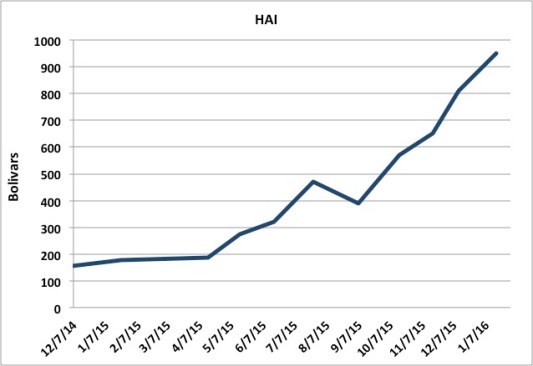
Hyperinflated Arepa Index (HAI) XII: Hard To Break The Bs. 1,000 Barrier

February 2, 2016

arepa

Well, I must say I was expecting the Hyperinflated arepa index to break the Bs. 1,000 barrier in order to keep it up with the unmentionable rate, but it was not to be. In my visit to Caracas last week, I “only” paid Bs. 950 for my traditional and delicious arepa de queso de mano at my secret place, which represents a 17% increase from six weeks earlier and a 431% increase from one year ago. This means that if you earn minimum salary today, you can eat 10.15 arepas per month, or about one every three days, not exactly good nutrition…

There were a number of observations during my visit that I think are worth mentioning. Perhaps the most important one is that I noticed a huge difference since early December when I went out at night to eat out. Really huge. I went to a well regarded steak place on Saturday night with my sister and at 8:00 PM there were only three tables full. And this place is huge.

The whole week was like that, no matter where I went. I took a friend, who was visiting from abroad to look at possible ¨change¨ in Venezuela, to an Italian restaurant that I love and when we arrived at 8:15 PM we were the only ones (It was Monday, but I went back on Thursday and it was similar). later two other tables filled up, including one of my coworkers. But that was it.

It repeated every night. Tell a group of Venezuelans my observations and they will argue for a while about whether it is about security or price. Easy, it is both. The parallel rate has gone up maybe 20% since I last visited, but prices at Restaurants have increased 30-40%. And this implies ordering ever cheaper wines, as the offerings become more expensive and of worse quality. At one place, after ordering three wines, none of which were available, I simply said, tell me what you have!

Simple questions become harder to answer. How much do you tip someone who parks your car? If you get Bs. 4 of gas (half a cent in US$) to fill your tank, what do you pay with? I only had a Bs. 20 bill (2 cents in US$), so I just gave it to the guy. Was it too little? Too much? I have no clue, he seemed happy.  I was probably over tipping the Valets at my hotel, at US$ 20 cents (Bs. 200), they seemed to be jumping to help me whenever I showed up.

Sad, very sad…

But not as sad as the scenes at the airport. Whole families come to say good bye to young people leaving. From Grandma, to aunts, sisters, brothers,nannies or whatever, people hold on to them, embracing them with almost despair. They have no idea as to whether they will see them again soon, or ever. I usually get annoyed at people who come to say good bye at airports en masse, but this time was different. I had to show respect. There were many very private/public spectacles full of emotion, my watery eyes were certainly not an allergy.

But I have always been a sentimental fool…

Then the stern cop asked me at the security check point: What do you do in Venezuela and how long will you be gone? I just said I don’t live here now, I live abroad.

No more explanations were required…he even seemed envious…

Sad, very sad…


Introducing The Puerto Cabello Non-Baltic Index (PCNI)

January 28, 2016

LaguirapictureJan

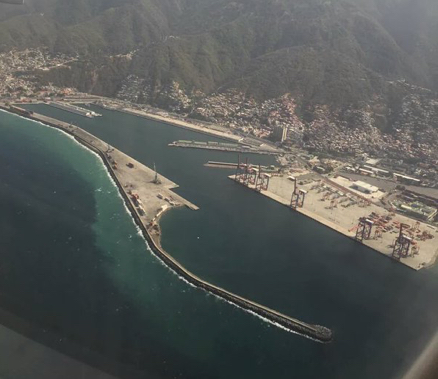
The picture above created a lot of noise on Jan. 19th. It is a picture of the La Guaira port just outside Caracas, showing that there were no ships unloading anything that date. The picture was purportedly shown as proof that famine is coming to Venezuela as imports had ground to a halt. Moreover, people suggested, this also proved that the country was about to default.

The faulty reasoning about the picture is that the La Guaira Port has not been the main source of food imports for Venezuela for quite a while. In fact, most ships that stop in La Guaira are container ships, bringing “stuff” or “peroles”, as Venezuelans like to call them. Venezuela’s main port is the Puerto Cabello port, where most food imports come to the country, as the Port has silos for storage, grain sucking facilities, as well as liquid discharge facilities.

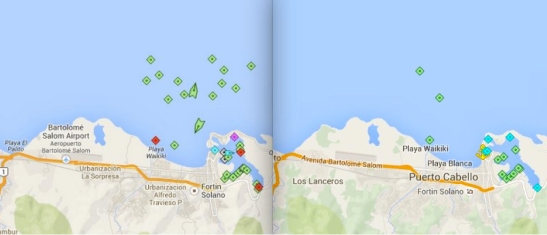
A while back I wrote a post about how ships carry  an AIS (Automatic Identification System) which allows all ships to be tracked. There are websites like this one or this one, where you can follow each step of what is going on. At the time, I was interested in the fact that there was a slowdown in downloading cargoes due to inefficiencies. Thus, on Jan. 19th. when the La Guaira picture circulated I compared picture from my post in May 2014, with that from the first website I mentioned on Jan. 19th.:

PtoCabelloJan19

What I found was that on Jan. 19th. (right panel) there were 15 ships in port, the same number as in May 2014 (left panel), the difference being that in 2014, there were many ships outside waiting to go in. But the number of ships unloading stuff were the same on the two dates: Fifteen.

Of course, this is a static picture, may depend at what time of day you go in, for example; and you don’t know what it is that these ships are unloading at any time. Some could be container ships bringing nails, rather than being grains or something else

Thus, I decided to start going into the website frequently and writing down the number of cargo ships in port and call it the Puerto Cabello Non-Baltic Index (PCNI) and follow it in time and report any significant changes. As I said, this is just an indication of the number of ships and it could be that its not all food. But should the PCNI drop at some point it would indicate that there is indeed trouble in the future in terms of food supply.

I have been taking data since Jan. 19th. simply recording the number of ships docked, whether they are container ships or not (I could actually look at each ship in the website and see what type it is). I hope this is useful in evaluating whether tougher times are coming and in making more quantitative whether things are going to become serious or not in the absence of hard Government data on any of these matters in real time.

Below is the first plot since then. It began with 15 ships and it has indeed been going down in the last few days, with 9 ships today, but according to the webpage 6 ships are due to arrive, even if it does not say when:

PtoCabello1

There is clearly a downtrend, but it is not clear whether this is due to the Xmas season (Venezula shuts down for Xmas) or whether it si something to worry about. In a few days we should know.

I will try to update it whenever the changes are significant


Postcards From The Mercado Libre De Chacao

January 24, 2016

One of the most fun things I do when I come to Caracas is to visit the Mercado Libre de Chacao on Sunday mornings. I just love watching the people, looking at the produce and, of course, buying those cheeses that you can only get in Venezuela. (Even if some failry good imitations are now sold abroad)

The market has changed, not only because it moved next door to a more modern building while Leopoldo Lopez was Mayor in 2008, but also because its nature has changed. What originally was created in the 40’s to have farmers from the surrounding areas bring fresh produce to sell directly, has now become a place to find what you can not find elsewhere. At premium prices, of course. But it does retain some of the original flavor, as produce remains its strength and since most produce is not regulated you can still find lots of good stuff there. (By the way, the webpage of the market ignores its previous history, only talking of the market from 2006 on, which is truly a pity)

The market has changed so much, that twenty years ago, I would go Sunday mornings because it was mostly empty (It opens from Thursdays to Sunday), but you would not necessarily find everything, most of the stuff had been sold. Today, Sunday are as bustling as any other day and what you can not get is likely due to its scarcity. The market has become so popular to look for scarce items, that even at noon on Sunday its still full.

These are some images from this morning:

On the left a picture of the produce section taken from above, you can see there is lots of produce and lots of traffic. On the right you can see the variety of produce you can find, since few of these are regulated, then you can find plenty of it at the right price. Not cheap, but most of it fresher and of better quality that you can get at the supermarket.

And then there is my favorite, the cheese vendors:

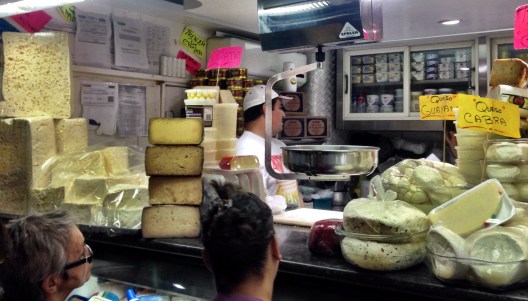
cheese

Some cheeses are regulated but many are not. He is well stocked. Note the beautiful PalmiZulia chunks on the left, the crinejas (strung cheese of a mozzarella-like cheese) on the right. One sign of the times is the “potes” (containers) of queso de mano, sort of in the middle. When these first appeared about fifteen years ago, they carried ten or twelve small “arepa size” cheeses. You can see on the left how they make them on small containers of three or four cheeses. The reason? The large container is 1200 Bs, (US$ 1.33) which most people can not afford, the smaller one is “only” Bs. 550 (US$ 0.60)

Even in the free market, it is really hard to find eggs:

On the left, you can see the empty egg store. I was told had some in the morning and they “think” they would get more in an hour. On that news, people start lining up as seeing on the picture on the rights. It’s only a hope, but the owners swears “some” will arrive.

While I was there there, was a big commotion:

The guy with the red shirt on the left is pushing a cart which has rice and oil, thus people start following him into the store on the right, where there were people already lining up for the goods that are arriving. As you can see in the picture on the right, this store specializes in hard to get goods at very high prices. You can see Corn Flakes, Domino sugar and on the left, all sorts of paper products that are scarce, such as diapers, feminine products and the like. Add oil and rice now, but those will not last long. As this was happening, the guy that owns the store where I was buying Saltine Crackers (hard to find) said to me: “I wonder where they can get that oil, I can’t”. (And that is his business line!)

The next two surprised me:

On the left a fruit stand that is usually well stocked. Most fruit stands looked sort of like this, half empty. This is not generally the case, fruit is like produce that you can find it because it is not regulated. On the right is the fish stand which was very well stocked, if you try to see the prices above the stand you will understand why, At Bs. 3,700. (US$ 4.1) it is not very affordable to the average population. (Remember the minimum monthly salary at the parallel rate of exchange is about US$ 10.7 per month)

You can have fun at the free market just reading the signs:

On the left, this stand advertises that it has a debit/credit card access point, but only for purchases above Bs. 500 (All of US$ 40 cents). In the middle a sign in the avocado stand plays a pun on the fact that the word in Spanish to play an instrument or touch something is the same: Do not touch (play), it is not a piano. BTW, the avocados were large and beautiful. Finally, a sign that says: For products with “just” prices (Maduro’s creation) there are no bags, additional bag Bs. 20 ( 2 cents).

Definitely signs of the times…

Finally, the free market continues to be a place for those with initiative:

On the left, a guy who claims to be a medical doctor and sets up a plastic table and provides Medical Certificates for driving. (Required in Venezuela) Today he was advertising hard, telling people that they should take advantage of it now, as the Government is about to increase the Tax Unit (Unidad Tributaria) which will increase the price of the Certificate, which today is at Bs. 600 (66 cents in US$). People were lining up for the bargain, including yours truly. That comes up to be about 11 US$ cents for year of validity of the certificate. (Remember on election day I was stopped by the cops and had all my documents in order, except that one)

And on the picture on the right above, the beautiful flowers grown in Galipan, inside the Avila mountain at near 6,000 feet above sea level. Flower growers from Galipan have been providing these since I was a little kid (Yes, eons ago) and as you can see, they continue to do so.

Always a welcome sight at the Mercado Libre de Chacao in Caracas.

The Santero Economics Trinity

January 18, 2016

Trinity_knot

Some people took offense at my last post on Santero Economics when the new VP for the economy was named. They thought the term lacked seriousness in an economic debate.

I disagree.

When I first introduced the term, I was making two analogies, one to the famous Voodoo economics term that Geroge Bush Sr. coined referring to Reagan’s economic ideas, but more importantly, I defined why the term was justified by defining what Santeria was and comparing it to the current framework for economic policy in Venezuela and I quote my post from July 5th. 2015:

“Santería, which is composed of a set of beliefs taken from various religions, which are some times incoherent and even contradictory and which are based on hope, spiritual beliefs and ideas with little fundamentals. Thus, we can characterize the current policies as, Santero Economics, as the policies are equally incoherent, based on hope and many times go against each other, with no relation to known economic principles and fundamentals.

And today, I complete the cycle, first it was Tony Boza’s ideas, then Salas’ and now with a description of the foreign part of the Santero Trinity, Spanish economist Alfredo Serrano, who has recently espoused his seven steps to solving Venezuela’s Economic problems.

I will not go over all seven of them in detail, but this reminds me of an article which is somewhere in this blog in which someone suggested Chavez was proposing a society which had nothing to do with who Venezuelans where and ignores their habits, culture and idiosyncrasies. Serrano’s proposals seem to ignore the reality of Venezuela and Venezuelans today. In fact, it seems to ignore the reality of what Chavismo has brought on Venezuela in the last 16 years too.

Let’s look at the proposals:

Proposal #1: The State of “Misiones Sociales” requires an economic mirror; for every social mission, an economic mission is needed to unleash new productive forces internally. To do this, public procurement must serve as the economic muscle in favor of the new democratizing social metabolism. We must pursue  the economic multiplier effect derived from the Social Revolution.

Jeez, I really don’t know where to start, let’s do it at the beginning: Which Social Mission are we going to work with? Has Serrano made a diagnosis of the current status of those “misiones”?  The way I understand it, the educational misiones, Ribas, Robinson and Sucre are sort of half-assed right now, as people are not getting neither the instruction, nor the money, nor the promised programs. And if they were, how would you propose to promote Mision Ribas, for example, as an economic force, when you pay people to study. Do you want them to study or to produce something? My understanding is that it promotes people not working as the “beca” to study is more than enough to live on, or at least as good as also working.

And I don’t see how the health “misiones” can be leveraged economically, least of all, when Barrio Adentro is 60-70% abandoned.

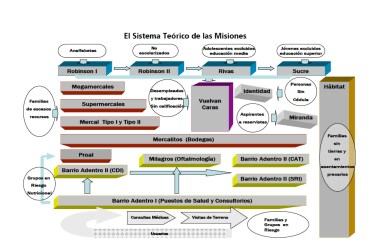
I mean really, tell me how this can be turned and “leveraged” into production, when half of it is simply not functioning:

misiones.jpg

I mean, pick your favorite Mision and tell me whether is active or not and, if it is, whether it can be leveraged into a new-fangled metabolism for economic production. His words, not mine. Mercales show lines and shortages, Barrio Adentro is barely alive, people are not getting their “beca” for Rivas o Sucre.

I mean, really? What country is Serrano talking about? And how is he going to do it?

Let’s move on

Proposal 2: It is necessary to sort out what can be produced and what is not. A productive Revolution requires getting down to work with the new economic engines, considering: a) the real added value that can be generated internally, and b) the outer limit imposed by global value chains. Nothing would produce new goods if it is just for importing much of the value added.

Sounds wonderful! But isn’t that what the Government claims to have been doing for the last ten years? And isn’t the fact that the Government did that, “prioritizing,” that we have shortages, lines and empty shelves?

Are we going to import Martians to do it this time around? Or Chinese? (They are here already). Or Cubans, to see if this time they get it right? Because it seems that all the Government has done in 15 years is do exactly that and the results are sort of lacking…(More than sort of, but let’s be magnanimous)

Proposal 3: Not everything is a matter of engines; it is also  a matter of actors. The democratization of the production system is a necessary and sufficient condition in the new economic era because it is the only way to break the current oligopolistic dependence. The communal power must be essential pivot in the new economic order, both productive and distributive issue and marketer. The commune has to stop being economically marginal; the output is certainly not a neoliberal communal output.

Uff! As someone once said, “Como se come eso?” (How do you eat that stuff?)

First of all, we are talking about a crisis that needs to be resolved TODAY, not in five years. People need to eat, for example. People in the communes are concerned about making ends meet, getting stuff that they can’t get, standing in line and surviving under current hardships. What are you going to do? Bring a whiteboard telling they have to produce milk, meat, tomatoes, mangoes chickens and rice?

Has this guy ever considered how it is different to breed cows in the tropics? Or to grow any sort of plant? Does he know about how the Government nationalized and destroyed Agroisleña, the only provider of technical advise, seeds and even funding to the small producers? In order for the communes to get into any of this  “productive” stuff, you would need to return Agroisleña (now Agropatria) to its original shape, before you can even think about educating, teaching and training the communes to produce really basic stuff. And the Government that destroyed it is supposed to do it?

Really?

To say nothing of obtaining the required medicines and vitamins to grow a healthy chicken, which have been lacking for months even to producers that have the money. To say nothing of being able to buy the cows that can produce milk in the tropics, feed for them and the medicines for when they are ill.

All very long term and you need a lot of money if you ask me.

4. We must avoid falling into the  neoliberal trap to address the issue of foreign exchange from the exclusive focus of the nominal value. Is it important to discuss the exchange rate? Yes, as long as previously defined what the new currency allocation matrix. At a time of scarce foreign exchange, it is crucial to choose how they will plant to flower currencies other real economy in the shortest possible time. It requires a kind of acupuncture so he is they will be given an anti-inflationary,  productive use and pro growth to the available foreign currency.

The “neoliberal trap” of focusing on the nominal value is because keeping the nominal value artificially and incredibly low is what has given rise to the biggest corruption racket and trap in the history of Venezuela and dozens of billions of dollars lost to Government officials as well as to exports to Colombia, which the Government has for years been unable to stop.

Again, will we have Martians running this? Does Mr. Serrano even understand what is happening in Venezuela every day and how inefficient, corrupt and incompetent Chavismo has been in the face of all these distortions?

I will skip 5, but here is 6:

6. Faced with restrictions outside, it is essential to make progress on tax sovereignty. There is enough room to do a tax revolution based on principles of social justice. It must implement a plan to combat fraud and tax evasion. It needs to raise in whatever it takes to ensure social and productive investment, and preventing external shock has negative impact internally.

Really? Who will pay this tax? Social justice when professionals make less than $30 a month? Again, who will pay? Companies? Which ones? What is the magnitude of this revolution or uncollected tax? Does Mr. Serrano understand even who pays taxes in Venezuela? Does he know the cutoff for yearly income to pay or not taxes? Does he know that banks make money by buying tax free bonds from the Government, which will be impossible to sell if they were not tax free? Really, with an economy with a 10% GDP contraction the solution is a tax revolution? Please…

And the best is the last point. I dont know where Mr. Serrano has been, but here is point 7:

7. Another answer is to return to the regional path effectively. It would surely trigger special margin Sucre plans to import priority goods bypassing the dollar. It is essential also import new paths without dollar, Mercosur, with some compensatory methods, while a new map of investment is achieved from the region.

Well, I will not even comment on this,  the “regional path”, enough said, wonder what Macri thinks?…but I have to wonder, has this guy ever been in Venezuela for any length of time?


Some Steps Forward And Some Back In Venezuela

January 17, 2016

6a00d8341c4e6153ef010535a11220970c-800wi

It has been six weeks since the opposition won the Parliamentary election and many things have happened. But I do not really want to give you a blow by blow analysis of what happens or is happening in the country, but rather try to see and understand the overall picture. Thus, I did not report on the details of Maduro’s speech to the Assembly or many other topics which some may think require some commentary.

But I think is more important to report on the overall picture of the country six weeks after the elections. And what I can say is that there has certainly been some progress, some steps forward, but the whole picture is still lacking, as the country seems to be drifting into a crisis, with probably more steps forwards than backwards, but too much uncertainty still present in the country.

To begin with, I don’t think either side has understood well the message the voters sent in Dec. 6th. On the one hand, the Maduro administration has not understood that the vote against it represents a vote against the consequence of its badly mismanaged economic policies. Despite this, it continues on a path to radicalize the country, blame the economic war, all of which will bring little economic benefit, precisely the only thing the voters wanted him to pay attention to.

The opposition, on the other hand, seems to be understanding its victory as a mandate to get rid of Maduro, which is probably why most opposition voters cast their vote for. But as I have discussed previously, The in between, both the Ni-Ni’s (who don’t belong to either side) and the pro-Chavista voters, were casting a vote to punish Chavismo, but not necessarily because the opposition electrifies them and wants them to run the country. So far, the opposition has said little in how it intends to deal with Economic problems. True, it is little that the Assembly can do on economic matters, but this does not mean that it can not make proposals or counter-proposals, of which it has done little on these matters. Perhaps the only exception is the Bill to give ownership to the Mision Vivienda homes, which was repudiated by Chavismo.

Perhaps the most positive thing to has happened is that there has been acceptance of the victory by the opposition. Even if this has been a reluctant acceptance or not, it is there, whether thanks to the military or not. The opposition found the need for security the first day the Deputies were sworn in at the Assembly, but the routine of at least bi-weekly sessions is such, that the last time the Assembly met in a regular session, there were no significant security forces outside the Assembly building. (The same inside, where reporters and public can now go in without much hassle)

This represents some semblance of the return of normal democratic life to the country, a huge advancement.

And this return to normalcy is also present in an increased access to the media by the opposition. Even if VTV did not want to show Ramus Allup (A negative nomination on which I have opined sufficiently), it had no other recourse but to show his speech right after Maduro’s speech. By now, some of the old/new media, such as Globovision, has begun to hedge it bets, increasing its coverage of the opposition.

More democracy can only be good.

I think it was a negative for the opposition to go back on the swearing in of the three questioned Amazonas Deputies. It should not have done so, if it was not willing to go Constitutional-conflict on the terrible decision by the Electoral Hall of the Court. Given the 45 thousand-plus decisions in a row  by the Court in the last 15 years, it should not have expected anything else.

While it was a puzzle why Amazonas was picked, given how close elections were there, the truth may have been revealed this week, when it was noted that some Chavista Deputies have requested the Supreme Court interpret whether the indigenous representatives to the Assembly should be elected by the population of those States at large or only the indigenous population. Curiously, the opposition had raised this issue in the past , only to be denied, even when Chavismo dominated that vote. Chavismo probably thinks that it can win one of the three Assembly members with this trick and deny the 2/# majority to the opposition, but I doubt it.

Unfortunately Maduro did not understand the message about the economy and seems to still be clueless at this time. Since Dec. 6th. oil has dropped by about US$ 8 per barrel (somewhat less for Venezuela’s oil basket) but the Venezuelan President did not mention any concrete measures in his State of the Union address and his “Economic Emergency” Bill” only include the possibility of more expropriations, despite the dismal failure by Chavismo with them over the last 16 years. He did say gasoline prices should be increased, a decision which is solely in his hands. He should talk less and do something.

And with oil under $30 per barrel (less than US$ 23 for the Venezuelan basket) this means that foreign currency revenues for the country will be under 50% of what they were during 2015. And as Venezuelans line up for food, medicines and even to have their deodorant refilled, one has to ponder how awful things will get in the upcoming months…