Archive for the 'Uncategorized' Category

ExxonMobil Versus PDVSA: Arbitration and Numbers

January 2, 2012

By now, people seem a little confused by the victory by Venezuela and PDVSA at the International Chamber of Commerce (ICC) over ExxonMobil.

First, there is a numbers confusion, the first headline (Bloomberg’s) was “PDVSA has to pay US$ 750 million to Exxon”, the second (Exxon’s) was “PDVSA will have to pay US$ 907 million” and now we have a third one (PDVSA’s) saying “PDVSA will pay Exxon US$ 255 million”

As noted by Setty, this is just spinning. Exxon wants to show the largest number, PDVSA wants the smallest and Bloomberg reported the net amount awarded by the arbitration panel after a claim by PDVSA against ExxxonMobil in the amount of US$ 160.6 million for debts ExxonMobil had against PDVSA.

So, these are the true numbers:

In the arbitration case for breach of contract at the ICC, the case was decided against PDVSA in the amount of US$ 907.6 million dollars, which is about the smallest number ExxonMobil could have expected to get, as it represents book value for its 41.7% in the Cerro Negro partnership. Thus, this is a victory for Venezuela, because the amount awarded is small.

From the US$ 907.6 million, you have to subtract the US$ 160.6 million in liabilities ExxonMobil had in Venezuela.

Additionally, ExxonMobil had a New York Court seize US$ 305 million from a PDVSA account, which will now be turned over to ExxonMobil.

Thus, the net amount of cash that PDVSA will have to pay is (US$ 907.6 million-160.6 million-UDS$ 305 million)= US$ 442 million. Additionally PDVSA says ExxonMobil owed Venezuela US$ 191 million from the repurchasing of the Cerro Negro bonds, which is not clear what it means. Those bonds were repurchased by PDVSA in a decision in which ExxonMobil did not participate.

Thus, PDVSA will have to pay less cash, but the award against it was indeed US$ 907.6 million. How much it really has to actually pay or take out of its pocket is a completely different matter.

However, the case is not over. ExxonMobil went to arbitration in two courts: The ICC and the Worlds Bank’s International Center for the Settlement of Investment Disputes (ICSID).

How can this be? How can two parallel cases coexist on the same case? This is the second confusing point.

Well, after calling a good friend who knows his arbitration stuff like nobody I know, it turns out this is perfectly normal.

You see, in the the 90’s when ExxonMobil decided to participate in the Cerro Negro project, it signed a contract with PDVSA and Venezuela (Which was approved by the National assembly). At the ICC, this contract is what was being disputed: the breach of contract by PDVSA or Venezuela when it expropriated the partnership or changed its conditions unilaterally. What is awarded in this court is what the arbitration panel interprets the two sides had agreed upon in that contract.

However, separately, ExxonMobil owned its 41.7% stake in Cerro Negro via a Netherlands-based subsidiary and it so happens that Venezuela and The Netherlands have a treaty to promote and protect mutual investments. This treaty has specific clauses to protect investors from both countries. It is the violations of this treaty that the World Bank’s ICSID arbitration panel is judging upon (A decision is not imminent, there will be a hearing in 1Q12), Thus, the award by the ICSID will be determined by what that treaty says and the violations that may have occurred. This could be larger in scope, as it could include additional compensations and indemnifications.

Thus, at the ICSID the panel may give (or not) ExxonMobil awards to compensate violations such as not being paid before the expropriation, modifying contracts unilaterally, not being treated fair and equitably, discriminating foreign investors from local investors, not guaranteeing payments and many others.

As an example, the treaty specifically states (my free translation from Spanish):

“The parts will not take any measure to expropriate or nationalize investments made by nationals of the other country, nor will take measures which have the equivalent effect of nationalization or expropriation, unless the public interest is invoked and subject to due process, without discrimination and with prior compensation, at market value for the investments and with payment without delay at commercial interest rates.”

Clearly many of these conditions were violated in this case and the ICSID will have to decide on what compensation to award ExxonMobil, beyond what it was established between the parts in the original contract. The wording of the treaty is clearly much different than what may have been contained in the contract (Which I have not seen). In fact, the original contract was not even signed by a Netherlands company, ExxonMobil later transferred ownership to a Netherlands company to enjoy the protection of the treaty.

Thus, it may happen that the ICC awards something and the ICSID does not, or vice versa or both award amounts that are different because they are based on different legal concepts.In the two cases that Venezuela has lost at the ICSID, the award has been roughly book value in any case, but the amounts involved were much smaller.

Thus, the ICSID could give ExxonMobil a bigger award, or not. But for now, score it as: PDVSA 1 ExxonMobil 0.

ExxonMobil Awarded US$ 750 million For Cerro Negro Nationalization by Venezuela

January 1, 2012

Well, it is early in the year, but Bloomberg last night reported that the International Chamber of Commerce awarded ExxonMobil “only” US$ 750 million in its arbitration case against PDVSA over the nationalization of its assets in February 2007. This ruling is very favorable for Venezuela, as essentially seems to recognize only book value for the expropriated properties. Exxon had been seeking compensation not only for the expropriated property, but also for the loss in cash flow from the operation of the project. ExxonMobil owned 41% of Cerro Negro, which produced on average some 95,000 barrels of heavy crude per day. The multinational company confirmed the news according to the Wall Street Journal.

ExxonMobil had been asking for US$ 7 billion of which about US$ 747 million were tangible assets. According to Bloomberg the award was for US$ 907.6 million, which was reduced to US$ 750 after a counter claim by PDVSA. But in the end the number looks exactly like book value.

ExxonMobil had also been seeking compensation at the World Bank’s ICSID Court, I am not clear how the two overlap or what judgement in one implies for the other.

If arbitration in the oil projects determines that there will be compensation only for the assets of the projects expropriated, then the total liability to ExxonMobil and ConocoPhillips should be of the order of US$ 3.5 billion, rather than the more than US$ 20 billion being sought by the two companies. Estimates put the loss of cash flow from operations around US$ 9 billion, so that a decision including book value and cash flow would have been expected to be (rough numbers) US$ 12.5 billion.

But if the World Bank’s ICISD decides in a similar manner, the Venezuelan Government would have scored a very important victory in its arbitration fights, which would impact the nineteen arbitration cases at the ICISD against Venezuela.

This should be positive for Venezuelan bonds early in 2012

A Possible 2012 Vice-Presidential Surprise and more…

December 29, 2011

A Wall Street strategist named Byron Wein, started a tradition a few years ago of making a list of “thinking out of the box” predictions for the New Year, which he called his list of surprises. This has become quite popular and by now I know of at least three such lists (One, Two and Three no yet out). The idea is to suggest events that go against the consensus and help you be prepared for it. The remarkable thing is how good these lists have turned out to be, with 50-60% of these unlikely events happening.

Ever since we learned about Chavez’ illness, I have been bothered by the question about his succession. Basically, none of the suggested names has ever satisfied me. They all have weak points from the point of view of Chavez, the military and the Cubans. Maduro may be loyal and have a good image, but he is no radical. Diosdado may be acceptable to many groups, but I don’t think he buys the Cuba angle, nor is his an real ideologue. Jaua is not liked, period.

So, in the spirit of thinking out of the box, I have identified someone who is not as well-known, is loyal, ideologically on the right side, former military, democratically elected Governor, acceptable to the Cubans and, more importantly, a man who has more influence on Chavez than many people understand.

His name?

Ronald Blanco La Cruz

Blanco La Cruz is a well educated, former military officer, founder of MVR, member of the Constituent Assembly, former Governor of Tachira, Ambassador to Cuba and more importantly, the man that crushed the Chavista bankers from Cuba, saving his brother in law’s position as Superintendent of Banks. (He is also the cousin of a high ranking General)

A powerful man indeed. Not very well-known, but Chavez has never wanted anyone to be well-known. Cabello may be well known, but he lost the Gubernatorial race to Capriles. Maduro may be popular among the powerful Chavistas, but is not a proven candidate. Rangel may be radical, loyal and a good strategist, but he has the charisma of a dead turtle.

But Ronald is buddy-buddy with Hugo, with the military, he believes in all this, trusted by the Cubans, has been a candidate.

Not well known?

Nothing that a few months as VP and a few billion Bolivars can’t fix.

So, I am going with Ronald Mac Blanco as my 2012 surprise.

It may not be obvious or probable, but it makes sense…

Would he be President Blanco or President La Cruz?

Hugo Chavez’ Christmas Spam to all Venezuelans

December 27, 2011

Above is the message that most Venezuelans got on Christmas Day from Hugo Chavez (including me, I got it early on the 24th., as you can see above), it says: “Each December, we have victoriously celebrated our unstoppable march towards the Good and Pretty Fatherland…Full of happiness, justice (sic) and social equality. Merry Christmas, partners (comrades?). Hugo Chavez.

People have noted that the message is abusive, it is after all spam, much like Chavez’ forced “cadenas” where everyone is forced to listen or turn the TV off since nothing else is on. There is also the question of who paid for it. Did Chavez force the message on the telecom operators? Is the list freely available to anyone like that? Is this a violation of privacy? A waste of resources?

We will never know. What we do know is that if this had been sent by an opposition politician, Chavez and the government would have raised hell over the issue.

You can also complain about the message, not only about the use of the term “compañero” without the “ñ”, this could have been avoided choosing a better word, like venezolano, ciudadano and the like. The message is also quite partisan, as half the population does not celebrate Chavez “unstoppable march” to wherever he thinks he is taking us .

But what I want to point out and note, is that the message is quite effective. First of all, it has a high impact, as it is received by most Venezuelans, as cell phone penetration is over 100% by now (Operators do not subtract cancelled lines from their numbers). But more importantly, people are impressed that Chavez sent them a message. Of course your average opposition person does not like it, but I talked to a few people, not pro-Chavez, some who once supported him, who actually appreciated the message and told me about it not as a complaint, but more like: How about that message from Chavez!

So, much like many of the moves that Chavez makes, he got his money’s worth (or ours for that matter) sending a message that in the end earned him more goodwill with his supporters or prospective supporters, even if it was wasted on most of us who will never vote for the revolution.

Note added: The SMS was indeed a “cadena” that was sent free at the request of the Government.

No Mercosur for you, Hugo!

December 21, 2011

Despite pressures from the Government’s of Brazil, Uruguay and Argentina, as well as Hugo Chavez showing up at the Mercosur Summit, the much ballyhooed “political compromise” to allow Venezuela’s full membership in Mercosur, thankfully did not materialize. The political solution was simply to change the rules so that not all countries had to approve the country’s admission as a full member, bypassing in that way this requirement, which implies every single country is satisfied that the democratic standards are complied with by the country requesting admission.

But Paraguay would not play ball, not the Paraguayan opposition that refuses to approve Venezuela’s entry because they don’t believe the country satisfies the democratic requirements, but that country’s Government, likely fearful of the reaction by the opposition if they are bypassed.

Shame on Dilma Rouseff for backing this proposal. The Brazilian President was a victim of abusive Governments, but seems to feel naively they can not come back in her lifetime to haunt her. I hope she is right, but allowing abuses to continue in one country will simply allow all countries in the region to relax the defense of human rights and this will eventually lead to a backlash against those that allowed it.

Meanwhile, Hugo comes back to Caracas (or direct to Havana for treatment during Christmas?) having lost the battle that he decided to play with a full court press, including his physical presence in Montevideo, where he blamed power and obscure forces for the delay in Venezuela’s entry into Mercosur.

A victory for Paraguay, a small country battling giants, something Chavez would have hailed two decades ago.

A victory for Venezuelans, who at least know that Chavez will have to watch what he does to keep the pretense of democracy.

A loss for the leaders of those countries trying to make the defense of human rights more “flexible” , all “left wing” leaders who now that they have attained power have forgotten their fights when others abused their rights. But they will try it again, if Hugo’s health gives them a chance.

But for now: No Mercosur for you, Hugo!

The Arrogance of Chavez’ Foreign Advisers

December 18, 2011

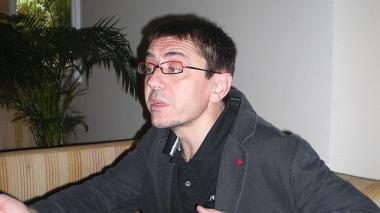
Juan Carlos Monedero spews out his brand of revolutionary BS for Madrid’s ABC newspaper

The paid ideologues and advisers of the revolution, like Juan Carlos Monedero above,  are truly arrogant and superficial. After a decade of living off the failed revolution, this is all they can say about what has happened in Venezuela. Some random choices with my comments:

-Chavez has learned to think for himself.

Really? When did this miracle take place? Last Year? Does it mean he no longer needs you? Shouldn’t it be the other way around, he should have been able to think by himself before he got to power rather than learn on the job, screwing up everthing?

-A large part of the budget has been devoted to opening schools so that people can think on their own.

Funny, the record of building schools by the Chavez Government is simply dismal compared to that of the failed IVth. Republic, where did the money go?

-The advance in social terms is spectacular.

Really? Spectacular? Where? Did you read Luis Pedro España’s book on poverty in Chavez’ first ten years? And why didn’t you answer the question about the money? To compare Mexico with Venezuela just because they produce oil is simply ignorant and evasive. Why not Nigeria? Did you also advise Mexico?

-UNESCO has declared Venezuela as a territory free of illiteracy.

Jeez, you still believe that BS? You are “critical” about the world, but have failed to note that illiteracy was not high to begin with in Venezuela and that there was never any such Unesco certification? Have you ever seen this link? Or is this one more official for you? Unesco gives no such certifications! Or have you ever read Francisco Rodriguez’ work? Or you are just not that “critical”?

-The largest indices of crime are in Central America and Mexico, not in Venezuela.

Again, the question was about Venezuela, the country that pays your vacations, not about Mexico or where are  the largest rates of crime. When Chavez got to power Venezuela was not even in the radar in the top ten of crime in the world, now we compete with those countries you mention. You say ten years is not enough, sorry it took ten years to get us to where we are in crime.

-The Bolivarian Government has preferred to pay with high inflation than with 5 million people without jobs like in Spain with low inflation.

Truly pathetic, we have both, high inflation and half the work force does not have formal jobs. Have you ever thought about the effect of high inflation on the poor? You clearly have no clue.

-(Chavez’ Government) needs more time to solve the historical structural problems , linked to corruption, inefficiency and the rentist culture and clientelism as a way of life.

You must be kidding me? Chavez’ Government has promoted corruption, inefficiencies and has been the champion of enhancing the rentist culture to say nothing of clientelism.

With advisers like this, no wonder Chavez has taken it upon himself to begin to think on his own.

The Curious Downfall of the Heir Apparent to Hugo Chavez

December 17, 2011

It was one of the biggest political surprises of the last few months, if not years, when Hugo Chavez announced that his Foreign Minister Nicolas Maduro, would be the candidate for Governor of Carabobo State in 2012. Maduro had been considered Chavez’ heir apparent if it became necessary for the Venezuelan President to step aside in 2012 due to health reasons. In fact, many people, including yours truly, believed that Chavez would name Maduro as his Vice-President some time in the very near future, replacing Elias Jaua, who is not popular among various Chavista factions.

That all was not well in Maduro-land was barely noticeable last week when his wife, Cilia Flores, was replaced in the leadership of Chavez’ political party PSUV by none other than Diosdado Cabello, once also considered Chavez’  clear successor. But Flores had been in the doghouse for a while, as she had been removed early in 2011, before Chavez’ illness surfaced, as President of the Venezuelan National Assembly.

It was unclear why the sudden change of heart for Maduro, who had been acting in roles beyond that of Foreign Minister, including being the main speaker at a service held for Hugo Chavez in Manhattan and being part of the commission studying the changes to the new Labor Law. Maduro was also the only Cabinet Minister to go back and forth between Caracas and La Habana, when Hugo Chavez received treatment for his cancer in that city between June and September.

Chavez’ announcement was made the day after Maduro received an ovation that apparently irked the President, but I am sure there is much more to the story. For now, Chavez is in the search for a new Vice-President, with most betting that it will remain all in the family with his son in law, Jorge Arreaza, the current Minister of Science and Technology, being named Vice-President early in 2012*. His current Vice-President Elias Jaua, had already been nominated as candidate for Governor of Miranda State by Chavez a few months ago in what was believed to be an elegant way of disposing of Jaua.

Chavez is making daily changes to his entourage, with rumors that new important military appointments will be made soon. For now, none of the groups fighting for power feels they hold in a solid position, as the downfall of the heir apparent may simply be a signal by Chavez that he has yet to make his mind up. When he does, Maduro may be back, in another sideways move by the Venezuelan President.

*I don’t think that Arreaza can be Vice-President if I understand what “parentesco por afinidad” means in Art. 238 of the Venezuelan Constitution, which bans the VP from being related by blood and/or affinity to the President. I believe, but I am not 100% sure that Chavez is related to Arreaza by affinity.

A Gallery of Chavismo “cursileria” (Tastelessness)

December 14, 2011

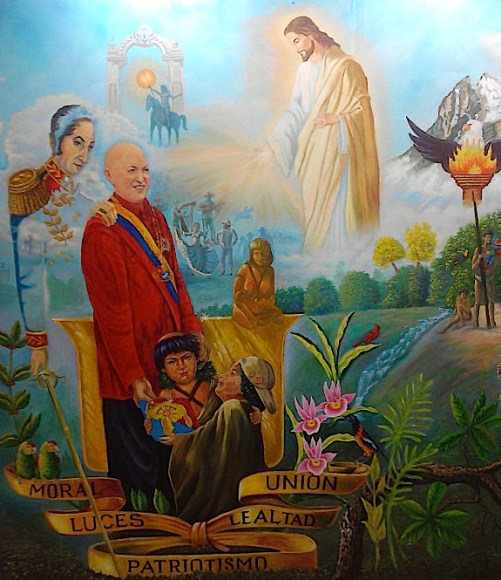
Yes, I read Tal Cual and saw the magnificent Guardia Nacional “cursi” tribute to Chavez that Daniel and Quico posted, but just did not have the time to post about the symbolism (Why so many indians? Really? Jesus Christ? Who is the guy in red?)

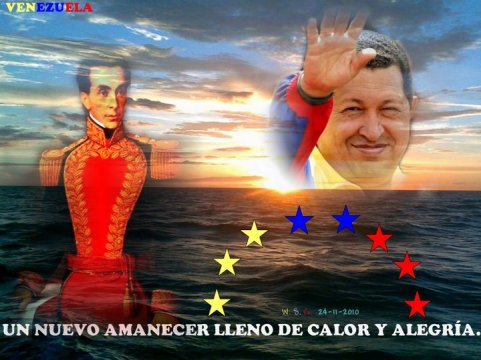
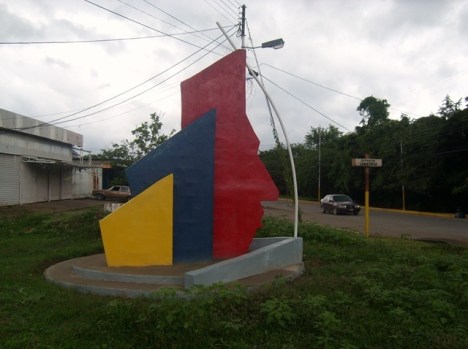
Thus, since I am late to the party, but the painting just has to be in this blog, here is a gallery of similar cursilerias from Chavismo, including today’s masterpiece:

Nativity Scene:

Bolivar and Hugo, or is it the other way around?

Merging his profile with the flag:

I guess Bolivar does goes first:

Just art

Sometimes Jesus comes in last:

and please don’t ask who is the guy with the beard, I have no clue.

The Devil Excrement at work…in Norway, as a smør shortage hits that country

December 13, 2011

While I usually don’t write about other countries, this one is too cute to pass up. Thanks to my Norwegian friends I learn that in that oil rich country there is a shortage of butter due mostly to protectionist policies imposed by the oil rich Government. Prices have reached absurd levels, like US$ 109 per pound and the like.

People are giving smør, as butter is called there, as gifts.

Now, there is an idea, a kilo of powdered milk for Christmas, I think I just finished my shopping…

Amazing how well these concepts work everywhere.

How Did Crime In Venezuela Ever Get to Where It Is today?

December 12, 2011

It was 1988, Venezuelans were truly upset about crime. Imagine that! That year, there were all of 1,600 homicides in Venezuela, all of 9 homicides for 100,000 people.(I am using Veneconomy statistics)

Then came the Caracazo, the violence of that fateful day made numbers soar and that year, the number of homicides soared to 2,513. The coups in 1992 did not help numbers, 3,336 people were killed in 1992, doubled the number of 1988. And with it, gave way to the outrage and dissatisfaction that led to Hugo Chavez being elected. By the time Hugo came to power, 4,500 people were killed in Venezuela in 1998.

Today, the National observatory for Violence says there were 17.600 homicides in 2010, 57 deaths for each 100,000 inhabitants.

Almost seven times as much as of 1988 (per inhabitant)

Almost triple (per inhabitant) than when Chavez got to power.

These are homicides, the actual killing of a human being. Say nothing about the increase of theft, kidnappings or petty crime. The Government and people don’t even look or think about those numbers.

But look at the other side. According to the same Veneconomy numbers, when in 1998, the year before Hugo Chavez became President, the police made 118 arrests for each 100 homicides. Yes, they would detain more suspects than crimes, but they would be released.

Today that number is down significantly. How much?

Venezuelan police detains nine suspects for each 100 homicides.

That’s right. For each 100 people that lose their life only NINE are detained, many released when they are found not be involved.

Can Chavez be blamed for this?

You bet!

To begin with, he was the guy who refused to swear he would uphold the old Constitution, Yes, he created a new one, but he seems to have ignored it olympically.

But for 12 years, Chavez simply minimized security as an important issue. He dismantled a fairly competent police management created over the years, replacing them with former or active military with no clue as to how to fight or control crime. Meanwhile Chavez even justified stealing if you are hungry, much the way the Supreme Court decided to decriminalize invasions of private property today.

A prelude of new things to come.The end result will be the same, until the invaders take over the Justice’s property.And they will.

Meanwhile, the fight against crime becomes a struggle. Start with the numbers of weapons. After 13 year without control (and it wasn’t great before that!) the number of pistols, rifles and the like has also tripled. Unless you go and try to reduce that, there will be no progress.

Follow that with jails as full as they have ever been, where the jailed are innocent, half guilty and guilty, but now they all train for a new career in crime under one single roof. Ready for the real world next time the Minister for Prisons decides to lighten up the numbers.

Or take a Justice system that follows now the orders of the big honcho, jailing all those that make it alive to the prison. Yes, Hugo has discovered the crime problem and the cops are dealing with it the most effective political way: Kill them!

Do I need to go on? Not really. In the end, the question is not how we got here, but how do we get out of this?

Which goes back to Daniels’ question: Why do these opposition guys/gals want to be  President?