Archive for the 'Venezuela' Category

As People Look For Pragmatism In Currency, Venezuelan Government Ready For More Controls

June 19, 2013

billete500

Things are going well, Maduro is in Paris eating and drinking better than in Caracas. The National Assembly will investigate how Chavez’ cancer was inoculated, but refuses to discuss how the terms of the Comptroller, some CNE Directors and some Supreme Court Justices have ended and they should be replaced (Most of the elected when the opposition had no representation in the National Assembly), while that exchange rate hits all time highs, even if its increase has been stopped by rumors the Government will do something to “open” the foreign exchange system.

But it is harder to find a dollar in Caracas that a roll of toilet paper.

People really understand little about how ideology is the main driving factor behind the now Maduro revolution. The papers are full of speculation about how the swap market will come back, the necessary laws changed and we will live happily ever after.

No such luck, as we have been predicting for weeks…

Yes, the Illicit Foreign Exchange Bill will be changed, but that’s about it. It will be changed so that the absolute ban on foreign currency trading without the Central Bank in the middle is removed and participants can buy/sell foreign currency in a market tightly controlled and regulated by the Venezuelan Government.

Yes, according to Central Bank Director Armando León, the “father” of the Bolívar fuerte, what the Government has in store for us, is simply a “new and improved” SICAD foreign exchange system, the same one that so horrendously failed in March.

According to Leon:

“The final alternative system to the official Cadivi system will be expanded and will be made to be as efficient as possible”

In fact, I can´t find a link to all that León said, but here is a summary:

-Venezuela is working to resume Sicad dollar auctions at the beginning of second half of year.
– The Government is working to allow private and public companies and banks to sell dollars on the Sicad system
addition to cash.
-The Government is focused in May and June on delivering more dollars to small and medium companies that are key to resolve shortages
-The Sicad in its debut was very complicated. A review of the system has been completed so that it includes small and
medium companies and individuals
-The Government will also make the official Cadivi exchange system more effective.
Thus, while people are looking for some sort of more pragmatic policy, what the Government is thinking about is about making more “efficient” a system that the same people planned and designed in March but failed miserably, but this time around, “trust us” it will be dynamic, pragmatic, efficient and will solve of the problems with shortages, drive the swap dollar down and make people happy.

Yeah, sure! And the Bolívar fuerte was going to stop inflation. Didn’t you suggest that Armando?

So, what we will see is a an expanded SICAD, with all sorts of rules and regulations. Remember SITME? The same people that created and designed SITME are in charge of this SICAD with Fluoride. These are the same people who blame the failure of SITME on the banks, the oligarchs and the capitalists.

Which is why the new system will also fail. First, they will make up a lot of rules. The ones for the first SICAD auction were doomed from the beginning. The ones for SITME were the ones that created the system that amde a lot of people a lor of money. They will improve on that and create many more. They love that, that is what they are experts on, control, rules, distortions and the like.

But, they have not said the most important thing: Who will sell dollars into the newfangled and improved system?

That, my friends, is the only important question. And as long as the system is rigged and controlled and the priced fixed, only the Government will. And that solves absolutely nothing.

As simple as that.
Venezuela: One Upgrade, One Downgrade And One Improved Outlook

June 18, 2013

While President Maduro has done nothing on the most pressing problems of the economy, in the last two weeks, the country received an upgrade in its status with the US, a downgrade from Standard and Poor’s and the Catholic Church seemed to give its blessing to Maduro and the country when Pope Francis met with the Venezuelan President., essentially seeing an improved outlook in relations with the country.

While Maduro is probably happy about the total, unfortunately for the average Venezuelan the only one of these that will affect his or her pocket is the downgrade from B+ to B by Standard and Poor’s. Yesterday morning, before the downgrade, Venezuela’s bonds were trading about at a 1% lower yield than today, which means that any new debt that is sure to come will cost around US$ 10 million more per year for each billion dollars issued.

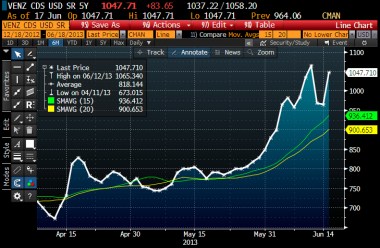
In fact, so far Maduro being elected has been quite costly for the country, as shown by the graph below:

cds-1

In the graph I show the value of the 5 year CDS, or the cost to insure against the country’s debt default, which is a measure of the so called “country risk” or “country premium”. As you can see, Maduro has been costly to the country since he came to power. Just by being elected the CDS jumped from about 673 basis points (6.73%) to about 830 bps (8.3%). Then, after the electoral noise went away, it was calm for a while, but then markets got impatient (and so did S&P) and started punishing Venezuelan bonds. A few days ago it got as high as 1065 (10.65%) basis points (which was also influenced by world jitters). Then it seemed to calm down dropping to 960 basis point, only to jump yesterday on the downgrade by S&P.

From the graph, it is hard to precisely separate world jitters from Maduro, but if we say the first jump was all Maduro and the recent downgrade was all Maduro, you have at least 250 basis point or about 2.5%due to him since assuming office, or roughly US$ 25 million more in interest payments per year for each billion dollar of bonds issued. In a US$ 3 billion issue, the likely amount of what this Government want to start its issuing would then cost (us Venezuelans) for ten years US$ 250 million.

But Maduro is probably relishing on the fact that the Pope met him, Kerry met Jaua and the FAO gave him the most stupid award possible given the current shortages and the level of inflation.

And when Maduro is gone, Venezuelans will be paying for his ignorance. Meanwhile Maduro is “celebrating” his tenth week as President without a single important economic measure being announced.

Which is precisely why S&P downgraded the country’s debt. Oh yeah! S&P did say that if economic policy became more “pragmatic” the outlook, which is negative, could improve.

Don’t hold your breath…

Nicolas, Really, What’s Up With The Hats?

June 16, 2013

Maduro1

Maduro2

Maduro3

Maduro5

Maduro6

Maduro8

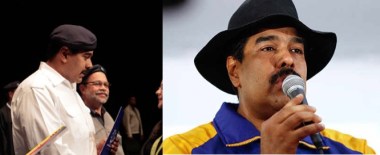
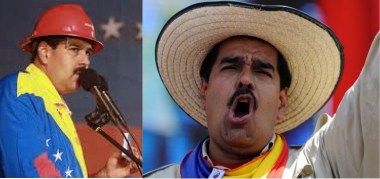
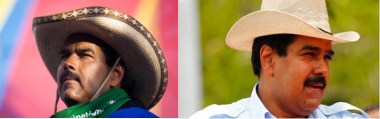
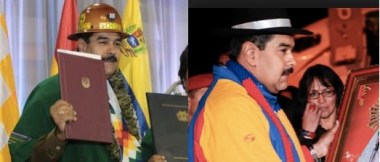
In his efforts to imitate Hugo, Nicolas Maduro can’t seem to resist putting on a hat. For someone whose head was always bare, it looks silly and most of the time he looks too contrived and unnatural. But he continues doing it.

Nicolas, you are no Hugo!

At Bandes, Wasting Money Is Just Their Way Of Doing Business

June 13, 2013

202949497_640

When Hugo Chavez started using the oil windfall to generate friends abroad, he thought Venezuela had infinite money. From coops to joint ventures with questionable partners, like Iran to Petrocaribe, money was thrown at many bottomless pits.

But the worst part is that there was no accountability, either before, during or after these ventures were carried out. Even more incredible, is how immune some of these organizations that have been in the middle of these deals seem to be to any investigation or accusation. But none more incredible that the two “development” related organizations, Fonden and Bandes. Fonden has been mentioned before, a billion dollar sink hole protected by Chávez and Giordani, but Bandes, which was actually in charge of many of the loans by the Chinese Government, including the oil for money credit lines, seems to be absolutely shielded and protected. In fact, its most recent President, has now been promoted to President of the Venezuelan Central Bank.

Way to go Maduro!

A few weeks ago, I reported on the US$ 66 million ripped off by Bandes officials via the trading of bonds, with as much as US$ 10 million lost in a single trade (world record?). Weeks have gone by and despite a sixth person jailed in the US yesterday and the opposition requesting an investigation, absolutely nothing has happened. Not a single investigation or question raised or asked. And the same people keep on running Bandes…

Who protects Bandes and its officials, past and present? It can’t be Chavez, he is no longer around. But the immunity continues.

I know US$ 66 million is pocket change for the bottomless pit of the revolution, but it just keeps adding up and Bandes seems to be always in the middle of things.

Take Bandes-Uruguay. In 2006, Bandes Venezuela purchased Bandes-Uruguay, which was bankrupt, for a scant US$ 10 million as reported in these same pages then. I was not too positive on the transaction:

“I like the business plan: Take over a bankrupt financial institution in a country you have no experience with and have it run by people with no financial experience. A recipe for financial disaster for spreading the goodwill of the revolution! More losses in the name of solidarity! Less money for Venezuelans!”

Wasn’t too far off the mark, no?

Even worse, the genius behind this investment is none other that then (and current!) Bank Superintendent Hernandez Behrens, the same guy who presided over the mini banking crisis of 2009 unscathed.

Bandes Uruguay lost money in 2007, 2008, 2009 and every year after that. So much, that it lost all of its capital. In 2010, I wrote a post again on the subject, this time because Venezuela was considering recapitalizing  Bandes Uruguay. Or Uruguay wanted Venezuela to throw some good money after bad. Which apparently was done once or twice, but now Chavez is dead. In the meantime, Bandes-Uruguay went from 35 branches to 24 and then to nine, as Bandes-Uruguay paid off hundreds of Uruguayans to take their severances and leave.

And Venezuela and Venezuelans (The people!) paid for this whole boondoggle…And Uruguay laughed all the way to the bank.

Well, it seems as this chapter has been at last closed, as oil went down and Venezuela did not want to capitalize Bandes-Uruguay any more.. So much for goodwill created in the name of the revolution.

The Uruguayan Senate approved now the absorption of 146 employees of Bandes-Uruguay to State owned banks, as well as absorbing nine branches of Bandes-Uruguay.

Meanwhile in Venezuela, Bandes gets away with not submitting financial statements, while handling billions in Chinese loans with no accountability. And any accusation against Bandes or its leaders is just ducked by the Prosecutor, the National Assembly or Maduro for that matter.

Which makes you wonder who used to protect those in Bandes? Who protects them now?

As a good friend (JG) said to me last week: Giordani is like a Catholic Archbishop, saying, yes I know that Bishop is a pedophile, but I am not.

Arrogant till the end…

Meanwhile at Bandes, wasting money is just their way of doing business, with OUR money.

Venezuela: From Magic Realism To Bizarro Country

June 12, 2013

mad

Venezuela has been the land of magic realism over the last fourteen years. Under the spell of Hugo Chávez, the country lost a decade of development under the guise of a revolutionary process, that brought little revolution anywhere, when you consider that the country enjoyed the biggest oil windfall in its history. Chávez could sell the people anything, an attempt on his life, borrowing at 12%, while lending at 2%, demonizing the opposition, recovering from cancer and even blaming nature for many of the problems he caused.

But over the last six months, Chávez’z successor has turned Chávez magic realism into a bizarre concoction that makes no sense. He managed an electoral audit that was not one. Maduro has been in power for over ten weeks, but has made no important decisions about the most pressing economic matters. He blames problems on things like consumption, as if his party was new in Government. He says the universities have received sufficient resources, but a Professor’s salary is near the minimum salary and since 2008 autonomous universities have not had any budget increase.

But things get really bizarre when important discussions are distracted by events such as:

-Jose Vicente Rangel, a former Minister of Defense and “reporter” saying the opposition has purchased 18 airplanes to attack Venezuela and that they are in Colombia. Of course, no mention of who, when, how, just like that, 18 planes, not 2 or 3, all of eighteen planes, bought with money that came from nobody knows who, to buy whatever. Maybe Rangel saw an Amazon purchase for 18 planes to fight Maduro’s drones.

-A Judge, Judge Afiuni, ordered incarcerated by Chávez, who has yet to be tried, but was raped in jail, has the Prosecutor ask the Court to change her prison for home and five days go by without the inhumane Court saying a beep and ordering that she be released. Whatever happened to compassion in Venezuela?

-A thousand cases of the H1N1 virus are not enough to have Venezuela’s Minister of Health worry, declare an emergency or anything like that. Never mind how contagious it is. Never mind the ignorance of the average Venezuelan on the subject. This is simply another plot to destabilize by the opposition. The country is even out of the vaccines, but don’t worry, toilet paper should be arriving soon.

-An obscure Director of the price control office is jailed for corruption in Venezuela, but the SEC charging that there was a massive kickback scheme at Bandes, which made that bank lose US$ 66 million, gets no reaction from any official in Venezuela. (The fourth person was jailed today in the US)No investigation, no questions asked. But Maduro still says he is going full blast against corruption. Sure Nico, I believe you. (Cross my fingers)

-In a country with excess lawyers. In a country where nobody in important positions seems to have experience in the area of the position, an engineer is named to supervise the Judicial system. Never mind he failed as Head of the electric company, his supposed specialty. Never mind there are thousands of Chavista/Madurista Judges, lawyers and the like. Choose failure, choose ignorance, choose a guy that failed. Oh! I forgot, he is Chavez’ brother Argenis.

-The Head of the Electoral Board comes out and says that the “audit” was perfect, not a single error. But after a reporter finds 90 dead voters in polling stations with 100% participation for October, the next day (June 3d) the CNE changes the records from October 7th., all of them, reducing, but not eliminating dead voters. But, says Ms. Tibisay, Venezuela’s electoral system is “shielded”.  Not from the dead, Tibi. BTW Tibi, we are still waiting for the fingerprint records from the SAI, which has turned out to be a useless system: It did not stop anybody from voting! Which is why they don’t want to give the opposition a copy.

Oh yeah! A guy named Kerry, who apparently holds an important position in the US Government, meets with Venezuela’s Foreign Minister Jaua, who grins at the meeting at Kerry, very much like Venezuelan kids do when they meet Mickey Mouse in Orlando.

Really, bizarro country, with a Capital B (not “V”), is getting harder and harder to understand it. All of this happens and not much of a reaction. Bizarro is, bizarro happens. Nothing happens.

As Economy Stalls, Inflation Heats Up and Maduro Seems Clueless

June 8, 2013

maduro_and_morales

Maduro badly imitating Chávez, what is he smiling about?

The week brought really bad news on the economic front, as the Venezuela Central Bank reported that the economy stalled in the first quarter, growing by a meager 0.7%, while inflation really heated up, increasing by 6.1% for the month of May (up from 4.3% in April). Both numbers were worse than expected by analysts and economists.

The internals of the inflation numbers were even worse. Twelve month inflation is now running at 35.2% (Inflation  for 2012 was 20.1%), while Food and Beverages went up by 10% in May, that group is now up 27.8% for the year and 49.9% in the last twelve months. Inflation is already up 19.4% for the year, compared to a devaluation of 31% in February. The scarcity index stood at 20.5% in May, barely budging from the same number in April. Even worse, many of the basic products currently under price controls, have yet to receive approval for price increases since the devaluation in February. Meanwhile, the black market rate has reached a new all time high.

To make all of this even more worrisome, is the fact that Maduro was sworn in nine weeks ago and he has yet to announce any significant change to economic policy. Soon after being sworn in, Maduro said that the Government would make the parallel rate fall and it is now 32.4% higher than when he won (sic) the election. And while investors and the private sector wait for announcements, Maduro makes non-announcements (Sicad was going to start again three weeks ago, there will be no devaluation)

But Maduro keeps saying things that may sound good to the “people”, but are either false or will make him look bad in the future. He said that what was coming was “the strengthening of our currency and our economy”, which at this point is an impossible target for the currency in 2013 and an iffy proposition for a growing GDP in 2013. Maduro also asked for applause for Minister of Finance Merentes “who is fixing our economy”, while in reality Merentes has shown that he does not have the power to guide economic policy, as he has yet to make a single change since being named Minister in April. (Even his road show to New York and London to talk to investors was cancelled soon after it was sort of announced). And Merentes may improve the foreign exchange system, but he is no economist and thus does not know the tools to attack the many distortions in place.

And Maduro may simply be clueless or have really bad advice. Yesterday he said that the reason inflation went up like this in May is because of “overheated consumption”, while the Government’s own numbers show that the growth in consumption slowed down between the fourth quarter of 2012 and the first quarter of 2013 from 7.1% to 3.1%. Maybe Maduro should be briefed on the effects of money printing and deficit monetization.

By now, in addition to the higher inflation and the stalling of the economy, the result of the Government’s inaction is that the bond issuance (likely directly in US$) that will certainly take place in the upcoming weeks, will be more costly than eight weeks ago. Between the fear of new issuance, the drop in US Treasuries and the lack of new policies, the prices of Venezuela and PDVSA bonds have been punished harshly in the last nine weeks. This means that before Maduro was elected, the benchmark Venezuela 2027 bond was yielding 9.18%, which last Thursday stood 11.48%, before dropping sharply on Friday to 10.88%. This means that any new issuance will be between 1.5% and 2% more costly than six or eight weeks ago. (US$ 45 to 60 million a year for the length of the issue of a US$ 3 billion bond)

About the only positive note is that Minister of Energy and Oil Rafael Ramirez has managed to sign some deals worth about US$ 9 billion with Rosfnet, China and Chevron, showing that he has more power than many. Except that none of what he did  implies cash flow any time soon, as the major chunks of all the deals are for expenses in PDVSA’s projects with these partners. The only one that implies money for PDVSA is a loan from Rosfnet to PDVSA of US$ 1.5 billion, capped at US$ 300 million per year for five years and so far, it is only a Memorandum of Understanding.  The other “loans”, are all going back to the “Giusti” model, where the purse strings are controlled and held by the partner and not PDVSA. Fourteen years of a revolution to end up in the same place.

At least, that new money will go in the long run for increased oil production, something the country needs, but the revolution has ignored for too long.

The Dead Voted Massively Last October in Venezuela

June 2, 2013

octubre

While the Electoral Board (CNE) did not allow the opposition to look at the voting notebooks, nor has it released the details of the fingerprint system (SAI) data, which would reveal how many phantom votes took place last April, there are ways to infer that there were fake votes in the recent Presidential elections.

One of the biggest anomalies in the last two Presidential elections is that the number of polling stations in which 100% of the voters cast their ballots has been on the increase. In the October 2012 election (you can download the data here), a total of 48 “mesas” had all of their voters show up and vote, comprising 20,012 voters.

While the CNE has not released the data from the 2012 or 2013 fingerprint data, the data of who is still registered to vote is public and the data from the National Institute for Statistics on who is dead is also public. Well, someone in El Universal took the trouble to check how many dead voters were registered in the 48 mesas where 100% of the voters cast their ballot last October. A picture of the list is shown above, you can see the full list here, there were a total of 90 dead voters that resuscitated that day and went to vote.

Well, if 90 out of 20,012 voters that cast their ballots were dead, that extrapolates to 66,887 dead voters nationally, using the total numbers of voters cast (14,872,739) in October. Given that the number of dead people in the  voting rolls is estimated to be 210,000, one can only conclude that dead voters went massively to the polls last October with 31.85% of them voting, despite the significant limitations to go and and vote associated with being dead. (To say nothing abut the state of your fingerprint)

Recall that Maduro “won” by 224,268 votes in April.If we assume that these same 66,887 votes, also were cast in April, plus who knows how many more fake pushes of the voting button by those that controlled the process, then the difference may have been quite small indeed (or changed sign!)

No wonder the CNE does not want to release the fingerprint data or have the voting notebooks checked!

Venezuelan Military “Technology”: It’s All Kid’s Stuff

May 30, 2013

droncito

Yesterday Venezuelan President Maduro presented this “new” system of drones built under a cooperation agreement with Iran which was hailed as capable of “counter acting any threat…so that the Fatherland is never violated…evidence that Venezuela is advancing in technology for military purposes”

The presentation also included “the launching of a test of an unmanned flight”, which according to the article was hailed by Maduro as “the bases for our the aeronautical industry of the future that we must have”

Well, I am not sure who was fooling who here. It was either Iran fooling Venezuela or the military fooling (or laughing?) at Maduro. This project, under the cooperation agreement signed in 2006 with Iran, took seven years to do what any model airplane club or kid in Caracas could have done ten or twenty years ago.

Because what you see above, is nothing but a large model airplane, comparable to the largest ones that Venezuelan model airplanes fans and their associations build. And in Venezuela there are quite a few of them.

And the Iranian “technology” and what is the basis of our country’s future aeronautical industry can be purchased at Amazon or any RC hobby store for a couple of hundred bucks, as can be seen in the picture below, where we can see the so called “drone” and its radio control.

avioncito

and in the red circle, you can see the sophisticated technology, basis for our technological future, shown here blown up (even if fuzzy):

kbtoys3

which anyone that has ever seen fly or flown an RC model airplane can recognize is an off the shelf RC radio system available at any RC store, hobby store and even Amazon for about US$ 100. Something like this model, taken from this page:

1034655_large

There are so many models, it is difficult to determine exactly which model it is simply from the picture.But all we can say is that Venezuelan military and aeronautical “technology” is all simply kid’s stuff. The only question is who is ripping off who. Somehow, I think it was Maduro whose good faith and ignorance was take advantage of.

It is truly sad that a country that 40 or 50 years ago had frontier science and technology, has now such ignorant leaders, that they think that model airplanes, Chinese satellites and Portuguese computers have any thing to do with the technological and scientific future of the country.

The worst part is that the Bolivarian scientific “leadership” will simply remain quiet about all this.

What a pitiful revolution!

Important Media Window Now Closed For Venezuelan Opposition

May 28, 2013

images

Anyone that thinks that the loss of Globovision as a possible channel for media communication of the opposition is not that significant, you just have to think back to how Capriles’ presidential campaign against Maduro was born out of a Friday press conference broadcast by Globovision  where Capriles created a “media intrigue” campaign announcing that he was ” considering”  whether to run or not in this unfair campaign on a Friday last March.

Thanks to that press conference, two days later, on Sunday, there was a popular clamor by most of the opposition that Capriles should be its candidate and that evening he held a second press conference, also broadcast live by Globovision, where he did announce that he would be the candidate.

The effectiveness of TV as a medium that weekend was reinforced, as we saw a “new” Capriles, more aggressive, “carajeando a” Nicolas. The traditional opposition loved it, the more radical opposition loved it.

No other TV station carried the press conference live that day.

Without Globovision, I don’t believe for a minute that the impact would have been the same. That beginning made Capriles’ campaign!

So, it is not a matter of Globovision’s editorial line, whether you hate it or not. It is not a matter of whether Globovision torments you or not, it is not a matter of whether Globovision was too political, too pro opposition or the like. No, what matters is that the only window the opposition had in Venezuela to communicate its personalities is now closed. We will no longer see the face of Capriles live, but more importantly, you will not see much of the faces (many of them new ones) of the opposition candidates to the mayoral elections later this year.

VTV will not show any of the opposition activity and will continue 24/7 promoting Chavismo and Madurismo, while all TV stations will be forced to show Maduro’s nationwide broadcasts.

But if the opposition needs to clarify a point about how to vote in an election, the latest scandal of Fonden, or Fondo GuachiGuachi, or the tenth installment of Mario Silva’s communication with Castro, you will not find it anywhere.

Oh yes, social media will carry it, but unfortunately, there is something very powerful of television as  a medium. And starting now, that power, dramatically reduced for the opposition over the last few years, will simply not be available.

The Government now has an almost monopoly of the most powerful media instrument available: television.

And I say almost, because there has to be a plan with Globovision. I never believed for a minute that the whole editorial line and programming would not be changed. I don’t believe for a minute that the latest moves are in reaction to Mario Silva’s tape either. This is the beginning of the execution of a plan. What it is, I don’t know, but you don’t spend a couple of hundred million dollars buying a TV station just to get rid of its audience fast and make the investment worthless in a few months.

If I had to guess, there is a political project behind the purchase, it is not pro-opposition, but it is not wholly pro-Government either.

My guess? Some sort of alternative to Chavismo/Madurismo. New figures promoted shamelessly as an alternative to both or something like that. I have no information pointing to this, but I just don’t believe the explanation that the idea was simply to silence the opposition

Time will tell.

The Maduro Toilet Paper Crisis

May 23, 2013

toiletThis signs shows the effects of shortages in Venezuela: Not only is toilet paper scarce you can only buy one package

It has been Nicolas’ misfortune that the toilet paper crisis exploded in his face less than one month after assuming the Presidency. It is not the worst shortage under Chávez or in Nicolas’ short Presidency, but it is one that affects everyone, captures the imagination of the foreign press and is simply quite symbolic of the failures of the Bolivarian revolution.

Start with the supposed solution to the problem. Have the National Assembly approve an emergency allocation to have the Government import two weeks of toilet paper. When you need to involve the legislature to import something, you can tell the system is really screwed up. After all, why toilet paper and not antibiotics, which have been scarce since December?

The answer is simple, not everyone uses antibiotics, or high blood pressure medicines or insulin, but in Venezuela, most everyone expects to be able to buy a roll or two once in a while when it is needed. In some sense, it is the same reason why Chávez never cared too much about fighting crime. At least in the first few years of his Government, crime only affected a small segment of the population, but as it went off the charts, it became a significant problem as more people were or knew victims of crime.

And while the Venezuelan President blames the crisis on hoarding and conspiracies by the opposition, the head of the National Statistics office blames the fact that people are eating a lot. Which makes you wonder if the problem is that they are eating the wrong stuff and going to the bathroom a lot, because there are many shortages in the food sector too.

But in the end, the problem is precisely that the Government has to go and import the toilet paper, because of the simple fact that it controls everything:

-The price of the toilet paper is controlled

-The foreign currency used to buy paper pulp is controlled

-The ability to buy or import toilet paper is controlled

Beyond that, it gets even more complex, depending if you are on the importing or on the local manufacturing side.

If you are an importer, you compete with none other than the Government. First your dollars may not be approved, thus you bring nothing. But the friendly “Boliborgeois” who competes with you, gets the money to import good quality toilet paper from reliable suppliers, but ends up getting it from who knows where, making half the profit in the toilet paper and the other half on only using a fraction of the dollars allocated to buy the toilet paper. The remainder dollars can stay in dollars or you can sell them at the unmentionable rate, making a profit with them of 344% at today’s rate.

So, as an importer, you can’t compete with those “briefcase companies” mentioned by Mario Silva in his top hit recording.

But if you are crazy enough to still be a manufacturer you are in Bolivarian control hell.

Suppose you priced the roll of toilet paper at a dollar in January 2010, when the exchange rate (official) was at Bs. 2.6. Well, your raw material costs had gone up by 65% by Christmas 2012 and 142% by today, but your price increases have not reached 40%.

To say nothing about your labor costs, which I will simply adjust for inflation, ignoring the recent labor Bill. By last December, your local costs had gone up by 98% and 122% by today. This is more than double the price increases for toilet paper.

And if you needed a part for your rolling machine, the dollar the swap market that you bought at Bs. 6 in January 2010 is now worth close to four times more and that is an integral part of your cost.

That is why the manufacturer is a fool, the legal importer is trying to get lucky and the “Boliborgeois” with his “empresa de maletin” (Mario Siva dixit) is becoming a millionaire.

And that is also why the revolution has failed. It has replaced a productive system by a planned system full of controls and corruption, which favors the buddies that can get official dollars, sometimes benefits occasional importers who get lucky and screws those that are still trying to make and produce something in Venezuela.

Just think, if you were trying to get into the toilet paper business in Venezuela, which model would you want to follow?

Well, given that they hate productive capitalists and oligarchs, Chavismo and now Madurismo have also chosen the same path that any sane person like you would, it is the most profitable for those involved, but the most expensive for the country.

And yes, people are eating more food, but I am not going to get involved in a technical discussion about whether the length of the toilet paper you use is directly proportional or not to mow much or how often you eat. But the most important reason that people are eating more is the same reason why they are using more gasoline and more electricity: They are all heavily subsidized. Assign a fair price to food, gasoline and electricity and the overall economy of the country would be better off, even if individually people would be worse off. And before anyone makes the argument that I have it backwards, you could give away the food for free, the electricity for free and the gasoline for free and the country would be in deep …. and we would all need a lot of toilet paper.

And with shortages comes rationing, something Cubans have known for 50 years, but Venezuelans had very little exposure to. Something the sign in the picture above clearly depicts.

Oh! But ideology beats realism or the “people’s” well being.

And thus Chavismo/Madurismo is never going to accept that its centralized planning system full of controls, rules and corruption is to blame for any of these problems. They have a religious belief that what they call “socialism” should work, despite the fact that all historical evidence shows it has always been a failure. But like Nicolas says, he believes more in “popular” wisdom than in scientific and technical facts.

Which only shows how primitive and lost the revolution is. Maduro’s paper toilet crisis is simply a reflection of both this and his ignorance.

Notes added: To add to the craziness, El Mundo reports today that the Government imports meat from Brazil at twice the price it pays Venezuelan producers. And people who are lucky enough to find toilet paper, put it into black bags to avoid being mugged, according to today’s El Nacional.

Such a pretty revolution!