Archive for the 'Venezuela' Category

Flights to nowhere? Or Drug Flow Through Venezuela?

July 27, 2012

You have to like this map in an article today in the New York Times showing flights between Central America and the Caribbean that go to the neverland between Apure State in Venezuela and Colombia.Note how clearly the flights are planned to be in international waters and Venezuelan airspace, avoiding Colombian one, where they may be intercepted or tracked.

The Venezuelan Government always says these are baseless accusations. What will they say now, that these are fishermen going to fish for pavones in that area?

The sad truth is that this is another legacy of the Chavez Government which claims to be fighting drug trafficking while not doing much about it.

Drug money can be one of the worst influences in a country’s life.

And they still say it is a revolution..

A Gringa in Venezuela’s Highest Court?

July 26, 2012

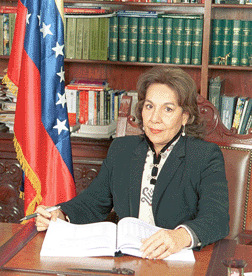
A while back, a trusted friend told me there was a foreigner in Venezuela’s Supreme Court, but this person could not prove it. Yesterday, this person sent me this article which says that someone has actually gone to the Prosecutors Office to accuse that Supreme Court Justice Evelyn Marrero Ortiz is not Venezuelan.

The article says that the Justice was born in Puerto Rico on February 22nd. 1942 and obtained the Venezuelan nationality in 1966 when she married a Venezuelan citizen whose name is irrelevant to this story. Thus, technically, if this can be verified and true, Justice Marrero is simply a US citizen, about the worst citizenship you can have if we are to believe Chavez’ revolutionary words.
The accusation further says that in the Judge’s papers at Universidad Central de Venezuela, it clearly says that she was born in Jayuya, Puerto Rico. According to Chavez’ own Constitution (Article 41) in order to be a member of the Venezuelan Supreme Court, you not only have to be Venezuelan by birth, but you can not have another nationality, which implies that you have to renounce to any other nationality you may have. Justice Marrero would not qualify for both reasons, even if she has renounced to the other nationality.

Personally, I would allow people born abroad but who have lived here all their lives to hold certain positions, including most Ministries. What astounds me is that these ultra nationalistic revolutionaries allow these blatant violations of their own Constitution to occur, without saying anything, while arguing sovereignty, self-determination  and other such BS for everything that happens around them. Just like they allow Cubans to run intelligence and security and have a say in military and identification matters and it is ok, because they are Cubans.

In fact, Minister of Planning and Finance Jorge Giordani, was accused of not complying with Article 41 in the first few years of Chavez’s tenure. At the time, it was argued that Giordani, who was born in San Pedro Macoris, Domenican Republic, held a position (Minister Planning) which was not the subject of Art. 41. Well, since they merged Planning and Finance, this is no longer the case, but given Chavez’ filial relationship with Giordani, nobody seems to want to bring this up either.

Again, I write this because I trust the person that gave me the info. You would at least think that the Justice herself would explain to us, whether she is not or not qualified to be part of the Venezuela Supreme Court. But as usual, there is simply silence.

But of all nationalities, I find it ironic that she is a gringa. Don’t Chavistas get paranoid that she could even work for the CIA, the NSA or the FBI?

What a joke this Government is!

Hugo Chavez. Bully, Autocrat and Incompetent

July 25, 2012

The last few days, President Hugo Chavez has clearly demonstrated the qualities that make him unfit to be President even of his condo board, if he had a condo, proving once again that he is intolerant, autocratic and does not believe in modern science and technology. To wit:

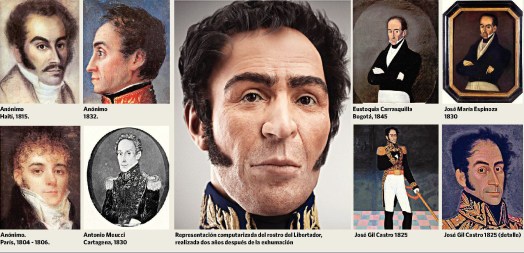
1) He spends millions of dollars exhuming the remains of Liberator Simon Bolivar to “prove” that he was killed by the Colombian oligarchy, a silly ideological theory. The scientific study concludes that there is no evidence of any poisoning and that Bolivar more likely died as a consequence of histoplasmosis, a fungal infection.

Chavez’s response? He still thinks that Bolivar was poisoned. This is the same line of reasoning that leads him to think that despite the disastrous economic policies of the last 14 years, they are correct, just because he thinks so. Or that the electric problem is fixed, even if there are daily blackouts. And so on..

As to the reconstruction of Bolivar’s face, what a waste of money! We now know the detailed face of Bolivar just when he died, about the worst point in life you can hope for. So, if you think he looks bad, ugly, emaciated or all of the above. Of course he does, he had just died! What do you expect?

The reconstruction seems consistent with the paintings of Bolivar, just nobody painted him right before his death.

2) Venezuela lost yet again,  another case in the Interamerican Human Rights Court (CIDH). Of course, you don’t respect human rights, they rule against you. Chavez’ response: He ordered his Foreign Minister to withdraw from the Human Rights Court. Among other things he argued, as usual, the “sovereignty” of countries. Where was he when Maduro went to Paraguay to tell the General not to allow Congress to impeach Lugo?

In any case, this is just grandstanding, in his infinite ignorance, Chavez apparently did not know that you can’t withdraw from the CIDH, you have to withdraw from the OAS, of which the CIDH is part. Then he will really be out of the mainstream diplomacy, which he surely does not want.

3) The Governor of Zulia State asks that there be a referendum on the use of the gasoline “chip”, the rationing tag imposed to that State in order to supposedly limit contraband. This possibility is part of the Venezuelan Constitution and it explicitly says a Governor can ask for such a referendum. Mind you, the Constitution is Chavez’ Constitution of the year 2000.

Chavez’ response? To warn the democratically elected Governor that he may suffer the same fate of former Governor of Zulia and Presidential candidate Manuel Rosales. Rosales was accused of corruption after his Presidential run and had to go into exile.

4) During the visit to Venezuela by Argentina’s Minister de Vido, who was part of the Maletagate case, Chavez theatened Repsol quite directly by suggesting that the company better reach an agreement with the Argentinian Government or this may have consequences in Venezuela, where Repsol has important interests. Talk about carrying a big stick! A bully is just a bully, is just a Bully!

I know, I know, is more of the same, we knew all that, it is just amazing that he can do all this in such a short span time.

The New Foreign Exchange Agreement Between The Central Bank And The Venezuela Government

July 21, 2012

There has been a lot of noise since yesterday because of the new Foreign Exchange Agreement (Convenio Cambiario #20) between the Central Bank and the Venezuelan Government, with most of the focus placed on the fact that bank accounts may now be opened in foreign currency in Venezuela. However, it is a limited form of bank accounts that can really be opened, as I will explain below. But first let’s review the current foreign exchange system before the new decree came out:

There are two ways of accessing foreign currency today in Venezuela. First, via Cadivi, which gives you dollars for imports, travel and certain medical treatments and studies. These dollars are sold to you at Bs. 4.3. You pay in Bs. and Cadivi pays the provider or if it is money for travel, you use your credit card in foreign currency and pay your bank in Bolivars. Similarly, banks are allowed to give you some cash for travel, which you pay in Bolivars. There may be dollars for other things, but they are not critical for the discussion.

The second way to get dollars is via SITME, the Central Bank’s foreign exchange system, in which you buy bonds, sell them abroad and you receive foreign currency. Companies can buy up to US$ 50,000 per day at the rate of Bs. 5.3 per US$ , but no more than US$ 350,000 per month if they satisfy certain requirements. Similarly, individuals may obtain up to US$ 5,000 per year for travel, $10,000 for health problems and $6,000 to send to relatives via SITME at the rate of Bs. 5.3 per US$. The only common criteria in both cases, is that you have a US$ account abroad in your name to receive the funds.

Thus, what the new Foreign Exchange Agreement does first, is to allow local banks to open accounts in foreign currency  for both companies and individuals in order to receive US$ that originate in SITME. This is done, because only those that had accounts abroad could receive dollars from SITME, no more, no less. It does not mean, like some people suggest that “Venezuelans will be able to save in US$ locally” from now on. People will buy dollars via SITME and more likely than not, will immediately send the money elsewhere or spend it. Nobody in their right mind is going to add to these accounts any new funds for reasons that are too obvious to mention. But let’s suggest just two: The Government could order their forced conversion to local currency (The banks will actually have the dollars at the Central Bank) at any time and the Government will know how much you have. That should be sufficient to scare away anybody.

The second thing the Foreign Exchange Agreement does, is to allow foreign companies doing infrastructure, “public investment” or development projects to have local bank accounts in dollars, which they will be able to mobilize via partial or total withdrawals in local currency at the official rate of exchange (Bs. 4.3 per US$).

Finally, and this is likely to be the most relevant thing, the Foreign Exchange Agreement allows “State companies” which obtain foreign currency from their exports to devote up to 5% of the average monthly balance of their foreign currency accounts, to acquire bonds in the secondary market to be sold in the SITME Foreign Exchange System.

Read: State companies will now be able to sell 5% of what they have in their dollar accounts at Bs. 5.3 per US$, rather than at the Bs 4.3 per US$ that they were forced to sell their foreign currency to the Central Bank before.

What this is, is a small partial devaluation of the currency which will give PDVSA and in lesser grade, other state companies, more Bolivars for the foreign currency obtained from their exports.

This also means that the offer in SITME will increase by 30-35%, as these bonds bought by the State enterprises flow to the SITME, rather than directly to the Venezuelan Central Bank. So far this year, the average daily volume via SITME has been around US$ 43-45 million, so we could see around US$ 56-60 million per day once this gets going.

One interesting consequence of this, is that PDVSA will have more local currency and less pressure to sell new bonds in the international markets. Another minor one, is that these companies will buy bonds in the open market, which can take up to a month to come back to the international markets, which means there will be a small impact on supply, which will be reduced.

Thus, the agreement aims to extend the people that can get SITME dollars. make it more practical for some foreign companies to operate in Venezuela and allow Government owned companies to get more Bolivars for their dollars which originate in exports.

That’s it, boys and girls, nothing to get too excited about. It’s actually quite boring and of secondary importance when you come down to it.

FBI Sting Operation Recovers Matisse Owned by Venezuelan Museum

July 18, 2012

(Try guessing which one is real and which one is fake, answer at the end)

An FBI sting operation in Miami led to the recovery of a Matisse painting entitled “Odalisque in Red Pants” owned by the Sofia Imber Museum of Modern Art in Caracas. The FBI agents posed as customers willing to buy the painting from a couple whose name has yet to be disclosed by the FBI.

The story started in 2002 when it was discovered that the Matisse hanging in the museum wall was a fake, after the Chavez administration had changed the Board of the museum a couple of years earlier, including Ms. Imber, who had run it from its beginning (And purchased this particular painting for a relatively low price)

Initially there were accusations that the painting had disappeared after the management change, but others have suggested that the switch took place even before when the painting was lent in 1997 to a Spanish exhibit. However, those at the museum until the management change have stated privately that they would have certainly noticed the switch. The current Director of the museum has suggested it was an inside job, without ever explaining her statement.

The switch was discovered when a collector was offered the painting in 2001-2002 and began performing due diligence on the painting and wrote to the Director of the museum. This led the museum to check the painting and the discovery that the one hanging in Caracas was a fake. The painting was offered to a number of collectors and rumors of that it was for sale have recurred over the years.

Hopefully, with the recovery of the painting the full story of the switcheroo will be revealed and those responsible prosecuted.

For now, this is another picturesque (pun intended) story of the always devious Venezuelans in Government (no matter when the switch took place) always looking for an angle that will make them rich overnight.

Answer: The original is the one on the left

The Upside Down World of Venezuelan Economics

July 15, 2012

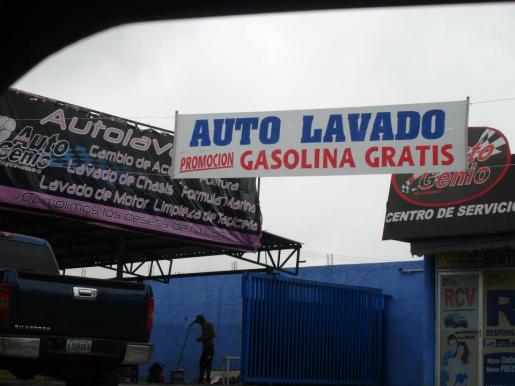
This is truly a devil’s Excrement item, stolen from Andres Rojas’ Facebook page. A gas station in Margarita offering free gas when you wash your car there.

How screwed up can you get?

Another Day, Another Control In Venezuela

July 8, 2012

Given the huge arbitrage between gasoline prices in Venezuela and Colombia (There is a factor of 65 difference in price!), contraband between the two countries is a very profitable enterprise. But rather than attacking the problem at its roots, the Chavez Government always has to invent a new form of control, when it can not impose order in a more rational way.

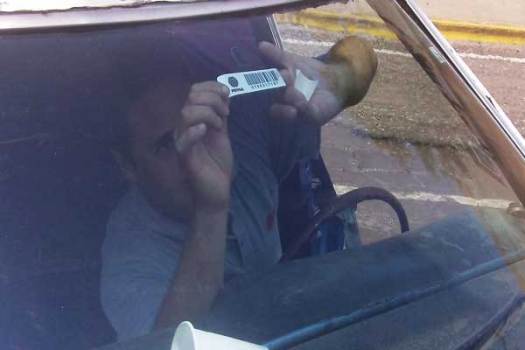
Thus, the Government introduced a form of rationing, which they call the “chip”, which is nothing more than a bar code attached to the windshield of your car. You are assigned a monthly quota and before you are dispensed gasoline, the gas station reads it and if you have not consumed your quota, the gas is dispensed

The system was first implemented in Tachira state, where it raised some noise. But now that the Government wants it installed in what is probably the most anti-Chavista state in the country, Zulia, it has become a campaign issue as Zulianos feel they are being picked upon for their anti-Government stance.

But the truth is that it is the huge difference in gas prices which promotes this business, but it is not the individual cars that contribute the most to the problem, but large vehicles with huge tanks, which cross the border to Colombia under the eyes of the Venezuelan National Guard, which has been duly paid off to look the other way.

Of course, implementing the system is a mess, long lines, the sale of the free chip for a price, being able to acquire a second chip if you want and accusations that the “chip” is sold to the Government by the son of the Chavista candidate for Governor of Zulia. The whole thing is a mess, as people now will likely go to other adjacent states in Venezuela in order to fill up when their quota runs out.

But more ominously, people fear that the chip will become a nationwide system and the perverse gasoline subsidy will become a rationing system as the price of gas has not been changed in 13 years.

Thus, rather than deal with a problem of their own making, the Chavez administration simply creates another expensive and perverse control mechanism, which is unlikely to stop the real problem of the “bachaqueros” (Professional gas smugglers) but creates yet another from of control and supervision.

Mercosur Shows Lack Of Ethics

July 4, 2012

It is truly sad to realize that so many Latin American leaders lack ethics. But what else can you say about Mercosur’s decision to suspend Paraguay as a member until a new President is elected and then have a few Presidents meet to rush to allow Venezuela to become a member using that loophole? This could only be done because Paraguay was the only country objecting to Venezuela’s entry into this “free market”. But Paraguay is still a member of Mercosur, even if its rights have been temporarily suspended.

Only some Uruguayans seem to be worried about what happened and while that country’s President was part of the back room deal, it is being questioned on both legal and moral grounds. There may be some hope in some countries after all, when the Vice-President of Uruguay warns that “it may be that the institutionality of Mercosur is so weak, that it will become useless” because of this perverse act.

And useless it will become, when a group of Presidents act like a bunch of hoodlums, making a mockery of Paraguay’s rights within Mercosur to allow them to take advantage of Chavez’ grandiose plans to belong to a free trade pact that we can not export anything into.

Because that is all they want, to be able to shove down Venezuela’s throats their products, knowing full well, our country will gain little from being a Mercosur member. We only have oil for export and any country in that weird “free trade” zone can impose tariffs on oil if they want.

And as the world watches Venezuela’s Foreign Minister interfering in Paraguay’s very internal affairs, video included, Mercosur’s leaders take sides with their less than democratic, but rich Venezuelan partner, in order to get back at poor Paraguay’s principled opposition to Venezuela’s membership in Mercosur, because they do not believe a country led by an autocrat should be part of their club.

But ethics has not been the forte of Latin American leaders as of late. Human Rights have become secondary to commerce and the gains of the 80’s and 90’s in that area have been eroded by the new Latin American Left. One day, when the pendulum swings against them, they may come to regret it.

If All Excuses Have Been Used, Blame The Opossum

June 15, 2012

Venezuela’s electric power company ran out of excuses again this week and decided to go back to creative ideas and blame an opossum for the latest blackout in Ciudad Guayana. The excuse goes even beyond the opossum by saying that people have been leaving garbage behind, which attracts animals, which then manage to eat a cable, cutting off all power to sections about half the size of a city like Ciudad Guayana.

Of course, nobody explains why there is no clean up to remove the garbage, or measures to prevent people from throwing garbage near the power plant or transformers. But more importantly, how can a system be designed such that a single opossum can short-circuit half a city?

Just asking.

While Government Finances Chavez’ Campaign, Opposition Figures Accounts Are Investigated

June 15, 2012

In the Hugo Chavez Autocracy fairness and honesty are not important when dealing with electoral matters. While La Patilla published a document showing how Ministries financed and mobilized the people to go to Chavez’ rally on Monday, the bank Superintendent asked all financial institutions to provide him with the details of all fund movements in the bank accounts for opposition figures such as Gerardo Blyde, Leopoldo Lopez, Stalin Gonzalez and Delsa Solorzano.

Thus, while Chavez finances his campaign in full violation of the law, in a manner that is punished with jail, the Superintendent of Banks goes fishing to see if any irrelevant amount of money is flowing to Capriles’ campaign via opposition leaders. This limits campaign contributions, as donors are afraid of being harrased for contributing to Capriles’ campaign, while all of the Government’s resources are at the service of Chavez’ efforts in blatant violation of the law.

Such are the unfair and unethical ways of the revolution.