Archive for the 'Venezuela' Category

The Venezuelan Opposition Debate I Did Not Watch

December 7, 2011

Unfortunately, I was unable to watch the debate among opposition politicians due to travel. But I have watched clips and read impressions from all sides. My conclusion: It is unlikely that the race will change much between now and February.

The format did not help, asking different questions to each candidate is simply useless in terms of being able to evaluate the field. It is clear that Maria Corina Machado was the best performer, but that type of performance is not what wins debates or changes a race. She started too far back and maybe we should start understanding that the average Venezuelan prefers a gray populist than a sharp visionary. It is, after all our history: Populism sells well. Chavez promised the world, but only delivered on the populism, he forgot about crime, democracy and corruption, but through over promising, remains popular despite his failed decade in power.

Those in Diego Arria’s camp had high hopes that he would once again win the day, but he failed to have the same spark he did the first time around. He had no big announcements and continued to sell his experience as the salient point. Diego’s run is valiant, he is making lots of good points, but my gut feeling all along is that Venezuelans do want new faces, even Chavismo does not seem to get that.

Leopoldo Lopez emphasized fighting crime too much. I did expect him to do much better, he did well, but not enough to move the numbers which is what he needed. Leopoldo should follow his instincts more, he got to where he is on his own, maybe he thought too much about what to say. I still think he should have made more out of the box proposals if he wanted to gain ground.

I think Pablo Perez did well, he was more relaxed than the first time and did not blow it, staying in second place behind Capriles. He needs this, as Venezuelans don’t like to waste their votes and any bad vies surrounding Perez could drop him like a stone. He avoided that.

Finally, there is Henrique Capriles, who won by not shaking the boat, which is what front runners are all about. Ever non-confrontational, Capriles seems to think he is ahead and does not want to offend the former Chavista voters he wants to attract in the Presidential race. So far, HCR has played every step of the way right. He is stiff, non-ideological and non-confrontational, which I would have thought was a sure recipe for disaster, but it seems to work. His CHACACA (Chavistas Con CApriles) joke, obviously prepared became amazingly one of the high points of the night. Maybe it was the realization he may have a sense of humor. I still don’t get him.

Debates are funny events. The format on Sunday did not help, but typically those in the lead try not to screw up and those behind try to catch up. Diego Arria managed in the first debate to create a bigger impression on the electorate. So far, he seems to be unique. Maria Corina did well this time, but there was nothing dramatic in her performance, she was uniformly better. Pablo Perez and Henrique Capriles did not blow it. That is a victory for both. Barring surprises, on primary day voters will all think about those two. Capriles seems ahead, but Perez has more traditional party machineries backing him, he has a chance

Oh yes, there was Pablo Medina ranting every fifth question. That is all he has done in his life, including backing Chavez’ coup in 1992. He has never been electable, but give him credit, he has a point he wants to make and does it.
Some Winners at Chavez’ CELAC summit

December 6, 2011

Chavez’ CELAC shindig is over and it went well for Hugo, attendance was better than expected, while everyone thought Dilma will show up, they weren’t sure about others like Felipe Calderon of Mexico and Piñera of Chile.

But beware of visitors coming to a Summit they don’t believe in. They always do at a price and there were some very nice winners for attending.

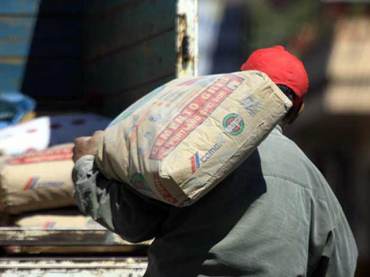
The biggest winner was the President of Mexico Felipe Calderon. He got Chavez to pay US$ 1 billion for nationalized Cemex Venezuela to Cemex, Mexico’s premier international company, which has been having financial problems due to the construction crisis all over the place. I noted this in the previous article.

But Calderon had another card up his sleeve, he managed to have Chavez reverse the nationalization of Gruma’s Monaca and turn it into two joint ventures with the Venezuelan Government to produce flour, rice, pasta and oatmeal. Not a bad change of terms for Gruma, as it places a long term bet that things may change in Venezuela.

Cemex probably preferred the money with US$ 15 billion in debt coming due in 2014.

Finally, Chavez signed a deal with Brazil’s Dilma Roussef to buy 20 jets built by Embraer, Brazil’s airplane company. Now, Embraer is a private company, formerly Government owned, trades in New York and while it is true the Brazilian Government owns a symbolic golden share, this is not the type of deal that President’s get involved in, unless…

Venezuela was dealig with Embraer and Dilma just gave the whole thing a little push at the end.

It is indeed a strange revolution. It pays money to its natural enemies in the region to gain favors. It pays high interest rates to capitalists and it gives preference to foreigners over Venezuelans. Just today, it gave a nice “windfall” to holders of Fertinitro bonds, much like it did with PDVSA, CITGO, EDC, Petrozuata and Cerro Negro before. If it fits the goals of the revolution, the money is there to pay for it.

Nothing says a revolution has to have scruples.

Did Venezuela Really Compensate Cemex For Only Half of What it Wanted?

December 2, 2011

Headlines are beautiful things. Just witness yesterday’s “Venezuela to pay Cemex US$ 600 million for its assets in Venezuela”. It really sounds like Venezuela got the good end of the deal, as Cemex had sought US$ 1.2 billion in arbitration and supposedly ended up with only half of that. But did they?

Not really.

First of all, Venezuela had said that Cemex Venezuela was worth only US$ 450 million when it first nationalized it. On the other side, Cemex was asking for US$ 1.2 billion for it. What is not clear is whether Cemex was asking for US$ 1.2 billion for Cemex Venezuela or for its 75.7% stake in it. That alone makes a big difference.

But let’s look at the numbers and the announcements:

1) Venezuela will pay Cemex US$ 600 million, US$ 240 million in cash and US$ 360 million in PDVSA bonds in 4 parts, each one of them of US$ 90 million in the next four years. I am guessing this means that next year Cemex will get a 2013 PDVSA bond, the next a 2014 PDVSA on and so on and so forth.

2) However, Cemex owed Cemex Venezuela US$ 154 million ( I think it is US$ 158 million, but that is a minor difference). You see, after the Venezuelan Government announced that it would nationalize the cement sector, Cemex Venezuela sold its parent Cemex, its subsidiaries in Dominican Republic, Panama and Trinidad for US$ 355 million. Cemex paid US$ 132 million of that amount with dividends that were retained in Cemex Venezuela, US$ 60 million that were assets of Cemex Mexico in Venezuela and thus Cemex owed Cemex Venezuela US$ 158 million. As part of the settlement this debt with Cemex Venezuela is settled. Thus, Cemex Venezuela gets the US$ 600 million in cash and bonds AND gets US$ 154 (or 158 in my numbers) million that it no longer owes, thus Cemex is getting US$ 754 million

3) Cemex did not own 100% of Cemex Venezuela. The public owns 24.3% of it. Thus, the Venezuelan Government that said that Cemex Venezuela was only worth US$ 450 million, is saying that the company is worth US 996 million. Under Venezuelan law, the Government is obligated to buy out these minority shareholders ( I am one) at the same price (in local currency, of course, Venezuelans are second class citizens, more so if they are oligarchic investors). Whether the Government will follow the law or not, it says that the 24.3% not in the hands of Cemex is worth US$ 242 million.

So, Venezuela has to pay about a billion dollars for Cemex Venezuela, closer to the US$ 1.2 billion that Cemex wanted, whether it wanted it for its stake or for the whole thing, than the US$ 450 million the Government was offering.

That this is more of a victory for the Mexicans than for the Venezuelan Government is confirmed by the fact that Mexican President Felipe Calderon said he was coming to Chavez’ CELAC shindig, only hours before it began and right after the agreement with Cemex was signed.

Oh, the pretty revolution!

Venezuela: The Fondo Chino Papers, Contracts and Details

November 28, 2011

No sooner had I finished the post last night that I received a few mails with more information on the Fondo Chino. There is a lot of information in this, but I will simply note the highlights and look at the details later, or have others look at the details.

The best source for documents that I received is this one, a little disorganized and duplicate documents, but all but one of the documents that I received today are there.

The main document is this one:

View this document on Scribd

This is the agreement between Bandes, the Chinese Oil Company, PDVSA and the China Development Bank on how the fund would work.  And it is indeed as I described last night.

But what got my interest was that this Government that wants only Venezuelan laws to apply to agreements, easily gives in to the Chinese Government, saying that any arbitration will go to the Singapore International Arbitration Center, as if Venezuela would have a chance there against China. (page 6)

There are many more details. For example, there is a contract for the oil sales, which clearly states what the formula for calculating what the Chinese Oil Company will pay is (page 7):

5. FOB PRICE

THE PRICE OF THE PRODUCT TO BE DELIVERED PURSUANT TO THE CONTRACT HEREOF, SHALL BE DETERMINED BY MEANS OF THE FOLLOWING PRICE FORMULA:

IFO380:  HSFO 380 4% SINGAPORE PLATT´S MID (USD/MT) PLUS K (USD/MT) MINUS FREIGHT (USD/MT).

WHERE K = USD -2.50 PER METRIC TON (MINUS USD TWO DOLLARS AND FIFTY CENTS PER METRIC TON)

and the pricing period is a market price period:

5.1.2 FINAL PRICING PERIOD (FOR FINAL INVOICE): THE PRICING PERIOD SHALL BE BASED ON THE AVERAGE OF THE EFFECTIVE PUBLISHED PRICE QUOTATIONS STARTING CALENDAR DATE FROM THIRTY ONE (31) TO SIXTY (60) AFTER BILL OF LADING DATE (B/L DATE COUNTS AS DAY ZERO)

This makes me feel better, there seems to be a “market” (sort of) mechanism for setting the price, of course, a dollar in oil prices can make someone millions, but this is better than saying that Venezuela was selling oil at US$ 40 or $50 per barrel, as understood by many.

And it made me feel quite good when I read this document, that establishes what the interest rate will be:

La parte ohina propuso que para la porcion en dolares, aplicar
una tasa de interes promedio entre la tasa vigente para la
Fase E del Fondo Conjunto China Venezueia (Libor + 2,35%)
y la tasa vigente para la linea de oreciito a empresas
venezoiar1as{Libor + 4,5%).

An average of Libor +2.35% and Libor + 4.5% is not bad for Venezuela. Ramirez fails to get that this may be the only reason this is good, not those given in his memo to Chavez.

The problem is that the same document says that these guys want to borrow, the not insignificant amount of US$ 116 billion from the Chinese. Not that the Chinese are lending it, they seem to mistrust what Venezuela will invest this money in, but these guys really are thinking BIG!

And this spreadsheet confirms what I said last night, the “excess money” at US$ 80 per barrel in one year is US$ 7.33 billion, Venezuela sends about US$ 11.2 billion in oil (at the estimated price of US$ 80) and “only” about US$ 3.9 billion actually pay for the loan, the rest is available to be returned to PDVSA or the Government (or the CVG for that matter!) to be used at discretion and out of the oversight of Venezuelan institutions.

As I said, Guilty, guilty, guilty! But nothing or little happens. There is a lot of stuff in those links, please look at them and let us know what you find.

Hugo Chavez and the Illegal Chinese Funds: Guilty, Guilty, Guilty!

November 27, 2011

While I was on vacation, I wrote a post based on a document a reader had sent me, in which the Minister of Energy and Oil and President of PDVSA, Rafael Ramirez, asked Chavez for the excess money in the Chinese Funds to be returned to PDVSA.

Since I was on vacation, I concentrated on the numbers given there for Venezuela’s oil production, which contradict official numbers. What I fail to understand or  comprehend, is that the document is a huge indictment for the illegality of the Chinese Funds, which the Government has been using to finance its activities and bypass the structure of the State.

In fact, as I will show, the whole mechanism is not only illegal, but it represents a perverse scheme for the Government to spend without the usual oversight, while simultaneously severely damaging PDVSA’s finances. For completeness, here is that document again:

View this document on Scribd

Between jet lag and catching up, I had not gone back to the document, even if I meant to. But two things made me look back: One, the interview in today’s papers (El Universal here, El Nacional, by subscription) with Deputy Miguel Angel Rodriguez and a simple question: What is Venezuela’s US$ debt service per year.

In the interview, Rodriguez says: “The truth is that crude is advanced, but money is returned”. This piqued my interest, together with the fact that I calculated that 430,000 barrels of oil a day, at US$ 100 per barrel for a full year, corresponds, to the staggering amount of US$ 15.7 billion dollars a year. Since the official document above clearly states (page 6) that the total debt of the Chinese Funds is US$ 20.8 billion, how could it be that it takes US$ 15.7 billion to service that debt per year?

Clearly, something did not add up and it was time to go back to the document and really study it!

The whole thing is perverse, incredible and totally illegal, here is how the whole thing works, as clearly explained in the document by the Minister of Energy and Oil and President of PDVSA:

1) PDVSA sells the oil to the China National Oil Corporation (CNOOC)

2) CNOOC pays the oil into a Bandes account at the Chinese Development Bank (CDB), which is the lender to the Republic of Venezuela.

3) CDB subtracts from the amounts debt service, both capital and interest.

4) If there is an excess, PDVSA asks CDB that the money be transferred to pay royalties to the Government, taxes to the Government and cover some of the production and refining costs.

Except that starting on Jan 2010, as the document clearly states, PDVSA stopped even getting that. It got zilch, the Funds got it all!

So, let’s make it really simple: The Republic borrows US$ 20.8 billion from the Chinese. PDVSA “pays” for this loan to the tune of US$ 15.7 billion per year, clearly an inordinate amount of money for the loan received. The Chinese collect interest and capital and any “excess”, of which there is a lot, returns to the Government, not to PDVSA, via parallel funds, which bypass the controls and approvals of Venezuelan Laws.

This is absolutely illegal for a number of reasons: First of all, as Deputy Rodriguez says in the interview,the Organic Law for the Financial management of the Public Sector says in its Art. 93 that no credit operation can be guaranteed with income or assets of the Republic. This is exactly what the Chavez Government has been doing by guaranteeing it with oil. Second, there is a clear intent here to bypass the laws of Venezuela, spending the money outside of the budget and controls of both the National Assembly and the Comptroller in the interest of “expediency”, but the law was clearly established to guarantee the money is well spent and this represents a way to circumvent  both the spirit and the letter of the law. But the worst crime is that the Republic is making use of PDVSA funds to pay for its debts, a clear violation of the law, but in the process, Chavez and his Government are weakening the finances of the company, as stated by Minister Ramirez in the memo to the President.

When Richard Nixon was President, in the midst of the Watergate affair, there was a big scandal with comic strip Doonesbury, which presented a cartoon indicting one of Nixon’s collaborators, by saying “Guilty, Guilty, Guilty”. Most of you can’t even remember this, but here is that strip:

Some newspapers did not run this, the Washington Post even ran an Editorial on it criticizing the cartoon for “reaching a verdict” on the Watergate affair in such fashion.

Well, today much like then, Hugo Chavez is ‘Guilty, guilty, guilty” of creating a mechanism to bypass the controls of the State, not only in violation of the law, but in order to spend the money at his discretion. The Chinese may one day have to face up to these illegalities and its consequences, but Chavez and his collaborators, if they lose power, will have to answer to Venezuela’s Courts.

Guilty, Guilty, Guilty!

Hugo Chavez: Still Improvising On His Cabinet After All These Years

November 26, 2011

It would be funny, if it were not so tragic: Thirteen years after taking power, Hugo Chavez keeps improvising in how he manages the Government. The amazing thing is that he announced that he would merge the Ministry of Basic Industries with the Ministry of Intermediate Industries as if it was the result of a study or an amazing inspiration in order to achieve more efficiencies, when the truth is that he was the one that separated the two functions. No only that, but by a mysterious chain of thought, Chavez merged the Ministry of Intermediate Industries with that of Science and Technology in 2009, a whim that has yet to be explained or understood by anyone.

So now, Chavez reverts the whole thing in the name of efficiency, when his whims of creating and destroying Ministries represents one of the biggest inefficiencies of his rule. Every time Chavez improvises “creating” a new Ministry, millions of Bolivars have to be spent in reorganizing and restructuring the new and the old Ministries and its personnel and assets. Imagine now the Minister of Industries arguing with the Ministry of Science and Technology, which office space, which employees and which funding stays with whom. And if they disagree, they will have to wait until none other than Hugo Chavez decides on each issue. Which could take months or may never happen. Some efficiency!

Take the Ministry of Transport and Communications which Chavez received in 1998. He changed it into the Ministry for Infrastructure, then he divided it into two, then it became the Ministry of Transport And Communications again, then he divided it into two again recently. Just the cost in changing the paper and the envelopes is staggering. To say nothing of implementing the changes under Chavista “Managers”, as oxymoronic a concept as there ever was one.

The remarkable thing is that Hugo Chavez dramatically reduced the number of Ministries when he came to power in 1998, but by now, the number has more than doubled, as he thinks that creating new ones is some form of management technique. Chavez received 21 Ministries from Caldera, reduced it to 13 and if I count correctly and the web pages are up to date, there are now 31 of them. I wonder what it does to efficiency to have 31 people plus Chavez, plus the Procurador sitting at the same table discussing things…

For Science and Technology this is good. It now goes back to having its own Ministry, as it should be. The Minister seemed to be distracted with “Intermediate Industries” whatever that may be. Now he will at least focus on science and technology, which now that I think about it, may not be a good thing. After all, the Minister may start improvising himself and creating “efficiencies” and inventing new concepts in science and technology just like his boss. Maybe we were better off when he was distracted…

Did Venezuela Really Give US$ 2 billion in Bonds For Humanitarian Projects?

November 22, 2011

Today Alek Boyd presented some documents showing that the Venezuelan Central Bank transferred US$ 2 billion in bonds for humanitarian projects to be executed by a company Kellmar Limited run by Anthony Caplin, a former Chief Operating Officer of the UK’s Conservative Party.

I believe these documents are fake due to a number of inconsistencies. Among them:

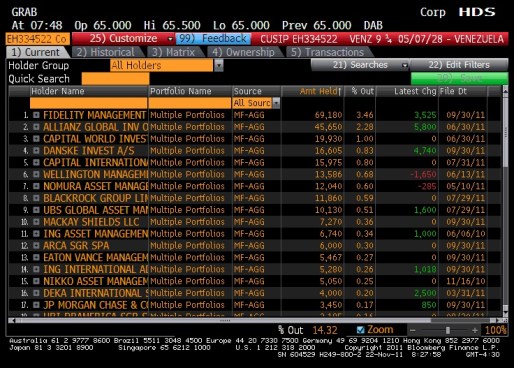
– The bond supposedly transferred was a Global 2028 and in the nominal amount of US$ 2 billion. The Global 2028 bond was issued in May 2008 and sold to local investors in Venezuela in the amount of US$ 2 billion paired up with a Global 2023 bond in the same amount. There is no record of additional issuance of a Global 2028 and the numbers that identify the bond shown are identical to the ones issued in May 2008 and no bond could be transferred electronically, like these papers claim, if there was no registration of the issuance. As shown below, owners of this bond are multiple, topped by Fidelity Investments which holds 3.46% of the issue, thus the Venezuelan Central Bank could not have transferred the amount claimed.

-The documents contain a series of inconsistencies as to Venezuelan laws and institutions. For example, it says the bonds are registered with the Comision Nacional de Valores (page 3 in Alek’s document, shown below). Venezuelan Sovereign bonds are not subject to the regulation of the Securities regulator, as per Art. 1 of the old and the new law, nor do they trade in the Caracas Stock Exchange as it says in the document purportedly written by the Venezuelan Central Bank. Moreover, the Comision Nacional de Valores no longer existed in May 2011 when this letter was written, it’s name was changed to Superintendence of Securities in September 2010.

-The documents always refer to the Ministry of Finance, which in May 2011 was actually called Ministry of Finance and Planning.

-The suggestion by the BCV that the good relations of Kellmar Inc with the Vatican and the Sisters of Charity does not sound at all as something coming from the Chavista Government.

-There is a letter of compliance by the BCV. Why would this be needed at all? If the bonds were coming from the BCV, that alone certifies the origin of funds and adequate provenance.

-Page 5 of the document is supposed to be a SWIFT transfer of the bonds. As far as I know and have been able to determine today, SWIFT is a system for the transfer of money, not securities. Securities are transferred either via Euroclear or via Clearstream. The SWIFT document also contains unnecessary explanations of why the bonds are being transferred.

So, I am of the opinion that these documents are fake, that the Venezuelan Central Bank has never made such a transfer, nor the Venezuelan Government wants to support projects by Kellmar and Mr. Caplin like those described.

Then, what is going on here?

My suspicion is that this is either an elaborate scheme to scam other philanthropic organizations to contribute to these projects by suggesting they already have a good “seed” funding provided by the Government of Venezuela or an attempt to create a cloud around Mr. Caplin or damage him politically. I would lean towards the first, but have no idea of how such an elaborate scheme would or could possibly work.

The Big Lie: Venezuela’s Oil Production

November 13, 2011
View this document on Scribd

We interrupt the Devil’s vacation for a short note on the Big Lie that Venezuela’s oil production represents. While I have not been keeping track of the news in much detail, I am after all on vacation, I do read my mail and the comments you make on the blog. One reader, call him VJ, sent me this incredibly revealing document above of a request by Minister Ramirez for Chavez to approve that PDVSA withdraw money from the Chinese funds to pay royalties and taxes as well as paying for the production of the oil that goes to pay for the Chinese loans.

When I return, I will analyze this document further, but for now, this document confirms clearly in page 3, the Big Lie that Venezuela’s official oil production represents.

According to the recently published financials of PDVSA, the country produced 2.95 million barrels of oil a day. These financials are audited, but using standard accounting rules, only financial aspects are audited, oil production is simply not part of the audit.

However, this document on page 3 contradicts this official number, as reader VJ notes. If 430,000 barrels of oil a day is sent to China to pay for the loans, as is clearly stated in the document, then Venezuela’s real oil production is 2.687 million barrels of oil a day, some 262,500 barrel a day less than the official numbers in PDVSA’s 2010 financials.

This number is higher than IEA or OPEC’s by a couple of hundred thousand of barrels of oil a day, but when one considers that in 2008 PDVSA said it was producing 3.3 million barrels a day, but this was reduced to comply with OPEC production cuts, you know the lie was even much bigger than it is today.

Not that one has any reason to believe this number either, after all: Would Ramirez tell the President the whole truth about his incompetence and the lies he has been telling since 2003? I doubt it, so take this number with a grain of salt. Do remember however, that PDVSA’s and CITGO’s US registered debt was repurchased in 2004 so that the members of the PDVSA Board could not be held liable in the US for lying. In Venezuela, they can lie all they want, there is no punishment for it.

But let’s assume for a moment the 2.687 million barrels a day is the truth.

Subtract Venezuela’s daily consumption of around 700,000 barrels

Subtract 430,000 barrels of oil a day to pay the Chinese loans

Subtract some 85,000 to Cuba, 20,000 to Argentina and 120,000 to Petrocaribe.

That’s some 1.355 million barrels of oil a day that do not generate any cash flow for the country in foreign currency (Except of Petrocaribe which we are told generates 50%). Subtract that from 2.6875 and you get 1.352 millions of barrel a days that generate foreign currency, according to official numbers. At US$ 100 per barrel that is less than US$ 50 billion a year, US$ 49.3 billion to be exact, a number smaller than CADIVI exports.

So, the Big Lie says that the Government is betting the farm on Chavez getting reelected. To Hell with the future, the future is NOW, borrow everywhere, issue bonds, borrow from China and hope for the best, unless the hand of God intervenes…

But the Big Lie is right there and it should be punishable by law at least as deception or misleading, at most as treason. But unless there is change, it will simply not matter. Ramirez can lie, deceive and manipulate all he wants as he allows PDVSA to be destroyed for the sake of Hugo’s reelection.

Delving Into the Past and Present of a Fascinating Country

November 13, 2011

This one is easy. Fascinating country, past and present and more like Venezuela that you could ever imagine.

Cross a second one off my Bucket List, not easy to do that in one year, but then again, I missed crossing one off in 2010.

More on this place later…

As the Devil flies off, he is optimistic about Venezuela’s political future

November 4, 2011

As I leave Caracas, I must say I am a little more optimistic than last time. Ignoring Hugo’s illness, it is clear that twelve years of bad Government, Chavez’ limited ability to appear in public and a field of fresh new faces on the side of the opposition is increasing the likelyhood of an opposition victory, even if President Chavez fully recovers.

Numbers in polls are better than they were a few months ago. While Chavez still has a high approval rating, the same rating for the top three opposition candidates is higher than that of the President’s. In fact, Capriles’ approval rating tops 50%, while Chavez is 5 percentage points behind. In one poll, 56% of the voters don’t believe that the country they want is the same one Chavez wants

Individually, October polls indicate that Capriles holds a very strong lead that may be hard to erode by both Pablo Perez and Leopoldo Lopez. Lopez is new to the race, but the latest numbers don’t show him gaining ground after the favorable decision in his case by the CIDH. If voters don’t see him gaining ground, it is likely that they will migrate mostly to Capriles.

For Pablo Perez to have a a chance he has to get closer than he is right now in polls. Even the AD and COPEI machinery will not be able to make up the 15% difference that separates him from Henrique Capriles.

Primaries are having an impact on the overall race, candidates are in the news permanently and the faces are not only new, but the message of unity and non-confrontation seems to be having an important impact on people. Similarly, the Government’s coordination seems diminished, Government official no longer seem to have a coherent attack on the opposition, which I ascribe to Chavez’ limited ability to meet, plan strategy and appear in public.

A remote and virtual Chavez will not be the formidable opponent he once was. PSUV still has a machinery, but Chavismo without Chavez does not exist. If he does not recover sufficiently to campaign fully, this will help the opposition even more. I have learned little of his illness while here, but heard nothing to indicate he is better or out of danger.

I am less optimistic about the “day after”. While we may talk about macroeconomic, devaluation, increasing the price of gasoline and the like, those are the “easy” solutions to implement. The tough part will be how to deal with a State now in the hands of Chavista unions, most without collective agreement and demanding huge salary increases. This State now includes hundreds of state enterprises, most of  them shut down or receiving huge subsidies and run by corrupt mafias who are there just earning salaries or making deals for themselves personally. I talked to at least three people in such organizations that see no way out of the conflict and problems of trying to get anything moving in these companies, where there are no bosses, no hierarchy and no clear goal of what their purpose is.

Thus, I leave optimistic on the political future, not so much on the ability of the new Government to get a large part of the Government moving. Sure there will be improvements and efficiencies, but conflicts will be the rule of the day and if the opposition were to win Chavismo will be waiting at every corner to boycott the new Government’s actions with cheap politics.

Long time readers of this blog know that every three years I go wherever the World Orchid Conference may be. This year it is in Singapore, so I am off to that part of the world for a couple of weeks. I will try not to post, not to read much about Venezuela, but you never know. If I have internet, maybe I should imitate Daniel’s posts with pictures of where I am, to see if people can guess the location.

Back in two weeks!