Archive for the 'Venezuela' Category

Bolivarian Bond Arbitrage for Dummies

February 13, 2011

I- The Question

I have been getting some emails asking about why it is that the PDVSA bond issued last week, the so called PDVSA 2022, has a price that is so much below the identical Global 2022 Venezuela bond issued by the Republic last summer.

II.-Bonds in general

But to understand why this is relevant, let me start at the beginning: Typically, when a country or a company issues a bond, it has a price and a yield to maturity which depends on the perceived “risk” associated with the issuer. Such a bond is simply a promise that I will pay the annual payments, the coupon, and at maturity, the day the bond ends, you will get 100% of the nominal or face value of the bond.

III.- Venezuela’s bonds and risk

Venezuela currently is perceived as being high risk, in fact, very high risk. There are two reasons for that, one is simply political, the feeling that one day Hugo may wake up and decide not to pay the country’s debt. The second one is that Venezuela has been issuing more and more debt and at some point this can’t go on, the country has to pay at maturity, as well as the increasing annual or coupon payments to the bond holders, which are already near US$ 5 billion per year.

As this risk has increased over the last few years, this coupon has gotten higher, meaning that the country or PDVSA has to pay more to convince someone to buy your bond. As an example, in 2009, PDVSA issued bonds maturing in 2014,2015 and 2016 with coupons around 5%. That means that if you hold $100,000 of the bond PDVSA has to pay you $5,000 per year and then at maturity give you back your money.

IV.- How Venezuela issues bonds

This is where things get complicated. Because of exchange controls, these bonds are not issued internationally, where they would trade very close to each other, but instead are sold to Venezuelan individuals or companies for Bs. That is, you pay so many Bolivars for each dollar face value of the bond at Bs. 4.3 per US$, but you know based of the coupon, that the bond will not trade at 100%, but at a lower value.

Why?

Because Venezuela would have to pay coupons of 14-16% for the bond to trade near 100% if issued in US$ directly. Instead, what the Government or PDVSA do, is to set a lower coupon, knowing that the bond will trade below 100%. Thus, if you are a Venezuelan and you pay say Bs. 4,300 per $1,000 of a bond that should trade around 70%, you buy it, sell the bond for 70% of its face value (You get $700) and then you are simply buying dollars at Bs. (4,300/700) or Bs. 6.14 per US$.

Since exchange controls are so strict now, people love these bond issues, because other than what the foreign exchange control office sells you at Bs. 4.3, there is no way for an individual to buy dollars as it is completely illegal to do so since last May. The same applies to companies. If the Government does not give them dollars for imports, they have to either use their own money or simply stop importing, it is illegal to buy foreign currency other than from the Government.

V.- The Venezuela Global 2022 bond

Last summer, Venezuela issued a bond maturing in 2022 (It actually matures in three parts, one third in each of 2020, 2021 and 2022) with a coupon of 12.75%. This is a very high coupon, very few companies or countries in the world issue at such high coupons. Even worse, these bonds trade at a discount in order to equilibrate with what investors expect from Venezuela. Last week, for example, this Global 2022 bond, as it is called, was trading at 88% of its face value just before PDVSA announced its bond. At that price it was yielding around 15.3%. The difference between coupon and yield is that coupon is what you get paid every year over the face value, yield to maturity is what your annual return will be if you keep the bond until it matures.

VI.- The PDVSA 2022 bond

And here is where the Bolivarian arbitrage and the topic of this post begins. You see, this week PDVSA announced an issue of a bond also maturing in 2022, also having a coupon of 12.75% and also having maturity in three parts in 2020,2021, 2022. That means the two bonds are identical. Given that PDVSA and Venezuela are so inter twinned, you would think they should have very similar prices and very similar yields. Right? Well, yes and no, because of all of the artificialities in the Venezuelan economy due to the controls, at the beginning of the trading of a bonds this does not happen. In time they will be very close, but it will take time.

In fact, last Thursday when the PDVSA 2022 began trading, it was being sold at 74% of its face value, while the Global 2022, essentially the same risk, same yield, same coupon, was trading at 86.4%, a full 12.4 points above the new PDVSA 2022 issue. Illogical. right?

VII.- The Bolivarian Arbitrage

You would think these two prices would become the same immediately, but they don’t. This is the Bolivarian Arbitrage, the subject of this post and the question I have been getting from readers: Why are they different, why doesn’t the gap close immediately? How can it make sense for Venezuela to be yielding 15.7% (same coupon, higher price of 86.4%), while an identical bond from PDVSA yields almost 19% (same coupon, lower price of 74%)? Aren’t markets “efficient”?

The answer is that this exists because of the dynamics of the bond sales by the Government and the banks. Eventually, the difference will close, but it will take time. Here is why:

Companies don’t want to buy the bonds, they want to get the dollars when they get the bonds and sell them. So, they go to a local bank and say: I will place an order with you, of say US$ 50 million, if you can guarantee a price for each dollar such that no matter what amount I get, the price will not change.

For the bank this is not easy. The client could be assigned zero of the bonds or it could be assigned the 50 million, the rules are never clear and vary from bond to bond. So, suppose that the bank expects the new bond to have a fair value of 82%, that means that each dollar costs (Bs. 4.3/0.82)=Bs. 5.24, but the company wants a guaranteed price, so you say I will pay you 70% for the bond, no matter how much you are assigned. This means, for the company, that the dollars will cost Bs. 6.14. This is a great deal in a country where there are no dollars to be had, so if your objective is to get dollars cheap, you are not very sensitive to the price, between not having access to any dollars or paying Bs 6.14 per US$, it is still a bargain. In fact, I bet most companies would pay even higher values, if they could get all they wanted.

VII.-Why the Government wants to sell cheap dollars

And here is another distortion. The Government knows that people would pay more, but it does not want to sell the dollars at a more expensive price (offering a lower coupon) because it wants to keep inflation down. Thus, it prefers to give away the dollars cheap, than to have the political risk of higher inflation. (Although in the end it is not as important for inflation as the Government thinks, it is mostly financing capital flight)

VII.- How local banks affect the international markets

But now, the bank has a problem. If six customers show up, each asking for a US$ 50 million guarantee of purchase, then the bank has undertaken US$ 300 million of risk, which could be dangerous. So, the bank measures how much risk it can take and starts selling these bonds in the international markets at say 74%, like the first day of the PDVSA 2022. It guarantees it will make a four point profit and lowers the size of its risk.

What is the risk? Well, the bank could have the opposite problem, that all customers are given nothing and then it has to go buy the bonds that it promised to deliver. Or that prices will go down because oil goes down or too many bonds hitting the market.

The problem is that these are huge issues for the markets, US$ 3 billion. To give you an idea, two weeks ago Petrobras issued the largest corporate bond in Brazilian history, a US$ 6 billion issue. PDVSA has issued US$ 9.15 billion since last November! Thus, there is an over supply of PDVSA bonds and when the bank tries to sell US$ 100 million, there are only buyers at a low price, if there is no bargain, there are no big buyers.In time, prices will go up as the bonds leaving Venezuela are absorbed by the international markets.

This is the Bolivarian Arbitrage, another artifact of the distortions and complicated schemes the Government has built in around the exchange controls and the large and frequent issuance of bonds. These type of arbitrage has allowed many people in the past few years to make a lot of money, it was just not as obvious to the average person because the bonds were never identical like this time.

VIII.- Making money with the Bolivarian Arbitrage

Let me give you an example. Suppose you had a Venezuela 2010 bond in 2009 which you bought at 70-75% in the middle of the world financial crisis. In August of 2009, that bond was back up at 94% when PDVSA announced a Petrobono 2011 with no coupon. This 2011 bond came out at around 64%, you could have sold the 2010 and bought the Petrobono 2011. Then, PDVSA issued the PDVSA 2014, which was sold at around 56% when the Petrobono was already at 82%. Then, you could have sold the PDVSA 2014 at around 63% to buy the Global 2022 at 76%. In that sequence, ignoring interest, you would have made over 100% profit in less than two years and now you are ready to make some more money again, switching to the PDVSA 2022.

IX.- The risk of playing this game.

The risk, obviously is that one day you will not get paid if Venezuela decides not to pay and the bond will drop to around 30-35% of its face value, the so called recovery value. (That is why some people buy the long dated bond, which trade around 45%) You will lose a lot of money, in fact, you will lose all your gains. Of course, everyone assumes they are so smart that if that ever happens or comes close to happening, they will have no Venezuelan bonds in their portfolio by then. They did not expect Russia to default in the 90’s or Argentina in the new century. They both did.

Of course, that is what markets are about. Some think oil is going to soar. Others that the Government will change. Many that Venezuela can do this for a few years without defaulting. Everyone has a different opinion on it.

In the meantime, they will continue riding the Bolivarian Arbitrage.

X.- Why this is so crazy.

But this whole thing is absolutely crazy and it should not be this way. Venezuela’s risk premium is high because of the constant  supply of bonds to the market and the non-transparent way in which things are done. If the Government set up a road map every year telling markets exactly how much it will issue and in roughly which part of the year, the risk premium would go down, the debt would not be as costly. Instead, after telling investors for weeks there would be no issuance in the first few months of the year, PDVSA surprised them with this bond. A road show abroad by the Government once in a while to explain its finances, would also not hurt either.

Additionally, there is no justification for the overvaluation of the currency in these sales. Venezuela has high inflation because monetary liquidity keeps going up and up while productivity goes down and down. It is the classic inflationary set up. But instead of attacking the real causes of inflation, the Government decides to sell these dollars cheap to those that have access to them. It is in the end a subsidy to the well to do and to foreign investors, who are as happy as can be investing in yields that are impossible to find anywhere else in the world.

But it is a crazy scam that will one day come back and get us. It is the Bolivarian Arbitrage.
The Devil Gets Stunned at the Supermarket

February 12, 2011

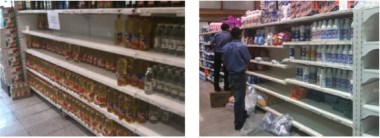
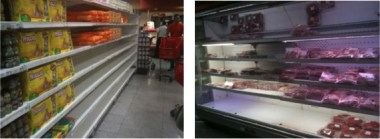
I don’t know if I have been distracted lately or if I was just not paying attention. I have been hearing for weeks about the problems with shortages of diapers and sanitary napkins (an almost daily topic of discussion by the women in my office), but to tell you the truth, I was stunned when I went to the supermarket on Tuesday and saw all the empty or semi-empty shelves. Thinking that it was just coincidental, maybe the shelves had not been replenished from the weekend, I thought by today things would go back to normal.

No such luck, the shelves looked even worse. On the left you can see the paper products shelf, looking truly empty, only one brand of diapers available. On the right, the ready-cut  meat shelves looked depressingly empty:

On the left below, the vegetable oil shelf. It may look full at first sight, but when you look closer you realize there is only one brand today and a sign that says: “Limit one bottle per costumer”. On the right the cleaning products section also looked somewhat desertic and once again, for many products you could only find a single brand.

On the left below, a “good” shelf, that one with grains and imported can goods, lots of soy sauce and olives have reappeared on the shelves, something I had noticed was getting scarce. I guess Sushi and Gran Martinis’s can still be made. On the right, about the only healthy looking area: That of fruits, vegetables and greens. Most of this stuff is produced locally and not subject to price controls, therefore you can find plenty of almost everything, another example of supply and demand and market forces at work. Of course, these products rose in price in triple digits in 2010 as reported by the Island Canuck Index earlier.

And just as I left and was paying (No Coke in cans, but that is another story), I was greeted by this happy sign at the cashier: “Two kilos of powdered milk per person”:

How there can be shortages of a product I despise, is difficult to comprehend.

The pretty revolution at work!

New Chavez-style autocracy in a few acts

February 11, 2011

This week we saw a new way in which Chavez imposes his power in order to interfere with the will of the voters, restricting democracy.

-First, Chavez picked single handedly his own choice for Governor of Apure in 2004 and 2008 in the person of Captain Jesus Aguilarte Gamez.

-Gamez turns out to be a so so Governor, somewhat corrupt, despite this Chavez hand picks him for a second term in 2008, his wedding last Fall is known as the wedding of the century now, Chavez turns against him publicly a couple of weeks ago, asking for his resignation “in the name of unity”

-Chavez names former Vice President Carrizales as “Executive Secretary” of Apure State, to watch over Aguilarte Gamez.

-Aguilarte refuses to resign until who knows how he was threatened and yesterday he quit, arguing “health reasons”  Carrizales temporarily replaces him as Governor. (Curiously, Carrizales resigned as Vice-President also arguing health reasons, good to see he has recovered fully)

I wonder what Apure voters think of Chavez-style democracy, where he gets this weird veto power over the voters wishes. I wonder if the outgoing Governor will ever be charged for anything. I wonder if the Comptroller will ban him from running for office.

I wonder how Chavez will restrict democracy further in the future.

Another Puzzling Bond Issue, this time by PDVSA

February 9, 2011

Once again, Venezuela, this time via its oil company PDVSA, gets ready to issue a bond which puzzles markets. As investors were asking for more transparency, more order and fewer surprises in the country’s issuance, PDVSA did exactly the opposite, announcing the sale of a US$ 3 billion issue to be sold via the banking system and with identical characteristics to the Venezuela Global 2022 bond issued by the Republic last August.

There are many puzzles:

-Why make it identical to the existing sovereign bond?

-Why pay a coupon of 12.75% when it would have sold equally well at a lower coupon? In fact, the Global 2022 was issued at a time last August that the yield curve was much higher than it is today.

-Why issue something so unexpected, after sending different signals to investors that are asking for more clarity?

In fact, even though the prospectus says the issue has been approved by the Superintendent of Securities, that office had approved other issues with different characteristics in the last few weeks, but not this one. This also leaves the puzzle as to why after all the publicity surrounding the Public Exchange, this is not being issued there, given that it has become Chavez’ pet project.

PDVSA had been sending very different signals in the last few weeks. In private it was telling investors it would issue the US$ 3.15 billion that it sold to the Central Bank and its pension funds, plus another US$ 3 billion through the Public Exchange. Then, high level insiders at PDVSA were saying, it would issue around US$ 2 billion in the second half pf 2011.

Well, so much of talking to officials to get real and transparent information. Instead, PDVSA issues an identical bond to an existing one, eliminating even the uncertainty of where the new bond (and the old one for that matter) should trade.

You see, The Government issued and identical bond, with a coupon of 12.75% and equal amortizations in 2020, 2021 and 2022, last August. This bond came out last summer at a time that Venezuela was yielding much more than it is now. In fact, when that bond first came out, its price was 78% and it had slowly risen to 88% (88.4% today) as Venezuela’s bond prices improved over the last few months.

Currently, the only dollars people have some access to is the SITME dollars at the Venezuelan Central Bank. Lots of rules, scarcity and all that, but that is the only one you can get at a price of Bs. 5.3 per US$. This is the reference price for everyone.

So, if the PDVSA bond is sold at 100%, with a 12.75% and identical conditions as the Global 2022, if it were to trade at 88%, it would mean you are buying dollars at a price of Bs. 4.88 per US$ (Bs. 4.3/0.88, that is you pay 4.3 for each dollar of bond, but when you turn around and sell the bond you only get 88 cents for each dollar)

But those that get the bonds (rules for this are not known until the bond is assigned) would be willing to sell at 81%, where you are basically buying dollars at the same rate as the SITME rate, the only available rate in the country to mere mortals: Bs. 5.3 per US$.

The result? The Global 2022 will start dropping in price, as investors sell it to buy the lower priced bond with a higher yield to maturity. Because, while there are differences in yields between some Venezuelan and PDVSA bonds, all of these have technical explanations, such as the fact that the 2014, 2015 and 2016 were issued under local law and the PDVSA 2017 has too much supply and more coming from the Venezuelan Central Bank.But as a general rule there is no much difference between the two yields to maturity.

For example,  the PDVSA 2027 and Global 2027 yield roughly the same, thus one would ot expect the PDVSA 2022 and the Global 2022 to have a yield to maturity that is not too different.

But they will be different for a number of reasons. First, there will be more supply of the PDVSA 2022 initially, it will be lower, you are buying dollars for more Bolivars. Second, the Global 2022 will drop but not trade identically to the PDVSA 2022.

For any Venezuelan getting their hands on the PDVSA 2022, it will be cheap. They will be cheap at Bs. 4.88, at Bs. 5.3 and even higher. Since there is scarcity and the parallel market is illegal, people will be happy to buy these bonds and thsu these dollars even at higher prices.

But the Government, somehow and mysteriously, does not want to take advantage of this, selling the dollars higher and getting more Bs. for them.

Why?

Is it capitalistic populism?

No idea. Another puzzling issue by Venezuela, this time around by our friends at PDVSA.

The Destruction of Venezuela’s infrastructure by the revolution, one step at a time

February 5, 2011

In the 1980’s phone service in Venezuela was the pits. It got to the point that to get a call through, you had to try two or three times before you even got a dial tone. If your phone stopped working, sometimes you had to wait months before the line was fixed. If you had no phone, you had to wait sometimes years before you got service.

Then in 1991, the company was privatized, part of it sold to GTE, later taken over by Verizon, and the service started improving.I still recall the night of Chavez’ coup in 1992, I connected to the Internet to a network of Venezuelans on then nascent Internet called Atarraya and stayed connected all night. I was afraid that if I disconnected my modem, I would not be able to get a dial tone again.

The arrival of cell phones helped, the company go a new revenue stream, which it used to fix up the system. Then the Internet came, first dial=up and later DSL, called ABA here, another new strong revenue stream for a company which now even had competition.  In 1997 the remainder shares of CANTV were sold to the public, both in Venezuela and abroad and the company’s stock listed in the New York Stock Exchange. By the time Chavez arrived in power, the company gave good service and was profitable.

In late 2006, Mexican Carlos Slim tried to take over the company for $21 a share. As the regulator considered the tender, Hugo Chavez feeling like the rich Dictator of Venezuela ordered that the Government buy the company. Rather than spend the money on housing or hospitals, Chavez spent two billion US$ buying the company to satisfy his unlimited desire for power. Amazingly, he offered $17.6 per share, less than what Slim was offering, and one investment fund in the US, Brandes, still has an arbitration case pending because of this at the World Bank.

Move forward three years later after the nationalization and we have come full circle. After only three years, CANTV’s service has begun deteriorating. My own phone stopped working about two or three weeks ago and every time I report it, I am told about a different date for my line to be back. Right now the target date is February 18th. , making it sound like the old CANTV. I am not alone, I have heard lots of people facing similar problems for the first time in a decade and  half. (I ahve asked that I don’t be charged the service for all this time and have yet to find a way to ahve this done at CANTV)

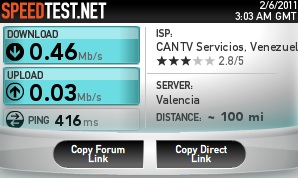
While I have no voice line, I still have DSL, which is a little surprising, I thought it came over the same pair of copper wires. Except that it seems as if it gets worse every day. Right now for example, this is what I get if I do a speed test at speedtest.net:

This is actually much better than it has been in the last three days. Of course, it is abominable service, I pay for over triple that download speed and the upload speed is just laughable. In fact, the post is likely to take a while to upload, so instead of saving the draft as I write and correct, I am copying it so as not to lose my work.

Yesterday the service got even worse, my download speed was about 20% of that above, but I learned from Twitter that this was generalized. I was unable to read El Universal last night and the New York Times page took forever to download. I did manage to read it only once. People in Twitter reported all sorts of different problems, depending on where they were.

But as local newspaper El Nacional reported this problem, the Government’s attitude was to deny this was happening. It got so laughable that a former Minister of Telecommunications denied this was taking place, not only denying that the problem existed, but assertively saying that this was a media campaign to manipulate opinion on internet services in Venezuela. He even went further, specifically blaming Alberto Ravell, formerly of Globovision for the campaign, saying:

“Ravell is mounting a campaign of manipulation on the internet services, launching rumors to measure the reaction to them”

Curiously, CANTV reported today that the problem had been fixed in a press release, saying that it was found at one of the distribution points for the DSL service in the country.Only two or three times in the last four years has Internet service suffered like this.

We truly have come full circle under Chavez. A service we had taken for granted like telecommunications, has now gone the same route as water, electricity, infrastructure. Much like the Government does with everything, the solution is to distract, deny, escape responsibility. Billions of dollars wasted in buying out companies only to later run them into the ground, wasting precious funds that could be used to solve the myriad of problems that people face, from infrastructure, to health, to poverty, to education.

It is just another step in the destruction of the country’s infrastructure by the revolution, as the Chief Terminator moves on to other problems he has ignored for the last twelve years. Unfortunately, this will be more work (and money!) whenever the reconstruction of the country begins anew or will become another promise by Chavez, if he stays in power, the day the CANTV problem becomes so general, that people begin to complain massively.

It’s happened before in the pretty revolution…


Creative Chavista Thinking for the Fight Against Inflation.

February 3, 2011

Chavismo has an incredible ability to come up with creative new ideas. These guys, who never seem to be able to complete a project or even manage one, seem to always be thinking of new imaginative ways to screw up the country.

The latest one s a report that the Cabinet is thinking of imposing a salary cap on private sector salaries. Your immediate thought is that this is once again a measure to make us all poor, rather than having all of us be well off, that is how socialism works., no?

Well, you are wrong. This has nothing to do with narrowing the gap between rich and poor (funny how they always want the upper layers to come down, no?). Nope. The idea has nothing to do with equality, or with narrowing down the difference between rich and poor. It is actually qute clever. The objective is… (drum roll)

To lower inflationary pressures!

You see, despite what that dead guy with the Nobel prize from the University of Chicago said, Chavismo does not buy this monetary explanation.  They like their explanation better, obviosuly there is inflation because wealthy people have more money (Even if there are few wealthy people and lots of poor ones), not because Chavez increased the money supply in eight years by a factor of 15.(Do these guys ever stop to think about what they are saying?)

But think about it. Capping salaries in the private sector will affect only a small amount of salaries, no? If everyone is as poor as Chavez says, and there are so few noisy, capitalistic oligarchs, then it is those salaries that will be capped and according to Chavista lore there are few people in this category, no?

But then, of course, some Chavistas think they are smarter or more knowledgeable than others. While Chavista Deputy Sanguino, President of the Finance Committee of the National Assemby thinks it is a very interesting idea in terms of fighting inflation, the VP of the same Committee is not so sure. He thinks that the inflation problem can be solved by stopping speculation, thus, says Deputy Farias, we have to concentrate in the Anti-Monopoly laws. He also thinks that being underdeveloped has a lot to do with inflation, but apparently he has no clue on how to get us out of that, so he will concentrate in the first law.

Meanwhile, the Devil sits here in his ignorance wondering what part of:

“Inflation is a monetary phenomenon”, these guys did not understand.

Let’s see, in 2003, monetary liquidity in public hands stood at Bs. 18.7 billion. Eight years later it stands at Bs. 295 billion. That is an increase of 1,577 %. An increase of almost 16 times more bills, coins, however you want to imagine or count them.

Is the country producing 15 times more?

Obviously not, But there is 15 times more money chasing for the same goods, plus the increase in GDP, which is about 50% in that period. So, you have 15 times more money and only about 0.5 more goods.

Guess why there is inflation?

But, they will likely approve this crazy idea and when inflation persists, they will blame the phases of the moon, astrology or El Niño, but somehow they will never imagine that this guy Friedman from the Evil Empire had any clue as to what he was talking about.

But if you don’t get Friedman, just see the picture of the little kid above and you will get the whole picture of what Friedman meant.

PDVSA’s “Investment” Plans

February 2, 2011

(With the increase in the price of the barrel of oil, we are going to be able to invest in housing and security)

These are numbers from Veneconomy in its latest issue on PDVSA’s investment plans:

PDVSA’s updated investment plan calls for US$ 252 billion in investments between 2010 and 2015, to expand capacity by 2.8 million barrels of oil a day.

PDVSA’s share of this will be US$ 192 billion, or US$32 billion per year starting last year.

Last year, PDVSA only invested US$ 11.5 billion, or 35.9% of the target.

In 2011, Ramirez himself said that PDVSA would only invest US$ 12 billion.

Thus, in the first two years, PDVSA will be behind US$ 40 billion in the “plan”

Recall that the earlier “Siembra Petrolera” plan under Ramirez 2005-2010, which was supposed to expand production to 5 million barrels a day, never got off the ground.

It’s all smoke and mirrors, but people like it.

Venezuelan Social Security Pensions: Can the country afford them?

January 30, 2011

For the past few years, the Chavez Government has been paying anyone that has worked a minimum of 5 years in their lifetime a Social Security pension equals to minimum salary plus four months of bonus per year. At current minimum salary and assuming the official rate of exchange we are talking about Bs. 1,200 (US$ 279 a month) per pensioner, but each pensioner receives Bs. 19,200 per year, equivalent to US$ 4,465 per year. besides the 5 years of employment, you get a pension when you turn 55, if you are a woman, or 60 years old, if you are male.Additionally, survivors are also eligible to receive 100% of the pension of the deceased.

The Chavez Government and the opposition seem to be in a battle to outdo each other in offering even more benefits. Last year, Chavez lowered the minimum number of payments required for nine months, so that more people could receive the benefit. The opposition in turn, made a proposal during the first week of the new National Assembly, asking that pensioners also receive a 10% increase given to them as food stamps, a benefit that most formal workers receive in Venezuela.

At this point, I have to clarify that these pensions don’t come from a “fund”, Venezuela’s Social Security administration has gone broke at least twice in my lifetime. People pay monthly proportionally to their salary, but there is a cap, the cap is around the payment for a yearly pension, but only those making more than 5 minimum salaries a year pay that much.

What I have never been able to figure out is whether the country can afford this. And as far as I have been able to figure out, ever since the old Economic Committee of the National Assembly disappeared, such calculations are not even made. So, both the Government and the opposition are playing populism without having a clue as to whether this makes sense or not.

So, I decided a few weeks ago to throw some numbers and see if this makes any sense.

My starting pint was the INE website, where I found data on how many Venezuelans are above 55 (for females) and 60 for males. This data can be found here, except that for some weird reason, the 55 to 59 group is missing from the table, so I had to do some extrapolation. The result is that there are 1.2 million women eligible by age to this pension, while 716,000 men qualify. That is over 1.9 million Venezuelans. If all of them qualified, the cost would be US$ 8.6 billion a year to pay all of the pensions.

The next step was to figure out how many of those people, given the low five year requirement and the fact that the pension can be inherited by widows and widowers, as well as underage children, which must be a small group, my guess was that around 50% of that population was eligible and collects that pension. Imagine my surprise when I found out that it is 83% of those eligible that receive the pension!

Well, at that rate, it costs the Venezuelan Government US$ 7.145 billion per year to sustain the pension system. I don’t know how much of this comes directly from those that contribute today to the system, but it sounds high to me. Very high. Because this year’s budget at Bs. 4.3 per US$ is US$ 47 billion, so we are talking about 15% of the budget going for pensions. And this number will simply increase every year as more people get older, unless the Social Security system is funded, a project that Chavez killed when he first became President in 1999.

But the opposition is no less irresponsible when it proposes that pensions should be increased. Without knowing whether the system makes any sense, asking for an increase about the minimum salary is not a very responsible position. Unless both the Government and the opposition begin calculating costs and looking into the future, the country’s finances will always be doomed under the management of irresponsible politicians.

And this does not even consider an even more complex question: Is it fair?

Breaking a Rule: The Devil on Egypt and the Middle East

January 29, 2011

I have tried during the last eight and a half years to restrict this blog to Venezuela and related subjects for the simple reason that this is not only the subject of the blog, but additionally because there are so many other significant and important subjects out there, that I did not want to distract attention from my main subject. Thus, I have tended to ignore in my writings, not in my mind or in my readings, other subjects, even when they had something to do with Venezuela.

I am breaking that rule today because of a personal story that made me follow Egyptian politics for the last ten years. Roughly ten years ago, give or take two years either way, well known investor Jim Rogers came through Caracas in his second drive around the world. (His first one was on a motorcycle). It was a very pleasant evening with Jim telling us about his recent experience around the world and asking us about Venezuela, trying to understand Chavez and the dynamics of our country.

At the end, he gave us a sort of overview of the world and he noted that he thought the Middle East was a powder keg and he worried most about Egypt, an explosion waiting to happen, whose impact would change the face of the Middle East forever. Egypt, he said, was the most worrisome, because unlike many of the other important countries in the region, it not only had the most ruthless dictatorship, but it was also the poorest country. His fear was that Egypt would explode and the impact would be felt all over the Middle East, toppling Governments everywhere, including places like Saudi Arabia and Kuwait.

Thus, I have kept up with the somewhat dysfunctional and complex politics of Egypt over the years.

But as the world watches Tunisia and Egypt asking for more freedom, it appears to me that the protesters in both Egypt and Tunisia, know clearly what they don’t want, their current or recently overthrow Governments, but don’t have a clear definition of what they want or where they will end if their protests are effective and succesful.

Because the truth is that while the movements leading the unrest are pro-democracy, freedom and pro-human rights, what lurks in the background is not only more of the same, another strong man looking to control the population, but one that embodies either the militaristic or the religious leader, if not both.

Remember that most of these countries have no democratic tradition and do have a strong religious influence, mostly fundamentalist ones. Thus, it would appear to me that few of these countries are on the road to a democratic Government. Perhaps something like a more benign Dictators will be more like it, but the religious factor clouds any prediction.

Perhaps the military will simply oust Mubarak and replacing him with a string of new military rulers that will promise more freedom, but not deliver it. Perhaps the democratic movement will manage to have the new rulers hold elections. But in the end, the winners of those elections will not be them and under the guise of of a democratic mandate, the people will continue to be repressed and dominated.

It is hard for me to see any other outcome. From what I have learned over the years, the region is sadly unlikely to move into more democracy and freedom. There is simply no tradition of that. Maybe all one can hope is that the new rulers truly strive to improve people’s lives, if only for fear that their stay in power will not be brief.

I hope I am wrong, but as I follow the events in Egypt in fascination, I can’t help but remember other examples where the people knew what they did not want and acted accordingly, only to get an equal or worse alternative.

For now, just remember you are watching history and no matter what the outcome, these historic events will likely change the Middle East region forever.

How a bully Dictator like Hugo Chavez runs Venezuela

January 26, 2011

This is how bully and Dictator Hugo Chavez runs Venezuela. Law and order be damned. When a couple told Chavez that they had not been able to move in because Banco Provincial had not approved a loan or given them the money, Chavez called the President of the bank and told him if the bank was not willing to fulfill the Constitution, decrees and the laws, then Chavez said:

“You have to begin to give me the bank, I will pay what the banks costs…do you have something to respond to me?” Chavez said.

At this point the President of the bank requested that his voice also be broadcast on nationwide TV, like that of Chavez.

Chavez said no, telling him he could go to the Government’s TV channel and ask for time.

“This is very serious” said Chavez “Tell me how much the banks is worth, I will not argue with you”

Then Chavez says that the President of the bank is saying the information is not correct. Chavez points at the guy with a document. The guy shows it. Chavez tells him that someone is not telling him the truth.

Threatening him Chavez says: “you are involved, you have to assume your responsibility… you have to meet with this people… tell me how much the bank costs, I buy it” the President off Banco Provincial says the bank is not for sale, Chavez says he can perfectly expropriate it.

Like a true despotic Dictator, Chavez threatens the President of the bank, without even knowing the details of the case, who is right or not, whether an illegality has been committed or not. There are laws and procedures for all this, but not for allmighty Hugo.

That is the way the bully runs Venezuela, like his own personal fiefdom, where he can do what he wants, if he desires something, it becomes “the public interest”, without even finding out the truth of the case.

If the same method were to be applied to his incompetent Government, he would have left long ago, as he is the one that does not follow the laws and abuses all of the time. Government owned banks have the lowest ratios for loans and are not forced to lend to the agricultural sector and the housing sector as strictly as private banks. But in any case, Chavez did his bully act without knowing anything about the case.

But he is the all powerful Dictator and ruler of Venezuela. With this he creates rumors, instability and people fear for their money. He then will say the opposition creates the instability.

So, beware!