Archive for the 'Venezuela' Category

The noose tightens around Freedom of the Press in Venezuela

August 18, 2010

It is a very simple story:

One month and eight days before the the National Assembly elections, the number one concern of the electorate is:

Crime

And as the press notes and emphasizes the fact that crime has tripled in the eleven years of Chavismo, a Judge issues the following prohibition:

“For the next four weeks, no newspaper, magazine or weekly of the country can publish images that are violent, bloody, grotesque, whether about crime or not”

This is done to protect the “psychic and moral integrity of children and adolescents”. The four weeks “temporary” protection alone should tell you how electoral this decision is.

Of course, these people have been nowhere to be seen as kids and adolescents get murdered day after day by the uncontrollable crime that Chavez and his cohorts refuse to admit as a problem, but only as plot by the opposition.

Another noose has sadly tightened around Freedom of Speech in Venezuela and in  clear violation of Art. 57 of the Venezuelan Constitution, which says:

Article 57:Everyone has the right to express freely his thoughts, his ideas and opinions either spoken, in writing or through any other form of expression and be able to use to that end any media of communication and diffusion, without the possibility of establishing censorship…

Can it be any clearer than this, it is simply another act of censorship and a violation of Freedom of Speech in Venezuela?

Stray bullet was “isolated” incident. How about this one?

August 17, 2010

Last weekend the Minister for Sports Hector Rodriguez (There is such a Ministry?) said with respect to the stray bullet that hit Hong Kong’s player during a game of the Womens Baseball Tournament taking place in Caracas. The touranment is being played within a military facility, the safest” of them all, Fuerte Tiuna:

“It was an isolated incident, so says the technical report”

Well, I live in one of Caracas less dangerous areas. There is a barrio next door, but it is relatively safer than most of the city. Despite this, the picture below shows another “isolated” incident which fortunately ended well a couple of years ago.

As you can see, a bullet hit my glass window. This isolated incident was such that obviously the bullet had lost momentum and was not even able to penetrate the glass. But I would not mind Minister Rodriguez sending his technical team to determine whether my incident was also isolated or not.

I imagine the technical report that the Minister is referring for the incident of the baseball player, goes something like this:

“We use the Drake Equation as applied to the number of possible civilizations in the Universe with whom we may communicate, but applied to stray bullets (CICPC Report # 3.1415)

N = R^{\ast} \times f_p \times n_e \times f_{\ell} \times f_i \times f_c \times L \!

Where N is the number of bullets that hit someone, R* is the average number of bullets in the air at any given time, fp is the fraction of those bullets flying at or below eye level, ne is the number of people out in the streets at that time, fl is a coefficient which depends on the  the time of day, fi is the fraction of bullets that reach the target at a speed capable of killing someone, fc is the safety of the area of Caracas and L is whether you are in a military facility or not.

Using CICPC Handbook of Data Tables # 2.718288 for all of the parameters, we conclude that this is an isolated incident”

There you have it, for all of you skeptics. It’s a formula, it’s mathematical, it’s isolated.

As simple as that.

The Picture by Teodoro Petkoff

August 16, 2010

I had no time to translate Petkoff’s Editorial this morning, but it is worth doing for those that are not  fluent in Spanish.

The Picture by Teodoro Petkoff in Tal Cual

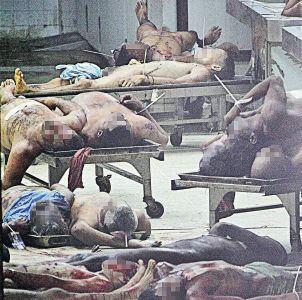
Thus, the problem is the picture. The problem is not that of the 16,000 murders a year, 95% of which remain unpunished, the problem is not the 400 or so dead, set aside in the prisons, the problem is not the thousands of vehicles stolen each year, not hundreds of apartment assaulted by gangs of thieves, the problem is not the thousands of express kidnappings, and of the other type, which take place each year, nor are the protection money that guerrilla and paramilitary gangs force people to pay at the border and it is much less those countless purse snatches, which are no longer even reported because they have become banal. This is not the problem. The problem  is the picture published by El Nacional.

Nor is the problem of the police overwhelmed by the criminals, underpaid, poorly trained and even infiltrated by criminals, let alone is a slow judiciary, of poor quality, most of whose judges are provisional, members of Chavez party PSUV, and who live afraid of issuing decisions that do not please the mighty. None of this is the problem. The problem is the picture published by El Nacional.

The former head of the PTJ spoke to let us know that now the floors of the morgue are brand new linoleum and there are ultra modern gurneys. That picture is old. The horrifying spectacle of hundreds of bodies that now enjoy new beds and lie on a floor again, and may be even polished, is not their problem. His problem is the “morbid” picture. Not the killiings that the picture captured. The ineffable Prosecutor of the Republic has already announced actions, but not against criminals, but against El Nacional. The Commission for the Protection of Minors, or whatever its name is, also mobilized itself.

Since acted against Tal Cua forl the horrendous crime against the “privacy of a minor” which was to publishthe name of the President’s daughter, that agency had not given any signs of life. Now out of its lethargy, as “child advocacate” whose “minds may be affected by the picture.” The hundreds of children who die hit by stray bullets, the young kids and adolescents who go through the horrible experience of seeing their parents or older siblings murdered before his eyes frightened, do upset the dreams of  the people of the Defence Commission for the Protection of Minors. What matters to them is the picture.

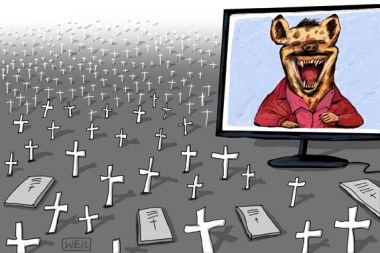
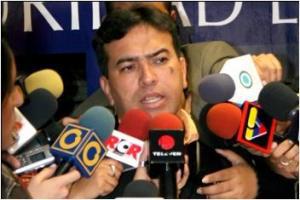
All of the self-righteousness, hypocrisy, which permeates to the core of this regime has shone ominously in this episode of the picture of El Nacional. What worries the adulators is not that there’s violence, but that people know about it. Here we understand the publishing  of this picture as an appropriate response to laughter, not necessarily less miserable and despicable, that whippersnapper who heads Telesur, who issued a hyena laugh while at his side while a Venezuelan expert on the issue of violence was informing us about the unbearable levels of violence reached in our country. The issue of crime makes you laugh, Izarrita, you make fun of the matter, do you think it’s an invention of the opposition? Laugh, then at this picture, you little preppy.

Tal Cual takes a stand

August 16, 2010

Tal Cual took a stand today, publishing the same picture as El Nacional in teodoro Petkoff’s daily Editorial, called La Fotografia, The Picture.

Will the Government go after him too?

I like these challenges, they upset the Government’s playbook…

As Izarra laughs, this is the reality in Caracas’s morgue

August 13, 2010

As Izarra laughs (previous post) this is the gruesome picture at the Caracas morgue where 2177 bodies of victims of homicide have been admitted in the first six months of the year.

This number is triple of what it was in 1998 before Hugo Chavez rose to power. At the time, All of Venezuela had less than 9,000 deaths from homicides  a year, now Caracas alone is slated to have half as many, while the country is going towards 20,000-plus.

Are you still laughing Andres?

(And now they go after El Nacional for publishing the picture above, using children as an excuse. Who protects the children that get killed?)

And the World Women’s baseball tournament was suspended in Caracas, after a player from Hong Kong was shot while playing.

The cynical laugh of Andres Izarra in the face of the tragedy that homicides have tripled since Chavez took over

August 12, 2010

Andres Izarra is President of Chavez pet international TV propaganda machine Telesur and has been Minister of Information and Communication. Yesterday on CNN Roberto Briceño León, Director of the ONG Venezuelan Observatory of Violence, was giving real statistics about homicides and comparing them to other countries and a hysterical Izarra did nothing but laugh like a hyena, denying everything and saying that Chavez is trying to change the problem structurally.

This is incredibly cynical as Chavez has been in power 11 years and the tripling of homicides nationwide has occurred during his tenure. In fact, during the last three years of the Caldera Government (which I did not like) the same homicide rate actually went down, so Mr. Izarra: Who did or not do something to change this tragedy that affects mostly poor Venezuelans?

How can you possibly laugh at this almost theatrically?

Watch Izarras almost hysterical laugh at what should have been a very serious discussion, it starts around minute 1 (Sorry, I dont have a translation, but would you laugh discussing such a serious topic?):

With people like this, no Government can progress.

Venezuelan 2022 Bolivar/Dollar Bond 101: Why it is a good deal

August 12, 2010

I have received many emails and there have been many comments on the previous post about the upcoming sale of the Venezuela 2022 bond, that suggest people are or get confused about it. Since people have until tomorrow to purchase it, I thought I would give a 101 introduction to why this is a good deal for those that need foreign currency.

The first reason is simple: We have exchange controls, there are only three ways to obtain foreign currency in exchange for Bolivars: Cadivi (Limited to $2,500 per year), SITME (Limited to individuals to $5,000 per year) and bonds denominated in dollar and sold by the Government (Minimum $3,000, maximum unknown at this time)

Even if the amount is limited, it is an additional path to obtain  foreign currency.

So, the Government is selling a 2022 bond (ends that year, this one is quirky, one third will end in 2020, one third in 2021 and the final one third in 2022). The bond will have a coupon of 12.75%, that is if you have US$ 100,000 of the bond you will receive (12.75%/2) or $6,375 twice a year, the first payment in February 2011 and every six months after that.

The Government will sell you these bonds at Bs. 4.3 per dollar. That is if you order $3,000, you pay 4.3 x 3000=12,900 Bolivars.

Here comes the part most people get confused about. Because Venezuelan bonds yield more than 12.75%, people will be able to sell this bond at a discount in international markets. That is, next week after you know how much you got, you can ask your bank to sell it in exchange for $ or transfer it to your investment account, where you will keep it until you want to sell it abroad. (No Bs. from now on, it’s all US dollars until 2022)

How do you know at what discount or at what price the bond will trade at?

Well, you have to see where comparable Venezuelan bonds yield today. Here are all of Venezuela’s bonds and what they were yielding today:

The red diamonds are PDVSA bonds, the blue triangles are Venezuela bonds.

As you can see, most Venezuelan bonds around 2020, like the 2023 were trading today at around 15% yield to maturity. This means that if you wait until 2023, collect all the coupons and at the end collect 100% of the face value, your effective annual yield would be 15%.

So, using an Excel formula for the yield (called YIELD) you can play and get at what price you would have to buy it to get 15% like the 2023 with the new bond. The answer is 87%.

This means that if you bought $3,000 for Bs. 12,900, when you sell the bond abroad, you will only get 87% of the dollars or $2,610. This means that each dollar cost you (12,900/2,610) or Bs. 4.94 (ignoring commissions)

The problem is that the Government is selling US$ 3 billion of this new bond, that is more than 30 days of trading for Venezuelan bonds and you can be sure most Venezuelans want the dollars, not the bonds. Thus they will turn around and sell them. That is a lot of bonds for the international markets. It will take time for the market to absorb them all. Therefore, the first few weeks the yield of the 2022 bond will be higher than it should be because of the excess supply.

How much higher?

Well, I drew a green arrow to show the possible range in the graph above, based on the numbers and past experience. In the last twelve months the worst yield of the 2023 was 16%. Thus if the supply is too much, it may be that the whole curve shifts up, that is, the comparable bonds yield up to 16%. Then the 2022 may be at most a point higher at 17%.

At what price would it have to trade to yield 17%? Using the same yield excel function, I get 78%. At 78%, you get 2,340 dollars for your Bs. 12,900 or Bs. 5.51. Given that the last time swaps were legal they were trading above 8, this is a very good deal.

The Government could do one more funny thing and increase the size of the bond from $3 billion to $4 billion (or 4.5 for that matter), that could lower it to 76-77% only briefly.

In fact, in the informal market today it was trading at around 81%

The high coupon makes this bond more attractive than the “comparables”. At 12.75% and 85% in 6.8 years, if Venezuela keeps paying, you would have recovered your investment and still have the bond, other bonds have much lower coupons, it would take much longer for this to happen. Additionally, the bond matures in three parts in 2020,2021 and 2022.

Thus, if you need foreign currency, the case is pretty clear and good luck!

Military Prosecutor goes after retired General for denouncing Cuban presence in Armed Forces

August 10, 2010

In another case that shows that the robolution has no morals or scruples, the military Prosecutor will go after retired General Antonio Rivero, accusing him defaming the Armed Forces and repeatedly revealing private or secret information about the Venezuelan Armed Forces. Both charges are punishable by prison.

Rivero, a former Chavez supporter and now victim of Chavez’ praying mantis effect, retired from the Armed Forces and immediately denounced to the General Prosecutor and the Venezuelan National Assembly the presence of Cuban in Venezuela’s Armed Forces in places and strategic areas which are beyond what is allowed.In denouncing this, Rivero said that this presence is not part of an alliance approved by the Venezuelan National Assembly and violates both the Constitution and the country’s sovereignty.

That is how much the regime controls the judicial strings of the country. Rivero’s accusations rather than cause the outrage of those that daily proclaim their defense of the country’s sovereignty, instead are turned against him by his former buddy.

The Cuban presence is considered to be a secret, a wide open one at that, in a country where even food imports are approved by Cuban , rather than Venezuelan officials. The so called revolution, which claims to defend the country’s independence from anyone, has sold out to the Cuban presence, allowing it to permeate in all aspects of civilian and military life and decision making.

Another outright lie by the fake revolution. Another miscarriage of justice by the Chavez Government. Another proof that the traitors are those in Government, including the Dictator himself.

2022 Venezuelan Bond details announced

August 10, 2010

The Government announced yesterday the details of the new bond which will mature in 2022. The bond will have a coupon of 12.75%, amortize in three parts in 2020, 2021 and 2022 and will be sold to locals at 100% of its face value, which was announced today.

With these parameters, the bond should yield around 15% in the firts few days, which corresponds to a price of 87% in US$. This implies that anyone buying the bond for local currency would be acquiring dollars roughly at Bs. 4.9 per dollar, even below the price of the Central Bank’s System SITME.

I puzzle about both the maturity and coupon assigned the bond. This is very expensive for the country.  They could have gone easily with 10-10.5% and/or a shorter maturity. The theory is the Governmenmt wanted importers to get as many dollars as possible.

The bond will be sold only by banks. With these parameters I find the bond attractive for both locals to get foreign currency and for foreigners in the secondary market. It should trade above the curve initially and the coupon is very attractive, thus I expect it to draw a lot of attention among the many Venezuelan bonds and the usual pressure by locals selling will make it trade below its true value in the first few days.

India, Brazil and Venezuela: Trying to learn what works in subsidies for the poor

August 9, 2010

Since we are always discussing how to solve many problems in Venezuela, I thought I would note this article in today’s New York Times about the discussion going on in India about the safety net for the poor. India has had a system in place to attempt to provide a safety net for the poor. The system gives people certain items every month. The new proposal is to simply give either food coupons or cash to the people in order to make the system more efficient.

I don’t know much about the current system in India, maybe someone could point us to a good source on it. But one thing that struck me about the article was that the budget for India for this safety net for the poor is US$ 12 billion. Since India has a population of 1.1 billion people, 42 times larger than that of Venezuela, this means that the program is puny on the scale of the population and the numbers used for Mercal/PDVAL/Misiones here in Venezuela is huge on a relative scale.

Note also, the parallel in corruption in both cases, as it is estimated that 70% of the subsidy (which includes kerosene) never reaches the people.

Coincidentally Luis Pedro España, a Professor at the Catholic University in Caracas who has devoted his life to study poverty in Venezuela, gave a talk recently saying that it would only cost US$ 3.5 billion to lift all Venezuelans out of poverty by using direct cash subsidies to the poor, as has been done in Brazil, rather than subsidizing the food, paying people to go to meetings like Mision Ribas and the like.

Think about it, US$ 3.5 billion is quite doable given the country’s macroeconomic numbers. In fact, this would be roughly the same amount spent in 2008 by PDVAL/PUDREVAL in bringing in food to the country, which we have recently learned only 14% of it eventually reached the people.

España notes that despite the close relations between the Chavez and Lula administrations, there has been no effort by the Chavez Government to learn about the Brazilian program, which has been so successful. España suggests that the programs set up by the current Government of Venezuela, not only are full of graft, but also have a clientelistic component in which those receiving subsidies only get them if they participate in political activities.

It would be interesting to know how España came up with his number, it is criminal not to try something like that in Venezuela at that cost. Unfortunately, Chavez has never much had interest on learning what true experts on poverty think on how to solve it.