Archive for the 'Venezuela' Category

Venezuelan GDP numbers terrible, even if you don’t believe them

May 26, 2010

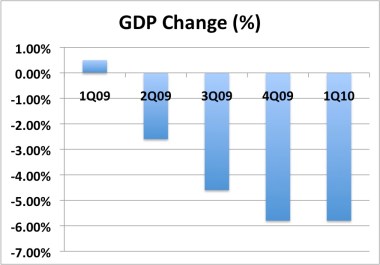
The Venezuelan economy remained in the same “solid” territory that President Chavez refers to, but this is solid negative, not solid positive, as GDP shrank -5.8% in the first quarter 2010. Of course, you have to believe Government statistics. I particularly find the number suspect, it is identical with 4Q09, when we did not have electricity rationing, lower CADIVI outflows and a devaluation.

But even if you believe it, it is absolutely horrible, at a time of world and particularly regional economies recovering strongly. The oil sector shrank by -5% and the non-oil sector by -4.9%. (Yes these two are incoherent, Quico has more on that) The private sector shrank by 6%, while the public sector contracted by 2.8%. Investment was down 27.9% (way to go Hugo!), exports declined by 8.1%. By sectors only Communications (+9.7%) and Government Services (up 2.8%) were positive. Manufacturing was down 9.9%.

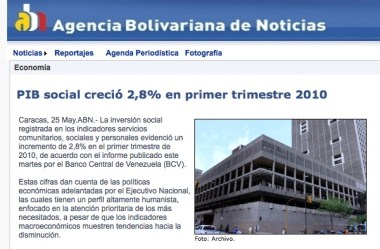
There you have it, of course, in Chavez La La land, the Agencia Bolivariana de Noticias, the headline is different:

“Social GDP up 2.8%”, a reference to the growth in community, social and personal services. As former Chavez hand Luis Miquilena would say: “How do you eat that?”

In any case, Venezuela is mired in stagflation, devil’s excrement, shortages and the systematic destruction of the country’s economy by XXIst. Century Socialism.The current foreign exchange crisis will only amplify the problem. Who will be blamed for all of this?

And reserves down to US$ 26.35 billion with two weeks of no alternative market.

Not pretty…

Oligarco Burguesito meets Nero the street vendor

May 23, 2010

(In Spanish here)


(Markets have been infiltrated by destabilizers, people are very unhappy when they leave the stores)

Nero Buo is a street vendor in Sabana Grande. Nero sells anything and everything, has been around for ages, sleeping in his make-shift tent, which can easily be moved should the police decide to go after him, like they do periodically whenever there are elections or the Mayor feels like it.Nero used to be pro-Chavez, but that lasted barely two years.

Last week, Nero was standing here when lo and behold, who should show up but none other than Oligarco Burguesito, his old friend turned Boli-arbitrageour, ever since Oli, like he likes to call him, discovered CADIVI and Government bonds, and began his long road to riches thanks to the revolution. Nero hasn’t seen Oli much lately, but every time Oli shows up, he would buy something in order to help out Nero in his business.

Except today Oli is sad, you can see it in his face, something is wrong, Nero can feel it, so he asks “Oli, what is wrong, you look terrible? Are you ill?.

To which Oli responds “No, Nero, my whole world has come crashing down, the owner of the broker/travel agency I used to work with, fired me yesterday, told me no more business, because Chavez forbid the swaps we had been doing for seven years and the worst part Nero, is that I don’t even know what a swap is, all I did is find clients for my boss and he would take it from there and pay me good money, and now, I am out of the job, nothing, back to the good old days, when Caldera was in power”

Nero says: “I know what has been happening, it’s actually rather simple, a swap is just a fancy name for what we street vendors do all the time when we don’t have cash, which is most of the time. Suppose you have Harina Pan and I have sugar, instead of selling you one or the other, we agree on a price to exchange the Harina for the sugar and done deal. Except that in the currency swaps, it was a legal way of exchanging Bolivars for Dollars and vice versa, because the Government did not allow Bs to be exchanged for dollars, you would buy, say, Harina Pan, and I would buy sugar and we would swap it, which was legal, because the law only forbid trading money”

Nero, you know so much, how do you do it? I work in the business and I didn’t have a clear picture of what I was doing and here you are understanding every bit of it. So, what happened recently, why is Chavez so pissed that I got fired?

Well, Oli, said Nero, you know how when there is no sugar, it goes up in price? Well, in that case, if we used to swap two packs of Harina Pan for one of sugar, I may have to ask you for three of Harina Pan for each one of sugar. The same thing happened in your business, Chavez spent the dollars on planes, Cuba and all those silly things when he had lots of dollars, but now oil went down, there are fewer dollars and lots of Bolivars, so those that have Bs. want more dollars, and the rate rose a lot, to almost double what Chavez said it would go down to and Chavez got mad and needed someone to blame for the whole deal. Rather than blame the old guy with the three Ferraris, he decided to blame the brokers like your boss.

But Nero, Chavez says this was illegal, but we have been doing it for seven years, day after day and nobody said anything! What changed? It was all very public, everyone was doing it and the Government and the authorities never said anything

Nothing changed Oli, replied Nero, for Chavez it was very convenient to have this market, even some of his buddies made money off it, PDVSA got more Bolivars for each dollar and this market, in the end, was better run than CADIVI, the money went to those that needed it and not those that paid a bribe or were favored by some Chavista Colonel. But Chavez was sure the rate it would go down and instead it went up, and you know Hugo, he thinks he can turn the laws of gravity off if necessary.

Well Nero, I am really confused-said Oli, Chavez said that selling bonds in Bolivars for three times its value in dollars was illegal and these brokers should be sent to jail because this was a rip-off, but that is exactly what Chavez would to to us, they would sell us a bond in dollars for Bs. for three times it’s value when you turned around to sell it in US$, what’s the difference?

Oh, Oli, you are so naive! Chavez is the Government, you are not. Chavez can rip you off with a smile and a TV program all the time, but you can only do the same if he authorizes you to do it and even if he does, he may change his mind someday. That is what happened, he got tired of you guys. So, now he is looking for scapegoats, jailing people and going after the brokers.

But I don’t understand said Oli, why blame us? We were not buying and selling the dollars, as my boss says we were intermediating them, why doesn’t Chavez go after the buyers of the dollars, they were the ones then that were violating the law. Or why not go after the people in Government selling the dollars? They were also violating the law.

Oli, Oli, Oli, don’t you understand, that’s too many people, thousands of them. By going after you, the brokers, he singles out one group, mostly rich ones, rather than an ill-defined mass of multiple buyers and sellers. In any case, you don’t want to make the buyers mad, they are the ones that import stuff, they could create shortages if you scared them away.

I guess, said Oli. Well, I am out of a job now, maybe I will go to Mercal pick up some packages of Harina pan cheap and start swapping them with you. I have got to make a living.

You do that Oli, said Nero, just don’t get greedy, don’t grab more than a dozen packages or so, there is a shortage, the price may go up too much and then Chavez may blame us for it and go after us.

As Oli went away, Nero wondered why it was Oli that got so rich in the last few years and not him, clearly he understood this stuff better than Oli. Well, in any case he did not think the new market being set up by the Government would work, so he would sit and wait for it to collapse and maybe then he would go talk to Oli’s boss, not to Oli, and take advantage of the next parallel market. At least he could advise the guy not to abuse the syste too much m, that’s how street vendors survive…
A view into the brain of the “intellectuals” of XXIst. Century Socialism in Venezuela

May 19, 2010

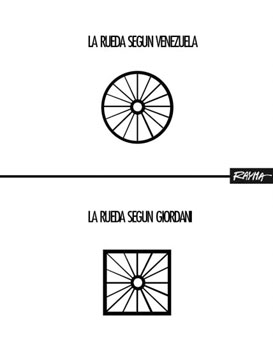
(The wheel according to Venezuela, the wheel according to Giordani)

To those wondering from what cubbyhole of the retrograde telematic world Jorge Giordani, the current Minister of Finance came from, this is a paper circa 1994, maybe 1996 of which he was an author accompanied by Minister of Higher Education Hector Navarro and former Minister of Health Jesus Montilla if my memory serves me right.

The paper is entitled something like ” Science and Technology an alternative proposal” and as you will see its interpretation of history speaks for itself.

But all of a sudden the USSR desintegrated and among the diverse causes of having copied the functional science of the West and not put it at the service of the economy and the basic needs of the population.(sic, what does this sentence say?) Eastern Europe abandoned the route to socialism imposed and now its new rulers tried to impose a market economy. The recent industrial and technological advance of Japan-based on the massive copying of advance technology, a competitive and technocratic education and the harsh treatment of the worker, which is the reason why it can not be a model of high quality of life, but has been imitated later by other Asian countries, presenting themselves today as another neoliberal development style. Socialism maintains itself, with great efforts, in China, where it could end with centuries of hunger and misery, in North Korea which, although isolated and solitary, has managed to have a solid economy (!!!), as well as in Latin America itself, in Cuba, with 30 years of an inhuman economic blockade , but whose achievements in health, education, science and culture are a spine that bothers the power of the North”

There you have it, this is the intellectual depth of analysis of the world situation by Giordani et al. in 1994. A post (any post!!!) in Quico’s, Daniel’s or my blog has more “intellectual” content that this pamphlet. Note that the North Korean famine began in 1995 and lasted until 1997, so much for the “solid” economy of that country. As for Chinese “socialism”. I think I don’t have to explain myself.

This is what the “minds” of Chavismo that control the country’s economy today were thinking 15-16 years ago. Clearly their view of the world is as out of phase today, as it was at the time.

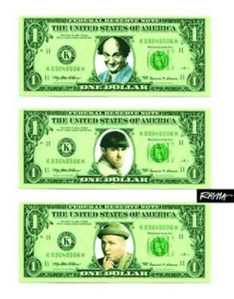
Venezuela’s Foreign Exchange Policy according to Rayma

May 19, 2010

Paralell market becomes strictly controlled in Venezuela

May 18, 2010

(Between the Galaxies of Merentes and Giordani there is a huge limbo)

There is clear disagreement within the Government, you could feel it at the press conference. Merentes let Giordani speak and he did, demonstrating he is incredible cynical or incredibly ignorant. Giordani gave explanations that have no basis. He showed a plot of how a bond worth Bs. 2.6 per dollar would be converted to a bond worth Bs. 7.8 per dollar. Of course, nobody can obtain bonds at Bs. 2.6 per $, so he is talking not about the flow of money in the swap market, but the implicit rate of the swap. These are very different things.

Then he proceeded to say that in the penal investigations, brokers would have to justify where all the dollars came from, because he said, it is so much money it had to come from drugs or from money laundering. Except that 95% of the funds in dollars offered in the swap market in the form of bonds have come from…

The Government and PDVSA…

Can the Minister justify this? Can he explain at what price they were sold? To whom? Why was it done in such an opaque fashion? Why isn’t it being investigated?

Much like the banking crisis, which Giordani said was confronted “head on” by Chavez, but those banks flourished under the not so watchful eyes of the Chavez Government, it was the Government that authorized the swap market and fed it with anything from Argentinean bonds to structured notes, to PDVSA bonds and whatever. Had all of these been sold in a transparent fashion, there would have been less graft and more efficiency and we are now supposed to believe that it is the brokers fault.

So, we will now have a “band system” for the trading of bonds at the Central Bank, with the bands decided by the Government and brokers left out of this market, only banks will participate. Replace a fairly efficient market with the regulated sale of bonds at the price decided by the Government at the Central Bank is supposed to solve the problem…

Sure…

The only problem is that the Government does not have the dollars to lower the swap rate, so a regulated rate is supposed to solve the problem? Sure.

To start with, this “new and improved” market will not start until at least two weeks from now according to BCV sources, which creates a pent up demand of around US$ 800 million to US$ 1 billion. Then, if the Government sells these dollars cheaper than Bs. 7, everyone in Venezuela who has Bolivars will like a piece of these dollars. Thus, you can imagine orders will pile up, much like it happened with the PDVSA bonds in 2007, where everyone knew that it was such a good deal that there were hundreds of thousands of orders.

In fact, Giordani confirmed this when he said that last year (or in 2008, he kept changing years) there were requests at CADIVI for US$ 92 billion, which he said was crazy and the oligarchs were trying to take away all of the country’s international reserves.

I see it the other way around. At Bs. 2.15 per US$, getting dollars for anything from CADIVI, even wheelbarrows, is a better business than manufacturing anything , let alone growing any foodstuffs in Venezuela. In fact, at the end of 2009, there were Bs. 240 billion in the country, at Bs. 2.15, this is US$ 111 billion. This means that 82 % of all Bolivars were aimed at getting the cheapest thing there was in Venezuela, a US$ at the official rate of Bs. 2.15 per dollar. At Bs. 2.6, the new exchange rate, the same number is lower at US$ 90 billion. This just shows what a unproductive country we have become under Cahvez.

And you can bet that slowly all of these Bolivars will start going to an ever increasing and unlimited number of orders to buy US$ via the banking system at the Central Bank at a more intermediate number which is supposed to be between Bs. 5 and Bs. 7 to start with.

But it will certainly fail, because the problem is once again, who will sell?

According to Giordani, the Government does not need to sell any dollars in this market, after all, it issued US$ 20 billion in debt in the last few years. It should be the holders of that debt that sell into this new BCV market.

Say What?

First of all, most of these bonds are now in the hands of foreigners, but who wants Bolivars when inflation is 30%+, interest rates are in single digits and the exchange rate keeps rising, whether official or parallel.

But if 95% of the dollars are produced by the Government, who do you think can intervene in this market? If the Government does not this BCV folly, the perfect storm for intense shortages in the upcoming months will unravel even faster than most think.

And I think is untenable anyway, an irresponsible policy that will simply blow up in the face of Giordani, which is what Merentes seems to be waiting for. He seems to understand better that the country needs a fluid parallel market to function properly. But this will not happen until the effects of Giordani’s folly are felt. And they will, watch put for shortages galore in the upcoming months.

And then they will come up with another scheme, hopefully a better one. It’s hard to think it can be worse, but anything is possible in the revolution.

While Chavez hails the country’s pavilion at Shagnhai 2010, it has yet to open

May 18, 2010

A week ago, we all heard Chavez on May 8th. extol Venezuela’s contribution to the World Expo taking place in Shanghai. Chavez said that visitors were praising the country’s pavilion and supposedly it was ranked among the top ten pavilions in the exhibit.

The note from the official news agency ABN went even further, saying that “visitors have packed the spaces, enjoyed the videos, the colorful graphic material and are fascinated with the exhibit of hammocks” (ABN picture above)

This is all great, except that at least two people from Shanghai report that the Venezuelan Pavilion is simply closed to the public.

In fact, one of the contacts reports that Chinese workers are still finishing things and working around. While the whole exhibit was open, according to one contact, the Venezuelan and Cuban pavilions are the only ones that have yet to open. Another non-accomplishment by the revolution!

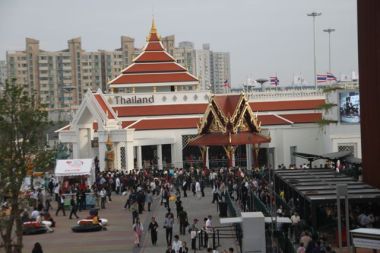
In fact, my friend was nice enough to take pictures next time he went to the exhibit last Sunday, May and while the Thai Pavilion is in full swing:

The Venezuelan one is a lonely and empty structure:

(Thanks to JRV and SM for their help on this story)

Interview from El Nacional with Moises Naim

May 17, 2010

This is a joint post between yours truly and Daniel Duqenal because we think that this interview of Moises Naim in El Nacional is an excellent vision of what has happened and is happening in Venezuela.  Nothing really that Daniel or myself have not written in one way or another, but Mr. Naim says it as clear as it is possible.  You can read the Spanish Original here (by subscription) or here.

—————————–

The current situation in Venezuela is as complex as the words of Moisés Naím are clear and strong . His unmistakable style has always been lucid during his long career in international political economy. Today, he talks about the consequences of the policies implemented in the country, rather than recommendations for their solution because he is convinced that the President will maintain his devastating policies. “Chavez will not hear anything different from what he believes, even though reality sends him strong signals that he is wrong.”

– What is the economic diagnosis of the country? –
The same as that of all Venezuelans. What more needs to be said of a country that has simultaneously extraordinary oil revenues and the highest inflation in the world? Not even African countries without governments and devastated by war have higher inflation than Venezuela. What can we say about the management of a country that has the largest energy resources in the hemisphere but that forces its people to live in a constant nightmare of blackouts and electricity rationing? A country whose policies have the effect of driving massive amounts of capital overseas and the its best trained people, and whose government gives to other countries and without anyone’s’ permission the  nation’s wealth while the vast majority live in misery? The cruelest irony of all this is that the President who claims to be the best at understanding the situation and the suffering of the poor is the one that has imposed the most devastating policies for those same poor. There is no “mision“, grants, gifts, subsidies or other handouts that he can give to poor Venezuelans, that can offset the impact of the combination of inflation, unemployment and murders in which he has condemned them to live.


– Capitalism or socialism, market or state? –

I believe in a strong state and that it executes well the things that the market and the private sector cannot do or should not do. Police, justice, defense and so on.
The market will not solve education, health, or the insecurity of people in the neighborhoods. That has to be done primarily by the state. But to be effective, the State must be selective. It cannot do everything. The Manichean debate between state and market, between capitalism and socialism is a waste of time and serves only to deceive the unwary. It is obvious that it takes both. It is not one or the other, but how to cleverly combine government and market.

– What do you think is the most serious problem in the economic sphere? –
There are many and they are all well known. But perhaps one of the main mistakes President Chávez has made  is to fall in love with an economic model that depends for its success on this country’s scarcest resource:  efficient government officials. When the President nationalizes companies right and left, they are handed over to officials who don’t have the faintest idea of how to manage such activities. And what we’ve seen is that despite the efforts and good will, or sometimes simply because of laziness or corruption these  nationalized companies quickly collapse. And if the government officials are efficient, why distract them, forcing them to produce sardines  or operate cement industries? Top officials should be put in charge of the public functions that are a priority for the country, those that if are not carried out by the state no one else will perform. If the state does not produce sardines, rice or cement, others can do it. But if it does not ensure that people are not  kidnapped or killed when returning from work, then who will? Protection and personal safety is a service that the rich can buy from the private sector. But the overwhelming majority of Venezuelans depends on the government to protect them and their family.
For Venezuelans it  matters less who is the owner of this or that company, than the fact that their children are being murdered on a daily basis while the President does not seem to be too concerned.

– What will be the result of all these policies? –
When a credible accounting of what has happened in Venezuela in these last ten years is carried out, we will discover that we lived through one of the most important episodes in the economic history of the world in terms of wealth destruction, loss of productivity and waste of resources that the country desperately needed to lift people out of poverty. Many wars have produced less material damage than the economic policies of these times. Today there are more murders in one weekend in Caracas than in Kabul.

-If you had the power for deciding measures an taking decisions on economic matters, what would you do?
One of the paradoxes of the situation we find ourselves in is that it is not even worth talking about what should be done on economic matters. What good is it to talk about the devastating effects which has the fact that the Government steps with one  foot all the way on the accelerator of consumption , while at the same time pushing strongly on the pedal that brakes the supply. It maintains an aggressive monetary policy and massive public spending which stimulates consumption , while at the same time and almost daily  it announces decisions that cuts  the supply needed to satisfy the booming consumption. We see how the President constantly thunders against speculation and corruption only to follow his laments and threats with measures that everyone knows boost speculation and  provide even more lucrative opportunities for corruption. He claims to suffer for the poor while his Government has become a very efficient poverty producing machine.
Do you think the Government will abolish the capitalist system and replace it with a socialist system? Do you think it will be able to achieve it?
I only know what the President of the Republic says. And Chavez is sincere, repetitive and emphatic with that. Why should I not believe him when he says he hates capitalism and adores socialism? It is one thing for us not to like it, but it is something else to refuse to listen to what a leader say. Until now he has maintained all of his promises on matters of public policy, even if the policies  don’t work and lead him not to failure regarding his promises about results.

-Why do you think the President is so committed to policies that have not worked?

Because he suffers from ideological necrophilia. He is in love with dead ideas. I don’t know what are the psychological motives that lead him to be in love with a vision that he has proof that has not worked anywhere. And he does not need to know history. It should be sufficient for him to see what is happening to him and the country. At the beginning, the socialist promises and the rhetoric of resentment, racism and revenge gave him political dividends, but the bet on fundamentalist socialism has not been won by anyone in the world. At the end those attempts have always created immense human suffering and the political failure of the fundamentalists that promote them. I don’t know if the love for those dead ideologies that the President has are chronic and addictive. Perhaps he will fall out of love with those bad ideas that he is infatuated with once he finally realizes that things are not working. But for now that love has blinded him. It is a pity that millions of Venezuelans have to pay the immense human costs engendered by Chavez’ blind passion.

-How do you judge the performance of the Venezuelan opposition?
With frustration, understanding and hope. Frustration, because it is difficult to see how it makes mistakes over and over again. Understanding, because the opposition to strong regimes is always fragmented, clumsy, easily sabotaged by the regime and prone to score goals against itself. And hope, because there is no doubt it has matured and learned from its errors. It is admirable to see the persistence and disposition of many in the opposition to continue their fight despite the risks that implies. How dangerous and costly is to be part of the opposition and how easy and lucrative it is to be Chavista! And it is quite revealing that despite this there is opposition everywhere: in the universities, high schools, the workers movement, the business sector, the farmers and cattle ranchers, in the world of culture and science. From the statements of some military that we have read recently in the press even in the Armed Forces. And even within Chavismo. Even the Cubans that come here end up being anti-Chavez.

What are your projections for the parliamentary elections?
That the opposition will have more representatives in the Assembly that at any time during the Chavez era. It will be interesting to see how he will adapt to a situation in which he no longer controls everything and everyone, all of the time. The muscles you don’t use for a decade become atrophied. And the President has spent too much time without exercising the muscles that allow for the reaching of  compromises with those that do not share your ideas, the negotiation with opposition politicians and the search for agreement with other social forces. All of this is known in other countries –and was known in the old Venezuela– as democracy…

Chavez’ original sin: Taking out funds from international reserves

May 16, 2010

The Venezuelan economy has been unraveling. Last year growth was -3.3% of GDP while official inflation was close to 26%. The Government was forced to issue US$ 12 billion in new dollar denominated debt in the last five months of the year and as the New Year began was forced to devalue, creating two rates, thinking that would take care of some problems. Instead, this introduced new distortions in the economy, as there was now a new level of discretion at CADIVI, which concentrated approvals at the lower rate of Bs. 2.6 per US$. This led importers and manufacturers to the swap market, which rose all year for the simple reason that demand (from importers and capital flight) simply outstripped the supply which was provided largely by the Government. (Nobody investigates this part!)

But these are just the consequences of what began way back when Hugo Chavez decided to take out “a millardito” (a little billion) out of international reserves, while allowing the Central Bank to print money in order to promote consumption. That was Chavez’ original sin and it is coming back to haunt him. Since then, Chavez took out US$ 60 billion in reserves,while increasing monetary liquidity by a factor of almost eight, while international reserves have barely increased from US$ 20.6 billion to US$ 27 billion, a scant 31%, versus the 800% increase in the amount of Bolivars in the Venezuelan economy (M2).

Since nobody trusts the Bolivar, everyone (including Chavez) wants some of those dollars at the Central Bank and allowing Chavez to take international reserves simply debased the Venezuelan currency.And you can see the folly on it, the 2003 exchange controls were established to control who you gave dollars to in order to protect reserves. In January of this year two rates were created to give preferential treatment to “political” goods: Food, medicines and, of course, Government expenses, once again in order to protect reserves. The first control did not work, the second one did not either. The solution? Start a third controlled rate, try to move the parallel market to BCV to once again establish who should and/or not get the foreign currency. How can it work? Experience shows these schemes never work.

The problem is that controls are always very inefficient, as the failure of CADIVI shows, it owes billions of dollars  to importers and the Central Bank has very limited resources to provide to this market what it needs unless, of course, it supplies this market more than it supplies CADIVI, a sort of masked devaluation, but I don’t think this is what they have in mind.

Why didn’t this happen earlier? Well, it did, but in slow motion because the sharp increase in oil prices covered the mistakes. Higher oil revenues gave the Government funds to keep the rate somewhat  in check, which was accompanied by issuing of debt to allow capital flight via Government and PDVSA bonds. But the rate always rose after the Government “intervened” with bonds and directly.

Like all crisis, you could see it was coming, but you did not know when it would explode, as it seems to be doing now. There has been no growth for over a year and inflation is accelerating very fast. It is stagflation at its best. And the solution chosen by the Government, to restrict the market rate that gave fluidity to the economy, will affect negatively both the “stag” and the “flation” side of the equation.

Because, to begin with, we will spend ten days to two weeks without a parallel market of any form, this slows down the economy. This will also result in some scarcity of products for companies that can not either import or manufacture because one component is missing. This adds to inflation, because it pressures prices up. Thus, both the “stag” and the “flation” will go up. To top it all off, there will be the repressed demand of two weeks without a market, which will certainly add to the “stag” side of things.

Once this new market at the Central Bank is formalized, not everyone will get dollars at these sales. If you are not one of the lucky few, or you don’t get the amount you need, you have to decide: Either you stop doing business, less employment, less economic activity, more “stag” or you find some way to get your hands on dollars at a higher price, which increases the “flation” side of things.

All of this would have been avoided if the Central Bank had not given Chavez international reserves that the Bank and the country sorely need today. If US$ 10 billion of the US$ 60 billion taken by Chavez were available, the swap rate could have been brought down in an instant. But the Central Ban should just not sell dollars, it should act on both sides without people knowing which side it is taking, but “markets” is a dirty word in Chavista-land and does not exist in Giordani’s brain.

So, if there are not enough dollars, what can you do?

Exactly what Chavez refuses to do:

1) Increase the price of gas from the cheapest in the world (1.1 US$ cent per liter) to cost (still the cheapest of the world at 12.6 US$ cents per liter if the barrel costs $20 to produce). This yields US$ 4 billion in savings to PDVSA, which is financing it.

2) Create a single official currency that floats, the equilibrium would be below Bs. 6, if not lower.Or

3) Have a controlled rate and a “market” value in which the BCV participates either buying or selling.

Of course, the Government is not ready to do any of this.

The consequences in the near future will simply be more stagflation. The commerce sector is likely to be hit more than the manufacturing sector, as the Government gives priority to large corporations. But things like spare parts and non-essentials will become scarce at any price, going up in price and stalling the economy.

Meanwhile Chavez wants to convince the “people” that this is not his fault, this is the consequence of speculation/US mortgages/Greek Crisis/US Conspiracy. Unfortunately, few Venezuelans realize that oil is u, but inflation is almost non-existent in the underdeveloped or developed world. Despite the oil windfall, Chavez and his economic team have managed to screw up the economy so much that Venezuela is one of the few countries showing very high inflation and a contraction of the economy, as the world recovers and oil prices have increased.

In fact, a country like Venezuela that has such a precious commodity like oil should be like Australia, Canada or Brazil, enjoying a strong currency and growth. Except that in Venezuela we have had Chavez and his empty XXIst. Century Socialism.

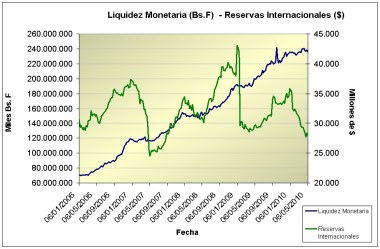
(Note added: To those that like graphs,Henkel Garcia published today the graphs for M2 and international reserves in his Blog de Economia y Finanzas:

as you can see, reserves have been essentially flat since 2006, while M2 has increased four fold.

Henkel also plots the “implicit rate” that rate, which arises from dividing all the Bolivars (M2) by international reserves in the same period:


Obviously, creating Bolivars at will, while holding reserves constant is dangerous to your currency. You can think of it in two ways, either there are too many Bolivars chasing too few dollars or the Central Bank does not have the dollars to satisfy the demand for foreign currency. The only caveats is that I usually don’t take into account the FIEM dollars in reserves, because the Central Bank can’t use them, they belong to PDVSA and the Government.

You know you have a centralized Government when the office of the President decides on science and scientific financing

May 16, 2010

(What are you searching for?)

On May 7th. the Director of Venezuela’s formerly premier scientific research Institute in Venezuela IVIC (there are none now) sent the letter below, translated liberally by me to all research personnel:

Good Afternoon, the present letter is to request from all those responsible of research projects with the Institute, your cooperation to fill out a file of project, at the request of the Presidency of the Republic, with urgent and priority character.

In this file, only those projects at IVIC which fulfill the following characteristics should be included:

Useful and or social impact projects that solve people’s problems or have the capacity to solve social problems.

The format can be found at the following link:

http://intranet.ivic.gob.ve/varios/ficha_de_proyecto.xls

which should be sent to IVIC’s Planning Office.

The deadline for handing in the information will be: Monday May 10th.

We should note that the information will be received and reviewed by the Director and later resent to the Office of the President of the republic for his consideration.

Regards

Angel Viloria

Director

Thus, “Science” in Venezuela is now reduced to the definition of President Hugo Chavez, beginning with the oxymoronic concept of “useful science” and Chavez will now bypass the peer review process and likely decide himself what should get funding.

I wonder how many Lysenkos this will yield?

Exchange controls get tighter in Venezuela, now what?

May 15, 2010

(Death to the Hoarders)

Not much has changed since I wrote the earlier post on the Government creating a third controlled exchange rate which will be managed by the Venezuelan Central Bank. The Bill was expedited through the National Assembly and in a few words the Bill, which has yet to be approved and published by Chavez, modified the earlier foreign exchange illicit Law, such that:

  • The definition of foreign currency includes dollar denominated securities, thus buying such an instrument is illegal now.
  • The Central Bank is given total control and supervision over the trading of foreign currency and securities such that someone receives foreign currency in the end. This has fines, if the amount is between 10K and 20K $10,000 and jail of 2 to 6 years if it is more than 20K.
  • The Law gives almost every relevant Government office competence in policing compliance with the law, including the Consumer Protection Agency, the Immigration Office and the Tax Office.
  • The Law appears to ban the trading of bonds held by Venezuelan companies (think banks) in foreign currency. The legal interpretation is that such sales will have to take place thru the Central Bank (I wonder if the Central Bank buys Ukrainian bonds). This is a legal interpretation, if true, the Government wants the controls to be Draconian.

The swap market is dead, as the Central Bank will apparently establish a market of dollar bonds for cash. That is, if you need Dollars you go to whomever is allowed to participate in this, put in your order and the Central Bank will decide if and how much you get of the short term BCV dollar bonds it will sell to you. If you want to sell that bond before maturity, you have to ask this agent to sell it to the Central bank also, that is, there will be no one on one transactions between those holding the bonds, the Central Bank will always be in the middle. If you have US$ and want Bs. you have to buy a bond abroad and offer it for sale to the Central Bank or sell one of those you already obtained earlier.

And I say agent, because it is unknown even who will be able to participate in this market at the BCV. Today’s papers say only Government banks will be able to, insuring the process is more cumbersome and opaque. (Yesterday recently nationalized Banco de Venezuela could not open a new account, because “we ran out of forms”)

Thus, now the Central Bank and the Ministry of Finance have to figure out how they want to set up this and how it will work. This could take days to define.

Of course, in the end, the Government led by the ignorance on economic and financial matters by Jorge Giordani, is attacking the consequences of the distortions and the structural problems, but not the origin of them. Thus, much like the much ballyhooed devaluation and dual exchange rate in January (Another bright idea of the Minister of Finance) this will simply not work. The problem with the parallel swap rate was not speculation, but lack of dollars in the market. This has not changed and will not change in the upcoming weeks or months.

One of the new distortions introduced by Giordani in January was a second exchange rate at Bs. 4.3. This introduced a new level of decision by the CADIVI bureaucracy which essentially decided to give largely at the lower rate, forcing those eligible for the Bs. 4.3 to go to the swap market, adding further pressure to the rate.

And since the dollars are limited and they will be sold at a fixed price to be decided by the bright minds at the BCV, they will be distributed inefficiently and ineffectively (just like Cadivi, this is just Cadivi 3). Thus, the book of orders will grow and grow in time until the Government creates the fourth rate or does away with this silly new scheme.

Of course, a new parallel market, illegal and black, will flourish and the sky is the limit and merchants will use it to fix prices and /or if persecuted, shortages will be truly Cuban style. Inflation or shortages, choose your potion.

Not a pretty picture…