Observations focused on the problems of an underdeveloped country, Venezuela, with some serendipity about the world (orchids, techs, science, investments, politics) at large. A famous Venezuelan, Juan Pablo Perez Alfonzo, referred to oil as the devil's excrement. For countries, easy wealth appears indeed to be the sure path to failure. Venezuela might be a clear example of that.
While we all know that Hugo Chavez and his Government control all independent powers, they no longer even seem to care about appearances. While we know that the CNE is absolutely controlled by Hugo Chavez and they do whatever he pleases even if it in violation of the law and the Constitution, the recent actions of the CNE are absolutely ridiculous.
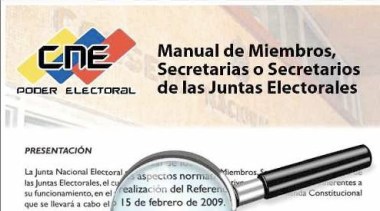
Yesterday El Nacional revealed that in December (Image above), the CNE ordered the printing of 295,000 instructional pamphlets for polling tables, and another 60,000 for the the members of electoral boards at a cost of Bs. 720,000 (US$ 334,000) and even if the National Assembly had not even yet considered the question or requested the upcoming illegal referendum, those pamphlets already included the date of the referendum as February 15th.
This shows that elections are no longer fair and the political rights of Venezuelans who do not support Hugo Chavez are routinely violated by the Venezuelan Government and its autocrat. Recall that it took the opposition eleven months between requesting the recall vote against Hugo Chavez in 2004 and the CNE found repeated excuses to delay and boycott the democratic rights of the opposition as well as the voters, forcing the petitioners to cross every t and dot every i at least twice.
This time around however, they have bent over backwards and satisfied Chavez’ illegal whim in record time, with five weeks between the time he first spoke about the possibility of a vote and the Electoral Board approving it. Moreover, the CNE says that they can hold the vote in four weeks. I am sure they can throw money at the problem and make it work, but there is a clear danger that not everything will be ready on time. (And Chavez will find a way to blame the opposition)
Because in the next for weeks the CNE has to reprogram all the voting machines, distribute them and have them checked. The logistics are not simple.
Chavez is so cynical that as four members of the Board of the CNE follow his every order, he accuses Board member Vicente Diaz of being a political actor of the opposition. All Diaz has done is ask that the law be followed. From not opening the Electoral registry, to allowing the question for the referendum, to not state explicitly what Chavez is asking for, to now violating the Electoral law by approving that polls stay open until 6 PM, the Electoral Board has simply become a joke.
Venezuelans have nobody to appeal to, the Supreme Court rules routinely on Chavez’ side even when the law and the Constitution are blatantly violated. You know something is fishy when the Venezuelan Supreme Court uses jurisprudence from Peruvian Dictator Alberto Fujimori’s Military Supreme Court, in order to argue that a ruling by the Interamerican Commission on Human Rights is not valid. Funny how the military left and the military right always end up looking so much alike, no?
And you have to worry when the autocrat himself orders that student demonstrations be met with the “best” tear gas if they dare block the streets. I don’t know what “best” means in this case, but Chavez certainly sees to have a clear ides. “Best” to him must be the most aggressive and toxic one in another clear sign that Chavez cares little for the rights of others.
What Chavez is afraid of is that the students lead the battle against his illegal referendum, so he wants to intimidate them. He may be surprised.
The next fours weeks will be tricky and whether Chavez wins or loses they will get even trickier after that as the level of conflict in Venezuelan politics and society can only increase whatever the outcome may be.
There was a controversy this week, as Globovision began showing during a session of the National Assembly the screens of the laptops of the Deputies as the now infamous and obtuse question was being discussed. Except that ooops, at some point they showed the image of the laptop of one of those Deputies that nobody remembers their name and he appeared to be watching porno in the privacy of his parliamentary seat as shown below on the first picture below, but turned out to be a presentation on breast cancer with rather explicit pictures . The Deputy said he was going to sue Globovision for violating his privacy.
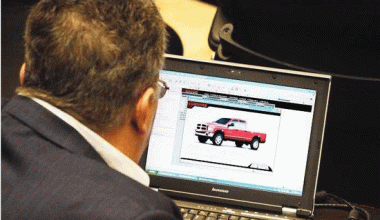
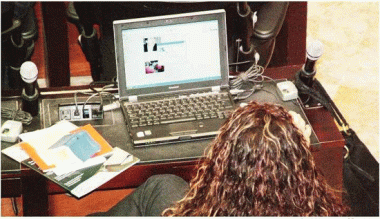
Then yesterday Tal Cual publsihed some of the images their photographer caught after the incident, including in the first picture below a Deputy (Escarra?) looking at his dream car. He probably put in an order for it to buy with his Xmas bonus, but is wondering whether CADIVI will give any dollars to the car company to import parts or cars this year. In the next row another Deputy (Desiree Santos Amaral?) plays solitaire, while only Iris Varela in the last picture seems to be doing something useful as she seems to be reading the news.
The Venezuelan Supreme Court ruled last month that it would not follow the order from the Interamerican Commission on Human Rights to reinstate the Judges from administrative Court who were fired when the Chavez Government decided to eliminate that Court because the Judges were ruling in an independent fashion. The decision was even worse than that, in which it even used jurisprudence from the Military Courts of Fujimori in Peru in a similar case and called the decision an “intervention” by the Court and asked the Venezuelan Government to denounce the Interamerican Convention on Human Rights, which would simply leave all Venezuelans without the international protection the Treaty gives against Human Rights violations.
Today, Amnesty International (AM) issued a press release criticizing the decision and noting the danger that it implies. Said AM:
“By rejecting a ruling by the Inter American Court of Human Rights and calling on the government to reject the Inter American Convention of Human Rights, the Venezuelan Supreme Court is sending a dangerous message that human rights are optional, said Amnesty International today.”
and
“The Venezuelan Supreme Court’s decision is surprising and disappointing,” said Kerrie Howard, Americas Deputy Director at Amnesty International. “The Court should not see this sentence as a criticism but as an opportunity to consolidate protection and respect for human rights.”
Despite the Supreme Court ruling, Venezuela retains an international obligation to abide by the Inter American Convention and the rulings of the Inter American Court.”
The case is clear, an International Court on Human Rights ruled that the Venezuelan Government had violated a convention it subscribed by intervening in the judicial power and firing judges that were independent. This is a threat to the rights of all Venezuelans who are no longer protected by the decisions of local Courts, which are the subject of pressure by The Government and/ or the Human Rights Convention.
Maybe Alek should write a petition supporting Amnesty International’s position and send it to Prof. Chomsky who apparently signs such petitions without regards to their content.
Just to make sure the Venezuelan economy has a chance of collapsing, Chief Economist Hugo Chavez announced today that he will take US$ 12 billion from the country´s International Reserves and put them in his petty cash development fund Fonden. This guarantees that if oil prices stay where they are today, the Venezuelan economy will implode later this year as the swap rate soars and a devaluation is sure to follow.
You have to wonder whether the whole thing is on purpose. Now you know why they transferred the US$ 5 billion to the Central Bank at the end of 2008, the autocrat wanted US$ 12 billion and that would have left reserves close to a dangerous level of US$ 25 billion.
Venezuelans are about to find out that Milton Friedman was absolutely right. They already suspect this is the case, as inflation topped 30% this year, they will soon get a higher education on its meaning.
On December 2, 2007, the people of Venezuela rejected the indefinite reelection of the President in a Constitutional Reform referendum. However, a year after the defeat of his proposal, President Chavez is pushing again for a constitutional amendment to reintroduce indefinite reelection. Following the presidential announcement, politicians, lawyers and figures of supposedly independent public powers have rushed to give us legal opinions to make us understand that there is nothing wrong, legally speaking, with the new proposal.
The legal contortions are not simple and present diverging strategies depending on each case: some concepts of the Constitution are interpreted with wide latitude, stretching to the maximum its possible meaning, while others are a narrow, myopic and literal reading of the Constitution, which completely ignores the spirit of the law.
The result is a silly putty Constitution whose interpretation is stretched or hardened so that it tailors to the desires of the caudillistic President.
In what follows, I analyze the different types of “alibis” that I have heard or read about with regards to the legality of the constitutional amendment.
1 .- Broad Interpretation Alibis
1.1.-The Potential Alternability
Alternability is a major hurdle for the amendment since Article 6 of the Constitution clearly declares it as a fundamental principle. Therefore, a reform that would involve touching this principle would be modifying the Constitution and would require the approval of a Constituent Assembly.
To bypass this major legal obstacle, a much broader interpretation has been given recently: Since there exist elections recall referenda procedures, the notion of Alternability contained in the fundamental principles of the Constitution would not be affected as long as the people have the power to decide whether the President stays or leaves.
In other words, Alternability would be interpreted as the potential to have a different President rather than the certainty of having him.
I disagree with that interpretation.
In fact, if Venezuelans awaken in twenty years with an elected President who has been in power for 30 years, one can not say that there was during that time alternability of power, even if elections have been impeccable.
Until a few days ago, the new definition of Alternability meant imposing a legal hurdle not easy to overcome: if the Presidential alternability were interpreted as a potential for alternating governments, the same definition should have been applied to the other elected positions which have the possibility of recall. Otherwise, Alternability would have been interpreted in one way for the President and in another way for other elected officials.
That two-headed definition is not recognized in the fundamental principles of the Constitution. Therefore to insert it would have implied a fundamental change and would have needed a Constituent Assembly.
Therefore, I suspect that those who devote themselves to making up legal alibis for the President warned him of this obvious duality, which is why the indefinite re-election proposal was unexpectedly extended to other elected officials.
1.2-Restrictiveness of Article 230
Another argument I have heard to support indefinite re-election is that Article 230, which stipulates that the President may be reelected only once, restricts the choice of the people and therefore it would be anti-democratic. In this case, the restrictiveness of Article 230 was precisely imposed by legislators to insure a solid democracy which would endure in time.
In fact, it was clear to lawmakers that there was the need to avoid the temptations that the archaic currents of caudillismo still present in the Venezuelan spirit would prevail. That is why the 1961 Constitution restricts reelection and that such a limitation persists in that of 1999.
Therefore, and because the restriction exists in explicit fashion , trying to change it is not a trivial matter because it goes against the fundamental spirit of the Constitution and would require the endorsement of a Constituent Assembly.
1.3-Great democracies of the world do not put an end to Presidential mandates.
In various occasions, I have heard as an argument the fact that the great democracies of the world do not impose term limits to mandates. This happens to be “a wide interpretation alibi” because the majority of the countries that are mentioned have parliamentary systems.
This is not a casual fact. Presidential systems give enormous amounts of power to the current President. Therefore, term limits are used to slow contain them. In fact, I know of no solid democracy with presidential systems without term limits. The example of France, which is commonly cited, not only ignores the fact that France has a mixed system (parliamentary and presidential) but also that recently a law was approved to restrict the terms of the President, so that indefinite reelection is no longer a French phenomenom.
The opposite is also true: the examples of presidential systems without term limits are not particularly representative of great democracies. Such is the case of Cuba, Zimbabwe and Bieloruss.
Parliamentary systems, on the contrary, not only are less focused on the individual, but they have a series of internal controls which automatically limit power and force the President to constantly give account of his actions and decisions. In fact, it is not the Head of State who governs, but the party. In the British system the head of the opposition even is part of the Government, with a budget, space and his own perks. His role is to question the Prime Minister and his Ministers daily about what they are doing. In other words, the opposition and the Government’s party have a key role to counteract any abuse of power by the Prime Minister.
As an example, in a parliamentary system like that of Canada, the Prime Minister asks for permission to have half an hour a year to talk to the Nation. The message is previously sent to the media and systematically, the Head of the opposition receives exactly the same space and speaks immediately afterwards in order to preserve a balance with the Government.
Very little to do with the weekly five hours of Alo Presidente, nor the continuos nationwide addresess (cadenas) of indeterminate length that exist in Venezuela.
1.4 The concept of a recall referendum is guarantee of Alternability
To those that support indefinite reelection, the recall referendum is the guarantee of democratic alternability.
It is a pretty alibi of legality since, in theory, the people have the power to freely revoke any mandate in the middle of the term.
That is the theory. Sadly, in the recent history of Venezuela, the petition to request the recall referendum against President Chavez was turned into a systematic instrument of discrimination and coercion in such a way that the Venezuelan people will never again dare to sign a petition to revoke anyone with true power.
Therefore, even if the recall referendum could have been an instrument to counteract the unlimited power of a President with caudillo aspirations, in practice, it not only has been a failure, since never modern Venezuela had been so dependent on the Caudillo, but it represented an instrument of division of the population and of limiting individual rights.
In conclusion, one can not use a legal concept whose applicability has been extremely harmful to both human rights as well as the democratic well being of the country as an agument to counteract the enormous danger that the introduction of indefinite reelection would represent.
2.-Narrow interpretation alibis
Those that back with legal arguments the indefinite election skip over the fact that there already was in Venezuela a referendum about a reform and one of points of that reform, the most important one, was precisely, that of the indefinite reelection.
But when they are asked about that important detail, those that on other points argue for the widest range of interpretation, turn then towards a literal and obtuse interpretation of the Constitution.
2.1 Article 345 of the Constitution states that a reform can not be voted twice within the same Constitutional period. The alibi used by the legal spokesmen of the President is that an amendment is not the same as a reform and that we would be voting on two completely different things.
There are two arguments, one literal, the words “amendment” and “reform” are different and another one to the heart of the matter, the reform of 2007 dealt with a group of changes while the 2009 amendment would deal with a very precise modification.
Let’s begin by analyzing the second argument according to which Article 345 of the Constitution would not apply because Venezuelans would be voting on two different proposals.
Article 344 of the 1999 Constitution establishes that the referendum for the reform can be voted separately. President Chavez was told to make use of the prerogative and he did not want to: He opted for inserting the indefinite reelection within a group of articles and ask that they be voted as a block. Thus, had the reform been approved, the indefinite reelection, and all of the changes the President had proposed would have been approved, even if the voter had disagreed with sme of them.
That was not the case: The president lost, which is why the indefinite reelection and all of the other articles proposed were rejected. In a few words, the indefinite reelection was voted on and rejected by the voters.
Let us now go to the literal argument according to which Article 345 does not apply because the amendment and the reform are two different concepts and 345 uses the word “reform”.
An amendment fits within the spirit of Article 345, despite what the defenders of the proposal want us to believe, because if you allow President Chavez to come back via an amendment to vote on a point that the people rejected already, nothing will stop a President, whether this one or any other one, to subject the country until they are worn out, to constant referenda on the same subject happily going from a reform to an amendment. The opposite would also be true: Nothing would stop the opponents from proposing the opposite point until it is approved.
That is why Article 345 exists, to avoid such a circumnstance. In conclusion, to legally accept that you can vote on an amendment over a subject that was already voted and rejected via reform or even, via a prior amendment is to open a Pandora’d Box that could be very costly for the country in terms of peace and democratic stability and a clear violation of the law.
2.2.-New Alibis
The New Year brought us a surprise: The President and his supporters, which up to a few days earlier fervently defended without any hesitation that only the President should be reelected indefinitely, made a spectacular about face. Whether for reasons related to the lack of popularity of the proposal or because the alibi of alternability would fit better from a legal point of view, it is now proposed that all popularly elected positions be allowed to have an indefinite reelection.
The problem is that the argument of the amendment was simply to erase a phrase to one of the article is not longer true, since now a number of articles need to be modified. One could ask if now the amendment which was not a reform is being transformed in a reform which is an amendment.
In the face of such an argument, the alibi makers tell us that Artile 340 states that the amendment has as its objective adding or modifying one or more articles of the Constitution.
That is in fact the case, except that the article adds at the end “without altering its fundamental structure”.
In other words, if the amendment of an article was illegal, so will be one on many articles since it is based on a new interpretation of what alternate mandates are and above all, it completely ignores the fact that the indefinite reelection was already voted on.
In any case, despite all of the legal intricacies that they want to sell us, we all know what is happening: The Constitutional changes obey only to the desires of a Caudillo to remain in power eternally and are possible only because of the huge vacuum of democratic institutionality in which the President and his alibi makers, have led Venezuela into.
If it ever was difficult to understand what is going on in Venezuela it is now. In the face of adverse polls that suggest he will lose an illegal second referendum that would eventually allow him to be reelected, Hugo Chavez changes his tune, allowing other elected officials into the package and begins provoking, lying and using silly charegs of treason against some members of the opposition as if plotting a strategy and meeting with experts in an election was somehow illegal.
So, we may ask, what is the point?
Because time seems to be too short to overcome the difference in the polls. Even the absurd question that will be asked in the ballot at the referendum is so bizarre, obtuse, absurd and unintelligible, that at times, it seems to me as if the strategy is actually not to hold the referendum.
But is it? I just can’t tell. In some sense the Obama inauguration limits Chavez’ ability to do something dramatic against the US, it would have no justification. Gaza seemed like a good topic, but while the opposition did not say much on it, it did not attack Chavez’ decision frontally either, so it was hard to use that as an excuse.
So, start provoking the students and make up silly emails against opposition figures, who seem to use code for some characters in their emails, but make sure that others are easily identifiable. To top it all off, they use company emails in a world where it is trivial to open dozens of fake email accounts all over the place.
Then, get up and state with a straight face, that there are no longer street kids in Venezuela, because Chavez actually solved that problem. Or that food inflation is zero (yes he said zero, cero) for those that buy in Mercal, as if the Government did not approve dozens of price increases in 2008 and the Venezuelan people were dumb enough to believe what he says.
Of course, there is no mention of crime and the daily threat it represents to the average poor Venezuelan, or that poverty is now measured differently to improve results and is nowhere near the lows in the much maligned and ever reivindicated IVth. Republic, when oil revenues per capita were not what they are today.
So, what is the intention? Provoke to divide? Provoke to delay? Lie to convince? Pulling all the stops to overcome the deficit?
Maybe it is just all of the above…
Chavez knows he is behind and the difference may be unsurmountable, but…
If he provokes, divides, lies, buys votes and cheats..maybe, just maybe, the inevitable can somehow be avoided.
And if not, maybe we can postpone too…If we can show the opposition is conspiring because they are trying to beat Chavez, the students are just pro-US pitiyankees and Chavez has saved us all, maybe we can make it close enough for the CNE to save the day.
It is just like the way they are managing the economy. It is a huge Hail Mary pass to try to save it all in one try. For the economy, it is oil, if oil recovers before June, the revolution is saved. If not it is in huge trouble. For the election if they can close the gap, maybe Rafael Ramirez can go spend PDVSA money and buy votes nationwide rather than just in Sucre State, the CNE can swing some votes or stop counting and we can get our hands in enough refrigerators to give away and save the day.
The whole thing is simply too bizarre for someone confident that he even has a chance. Thus, the strategy is surprise, confront, provoke and hope for the best. Don’t let the opposition develop a strategy, keep them off balance. Cheat, lie, deceive and do whatever is necessary.
Which is what worries me. Chavez and his Government have proven to have no scruples in all this. Violate the Constitution, change your mind, violate the law, violate people’s rights, accelerate the process, don’t let anyone new register to vote, forget about doing anything about the economy until the vote is over.
What else will hapen in the next four weeks? What new suprises, rabit out of the hat, challenges and lies are we going to see before February 15th.?
Every exchange control system has led to huge levels of corruption in Venezuela. CADIVI is no different. What is different this time around is the lack of checks and balances and fear. With other Governments in the past, reporters would denounce graft, an investigation would be opened and even if those responsible were not punished, those involved in the graft would stop doing it or try to hide it even more. This is no longer the case. Under Chavez, few things are ever investigated and the media is afraid to report things. Moreover, even if you knew all the details, who would you go to? The Prosecutor? The Comptroller? There really is nobody to go to as everything gets covered up even when Chavez and his Government know things are going on. In fact, Chavez has removed people from CADIVI, but quietly. He has also gone after one case, the infamous Microstar case, but this seems to be more about getting someone out of the way, rather than corruption.
So, without much further ado, here is a guide to CADIVI corruption:
The Straight Bribe: This is the most common case. Want to accelerate your CADIVI request? Maybe a payment of Bs. 0.15 to Bs. 0.3 will speed it up dramatically. As someone I know told me: There is a CADIVI guy with a very fancy car and a nice house in Florida and I paid for most of it. Except for food and medicines, if you don’t go the straight bribe way, you are likely to see huge delays.
The Inflated Invoice: Import something, but have your supplier inflate the price, without overdoing it. Then have your supplier keep the difference abroad and you can either keep that or bring it back at the swap exchange rate thus reducing the costs. You can avoid this hiring specialized companies, but most of them are American and we want no official dealings with pitiyankee companies, so we don’t use them. This is a revolution.
The Forgotten Debt: In contrast to all previous exchange controls, this Government has given out foreign currency to pay debt. Find a business that is bankrupt or under impossible conditions to pay back the debt, buy the debt for ten or twenty cents on the dollar and then go to CADIVI and ask that you get paid the dollars at Bs. 2.15 per dollar. You will have to pay a little for this, but the margin s so huge it is worth it. This mechanism is practically exhausted as most of the debt available has been found and paid for at a huge profit.
The Official Export: Find something you can get the Government to sell to you, say a Diesel tanker, an iron ore barge or a steel products, but pay them at international prices, but at the official rate of exchange. Turn around and sell the goods abroad in exchange for US dollars and turn around and sell the dolars in the swap market. Huge profits, just need the contact at the appropriate Government industry. CADIVI does not even have to get involved as long as you can get the export permit.
The Carousel: Find something innocuous to import from Colombia, let’s say school notebooks, not food or anything that will get custom officials suspicious. Import it form Colombia at the official exchange rate of Bs. 2.15 per US$ and ship with a truck via one Colombian border point and immediately send it back to Colombia via another. Start the process again, getting import permits to bring the trick back. Same stuff, you just never sell it, just recycle it and move it around like a carousel.
The Phantom Container: Set up a company in Panama that sells widgets. Get a permit to buy a couple of million dollars of widgets from it. Bring in a container full of boxes of widgets, but just fill the outside boxes with widgets, the rest are empty boxes. You get a couple of million to bring a few thousand dollars of widgets. The rest is pure profit.
The Nouveau Travel Agent: Set up or buy a travel agency. Find people who have credit cards but cant afford US$ 5,000 for travel (plus a cash advance of US$ 500). Promise to take them to Panama, Aruba and the like, pay their hotels for a couple of nights and arrange a way to get them all of their quota. You pay their expenses, give them some cash and you keep 60-70% of the dollars purchased at Bs. 2.15 per US$, which you sell at the swap rate which is almost triple that.
The Software Reset: I am told this is no longer being offered as new software is in place. But it used yo be very simple:You would pay somebody a fee to reset your quota so that it appears as if you have yet to spend your foreign currency. You can then travel again and take advantage of the Government’s largesse.
Have a different one that you know about first hand? Let me know…but you can see how huge fortunes have been made in the name of the revolution, but there is nobody to keep it in check.
Carta abierta a los más de 100 “expertos” de América Latina, que criticaron el informe sobre Venezuela de Human Rights Watch.
Estimados Señores:
Hemos leído su carta criticando el informe Una década de Chávez: intolerancia política y oportunidades perdidas para la Promoción de los Derechos Humanos en Venezuela por la organización Human Rights Watch, y estamos atónitos por su superficialidad y la falta de rigor académico que ustedes injustamente le reclaman a HRW.
De hecho, el título por sí solo es bastante engañoso ya que algunos de los firmantes de la carta apenas califican como “expertos” en América Latina y es evidente que el vínculo común de quienes firman la carta es simplemente un apoyo ciego a Hugo Chávez y a su falsa pseudo revolución. No esta basado en un conocimiento concreto de lo que está ocurriendo en Venezuela y lo que critican del citado informe.
En cuanto a la la discriminación por motivos políticos, están, por supuesto, refiriéndose a la infame lista Tascón / Chávez, una perversa base de datos de aquellos que firmaron una petición para revocar el mandato de Hugo Chávez, que ha sido ampliamente utilizada para discriminar en el empleo y/o en la prestación de servicios a los ciudadanos venezolanos. Ustedes cuestionan la veracidad de esta discriminación, la cual Teodoro Petkoff ha calificado como una lista “apartheid”, pero quizás debería HRW haberla vinculado con este vídeo del documental “La Lista” (Para un resumen escrito de “La Lista”, léase aquí) donde en el minuto 0:49, Hugo Chávez, dice: “El que firme contra Chávez, ahí quedará su nombre registrado para la historia”. Más adelante, en el minuto 2:17 el presidente Chávez, en su show de variedades dominical Alo Presidente (# 214) bromea acerca de la lista Tascón y el miedo que tiene la gente de estar en ella. Finalmente, en el minuto 3:08, en una reunión de Gabinete, Hugo Chávez dice: “La famosa lista de Tascón nostros debemos archivarla ya. Eso ya paso. Entierrese la lista de Luis Tascon, Seguramente cumplio un papel importante en un momento determinado, pero ya eso paso.”
¿Qué habría querido decir el presidente de Venezuela, cuando ordenó públicamente “archivarla ya” y el “entierro” de la lista? Enterrarla, tenía un significado muy claro: Chávez sabía de la lista y la respaldó por un largo tiempo, nunca la condenó y entonces pidió que ya no se utilizara. Ordenó que la enterraran ya que la prensa local comenzó la impresión diaria de decenas de casos de discriminación y despidos, mediante el uso de la lista Tascón / Chávez. Muchos de estos casos están bien documentados en “La Lista”.
Pero en el nombre de la precisión y el rigor, tal vez podrían ustedes haberse simplemente tomado el tiempo de descargar la base de datos de la lista Tascón / Chávez, y estudiarla un poco. Esta representa un uso perverso de la tecnología, y es un abominable ejemplo de lo que puede hacer la humanidad en el nombre de la ideología y la política. Clasifica a millones de venezolanos a favor o en contra de Hugo Chávez. Sus partidarios, son llamados “Patriotas”, por supuesto, y para asegurarse que la presión apropiada pueda ejercerse sobre aquellos que están en contra de esta revolución vacía, se incluye su dirección personal y la de de su centro de votación, asi como un poderoso motor de búsqueda.
Imaginanensecon la lista se puede espiar a su familia y vecinos, desde la comodidad de su computadora portátil y saber si firmaron contra Chávez (si usted está en contra de él); o si se han beneficiado o no de los programas de asistencia del Gobierno (si usted lo apoya), creando así un instrumento de división y odio para todos los venezolanos
Sólo su existencia y elaboración, por parte un Gobierno que pretende ser democrático, es una violación de los derechos otorgados por la Constitución de Venezuela, así como del Pacto Internacional de Derechos Civiles y Políticos y la Declaración Universal de los Derechos Humanos. Y recuerde, Chávez ordenó que fuera enterrada, pero nunca la condenó.
Sí, en efecto, Venezuela no es un modelo político para nadie, como claramente lo exponen HRW y José Miguel Vivancos. El país es signatario de estos acuerdos y declaraciones internacionales, los cuales ustedes no tomaron en cuenta en su carta. El hecho de desconocerlos no es ninguna excusa, especialmente cuando están reclamando el rigor académico que un proceso de revisio por pares debe tener.
Y sí, en la mayoría de los casos no se puede probar que hubo discriminación. Cuando a uno de nosotros se le negó un pasaporte, no se le dio un trozo de papel indicando que era porque había firmado contra Chávez, pues sólo se le dijo verbalmente que ésa era la verdadera razón. Esto sucedió a miles de venezolanos que no pudieron obtener un pasaporte o una cédula de identidad durante meses después del referendo revocatorio de 2004.
En cuanto a los empleos o contratos con el Gobierno, incluso después de que Chávez pidió que la lista fuese enterrada; se utilizó para deshacerse de los enemigos del Estado que trabajaban en la empresa petrolera Sincor, cuando el Gobierno la nacionalizó. El recién nombrado presidente de esa compañía no dejó dudas al respecto: “Esta es una cuestión de Estado. Hay una lista que se distribuyó en la prensa y que es real. Salió de aquí, estamos investigando y quien la filtró irá a la cárcel. Se aplicará a personal clave que se encuentra dentro o fuera de la empresa”. Y sí, las personas fueron despedidas, no son tantas las inexactitudes y rumores, ¿verdad?
Y está el caso de Rocío San Miguel y otros dos abogados (que se muestra en “La Lista”) que trabajaban en el Consejo de Fronteras, quienes grabaron 55 minutos de conversaciones telefónicas con sus superiores; quienes les explicaron que fueron despedidos por firmar en contra de Hugo Chávez y que el Vicepresidente de Venezuela directamente lo había aprobado. Este caso está ahora en la Corte Interamericana de Derechos Humanos.
Mientras que ustedes dicen que el Gobierno tenia el derecho de despedir a los trabajadores petroleros por irse a la huelga, omiten el no tan irrelevante hecho de que no sólo fue ilegal, -haciendo caso omiso a la estricta legislación de Venezuela-, sino que les confiscaron sus prestaciones sociales (también ilegal bajo la ley venezolana), así como las contribuciones voluntarias al fondo de pensiones y los ahorros de todos los trabajadores, sin ninguna orden judicial que lo autorizara. Estos trabajadores, iban desde mensajeros y secretarias, hasta de hecho, ejecutivos de alto nivel. Los Tribunales del Trabajo de Venezuela no han procesado ni uno solo de estos casos desde 2003. Si eso no es una discriminación y la violación del debido proceso y el Esatdo de Derecho, ¿entonces qué es?
En cuanto a la autocensura, -la cual ustedes desdeñan sin ningún rigor- fallan al no tomar en cuenta las decenas de periodistas cuyos programas han sido cancelados en los medios de comunicación que decidieron “seguir las órdenes” del Gobierno; en contraste con la terminación ilegal de la licencia de radiodifusión y la incautación de los bienes de la cadena de televisión RCTV, la cual se negó a obedecer las órdenes de los más altos niveles del poder en Venezuela.
Y es absolutamente ridículo cuando dicen que “En el informe se utilizan incluso insinuaciones queriendo dar a entender que el Gobierno es el culpable de ataques contra periodistas”; cuando el Gobierno de Venezuela no ha proporcionado protección a más de 250 periodistas, de acuerdo con lo solicitado por la Corte Interamericana de Derechos Humanos, en el marco de los tratados de los cuales Venezuela es signataria.
Finalmente, cuestionan que HRW haya usado un informe de un “blogger de oposición”, llamándolo ‘inestable mental’, de lo cual no tienen ninguna prueba, ya que ningún profesional lo ha examinado en este aspecto, y sin embargo no contradicen ni cuestionan ni un solo aspecto del trabajo de este blogger citado por HRW. Claro, esto seria muy difícil de hacer, puesto que la citada referencia es una descripción fáctual de la lista Tascón / Chávez y prueba de que el Consejo Nacional Electoral fue quien autorizó la liberación de la copia de todas las firmas al Diputado (pro-Chávez) Luis Tascón.
Y econtramos sorprendente, que utilicen como prueba el hecho de que algunas personas han llamado al derrocamiento violento del gobierno venezolano presidido por Hugo Chávez; quien apoyó dos intentos de golpe, violentos ambos por cierto, y uno de ellos dejó a más de 200 los venezolanos muertos en las calles, incluidos niños. Un interesante doble estándar, que tienen ustedes para la defensa de los derechos humanos, por decir lo menos.
Finalmente, su carta es un pésimo intento de desacreditar a HRW, -quienes curiosamente defendieron al Sr. Chávez en el año 2002- a pesar de las muertes inducidas por el Presidente venezolano contra una marcha pacífica. Su carta fracasa precisamente donde intentan encontrar fallas en el informe de HRW, carece de rigor, es superficial y representa el terrible error de firmar un documento tan parcializado.
Mientras tanto, en Venezuela, Hugo Chávez busca su reelección indefinida, a pesar de que un referéndum en 2007 le negó esa posibilidad, y en contra de la prohibición expresa de la Constitución de Venezuela (Título IX), de considerar la misma pregunta dos veces en un solo período constitucional. Por otra parte, Hugo Chávez emitió 26 proyectos de ley en julio de 2008, las cuales contienen disposiciones que también fueron rechazadas en ese mismo referéndum.
Esta es la mayor violación de los derechos democráticos de la mayoría de los venezolanos que votaron en contra de tales disposiciones, en diciembre de 2007.
Ya tenemos 10 años de esta revolución chavista sin contenido alguno. Venezuela ha tenido ingresos por más de 800 millones de dólares, cantidad comparable al paquete de rescate del sistema financiero de los EE.UU. A pesar de esta bonanza, los índices de pobreza apenas han mejorado, los de nutrición y salud han bajado, el sistema hospitalario venezolano está en ruinas y la delincuencia se ha triplicado bajo el régimen de Chávez. Pero sin duda, el país tiene un arsenal de modernas armas militares, y Chávez amenaza regularmente a la oposición con el hecho de que su revolución “está armada”; mientras que la corrupción es tan rampante que maletas llenas de dinero en efectivo son transportadas en los vuelos oficiales del Gobierno y los que fueron sorprendidos en posesión de este dinero, describen sin pudor la forma en que ganaron cientos de millones de dólares gracias a su estrecha relación con funcionarios del Gobierno venezolano bajo Chávez. Y Hugo Chávez y su Gobierno, abiertamente apoyan la guerrilla colombiana.
Sorprendentemente, hay todavía “expertos” como ustedes que apenas han examinado la superficie de lo que está ocurriendo en nuestro atribulado país, y siguen defendiendo lo indefendible; continúan apoyando a un gobierno que está al margen de la ley, a un gobierno que carece del apoyo de los círculos académicos y de los estudiantes universitarios venezolanos, y Uds. ni siquiera se preguntan el por qué ello.
Irónicamente, mientras ustedes se sientan cómodamente en el confort de sus oficinas, trabajando en sus proyectos académicos y dándole el apoyo a la revolución chavista; sus colegas de las ciencias sociales en Venezuela reciben escaso financiamiento y el premio de ciencias sociales, no ha sido otorgado en los últimos dos años.
Es verdaderamente triste cuando en el nombre de la academia, una muy respetable y seria institución dedicada, a la defensa de los derechos humanos es atacada con fines políticos, de manera tan deficiente y superficial. Pero es aún más triste y una vergüenza, cuando la sistemática y bien organizada violación de los derechos humanos por el Gobierno venezolano presidido por Hugo Chávez; es ignorada por los que afirman que suenan y creen en la dignidad básica y los derechos de todos los seres humanos.
Miguel Octavio, Daniel Duquenal and Alek Boyd, bloggers
Felix J. Tapia, Professor-Reseracher, Universidad Central de Venezuela
Kensey Amaya, Ph.D. Candidate, University of Illinois Urbana-Champaign
Benjamin Scharifker, Professor of Chemistry, Universidad Simon Bolivar, Member, Academia de Ciencias Fisicas, Matematicas y Naturales
Diego Arria
Maria J. Gonzaez Associate Professor, Department of Zoology, Miami University, Oxford Ohio
Gioconda San-Blas, Individuo de Numero de la Academia de Ciencias Fisicas, Matematicas y Naturales
Jaime Requena, Miembro de la Academia de Ciencias Fisicas, Matematicas y Naturales
Claudio Bifano, Presidente de la Academia de Ciencias Fisicas, Matematicas y Naturales
Luiz Gomez C. Investigador, Cendes, Universidad Central de Venezuela
Gustavo Coronel
Balvant Rajani, Principal Research Officer, National Research Council Canada
Alpha http://free-opinion-venezuela.blogspot.com/
Kate http://rolita816.blogspot.com
Iruna Urruticoechea, Periodista
Carlos Armando Figueredo, Profesor Postgrado en Derechos Humanos,Universidad Central de Venezuela
Julia The end of Venezuela as I know it http://antipatrioticvenezuelan.blogspot.com
Carlo Caputo, Investigador Titular Instituto Venezolano de Investigaciones Cientificas
Grupo 400+ http://g400mas.blogspot.com
Heinz R. Sonntag, Emeritus Prof. of Sociology, Reserach Fellow and Professor of CENDES-UCV, Universidad Central de Venezuela.
Silvya de Puki, Interpreter, Translator, RECIVEX Denver
Ignacio Iribarren, Miembro de la Academia de Ciencias Fisicas, Matematicas y Naturales
Humberto La Roche
Nora Palacios, Systems Analyst, Department of Education, Victoria, Canad
Dorindo Burgo, Hermano Marista
Jose Felix Oletta, Profesor Jubilado, Escuale de Medicina, Facultad de Medicina, Universidad Central de Venezuela
Carlos Walter, Investigador CENDES, Universidad Central de Venezuela
Rafael Hidalgo, The Open University, UK
Alvaro Rotondaro Gomez, Abogado
Werner Corrales Leal, former ambassador to the UN and the WTO in Geneva; former professor at the Center for Development Studies (CENDES) in Caracas; Senior Fellow at the International Centre for Trade and Sustainable Development, Geneva
Tanya Miquilena; development specialist in andean countries
Cheryl Riera
Isaac Nahon Serfaty, Professor, Department of Communications, University of Otawa, Canada
Barbara Bessone
Hayde Deutsch,Abogada, Mcs en Seguridad Social, Docente Universitaria, Presidenta de Fuerza Liberal
Carlos Alberto Moros Ghersi, Medico, Profesor UCV, ex-Rector Universidad Central de Venezuela
Jackie Hines
J. Scott Barnard, blogger
Rachel Chonchol, another Venezuelan Citizen
Jorge Mostany, Profesor Titular del Departamento de Quimica, Universidad Simon Bolivar, Miembro de la Academia de Ciencias Fisicas, Matematicas y Naturales
Rosalba Guerra, Ingeniero
Robert Bottome, Editor, Veneconomy
Nathalie Brogan
Soledad Gutierrez, Comunicador Social
Adele Mondolfi, Abogado, Investigadora Artes Plasticas, UCV
Luis Felipe Cabana, Calgary, Alberta, Canada
Maria J. Diaz M.
Clemy Machado de Acedo, Profesora Jubilada UCV
Pedro Vaca Gonzalez, Ingeniero de yacimientos, ex-investigador de PDVSA-Intevep (despedido por razones politicasticas).
Rosalba Guerra
V. J. Los Arcos Ayape, Journalist
Mercedes H. Rosas, Investigador Ramon y Cajal, Universidad de Sevilla
Miguel Albujas Dorta, Profesor-Investigador del Instituto de Filosofia de la Universidad Central de Venezuela
Paul Esqueda, Prof, of Engineering Penn State University
Dorian Dyer
Duke Banks Romero, Public Administration Specialist
Andres Dominguez Burgos
Roberto Rodriguez Abreu, Fundacion Jardin Botanico, Merida
Daphne Paul, writer
Jerry Diaz
Tomas Paez, Profesor Titular Universidad Central de Venezuela, Coordinador Observatorio PYME de Venezuela
Pura Bolanos, Profesional Asociado a la Investigacion IVIC
Mike M.
Between Dec. 29th. and Dec. 30th. Venezuela’s International Reserves went up by US$ 5 billion, which remains largely unexplained until today. Obviously, this was some last minute manipulation by the Government. In the old days, PDVSA was obligated to turn over to the Venezuelan Central Bank all of its foreign currency, except what it needed for expenses. This is no longer the case, so there is little transparency as to what the numbers mean. My theory is that this was done in order increase reserves so that Chavez can get away with withdrawing this month US$ 7 billion from reserves and give it to development fund Fonden and today El Nacional gives a very confusing story that seems to confirm my theory. The story says PDVSA owed the Government a dividend from 2007 and some of the money came from Fonden.
Inflation for the year did indeed close above 30% whether you used the new and improved national index the INPC, up 30.9%, or the old Caracas CPI, up 31.9%, a little bit off the initial Government target of 11% last January (Cabezas even talked about 3% at one point), 18% in June and 27% in September. More ominously, Food and Beverage prices were up 41.6% according to the INPC or 46.7% according to the Caracas CPI. Of course, the Minister of Light Industries and Commerce came in with his revolutionary and idiotic theory that the poor are not affected by inflation as much as the rich because the poor purchase their goods at Mercal, as if controlled goods were not at the heart of the measure of the CPI. (Which ean inflation is higher) Moreover, the fraction of a household budget spent on food is much higher for the poor than for the better to do. This shows how indolent and ignorant these officials are.
And PDVSA announced that it will cut 189,000 barrels a day of production in January to comply with OPEC’s cuts. However it said it had cut in October and November, 46,000 and 129,000 barrels a day, but the November and December OPEC reports showed cuts of only 29,000 and 20,000 barrels a day. Moreover, the cuts seem to have been imposed on the joint partners projects which are being asked to cut 20% of their production. The good news is that if OPEC keeps cutting, PDVSA and the Government will have to stop lying as their virtual production, now at 3.1 million barrels of oil a day, will converge to the real production of around 2.4 million barrels of oil a day.
And funny man Juan Barreto, the former Metropolitan Mayor of Caracas, authorized additional expenditures for US$ 87 million in the week after his party lost the election. I wonder if the Comptroller will ban him from running for office in the future. The new administrators also found more than 500 phantom workers in the Metropolitan mayors office. These workers had no formal functions except to be ready to receive orders from three Deputies of the National Assembly to mobilize for spontaneous protests as well as providing protection for political figures.
And monetary liquidity, M2, the measure of how many Bolivars are out in the Venezuelan economy closed the year at US$ 89 billion, up from US$ 71 billion on January 1st. 2008, or an increase of 25.2% for the year. In order to attempt to sterilize this, the Central Bank had issued by the end of the year a total of US$ 24.7 billion in short term CD’s to the banking system. And the Government wonders why there is so much inflation…
In order to leave no doubt that Venezuela is living in an autocracy, the Venezuelan Electoral Board (CNE) today approved which Electoral Registry will be used in a future referendum that has yet to be approved and/or requested by the Venezuelan National Assembly. Of course the request is coming, but the problem is that if Chavez is to get his illegal way and hold the referendum on February 15th. , everything has to be accelerated. Thus, the CNE approved that the Registry that will be used if/when/whenever this referendum occurs will be the Dec. 11th. Registry.
Which of course is absolutely unconstitutional…
Because Art. 64 of the Bolivarian Constitution of Venezuela says that any citizen eighteen years of age has the right to vote. This has always been interpreted as anyone who is 18 on the date of the vote, can register to vote and will vote in that election. Not doing this violates their rights.
Except for this referendum, because Chavez is above the law and the Constitution and his whim has to be satisfied.
Legality can only be complied with by opening the registry so that everyone who turns 18 by the date of the vote may register. But the regulations say that the registry has to be open for at least 30 days and the vote has to take place 90 days after the Registry has been closed so that people can check and change any errors or omissions in the new registry.
Except this time. I guess article 1 of the Bolivarian Constitution approved in 2000 should have said: Anything in this document can be violated if the autocrat so desires.
There is no way around this one, the CNE is violating the rights of everyone who turned 18 between the last vote and whatever date is estabished for the referendum. Their political rights are not being respected.
This represents the first formal violation of the laws and the Constitution in order to hold the referendum to allow for the indefinite reelection of autocrat Hugo Chavez.




 The Devil's Excrement