A Confusing Future Ahead For Maduro And Venezuela

November 25, 2013

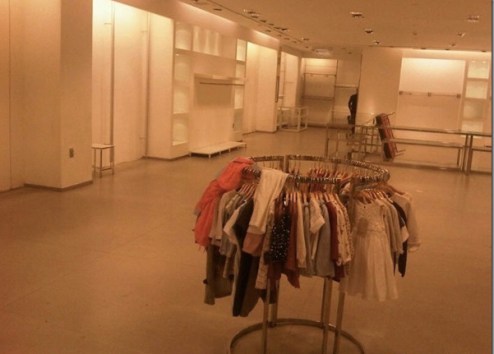
zaraZara store in Valencia after forced discounts at “just” prices

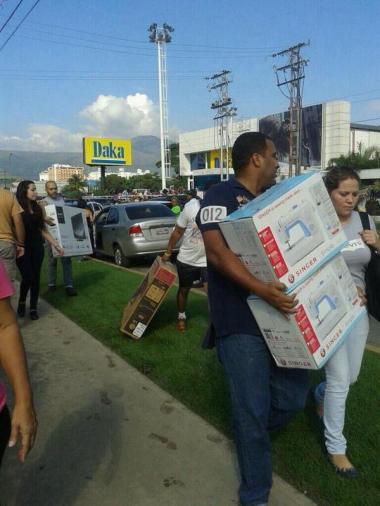
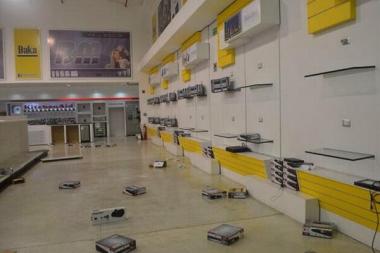
It is somewhat ironic, if not perverse, that in a country with chronic shortages of milk, toilet paper and other basic staples, someone comes out to reassure the population that the inventories of appliances and clothing, which have disappeared from store shelves after the Government forced shopkeepers to lower prices by as much as 70%, will be replaced by January.

Ironic, because few believe it. Perverse, because somehow the socialist revolution has been turned upside down into some sort of capitalistic consumer festival. Basic food staples are missing form store shelves, but the new revolutionary man is prodded into making new lines day after day, to get his new plasma TV or Blue Ray player, or cell phone, but at a “just” price. Hurry! Before inventories run out, get your socialist dream, but made by Samsung and discounted by Nicolas.

And after forcing myself to listen to a couple of Maduro speeches, I must say, he has improved his delivery, but the content is a rambling and incoherent potpourri of empty words, where the Venezuelan President sometimes catches himself going in the wrong direction and completely backtracks when he realizes the absurd or inconsistent path he is taking.

And in between, the Venezuelan President makes promises that are simply impossible to fulfill or makes statements that are outright lies. Such as saying that now that the Government has taken control of all storage for commerce, there are supplies for a full year of all goods (Where is the toilet paper, the corn flour or the milk?). Or promising that “investment” will come to Venezuela this year and growth will be strong and inflation is about to fall sharply.

Because Maduro really believes that lowering prices in a fraction of about 12% of all goods can somehow lead to a 5% drop in monthly inflation. Not only does Maduro show how little he understands the problem, but in the end the Government is a victim of its own tricks to insure that the CPI will not go up strongly, because it created created a diverse number of groups in the CPI to minimize the traditional ones that go up relentlessly. But more importantly, nobody has (or can?) explain to Nicolas that by doing what he has done, he has suddenly increased the velocity of money, at least temporarily, such that inflation may even pick up after his latest actions.

But more importantly, even if Maduro will score some points on December 8th. , particularly by motivating Chavista voters to go out and vote, he has caused a variety of new problems and distortions for the already stressed and strained Venezuelan economy.

To begin with the commerce sector is one of the two with the biggest growth in GDP and in employment generation during the last 14 years (The other being the Government itself). With his actions, Maduro will destroy jobs, shut down stores and create shortages. While Maduro is looking for short term gains in lowering inflation, he does not realize that the commerce sector that he has been attacking, barely represents 12.8% of the weight of the national inflationary index and of these, he has affected the goods of less than 20% of the index.

But more importantly, does Maduro  understand (can he?) that there are three factors that affect inflation: The monetary base, which the Central Bank will take care of assuring that it increases. The velocity of money, which Maduro has made sure increases faster now with people going out and buying just about anything they can get their hands on. And finally there is the the availability of goods, which is certainly going to decrease dramatically over the coming months.

And while Maduro was likely looking for short term gains with his war against commerce, the policies that he will put in place, like more controls, Government importing even more goods for the economy and persecution of merchants will create problems long term.

What is clear is that among other effects, we will see the following:

-The stores that were forced to lower prices over the last three weeks will reduce inventory, reduce investments and even close over the next few months. Many of the goods were being imported at the black market rate and are not part of the Cadivi lists, thus, given the accusations of money laundering against some stores for selling goods purchased with these illegal dollars, whole sectors of the commerce sector will certainly disappear.

-A gray market for goods will evolve in time. You will go to a store and they will not have a particular item on display or in their inventory, but the store keeper knows somebody, who knows somebody, who has a cousin who has one and can deliver it to your home at a certain price.

-Government buddies will be able to sell goods imported by the Government, creating yet another source of graft and commissions and a vast network of new beneficiaries of arbitrage. Nobody will prosecute Government owned distributors for selling goods at outrageous prices.

-The Government’s own import and distribution machine, which is already strained and incapable of importing and distributing everything, will be strained even further, distracted by the need to provide the new socialist hyper consumer society with appliances, plasma TV’s, cell phones and fancy clothes.

-New controls will delay imports and create new bottlenecks. Importers may get foreign currency approved, but if the new all powerful control office does not approve a price increase, the importer may not bring the goods to Venezuela until this happens. Other the importer will get the increases, but not the foreign currency.

-All of the items above lead to less tax collection and lower economic activity.

-Commercial real state construction will slow down. The Government also wants to control commercial storefront rents. Mall owners have been charging a percentage of sales ever since the Government forbid automatic inflation increases and/or dollar indexing of rents. The Government now wants to eliminate this practice too, removing all incentives to build new commercial real state properties.

All in all, another step backwards for the revolution and the Venezuelan economy. Like Maduro’s thoughts and speeches, the future is confusing, with each action creating a wide variety of new limitations and distortions. Sadly, Maduro will likely gain some votes on Dec. 8th with his actions, but the victory will be a pyrrhic one, the opposition will still get more votes than Chavismo and likely triple the number of municipalities it controls today. But another sector of the Venezuelan economy will be placed under control and close to intensive care, just because…


Freedom Of The Press In Venezuela?

November 23, 2013

I know, I have not been posting much. Spending a week in Caracas takes a lot of energy. It is not easy to digest, investigate, see friends, party, eat, drink, work, have gastritis and expect me to write at the same time. More so, when you decide that you better listen to a complete Maduro “cadena”, something I did twice this week, which is enough to cause a variety of ailments, both mental and digestive ones.

But I will start with a simple issue, the attack on the press by the Maduro administration and directly by Maduro personally. For those that even dare suggest there is freedom of the press in Venezuela, please shut up!. Every single day there are threats to sue, to bar, to fire, to do anything to intimidate the press. The Government controls the media and the media which is not controlled has been effectively silenced with few exceptions. With the recent sale of the Cadena Capriles to unknown “forces”, everyone was looking at flagship Ultimas Noticias to see if any changes would take place, but the first casualty occurred in sister publication El Mundo, whose director of four years Omar Lugo, was fired for putting this on the cover:

Mundo

A bit scandalous? yes, for a serious a economic newspaper it may be somewhat over the top, but certainly not as scandalous as Maduro’s accusations, charges and speeches. Yes, everything is on sale in Venezuela as the headline says, including the country’s international reserves that are going down at a rate of one billion dollars a month. Lugo had been asked to “behave” by the new owners, which he didn’t and he was summarily fired.

Then, Minister of the Interior and Justice Torres threatened to sue newspaper El Universal for publishing a picture of the pool of blood left on the ground by the death of an engineer who had been kidnapped and was killed by police when his relatives were trying to pay the ransom. The police happened to be nearby coincidentally, leading to the deaths of both the kidnappers and the victim. The picture was this one:

gruesome

Gruesome? Of course, but that is daily life in Venezuela, that happens to be the truth, a trith that the Government controlled media simply does not talk about at all, as if the dead were Martians. As if those killed were not Venezuelans, on both sides. As if those killed had no relatives and nobody noticed their deaths.

Similarly, Maduro accused regional newspaper El Tiempo of “inciting violence” for publishing the words of a storekeeper who said that he preferred to be looted than to sell goods to the public at an arbitrary discount, as it was cheaper for him. Given that it was Maduro who promoted the looting in the first place, this statement is simple pressure to not report what is going on with Maduro’s forced sale by merchants in Venezuela. Which by the way, is an absolutely illegal act, not backed by any act of a Judge, nor a process in which people have been allowed to defend themselves.

Then there is Miami Herald reporter Jim Wyss, who was held for 48 hours by the military for trying to report shortages at a city near the border with Colombia. Wyss is in charge of the Herald’s Bogota’s office, but is registered with Venezuela’s information Ministry,  and went to San Cristobal, in Tachira State to learn about the upcoming election, smuggling and shortages. He told his story very clearly in this article, where he tells us how his belongings were removed from his hotels, he was checked out and his computer and phones inspected and copied in what is certainly an illegal procedure in Venezuela. It is unclear if he would have been held longer, had he not been seen by someone when he went to the bathroom.

Maduro has also accused El Nacional of promoting an economic war against the Government, withheld permits to import newsprint for a number of papers and criticizes in a very explicit fashion the editorials of newspapers for being critical of him. To say nothing of the banning of a number of websites that publish the price of the black market rate, but taking advantage of the opportunity to ban any website, blog, page or site that links to any of them at the same time. Who knows how many websites have been banned by now? I do hope they find ways to use Facebook and Twitter, which would have a much higher politically cost if blocked. The Government even banned URL shortener Bitly to stop dollar pages from tweeting the price. Of course, all users of the service are now banned from using it in Venezuela. Yes, there are others, but…

The telecom regulator in Venezuela even asked Twitter to block the accounts of those that publish the black market rate via Twitter, because publishing such a number was illegal in Venezuela. These guys really have little understanding of what freedom of the press means around the world.

What’s next? Facebook? WordPress? Twitter? There is no limit for these little dictators, whose fascist roots seem to be surfacing more and more these days.

So, going back to the question: Freedom of the Press in Venezuela?

Are you kidding me?


An Untimely And Confusing PDVSA Bond Announcement

November 12, 2013

Sometimes it is not easy to write about Venezuela. I don’t want to be repetitive, thus I will not write again about Maduro seeing Chavez in pajarito (little bird) shape, after all it could all be a CIA drone playing with Nicolas’s brain (if any). That’s not a joke, it is hard to do worse than Nico is doing.

But today was promising, I could write about freedom of the press, because on the same day that we had a reporter for a major international paper telling us about his detention (And expelling!) out of Venezuela, and we had a screw up at the Government’s TV station, when someone began to show at VTV and Avila TV the same movie, Goodbye Lenin (Was it a joke?), until someone noticed  the irony and it was yanked off the air, forcing many Venezuelans to go to their favorite “quemaito” store to see the ending. Or when the Government forced all ISP’s, cable companies and the like to stop (read: block) webpages which broadcast the parallel exchange rate for the dollar, the same one that now has no importance for the Vice-President who was also in charge of announcing the useless ban of these webpages.

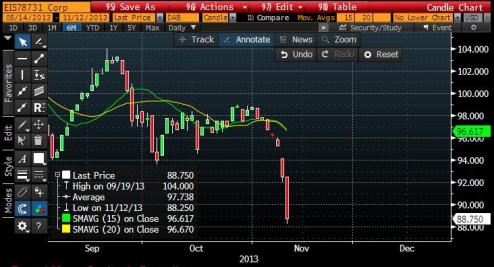
But given my involvement in finance, it was the news about the sharp drop in Venezuela and PDVSA’s bonds, the biggest single day drop in a while, that was sure to take the cake:

BY4aqLyCcAEVaoP.jpg_large

PDVSA 2022 in the last few months

But then came Minister of Energy and Oil Rafael Ramirez and made the most untimely and confusing announcement, when he said that PDVSA would issue US$ 4.5 billion in a new bond (no specs), which according to reporters was first described as being private, then to both some private companies and the Government, only to be later described as to being sold openly to the market.

So, we don’t know. Par for the course in Maduronomics.

The question is why would the Government announce such an issue on the worst day for Venezuelan bonds in the last few years? This would certainly cost money, since the yield today was the highest, for example, for the PDVSA 2022, that it has been since the pajarito got sick:

BY457f3CQAE6Vkz.jpg_large

Yield to Maturity of PDVSA 2022, since it was issued in February 2022

The problem is, PDVSA had to issue, but of all days, announce today? Come on, you have to be kidding me!

You see, we all knew that PDVSA had to issue. In fact, when Ramirez said last week that HE (with capitals) would announce any new issue, I knew that it was a matter of when, not if.

Because among other things, PDVSA needs to pay the 2013 issue (about US$ 1.3 billion) on Nov. 17th. (by Monday pues). Given that the PDVSA Pension Fund owns about 600 million dollars, we all thought they would just shove a new issue up their throats.

Maybe that is why the issue is private, but public, but open. All at the same time. Maybe it will do many things at once. Maybe that is why it is so confusing.

Among other things it could:

-Be used to pay the PDVSA 2013 which matures on the 17th.

-Be used to pay the Central Bank PDVSA’s debts in dollars (directly with the bonds) or in Bs.. Thus, it could be a dollar bond and a Bs./Dollar bond at the same time. (These guys are creative!). As to those that worry about a “high coupon”, it could be low, it would just trade lower in the international markets. Now, if it is Bs./US$, the Central Bank would los money if it sold them in Sicad, for example, but if there is a big devaluation in December, then the Central Bank makes money. (Told you, they are creative)

-Be used to give US$ to companies, so as to reduce pressure on the parallel rate. Unless you really believe that this rate is not significant like VP Arreaza says.

-It could be used to pay oil service companies, like Ramirez said last weekend. But in this case, it will likely happen after a devaluation, so as not to affect the Government’s accounting.

Confused? Aren’t we all. It was as confusing a statement, as it was untimely.

As to the bonds, J.P.Moragn and Barclays downgraded Venezuela today. And lest you think there are no bulls left in the world, there is still Bank of America on that camp, after their nerdish report this week. (Quico is nerdier than me, I read it, he wrote about it!)

But my feeling is bonds go lower, even if they bounce a little before that. Simply put, there are too many people trying to get out and few buying (except shorts). Investors used to believe that there was some sort of commitment to pay under Chávez, but under Maduro, given what happened with Sidetur and what he has (or not) done on the economy: All bets are off!

It is remarkable that the PDVSA 2014 was yielding 15.7% today, a remarkable yield given, that it only has eleven months to mature. I don’t think PDVSA will not pay it, but after all, I am not that pajarito…

Note Added: PDVSA announced on the morning of Nov. 13th. that the bond will be private. It will have a maturity of 2026, with three equal payments in 2024, 2025 and 2026. The coupon will be 6% and the bond will be used to pay suppliers of the company to the tune of US$ 3 billion. The reminder US$ 1.5 billion will go the the Central Bank.


It Is All About Arbitrage in Venezuela

November 10, 2013

While it is clear that the Maduro Government is worried about inflation, there are many things about going after appliance stores that just does not jive. The attack on them was too vicious, particularly against Daka, which was singled out among all and likely had gigantic losses. And I say it is not easy to understand the viciousness against this sector, because appliance inflation has gone up 65% this year, comparable to the inflation rate and certainly less than the huge rise in that other unimportant exchange rate called the black market rate.

But over the years, I have learned that when you don’t understand what makes Chavismo act and it has to do with exchange rates and finance, all yo have to do is think about the arbitrage between the official and the parallel rate. I still recall when I could not understand where all the dollars were coming from into the swap market, when I realized that the Government was selling Argentinean bonds into the market. It was all about arbitrage. And when the Chavista bankers got wealthy, it was all about arbitraging the Government. The Government changed the rules and they changed how they did it. In both cases, the Government got tired and went after its buddies.

And I suspect that it is the same in this case. Yes, Maduro wants to scare the private sector to hold prices in line, but in the end, it is going after groups considered to have some form of affinity to the Government. My feeling is that this is all about arbitrage.

You see, when exchange controls were imposed in 2003, initially there were relatively small differences between the official rate and the parallel rate, which was established by the swap market until 2010 and by the black market since then. Differences were initially 20-30%, which gave some groups some incentives to do business arbitraging the official rate with the parallel rate. By 2010, the difference got as large as 100%, where you can really make a lot of money if somehow you can obtain official dollars, import or make something and then sell it at a price set by you.

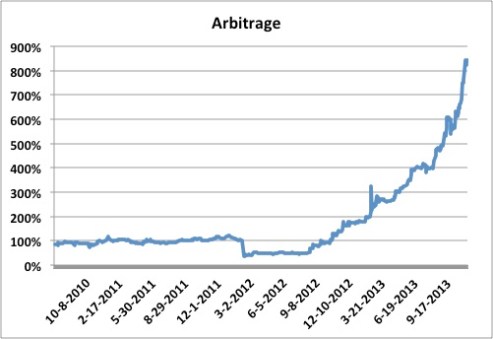
You see, when you buy anything in Venezuela, seldom do you know whether the dollars for the product or some of its components came from, either from the official rate or the parallel rate. Since ordinary people have little access to official dollars, their reference price is the parallel rate. If something seems cheap as measured by the parallel rate, then it’s ok. But the guy at the other end may be making a mint, because the difference between the two (taken from the data in one of the banned sites) has soared over the last year and a little bit, as shown in this graph:

Arbitrage

As you can see, a little over a year ago the percentage difference between the unmentionable rate and the official rate exceeded 100% and has now soared to over 800% (I believe this is a first in the world’s economic history). What this means is that if you somehow can get your hands on official dollars or officially bought products, then you can make a lot of money if you can sell your goods somewhere in between, particularly if because of the restrictions in foreign currency, most goods are in short supply. Supply and demand are the biggest enemies of Chavista policies.

There are basically three ways to obtain dollars: Cadivi, Sitme/Sicad or the parallel exchange rate. Cadivi (Bs. 6.3 per dollar) only works for certain items on a list that has become shorter over time. Sitme/Sicad has varied over time. In Sitme (Which was Bs. 5.3 when the official rate was 4.3 per dollar) there were fewer rules than Cadivi, you just needed to be lucky and know someone in the bank to get some dollars. In Sicad, you can obtain dollars at about Bs. 11 per dollars, but each “auction” has different rules and target sectors.

Let’s assume you are a bicycle importer. You got some Sicad dollars and bring 50 bikes which cost retail in the US, say one thousand dollars, with Sicad dollars at Bs. 11. Because there are few one thousand dollar bikes in the market, you can probably charge anywhere from Bs. 20,000 (cheap!) to Bs. 50,000 (not so cheap!) for it. To the buyer, who knows how much the bike costs in dollars abroad, even the Bs. 50,000 sounds reasonable. To the seller, it is just a matter of gauging interest. If bikes in that range are in short supply he can go the Bs. 50,000 route. Nobody knows whether he got dollars at Bs. 6.3 or at the unmentionable rate. At Bs. 50,000, he is making close to 400% profit, but to the buyer, the price is reasonable.

That is how screwed up the whole system is now in Venezuela.

But there is an additional way to get things at the official price for a dollar. You see, ordinary people and companies have to go through Cadivi, but the Government does not. And Government imports keep increasing. Last year, they were US$ 34 billion, versus US$ 26 billion for the private sector. (Giordani’s goal is zero for the private sector) And the Central Bank reported that Govt. imports went up 20% in the first half of this year. But the Government does not have the distribution capacity or the point of sale capacity to deliver all this “stuff” (some of it does not exist) to the consumer. It hires the private sector to both distribute and sell some of it. And there are huge arbitrage opportunities there, for the simple fact that the consumer has no clue as to whether the stuff was bought at the official rate or the parallel rate.

Which brings me to my punchline. My suspicion is that the viciousness against Daka was largely due to the company either receiving goods from Government imports (My main bet!) or receiving some Cadivi dollars for the stuff they sell. Daka was simply taking advantage of the arbitrage the Government was handing it over on a silver plate and the Government found out about it and got mad.

My reason for thinking this, is that all these appliance retailers have been close to the Government in the past. Daka received almost half a billion dollars from Cadivi over the nine years covered by the Cadivi data and some of the other retailers inspected received similar amounts. Another reason: Where are the owners defending their business?

In fact, I have always wondered how some business thrived in Venezuela which made no sense. Like computer makers. But after seeing that they received half a billion dollars also in nine years, then it is clear that the business was more arbitrage related than a real business.

Government dollars are obtained and used at the discretion of any Minister. (Think Minister for Sports!) The Government also got into the appliance importing business, using the Yuan from the Chinese loans, but nobody knows what they import or not. Given the closeness of some of these retailers and the Government, I would bet that the retailers were caught padding margins obscenely and Maduro (or the VP?) knew exactly at what price the goods or the dollars were obtained, leading to the events of Friday night.

In fact, Daka or Pablo Electronics charge prices which are in many cases better than those in Government stores like Bicentenario. The question is then: Who is making the money in the arbitrage from that case? Yesterday someone twitted the picture of a price tag for a 32 inch TV at Bicentenario, which clearly showed the model number. The price was Bs. 10,500 (US$ 1,666 at the official rate), I found it at a US retailer for $345 or Bs. 2,173, a 383% difference. The stuff costs some money to bring, but not that much. Who is pocketing the difference?

In Venezuela these days, it is all about the arbitrage both in the private and the public sector.

Maduro also wants to outlaw the laws of supply and demand in which too many people around him benefit from. He wouldn’t be able to.


Maduro Promotes Anarchy In Venezuela

November 9, 2013

President Maduro ordered that all of the products of an appliance distributor called Daka be sold at “just” prices because of some “irregularities” found in the pricing and thus promoted anarchy in both Daka, as well as Pablo Electronics, a store that was mentioned by the Venezuelan President.

Starting last night, people gathered around the stores of these two companies to participate in the “piñata” creating fights, some looting and even shots were fired as the free for all began. While in some stores order was maintained by the police and the National Guard, in others, people left without paying.

And it was a free for all in some cases, as customers broke windows, took stuff without paying and authorities and “pueblo”, both opposition and chavistas, participated in this obscene act, which shows how low the country has come. One has to wonder whether Maduro was losing grip of the situation with his actions, which will certainly lead to shortages for appliances in short order.

Here are some shots from the Daka store today. A return to “ta barato dame dos” (cheap give me two):

dakan1

and more

BYoyCjgCAAA10VK

And this National Guardsman must be thinking he had a good day:

BYo7EH4CUAAH4J3

And indeed, the shelves were emptied

BYo0zGNCUAErIMM

even if some shots were fired to maintain order at some point:

BYocP49IQAAFZpz

The curious thing is that while the “irregularities” have not been described, it is a matter of “just prices”, calculated at the official rate of exchange of Bs. 6.3 per dollar, which curiously does not appear to apply to appliances or TV’s. In fact, I reviewed the list of CADIVI importers up to 2012 and Daka is not in the list between 2004 and 2012 and Pablo Electronics was assigned all of US$ 135,000 in 2012, the last year for which Cadivi published the list.

Thus, these importers are being punished, without proof, for importing at the black market rate and trying to make a profit amid shortages, which in fact raises prices even further. What this means going forward is that there will be more and more shortages and higher prices. But Maduro fails to get that.

What is more ironic about all this is that Pablo Electronics and Daka sell cheaper than the Government’s Bicentenario stores. Moreover, in the Mi Casa Bien Equipada program, in which the Government “sold” Chinese Haier appliances at “just prices”, prices turned out to be over 50% higher than those charged by Amazon.com. Where was Indepabis then?

In the end, I have to wonder if part of the stuff that Pablo or Daka are or were selling, was actually imported by the Government and resold by some “guisadores” to these stores for a quick profit. With the arbitrage close to ten to one at this time, it is too tempting for Government operators to set up deals like that. Just think, you import and let someone else take care of the distribution and sale.

All in all, a very sad scene in Venezuela, where people seem to have lost sight of reality. This maybe just grandstanding by Maduro, but the scenes are reminiscent of those seen in Zimbawe in 2007, where the “inflation police” forced shopkeepers to sell things at “just” prices. And we all know how that ended up.

In the end, the rule of law no longer exists in Venezuela. A bullish Government can just push you around, inadvertently pushing the country closer to anarchy. Today, appliances, tomorrow, Harina Pan, the day after, there will be nothing left. At that point will people fight each other or decide to get rid of the Government?


Clueless in Caracas

November 6, 2013

clueless

It took Nicolas Maduro three hours to announce the “new” economic measures. But during this time, he failed to announce any real economic measure. What he did announce, was a set of more controls, checks, threats and institutions to allow (hope?) the Government to force prices down as a way of controlling inflation. To Maduro, his Government or that of his predecessor have done nothing wrong. It is all part of an economic war waged by who knows whom, which requires no change in economic policy. Instead, he blames speculators and hoarders for the problems and “Cadivismo” is out of hand.

Funny, who created Cadivi ten years ago, who has managed and allowed it to become the monster it is today?

But in the end, as Maduro called the black market dollar fictitious, showing and proving how clueless in Caracas the Venezuelan President is. The fictitious dollar will continue to soar and feed inflation, the more Maduro threatens and controls. As usual the reaction is simply more controls, which assumes the Government can do it all (and with no corruption), as if Chavismo has learned nothing the last ten years.

The “things” Maduro said he would do are:

-A great fight against hoarding and price speculation.

-A new framework for price controls.

-A new fund to stabilize prices of essential consumer items.

-A new National Center for Foreign Commerce to oversee foreign currency policies.

-A budget for foreign currency (They did not have one?)

-A new National Corporation for Service, Logistics and Transportation.

That’s it. Period.

The Government continues to say that there are enough dollars for the Venezuelan economy, failing to ask the basic question: At what price? If everything is too cheap, everyone will like to eat, buy, use the best, whether it is lomito (tenderloin), caviar or iPhones. At Bs. 6.3 per dollar, there is basic infinite demand for them, there are myriad strategies for arbitrage of the same (and by the same) Government that creates all these rules, controls and regulations. It is a losing game for Maduro and the rapid increase of the fictitious dollars in the last few weeks proves it. With an increase in monetary liquidity of 20% coming in the next few weeks, fictitiousness will explode in the face of clueless in Caracas.

In closing, internet websites like mercadolibre.com, tucarro.com and tuinmueble.com were singled out and blamed for part of the inflationary forces in Venezuela in the continuing satanization of the internet in Venezuela. At this rate the jump back into the nineteenth century is being prepared with eagerness.

Truly a sad spectacle of ignorance and emphasis on the same policies which have failed over the years. Chavismo is never to blame for any problems, it is always someone else’s fault.

Truly clueless, truly sad.


Venezuela Declares War On Twitter

November 3, 2013

Maduro-volvio-encontrar-pajarito-Chavez_IECIMA20130614_0033_7

It is somewhat ironic that while the Venezuelan Government has not made a single tweet about the NSA monitoring the email accounts of a bunch of Venezuelan politicians, it seems to have declared war on Twitter, with Maduro going as far as comparing the six thousand followers he lost to the “desaparecidos” of Latin American dictatorships and suggesting that this is a right wing attack led by Twitter. The whole thing is absurd and laughable, but at the same time makes you wonder what goes on in these people’s minds.

It all began with Maduro losing 6,000 followers recently, or about 0.4% of his followers in one of those periodic “clean ups” that Twitter does, erasing phantom users, unwanted users and those denounced by other twiteros as spam. But apparently Maduro’s experts on social media noticed the drop and decided to raise a stink. You have to wonder why such numbers are so important to the revolution and revolutionaries, you would think polls are more significant at this point.

And by now Maduro has mentioned the topic twice, Cabello once (Did you know Twitter has country heads and Venezuela’s is Ravell’s son of Chigüire Bipolar fame?) and they are by now proposing an alternative Twitter, which I guess will be called either www.piaste.com or www.tardepiaste.com)

But you really have to wonder what motivates these guys, after all, Maduro has north of 1.4 million followers, which in itself shows how democratic Twitter really is and how insignificant the number of followers really is. I mean, Katy Perry has 30 times Nicolas’ followers, topping Justin Bieber. Do you need further proof of how meaningless followers are?

But beyond that, do they really want to make fool of themselves creating another “alternative” social network for radicals? Who would use it? Don’t they realize how competitive the social network world is? I mean, social networks were invented, funded and developed by capitalists, few of which had the “good” of the world as their goal. In fact, most of them are looking for the gold at the end of the rainbow.

And you have to wonder what happened to the alternative to Facebook, called Face Popular, rather than Caraelibro.com, which last I looked was something like the 80,000th. most important website in the world. Compare, for example with El Universal, which is the 2,458th. most important website in the world. (I mean, elchiguirebipolar.net beats face popular hands down!) But perhaps one has to wonder why Facepopular links to all important social networks in its own website or why Minister Iris Varela announced the website via, of all places, Twitter.

I mean, calling Maria Corina, Leopoldo and Henrique “La Trilogía del Mal” is laughable enough, more so when Diosado Cabello, who does look like a really bad guy, does it, but involving Twitter in a plot against Maduro is mostly laughable, except it also makes you feel like weeping from embarrassment.

More ominously, I wonder if Maduro knows that Twitter will be going public in the next couple of weeks? Maybe the only reason is to have the funds to further attack Nicolas. I mean, with the billion dollars that will be raised, Twitter could probably wipe out half of Maduro’s followers.

And I bet they would not even notice!


Giordani´s Cyanide Candies?

October 29, 2013

Giordani

Nelson Bocaranda reports in today El Universal that the nomme de plume Simón Andrés Zuñiga, frequently present in aporrea pontificating about economic matters corresponds to none other than Minister of Planning and former Minister of all things financial Jorge Giordani, citing as the source former Minister of Planning Felipe Perez.

I had read Zuñiga frequently, but if true his writings gain an added value because Zuñiga claims to be an economist.  But Zuñiga frequently shows weak points on economic matters, citing isolated cases, like Argentina’s Caja de Conversión but ignoring other experiences on the matter. (Hong Kong anyone? Or Venezuela pre-1970?). In fact, he cites Ecuador as another example, suggesting that Correa can not remove the dollarization he inherited because of its political cost. In fact, Zuñiga’s arguments are dense on ideology and short on content.

Because it takes a very ideological point of view to suggest dollarization, or any sort of foreign exchange flexibility, would “bad” for the workers, given that Chavista policies have generated 1000%-plus inflation over the last 14 years, truly hurting the working class, which managed periods of prosperity only when the Government had the foreign currency to keep the parallel rate down and whose purchasing power is currently decimated.

While the articles show an understanding of how the parallel market and why you need funds to lower it (At least better than Minister of Oil and Energy has), it seems to blame everything on conspiracies, as well as a deep belief that exchange controls have to be in place, despite the fact that economic history shows their recurrent failure. The main conspiracy: That players want to benefit form the bounty that Cadivi represents, but Zuñiga, whether Giordani or not, fails to note that it has been those near the revolution that have benefitted the most from it.

And that cyanide candy is not mentioned in the article.


Venezuela Creates Vice Ministry For Supreme Happiness

October 25, 2013

images

In the latest move by the Maduro Government, the Vice-Presidency for the Supreme Social Happiness of of the Venezuelan people was created this week. While many have laughed at the idea, I disagree. I think this office was badly needed and will play an important role in celebrating life in Venezuela and making its citizens happy.

While there have been no details as to what the office will do, I can think of so many ways that it can celebrate and promote the happiness of all Venezuelans, particularly by pointing out happy events around the country, of which there are so many.

As an example, the Vice-Ministry could make sure to interview on TV anyone who managed to buy a package of corn flour, which has become one of the supreme moments of any Venezuelan’s life in the the last few months. And even if you think that finding toilet paper is another such happy moment, the Vice-Ministry could celebrate not only the finding of the roll of toilet paper by those citizens that lacked it, but more importantly recreate the moment of supreme happiness that represents using it for the first time after not having any for a while.

Since happiness is relative, imagine how happy someone that survives an express kidnapping is, another area where the Vice-Ministry is likely to have a strong participation.

It is unclear what the budget for the Vice-Ministry is, but there is some overlap in what it will do. For example, if you manage to get a new passport, should that be paid by the new Ministry, given the happiness that the moment will provide, or should it still be paid by the Ministry of the Interior? Same with Cadivi. If you get your foreign currency for travel, given the happiness that this induces in you and your family, should it come out of Cadivi’s budget or the Vice-Ministry?

The range and scope of the new office is so wide, that eventually the Vice Ministry may become the Government, since the role of Government is essentially to try to make the population happy. The danger however, is that the Vice-Ministry may one day join the opposition when it realizes that nothing will make the people happier than the departure of Chavismo from Government.


A Perturbing (Or Is It Disturbing?) Budget Presentation in Venezuela

October 23, 2013

merentes

So, Minister of Finance and former Vice-President for the Economy Nelson Merentes presented the budget yesterday in front of the National Assembly and made us all feel at ease, projecting inflation for 2014 at “only” (my words) 26-28%.

This is actually quite scary, because a year ago he was projecting 28.8%  for 2013 ( including the decimal) and now it is almost 50% and in 2009 affable Nelson was projecting single digits by 2012, which he also had projected for 2011.

But the whole speech was quite disturbing, if only because Minister Merentes suggested that the Venezuelan economy faced three perturbations: inflation, shortages and the foreign exchange system.

Well, when you think about it, there is only one perturbation: The Chavista-Madurista Government that imposed the exchange controls that have led to shortages and spent and printed money, causing inflation.

That is a single explanation, a single perturbation. But quite disturbing.

But maybe you can add a second one: The fact that the Venezuelan economy has been mismanaged by non-economists like Nelson Merentes for too long.

Because nobody understood what he meant when he said that inflation is “out of range”. Venezuelan inflation has been “out of range” for too long due to irresponsible policies and Government officials. Inflation is what it is, it has no range, ask Mugabe. Venezuela has the second highest inflation in the world. At least five times the rate of any other Latin American country.

Maybe Minister Merentes should coldly think about the numbers he presented. He is a mathematician after all, he knows no economics, but he should be able to at least understand orders of magnitude, no? For example:

-He proposed a budget of Bs. 550.36 billion Bolivars, US$ 87.37 billion dollars at the official rate of exchange, a full 38.8% higher than that presented a year ago by his predecessor the non-economist Jorge Giordani. But wait! Before you think about that 38.8%, it turns out that since it was presented and up to October 2013, the same budget has been increased by 61%. Yeap! With two months to go the Chavez/Maduro Government has spent a full 61% more than was budgeted.

-And if you compare the 2014 budget to the 2010 budget, as presented originally, which is the only fair comparison, the 2010 budget was only 159.40 billion Bs., so that the 2014 budget is “only” 3.45 times the budget of only three years ago.

-And in his budget, Merentes proposed to issue debt in the amount of Bs. 112.7 billion in 2014, which is an amount almost identical to the projected income of the Government from oil, which will be, according to the same presentation Bs. 114.59 billion in 2014. Think about it, the Government will issue debt equal to the amount of money it will receive from oil. Talk about being irresponsible.

-And in 2013, up to today, monetary liquidity has increased by 35.5%, a huge (and inflationary!) number and that if it grows like it did last year in the last two months, it will end growing by at least 50% by December 31st. (This happens every year, a huge jump in M2 due to seasonality)

But despite all of the above, Merentes called for the need to “investigate” why inflation in Venezuela has been in double digits for thirty years in Venezuela.

There is nothing to investigate: Irresponsible Governments is the explanation. Period.

And despite all this, Merentes projects GDP will grow between 4% and 6% in 2014. Funny, last year he projected 6% for 2013 and we are unlikely to go over 2%.

And, yes, there will be no devaluation…

At this point, the fantasy was complete, I changed channels and turned to watch a more realistic movie about a Martian invasion.