The Right Diagnosis For Venezuela, The Wrong Hands to Fix Things.

September 17, 2013

fixit

Suppose I wrote in this blog the following about the Venezuelan economy:

“The problems to be solved (in Venezuela) are related to endemic inflation and a productive system that has not responded to the stimulus of government spending, while rentism has deepened the country’s dependence on oil. It can be characterized by inflation above thousand percentage points in the 14-year rule of Chavismo, with food prices rising 1760% in the same period, the highest figure in all of Latin America, with clear signs of acceleration, as May inflation reached 6%, highest in a month, than in a full  year anywhere in Latin America. Production has only grown by 10% in 14 years, the lowest in the region, except for Haiti. The rate of industrialization in this government continued to decline, reaching 13.9% last year, when it had reached 20% in 1986, and non-oil exports went from being 40% of the total, to only 4% in 14 years. The fiscal situation is severe, reaching 15% of GDP, with problems to finance social spending, with oil production in a very problematic situation, despite high oil prices, and the Government has resorted to the Central Bank printing money in order to finance itself.

The causes of the situation have to do with increasing the size of the centralized state inherited from the Fourth Republic, which was unable be transformed from the top and has absorbed in its corruption a large fraction of the Government’s execution. In addition, social spending and production incentives have become inflation, not production, in the presence of a regime and import policies that have harmed the development of production, especially by the issuance of paper money by the Venezuelan Central Bank.”

And suppose then that among the solutions I proposed here that the Government talk to the productive sector to establish clear rules, remove the Board of the Central Bank, reform the tax system, create a monetary stabilization fund, implement a transition plan so that everything that is imported is made in Venezuela and within seven months allow the currency to float freely.

I am sure that more than one Chavista would read that and accuse me of being a capitalist, an ignorant and who knows what else. Because anyone that writes the above is simply saying that Chavismo has failed miserably. No?

Right diagnosis. Wrong hands to fix it.

Except that I did not write that. With small changes, just to make a point, the above was written by a group of Bolivarian professionals, under the title ¿Que Hacer?. led by former Minister of Planning Felipe Perez and contained in the fourth version of a very long document, which is exquisite in its diagnoses of the economic failure of Chavismo, but, in my opinion, fails miserably on the solutions, as it proposes as a solution to the execution problem of the Government  to turn control to communal power.

I had read the first revision a few months ago, but this one is much more detailed. What is shows is that someone that knows economics knows how screwed up the last fourteen years have been. What I find amazing is that in the face of that critique, anyone thinks that Chavismo deserves another chance to screw up. So, if you speak Spanish and have patience go read it, the details on the diagnoses of the economic problems are pretty, pretty good.


The Curious And Dysfunctional Iranian Prefab Housing Contract

September 16, 2013

casas

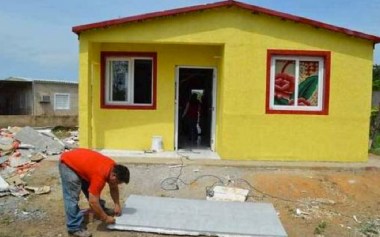
Yesterday in El Universal, there was this curious tale about an Iranian company that sold the Venezuelan Government three factories to make prefab homes. The whole tale is one of the dysfunctionality that the Venezuelan Government has become. From start to end, the whole thing is a story of inefficiency, incapacity, commissions, fights and over payments. In the end, three factories to build prefab housing sit idle nine months after being handed over to the Government. Of course, all three factories were grandly inaugurated by some Government official and apparently only six houses have been produced by three factories with supposed capacity of 380 houses per week.

Meanwhile, the lawyer for the Iranian company that built the factories says he was ripped off. You see, Iranian companies can not work directly via the US because of the boycott, so that there are companies that charge 10-15% commission, according to the article, to “triangulate” the payments via Canada. Well, the US$ 2.8 million payment is apparently in some sort of limbo, as it was sent to one of these intermediary companies and never reached Iran. The Iranian guy even boasts that some of the equipment for the project traveled via the US, “without anybody” noticing.

Nobody knows why the plants are not working. One guy says they have not been completed. Another says that the Government has not received all the equipment. Meanwhile, apparently Bandes is asking that the US$ 2.8 million in profits be returned. And another guy charges that Venezuela paid twice for the same equipment, with one of them being just steel scrap.

The story is complicated and not easy to understand, but the end result is the same: Like so many other projects, Venezuela spent millions of dollars importing technology that likely was available in Venezuela, from a country that is probably more costly to do business with. In the end, it does not appear as if anything is happening or will happen with the project and the money was simply wasted.

A contract that simply shows how dysfunctional the Bolivarian Government is from beginning to end in most of the projects it manages.

(I also found this comment intriguing in this interview in the same issue of El Universal: An accusation that in some housing projects, the cost of the housing units ended up being US$ 294 thousand. Way to go! Theye were either huge, so much for popular housing, or a huge rip-off, you take your pick)


What’s Up With Merentes’ Proposed “New” And “Improved” Currency Swap System?

September 12, 2013

swapFor the last two weeks the Government has begun talking about the possibility of reviving the swap (permuta) market, given that Sicad has been a gigantic failure, in that it has done nothing to lower the parallel black exchange rate and the Government has discovered all sorts of scams in it, aided from within.

So, are we to believe this talk about a new foreign exchange swap market, where people will be able to go and buy foreign currency at prices determined by free market forces and without any limitation?

Well, call me skeptical, dubious and  incredulous. I just don’t think so.

Not under the current conditions of limited foreign currency, excess monetary liquidity (and growing!) and artificially low official exchange rate.

Just as a reminder about swaps, when the Government imposed exchange controls in 2003, it banned the use of Brady bonds as a foreign exchange mechanism, which was the parallel mechanism in the Caldera exchange controls in the 90’s.

But then a clever guy, realized that the permuta (swap), whereby you can exchange an object for another, was an instrument which is part of Venezuela’s Codigo de Comercio (Commercial Code) and had nothing to do with securities. Thus, you were forbidden to buy or sell dollars, but you were not forbidden from swapping your house in Caracas for one in Madrid, or a chocolate ice cream for a vanilla ice cream, like the picture above, or more importantly a dollar denominated bond for a Bolivar denominated bond, at a rate determined by you.

And thus the permuta or swap market was born.

Almost three years later, the Government gave its Seal of Approval to the permuta market, when it approved the Foreign Exchange Illicits Bill,in which the Government, recognizing the need for a escape valve, exempted securities explicitly in the Bill. Before this, there was no punishment for the swaps, after this, the Government was acknowledging that it was legal.

The market boomed, until May 2010, when Chávez, upset over how much the swap or parallel rate had gone up, decided to intervene that market, which was mostly supplied by Government dollars, and in the process, jailed a dozen brokers and intervened and shut down some 48 brokerage houses.

So now, the Government wants to revive this relief valve, but it is clear that it does not want the rate to be public or to go up. Furthermore, it wants official rates, those of Cadivi and Sicad to be lower than they should be. When they launched Sicad, there were all sorts of expectations that the Government would make that exchange rate higher and instead, the Government sold the dollars lower.

But suppose the Government overcomes this, decides it does not care at what price dollars go. Well, the problem is that I don’t think they have the foreign currency to supply this new market so that it does not go up.

Let me explain…

When the Government stopped the swap market in 2010, multi-nationals had not been given any foreign currency to repatriate dividends at the official rate of exchange for three years. It has now been six. These companies have lots of Bolivars just sitting there losing value, day after day. The moment the Government creates a legal foreign exchange parallel market, these companies are going to want to go to it and buy dollars. At almost any price.

Add to that the many Venezuelans that have savings. The many companies that would see such a market as a way of reactivating their business. The arbitrage between the official rate and the parallel rate.

And what you have is a lot of pent up demand to buy dollars.

But the Government has given signals that it does not want to give dollars to the private sector. It has given signals that it does not have as much money in parallel funds as it did in 2010. To top it all off, it would be very costly for the Government to issue debt, as it did in 2009 and 2010 to sell bonds to ease off demand in the parallel market.

Thus, I believe that if the Government really created a legal parallel market, the black (now) parallel rate (then) would move up. Strongly.

And thus my skepticism…

But let’s suppose I am wrong. The Government has realized that things are getting worse. It does not mind if the rate goes up. It is willing to sell lots of dollars into the new swap market.

What will happen?

Well, let’s do the following Gedanken experiment:

Let’s assume that the conditions in 2010, prior to the shutdown of the swap market, were “equilibrium” conditions. That is, the swap market, which was roughly a free market, provided a good measure of supply and demand, in the context of the exchange controls, which kept the official rate at Bs. 4.3 per US$. All the Bolivars that did not get US$ at Bs. 4.3, went to the swap market for imports.

What would be the equivalent Gedanken “equilibirum” be today?

Well, let’s use May 1st. 2010 as the reference date for that moment. On that date, international reserves stood at US$ 28.2 billion and M2, monetary liquidity stood at Bs 238 billion, so that the “intrinsic” exchange rate stood at Bs. 8.3 per US$. That is if you compare how many Bolivars there were for each dollars in reserves, there are Bs. 8.3 per US$, fairly close to the swap exchange rate of Bs. 8 at the time the swap market was closed.

If we do the same today, international reserves sit at US$ 22.17 billion, while monetary liquidity sits at Bs. 912.9 billion, so that the same “intrinsic” value is at Bs. 41.18.

Thus, going back to our Gedanken experiment, if we think that the conditions in 2010 were those of an ideal equilibrium, with a fixed official rate of exchange at Bs. 4.3 per US$, what should be that same rate today, to make conditions in terms of M2, international reserves and the official rate of exchange identically the same to those of May 2010?

The answer is that the official rate of exchange should be today at Bs. 22 per US$! ((4.3/8)xBlack Rate)

And therein lies the problem. By holding the official rate so low, the Government has created an artificial system, in which any item that gets officials dollars is so cheap, compared the huge amount of Bolivars that have been created at a rate of 65% increase per year and the inflation rate of over 20% per year for the last three years, that everyone wants to buy it.

Thus, if the Government created this fantastic new swap market, all you can buy, and absolutely legal, it would have to devalue to Bs. 22 or near that, in order for conditions to be similar to those of 2010.

Except that things are worse:

-The Government has fewer dollars.

-Pent up demand is much higher.

-The Government could issue much less to in bonds to supply the new market

-The Government is not ready to devalue to Bs. 22, nor does it want the unmentionable parallel rate to be higher than it is.

This, my friends is why I am such a skeptic of all these announcements about the newfangled swap market.

Thus, I think the Government will set up a controlled, regulated, limited, maximum, minimum, rules, regulated “market” at a rate much lower than the current black rate, which in the end will do nothing to stop the other rate from rising. Maybe, just maybe, after this new market fails, will the Government will be ready to implement something more realistic.

And this would require both a sharp devaluation and a slow down in the growth of monetary liquidity.

Thus, I find nothing in these announcements that makes me excited.


Waiting For Venezuela To Bottom

September 8, 2013

bottomless_pit

Many people seem to think that Venezuela is or may be close to some sort of economic bottom. That the current economic situation is unsustainable. That things are about to crack up somehow due to the economy. Collapse, explode or implotion.

Well, think again..

Countries are like the shares of a bad company. they keep going down and down, and too many people think it can’t go lower and they buy more, but it continues to go down.

I think Venezuela is the same. Things continue to deteriorate, shortages, blackouts, inflation, crisis after crisis and conflicts, crime and constant devaluation.

Guess what? That is the story of the last fourteen years, but the bottom may be far into the future.

First of all, think Zimbabwe. If country’s economic crisis hit a bottom and political change would follow, then Mugabe would have been a goner long ago. Instead, there is Robert Gabriel Mugabe, plodding along, year after year. In the middle, the country has seen a variety of things, from hyperinflation, to sanctions, to austerity, with plenty of elections all the time. And Mugabe is still “it”, leading and ruling the country, like Chavismo owns ours. Except Chavez died.

But Mugabe does not have the pipeline of dollars that Chavismo has, nor the leeway to adjust and change in order to plod along along longer. In fact, I suspect that Mugabe has more smarts to adapt and change politically and that is about it.

Think about it, Chavismo has the barrel of oil at US$ 107, give or take some cents, almost as high as it has ever been. It also has a gazillion barrels of oil (and gas, and gold, and iron) underground that it can lease, lend, promise and/or mortgage, in order to achieve its means.

Yes, thing are not well, but an adjustment here, an adjustment there, and quicker that you can say devaluation or default, for that matter, things could improve rather quickly.

And they have. Really. Things are worse now in terms of dollar availability, for example, but at 21% scarcity levels, we are far from the 49% levels of 2007, or the electricity rationing of the 2010 crisis. Think about it.

And oil is as high as it has been in the last five years for example. That means that even if the parallel funds have less in them, they probably have at least US$ 16 billion to muddle through until things get very tight. And if PDVSA needs money, the Central Bank can increase lending to it, by 50%, rather than 28% like in the last year. Crazy? Yes. Inflationary? Yes. But when you have no scruples, the show must go on! As long as you can keep it going.

You are worried that there is a shortage of dollars? Well, let me remind you this is a revolution. And the reality is, that there is a shortage of foreign currency for the private sector which imported US$ 38.7 billion in 2007, but only received US$ 26 billion last year. That is a 32.8% drop. But guess what? The Government in the meantime, has gone from importing “only” US$ 19.7 billion in 2007 to importing US$ 34.3 billion in 2012, that is “only” a  74% increase.

So, you “feel” the lack of foreign currency, because you get essentially 33% less, but the Government has almost doubled what it imports and the Central Bank said those imports went up 25% in the first half of 2103. Yes, their imports are inefficient, overpriced, full of graft and the like, but they have the money, you don’t. Feels bad, but is reality…

This is, after all, a revolution…Remember?

And lest you think that they don’t know they are in trouble, let me tell you three stories:

-Financing for Petrocaribe has almost ground to a halt this year. Yes, according to Central Bank numbers, last year financing to oil exports to Petrocaribe grew by US$ 7 billion. This year? A small increase of about US$ 300 million, according to the Venezuelan Central Bank. That means more money from oil for the Government, more foreign currency for other things.

-Many importers have received in June and July more new foreign currency from Cadivi than what they had received in the last twelve months.  Where is the money coming from? I don’t know. It may be coming from lower Government imports, or it may be coming from funds that used to go to shell companies that never imported anything under the “old” Cadivi management.

-The Government had to import gasoline with the Amuay fire, by now, most repairs have been completed. That means more dollars for PDVSA, as imports of gasoline go down.

And there are more economic tools that could be used. Devaluation, for example. Increase the price of gas from free to free by 200% or 300% higher. Sell dollars at a much higher rate for Sicad. Or if push comes to shove, no dollars, really critical, do you really think these guys are incapable of default? Think again.

But that is far in the future, we are not even close to that.

For now, if you are waiting for Venezuela’s bottom, look again. It’s not close. Going back to my stock analogy, buy Facebook shares ($FB). That one did hit the bottom. And it is going up…

Because about the only thing that Venezuela has hit bottom yet, is on the leadership. Maduro is really near bottom, he is no Chavez, but oil and oil prices and some reasonable decisions could keep him there for a long time, let’s say, all of his six years.

Countries do not reach economic bottoms, only political ones. And that is what the opposition has to work on. The opposition will likely get more votes in December than Chavismo. But Chavismo is likely to get more Mayors than the opposition.

And that, my friend, would not be a sign of a bottom. Chavismo would sell it, through the State controlled media, as a huge victory. And it would be.

So, if you are waiting for Venezuela’s bottom, this is likely not it.

It is after all called the Devil’s Excrement. A true curse. More than you could have ever imagined.


Accountability Is A Dirty Word For Chavismo

September 1, 2013

NM

Accountability is simply a dirty word for Chavismo. There he was, Nelson Merentes, the current Minister of Finance talking on TV on what a mess the economy is, as if he had not been omnipresent in Chavez’ Cabinet and as if all of the things he was saying are not working, were not the creation of Chavez, aided by none other than Nelson Merentes, Jorge Giordani and others. Sadly, he also showed that he has no clue as to how to solve the problems anyway.

First, the clueless Mathematician says that the black market dollar “perturbs and gives anxiety” to Venezuelans. Thus, the wise man suggests that the Illicit Foreign Exchange Bill needs to be changed because it has not fulfilled its objectives. He also suggests that the Securities Markets Bill also needs to be modified.

Let’s see. The first Bill has been in existence for eight years and was passed when the National Assembly was 100% Chavista. It was modified once to make controls tighter, not softer, making it illegal to even mention what the exchange rate is and to make all foreign exchange transactions, except those made thru the Government, absoluetly illegal.

Even worse, up to 2010, there was a functioning parallel market in Venezuela, which the Government squashed because it did not like the ever increasing rate of exchange, killing Venezuela’s Capital markets in the process, jailing people and modifying a well-thought out (and widely consulted!) Capital Markets Law to satisfy the regime’s wishes at the time.

The result? That same parallel rate is now five times larger, barely three years later!

And Merentes apparently thinks that changing these laws will apparently solve the problems, the same way he thought SITME was the best foreign exchange market in the world (Will last 100 years! Nelson dixit) and silly SICAD would solve the scarcity problems)

Which shows that after eleven years practicing finance, which Merentes had never been interested in, he has yet to learn much about it. Moreover, things are what they are because of the absurd monetary and foreign exchange policies, which he helped implement at the Central Bank and are still in place today.

Because changing the laws, will not lower the black market rate. Creating a parallel market will not lower the black market rate. (I personally think it will increase it, not decrease it!) Because the problem is excess demand for foreign currency, generated in part by the artificial creation of money, while maintaining the official exchange rate constant.

It’s very simple: You start with pent up demand for foreign currency which has been building up over the years. Then, you increase restrictions on who can get the foreign currency. You follow it up, by having the Government increase its imports, which is not only inefficient, but full of “guisos”, overprices and empty containers and follow it up with keeping the official rate of exchange artificially low, while all this time the number of dollars you have to sell are constant, if not lower.

It is an equation that will never work, to put it in terms the Minister should understand.

Because the US$ 47 billion that Merentes magically mentions as what Venezuela imports, is not really that much. When the Government is directly importing US$ 34 billion, while “assigning” US$ 26 billion to the private sector using convoluted criteria at such a favorable rate, simply does not work. Even Jorge Giordani has admitted that as much as 40% of all that may be fake.

And then, the final and golden touch to his statements is when Merentes says: “We want to produce what Venezuelans consume”. Really? You could have fooled me Nelson, because you have spent fourteen years doing exactly the opposite, threatening, expropriating and making it very difficult for the private sector to grow. And just a hint, keeping a low official rate of exchange, with 20-30% inflation is exactly a recipe to kill local production, so start there.

Same with exports, where many of those same exports don’t exist today, because the plants and factories were expropriated and lie idle under Chavista management.

But Merentes speaks as if this is a new Government and he was never part of the previous one. As his predecessor in his current position, there is simply no accountability. It is as if these failed policies were implemented by extraterrestrials. In fact, It is as if he became Minister of Finance last week, not almost five months ago.

Accountability is a fifteen letter word, but for Chavismo it appears to be a four letter one.


We Interrupt Maduro’s Enabling Bill In Order To Defend Syria

August 30, 2013

20130830_NACI1_3_4_F1

All of a sudden Maduro’s PSUV party has lost one vote in the Venezuelan National Assembly, leaving it two short of the required 99 votes because, of all reasons, Deputy Adel el Zabayar, a Deputy from Bolivar State, has requested a leave of absence to go and fight for the Syrian Government.

El Zabayar was an alternate in the National Assembly, but became a Deputy when Rafael Gil was named President of the Corporación Venezolana de Guayana. Thus, El Zabayar has no alternate and PSUV has thus lost a vote. .

El Zabayar is of Syrian origin and is President of the Venezuelan Arab League and a former member of the Venezuelan Comunist party.

I guess that is what Maduro meant when he said that he would help Syria if the US attacked. El Zabayar said that he would return to Venezuela if Maduro asked him to. But I guess the Syrian fight is more important than anything happening in Venezuela. I hope other PSUV Deputies join him in this fight for authoritarianism. Maybe they will be further away from their quorum.


Metals Trader Calls Venezuelan Plan On Prices Crazy

August 27, 2013

crazy

Reuters today had this piece about Venezuela’s new plan to get a “fair price” for its metals under Maduro’s new “Sovereign marketing Plan”. The plan is simple, nobody is going to come and set the prices for Venezuela. Nobody is going to come from abroad and set the price of what belongs to all Venezuelans. We want fair prices.

WE will set the price, you hear!

This is really revolutionary, Venezuela from now on will sell all of its metals well above international prices, using their own proprietary formula for what fair prices is.

Comments so far by traders:

“The government has no idea what it’s doing … They put up so many obstacles that clients are losing faith in Venezuela”

“This is crazy, it’s never going to work,” said a metals merchant based in the United States. “People are leaving Venezuelan minerals in the ports”

What’s next? Venezuela will only sell oil at US$ 200 per barrel?

Now, that would be truly revolutionary, no?


New Venezuela’s Central Bank President Tries to Pull A 1984 Fast One

August 22, 2013

Was reading the news coming out of the Central Bank’s press conference on GDP with some skepticism when I saw a line go by:

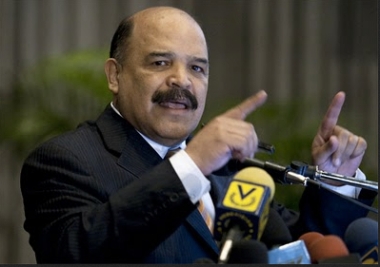
The (new) President of the Venezuelan Central Bank (Eudomar Tovar) said ” The (Venezuelan) economy has now shown 58 consecutive quarters of growth”

I thought to myself,: Say what? Whatever happened to 2009, or 2003 or 2000 and began looking for charts in my blog, found a couple but then decided, what the hell, let me look in the indicadores page of the Banco Central de Venezuela, after all, someone may think I altered the data.

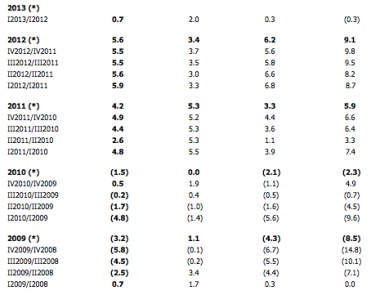
But no, here it is the data from the BCV itself:

GDP1

GDP2Funny, I see some 20 quarters of negative growth (First column inn bold) since Chavez became President. Thus, Eudomar, who was supposed to know what he was talking about, instead pulls a 1984-like fast one and tries to lie straight form the start. So much for our hopes that an economist at the helm of the Central Bank could be a positive.

So, file this with:

-Maduro wants to fight corruption.

-GDP grew in the second quarter because banks and insurance grew so much.

-Elections are clean in Venezuela.

Yeah, sure!


Writers Block About The Absurdity Venezuela Has Become.

August 19, 2013

wb

So, Maduro wants to fight corruption. Where should I begin?: Antonini, Illaramendi, Giordani/Fonden, Bolivar 2000, Fernandez Barrueco, Arné Chacón, Argentinean Bonds, Structured Notes, PDVAL, Chávez family, and dozens of posts on similar and equivalent subjects, over and over and over.

I can’t write about that, already did. Too many times.

Maybe I should write about a Constituent Assembly. Yeah! We need another Constitution, because the 26 we have had since the first one in 1811 have not worked. So, is it the Constitution or is it us?

Really, thirty years ago Venezuela had the most advanced (and complex) anti-corruption law, but Maduro needs magical powers, Harry Potter-like powers, all of a sudden and the opposition may need (or not) a new Constitution. Give me a Voldemort break!

Look, the 2000 Constitution may not be perfect, but why not try to follow it to the letter for four years and see what happens?

Look, democracy is hard, you really have to work at it, every single day. It is not a matter of just getting elected. You have to talk, negotiate, find the middle ground. Include everyone. Not Carreño, everyone that is representative. I draw the line with him.

Want to fight corruption? Name a Comptroller that everyone respects, both sides. If that person does not exist, then we really have problems, don’t we?

You think that even if you get elected, the other side will control the Government? Oh well, nobody said this is easy, but how about working hard for the country for a while? Earn each piece, one step at a time. That would be nice, no?

Because you may object to the 2000 Constitution, but hey, it is no better, nor worse than the other 26. You mean to tell me that none of the 26 were any good? Then we are screwed, don’t you think? Maybe it is something up there at the neuron level that makes us believe that ideology can fix everything. Try it next time your car breaks down. Well, I take that back, I am sure a true hard core socialist could prove a Lada is easier to fix, even if it breaks down more often.

But talking about all these things is easier than talking about the Vice-President of Fascism with a  capital “F” Jorge Arreaza, saying that everyone that is against Maduro’s Enabling Bill is suspect of being corrupt. To begin with, look at yourself, anyone that is suspect of being Vice-President just because of who he married, is then suspect too. No? Agree?

More so, nothing, absolutely nothing, qualifies you for any of the positions you have held. Only two words: Rosa Virginia. Because you have a degree in European Studies which would qualify you, at best, to a mid level position in some bureaucracy in Europe, where I am sure you would serve Venezuela better than in the Ministry of Science or in your current position. BTW, you spent a few hundred million dollars on that Chinese satellite but forgot the local antennas. So, we don’t get to use them, because you were clueless. Under current Venezuelan law, that happens to be corruption. Read it, you may be enlightened, but it says you should be in jail. Four hundred million dollars is a lot of money, even for rich Chavistas.

So, I don’t know what to write about, It’s writers block. I wanted to alliterate the title: Corruption, Constituent, Cambio, Compliance, Conciencias, Comptroller, Corpoelec, Censorship, Central, Cilia, Chavismo, Cruz Weffer, Chacón, Cadivi, Carreño, Cabello, Chávez…

No, it just would not work. Simply Writer’s Block about this absurdity Venezuela has become.


A Tragic Statement About Venezuela

August 15, 2013

black-ribbonWhenever something like the deplorable homophobic spectacle of the National Assembly two nights ago occurs (The details here, here and here), I prefer to stand back and allow it to sink in before I write something. In this case, I have found (and find it) it hard to verbalize my reaction to the whole thing. Because in the end, it is not only about the homophobia,  but there has always been in Chavismo a very mean streak, that bars many of its leaders from exhibiting any compassion or respect for others. Call it lack of sensitivity or simply lack of scruples, Carreño, Cabello, Maduro and their combo, seem to have no moral foundation to their ideals. The end not only justifies the means, but there seems to be some joy in the means, however perverse, whether we are talking about the murders when the opposition used to march, allowing Franklin Brito to die, jailing Judge Afiuni, the Tascón list or using material obtained by the police in the National Assembly to express your most homophobic and hateful feelings against your opponents.

But if the spectacle was deplorable, the reaction to it, whether Carreño trying to say he was sorry, or Diosdado saying they could jail Capriles, or Maduro accusing Primero Justicia of promoting orgies and prostitution in Miranda, is as despicable as the original hateful speech by the ever absurd Pedro Carreño. Carreño’s attempt to be contrite, simply showed he meant every word he said that night, as he only apologized for the words he used, but made sure to explain that he thought long and careful about what he said. There was simply no remorse.

It is simply just another version of Chavez’ “The show must go on”, when faced with the Amuay tragedy twelve months ago. No sense of compassion, no sense of responsibility, no civility, no humanity, no feelings for others and their rights.

But the real tragedy is not that we have become accustomed to this without realizing it, but that there will be no moral punishment for Chavismo for their behavior. That this lack of humanity and compassion has become a pervasive and accepted attitude. That some actually cheer what happened.

A terrible and tragic statement about what Venezuela has become.