Diosdado Cabello Is Back!

January 6, 2012

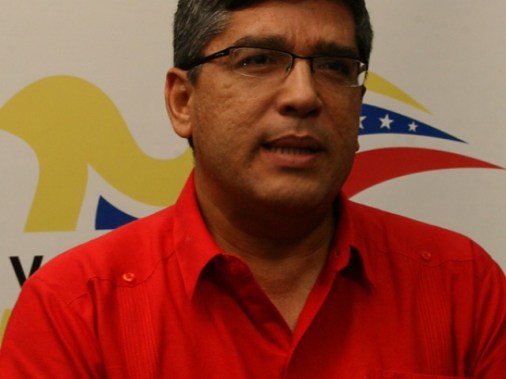
Who would have thought that once ostracized Diosdado Cabello would all of a sudden  become again one of the most powerful men in the country? Diosdado was once Chavez’ buddy and ūber-Minister. Vice-President during the 2002 “coup”, but whose ambitions and mercantile interests and questionable relations brought him down. He was banished to the Miranda Governorship, where he failed to hold on to the position, giving way to none other than opposition front runner Henrique Capriles Radonsky.

But all of a sudden Diosdado has resurrected or is being resurrected. Last month he was elected first Vice-President of Chavez’ political party PSUV, and today he was anointed as President of the Venezuelan National Assembly. He replaced former guerrilla member Fernando Soto Rojas, who did a more credible job than anyone expected, trying to clean up the corruption in the National Assembly and a man who proved to be more open to talking to anyone than could be expected.

But clearly, this was a victory for the “mercantile-anti-Cuban-military” side of Chavismo, led by Diosdado, over the “bolsas-loyal ideologues” of the Miranda front led by Jaua and  the “pro-Cuban front” led by brother Adan and some military and the “suck-up to Hugo” group led by Maduro.

And it is hard for me to believe that Hugo wanted it this way. There is clearly some serious dissension and tension within the military about the current Cuban role in the country. And as I noted when Hugo got sick, the successor would likely be chosen between Maduro and Diosdado, favoring Diosdado because of his military connections. He is the one that can hold all the sides together, except for the Cubans, who will play a role to the last minute, so don’t count them out, I still think they may rise again with Ronald Blanco La Cruz as their candidate. Maduro apparently believed he was the one and Chavez did not like it.

And it has everything to do with Chavez being sick. Some military may feel comfortable with the Cubans as long as Hugo is around, but get edgy thinking he may not be around and the Cubans might decide to stay. And Godgiven is their man. Never mind his troubled past, his connections to the failed revolutionary banks, he is their choice and was forced on Chavez, despite Cuban protestations.

Por Ahora!


Will the Chavez Government Thank The “Old” PDVSA For Saving The Day On The Exxon Arbitration?

January 5, 2012

I know, this Exxon/Cerro Negro stuff is getting boring, you don’t want to hear any more about this dull ExxonMobil arbitration, who won, who lost. But there are a couple of more points that it is important to make, so please bear with me. Hopefully, this is the last post on that matter.

Yesterday President Chavez said that ExxonMobil’s demands for as much as US$ 12 billion was “crazy”. Except that such a demand never took place at the International Chamber of Commerce, but at the World Bank’s ICSID arbitration Court. And that court told ExxonMobil that it could not ask for such a compensation, because its stake in Cerro Negro was not owned by a company from The Netherlands until later, and the company could not ask for compensation for what happened before then.

What we will never hear is Chavez thanking the “Old” PDVSA for a job well done. And he should, because that is exactly what happened. ExxonMobil got in the arbitration exactly what the contract called for. And it was smaller and more limited than people expected, because the lawyers and negotiators of the “Old” PDVSA did a very good job and included a cap or a limit on the oil price that could be used in any such compensation as explained very well by Noel Maurer in his blog “The Power and the Money” via the great Setty.

The key is that the decision by the arbitration panel at the ICC was based essentially on Clause XV of the Cerro Negro Association Agreement, which in 15.2 says:

“Notwithstanding the foregoing, after the first period of six (6) consecutive months during which the Price of Brent Crude Oil is in excess of the Threshold Price, Lagoven CN will not be required to compensate any Foreign Party for any Discriminatory Action(s) with respect to any Fiscal Year in which the average Price of Brent Crude Oil is in excess of the Threshold Price, and such Foreign Party received Net Cash Flow commensurate, after taking into account the effect of the Discriminatory Action(s), with a reference price for the Production produced by the Parties that bears at least a reasonable relationship, adjusted for quality and transportation differences, to the Threshold Cash Flow for such Fiscal Year.”

The key is that Threshold value which I have placed in bold letters. Above that value, there was no compensation. As Maurer explains, that value was US$ 27 in 1996 dollars and inflation adjusted became US$ 37.5 in 2007. Thus, even if oil prices were soaring above this value ExxonMobil could not ask for more.

And thus, thanks to those people of the “Old” PDVSA, all ExxonMobil received was the compensation for the economic consequences from 2007 to 2035 up that cap or threshold value for oil. According to the decision by the ICC panel, this was US$ 12.68 million for 2007 and US$ 894.9 million for 2008-2035. Period. ExxonMobil could not ask for more.

At the ICISD it will be a different matter, as the treaty between Venezuela and The Netherlands talks about “market value”, a much harder to define concept, which has no limitation. What this market value is, or how it is calculated, will depend a lot on the arbitration panel. But in arbitration circles, market value is interpreted in a fairly restrictive way and is usually considered to be something like “What a willing buyer wants to pay a willing seller” to put it in simple non-lawyerly words.

How much can that be? Hard to say. But we can take a stab at it, using the above definition and book value. This is a very approximate way, but it is a reasonable guess.

The price to book value of the shares of most major oil companies ranges from 1.5 for ConocoPhillips to 2.6 for ExxonMobil. If someone, a “willing buyer”, tried to take over any of these companies it would have to pay a premium, to turn the owners into “willing sellers”, of between 30%-50% to current stock market value. That would be as low as 1.95 x book for ConocoPhillips, as high as 3.9 x Book for ExxonMobil.

Applying this back of the envelope estimates to the Cerro Negro property which had a book value of US$ 750 million, then one should expect a range of US$ 1.46 billion to US$ 2.95 billion.There may be other damages and compensations involved fort chaing royalties and taxes, but in terms of market value the answer should be around these numbers. (For ConocoPhillips, that could be as high as US$ 10 billion, those projects were much larger)

That’s my guess.

And after learning about the origin of the arbitration from Maurer, the contract and other various sources, I am changing my score to: ExxonMobil 1, “Old” PDVSA 1, PDVSA 1.


What the ExxonMobil Versus PDVSA Decision Means For The Country’s Bonds

January 4, 2012

We now have a decision from the International Chamber of Commerce (ICC) arbitration panel. No matter who won or lost, and I am close to ready to review my conclusion to now call it at least a tie, but I just need more info at this time.

The question is: What does the decision mean for Venezuelan/PDVSA bonds?

Well, I think it is very bullish.

It’s simple:

With the decision, I do not expect another one in 2012. While the ICSID could decide before the Venezuelan Presidential election in the Exxon case, I think it is unlikely, and if it does, it will be so close to that event, as to be essentially immaterial. (There will be a hearing in 1Q12 at ICSID) ICC could rule on ConocoPhillips, which is larger in scope, but given how it ruled in the ExxonMobil case, it would likely be also good news.

Thus, there does not appear to be any possible surprises from arbitration on the way to the election, which was one of the biggest uncertainties on the bonds for 2012. Oil could go down, but it could go up too if Iran gets tricky. Thus, based on internal politics, there will be two, maybe three scenarios:

1) Chavez’s health is fine, he leads the polls, get out of the bonds, it will not be received well by those betting on political change.

2) Chavez’ health is not fine, it deteriorates, bonds soar.

3) The opposition does well in the primaries, leads the polls, bonds soar.

But it is unlikely that there will be surprises in the middle, no decisions to screw up your strategy, to use a fairly technical term. Given 1) you get out by mid year, you may lose a little, not much. Given 2) and 3) collect the coupon and enjoy the ride. No ride, nice coupon.   If there is a ride, it will likely your best investment all year. Just like 2011 if you were in the right Venny bonds. (Mostly PDVSA’s)

It’s Venezuelan bond investment at its simplest: Enjoy the carry trade, bet on the upside!


ExxonMobil Versus PDVSA: Arbitration and Numbers

January 2, 2012

By now, people seem a little confused by the victory by Venezuela and PDVSA at the International Chamber of Commerce (ICC) over ExxonMobil.

First, there is a numbers confusion, the first headline (Bloomberg’s) was “PDVSA has to pay US$ 750 million to Exxon”, the second (Exxon’s) was “PDVSA will have to pay US$ 907 million” and now we have a third one (PDVSA’s) saying “PDVSA will pay Exxon US$ 255 million”

As noted by Setty, this is just spinning. Exxon wants to show the largest number, PDVSA wants the smallest and Bloomberg reported the net amount awarded by the arbitration panel after a claim by PDVSA against ExxxonMobil in the amount of US$ 160.6 million for debts ExxonMobil had against PDVSA.

So, these are the true numbers:

In the arbitration case for breach of contract at the ICC, the case was decided against PDVSA in the amount of US$ 907.6 million dollars, which is about the smallest number ExxonMobil could have expected to get, as it represents book value for its 41.7% in the Cerro Negro partnership. Thus, this is a victory for Venezuela, because the amount awarded is small.

From the US$ 907.6 million, you have to subtract the US$ 160.6 million in liabilities ExxonMobil had in Venezuela.

Additionally, ExxonMobil had a New York Court seize US$ 305 million from a PDVSA account, which will now be turned over to ExxonMobil.

Thus, the net amount of cash that PDVSA will have to pay is (US$ 907.6 million-160.6 million-UDS$ 305 million)= US$ 442 million. Additionally PDVSA says ExxonMobil owed Venezuela US$ 191 million from the repurchasing of the Cerro Negro bonds, which is not clear what it means. Those bonds were repurchased by PDVSA in a decision in which ExxonMobil did not participate.

Thus, PDVSA will have to pay less cash, but the award against it was indeed US$ 907.6 million. How much it really has to actually pay or take out of its pocket is a completely different matter.

However, the case is not over. ExxonMobil went to arbitration in two courts: The ICC and the Worlds Bank’s International Center for the Settlement of Investment Disputes (ICSID).

How can this be? How can two parallel cases coexist on the same case? This is the second confusing point.

Well, after calling a good friend who knows his arbitration stuff like nobody I know, it turns out this is perfectly normal.

You see, in the the 90’s when ExxonMobil decided to participate in the Cerro Negro project, it signed a contract with PDVSA and Venezuela (Which was approved by the National assembly). At the ICC, this contract is what was being disputed: the breach of contract by PDVSA or Venezuela when it expropriated the partnership or changed its conditions unilaterally. What is awarded in this court is what the arbitration panel interprets the two sides had agreed upon in that contract.

However, separately, ExxonMobil owned its 41.7% stake in Cerro Negro via a Netherlands-based subsidiary and it so happens that Venezuela and The Netherlands have a treaty to promote and protect mutual investments. This treaty has specific clauses to protect investors from both countries. It is the violations of this treaty that the World Bank’s ICSID arbitration panel is judging upon (A decision is not imminent, there will be a hearing in 1Q12), Thus, the award by the ICSID will be determined by what that treaty says and the violations that may have occurred. This could be larger in scope, as it could include additional compensations and indemnifications.

Thus, at the ICSID the panel may give (or not) ExxonMobil awards to compensate violations such as not being paid before the expropriation, modifying contracts unilaterally, not being treated fair and equitably, discriminating foreign investors from local investors, not guaranteeing payments and many others.

As an example, the treaty specifically states (my free translation from Spanish):

“The parts will not take any measure to expropriate or nationalize investments made by nationals of the other country, nor will take measures which have the equivalent effect of nationalization or expropriation, unless the public interest is invoked and subject to due process, without discrimination and with prior compensation, at market value for the investments and with payment without delay at commercial interest rates.”

Clearly many of these conditions were violated in this case and the ICSID will have to decide on what compensation to award ExxonMobil, beyond what it was established between the parts in the original contract. The wording of the treaty is clearly much different than what may have been contained in the contract (Which I have not seen). In fact, the original contract was not even signed by a Netherlands company, ExxonMobil later transferred ownership to a Netherlands company to enjoy the protection of the treaty.

Thus, it may happen that the ICC awards something and the ICSID does not, or vice versa or both award amounts that are different because they are based on different legal concepts.In the two cases that Venezuela has lost at the ICSID, the award has been roughly book value in any case, but the amounts involved were much smaller.

Thus, the ICSID could give ExxonMobil a bigger award, or not. But for now, score it as: PDVSA 1 ExxonMobil 0.


ExxonMobil Awarded US$ 750 million For Cerro Negro Nationalization by Venezuela

January 1, 2012

Well, it is early in the year, but Bloomberg last night reported that the International Chamber of Commerce awarded ExxonMobil “only” US$ 750 million in its arbitration case against PDVSA over the nationalization of its assets in February 2007. This ruling is very favorable for Venezuela, as essentially seems to recognize only book value for the expropriated properties. Exxon had been seeking compensation not only for the expropriated property, but also for the loss in cash flow from the operation of the project. ExxonMobil owned 41% of Cerro Negro, which produced on average some 95,000 barrels of heavy crude per day. The multinational company confirmed the news according to the Wall Street Journal.

ExxonMobil had been asking for US$ 7 billion of which about US$ 747 million were tangible assets. According to Bloomberg the award was for US$ 907.6 million, which was reduced to US$ 750 after a counter claim by PDVSA. But in the end the number looks exactly like book value.

ExxonMobil had also been seeking compensation at the World Bank’s ICSID Court, I am not clear how the two overlap or what judgement in one implies for the other.

If arbitration in the oil projects determines that there will be compensation only for the assets of the projects expropriated, then the total liability to ExxonMobil and ConocoPhillips should be of the order of US$ 3.5 billion, rather than the more than US$ 20 billion being sought by the two companies. Estimates put the loss of cash flow from operations around US$ 9 billion, so that a decision including book value and cash flow would have been expected to be (rough numbers) US$ 12.5 billion.

But if the World Bank’s ICISD decides in a similar manner, the Venezuelan Government would have scored a very important victory in its arbitration fights, which would impact the nineteen arbitration cases at the ICISD against Venezuela.

This should be positive for Venezuelan bonds early in 2012


Let 2012 Be The Year Of Change and Improvement For All: The Best to You All!

December 31, 2011

The year is leaving us. The Government says we had a great year because GDP grew by 4%. I ask if with a 39.5% increase in the price of the Venezuelan oil basket and a 51.5% increase in monetary liquidity, is this supposed to be good? To say nothing of the 27.9% increase in inflation. It was only in April that Giordani was “seeing” a slowing of inflation, when the 12 month CPI stood at at 27.4% and we are closing the year not only higher, but with the highest level of inflation of any country in the world. Giordani does not see very well.

And I go back to the numbers. I like numbers. Thus, I find it curious that the President of the Venezuelan Central Bank says explicitly: “Las reservas internacionales se ubicaron en US$ 29.899 millones al 30 de diciembre de 2011” (International reserves were at US$ 29.899 millions on December 30th. 2011). Funny, as of the 29th. of December, the day before, on the webpage of the Venezuelan Central Bank the number was US$ 2.44 billion lower at US$ 27.45 billion. Where did this money magically appear from? When accounting at the Venezuelan Central Bank becomes creative, you have to be concerned. (In Spanish is called “maquillaje”, applying make up to the numbers. That’s exactly what they did)

So, Chavismo keeps stretching and stretching the distortions so they can win in 2012. But Venezuelans will have to pay one day for all of this.

That’s the bad news. The good news is that it will not be in 2012. There is too much at stake. All adjustments will have to wait for 2013, no matter who is in charge.

Given that, after this dose of numerical reality, I can only wish all the readers of the Devil, the best in 2012. Let the year be the year of change, the year of hope, the year that Venezuela turns around and finds a path of prosperity and harmony. A year in which peace and rationality prevail and rule over all of us.

Happy New Year my friends!


A Possible 2012 Vice-Presidential Surprise and more…

December 29, 2011

A Wall Street strategist named Byron Wein, started a tradition a few years ago of making a list of “thinking out of the box” predictions for the New Year, which he called his list of surprises. This has become quite popular and by now I know of at least three such lists (One, Two and Three no yet out). The idea is to suggest events that go against the consensus and help you be prepared for it. The remarkable thing is how good these lists have turned out to be, with 50-60% of these unlikely events happening.

Ever since we learned about Chavez’ illness, I have been bothered by the question about his succession. Basically, none of the suggested names has ever satisfied me. They all have weak points from the point of view of Chavez, the military and the Cubans. Maduro may be loyal and have a good image, but he is no radical. Diosdado may be acceptable to many groups, but I don’t think he buys the Cuba angle, nor is his an real ideologue. Jaua is not liked, period.

So, in the spirit of thinking out of the box, I have identified someone who is not as well-known, is loyal, ideologically on the right side, former military, democratically elected Governor, acceptable to the Cubans and, more importantly, a man who has more influence on Chavez than many people understand.

His name?

Ronald Blanco La Cruz

Blanco La Cruz is a well educated, former military officer, founder of MVR, member of the Constituent Assembly, former Governor of Tachira, Ambassador to Cuba and more importantly, the man that crushed the Chavista bankers from Cuba, saving his brother in law’s position as Superintendent of Banks. (He is also the cousin of a high ranking General)

A powerful man indeed. Not very well-known, but Chavez has never wanted anyone to be well-known. Cabello may be well known, but he lost the Gubernatorial race to Capriles. Maduro may be popular among the powerful Chavistas, but is not a proven candidate. Rangel may be radical, loyal and a good strategist, but he has the charisma of a dead turtle.

But Ronald is buddy-buddy with Hugo, with the military, he believes in all this, trusted by the Cubans, has been a candidate.

Not well known?

Nothing that a few months as VP and a few billion Bolivars can’t fix.

So, I am going with Ronald Mac Blanco as my 2012 surprise.

It may not be obvious or probable, but it makes sense…

Would he be President Blanco or President La Cruz?


Chavez Entertains and Distracts Even at Christmas Time

December 28, 2011

While Hugo Chavez has patted himself on the back for working through Christmas, I am not sure he has really worked. The problem is that he calls talking, work. One of the dangers of talking too much is, however, that you may say absurd things as you try to entertain and distract the country from its problems. Many things he says are things that would make you laugh anywhere, but in Venezuela we have practically heard it all, from Chavez saying that men never walked on the moon, to inventing the number of housing units that have been built in the last year.

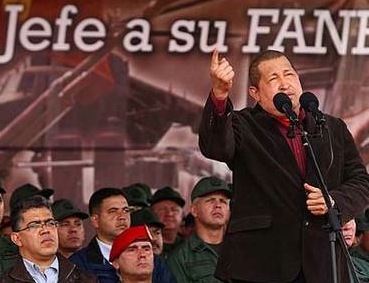
But Hugo clearly wants to close the year with a new bang in entertainment prowess. First, in a ceremony (see picture above) that looked taken out of a communist country in the 50’s, Chavez thanked his Russian friends for allowing Venezuela to have the strongest military power in its history, as if this was some sort of achievement or due to hard work and not thanks to all of the oil billions misspent in weapons, rather than on people. And the Russians, of course, have laughed all the way to the bank, with all of the stuff Hugo has purchased.

And to insure that we are all awed with is intellect, Hugo then begins speculating about the strange coincidence that four Presidents in Latin America contracted cancer roughly at the same time. Never mind that Lula was no longer President when he got his. Or that each of the cancers is different and in a different part of the body. Chavez’ perceptive mind has noted the coincidence and like everything, he wants to pin it down on the old USA, the source of all our problems, including, I guess, his terrible and ineffective Government.

And after saying he has learned to administer the resources of the country better, not bad after being thirteen years on the job, we learn that after more than 1,000 expropriations and nationalizations and eighteen cases in arbitration at the World bank’s ICSID, the Government has now issued two decrees creating advisory councils to deal with both. These advisory councils have, as their main goals, such things as “respecting the constitutional rights of people”, which have been violated right and left since Chavez began expropriations eight years ago. They would also establish mechanisms to determine the fair price to pay for expropriated properties. They would also advise on new expropriations that they feel like doing. It would also create, don’t laugh, a registry of all expropriations, because clearly the Government has no clue as to what it has taken over on the orders of the man who “has learned to admiisiter the country’s resources better”

And the Advisory Council on Arbitration is even funnier, more so given the fact that the Government itself has been saying some of these processes are close to being decided upon. But this new body will determine “strategies for the planning and coordination that State institutions have to follow to defend the country in front of foreign institutions, particularly those of arbitration”

Of course, this is all the work of the new Attorney General, Carlos Escarra, who is no dummy and realizes, a bit late, how illegal and arbitrary most expropriations have been and how the defense of the country’s position in arbitration panels has been carried out on a case by case basis and managed by various institutions. This could all be turned back, were PSUV to lose the next Presidential election, due to the myriad violations of the Venezuelan Constitution involved.

But maybe, just maybe, one day Chavez will learn that administering those resources better, should have involved appointing people who know that they are doing and not the mad whirlwind rotation of 180 Ministers (134 different people) that have “helped” him run the country in the last thirteen years.

And maybe, just maybe, if he stopped talking all the time, he could accomplish something.


Hugo Chavez’ Christmas Spam to all Venezuelans

December 27, 2011

Above is the message that most Venezuelans got on Christmas Day from Hugo Chavez (including me, I got it early on the 24th., as you can see above), it says: “Each December, we have victoriously celebrated our unstoppable march towards the Good and Pretty Fatherland…Full of happiness, justice (sic) and social equality. Merry Christmas, partners (comrades?). Hugo Chavez.

People have noted that the message is abusive, it is after all spam, much like Chavez’ forced “cadenas” where everyone is forced to listen or turn the TV off since nothing else is on. There is also the question of who paid for it. Did Chavez force the message on the telecom operators? Is the list freely available to anyone like that? Is this a violation of privacy? A waste of resources?

We will never know. What we do know is that if this had been sent by an opposition politician, Chavez and the government would have raised hell over the issue.

You can also complain about the message, not only about the use of the term “compañero” without the “ñ”, this could have been avoided choosing a better word, like venezolano, ciudadano and the like. The message is also quite partisan, as half the population does not celebrate Chavez “unstoppable march” to wherever he thinks he is taking us .

But what I want to point out and note, is that the message is quite effective. First of all, it has a high impact, as it is received by most Venezuelans, as cell phone penetration is over 100% by now (Operators do not subtract cancelled lines from their numbers). But more importantly, people are impressed that Chavez sent them a message. Of course your average opposition person does not like it, but I talked to a few people, not pro-Chavez, some who once supported him, who actually appreciated the message and told me about it not as a complaint, but more like: How about that message from Chavez!

So, much like many of the moves that Chavez makes, he got his money’s worth (or ours for that matter) sending a message that in the end earned him more goodwill with his supporters or prospective supporters, even if it was wasted on most of us who will never vote for the revolution.

Note added: The SMS was indeed a “cadena” that was sent free at the request of the Government.


Happy Holidays and Thanks For Visiting!!!

December 24, 2011

I am here in Caracas to spend Christmas with family. I wish everyone a Merry Christmas and hope you enjoy the Holidays, may you receive whatever gift, material or spiritual, you desire and enjoy a quiet, peaceful time with family and friends, forgetting for at least a while the problems around Venezuela and the world.

I would like to thank everyone for visiting the Devil, it is a privilege to have you all care for what I may have to say and many of you have become real or virtual friends in these nine plus years. This year I had the honor of having dinner with readers from as far away as Singapore, with friends from Caracas and San Felipe, with readers from Miami, a wonderful magical gift and an unexpected bonus for writing this blog, as I now “know” people wherever I may go.

Happy Holidays!