If regulations for observers are an indication, we can look forward to a very unfair election in September

July 7, 2010

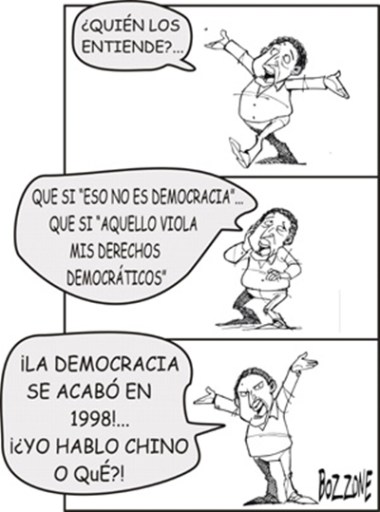
(Who can understand them? This ” is not a democracy:, that “this violates my democratic rights”. Democracy ended in 1998, do I speak Chinese or what?)
According to Sumate, here are two of the articles of the regulations issued for observers of the upcoming electoral process to elect Deputies to the National Assembly:

Art. 15. Observing organizations are banned from publicly denouncing violations of fairness in the election…

similarly, that same article says:

Accredited persons will not be able to: Issue statements, nor opinions in general or in particular about internal matters of the Bolivarian Republic of Venezuela until the electoral process is over…similarly, they will abstain from…making public pronouncements…

Art. 16. paragraph 3. Observing organizations will have to maintain under strict confidentiality or reserve the content of the exchanges of opinion and suggestions presented to the electoral authority (CNE)

Jeez, if these are the ground rules before the process has even begun, anyone expecting anything fair in September is simply dreaming…


The rambling, illogical mind of the Chavista revolution

July 6, 2010

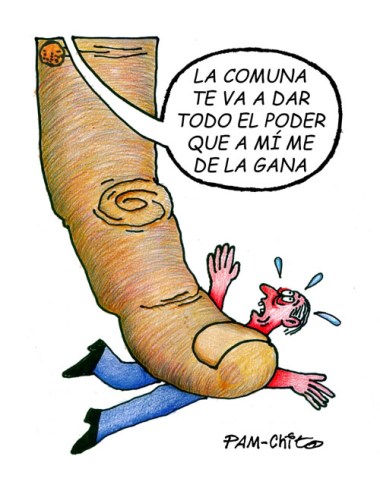
(The commune will give you all the power that I feel like giving to you)

PSUV: Communists? No, we are not communists, ask the Venezuelan Communist party (PCV)

PCV: Communism? No, why would we want communism in Venezuela? This is a media campaign against the Government of Hugo Chavez which clearly states that it is Socialist, not communist. This is just the opposition, trying to accuse us of being communist. We have been communists for a long time, but really, a communist country in Venezuela? We really don’t want that.What we want is communes. That is soooo different. The root is the same, the word is way different.

Aristobulo: Remember me? I am no longer around, but boy I would love to be somebody in Chavez’ Government, so I come on TV every two weeks and defend Chavez. Today’s version: “The opposition flip flops between terrorism and elections” Sounds good, no? Hope Chavez sees it and he forgets that I talked about him smoking an egg roll.I don’t want to live in a commune, I have too much money for that.

Minister of Communication: We don’t understand why the opposition keeps talking about rotten food and forgets the sacred burial of Simon Bolivar’s mistress Manuelita Sanz. They are not patriots. What could be more important than her burial. They want to deny our history. The food may be rotten, but we brought Manuelita’s remains into the country. Both rotten, but we are very happy, after all, we would all like to be you know who’s mistress.

Chavez: The Cardinal is a troglodyte, this is really an endearing term. It has nothing to do with communism. It has to do with the Catholic church in Venezuela, they are bourgeois, they love to have their …hand kissed. But listen to Escarra, we may like communism after all. The church does not want communes.

Chorus: The words commune and communism are similar, but they are not even related. It is all coincidental. Chavez wants communes, but not communism. It is very simple. The Communist Party is pro-communes, not pro-communism. It’s like saying Fidel is a communist, No, times have changed. Cuba has matured, so has Venezuela. We only want communes, no opposition, no communism. Can you opposition people please leave the country? It would make our life and that of the communes so much easier. In fact,  if you guys leave, we could get a higher percentage of the vote. Like Fidel.

So, just remember, communes not equal communism, opposition should leave, church should leave. Aristobulo can stay.

Get it?


Uruguay concerned about Chavez backing their team

July 5, 2010

I have not written about the World Cup, but I could not resist.

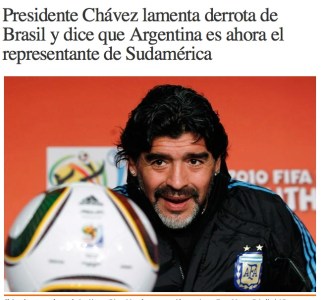
Uruguayan authorities expressed their concern that President Chavez would back their country´s team before Wednesday¨. ¨Given his track record so far, we can´t help but be concerned that he will decide to back our team and say it publicly like he did with Brazil and Argentina¨.  After Brazil was eliminated Chavez said that Argentina would socre all of the goals that Brazil did not. Argeintina failed to score against Germany.

Meanwhile, Mick Jagger said that Chavez can not beat his unquestionable record of backing losers at each stage of the Cup. ¨His record is not as unquestionable like mine. He was wishy washy at the beginning, it was not clear if he was backing Brazil or Maradona, pardon me, Argentina, in the first few stages of the Cup. We will see, I am not backing Uruguay, thus, we will know who is really bad luck after this stage of the Cup¨


The Lake Maracaibo oil spill is sixteen times denser than the one in the Gulf of Mexico

July 1, 2010

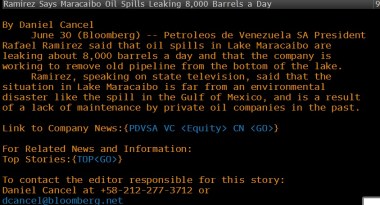
Orders of magnitude continue to get this Government into trouble. I could not believe it when I heard Minister of Energy and Oil Rafael Ramirez say today that the oil spill in Lake Maracaibo is far from the environmental disaster of the one caused by BP in the Gulf of Mexico. I could not find the link, so I went into Bloomberg and copied it, just  so you make sure I am not BSing you:

So, Ramirez says that the 8,000 barrels being leaked or spilled are not a disaster like the Gulf and , as usual, they are the fault of the private oil companies that came before his time. Something the Prosecutor fully agrees with. Amazing!

Go figure!

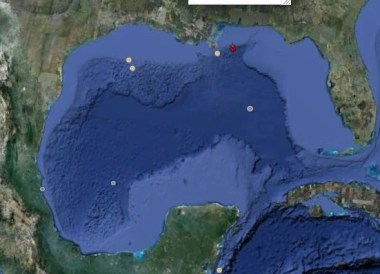
But let’s put this into perspective. The US Government estimates that from 35,000 to 60,000 barrels of oil are spilling from the Macondo well disaster into the Gulf of Mexico which looks like this in Google Earth:

but on the same scale, Lake Maracaibo looks like this:

Now, spilling 8,000 barrels a day of oil into the bottom picture of Lake Maracaibo would seem to be as much of a disaster as spilling 60,000 barrels a day into the top picture, no?

In fact, according to Wikianswers, the Gulf of Mexico has an area of 615,000 square miles, so that in the worst case scenario the BP spill corresponds to 0.097 barrels spilled per square mile every single day.

In contrast, Lake Maracaibo, according to the same Wikianswers is 5,130 square miles in size, which corresponds to the spill that ramirez thins is irrelevant to 1.56 barrels of oil per square mile being dumped, spilled or leaked per day. Even worse, Lake Maracaibo is an enclosure, while the Gulf is open to the seas, which should dilute the effects of the spill.

Thus, the statement about this spill not being a disaster is another irresponsible statement by Ramirez, who has oil spills, rotten food and suitcases bounce off his cynical and Teflonic face almost daily.

But orders of magnitude don’t lie, per unit of area, the spill into Lake Maracaibo is 16 (sixteen times) denser than the one in the Gulf of Mexico.

But hey, maybe they can take advantage of it and dump some rotten food into Lake Maracaibo and mix it with the oil. Who would notice?

Or who would report anyway?


Latest poll about Venezuela and Chavez, a very interesting read

July 1, 2010

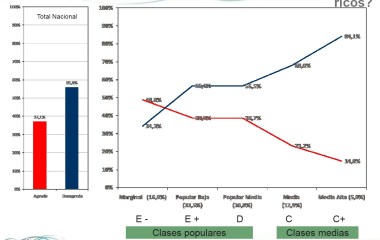
The latest poll by Consultores 21 makes for a very interesting read. I particularly liked the historical look at the Dictators’ popularity, with his approval rating at 37%, versus a disapproval of 55%. But the most remarkable chart was this one above, showing the approval and disapproval rating of Hugo Chavez by social strata. Only in the Marginal class E part of the population does Chavez still have more approval than disapproval and this segment comprises only 16.9% of the population. In all other segments, Chavez disapproval tops his approval rating, including in class E+.

Truly remarkable!


First Margarita non-expert Venezuelan CPI. Make your own!

June 30, 2010

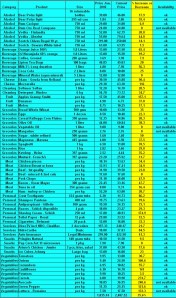
Reader Island Canuck has been keeping tabs on prices on that island for the first six months of the year and comes today to report an increase of 35.6%, you may agree or not with his choices, but he did the work.

Let me tell you what impresses me the most about the increases: The fact that so many local products have gone up the most. Look at the Avocados, onions tomatoes, lettuce and green peppers. Spaghetti? For God’s sake, it’s all made here. I can understand the apples, but water? Or Orange Juice.

The puzzle: How come imported microwave popcorn is flat?

In any case, make up yourown index using the data and tell us how it fared. Simply pick a basket, your taste, then calculate the increase in the first six months and tell us the result.

Kudos Island Canuck.


More news from Bizarro VenWorld

June 30, 2010

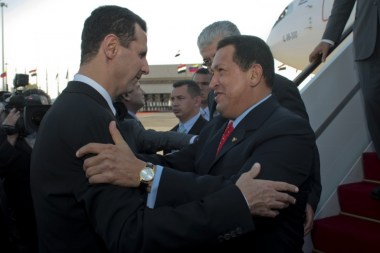
(Syrian President makes a face when Chavez tells him his refinery will be built after he finishes the other 16 promised)

Too much to digest at once, so here are just the headlines, with comments:

Chavez offers the President of Syria that he will build a refinery in his country.

Does Al-Assad know that there is a huge line? Just off the top, he has to wait until Chavez builds one with Brazil, Panama, Uruguay, Jamaica, Nicaragua, China, and abut ten others, none of which have even been started, but were announced at least three or four years ago. The lone exception: The Cuban refinery, the only one that Venezuela has devoted the time and the money to work on it.

–To get a job in Government denounced Andres Velasquez, you have to get a “Patriotic Certification” saying that you are loyal to the revolution.

This is an improvement, no? This is the Chavez/Tascon list but backwards, you want a job, you register as being part of the faithful, don’t bother if you are not. You can even lie if you want to. In the old Chavez/Tascon list, it was taken from a recall referendum list if you signed against the Dictator.

–According to the Rector of Universidad Jose Maria Baralt, a Bolivarian that supports the process, they are “immersed in forming a new and different educational model in which the professional does not sell himself or buys his degree. Thus, they are thinking of doing away with undergraduate thesis, research and projects as part of degree requirements”. (Bolivarian students marched today rallying, among other things against university internal entrance exams)

I agree, what a bothersome bunch of useless stuff, thesis, research, projects, while they are at it, maybe they should do away with exams, courses and, hell, teachers…bring back the honor system, Bolivarian in this case.

National Assembly refuses to discuss the spoiled food case.

Of course it should. Imagine if all the corruption surrounding the case came up in the discussion. We are talking about 122,000 tons of rotten food, but we know the corruption involved most of the imported food, the containers (you pay rent for them did you know that?), the storage time, the fees, the permits. The guys involved in this are millionaries. Ask Andorra. But it’s bad timing, no corruption fighting until October, at the least.

–Chavez’ PSUB party asks for an investigation into where the opposition is getting money.

You got to be kidding me! PSUV spends 100 times more than the opposition and everyone knows where the money is coming from: From the Government and you want to ask where the puny amount of money the oppo has is coming from? That’s like asking if the US is advising the opposition, when Chavez only does what Fidel suggests and Cuban advisers have invaded Venezuela. Why is this asymmetrical?

–Chavez has given Cuba a billion US$ for cooperaton in science and research between Cuba and Venezuela according to Jaime Requena in Tal Cual.

This has generated a total of 16 publications at an average cost of US$ 62.5 million per paper. I guess we should have quite a few Nobel Prizes coming our way. Or am I an optimist?

Bizarro indeed…


Venezuelan Government regulates street vendors and their prices. Next: The Buhonero Police?

June 29, 2010

The ability of the robolution to amaze and awe is truly remarkable. Bizarre has now become a normal word in Venezuela as the Chavez Government does nothing that could be construed as being normal.

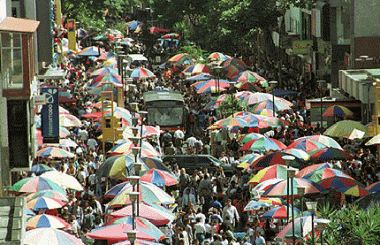
Take the term “informal” workers. They represent the more than half of the Venezuelan population who have casual jobs, selling stuff in the streets and trying to make a living. Nothing organized or regulated about them. Periodically, the Government tries to move them from one place to the other, they are banned from certain places, but somehow they survive, resurfacing somewhere else. Informal workers, called “buhoneros’ in Venezuela, used to be pro-Chavez, but they seem to support him less and less. I tried to depict some of their activities and smarts in the reappearance of Oligarco Burguesito, who met Nero Buho the street vendor to talk about the end of the swap market.

But Nero’s life, if he existed will become rougher starting today, as the Government issued a decree, essentially forbidding that street vendors sell foodstuffs at a price different than the regulated price and as long as they maintain the required hygiene and health standards necessary.

Moreover, these “informal” workers will have 30 days to comply with the decree and those found to be in violation of the decree will have their merchandise confiscated.

Where do I start on this? It has so many weird edges that it is actually quite hard to know the beginning. I have a thousand questions. For example, who the hell is going to supervise this? Will Chavez create the “Buhonero Police” to check it all out?

But even before that, where do you find the street vendors? I mean, these are street vendors, they are all over the place, do they have to register now? Doesn’t that turn them into some sort of “formal” workers? What if they move from one place to the other?

But what happens, for example, if one of these street vendors barters rather than sell one kilo of merchandise for another? Does this apply to fair pricing in barter too?  Didn’t the Government want to promote barter? How do you regulate barter in the end? Isn’t that an essential part of the communal law recently passed by the National Assembly? What differentiates a communal vendor or barterer form an informal worker? Is he regulated by this? Who has to register? Where? How does this all work?

And once you get beyond these nitpicking details, everyone is legit, everyone has registered, do they all become “formal” workers? Does the unemployment rate become negative then? Because if informal employment is more than 50% and unemployment is 7 or 8%, like INE says, then we would have -40% unemployment or something like that.

And in the end, when the poor now formalized, “informal” worker has his stuff confiscated by the buhonero police, can he appeal? Can he get his stuff back? Can the buhonero cops become street vendors too? How many buhonero cops do you need to supervise this? Who will train them? Is this an massive employment program in the end?

Does it apply to trucks that come from the interior to sell their goods in the cities too?

Will buhoneros have to have prices marked on all items? Do they need to get cash registers? Do they have to print official tax office receipts? Collect Value Added Tax? Pay it? Pay income taxes?

In the end, this sounds as bizarre and harebrained as so many other things the robolution has ever created or improvised.

But hey, eleven years running and they are still running things…


Looking at the volumes at the “new”, “new” Venezuelan Central Bank exchange market

June 29, 2010

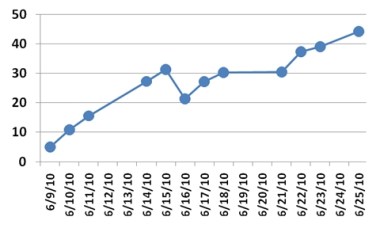
Well, we were told that the now banned swap market was mostly speculation and the President of the Central Bank said US$ 26 million a day should be sufficient. Well, the graph below shows volume so far:

Thus, with corporations limited to US$ 50,000 a day, individuals with US$ 5,000 a year, banks still putting the system together, volume is already up to US$ 44 million.

Not pretty.


Another look at how Chavismo tries to “manage” food imports and distribution

June 27, 2010

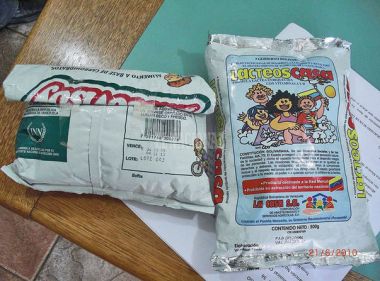
(Milk packages with expired dates on them)

Both El Nacional (page A-6 by subscription) and El Universal have articles today about the failure of the Government’s food import policy. The amazing thing is that some of the data used by both newspapers  is taken right our of reports by the Government, and in the case of PDVAL it is from a recent PDVAl report.

According to the PDVAL report, in 2008 PDVAL imported 597,000 Tons of food, which triples its distribution capacity. Thus, the 120,000 Tons of spoiled food represents about 20% of what was imported in 2008, not an insignificant amount as the Dictator would like you to believe.

According to the report, the amount of food purchased was not decided by PDVAL, but was an order by Cenbal, the National Center For Feeding Balance, an organization I have never heard of, but which reports to the Vice-Presidency of the country. Cenbal is composed of representatives from the Ministry of Agriculture, Commerce, and you guessed it, Cuban advisors, who now seem to have shifted from advising on how to produce food on how to import it.

Cenbal itself imported, via various mechanisms a total of 1.7 million Tons of food. The idea, was to import the food to guarantee supply and even sell it to the private sector, something that was never done. The report also says that it was the Cubans that advised PDVAL on how much to buy, the scheduling and the permissions needed for items. Most of the food imported via PDVSA’s Bariven import company was bought via competitive bidding, except when it was purchased using Government to Government agreements. (Think Argentina and China)

The report says that the bottleneck for all these imports was simply the ports which were unprepared for this magnitude of imports .Similarly, it blames the tax office, the lack of storage facilities and the delays in obtaining permits for the problems. So much for trying to blame the private sector!

Clearly the Government’s strategy was to import so much food to guarantee that there would be no shortages, but nobody was taking into account how much could actually be brought in into the country within a time period and the Government’s buerocracy was itself to blame for the problems.

The article in El Universal looks at the evolution of food imports and food production in the last few years. It concludes we have gone from importing 70 dollars per inhabitant a year to US$ 392 per inhabitant per year, which represents the need of importing US$ 14.3 billion per year in food. Thus, all of the BS about sovereignty, endogenous development and the like was Mr. Chavez BS.

Then the article gives examples, such as the fact that the country imports 90% of the black beans we eat, half the meat and  70% of the rice. Up to 2003, Venezuela was self-sufficient in meat, importing about 1% of its needs, but then the Chavez administration began regulating prices and local producers could not compete with the cheap Government imports.In 1998, Venezuela produced 407,000 Tons of meat, which is now down to 269,000 Tons with imports reaching 395,000 Tons.

In milk, the story is not too different. In 1998, 67% was local production, today 67% is imported. In 2008 and 2009, imports were over 100% of consumption, which also explains some of the problems with the putrid food.

While all this happens, report El Nacional, the Comptroller, contradicts himself day after day. First he said that he was investigating the food imports for the last two years. Then he said he was doing t, but did not know that some of the food was going bad, but it turns out that in his own report t the National Assembly, the Comptroller reports the containers of spoiled or expired food. It turns out that it is  cheaper to buy food about to expire and that may be part of the problem. The Comptroller reports even food packages with two expiration dates in the same package, suggesting tampering.

There you have it, Chavez knows how incompetent and inefficient his Government is that he manages the country trying to import too much, distributing too much and spening too much in the hope that there wll not be shortages and his popularity does not decline.

But in the end we have the same story: waste, corruption and inefficiency dominate and we Venezuelans pay for the Dictator’s follies.