

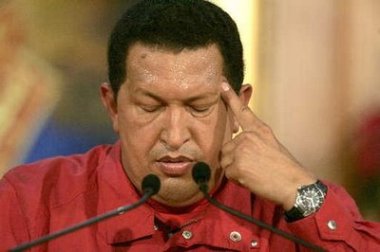
Chavez really at it today with his wisdom:
“There is a bank, I have all the reports, that is dangerously close… don’t blackmail me with that stuff that if your bank falls, the system is endangered”
How is that to create some more panic tomorrow? Who needs anyone else to create rumors and panic when Chavez does it alone?
“I will expropriate those that speculate”
This from a guy that just increased the price of 54% of all imports by 100%.
“Airline tickets are not going to double in price”
He should talk to Giordani who said that they would go up exactly by a factor of two
Chavez has discovered the Devil’s Excrement, it took him more than 50 years alive and 11 as President to make this huge discovery
“Everything is imported here”
(Can’t find link yet) Well, three or four years ago Chavez would threaten the local private sector precisely with importing things if they did not lower prices. And five years with 300% inflation for locals and the Government importing everything made local industry non-competitive and it is Chavez’ and his Government’s fault. He talks like he just got there and is learning the ropes.
“We were imposed the model of producing oil and nothing else”
Which you have emphasized. You shut down steel and aluminum but not oil to save electricity. Who imposed this model on Chavez for the last eleven years? Wasn’t this an all powerful “revolution” led by you?
 The Devil's Excrement
January 11, 2010 at 12:50 pm
I paid attention to his demeanor and explanations during the announcement. It looked, sounded and said things that I heard 11 years ago. Nothing new.
Any respectable government would use fines or closings to curb especulative price markings. He loves stealing private property.
January 10, 2010 at 8:16 pm
Airline tickets issued by US carriers were actually priced at the swap rate, not CADIVI. In fact, a ticket to Europe (9 to 12 fliyng hours) was cheaper that a ticket to Miami (less than 3 hours). Just check in the American Airlines web page the following:
Miami-Bogota- Miami or Bogota-Miami-Bogota about 300-350 dollars RT, 3 hours flight.
Miami-Caracas-Miami about 500 dollars (paid in US$)
Caracas-Miami-Caracas about 900 to 1200 dollars (paid at Cadivi rate)
American Airlines overpriced tickets to be paid in bolivares assuming it would never get US currency from CADIVI. So, How can they expect to collect a price increase (for the 2.15 to 4.3 devaluation) if they were in fact buying currency at swap rate 5-6 Bs)??
For whats concerns europeand and southamerican airlines they were in fact pricing according to CADIVI rate (1000-1200 US$ for a 10 hours flight). So they must be entitled to increase prices to the new CADIVI rate and collect the price increase.
January 10, 2010 at 7:15 pm
After 7 years of asfixiating the local producer with fixed prices, overvalued exchange, unfair competition, threats and expropriations Chavez “con su cara muy lavada” complains that we import everything and produce little. To add insult to injury he blames others for it.
It’s the epitome of cynicism.
January 10, 2010 at 7:05 pm
It wasn’t “my article” Iw as just asked a few questions, there are a couple of numerical mistakes like it says two years for the increase in monetary liquidity and I sadi fice and there is a number I did not say about 63% is imported, 63 of the inflation index has imported components. Here is the text:
Economía
POLÍTICA MONETARIA 54,1% de los productos importados aumentará 100%
Fijan dólar para viajes en Bs 4,30
El ministro Jorge Giordani informó que las compras por Internet se harán a ese mismo tipo de cambio
BLANCA VERA AZAF
bvera@el-nacional.com
El tipo de cambio que operará para viajes al exterior y pagos electrónicos será de 4,30 bolívares por dólar, anunció el ministro de Planificación y Desarrollo, Jorge Giordani, mientras que el tipo de cambio de 2,60 bolívares se destinará a remesas estudiantiles, pensionados y jubilados en el exterior.
“Esto pone en evidencia las prioridades del Gobierno para los casos que realmente importan a la nación. El que realice un viaje netamente de placer deberá pagar un costo más elevado”, indicó Giordani durante la plenaria del Partido Socialista Unido de Venezuela. Precisó que el ámbito de turismo nacional se verá realmente beneficiado porque costará menos viajar dentro de Venezuela.
La decisión del Ejecutivo de implementar un tipo de cambio dual a 2,60 bolívares por dólar y 4,30 bolívares por dólar tendrá un efecto sobre los precios de bienes y servicios.
Mucho mayor al 3% y 5% anunciado por el presidente Hugo Chávez el viernes pasado, cuando informó las medidas. Ni siquiera aquellos productos que se consideran esenciales tendrán una inflación menor a 20%.
El analista financiero Miguel Octavio calcula que si el flujo de importaciones se mantiene igual al de 2009, con la nueva decisión 45,9% de los productos adquiridos fuera del país a 2,60 bolívares por dólar correspondientes a alimentos, medicinas, algunas remesas y maquinarias estarán sujetos a una inflación que no estará por debajo de 20,9%. El restante 54,1% de las compras en el exterior, que se realizan a través de Cadivi, presentarán alzas de precios superiores a 100%.
Octavio añade que cuando se estudia el comportamiento del consumo de los venezolanos se obtiene que 63% de los bienes que utiliza son comprados en el exterior y el otro 37% son servicios cuyos precios están controlados, como luz, alquileres y agua.
Multiplicar el presupuesto. El ex ministro de Industrias Básicas y Minería Víctor Álvarez considera que la implementación de la política monetaria le permitirá al Gobierno multiplicar el Presupuesto de la Nación precisamente en un año electoral, para así culminar obras de infraestructura en las regiones.
Octavio asegura que la única razón que impulsó al Gobierno a imponer una decisión tan poco popular entre la población son los problemas de flujo de caja. “El Gobierno ni siquiera ha cancelado las deudas de 2009 que mantiene con las empresas”. Señala que el esquema utilizado de emitir bonos para venderlos al sistema financiero, para disminuir la cotización del dólar paralelo, se había agotado.
El viernes, Chávez se refirió precisamente a este punto: aseguró que con las medidas anunciadas la cotización del dólar de permuta disminuiría. Álvarez señala que el Banco Central de Venezuela tiene la potestad de intervenir este mercado a través de la colocación de Petrobonos.
Miguel Octavio llama la atención sobre el hecho de que mientras se anuncia una devaluación del bolívar, se decide traspasar 7 millardos de dólares de las reservas internacionales al Fondo de Desarrollo Nacional. “Esto significa que se le inyectará a la economía un flujo importante de bolívares, lo que se traducirá en un incremento de los precios de bienes y servicios”. Afirma que la liquidez monetaria pasó en los últimos 2 años de 46 millardos de dólares a 236 millardos de dólares.
Álvarez considera que el éxito de esta medida dependerá del resto de las políticas económicas que se implementen, de lo contrario, en un año el efecto se perderá. Octavio también comparte esta opinión y es poco optimista en cuanto a su eficiencia, pues asegura que en menos de 12 meses el Gobierno podría verse obligado a devaluar de nuevo.
Efecto en los precios. Las devaluaciones siempre han tenido efectos negativos en el comportamiento de los precios. De acuerdo con registros del BCV, el conocido viernes negro de 1983, durante la administración de Luis Herrera Campins, el tipo de cambio pasó de 4,30 bolívares por dólar a 4,90 bolívares por dólar, pero su impacto inflacionario fue mínimo debido a la caída del consumo por la fuerte recesión que se registró.
No sucedió lo mismo en 1989, cuando Carlos Andrés Pérez, en medio de los anuncios de un paquete de medidas impuestas por el Fondo Monetario Internacional, elevó el tipo de cambio de 14,50 bolívares por dólar a 32 bolívares por dólar, lo que significó un alza de precios de 32% en un año.
En 1996 hubo otro ajuste cambiario en medio de la crisis financiera que se produjo durante el segundo mandato de Rafael Caldera, cuando la moneda se devalúo de 170 bolívares por dólar a 450 bolívares por dólar, lo que generó una inflación de 103%.
El último ajuste fuerte dentro de la economía venezolana ocurrió en febrero de 2003, después del paro petrolero, cuando el precio del dólar pasó de 650 bolívares a 750 bolívares. Este ajuste provocó un alza de precios de 31%.
January 10, 2010 at 6:59 pm
Would it be possible for you to link us to your article on El Nacional? My suscription expired. Thanks.
January 10, 2010 at 5:31 pm
Airline tickets for international flights are (generally) prices in Dollars, so they’re going up based on how the airlines can convert their Bolivares to Dollars. If the government does not allow such conversion, the airlines simply stop flying to Venezuela, and Venezuelan airlines lose their rights to fly overseas. Chavez may actually desire such an outcome, but then you have a similar situation with telecommunications. Accounts between telephone companies are settled in dollars, with the minutes in and out either balancing or paid as required.
With three different exchange rates, Chavez has opened a real Pandora’s Box, and it will take weeks, if not months, to figure everything out.
January 10, 2010 at 5:06 pm
In a way, Chavez’ policies are simply the last nail in the coffin of local manufacturing. There have been serious problems with anyone who tried to manufacture since at least the 1980’s. For example, when PDVSA priced its imports at Bs. 14.50 to the dollar, when the local manufacturer did not have access to the “preferential dollar” to import raw materials and tooling, but instead paid up to Bs. 30.
Of course, Chavez explains it so much more stupidly …
January 10, 2010 at 3:39 pm
Aren’t the AK-47s imported? Aren’t those Russian jets imported? Isn’t his presidential plane imported? What about his red shirts? Even the cocaine he snorts is imported!
January 10, 2010 at 3:33 pm
That’s ok, does not take much storage, just the link.
VTV has low ratings less than 5% even with Alo presidente on
January 10, 2010 at 3:28 pm
Sorry only meant to post the link, not the video.
January 10, 2010 at 3:26 pm
Miguel,
Here Chavez complains how much of what Venezuela consumes is imported:
January 10, 2010 at 3:12 pm
What proportion of TV sets tune into Alo Presidente, compared to ordinary TV use?