

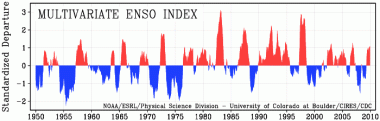
Given that El Niño is being blamed for the electricity crisis, I thought I would show this plot sent to me today on its strength by people at the Venezuelan Academy of Sciences. This is taken from NOAA’s website. This is a plot of an Index which attempts to measure the strength and duration of El Niño. When the index is in the red, it means that there is El Niño. As you can see, it is barely starting and is not particularly strong (yet, could get much worse). The 2003-2004 crisis was due more to the duration of El Niño. El Niño in the 80’s and 90’s was much worse in intensity and duration that this event:
 The Devil's Excrement
March 8, 2010 at 9:20 am
[…] same date. El Niño is a complex phenomenon, this is not the strongest one, nor the longest running as noted in this post in January. El Niño is simply a convenient political […]
January 15, 2010 at 7:20 pm
Ooops, my high tech the graphics did not work.
A is a square section, and B is a trapezoid section, wider at the top and narrower at the bottom….
AAAA
AAAA
AAAA
BBBBBB
BBB
B
January 15, 2010 at 7:18 pm
Miguel:
Now probably many people will follow day by day the Guri dam levels.
There is one detail, though:
The transverse section of the reservoir is irregular, most probably wider at the top and narrower at the bottom like B:
* * *** * * * * * *
* * * *
* * * *
************ ******
A B
If it were like A, if you lower at a fixed volume per day, the depth will lower the same amount. For example, if you take away 1.000 cubic meters every day, it would lower 1 cm per day. But since it is more like B, if you take 1.000 cubic meters per day, one day it would lower 1 cm, next day maybe 1,2 cm, then 1,5 cm, an so on, in a non-linear way.
So even if you are taking away less volume per day, you may see the same amount of cm per diminishing day o even higher.
Just something for you to comment…..
January 15, 2010 at 3:38 pm
Andrés,
I think there are always selections. I appreciate when
different parties in a discussion get basically more or less the same
time to debate. Thus: let the journalist moderate, ask the questions, and let the people speak, or let the journalist ask hard questions to a group or one specialists, not just have one guy with his own show. I think the accent on one form o r the other is pretty different.
I have the impression in Bbc (England or Scotland, which is not necessarily what you see on cable) and definitely in other countries
you have programms where a clash of ideas is possible:
For instance, very often, outside election time, you get the prime minister discussing things with the main opposition leader AND other top people from very diverging positions.
This may have to do with the parliamentarian system, where although there are often two main parties, other very different voices are also heard.
In the case of Germany I see this more often. I already added another time a video where you could see Merkel discussing in a very heated debate with all the other top leaders from right to the very commies about tax reform, war and other issues.
I think those discussions help in making people aware that there is more than two points: their position (whatever it is) versus .
My experience has been that I have seen on state TV in several countries in Europe (where there are lots of differences, see northern Europe versus Italy) more of this:
– equal time asking people in a conflict about their position
– more familiarity with the area
– more time letting local people speak out (like letting pro and anti-Western talk about the Iraq invasion or the role of Germans in Afghanistan)
– more journalists from the STATE TVS grilling the prime minister and then the oppo.
I think more of that would’t hurt in the Americas…
those possibilities, state and private, can perfectly coexist.
Selecting the heads of the board of directors for the public stations through decision of government and opposition is a good idea. Perhaps that is easier in a parliamentarian system.
I leave it here.
January 15, 2010 at 3:05 pm
Kepler it is an interesting pioint, the problem i see with public media, is they tend to all lean towards the interventionist side. BBC is good but their policy of keeping moral equivalence, lets too many off the hook.
Fox is redonculous on a many levels, but the n again so is some piece made on BBC, i dislike extremes, and publix media is usually one. But we have the choice to listen or not, this is your individual choice.
January 15, 2010 at 3:04 pm
Anyone can speak all kinds of languages with google translator…just copy the text and viola !! there it is, in your own language.I am sure there are even better online translators out there.
The problem is that there are many nuances of meaning in each language/culture that are not understood by the computer, but when folks are not native speakers they don’t capture these differences.
I have said it once and I will say it again..better to make perfect sense in one language that to speak a lot of nonsense in 5 or 6…
As for comparing news sources, this also depends on culture and language comprehension.
Even more important, it is common knowledge that a mega easy way to score faux points in an argument is to:
Instead of arguing points….discredit a person’s sources.
But in the end it will just boil down to a boring :
“yes it is, no it isn’t ” until all parties agree to emphasize ideas instead of attacking sources and personalities.Another way that is even more irritating and cowardly to score faux points is to amass a group of ” friends” to gang up on those they wish to be seen as substandard.
January 15, 2010 at 2:30 pm
Kepler,
If you are producing a one hour tv show you have to be “choosing your data” and use “selective history”.
I think most public broadcasters in the US and the BBC are worse at mishandling facts.
January 15, 2010 at 12:56 pm
Sorry Miguel, I’ll leave it at that.
January 15, 2010 at 12:51 pm
Impartial, I probably deliver more at work than you, but it is not your business, as it is not mine what you do.
Stop being a chauvi. No country is sacred.
You don’t have to talk several languages. Just try to find out what they say outside one single country.
Last time I checked, they were speaking in English on Bbc.
January 15, 2010 at 12:48 pm
Running the risk of having this message deleted, I have to say: “Screw you, Kepler”. (I would use a harsher word but I’d like to keep it civilized). What makes you think we all speak French, German or Dutch? I know, I know, you speak all those and more (Russian, if I remember correctly is one of them). Impressing.
And while I’m at it, wtf do you do all day? You spend an inordinate number of hours writing on this and other websites. How much better are you doing to society than those you berate for being sucking on the revolution’s titty?
Venezuela needs people that work, not writers who can speak many languages.
January 15, 2010 at 11:41 am
I had forgotten about the little video of the Abilene Paradox…That brought back memories.
The Barinas Paradox would be more like, What do we have to do to keep this goose laying the golden eggs?
January 15, 2010 at 11:39 am
Andres,
It is not just style. It is a very questionable way of using statistics and other ‘facts’.
Like choosing your data to fit “eating tomatoes causes crime” (all criminals…).
The whole financial crisis had a long time in the making.
Also: the guy shows his absolute love for selective history knowledge.
I think some people in the US are afraid what good public TV stations could do.
There is a nice option in Bbc UK, even if it is not perfect.
Public stations are even better in such countries as Germany or Norway, Netherlands or Sweden or even in Belgium or France.
I suppose the canadian state radios also offer some general view of the world and of differing ideas.
Sorry, but the political simplifications I see in the US are amazing.
If you want, you can go through the German news of the “state TV channel” ZDF here
http://www.zdf.de/ZDFmediathek/kanaluebersicht/aktuellste/302#/hauptnavigation/nachrichten/
January 15, 2010 at 10:55 am
Syd: You may not like his style, but I don’t need to be persuaded by what he says. He’s just stating facts.
January 15, 2010 at 6:45 am
Firepigette, I don’t see how the Abilene Paradox could apply here – because there is NO groupthink where Chavez is involved. Maybe we need to devise some sort of “Barinas Paradox” which would describe what might happen to a group of his underlings who, when faced with a decision, typically sit around thinking, “What would Hugo want us to decide?” And the paradox would be when, instead, they actually make a decision based on what might be good for Venezuela. Sort of a reverse Abilene, because they all do what they want instead of what they don’t want, but end up unhappy anyway because they all get fired.
January 14, 2010 at 5:36 pm
I agree with Syd annoying
January 14, 2010 at 5:09 pm
Glenn Beck needs a whole lot of polish to sound less sensational and more credible. His repartee comes second to listening to Chávez. As a result, I turned off. Not impressed.
January 14, 2010 at 4:05 pm
Off topic: Glenn Beck on Chavez & Obama
http://video.foxnews.com/v/3965419/the-one-thing-111
January 14, 2010 at 10:48 am
For additional information, here is what I posted at Caracas Chronicles yesterday. While most of it recycles what you and commenters have posted here, I have added information from Professor Guevara’s paper.
Much of this has already been covered in Devil’s . Here is Opsis Boletin Mensual Nov 2009 , courtesy of commenter Moses in Devil’s.
1) Water level of Guri Reservoir is higher than 2003 and most of 2004. Not so bad.
2) Flow of Rio Caroni is lower this year, below average
3) While flow of Rio Caroni is lower than average, since 1950 there are a number of years that are lower.
Documentation follows.
1) Water level: Opsis November 2009 . See graph: Cota del Embalse de Guri
2) Flow of Rio Caroni is lower this year, below average. Opsis November 2009. See graph: Aportes al Embalse de Guri ( m3/seg)
November flow was 16.9% below November average, and thus far flow for the year is 10.7% below historical average.
3) While flow of Rio Caroni this year is lower than average, since 1950 there are a number of years that are lower. ( As far as I know, this has not been covered in Devil’s in this detail. This is my addition)
a) To get average flow, we go to the graph Embalse de Guri, which shows average flow by month.
January 5.468
February 2.846
March 3.296
April 3.315
May 2.687
June 3.654
July 7.506
August 8.347
September 4.58
October 2.894
November 3.529
These average to 4.374 (4,374)cubic meters per second
b) We then go to a paper by Professor Guevara at Carabobo University, which gives annual averages for Rio Caroni water flow in his paper The Influence of El Niño Phenomenon on the Climate of Venezuela .
Comparing this with the average for January –November 2009, with an average flow of 4.374 cubic meters per second, we get a reduction of 9.5% from this historic average. While this is not the same as the 10.7% reduction cited in Opsis November 2009, there are at least two differences in the data. The Guevara data is for 1950-2003, while Opsis is for 1950-2009. The Guevara data is for January-December, while Opsis is comparing January-November. Anyhow, close enough for government work.
In looking at Figure 3. Historical flows of Caroní river at Guri Gauging Station, we see that from 1950-2003, there are 10 years that have flow significantly less than the 4.374 cubic meters per second for January-November 2009, which I arbitrarily define as around 4.000 cubic meters per second or below, with four years around 4.400, comparable with the 4.374 January-November 2009 average.
From Prof Guevara:
During the cold El Niño period in the Pacific (La Niña) flows in Caroni basin diminish affecting the storage and level of operation of Guri reservoir and the production of hydro electrical energy. In fact, 12 from the 15 El Niño events that happened during the analyzed period of flows (1950-2004) coincide with years in which mean annual flow is far smaller than the historical mean.
Perhaps the skeptic would say that this posting doesn’t hold much water.
January 14, 2010 at 9:39 am
Read about : Abilene Paradox
http://en.wikipedia.org/wiki/Abilene_paradox
When Chavez blames problems on El Nino, most people don’t know whether to believe him or not. If they do, he has successfully shifted the blame to El Nino and therefore it’s not his fault. If they don’t believe him, he can just grin and let them know he was just kidding.It is a totally win-win situation.
He knows he must work defensively and not creatively because to be creative and innovative requires risk.When trust is missing, risk real solutions cannot be taken without his losing face.