Archive for January, 2010

The Socialist Arepera going the way of the Empanada Route

January 20, 2010

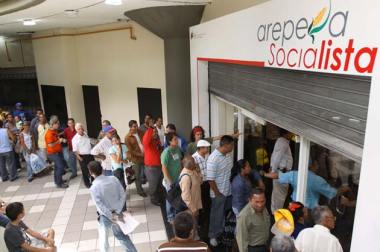
Barely a month ago, Chavez inaugurated, for lack of anything new in eleven years, a store front containing a “socialist arepera” where the Government would sell the Venezuelan staple at Bs. 5 per arepa. I thought in six months they would be failing, even if Mr. Super-Saman was going to work four hours as a volunteer there every week (Has he?).

Well, Tal Cual reports today that the Arepera Socialista is facing supply problems, from lack of flour (no arepas then!), to lack of ingredients, its customers are getting mad at the bad service. Add to this random hours and long lines and as predicted here and by Daniel (He argued a Government that could not run a dry good business in Mercal, would certainly fail at this).

As Tal Cual reminds us today, the Socialist Arepera may be going by another Chavez proposal, the “Empanada Route”, which never got off the ground as a Tourist attraction.

Par for the course for Chavez and his hare brained ideas.

The Hyperinept by Teodoro Petkoff

January 20, 2010

The economic  and electricity crisis were announced years ago. In both areas a lot of people got tired of noting that the course set by Chacumbele led inexorably to this disaster we are experiencing today.

But the inept one did not to hear. Drunk with petrodollars, he thought he had invented a new type of economy. But the country itself had learned from its previous crises and many people (including pro-Chavez ones that whispered privately in cowardly fashion, afraid to sing the truth to the inept one) noted that Chacumbele’s economic policy was unsustainable. Unfortunately, the facts have been proved right.

But the inept one does not learn the lesson. Now he is trying to skirt his responsibility. It’s the worst possible behavior. It has been shown that when in a crisis, governments that say the truth, as harsh as it may be, people react positively and sympathetically and are willing to sacrifice. But when you lie, people get pissed. When people hear the inept one say “¿Who manages the dollars? ¿Do the people manage them? ¿No, they are manage by the bourgeoisie, which is  accustomed to cheap dollars,” people know that he is lying and they are being manipulated.

The dollars are managed between PDVSA, the Central Bank, Fonden and the government.

After eleven years of “revolution” now the inept one attempts to convince the “people” that the dollars are handled by the bourgeoisie. If so, what is this revolution which puts its fundamental resource in the hands of the bourgeoisie? “The dollars are produced by the bourgeoisie? No, PDVSA produces them. ¿Does PDVSA give them to the people? No, they are sold to the Central Bank and with the Bolivars it pays taxes to the government, who handles these Bs and the dollars that now passes directly the Central Bank.

The money, therefore, is managed by the government. The exchange controls, to control the management of dollars, was established by the government, not the “bourgeoisie.” The “very cheap dollar” was established by the Inept one and he maintained it that way for five years while, incidentally, from the productive sectors of the bourgeoisie, he was warned that it was destroying the productive apparatus and causing and overflow of imports. The naive ones who still believe that Mr. Saman can possibly control the rapid increase in the cost of living by closing businesses, will soon face reality.

Just for the record, we anticipate the inept one what’s coming up in the future with his current economic policies. You’ll have plenty of Bs,between those produced by your devaluation and that produced by the 7 billion dollars you took from the Central Bank. You are going to spend that excess money  electoral excesses.

A temporary joy only. There will be more inflation this year than last, because there will be more Bolivars chasing goods and services and the bolivar will continue to lose value, so in reality the relationship between the bolivar and the dollar will be higher, which is measured at the parallel market . This will result in higher inflation and in a while you will face the panorama of having  to devalue again. Sooner or later there will be more zeros on the notes of the  “strong” Bolivar. By the way, there will be neither economic recovery nor a significant improvement in exports. Continue, thus, inept one on this course and in a while he himself will understand the Chacumbele syndrome.

Three more banks intervened and shut down, everything is normal in Venezuela

January 18, 2010

Tonight the Superintendent of Banks announced the intervention and shut down of three more banks in Venezuela: Inverunion, Mi Casa and the development bank Banco Del Sol. The first two were associated with Chavista boliburgueses, while I suspect the third one was too, but can to swear that was the case. Inverunion was bought by Gonzalo Tirado, former President and chief strategist of Stanford Bank in Venezuela and Jose Zambrano, another infamous friend of the robolution.

While they are small, they add up to the crisis and FOGADE that is supposed to protect depositors will have to provide the funds for this. Since there are none, the Government will have to contribute, more money printing, more inflation, another failure of the revolution and more banks to come.

Even revolutionary movements like the Carapaicas are somewhat pissed at the “robolution” so Chavez better watch out, there are some baseball games coming up and “You’ve struck out” has hit a chord in Venezuela. How many such banners will show up at the baseball finals?

Since I am home and going on a very personal trip tomorrow, I can’t look up at my database to see what deposits were like at these three institutions. You can bet Mi Casa is not as small as you think it is. However, I do know the Government “plans” to solve part of this crisis by increasing the contribution from banks to FOGADE from 0.5% of deposits to 3% of deposits. Many banks in Venezuela don’t even make 3% of their deposits in profits, so you can bet this is another problem in the works. For those that are subscribed, I recommend Francisco Faracos’ interview in today’s El Nacional, one of the most lucid descriptions I have seen recently on the state of disarray of the Venezuelan economy. God helps us!

And by the way, recall I was accused of being scandalous when this financial crisis began. Well, three more added to the list and still counting, another triumph in management and supervision by the robolution. And Chavez helping the panic at each step of the way!

And these were the friendly guys to the silly Chavista process!

Freedom of Speech? Not in Venezuela. Hugo: You struck out!

January 17, 2010

So, a group of students in the middle of the deciding game to see who goes to the next stage pull out a billboard that says:

“Three strikes, crime, water and lights, Mr. President, you struck out!”

The National Guard arrests them, takes their sign even if no law was violated.

They have been released, but their protest was violently stopped, even if no crime was committed other than show the country the truth.

From the amazing tongue (and brain!) of Hugo Chavez

January 17, 2010

So Chavez gave his State of Disarray of the Union speech on Friday and it was as nutty and disastrous as the country:

–He named Jorge Giordani Minister of Planning AND Finance. The man responsible for the bad state of the Venezuelan economy  as well as the electric grid is now given more power than ever. I guess Chavez had to join the two ministries now that Jesse is not around. At least Jesse knows that he doesn’t know.

–Since crime has become the number one problem for Venezuelans, he had to say something about it, but it did not come out too credible. Said the Dictator:”Crime and violence is a political problem and one of the greatest enemies of the Bolivarian revolution. I have no doubt that the crime and many of those criminals bands are trained, financed and backed by the counterrevolutionary bourgeois, the Yankee empire and its lackeys.” Unfortunately for Hugo this will not fly in the barrios where they have not seen a cop, a bourgeois or a Yankee in the last eleven years as crime by their own has soared.

–He once again spewed out the BS about Coltan, which I wrote about earlier. The charlatan now thinks it is worth US$ 100 billion. Well, if it is a money losing proposition, then it is really worthless and if it is in Venezuela manged by Chavez and his incompetent robolutionaries, it is worth even less. Oil use to be the sure thng, but in eleven years Chavez and his brilliant cronies have been unable to come up with a single new project that has generated a single new barrel of oil.

–Chavez said that the Venezuelan economy is fine, not like the US, because the US’s economy generated unemployment. Well, you have to be ignorant to believe that an economy can shrink 2.9% like the Venezuelan one and not lose jobs. Oh! by the way Hugo, the Venezuelan economy shrank more than the US’s in 2009. (Which shrank by 1.9% a full point above Venezuela’s). And inflation is going to top 60%, but has anyone told Hugo?

–Chavez says he is a Marxist but never read Das Kapital. That’s like me saying I love West Indies cricket and don’t understand the game.

–Chavez called for the Vatican’s representative’s building to be exorcized because it held a rapist in its walls. Once again Chavez assumes someone is guilty until proven innocent and he personally becomes Judge and Jury. What else is new?

–And once again, Hugo said he would revalue, because the swap rate is going to Bs. 4.3 per dollar. He was probably assured this by the same bullshitters that told him in September they would drive it down to 65% above the Bs. 2.15 per dollars. Maybe they think that if they keep increasing the official rate, they will find convergence. the problem is they keep running the Government and don’t realize that it is not a problem of magnitudes but of policies. They drove the swap rate down below Bs. 5 briefly, because they spent US$ 11 billion in bond sales. But four months after the rate is near Bs. 6 per dollar and it would be hard for them to issue  11 billion dollars more. Meanwhile, Chavez is taking US$ 7 billion from international reserves. Given OPEC’s high current capacity, if oil prices drop, this could be catastrophic.

Why the BCV zero coupon sales won’t drive the swap rate down

January 17, 2010

A few people have asked me about the zero coupon bonds that the Central bank is selling asking why it is I don’t think it will drive down the swap rate down. While Chavez claims he is revaluing the currency because the swap rate will go to Bs. 4.3 per dollar and some respected analysts think this mechanism will work, I disagree. I actually think that the way it is currently designed, this will get nowhere and I think we have already seen the first signs of this. Unless the Central Bank changes the design, it is wasting its time (and our money). Here is why:

First of all, the process is not an auction. It is a sale of dollars at Bs. 5 per dollar, far from the swap rate that closed on Friday at Bs. 5.85 per US$. Thus, there is no way to lose, you sell dollars at close to Bs. 6 and get some sort of democratic allocation at Bs. 5. Whatever you get, if you do, is a gift. Zero risk gift at that. If it was an auction there would be guessing and there would be risk, those needing more dollars would pay higher for it and would get them. There would be no sure thing.

Second, the big drivers of the swap market are corporations. They need millions of dollars not thousands, but if one is to believe what people are being allocated and that nobody has been given preferential treatment, on the first day, orders above $ 60,000 were allocated $60,000, orders below were allocated the full amount. On Thursday, the same thing happened but the number went down, orders above $53,000 were given $53,000, those below the full amount. (I have heard someone was sold millions in the CD’s, either they got preferential treatment or they placed many small orders)

And we come to the crux of the problem: As time goes by, more institutions, individuals and companies will put in more and more small orders, much like in the bonds sold by the Government to drive the swap rate down, but which failed to do so except psychologically. Each day smaller amounts would be allocated and the swap rate will not go down, unless the Government sells a huge amount and wipes out the bids. But I understand the first day there were US$ 500 million in orders. Thus, by the end of next week we may see allocations of $20,000 per orders and thousands of orders.

Whether the CD’s are registered abroad or not to me is almost irrelevant at this point. If they are, those that get them will sell the CD’s and then go back to the “auction” to ask for more. So, it may actually go against the Government to register them. Note that the first day, local banks were buying the CD’s back from the buyers. On the second day they did not, because the Government changed the wording and removed what the Prospectus said on the first day: That the zero coupon bonds would be sold in the international markets. The BCV says it will now register them abroad.

Thus, I expect the Central Bank to change the mechanism soon. In the meantime a few hundred million dollars would have been wasted by the Central Bank. What else is new in a wasteful and incompetent Government? I obviously have ideas as to how I would do it, but I will not tell the BCV how, in their self sufficiency and arrogance they haven’t even asked.

And to make sure I answer all the questions, these bonds will not trade in local currency, it is explicitly prohibited by law.

The electric crisis in Venezuela: Cancelling Alto Caroni and nationalizing the elctric sector

January 16, 2010

Forgotten in the debate about the electric crisis are two decisions made by the Chavez administration which are key in understanding the current electricity shortage, independent of how many Guri turbines are out of order which is the real problem even if Chavez continues to blame El Niño for the gallery: The first one is the decision to halt the construction of four (not three as I indicated earlier) dams in the Alto Caroni and the decision to nationalize the private electric sector.

The Alto Caroni dams: The Alto Caroni dams was a hydroelectric project for building four dams in the Upper part of the Caroni River (Guri is in the lower part). The four dams were in an advanced stage of design and practically ready to be started when Chavze arrived in power. They were Tayucay (1.800 MW), Eutobarima (2.700 MW), Aripichi (2.800 MW) and Auraima (2.700 MW) for a total of 10,000 MW in ne generation capacity.

It was Jorge Giordani, named czar of Venezuela’s economy last night after ruining it for eleven years, who argued then that Venezuela had energy for 500 years and that the Alto Caroni was not an option that should ever be needed. Giordani, an electric engineer as an undergraduate, said that the environmental impact of these dams was too large and instead the Government should focus in the use of thermoelectric power plants that use gas. However, the Tocoma project in the lower Caroni was never canceled, it was delayed and it was not until 2006 that the bidding was opened to begin the excavation of the dam.

Chavez however did not cite this issue when he said it was the oligarchy (?) that wanted this project in the Alto Caroni, which would have increased our dependence on the Caroni are and saying imagine what a crisis we would be in because El Niño. Which clearly shows he does not understand the issue, first of all these dams would not exist as of yet, if Tocoma which was further ahead in the planning is not ready (2012? more like 2014), these would not be ready. But Chavez seems to think that it is the flow of the Caroni river that matters, not the potential energy stored in the water of the dam. Once the dam is filled, the flow is unaltered by the presence of the dams, in fact that is one of the reason why dams are built to save flow from the rainy season for the dry season.

The reason hydroelectric power is attractive is simple: Cost. The large cost in a hydroelectric plant is building the dam. Once it is over maintenance should be cheap (If you do it!). In countries like Venezuela it is even cheaper to bulid dams, because there is no ost associated with buying out the land.

There are typically three issues associated with the environment in building dams: indigenous populations, wildlife and water quality. Water quality is not relevant here as these dams are not used for drinking water. The usual problem is that building the dam alters the quality of the water and may deteriorate it. The largest history in building dams in other countries in terms of wildlife has been species which may become extinct and altering fish traveling patterns. The latter is once again not relevant here. The former is, but when Guri was built it was determined that there were no threatened species, the problem was more helping the migration of species present in the area.

However, thermoelectric power plants are also problematic in terms of the environment and long term imply not only a higher cost, but a long term fuel commitment, read less oil for export which the way we are going may become an issue soon in any case. (Mark my words!)

But in any case, the environmental record of the Chavez administration is simply abysmal, thus even if seem to have forgotten this argument, they can longer claim given everything they are allowing to take place in Venezuela, from the huge increase in CO2 emissions due to cheap gasoline, to gold mining to the Maracaibo Lake eutrification. Only in giving relevance to the problem of Venezuela’s indigenous populations can the administration claim success, even if it has been more hot air than anything.

(PS: There is a lot of BS with Caracas, EDC has capacity of 2,300 MW (or had) Caracas uses less than 2,000, thus bringing “barcazas” to Caracas as the VP said just means they want current power somewhere else.}

From the wisdom of Hugo Chavez: There was no devaluation, it was a revaluation!

January 15, 2010

From the incompetent mind of Hugo Chavez here you have what may become the phrase of the year for Hugo Chavez:

“What we have done in reality, is a “revaluation of the Bolivar” and the swap exchange rate will go down to Bs. 4.3 per $”

This is typical Chavez, talk about a future that never materializes. Remember that three months ago the goal was to have the swap rate be 65% above the official rate of Bs. 2.15 per $. That never happened. Now he says the swap rate will be brought down to Bs. 4.3 per $. Well, I wonder if anybody actually told him today before the speech that the swap rate closed today UP at Bs. 5.87 per US$. Jail me if you want Hugo!

(More on the speech tonight tomorrow, full of little Chavez wisdom jewels!)

Zuela by Laureano Marquez

January 15, 2010

Zuela by Laureano Marquez in Tal Cual

In this article, Marquez’ “Serious humor”, becomes very serious indeed. Enjoy!

Zuela, as in Thomas More’s utopia, is a non-existent country, it is an imaginary country, is what remains of a great country, or perhaps it is better to say, than it could have been a great country, which it isn’t,  but it  still can be .

Zuela is like those kids who seem promising, with a future ahead: children of wealthy parents with resources to provide them with an education, to make  a good man out of him, but the boy inexplicably goes rogue.

This imaginary country, is the antithesis of utopia, which does not exist because its ideas are so advanced. Zuela does not exist because it is unthinkable that there may be such incapacity in the midst of extreme wealth. In Zuela money is the driving motor for everything, money buys consciences and more than one nation it is a center for unpredictable businesses: In Zuela, when the currency is devalued, for example, people instead of protesting  the inflation that is about to hitm them, decdicae themselves to buying appliances in an attempt to capitalize on the debacle. Make sure that you take into account, in order to underline this contradiction that Zuela is a country without electricity.

Zuela’s prosperity is not measured by the collective progress, by the beauty of its public spaces, but by individual advancement. The residents of Zuela boast of the way they swindled the money of the collective and consider an imbecile anyone that, having the opportunity to steal does not.

The inhabitants of Zuela have a term for this type  people: “He is a pendejo (dumbell)” they say. Thus, theft and fraud are the main source of wealth in this imaginary country.

Almost everyone does it, “each according to his needs, each according to his abilities.” In Zuela the law exists and is theoretically good, but the judges of Zuela are zueleños and as such they always put their individual welfare above the collective one, especially when every time a judge shows some sign of dignity, he or she is severely punished. The locals seem to accept their fate with resignation, though sometimes they protest and receive harsh repression so taht they learn taht protest will not be of any help.

In Zuela you live at your own risk. Criminals and police team up to commit crimes. Life is worth little and the streets are unsafe.

In Zuela, of course,  that there are people – and a lots of it – that does not share this way of life and they exist in all sectors and an at all levels of society. For example, although there is no reliable electricity in Zuela, it does have the brightest people to solve the problem, but in general they are not payed attention to. Zuela has first-rate universities and is full of smart people who become “prophets of doom,” announcing the coming catastrophes, but they are rarely paid attention to.

Zuela has wise legislators, technically very capable and professional technicians trained in the best universities of the world and, despite their fate, an enviable infrastructure product of the time when zueleños have agreed to advance together.

But with very brief exceptions, civilians are rarely the leading actors of the history of Zuela, but it is military mentality, which too often is at their own service  rather than at teh service of the  “homeland”. Ordinary people are generally kind and lives off the expectation that the future will be better. But in Zuela But, like in the  myth of Sisyphus, whenever there seems to be  a chance to climb the hill, the stonerolls back down at them and they must begin the task again. That is, amidst all, a positive sideof  Zuela: Its dwellers are accustomed to start again from the bottom each time a project of destruction of their hope in disguise, robs them of  their destination. The zueleños often say in the face of each crisis “now we”ve hit bottom, but their leaders always have the ability to surprise with new and unforeseen funds. The end of this story and  if Zuela will be in the end the promised land or a ruin has yet to be written, because one of the disinctive features of Zuela is that it is unpredicatble, you can expect anything, even something good.

El Niño: How strong is it?

January 14, 2010

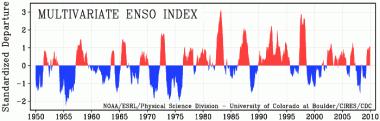
Given that El Niño is being blamed for the electricity crisis, I thought I would show this plot sent to me today on its strength by people at the Venezuelan Academy of Sciences. This is taken from NOAA’s website. This is a plot of an Index which attempts to measure the strength and duration of El Niño. When the index is in the red, it means that there is El Niño. As you can see, it is barely starting and is not particularly strong (yet, could get much worse). The 2003-2004 crisis was due more to the duration of El Niño. El Niño in the 80’s and 90’s was much worse in intensity and duration that this event: