Well, I continue to try to understand the electricity problem. I want to know both qualitatively and quantitatively how big the problem is. Thus, another post on the subject and thanks to those that really participated in the comments in helping understand whether the rules made sense or not and how much in deep s… we are or may be in the near future. I will summarize some of what I have learned.
First of all there is clearly a big problem, which can be illustrated with this pictures of the Uribante river where the dam is, which compares the same location in November 2008 and October 2009. 
A picture is clearly worth 10,000 words as you can see the water level is very bad shape.
While graphic, the problem is that Uribante is almost a footnote in Venezuela’s power generation picture, since Guri, the dam in the Guayana region generates 63% of the electricity in the country. Unfortunately, in the Corpoelec report where the pictures above were taken from, those of Guri are not as dramatic as the picture above, for a very simple reason: The level of water at Guri, while low, is not at a historically low level, as this graph shows:
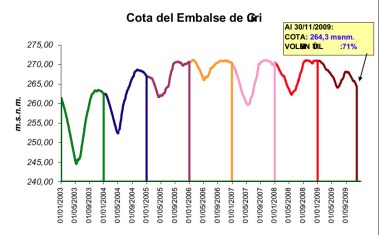 each vertical line indicates the height of the water level on January 1st of each year. As you can see, the level is at 264 meters above sea level. In both 2003 and 2004, the level was found to be lower on Jan. 1st than it is today. Thus, at first glance one would think that given that this crisis seems to be playing out to be much more dramatic than in 2003 and 2004, this is not justified.
But it is, because in 2003 and 2004 the Rio Caroni that feeds the Guri dam was not running at such a low level as it is running today as shown in the next graph:
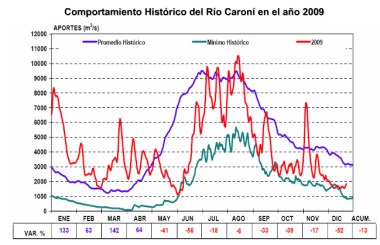
This is a plot of the day by day flow of the Caroni river (in red) during 2009 where it is compared to the worst flow recorded in history (in green) and the historical average (in purple). As you can see the water flow is 50% of the historical maximum at this time of the year and very close to the historical minimum. And this is precisely the problem, the dam is not filling as fast as usually is which means that if you keep using it at full capacity, the wtaer level will drop to critical levels much faster tahn it did in 2003 and 2004.
And yes, you can blame El Niño for that, but this is not an unusual phenomenon either, it comes and goes in periodic cycles. But since you can not longer blame the previous Government (even if it was tried) you might as well assume the usual “don’t blame me” attitude of the Chavista Government.
But in the end, El Niño is not the real problem either. The real problem is that demand since 2004 has grown by ~40%, as can be seen in the next graph:

And what is the reason for this growth? Well, the main reason was the oil boom, which led to a spending and consumption boom, but there is also a factor of the lack of any incentives to save energy or electricity. Not only have rates been frozen for 7 years, but 32% of residential homes steal their electricity and many Government offices and institutions do not pay Corpoelec or pay with considerable delay.
But nothing was done about the rates. In fact it was the Government’s policy to keep them low. And like Petkoff says in the previous post, this growth which originated in the oil boom, was not accompanied by the investments that could have been made using part of the funds from the oil boom.
But it was worse that this. When Chavez got to power in 1998, there were two large power plants under constructions that were supposed to be finished before 2003 and three hydroelectric plants planned for the Alto Caroni region. Of these only one was completed in 2007 (four years late). One is scheduled for 2011-2012 and the three hydroelectric plants were replaced by about two dozen fuel plants of which only two or three have been built and only two are fully operational. Remarkably, those ineffective Governments of the much maligned IVth. Republic planned sufficiently ahead in the 70’s, 80’s and 90’s such that there was always over capacity.
Not any more…
Through lack of investment and planning and despite Giordani, as noted by someone in the comments, having a Bachelors in Electrical Engineering and spending eight of Chavez’ eleven years as Planning Minister, the whole field was mismanaged and it is fully and completely this Government’s fault that the country faces this crisis.
But it is interesting to look at some other numbers which tell us a lot of about the industrial and electrical power infrastructure of the country.
First of all, the following graph shows the power produced by Edelca (mostly Guri) and how it is used:
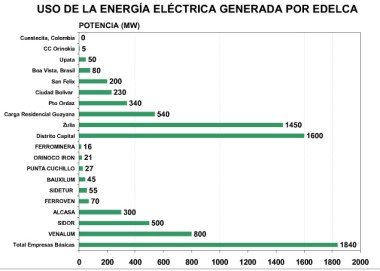
The last line is truly amazing, it represents the electricity consumption of all of the basic industries in the Guayana region, they use 1,840 MW of power, more than all of Caracas or all of Zulia State. In fact, it is more, because the cities of San Felix and Pto. Ordaz are fully devoted to those basic industries and they use another 540 MW, so that the combined consumption of the Guayana Industrial Complex reaches 2,380 MW in total. (Edelca generates a total of 9,780 MW and Guri 6,200 MW)
Which is why the focus of the savings program is in this region. The Government plans to cut production of Aluminum and Steel, chopping off 500 MW of power, cut off supply to Brazil (60 MW), install an additional 35 million energy savings lightbulbs (200 MW), increase thermoelectric generation (adds 100 MW) and finally, reduce electricity demand at shopping centers (20 MW)
The last number is what is ridiculous. The misguided policies proposed by the Government, only to be withdrawn when the outcry forced them to, represented barely 2% of all of the savings and cuts proposed. As I have suggested elsewhere in this blog, this improvised decree could have been replaced with forcing shopping centers to cut 10-20% of the energy usage in November 2009, by policies chosen by them under the penalty of paying four or five times the going rate in any excess of the power used above the targets.
You can bet that shopping centers would have happily complied, choosing what to do so as to maximize business, jobs and convenience to their customers.
But stupid Big Brother thinks he knows it all, while the opposite has been shown to be the case in this field.
Finally, the presentation by Corpoelec has ince again over optimistic projections like saying Planta Centro will be up to 400 MW by next month. Sure…I also understand that Guri is below performance due to a number of turbines being off line.
There are other topics that are interesting in all this, such as whether the Guayana complex makes sense, why the Chavez Government decided to buy Sidor, the economic impact of these plants running at half capacity while the Government pays everyone’s salary. But for now, I think this post is long enough and I am sure you agree.






 The Devil's Excrement