Archive for October, 2012

The Devil Peeks Into His Crystal Ball and Spreadsheet

October 4, 2012

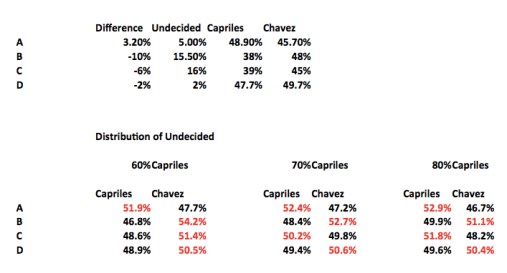
Predictions by pollsters A,B,C and D (top) for the Sunday election. In the lower half, the same predictions adjusted for the undecided in three scenarios. Red indicates which candidate wins in each scenario.

Predicting elections in Venezuela has always been tough. I am no pollster, nor do I have the feel for what the people of Tucupita are thinking, even if when I was a kid when asked where I was born, I thought it was cool to say I was born in that city in Delta Amacuro.

In the last election, most reliable pollsters were saying Rosales was doing badly, but there was one prediction that said the opposite, wholly confusing me. I have since erased him form my studies as I did not dare predict the outcome.

And then came this election, where pollsters had either a close race, or a large Chavez advantage but an even larger number of undecided. Even worse, the number of undecided did not decrease in time, leading to the question: How can it be that in such a divided and polarized country, there can be such a large number of undecided voters?.

In the table above, I show the four pollsters I consider to be serious and their last predictions. Some don’t have decimals because I have been dictated numbers over the phone or been given the numbers in pieces of paper. Since I don’t pay for any of them, I don’t give the names associated to each, labelled A,B, C and D.

What I have done is to say that since I don’t believe that the large “undecided” all really exist, these people must be hiding something. Therefore, there has to be a large bias among them towards Capriles, after all, it is the Government that instills fear in them. Thus, I consider three scenarios in which for all of the polls, the undecided divide themselves 60% for Capriles, 70% for Capriles and 80% for Capriles. To me, the middle scenario 70% for Capriles/30% for Chávez is likely to be the more realistic one.

Given that, the four pollsters are split evenly. However, I can never forget the advice given to me by pollster Segundo Cazalis long ago, pay attention to the trends more than the numbers. And the trend has been Capriles’ friend for the last two months. Even in the most Chavista polls, Capriles has been rising.

With this information, and the fact that most of those polls above were made before Sept. 20th. , those two additional weeks and the campaign closing rallies should tip Capriles over the top and he should win, in my opinion, by 1% to 2%, barely 140,000 to  200,000 votes. Too close for comfort.

I could throw in abstention, which I think will be near 30% and increase the lead by an additional 1%, but I will leave it at this: A tight Capriles win with 140,000 to 300,000 votes advantage.

It is a small number. It may keep us up until the wee hours of the night Sunday evening, since the CNE clearly said it will not call the election until the trend was “irreversible”. (At the lower end foreign votes will be needed to call the winner) If larger, we could go to bed earlier, but this is as far as I can predict given the knowledge that I have.

Hope I am right!

A Bifurcation In The Path Of The Venezuelan Future…

October 3, 2012

Two events prove that Venezuela faces a bifurcating choice on Sunday. Two separate events, one at the top and one at the bottom of the political food chain, which simply show the world that Chavismo not only has lost all scruples, but it aims to control the daily lives of all Venezuelans if it is allowed to spend six more years in power.

The first one, was the statement made by the Minister of Defense General Rangel Silva that Capriles’ statement that he will name an active General as his Minister of Defense only aims to destabilize the Venezuelan Armed Forces. Rangel Silva followed this up by saying that no active General would accept the post with Capriles, because the opposition candidate aims to “desarticulate” the Venezuelan Armed Forces. Later the General, when asked if it was appropriate for him to criticize a candidate, answered that this somehow is part of the “new democracy” and that he was forced to respond because of the “disdain” shown by candidate Capriles towards the Armed Forces.

Coming from the same man, declared a drug kingpin by the DEA,  who once said that he would never recognize a Commander in Chief other than Hugo Chavez while he was Minister of Defense and coming so close to the election, the General’s words are not only anti democratic and insulting to anyone’s intelligence but show the dangers ahead of continuing for another six years under the Chavez autocracy.

Fortunately, the Ministers message shows that Capriles statement had the desired effect: It tells Rangel Silva, who has little influence on most high ranking military and commands no loyalties beyond the cronies that surround him, that he may find internal resistance within the military should he decide to join any attempt not to recognize Sunday’s results should Capriles be the winner. And it shows the Minister is no democrat when he tries to interfere with Capriles’ right to say who will accompany him, should he win the Presidency.

And if this shows how putrid Venezuela’s Chavista democracy is at the top, the same goes for freedom at the bottom of the Chavista food chain with the decision to shut down all Government offices tomorrow, so that Government workers can “accompany and support” President Chavez, in the closing rally of his campaign. But these civil servants will have to show up for work, so that their bosses can check their presence and take them to Chavez’ rally under the threat that if they do not show up on Thursday or attempt to leave the rally, this could endanger their career and /or originate a demotion or a transfe to a job in the Interior, rather than Caracas. This form of political harassment also shows how the freedom and the rights of Venezuelans would be increasingly limited should Chavez win on Sunday.

It is indeed a bifurcation in our path to a better future. A Chavez victory would lead to further limitations to freedom at the top and at the bottom, while a Capriles victory will lead to more plurality and democracy. Tomorrow, I will give you my final take on what I think will happen and I certainly hope Venezuelans choose the path of a more open society.

Venezuelans deserve better.

An Update On What I Think Will Happen In Venezuela’s Presidential Election

October 2, 2012

My friends keep giving me Hell for not being more optimistic, some even send me tweets that are meant to say I have no clue what I am talking about. However, in the absence of any new information, I think it is a still a close race and Capriles has the momentum. I just need more one data point to make my prediction and I should get that in the next two days. Yes, I am going to say Capriles will win, that seems to be the likely result. But I am not in the camp of a 10% victory by Capriles or even a 5% victory, I think it will be smaller even if I have lots of respect for Daniel’s data, which he just published.

There are many reasons to get excited, Capriles has the momentum, the rallies are huge, the response to Capriles is extraordinary and Chavistas should really not be as motivated as the opposition. But…

-The numbers are not overwhelming in Capriles’ favor in reputable polls.

-The Government is pulling all of the stops.

-Abstention continues to be key on Sunday.

And when I say the numbers are not overwhelming, there are three pollsters that have been fairly accurate in the past. One says Capriles is barely ahead, one says Capriles is 2% behind and the third one says Capriles is 10% behind with 10% undecided.

I can not dismiss that.

But I always go back to abstention. Even if polls are right (Or wrong!) abstention has always been the hardest number to predict in Venezuela’s election. Most of the time, Venezuelans say they will vote and later they don’t.

Currently, most polls are saying that abstention will be around 27-28%. In 2006, a Presidential race, abstention was only 25%. In the Assembly elections in 2010, abstention was 32,5%. And that my friends makes a big difference. Never mind that Chavismo won by 26%-plus in 2006 and lost by 4% in 2010 in terms of the total number of votes.

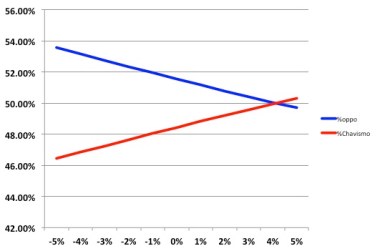
Thus, last night, I made a little model, using rough numbers from the 2010 election and asked: How many more Chavistas going to vote in 2010 would it have required in 2010 for the number of votes to be the same between the opposition and Chavismo. The answer is, slightly more than 4%:

and to me that is too close for comfort. Because on Sunday, Chavismo has a lot to lose and they will try their darndest to get out the vote. Thus, I can not say whether abstention will be 25% or 32% and it will make a HUGE difference.

In conclusion, it does seem that Capriles has the momentum, it does seem that he may be ahead. But, but…In the next two days I will get the last data point that will allow me to make an educated prediction within the scope of my knowledge. For now, Capriles ahead, but it is very close.

Cheer up!

Russians Pay For Their Orinoco Oil Lottery Ticket

October 1, 2012

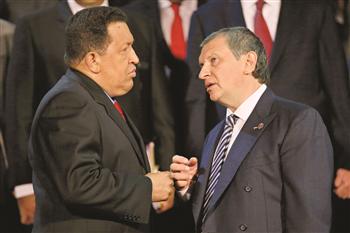
(Chavez with Rosneft Chief Igor Sechin)

Last week, the Russians decided to pay for their Heavy oil crude oil field lottery ticket, by paying for all of it and lending PDVSA the amount needed to finance PDVSA’s side of the deal.

You see, these Russians are being very, very clever. PDVSA has been asking most oil companies to fund PDVSA’s part of the project, but except for Italy’s ENI, most of them have balked at the idea. Even the Chinese said “bù” to Chavez on the idea, feeling that PDVSA should fund its part of the deal. The consequence is that most projects are behind because PDVSA has not fulfilled its part of the deal, mostly paying for the infrastructure related to the projects.

But the Russians have been very clever. They first bought the first half of the Junin 6 deal by bringing none other than Vladimir Putin, el hijo mesmo, to Caracas to sign the original deal and thus make it a “Government to Government” deal, harder to go back on it should the Government change,  even if other projects are similar. Except that Putin came when he was not even Primer Minister of Russia. And now that things look iffy, the smart Russians give PDVSA a US$ 1.5 line of credit to fund its size of the deal, just in case. Lock, stock and barrel Junin 6!

Come Jan. 10th., Capriles may decide to delay or postpone some of the heavy crude oil deals given to the many operators who have no clue what the Faja Heavy Oil is about, but the Russians will show their lottery ticket, winning numbers, loan, good companies like Gazprom and Rosfnet and Prime Minister Vladimir Putin attached to it.

Clever and dangerous guys these Russians are…

Chavez’ “Developement Fund” Fonden: Lies, Deceit And Mismanagement

October 1, 2012

When the development fund Fonden began, the idea behind it was to have PDVSA contribute foreign currency to the fund, together with larger transfers from the Venezuelan Central Banks’ (BCV) international reserves to create a fund that would spend abroad to back development projects in Venezuela. The reason was clear, since the main provider of foreign currency in Venezuela is PDVSA, when PDVSA hands over foreign currency to the BCV, it gets Bolivars. If you removed these dollars and spent it locally, you would be debasing the currency and creating inflation. Simply put, if you took Fonden dollars and spent them locally, you would have to change them into Bolivars, creating essentially more Bolivars with the same dollar that you already gave Bolivars to PDVSA for. It would be money printing on steroids.

Chavismo envisioned this money buying mostly equipment and machinery for development and infrastructure projects. This was quickly perverted, as Fonden became Chavez’ petty cash fund, used to fund his every whim and idea, with money thrown irresponsibly around, including using it locally in Bs. and for non-investment purposes. After US$ 105 billion spent, Fonden has become a black hole of waste, deceit and mismanagement, with its funds used to finance projects outside Venezuela, including US$ 6 billion in Cuba, to buy weapons, to buy a Russian bank, to buy buildings abroad, to give hand outs to people and to make dubious investments.

Recently, Reuters published an excellent investigative report on Fonden, you can find it in Spanish here and in English here. In this article, I pick up and look at in more detail at something mentioned in this report and which I had written about before: How Fonden began making financial investments, some of them of a dubious nature, and then proceeded to cover up the losses, hiding them behind accounting tricks and structured notes, with no accountability for the lost money.

The excellent Reuters report shows how many of the projects are sitting there unproductive, below I show how more than a billion dollars was lost and the losses are still hidden behind financial products in a fund that was managed directly by the Minister of Planning and Finance and the President of PDVSA.

In pages 11 and 12 of the “Informe de los Comisarios” of Fonden, which I discussed here, there were three transactions which were quite questionable:

1) Fonden had invested or purchased some form of notes from Lehman Brothers (point 6, page 11) in the amount of US$876 million. It has never been made clear what this investment was, but it was dumb to invest in a note issued by Lehman Brothers in such a large amount, If the purpose was to invest, it should have been made in a diversified portfolio in custody with Lehman Brothers. (Those who had custody did not lose a cent with Lehman, only those buying securities issued by Lehamn lost their shirt) Of course, this note in itself had some dubious purpose, which we do not know. The result was that Lehman Brothers went bankrupt and in the first few months after its bankruptcy, instruments issued by Lehman were trading around 20% (or less) of its face value, roughly US$ 175 million, yielding a loss to Fonden of approximately US$ 701 million.

2) Fonden invested US$ 494,600,000 in Ecuadorian bonds (point 8, page 12). This was clearly a political investment made to help President Correa and Ecuador. However, Ecuador decided not to keep paying these bonds. (Nice friends, no?) It is not clear which bonds Fonden purchased. But in December 2008, the Ecuador 2030 bond had a price of around 25%, giving Fonden a loss of US$ 370 million.

3) At some point Fonden bought US$ 50 million in dollar denominated bonds of Honduras. Given that this country has not issued bonds publicly, this was clearly a private issue made for Fonden simply as a way of Chavez helping prop up the Government of Manuel Zelaya. These bonds have no know market value, let’s generously assume a value of 20% and we get a loss of US$ 40 million. As we will see below it was much more.

Total loss in these three investments of US$ 1.42 billion: At least US$ 1.11 billion. So, we know what happened to at least one billion dollars of the US$ 105 billion given to fund: It was used politically to make questionable investments and in dubious fashion.

The timeline of all these investments and exchanges is as follows:

-In August 2008, Fonden exchanges the Lehman notes for Notes worth US$ 876 million and US$ 260 million.

-In December 2008, Fonden exchanges the Ecuador bonds for a note worth US$ 650 million

-In April 2009, the financial institution that issued the US$ 876 million note is cashed in by the financial institution that issued it, Fonden keeps the US$ 260 million note, as agreed in the right of the issuer to cash in the first US$ 876 million note.

Of course, there was no accountability, those that made these decisions and lost the money are still the same people running Fonden. But not only nobody was made accountable, but the losses were hidden on purpose, so that they would go unnoticed. And the proof is in this Prospectus from Emerald Capital, which was mentioned in the “Informe de los Comisarios” and which a friend has generously sent me to allow me to tie up most of the details

View this document on Scribd

I don’t want to bore you with the details (maybe you already are bored). But in the Informe de los Comisarios, it says that (point 6, page 11) the Government exchanged the Lehman instruments for two zero coupon notes of US$ 650 million and a US$ 260 million which was apparently with Nomura, as later it says that Fonden maintained investments with Nomura and the Informe mentions only a “Japanese institution”. In point 4) page 9, it also says that “later it asked another financial institution to exchange the Notes for US$ 650 million and US$ 210 million and the US$ 50 million in bonds”.

And then, magically, Emerald Capital, also mentioned in the “Informe” as one place where Fonden kept investments, issues a note for US$ 310 million (US$ 260 million+US$ 50 million), which has as collateral a Nomura note (page 29) linked to the Venezuela 2024 bond and is apparently swapped for US$50 million of Honduras bonds (This is never specified above) and is referenced starting from that moment on to Venezuelan bonds. (If Venezuela defaults before 2024, Fonden gets nothing!)

And that is the key to hiding losses. A zero coupon note pays no interest until the end (2024). What Fonden does is give the securities of Lehman, Ecuador and Honduras, which have low values (20% or even less) and exchanges them for an equal amount of Venezuelan bonds which pay interest. With this interest, in 2024, the Emerald note will go up in value to almost 100% of what Fonden invested and because it is a Venezuelan bond, the Government recognizes it as being worth 100% or close to it, even if you have to wait until 2024 to have them be worth that much (There are many details not described in the Emerald note).

But as you can see in page 26 of the Emerald note, it is worth much less. In June 2012, for example, if Fonden had asked for the Note to be cashed in, it would have been worth only US$ 41 million. And since it was worth less than US$ 26 million during the first year, it means that the original $260 million which was left of the US$ 876 million invested in Lehman, was worth less than 10% when it began (and there are commissions too).

Somewhere else, there is the second note for US$ 650 million, I have not found it. If it is anything like this one, it is worth at most US$ 65 million. Thus, in the end, it appears that Fonden lost 90% of the investments, registers US$ 910 million in notes, but they will not get closed to it until 2024, cross your fingers.

By then these people will be long gone, never accounting for their lies and crimes against the people of Venezuela.