Archive for the 'Uncategorized' Category

The Venezuelan Opposition Blunders Criticizing The Gasoline Price Increase

December 18, 2013

gas49.76 Liters (13 gallons) for Bs. 3.5 , that is US$ 0.55 at the official rate for a full tank, or US$ 0.055 at the parallel exchange rate. (4.2 cents per gallon at the official rate or 0.42 cents per gallon at the parallel rate)

I think the opposition is making a huge blunder criticizing the gasoline price increase and it shows its inability to evaluate how it reacts first before going forward. In the particular case of the gasoline price increase, which has now been opposed by at least, Henrique Capriles, Julio Borges, Leopoldo Lopez (The only winner in the recent election) and Maria Corina Machado, I think they should have waited for the full proposal before jumping the gun, rather than reacting viscerally to the announcement.

First of all, the announcement is incomplete, we don’t know what the new price will be and who it will apply to. The Vice-President suggested that it will not apply to public transportation and freight trucks, but we don’t know yet. Moreover, while the President of PDVSA has suggested that the new price for a liter of gasoline will be Bs. 2.8, there has been no formal announcement, what he had was a slide that showed at what price PDVSA breaks even in selling gasoline.

Second, if the opposition should believe in something is in that the current price is simply absurd (see picture above) and should be careful in opposing it today, when it may have to be in favor of it in a few years. It makes no sense to sell gasoline at a loss, it makes no sense to oppose the price increase if you believe in having a rational economic system and that the subsidizing of everything has to stop, particularly such a regressive subsidy.

Third, tying it to the Cuban or Petrocaribe subsidy makes it a very complex issue that most people will not understand and it is not true that the gasoline  given to these countries is “free” either, as most of them have suggested. Petrocaribe countries pay 50% within 60 days of delivery and the remainder with a loan that makes no sense, but that is a different matter. And while Cuba does not pay with money, it pays the gasoline with services. These services are paid at absurd prices, yes, but again, if you start lying and saying half-truths you are behaving the same way we criticize the Government for behaving.

Fourth, the Petrocaribe subsidy has actually been reduced in 2013, as clearly explained in this article in El Nacional, so the Government is actually doing something about that too. So, check your facts before you speak should be an important rule.

And finally, the opposition should be careful with anything proposed by a Government that has been so clever at manipulating public opinion and getting its way. While everyone thinks back to El Caracazo when talking about gasoline price increases and its consequences, people seem to forget that a very unpopular President, Rafael Caldera, actually increased the price of gas by about 800% in 1996, with little political consequence, as it sold the idea well and people understood it was needed. I don’t believe for a moment that the Government is being naive in proposing this price increase. They must have polls that show that people would support it and are ready to make the subject even more popular. Even to the point of having a referendum on the subject and beating the opposition (again!)

So, I think the statements made were wrong. The opposition should have waited for the details and oppose the details, but not the very logical and sensible gasoline price increase. Not doing so is simply cheap politics of the worst kind. The same way, it should say it backs it, but it also backs better terms for Venezuelan in the Petrocaribe and Cuba deals.

What the opposition is showing is that it has no solid proposal of any kind, it just reacts and opposes what the Government says. Maybe that is part of the reason why a large segment of the population does not trust it.

Moody’s Downgrades Venezuela’s Debt to Caa1

December 17, 2013

images

Moody’s Investors Services downgraded last night Venezuela’s dollar denominated debt to Caa1, the equivalent of a CCC level for other credit raters. This is the first credit rater to downgrade Venezuela to this level, which means the debt has gone from having “substantial” risks to being “highly speculative”. To add insult to injury, the company keeps Venezuela on “negative watch”, suggesting it may downgrade it further at any time.

Moody’s cites increasingly unsustainable macroeconomic imbalances, as well as a higher risk of an economic collapse.

While I am not on the economic collapse side of things, I think the Government still has a lot of leeway in what it can do, I do think that the country’s debt will go lower than where it has been. Since the Mayoral election, bond prices have risen because analysts really think that the Government will become more pragmatic. I disagree, the Government will devalue and raise the price of gasoline a bit and that will be the end of the “adjustment”, but it will continue on its radical agenda, spending money like there is no tomorrow and controlling more the private sector. I will write more on what I think will happen in a post before the end of the year.

While some of these credit raters are usually late to the game and people tend to ignore the news, they are important. In particular, this lowering to CCC or Caa1 in Moody’s system, represents the first time Venezuela goes this low since when oil production went down right after the 2002-2003 oil strike. Investors will take notice and this will reflect in higher interest rates for the country and fewer investors being interested.

As I said, I think prices of the debt will go lower as investors realize there will be little pragmatism and more radicalism. To start, the inflation number, which by law has to be released in the first ten days of the month, has yet to be released and it is Dec. 17th. I hear that it is not the inflation number that looks bad, but the scarcity number which went up 50%. Thus, while investors want to hear the good news, they seem to be ignoring the bad ones. While inflation numbers have been doctored in the past, they have been manipulated using new formulas and weights, but this time we don’t even know the number and whatever is announced will have less credibility.

So, hold on to your seats, the movie gets interesting. Never a dull moment in Venezuela!


What’s With Maduro’s Plan To Allow People To Import Cars?

December 15, 2013

inventoryjpg-0602d3513692b365

Just before the election and completely out of the blue, the Maduro Government announced that it would allow both individuals and companies to import one car during the next 12 months. The only conditions for this would be that you open an account in dollars in a Venezuelan bank (mostly Government owned ones) and that you can not sell the cars for 36 months. Up to now, there has been no information on whether there will be limitations on what type of car you can bring. You simply have to bring your bucks, deposit them and pay all of the taxes, which will be in Bolivars at the official rate of exchange, i.e. they will be not be that large if you have greenbacks abroad.

The strange thing is that nobody asked for this, nor suggested it, it came as so many Chavista decisions are made, they decided to do it and announced it.

So, what gives? I have seen nobody to attempt to explain this decision, a sort of market friendly decision, very un-Chavista-like.

My theory is that the Government realizes that with the lack of foreign currency right now, the automotive sector is one in which it simply does not have the money to satisfy demand. After two years of 100,000 cars sold per year, in a market of at least 200,000 per year if no more, there was simply no way the Government would spend another billion and a half per year to satisfy demand. At the same time, not satisfying demand, continued to drive prices higher, cars are scarce and importing chimbo Chinese cars was not working, you still have go pay for them. And it was a huge racket anyway.

Enter a market friendly, screw the private sector solution: Let those that have savings in foreign currency bring the dollars and the cars. That way, have the wealthy finance the supply of cars, partially helping to solve the problem. At the same time, it would also ease the pressure on the Government to give foreign currency to local car manufacturers to build cars or import cars, bypassing the private sector and reducing their profits.

If implemented correctly, the plan will work. Many companies and individuals with foreign currency abroad will take advantage of this window of opportunity to solve their car problems. Others will simply take advantage of it to change the model they drive, the used car hitting the market. Others will turn this into a business, bringing cars under the name of everyone in their family and selling them via a private document without transferring the car until the 36 months are up. In fact, it has even been suggested that there could be a Sicad auction for importing cars, in which case you know someone will make a lot of money with this new policy by the Government.

A good pragmatic solution to a problem, even if for the wrong reasons.

The Details Of Sunday’s Venezuelan Municipal Election Results Are Ugly For The Opposition

December 12, 2013

totals

While people are still trying to show that the municipal elections were somehow a victory for the opposition, the more the results are analyzed, the worse it actually looks for the opposition. I had tried to analyze the results of the election to look at local parties which ran independent candidates and separate the votes according to the leanings of those parties. But since the CNE  site is blocked outside Venezuela, it is very difficult to do. Someone was helping me locally, but then today Eugenio Martinez did an even better (more precise) job in El Universal, as he even had two additional categories, candidates supported by both sides (bizarro country) and really independent candidates with no ties to either side.

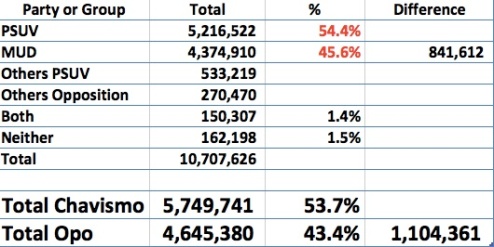
The results are shown in the table above. The first two lines are the Lucena-style results, in which you only take into account the votes for PSUV and the votes for the MUD, which makes it look like PSUV got 54.4% of the vote and the MUD 45.6%. (Both in red).

The opposition had a different interpretation, which was to add ALL votes not for the MUD or PSUV to the opposition, which made it look fairly close, with a slight advantage to the opposition.

But the reality is that, as Martinez shows, of those additional votes, about 533,000 correspond to candidates who are part of Polo Patriotico, but were in municipalities where the votes were divided. Similarly, about 270,000 were for parties which are part of the opposition, but ran separate candidates from the MUD. Finally, about 300,000 votes can not be accredited to anyone, because the candidates were either supported by both sides or neither.

What the totals say is that the results up to yesterday, are quite close to the Lucena-style results with PSUV and its allies obtaining 53.7% of the total vote and the MUD and its allies 43.4% for a total difference of 1.1 million votes between the two sides.

This means that the results are even worse that they looked initially, as the opposition lost by about 8% of the vote, compared to the minimal difference (if any) of the April Presidential election. Thus, about the only positive thing you can say is that the opposition managed to win the more “emblematic” races, including most large cities, but losing Maracay, Distrito Libertador and Sotillo (Puerto la Cruz), as well as the “in your face” opposition victory in Barinas.

Chavismo on the other hand won the popular vote handily, won nineteen of twenty three states and only lost 26 cities when compared to the 2008 election. Maduro can also say that he is now more legitimate than he ever was and Capriles lost the plebiscite.

By now, even one Mayor elected within the MUD has already switched sides in Aragua, while the opposition lost one Deputy in the National Assembly because both the principal and his alternate were elected as Mayors in Zulia State.

Meanwhile, both sides are claiming victory with Maduro even saying his candidate won in Lagunillas (??). But what is true is that the Daka offensive, the so called “Cadakazo” worked, it changed public opinion overnight. And the opposition had no time or did not have time to react. Thus the loss. And it is a big loss.

And in the best Chavista (and Venezuelan!) fashion, to celebrate his victory, Maduro decides to give Venezuelan a “gift” by cancelling school all of next week with return to classes on Jan. 6th. Makes sense, the last thing Chavismo needs is an educated voter. Maybe they would start to understand what the populist game is all about.

Three I “forgots”: 1) I think we may have a referendum on the gasoline price increase, that would really divide the opposition, Capriles already came out against it.  2) Government discovers 40% of companies given CADIVI are fake, but it is someone else’s fault. 3) Apparently inflation in Novemeber was imaginary= i, because the number is already three days late.

Announced Offcial Results Of Venezuelan Election at 10:06 PM

December 8, 2013

The “best” electoral system in the world can only give official results after 4 hours and six minutes after polls closed.

Tibisay is happy because abstention was 52% and can not read it well. She said 98% participation to begin with.

257 municipalities have so called “irreversible” results.

PSUV 196 municipalities

MUD 53 municipalities

Others 8 municipalities.

PSUV 4,584477 votes 44.16%, MUD 4,252,082 40.46%

PSYV and allies 5,106,336 votes 49,24%, MUD+ allies 4,435,097 42.72%, Others 8.03%

Municipio Bolivar, PSUV Anzoategui 52%

Municipio Apure PSUV 65%

Municipio Barinas MUD 51%

Municipio Heres PSUV 47%

Valencia MUD 55%

Cojedes PSUV 54%.6

Arismendi 51% MUD

Sucre, Sucre PSUV 54%

San Cristobal MUD 67%

Trujillo PSUV 53.4%

San Felipe PSUV 49.5%

Maracaibo MUD 51.8%

Metropolitano MUD 50.8%

Some Results, Looks Even, As Expected (Updated)

December 8, 2013

Not that many polls closed, but all indications are:

Update 9:56 PM: Opo looks like winning San Felipe

Update: 9:37 PM: Initial reports from Barinas gave Chavismo a victory, it is now very close

Opposition lost Libertador (double digits)

Opposition won the Metropolitan Mayor’s office +2%

Opposition won Sucre (+7%), Chacao, Baruta, El Hatillo

Opposition won Barcelona, Lecherias and Valencia (5%)

Chavismo won Maracay, Caroni (+12%), Barinas (very close), Apure, double digits

Opposition wins Maracaibo.

Opposition wins Guatire, loses Guarenas.

Good source of data

Of the three biggies up for grabs, opposition keeps Maracaibo, loses Libertador and Maracay

Chavismo seems to win total votes, but Unidad may beat Chavismo (PSUV)

Venezuelans Go To The Polls. Will It Matter?

December 7, 2013

1957891-1-375x249

I am in Caracas and the excitement over the Mayoral elections is more or less that of an Iguana racing contest in a coastal town: Everybody goes, because there is nothing better to do. But nobody knows the iguana’s, so the betting is slow.

And in this case, Chavista candidates told Nicolas to please stay home and campaign, but don’t show up to raise my hand. So, the excitement is precisely that of whatever the local race may bring. In most places: who cares? How can one get excited about voting for Jorge Rodriguez, for example, the least simpatico and disagreable Chavista ever to hold office. He will likely win.

That is the type of election this is.

And polls claim that Nicolas’ strategy of declaring the war on commerce will work. Will work in that Chavistas that a month ago were thinking of staying home are now thinking of going to vote, as long as there are no lines and they can get something in return. Anything, but one carton of milk is not enough. Come on! We are a democracy! We have a price, but not that low…

So, gimme a break. I will go vote because I am a radical Chavista/opposition.The rest? The weather better be good, my candidate pretty and smart (sorry Potro, sorry Winston!) and I better be in a good mood to show up.  No threats please! And some giveaways are appreciated!

Which only means that the races will be close. Closer than the pollster say. They say that Chavismo has an edge. That Maracaibo and the Metropolitan area are in trouble for the opposition.

I say, that abstention will be the winner and will determine the winners. And that the opposition, Cadakazo or not, will come out on top in total votes. And I claim that rather than the 120 Mayors, an improvement over the less than 50 from the previous election, that the polls say, we will obtain around 140-150 cities, which still means Chavismo can claim a victory in the end with 175-178 cities.

So, the symbols are important. The Metropolitan Mayor, Libertador, Maracaibo, Maracay and Valencia will be the trophies that everyone will want to claim. And I think we lose Maracay and Libertador and that’s it.

But in the end it does not matter. The result will be “even” unless either side can win by 8% points and win some of the emblematic cities from the other side. Which I don’t think will happen, but abstention remains the wild card.

So, in the end it is likely to be a draw. Which implies Chavismo still has a level of support that the opposition can only wait for the Parliamentary elections of 2015 to try to do something about. Two long years from now, in which the revolution will try to press on its radical agenda, in the face of empty shelves, high inflation and Chavez’ weakling son as their leader.

Not a pretty picture, but in the end one that is not likely to change tomorrow even in the context of my predictions, which are considered to be on the very optimistic side locally.

But I call them as I see them. I don’t know whether to wish I am right, or wrong. That is how irrelevant Sunday’s results may be.

Maduro Now Set To Regulate Car (???) Sales

December 2, 2013

chery

President Maduro announced today that his war on inflation, prices and commerce will move over today…to cars. Yeap! For those of you that have been looking for a car to buy (or used for that matter) for the last two years and have not found one, you can rejoice, as, as of tomorrow, that non-existing car will actually go down in price, in another milestone for the revolution.

Maybe he should lower the price of toilet paper, while he is at it.

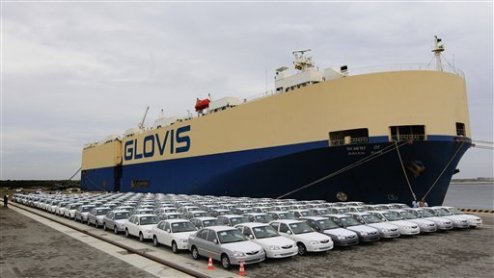
The story of the automotive sector is the same as that of most sectors of the the Venezuelan economy. The Government begins to squeeze out the private sector, destroying manufacturing capacity for the sake of socialism , favoring imports, particularly Government imports. The private sector gets fewer and fewer dollars and the Government gives out favors, charges commissions and uses the cars for political purposes. Of course, it is all sold as a big favor to the middle class, who supposedly will benefit from it. Maybe , like in the picture above, it will be the military middle class that gets the cheaper cars.

Car sales in Venezuela are down sharply in 2013. Total sales the first nine months of the year, according to Veneconomy were down 17.5% at 81,950 cars, but more importantly, sales of cars made in Venezuela were down 31.1% at 57, 236 units in the first nine months. For comparison, in 2007, car sales were 491,000, of which close to 200,000 were locally made.

Car makers in Venezuela are owed US$ 1. 8 billion today and find the flow of foreign currency spotty. Last June they had a big burst of  Cadivi payments, which by now have disappeared.

Meanwhile, cars imported by the Government are increasing. Veneconomy reports that while SEAT and Honda have not been given licenses to import cars for six years, independent importers related to the Government have been give licenses to import Chinese cars from distributors which are not even China based. They expect that 30,000 such cars will be imported this year. I wrote about some of these imports a couple of months ago.

Then there are the four car assembly projects which involve the Venezuelan Government, including the Chery project, which claims to be making 18,000 cars a year and will expand in the nationalized plant of another Chinese company called Great Wall. The other projects, including Venirauto, are seldom heard about. But are reportedly making some cars.

But the smoke and mirrors continue. The Government announced with great fanfare the Productive Venezuelan Automotive System, sort of like Gran Mision Vivienda for cars, and close to 400,000 people registered for it. About 3,800 people have so far received a car so far.

And today will be the crowning glory, as Maduro regulates car sales and sets car prices to go down. If you can ever find one.

Fortunately, as reported in Fausta’s blog, we have enough ambulances that they can be used for other purposes, such as electoral campaigns:

BaGHApnCUAAPULt

Maybe they should sell ambulances to the public.

You have to love socialism.

CITIC Mining Survey Agreement With Venezuela: Another Boondoggle?

November 29, 2013

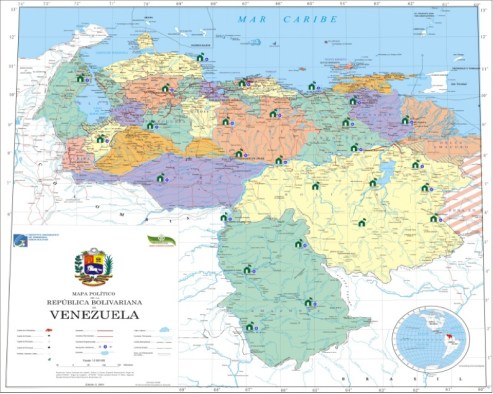
mapMaps of camps for mining projects

A while back, the Venezuelan Government signed a puzzling agreement with Chinese company CITIC to do a mining survey of all of Venezuela. Puzzling for a variety of reasons, including the fact that CITIC is at the end of the day an investment company, which was simply going to use the resources of the Chinese Government and academia to develop the project. But it was also puzzling, because of the price tag of US$ 600 million. US$ 600 million is an Apollo-size project in the context of Venezuelan science and technology, more so, for something that has essentially been done already, without the aid of the Chinese or the Americans for that matter. In fact, CVG, Tecmin, National Universities and the National Institute for Geology and Mining already have a digitized database. In the 80’s, when I used to work in related fields, I recall being given maps of where you could find Niobium and Tantalum in Venezuela, not exactly the most precious of minerals.

But even more puzzling is that the National Assembly has not approved the contract. You see, minerals and mining are considered to be of public utility and according to that piece of paper called the Constitution, contracts relating to it have to be approved by the National Assembly. But even more puzzling, the job that Citic was hired to do, is the mandate for the National Institute of Geology and Mining, Ingeomin, which according to the law has as on of its main purposes: “To create and maintain the inventory of the mineral resources of the country” among many other functions. And US$ 600 million is over 100 times the yearly budget of Ingeomin, which has yet to be contacted for the project.

And that is the biggest puzzle. The project supposedly has been mostly paid for. the work should have been started, Venezuelans trained, etc. But nobody has been trained, no camps as those shown in the map above (Xeroxed in a copy machine with a bent surfaced?) have been established. In fact, according to Deputy Americo de Grazia “The Chinese are doing absolutely nothing in Venezuela…but they are getting paid”

The Deputy even wonders if the Chinese ever meant to do anything, except get paid. With the available information and the digitized maps available in Venezuela and a couple of trips by technicians, you could “update” the information and that would be it. Hand it it, get paid US$ 600 million.

Another boondoggle by the revolution. More money thrown out the window, or down the toilet. Chavismo has a strange concept of sovereignty and a total lack of respect for local knowledge.

And, of course, the National Assembly refuses to hear the complaint that the contract should have been approved in that body. The Chinese may get mad…

A Confusing Future Ahead For Maduro And Venezuela

November 25, 2013

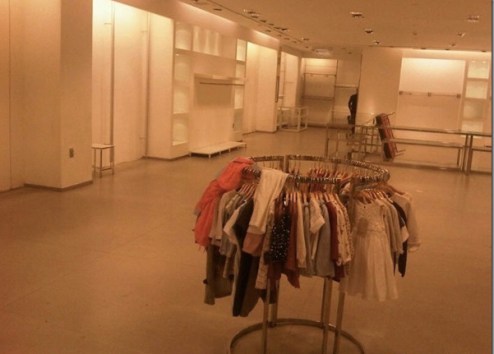
zaraZara store in Valencia after forced discounts at “just” prices

It is somewhat ironic, if not perverse, that in a country with chronic shortages of milk, toilet paper and other basic staples, someone comes out to reassure the population that the inventories of appliances and clothing, which have disappeared from store shelves after the Government forced shopkeepers to lower prices by as much as 70%, will be replaced by January.

Ironic, because few believe it. Perverse, because somehow the socialist revolution has been turned upside down into some sort of capitalistic consumer festival. Basic food staples are missing form store shelves, but the new revolutionary man is prodded into making new lines day after day, to get his new plasma TV or Blue Ray player, or cell phone, but at a “just” price. Hurry! Before inventories run out, get your socialist dream, but made by Samsung and discounted by Nicolas.

And after forcing myself to listen to a couple of Maduro speeches, I must say, he has improved his delivery, but the content is a rambling and incoherent potpourri of empty words, where the Venezuelan President sometimes catches himself going in the wrong direction and completely backtracks when he realizes the absurd or inconsistent path he is taking.

And in between, the Venezuelan President makes promises that are simply impossible to fulfill or makes statements that are outright lies. Such as saying that now that the Government has taken control of all storage for commerce, there are supplies for a full year of all goods (Where is the toilet paper, the corn flour or the milk?). Or promising that “investment” will come to Venezuela this year and growth will be strong and inflation is about to fall sharply.

Because Maduro really believes that lowering prices in a fraction of about 12% of all goods can somehow lead to a 5% drop in monthly inflation. Not only does Maduro show how little he understands the problem, but in the end the Government is a victim of its own tricks to insure that the CPI will not go up strongly, because it created created a diverse number of groups in the CPI to minimize the traditional ones that go up relentlessly. But more importantly, nobody has (or can?) explain to Nicolas that by doing what he has done, he has suddenly increased the velocity of money, at least temporarily, such that inflation may even pick up after his latest actions.

But more importantly, even if Maduro will score some points on December 8th. , particularly by motivating Chavista voters to go out and vote, he has caused a variety of new problems and distortions for the already stressed and strained Venezuelan economy.

To begin with the commerce sector is one of the two with the biggest growth in GDP and in employment generation during the last 14 years (The other being the Government itself). With his actions, Maduro will destroy jobs, shut down stores and create shortages. While Maduro is looking for short term gains in lowering inflation, he does not realize that the commerce sector that he has been attacking, barely represents 12.8% of the weight of the national inflationary index and of these, he has affected the goods of less than 20% of the index.

But more importantly, does Maduro  understand (can he?) that there are three factors that affect inflation: The monetary base, which the Central Bank will take care of assuring that it increases. The velocity of money, which Maduro has made sure increases faster now with people going out and buying just about anything they can get their hands on. And finally there is the the availability of goods, which is certainly going to decrease dramatically over the coming months.

And while Maduro was likely looking for short term gains with his war against commerce, the policies that he will put in place, like more controls, Government importing even more goods for the economy and persecution of merchants will create problems long term.

What is clear is that among other effects, we will see the following:

-The stores that were forced to lower prices over the last three weeks will reduce inventory, reduce investments and even close over the next few months. Many of the goods were being imported at the black market rate and are not part of the Cadivi lists, thus, given the accusations of money laundering against some stores for selling goods purchased with these illegal dollars, whole sectors of the commerce sector will certainly disappear.

-A gray market for goods will evolve in time. You will go to a store and they will not have a particular item on display or in their inventory, but the store keeper knows somebody, who knows somebody, who has a cousin who has one and can deliver it to your home at a certain price.

-Government buddies will be able to sell goods imported by the Government, creating yet another source of graft and commissions and a vast network of new beneficiaries of arbitrage. Nobody will prosecute Government owned distributors for selling goods at outrageous prices.

-The Government’s own import and distribution machine, which is already strained and incapable of importing and distributing everything, will be strained even further, distracted by the need to provide the new socialist hyper consumer society with appliances, plasma TV’s, cell phones and fancy clothes.

-New controls will delay imports and create new bottlenecks. Importers may get foreign currency approved, but if the new all powerful control office does not approve a price increase, the importer may not bring the goods to Venezuela until this happens. Other the importer will get the increases, but not the foreign currency.

-All of the items above lead to less tax collection and lower economic activity.

-Commercial real state construction will slow down. The Government also wants to control commercial storefront rents. Mall owners have been charging a percentage of sales ever since the Government forbid automatic inflation increases and/or dollar indexing of rents. The Government now wants to eliminate this practice too, removing all incentives to build new commercial real state properties.

All in all, another step backwards for the revolution and the Venezuelan economy. Like Maduro’s thoughts and speeches, the future is confusing, with each action creating a wide variety of new limitations and distortions. Sadly, Maduro will likely gain some votes on Dec. 8th with his actions, but the victory will be a pyrrhic one, the opposition will still get more votes than Chavismo and likely triple the number of municipalities it controls today. But another sector of the Venezuelan economy will be placed under control and close to intensive care, just because…