Archive for the 'Uncategorized' Category

Important Media Window Now Closed For Venezuelan Opposition

May 28, 2013

images

Anyone that thinks that the loss of Globovision as a possible channel for media communication of the opposition is not that significant, you just have to think back to how Capriles’ presidential campaign against Maduro was born out of a Friday press conference broadcast by Globovision  where Capriles created a “media intrigue” campaign announcing that he was ” considering”  whether to run or not in this unfair campaign on a Friday last March.

Thanks to that press conference, two days later, on Sunday, there was a popular clamor by most of the opposition that Capriles should be its candidate and that evening he held a second press conference, also broadcast live by Globovision, where he did announce that he would be the candidate.

The effectiveness of TV as a medium that weekend was reinforced, as we saw a “new” Capriles, more aggressive, “carajeando a” Nicolas. The traditional opposition loved it, the more radical opposition loved it.

No other TV station carried the press conference live that day.

Without Globovision, I don’t believe for a minute that the impact would have been the same. That beginning made Capriles’ campaign!

So, it is not a matter of Globovision’s editorial line, whether you hate it or not. It is not a matter of whether Globovision torments you or not, it is not a matter of whether Globovision was too political, too pro opposition or the like. No, what matters is that the only window the opposition had in Venezuela to communicate its personalities is now closed. We will no longer see the face of Capriles live, but more importantly, you will not see much of the faces (many of them new ones) of the opposition candidates to the mayoral elections later this year.

VTV will not show any of the opposition activity and will continue 24/7 promoting Chavismo and Madurismo, while all TV stations will be forced to show Maduro’s nationwide broadcasts.

But if the opposition needs to clarify a point about how to vote in an election, the latest scandal of Fonden, or Fondo GuachiGuachi, or the tenth installment of Mario Silva’s communication with Castro, you will not find it anywhere.

Oh yes, social media will carry it, but unfortunately, there is something very powerful of television as  a medium. And starting now, that power, dramatically reduced for the opposition over the last few years, will simply not be available.

The Government now has an almost monopoly of the most powerful media instrument available: television.

And I say almost, because there has to be a plan with Globovision. I never believed for a minute that the whole editorial line and programming would not be changed. I don’t believe for a minute that the latest moves are in reaction to Mario Silva’s tape either. This is the beginning of the execution of a plan. What it is, I don’t know, but you don’t spend a couple of hundred million dollars buying a TV station just to get rid of its audience fast and make the investment worthless in a few months.

If I had to guess, there is a political project behind the purchase, it is not pro-opposition, but it is not wholly pro-Government either.

My guess? Some sort of alternative to Chavismo/Madurismo. New figures promoted shamelessly as an alternative to both or something like that. I have no information pointing to this, but I just don’t believe the explanation that the idea was simply to silence the opposition

Time will tell.

The Maduro Toilet Paper Crisis

May 23, 2013

toiletThis signs shows the effects of shortages in Venezuela: Not only is toilet paper scarce you can only buy one package

It has been Nicolas’ misfortune that the toilet paper crisis exploded in his face less than one month after assuming the Presidency. It is not the worst shortage under Chávez or in Nicolas’ short Presidency, but it is one that affects everyone, captures the imagination of the foreign press and is simply quite symbolic of the failures of the Bolivarian revolution.

Start with the supposed solution to the problem. Have the National Assembly approve an emergency allocation to have the Government import two weeks of toilet paper. When you need to involve the legislature to import something, you can tell the system is really screwed up. After all, why toilet paper and not antibiotics, which have been scarce since December?

The answer is simple, not everyone uses antibiotics, or high blood pressure medicines or insulin, but in Venezuela, most everyone expects to be able to buy a roll or two once in a while when it is needed. In some sense, it is the same reason why Chávez never cared too much about fighting crime. At least in the first few years of his Government, crime only affected a small segment of the population, but as it went off the charts, it became a significant problem as more people were or knew victims of crime.

And while the Venezuelan President blames the crisis on hoarding and conspiracies by the opposition, the head of the National Statistics office blames the fact that people are eating a lot. Which makes you wonder if the problem is that they are eating the wrong stuff and going to the bathroom a lot, because there are many shortages in the food sector too.

But in the end, the problem is precisely that the Government has to go and import the toilet paper, because of the simple fact that it controls everything:

-The price of the toilet paper is controlled

-The foreign currency used to buy paper pulp is controlled

-The ability to buy or import toilet paper is controlled

Beyond that, it gets even more complex, depending if you are on the importing or on the local manufacturing side.

If you are an importer, you compete with none other than the Government. First your dollars may not be approved, thus you bring nothing. But the friendly “Boliborgeois” who competes with you, gets the money to import good quality toilet paper from reliable suppliers, but ends up getting it from who knows where, making half the profit in the toilet paper and the other half on only using a fraction of the dollars allocated to buy the toilet paper. The remainder dollars can stay in dollars or you can sell them at the unmentionable rate, making a profit with them of 344% at today’s rate.

So, as an importer, you can’t compete with those “briefcase companies” mentioned by Mario Silva in his top hit recording.

But if you are crazy enough to still be a manufacturer you are in Bolivarian control hell.

Suppose you priced the roll of toilet paper at a dollar in January 2010, when the exchange rate (official) was at Bs. 2.6. Well, your raw material costs had gone up by 65% by Christmas 2012 and 142% by today, but your price increases have not reached 40%.

To say nothing about your labor costs, which I will simply adjust for inflation, ignoring the recent labor Bill. By last December, your local costs had gone up by 98% and 122% by today. This is more than double the price increases for toilet paper.

And if you needed a part for your rolling machine, the dollar the swap market that you bought at Bs. 6 in January 2010 is now worth close to four times more and that is an integral part of your cost.

That is why the manufacturer is a fool, the legal importer is trying to get lucky and the “Boliborgeois” with his “empresa de maletin” (Mario Siva dixit) is becoming a millionaire.

And that is also why the revolution has failed. It has replaced a productive system by a planned system full of controls and corruption, which favors the buddies that can get official dollars, sometimes benefits occasional importers who get lucky and screws those that are still trying to make and produce something in Venezuela.

Just think, if you were trying to get into the toilet paper business in Venezuela, which model would you want to follow?

Well, given that they hate productive capitalists and oligarchs, Chavismo and now Madurismo have also chosen the same path that any sane person like you would, it is the most profitable for those involved, but the most expensive for the country.

And yes, people are eating more food, but I am not going to get involved in a technical discussion about whether the length of the toilet paper you use is directly proportional or not to mow much or how often you eat. But the most important reason that people are eating more is the same reason why they are using more gasoline and more electricity: They are all heavily subsidized. Assign a fair price to food, gasoline and electricity and the overall economy of the country would be better off, even if individually people would be worse off. And before anyone makes the argument that I have it backwards, you could give away the food for free, the electricity for free and the gasoline for free and the country would be in deep …. and we would all need a lot of toilet paper.

And with shortages comes rationing, something Cubans have known for 50 years, but Venezuelans had very little exposure to. Something the sign in the picture above clearly depicts.

Oh! But ideology beats realism or the “people’s” well being.

And thus Chavismo/Madurismo is never going to accept that its centralized planning system full of controls, rules and corruption is to blame for any of these problems. They have a religious belief that what they call “socialism” should work, despite the fact that all historical evidence shows it has always been a failure. But like Nicolas says, he believes more in “popular” wisdom than in scientific and technical facts.

Which only shows how primitive and lost the revolution is. Maduro’s paper toilet crisis is simply a reflection of both this and his ignorance.

Notes added: To add to the craziness, El Mundo reports today that the Government imports meat from Brazil at twice the price it pays Venezuelan producers. And people who are lucky enough to find toilet paper, put it into black bags to avoid being mugged, according to today’s El Nacional.

Such a pretty revolution!

Mario Silva’s Gossip Tape Aimed at Discrediting Chavismo/Madurismo

May 21, 2013

06 MG__9771Mario Silva with Chávez in happier days

Back from vacation in time to read the transcript of the purported conversation between Mario Silva and the Cuban intelligence General, in which Silva spews out a dense amount of gossip about a wide variety of Chavista/Madurista figures.

The first question one needs to ask is whether the tape is true or not. My impression is that it is a bit long and complex to be made up and the fact that Silva is the only one to deny its authenticity suggests it is real. In fact, Diosdado Cabello called it just gossip, which it is, but seems to be saying it is very realistic gossip coming from Silva’s mouth. The fact that Silva all of a sudden plans to leave his program “La Hojilla” also makes me suspect the tape is very real.

It is obvious that someone leaked the tape to damage someone’s credibility, what is not clear is who was the main target. While many think that it was Cabello, as he is blasted repeatedly, most of what Silva says about Cabello comes as no surprise to anyone that has been following this somewhat sinister figure of the revolution. Suffice to say that since Chávez left for Cuba in December, all of Cabello’s buddies that had been jailed by the former President have now been freed.

In fact, the most novel aspect of Silva’s gossip to me was the part about Maduro being looney and thinking that he had seen Chávez (again) in the military museum and claiming he even had a tape. I guess Maduro’s spiritual experience with Sai Baba has made him quite sensitive to having weird supernatural experiences.

Beyond that, the most significant thing about Silva’s tape is simply the fact that he is talking to the top Cuban General on intelligence matters. This alone should induce an investigation by the General Prosecutor and the National Assembly. While the opposition despises Silva, he is a mayor figure of Chavismo, whether Chavista/Maduristas like it or not. Silva rose from relative obscurity from aporrea and Chávez catapulted him to stardom by calling in to his daily program where Silva trashed just about anyone in the opposition, the same way he trashed Chavismo/Madurismo in this tape. Chávez would not only call in late at night to make announcements via La Hojilla, but Silva was the PSUV’s-Chávez backed-candidate for Governor of Carabobo, a race that fortunately he lost.

Beyond that, the main effect of the tape will be on Chavismo itself. Those that supported Chávez or his anointed heir have heard most of these accusations before, but always believed that they were opposition fabrications, now they will think twice about many of them. And that is the most important point of leaking the tape, it is not aimed at the opposition but at Chavismo/Madurismo. Its goal is to discredit the leaders of the Government, without it being clear who it was mainly aimed at. Cabello seems to be the main target, but there are very few stones left unturned.

In fact, Silva seems to defend only two people in the tape: Jorge Giordani and Admiral Molero. That’s it. He blasts the Vice President harshly, even suggesting that he may be the source of Bocaranda’s leaks about Chávez. He blasts Nicolas Maduro, Jose Vicente Rangel, Diosdado Cabello, Rafael Ramirez, Cabello’s brother, the former head of Cadivi Barroso, the Alcala Cordones brothers, Maduro’s wife Cilia Flores, Maduro’s confidant Temir Porras and the CNE ladies. So, its unclear what the objective of being divisive is, but the tape is very divisive for Chavismo.

For the opposition, nothing new in the tape. Maybe some juicy and explicit details of what we all know and knew has been happening in Chavismo. But nothing that surprises anyone reading this blog for the last few years. Just a very explicit confirmation from a very Chavista source.

Very divisive for Chavismo and another contribution to the erosion of the credibility of the Maduro Government and those near him.

Nothing less and nothing more.

The revolutionary corruption beat just goes on…

May 14, 2013

The cynicism of the so called revolution never ceases to amaze me. While away, I have been trying to follow the latest corruption scandal unveiled by the the US SEC in which some relatively minor officials in development bank BANDES managed to rip off US$ 66 million by performing artificial trades with bonds owned by BANDES. In one trade, for example, one hundred million dollars in bonds were sold and repurchased on the same day by BANDES, except that by the end of the day, BANDES had lost ten million in commissions, while the bonds still had the same price. The SEC is asking that all the “profits” be returned and has charged the individuals as well as the companies that funneled the kickbacks to a BANDES official.

Some of the transactions were somewhat comical, as the broker had to ask the BANDES official to return to him the money he paid in taxes, as he reported the gains as income. Showing there is little honor among thieves, he actually under reported his gains to his BANDES crony in order to pay her less in kickbacks.

But like so many other corruption cases in the last fourteen years, the Government’ policy is to ignore the case. The Prosecutor has been silent on the case, so has the Minister of Finance, the Minister of Planning who oversaw BANDES at the time and least of all the President. Maduro has said nothing of the money stolen from the people by these so called revolutionaries.

But the Prosecutor is the worst one as she is so quick to prosecute opposition figures for small amounts spent by them arguing obscure irregularities under budgetary laws.

The amazing thing is that these are minor officials who managed to do this scam, but they made off with US$ 66 million just like that. Recall that BANDES is the bank that gets the loans from the Chinese, money that is spent with no transparency or accountability. I dont even want to think what goes on in there!

You have to add this BANDES case to Maletagate, Illaramendi, the check in the hands of an Iranian for 40 million euros, all cases discovered abroad but never investigated or even discussed in Venezuela. But the largest of these cases, all discovered abroad, is “only” half a billion dollars, small scale in revolutionary terms. Nobody knows how much money was made selling the seven billion dollars in Argentinean bonds, or who received over thirty billion dollars in Pdvsa bonds or about twenty more billion in sovereign ones, all of them assigned using ever changing rules and with zero transparency or accountability. To say nothing of the billions fed to the swap market by the Government while it allowed it to exist until 2010.

. Or try to imagine the US$ 100 billion spent by Fonden under the same careless watch of Jorge Giordani! Or the billions stolen in the 2009 banking crisis, whose main Bolivarian actors, including Jesse Chacon’s brother, have now been quietly freed.

But the corruption beat goes unabated under revolutionary watch. While the opposition is blasted for its capitalism, capitalist greed and corruption is alive and doing extremely well under Maduro and inside his Government, slightly better than under Hugo Chavez. And allowing it to go on unpunished simply promotes the audacity of those involved. Billions of dollars have been robbed in the name of the revolution and there is nothing there to stop them.

Poor Venezuela!

Maduro Blasted By Chavistas In Los Teques

May 2, 2013

In this video, a lady blasts Maduro for not including the people in decisions, suggesting they are actually bypassed. The lady says that if elections were held for Mayor, Chavismo would lose “totally” . The people are organized, but they are not included:

https://www.youtube.com/watch?v=xD6-rWaem5I#!

Note the lady behind with the fake Maduro mustache. Maduro comes back and says he will not approve the project and asks how come the “right wing, bla, bla, bs, local Government” is not criticized but we are so autocritical of the revolution. The people present disagree with his decision and express it.Express it very clearly.

Not a good “mesa de trabajo” for Nicolas. Not a good day for the new President. A rough day for him in fact.

Trying To Nail The Productive Sector Under Madurismo

May 1, 2013

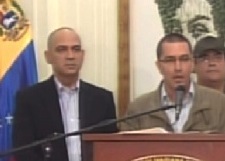
arreaza1

We have had “new” Ministers for ten days, but very few announcements of new programs and policies. This is due in part to the repetitiousness of names in the Cabinet, most of which have already been there and have no new ideas. Others are simply not very qualified, as their expertise, if they have any, is seldom in the Ministry they hold.

One of the lone exceptions is Minister for Electric Energy Jesse Chacon who has made daily announcements about plans, programs and ideas. Chacon is not that qualified for the position, his expertise is in telecom, but he has been around and held a half a dozen positions, most of them Ministries, where he has learned how slow things move in Government and how things only move from the top. He showed that when he was Minister of the Interior and Justice, where he tried to understand the security problem, brought advisers from abroad (Even from the US! Fin de Mundo!) and was removed by Chavez when he had begun to formulate plans and understand things.

In his new Ministry, Chacon has been candid at times. He does not blame the power problems on opposition sabotage, a laughable position when power plants have been militarized since 2006 and those not loyal to the revolution were fired (and are still being fired) in various purges from important positions.

He has told us that the main problem is how the twelve companies that were integrated into Corpoelec don’t work together (Some have been “integrated” for ten years!) Well, this is a blunt criticism of Chavez’ brother Argenis, who learned of the appointment of his new boss watching TV and resigned immediately. He has also said projects are delayed, consumption is high and rates are behind. (Behind? Last rate increase was in 2000, the CPI is up about 900% since then. So behind is a mild word)

But so far, he has said little about specific projects, other than increase rates and force people to buy energy saving lightbulbs (At 4 times the price) He also gave himself an ultimatum of 100 days. Good luck!

But Chacon has also been less than honest in what he has said. He said that Caracas’ power is unstable because when AES took over Electricidad de Caracas (EDC), it stopped investing. What he fails to say is that AES owned EDC for only seven years, the Government nationalized and ran it for almost that same amount of time. EDC was taken over by AES in July 2000, Chavez took it over in April 2007, so it has been six years, not much of a difference. What did the Chávez Government invest in six years? Zilch. And the company now loses money. Way to go!

He also fails to say that at a time that Venezuela has power problems, the IDB (Interamerican Development Bank) has yet to disburse the US$ 700 million approved in 2010 for Guri and other power plants. Why? Venezuela has not complied with the requirements yet. The money is there, earmarked, approved, ready to go, but…

Chavista management…the biggest oxymoronic concept in Venezuela.

But Chacon is definitely better than Chave’z son in law Jorge Arreaza. He said the other day something like: ” We are trying to deal with the mess in the (State) productive sector. The State has yet to figure out (nail) how to leverage some industries”

Well Jorge, it’s very easy, you need people who know what they are doing, work hard and know what management is all about. Let me give you an example: Remember the satellite you purchased from the Chinese? The one bought to survey the country and called VRSS? When you made all the noise and it went into operation in Chinese hands, you yourself said that in three months it would no longer be in Chinese hands, but would be operated by Venezuela.

But shucks, you remembered to pay US$ 170 million for the satellite four years ago (easy money that could have been used in sooo many productive things!!!), but you forgot that to control the satellite from Venezuela, you had to install the antennas to control the satellite and to receive the images. The result is that the satellite “sees” Venezuela a few times a day, but its useless. Besides the pictures you asked the Chinese to take for show, the return has been exactly zero. (To say nothing of the fact that with US$ 170 million you can buy all of the images of Venezuela of France’s SPOT satellite since of all its satellites were launched and in all frequencies available, but that is another matter)

And you call this “technology”…I call it turnkey waste.

The problem is that to “figure out” or “nail” the productive sector, you need people that know the business, you need planners and you need managers. When the criteria for hiring people are political, nepotistic or cronyism, things can’t work.

You also have to care, understand what is wasting time or money, plan every day, have the know-how. All your Marxist ideas don’t work, because you are trying to adapt an ideology to the wrong type of people, led by the wrong leaders. Yes, you also need leadership. Like you screwed up in the satellite project, if you had not been your father in law’s son in law, you would have been fired.

But Maduro promoted you to Vice-President.

Think about it and you will figure it out Jorge, but you will not nail it!

Fascism Is, Parliamentary Fascism Does, In Venezuela

April 30, 2013

julioborgesherido660-660x330

mcjb

Tonight seven Deputies, including a female, were injured in Venezuela’s National Assembly. One is hospitalized. While this happened, the President of the National Assembly Diosdado Cabello smiled. Funny thing is, only opposition Deputies were injured. They were not allowed to speak in the Assembly. They were told, they would not be allowed to speak in the Assembly where they are the legal and elected representatives of the “people”. Except for Chavismo, the “people” are only those aligned with them. Here is the video:

This is the outright fascism that Diosdado Cabello has been promoting in the National Assembly since Chavez died. Diosdado thinks Chavez should have named him. Instead he named whimpy Nicolas. Maduro may say what he wants, but it is his fascist hordes that are acting and he clearly can not control them. Diosdado is undermining Maduro by being very radical, while he just watches. Diosdado is claiming the ground of the radicals, because he knows Maduro is unsure of himself. Thus, Maduro may not want this to repeat, but he either stops it or he sinks under then wave of fascism of his buddies. Maduro’s peaceful overtures to Capriles of the day before, were erased by Diosdado in a few minutes today.

Facism is, Fascism does.

Crass Ignorance And Naiveté From Venezuelan Government Officials

April 26, 2013

images

It is starting to get spooky listening to Government officials as to how problems will be solvedor how clever they are about knowing what Capriles is doing. The question is whether this is crass ignorance or naiveté. Do they really think people are that stupid? Maybe they are, but…

-Take President Maduro´s statement yesterday in Zulia:

“We will facilitate the requirements so that Venezuelans can bring their foreign currency from abroad and invest in a national savings fund in dollars. This fund will invest in the priorities established by the Government”

Wow! I really don’t even know how to begin to dissect this statement. Why would Venezuelans want to bring their foreign currency back? Who will manage the fund? What are those priorities? Will it be a socialist fund? Where will the custody be? What is the management fee? How many dollars do you think will come back to this fund Nicolas? How will you guarantee that these dollars are not converted to Bolívars?

But the real question is: Nicolás, do you think there is a single Venezuelan who will actually bring back one hundred bucks for this?

Really…

-Then, there is Jesse Chacón, the new Minister for Electric Energy who gave himself (?) an ultimatum:

“If in one hundred days I have not managed to stabilize the electric system, Iresign and give way to a Venezuelan that can do a better job”

Well Jesse, you should have given the address for people to apply to replace you by sending their CV.

Because Jesse, you were in the Cabinet in 2006, when the Government created “Mision Revolucion Energetica”. You were also in the Cabinet in 2007 when the Government issued the “Organic Bill for the reorganization of the Electric sector”. You were about to leave the Cabinet in 2009, when the Ministry of Electric Energy was created. I know, you were no longer part of the Cabinet in 2010 when Chávez decreed “National State of Emergency of  electric matters on and the creation of the Electricity Chiefs of Staff”. Sounds a lot like what you are saying today.

And now you want to do the same thing that was not done in seven years in 100 days? Let me give you a tip: In 2006-2007 there was money to invest and you are telling us Merentes is looking for money for you. Hope he finds it, hope he gives it to you too.

Dream on!

BTW Jesse, have you noticed the light bulbs you want to force people to to use cost ten times more than regular ones? Just a thought.

-And then there is the new Minister of the Interior and Justice, holding a press conference telling us that as Head of the intelligence police, he knew that Capriles was not going to recognize the election.

What is most remarkable about this, is that in his own words, the intelligence plan was called “Connection April”, like in April election,  which in October, November and December detected this outrageous plan by Capriles not to recognize the election.

Definitely very interesting. In particular, I would like to ask The former Head of Sebin: Exactly how did you know that Chávez would die in March, leading to elections in April?

Just a thought…

Why not May, or February, or July for that matter? I guess your SEBIN was both an intelligence and fortune telling unit.

BTW did you tell Maduro you knew all this? It could have helped him, you know?

Just wondering.

Venezuelan Election Postmorten: Maduro Ain’t Chávez

April 21, 2013

20130418_TALC1_7_2_F1

Independent of the outcome of the audit (Just think, besides the irregularities and votes abroad, 166,000 people could not vote because the border was closed ahead of time and 140,000 new voters were not allowed to vote, despite the law saying they could) Nicolas Maduro starts his term weakened by the close electoral result, his backtracking on the audits and the protests and the questioning of his victory. Had he allowed the recount on day one, he would be in a much stronger position, even if still quite weakened by the fact that his candidacy lost some 600,000 votes from the October Presidential election.

Maduro won in 16 states, while Capriles won in eight states, but the latter are the most populous and urban states in the Nation. Among large population states, only Carabobo went for Maduro and in that State is where the opposition appears to have the largest numerical inconsistencies.

Maduro was a very inexperienced candidate and that had a lot to do with his narrow victory. In contrast, Capriles started out weak last year in his campaign against Hugo Chavez, but improved dramatically as the election approached, Maduro had never been involved in a large campaign and the electorate did not get a clear picture of who he is, other that Chavez’ chosen successor. Maduro tried to be Chávez, but he is only a bad imitation, without the quickness, the wit or the charisma.

Maduro´s weakness began in January, when he started out on the wrong foot, as the Venezuelan Supreme Court created the concept of continuity to justify Maduro becoming interim President and guarantee that he would be President and candidate at the same time.

Maduro’s campaign began by appealing to the emotions associated with Hugo Chavez’ death. But he went too fast from mourning to singing, sending a mixed message to the electorate. Moreover, he never defined who he is, trying to sell himself as the son of Chavez, his successor, without clearly explaining what that meant. Voters really knew him very little, since as Foreign Minister he has not been in the public eye in the last six years and he presided over the country for the last three months, a period in which inflation and shortages have increased significantly. (The Venezuelan Central Bank did not report the shortage index in March for the first time in years, inflation was 2.8% that month)

And people were never too satisfied with the announcements of Chavez’ illness and the constant assurances that he was recovering, only to die on March 5tth. And while the long funeral gave people a chance to grieve and pay their respects to the leader, Easter week, a vacation week in Venezuela, broke the mood and by the time it was over Maduro’s campaign seemed to change, talking more about Maduro, son of Chavez, than about how much Chavez was missed. In the end, he never explained who he was or why he deserved to be chosen by Chávez.

And Chávez can also be blamed for the failure. Clearly, Maduro was not the best choice and he never explained beyond his loyalty, why Maduro should be the successor. Because loyalty was the only reason Maduro rose in the Chavista hierarchy. He did what Chávez asked him to do. He never questioned anything. Clearly, Chávez somehow thought he would not die, but not considering the possibility and announcing or even just promoting his successor earlier, now has a big political cost. In fact, even refusing to accept he would never go back to the Presidency had a cost. Had he stepped aside and an election held in February with Chávez alive, would have guaranteed a more ample victory for Maduro.

Time always was Maduro’s worst enemy.

Capriles on the other hand, reignited the opposition by frontally attacking Maduro, something he never did with Chavez. He managed the timing of the campaign very well, even beginning with an intrigue campaign the first weekend, creating the impression he had not decided whether to run or not. Two days later the MUD told him he was the candidate if he wanted, which he readily accepted the same day. This allowed him to be on the forefront of the news while Chavez’ funeral was still taking place.He treated Maduro as an equal, while carefully respecting Chavez and his memory. And Capriles also talked more about the problems that concerned the people, mostly shortages, inflation and crime, which Maduro seemed to be avoiding or trying to blame the opposition for, while making a few gaffes which made him look bad.

But perhaps the biggest surprise is not that the election was so close, but that it was close because a significant number of voters shifted their votes from Chavismo and actually went and voted for Capriles. Before the election, and in the absence of detailed polls, it appeared as if Capriles’ only chance was for the Chavista light votes, the more independent minded voter, not to show up for the election.

But show up they did and to vote for Capriles, who actually increased his vote total, something that was not expected. In the end Capriles was up close to 600,000 votes, while Maduro’s total was lower than Chavez’ in October by a very similar amount. This was totally unexpected.

And polls were really off the mark in this election. You can blame the short period of the campaign or Easter week, but clearly they were not even close, with only two pollsters projecting a Maduro win by single digits, the closest being Datanalisis with a difference of 7.2%, outside the error of the poll

But as we suggested last week, none of these polls gave us an inkling of the electorate was thinking, particularly the voters in the middle, those that do not consider themselves Chavista, but traditionally voted for Hugo Chavez and did not trust the opposition. Abstention was 21% and continues to be the most difficult number to be precise about in Venezuelan elections. Polls said it would be 15%, history suggested close to 30%, but clearly people were engaged and interested in the electoral process, even in Chavez’ absence.

If the result stands, Maduro does not start his Presidency on the right foot. He did not get the mandate he wanted and it will be thus be much harder to press the revolution further, without a backlash from the population. Moreover, his handling of the recount issues and the protests has only undermined further his weak mandate.

Maduro also faces very difficult decisions on the economy, with shortages on the increase, oil dropping and inflation increasing and being felt by everyone. His best path would be to change course on economic policies, change the economic team and impose a new line of thinking to fix some of the distortions created by Chavez’ policies. But his weak mandate will make it difficult for him to change course, given the differences within Chavismo. And these are huge. But beyond that, people need jobs, infrastructure needs investment, a model of distributing a now decreasing amount of money is now doomed unless there is true change.

For the opposition this has been a huge victory. Not only did they manage to show the country is divided exactly in half, coming very close to a victory, but the audits may show an even weaker victory for Maduro, which will only damage the credibility of the Government. Furthermore, Capriles, who appeared to be the person with the most to lose in this election, has now become the rightful leader of the opposition. He may not have won the election on Sunday, but he won the recount fight, a political victory in a country where a single man has dominated all political battles for the last fourteen years.

Politics is back in Venezuela, as we said a few weeks ago and some people have to learn how to play politics again.

But the opposition also needs a model for the country. We all know the things that have to be changed, from the exchange rate, to the gasoline subsidy, to restoring the rule of law, to the oil subsidy for foreign countries, to the subsidy to money losing enterprises, to really improving the electric infrastructure, to fixing infrastructure and promote local production.

But to the poor of Venezuela, there has to be real change, not the small change of money in the pocket seen in the last fourteen years, while crime soared, blackouts increased, less housing was built, human rights violations boomed, corruption increased dramatically, fewer jobs were available and the dependency on oil increased even further.

Until such change occurs, political instability will be the rule of the day, no matter who is in power in Venezuela.


Maduro Blinks, Recount Will Take Place

April 19, 2013

Madurosilla

Despite all the bravado, all the refusal to recount and even Luisa Estela’s opinion, the CNE spent a full nine hours yesterday discussing the possible recount and magically. an hour before UNASUR was to recognize Maduro but strongly request a recount, the CNE announced that the 46% of ballot boxes would be audited.

You have to realize that the other 54% was not 100% audited and that an audit is truly a recount, as votes, machines and voting notebooks have to match in detail.

So, what happened? Simply, Maduro was forced to blink. It was not only UNASUR, but also the Venezuelan military that exerted its pressure and force the acceptance of the recount that Maduro had backtracked on. And opposition radicals can claim what they want, but 46% is statistically VERY significant. Any discrepancy, any irregularity, any inconsistency will certainly come out in this audit.

Maduro may look really bad after this recount…

What Maduro and his cronies did not realize is how sensible a recount sounds no matter how partisan you may be. Thus, internationally, Maduro accepting the recount only to “recular” (go back) the next day, looked certainly suspicious to say the least.

For Capriles, this is a win-win situation. He knows the hundreds of irregularities in the voting and his team will focus on it. Any ballot box not present, any inconsistency and those votes will be subtracted from Maduro’s lead. Add Capriles 57,000 international votes and Maduro’s lead of 270,000 could easily melt into the 100,000 lead.

And make him look even weaker.

And what do you say at that point? If all irregularities add up to something significant, the road ahead could be quite difficult.What happens if Maduro’s lead is reduced to 100 thousand or even less? Do they audit the remainder votes?

Nobody knows…

But it could get tricky as soon as next week, when the audit begins and Capriles’ team asks for international observers and the CNE refuses them. Or Tibisay says in this audit no actual ballots will be counted. The road will not be easy or simple.

But I am told the military knows what happened in detail on April 14th.Thus, Maduro blinked, but not only because of UNASUR, but because the military knew what was happening on Sunday. The Government claimed all afternoon that Maduro was ahead by as much as 10%, only to announce a small (<2%) victory at the last minute and rushing the proclamation of Maduro, and event that has always taken two or three days to take place.

And the military is divided. Yes, they have opinions, but leadership, true leadership, is nowhere to be seen on either of the two sides. Or maybe they are afraid to show their true colors.

But in the meantime, Maduro blinks and backtracks, Tibisay goes back on her words and Luisa Estela is made to look like the obeying fool everyone knows she is.

The whole thing is more volatile than most people imagine. Maduro was weak, even if he won. But his performance since has weakened him even further, while many of his comrades wonder why Hugo picked Nicolas, if they are so much better than him.

Things could change so fast, that I can’t predict a month, let alone a year. And as I had suggested before the election, politics is a new game in Venezuela. Chavez dominated politics and the agenda for fourteen years, but Capriles has lead the first political fight of the post-Chavez ear and he seems to have won resoundly.

In fact, Maduro may want to sound tough, but in reality nobody fears him, after all, Capriles and others already made him blink…