Archive for the 'Uncategorized' Category

Chavismo Takes The Path Of Maximum Illegallity In Venezuela

January 8, 2013

20130107_TALC1_1_1_F1

Chavismo and the Venezuelan National Assembly have today decided to follow the path of maximum illegality when they announced that Hugo Chávez will not show up on Thursday and will be sworn in a some time in the future by the Venezuela Supreme Court. At the same time, the National Assembly approved that President Chávez can take an unlimited leave of absence, something that it is unconstitutional and illegal.

The whole show is a bizarre and unnecessary twist to the problem of what to do with Chávez’ inability to be sworn in due to his illness, as this is simply a break with the laws and the Constitution that is likely to have repercussions beyond what Chavismo apparently believes.

The whole sequence of events is bizarre to say the least:

-It all starts by a letter by Vice-President Maduro, the person with the largest conflict of interest in all this, as his tenure as Vice-President clearly ends on Jan. 10th. with Chávez’ six year term. Moreover, there is not even the pretense of having Chávez sign the letter. If Chávez is doing better and will be able to be sworn in sometime soon, why didn’t he even sign the letter? Maduro clearly has no legal right to make this request for the Venezuelan President.

-As if this was not enough the National Assembly approves a spurious resolution, giving Chávez an unlimited leave and without even following what the law requires for a President, which is a medical committee giving an opinion and the Assembly approving the recommendation of such a committee. Only the Supreme Court could approve that you can extend to Art. 233 of the Constitution a President-elect, but under no circumstance could the Court or the Assembly grant Chávez an unlimited leave.

-In the case of a temporal absence, the Vice-President would become President, but since Chávez has not been sworn in, it is absolutely unconstitutional for current Vice-President Nicolás Maduro to extend his Vice-Presidency into the next term. Since Chávez has not been sworn in yet, and it Maduro says he will not be for a while, then the only legal solution is for the President of the National Assembly to become President until the situation is resolved with the approval of the Venezuelan Supreme Court (Which may still happen before Jan. 10th.)

What is scary about this whole situation is that if it does extend into Jan. 10th. Chavismo (And not Chávez! We do not know his opinion!) will be taking the country on a path of piling up one illegality on top of the other. This could take years to unravel, as someone has to run the country, but all decisions after Jan. 10th. will lack any legality and could be challenged some day. This could have dire consequences for the stability of the country medium and long term. Moreover, once someone decides to bypass the Constitution, all sorts of demons are unleashed among all of those aspiring for power.

I wonder if those demons are what is already causing these bizarre situation.

The question remains why this path has been chosen. Either Chavismo does not want or does not trust Diosdado Cabello as President or Chavismo (and the Cubans) have decided to turn the country into a Dictatorship, the Constitution be damned. The question is in the former case is why would Diosdado follow Maduro on this?

And as one analyst asked me yesterday: Will these guys even hold elections if Chávez dies?

You have to start wondering…

For the last few days, I have believed that a Constitutional crisis would be avoided when push came to shove. Right now, I can only sit here and hope that the Supreme Court will say something tomorrow, before Venezuela is taken into an unknown path packed with instability.

After Jan. 10th. anyone that sides with Chavismo and this foolishness will be on the side of illegality and and a coup. Remarkably, not one person on the Chavismo side has yet raised a voice of concern.

They have less than two days to speak up or side with those breaking with Venezuela’s Constitution.

Chavismo Seems To Be Taking The Wrong And Unconstitutional Path In Venezuela

January 5, 2013

cabelloMaduro

(In Spanish here)

A month ago, when Chávez designated Nicolás Maduro as his successor, I was thinking that Chavismo would seek a quick election, catch the opposition off guard and easily win, holding power for six or seven more years.

Now I am not so sure.

If we are to believe what Maduro said yesterday, Chavismo plans to take the most unconstitutional road possible: They have no plan to ask the Supreme Court to rule on anything and will delay the swearing in ceremony for the President elect until it is possible or his demise occurs. They say the swearing in of the President is a “formality” in a country where you need to apply with your ticket to get foreign currency to travel abroad and provide receipts and invoices when you come back. A country where my severance payment after I quit working for the Government after 24 years, was delayed six months because a staple perforated the copy of my ID card and only six of the seven digits could be identified as matching my number. Are these guys out of touch with Venezuela’s “formalities” or is it just a lack of scruples?

And while you could argue legally that Chávez can delay being sworn in, can be sworn by the Supreme Court, can be sworn in in Cuba, can be declared temporary unable to assume the Presidency, all of which are questionable from a legal point of view: About the only thing you can not possibly argue legally or in any other way, is that Nicolás Maduro can continue to be Vice-President on January 10th, but that seems to be what he is saying and how they plan to play it.

But this would be unconstitutional, because Maduro is named and removed by the President. There is no way to interpret or suggest that his nomination, or that of the Cabinet for that matter, can be extended beyond Jan. 10th. On Jan. 10th. a new Constitutional period begins, there is a reset. Reelection is not the continuation of a mandate, it is a new mandate and in Venezuela’s Constitution it has a new date for its beginning. Thus, for Nicolás Maduro to continue being Vice-President after Jan. 10th. unless Hugo Chávez is sworn in, would be absolutely illegal and a break in Venezuela’s Constitutional order. A coup, no matter how yo try to spin it. A very clear one at that.

And Chavismo will hear about it, both in Venezuela and abroad. And even Chávez’ friends around Latin America will be particularly appalled by this unconstitutional strategy.

Thus, in contrast with Chávez, who always managed to walk the grey line of the Constitution, by having the Supreme Court spin things his way or making decisions dense to understand, these guys, led by Maduro, are not starting very well. If they do break the Constitutional order, it will one day come back to haunt them.

Since Diosdado was reelected to be the President of the National Assembly today and seems to agree with Maduro that the swearing in can be delayed, he is in the end the person most affected by this strategy. He should have been President on Jan. 10th. until the issue of Chávez’ swearing in could be resolved legally or de facto. But now, Diosdado is following the party line, but he could easily one day come back and say he should be President, or even candidate, because Maduro broke the Constitution denying him the right to be President as stated by law.

I have never expected Diosdado to go on his own or try anything as long as Chávez is alive, but he has now been given a huge opening, should he desire at some point to grab power away from Maduro, whenever Chávez is no longer around: If the Constitutional order was already broken, why can’t I do it now, when asking for the right I had under the law and the Constitution?

But Maduro seems to be giving Diosdado a second huge opening with his bland interviews, in which he tries to imitate Chávez but comes across as very boring, very forced and showing the charisma of a rock. Even his diction is bad. Furthermore, things like boasting that he has no Twitter or Facebook account makes him the anti-Hugo, in a country that is in the top ten in the world in participation in social networks. Everything about Maduro’s message seemed wrong and for the first time, I am thinking that having Maduro around a few months blabbing around, could be the burial ground for his candidacy very early in the game, no matter how much money the Government throws at his campaign.

In fact, Diosdado has been much better than Maduro in all this. He is showing his experience as a candidate and Governor, an experience Maduro lacks. Disodado comes across much better as a radical Chavista, than Maduro does. He delivers the tough lines well, speaks better, delivers better. He just needs to lose a few pounds or wear looser clothes to mount a good race against anyone in the opposition. Much better than Maduro, who should disappear from view, but seems to be planning to go on nationwide TV regularly, as part of his “be-like-Hugo” campaign.

But this whole scenario is also giving the opposition a huge opening that I never believed would be there: The opposition can now have time to organize, even take its time selecting a candidate and hope for Chavismo to keep fumbling the way they seem to be doing so far.

In fact, if I were the Governor of Lara, Henri Falcón, I would be organizing my campaign committee tonight and calling Capriles to tell him he will have competition if he wants to run. With Maduro as a candidate, Falcón could roll along over him, appealing to the opposition and Chavismo at the same time. Falcón is articulate and much more charismatic than Maduro and can use his Chavista origins to talk to Chávez’ supporters. In fact, he could even tell them he never left Chavismo, but the “cogollos” (without mentioning Chávez) pushed him aside. But he can claim to be a true heir of Chávez’ ideals, he cares for the people and is a unity candidate. It could work, something I could not think would ever work a month ago. Things seem to be moving very rapidly in Venezuela, proving that it is impossible to predict what will happen six months out.

For now, the opposition should have and concentrate on a single message: The Constitution has to be followed and without a Supreme Court opinion, that implies Diosdado Cabello should become President of Venezuela on Jan. 10th. if Hugo Chávez can not be sworn in.

Anything else would be a coup and unconstitutional. And anyone backing this should be jailed. The MUD should send a teams to Brazil, Argentina, Peru, Chile, Colombia the UN and the OAS, with experts explaining to them why this is so and it should be unacceptable to anyone who claims to believe in democracy and the rule of law.

It may make little difference for now, but Maduro’s Government would be illegitimate and dealing with this alone would eventually undermine its ability to stay in power for very long.

The Caracas Stock Market, The “Best” In The World, Is Not As Good As It Seemed

January 3, 2013

sg2013010385352

Caracas Stock Index during 2012

I keep reading these articles about the Caracas Stock Market being the “best” market in the world in 2012 and I am a little amused by the explanations, which tend to concentrate on the fact that President Chávez was ailing. There is a pretty good article here, but I am quoted in it, so I prefer to give my complete opinion.

Let’s start at the beginning, what is the definition of best?

If best is the market that went up the most, the question is: In what currency? Because if the Caracas Stock Index went up 302%, it did so in Bolivars, the local currency, which is fixed, controlled and established by Government fiat at Bs. 4.3 to the US$.

But…

the unspeakable, illegal, black market rate, which does not exist, actually devalued 50% in 2012, so that in US currency, if you managed to find someone that sold you US dollars, the Venezuelan Stock Market,went up “only” 150%, which brought it from the top performing market in the world, to the top performing market in the world, because the second best was Greece, up only 32%.

But again, the best?

Try to find some shares, without raising the price…

Well, let’s say the best market is the one that is covered by many analysts. How many do cover the Venezuelan Stock Market?

Umm, I think I am the only person left. Yeap! The only person that still writes regularly about the Caracas Stock Market in the world. If I am not, please write to me, we should talk once in a while, we are a pretty lonely hearts club, if you exist (I write a weekly report with market and company news and a monthly report for Veneconomy)

But let’s recall that the Venezuelan Government intervened, trampled over and busted 48 brokers in 2010, turning the market into a less of a market, as the most important players were simply wiped out. Some jailed. By now, only bank brokers actually do most of the tradings. The market has been diminished, minimized.

How much? Well, the stocks that trade in the market have a value of about US$ 7 to 8 billion in an economy worth about US$ 300 billion, that is all the market is worth.

But. How much is traded every day? Well, not much. Because the average daily trading volume was US$ 500 thousand in 2012. Not much. Think about it. If ten clients buy fifty thousand dollars, that is it!

Even worse, only 43 days in the year had a volume of more than half a million dollars. And 136 days had volume of less than US$ 50,000. Yeap! More than half the days of the year had volume of barely US$ 50,000. And all this at the official rate!!! Use the parallel rate and it gets really depressing, divide by four!

In fact, there were many days (about a dozen) in which no stocks traded. Not at all. Not one. In fact, there were 105 days in which less than 10,000 shares traded. An some of them are worth less than one Bolivar. Even worse, there were 24 days in which less than 1,000 shares traded.

So, why did stocks go up so much in 2012?

Easy:

1) Banks make money hand over fist in Venezuela thanks to revolutionary stupidity or largesse, they pay big dividends. As an example, Banco Provincial had a return on equity of 48% in 2012. It’s dividend grew 35% and for the full year, it paid a 14% dividend. Add the capital gains and the total return on its shares was 213% in a country where a CD pays 10% and inflation closed at 19.9%, if you believe Government figures. (I don’t, they said it would be 20%, funny, a 0.1% error and the third worst inflation in the world) Nice investment if you can get some shares, which is really hard.

2) Since Venezuela has strict foreign exchange controls, there are very few ways to protect the value of your money. You can buy “real assets” like a car, real state or other hard goods. But if you are an insider at any of the companies that trade, you can buy your own stock, which is cheap and most likely pays a good dividend too. In fact, much of  the large volume in the market were large “cross trades” performed by the broker of the bank whose shares were being traded.

3) Of the 16 shares in the Caracas Stock Exchange, three don’t trade. Cemex I and II, because the Chavez Government nationalized the company, paid Cemex for its assets, but left the minority stockholders hanging out to dry (So did Cemex). The shares have not traded since August 2009. Sivensa no longer trades either. The Government nationalized  half of the company in 2010 and the other half recently leaving the company with few assets.

4) You can buy Government owned companies, like CANTV and Banco de Venezuela, in the expectations that if there is change, they will be worth more or even privatized.

5) Investors know that a devaluation is coming, which benefits industrial companies or banks that are allowed 15% of their capital to be in foreign currency. Investors tend to rush to buy first, before this happens. Think Japan the last month, the currency devalues, the stock market goes up.

6) And yes, people did play Chavez’ illness. However, the market went up all year, whether he was fine or not, as shown in the graph above. Note the big spike in October right before the election, as some overly optimistic Venezuelans drove shares up. But also note that it went down, but recovered fast and by the beginning of November it was rising going to all time highs by December 1st.

But in the end, realities are what they are: It is impossible for a foreigner (or almost) to buy local shares. He would have to exchange currency at the official rate and or the black market, Foreign investors simply don’t like that. But even if they could, how much could they invest in a market that does US$ half a million a day?

Not much really, because these statistics are distorted by large cross trades.

So, the Caracas Stock Market is simply an oddity. Only Venezuelans allowed. A weird “market” which is not truly a market and whose movements respond to many weird variables and distortions created by the Chavez administration over the last 14 years.

But it is not the “best” market in the world, just the one that mathematically went up the most in a currency that nobody knows what it is worth.

And given the volumes, it takes very little to move prices.

But do you want a good investment in 2012? If you had bought PDVSA 2022 bond in US$, you would have paid 84% on Jan. 1st 2012. It was up to 117.5% today and you collected 12.75% in interest thanks to the stupid “revolution”. That gives you a total return of 55.41% in 2012 in US$, not in some controlled, trapped currency, called Bolivars. And a liquid bond, not some illiquid stock, quoted in Bolivars.

¡Viva la revolución!

Time to sell? You bet, very soon, very, very soon.

Uncertainty Prevails In Venezuela, Days Before Inauguration Is To Take Place

January 2, 2013

20121120_TALC1_24_1_F1

Happy New Year to all! The last day of 2012 was so full of rumors, that I did not dare make a post about the New Year too early and then the partying took over. I still do not quite understand why the New Years Eve parties in Caracas were cancelled, given last night’s interview with Maduro, in which nothing new was said about Chavez’ health.

And speaking of that interview, I think they should avoid them in the future. If the objective was to promote Maduro as the future leader of Venezuela, he did not do very well. He was dry, boring at times and at a time when rumors abound, he barely mentioned Chavez’ condition. I still wonder what giving all the historical dates were all about. Was he trying to imitate Hugo? If so, he failed miserably.

What is true is that we still don’ know what ails Chavez and days before he is supposed to take over, we really don’t know much about his current condition beyond “delicate” and his son in laws’ statement that he was “stable” the next day. I wonder if we will ever see a medical doctor explain anything before Jan. 10th., as it should be if there is any attempt at bypassing the Constitution on Jan. 10th. Because in a country full of conflicts of interest, we now get Maduro’s own wife giving opinions about the formalism of Chavez having to be sworn in on Jan. 10th. What’s next, a Maduro/Maria Gabriela ticket?

Logic says that Chavismo should rush an election and after seeing Maduro yesterday in the interview, this opinion is only reinforced. You don’t want him to go around campaigning or talking too much, he may have the backing of PSUV, but people may fall sleep listening to him. Thus, if logic follows, Chavismo should change course in the next couple of days and begin talking about a transition on Jan. 10th. If they don’t do that, they are simply fools. Remember, Maduro has never run for office and simpatico or charismatic, he ain’t.

Meanwhile, it still seems bizarre to have had this broadcast from Cuba, led by a Cuban reporter and in which Maduro devoted the first few minutes to praising the Cuban revolution and its achievements (??). Given that Cuba is likely the most divisive issue within Chavismo, it was not precisely the best signal to send to his PSUV mates. It made Maduro look like he follows Cubans orders, while his lack of charisma and even the absence of any information on Chavez reduced the impact of the event.

And the Jan. 5th watch continues at this time. Will Diosdado be replaced? If so, who will replace him? Will he be kept in the interest of unity? Do they trust him enough to ratify him as President of the National Assembly? The best thing for Chavismo unity is to keep him in place. But for that, they have to trust he will follow the playbook if he has to be sworn in on Jan,. 10th.

I still believe that Chavismo will stay close to what the Constitutional order demands. It aligns too well with their best interests to call for quick elections and preserves the image that the law has been respected. But in the end, it will be what Chavez decides to do, if he is capable of deciding. If not, the instructions are likely to come from the Cuban strategists, proving once again how low Venezuela’s sovereignty has fallen under the revolution.

To delay Chavez’ swearing in without any formal proof that he can recover or even that he is conscious, would be a travesty and it will certainly create uncertainty and introduce new tensions within Chavismo. I still think logic should prevail and the Constitutional order will be followed, but neither has been a strength of Chavismo. But to attempt to break the order in Chavez’ absence, may be too risky a strategy for those jockeying for power in Venezuela.

Chávez In Delicate State Says Vice-President (?) Maduro

December 30, 2012

From Cuba, Vice-President (maybe) Nicolas Maduro tells the country that President Hugo Chávez is in delicate condition and has had “new” complications from a respiratory infection.

If part of the truth is being told, things must not be looking up. Meanwhile, the Vice-President is not in Venezuela and has left a spurious and illegal Vice-President in charge.

Que Dios nos agarre confesados de esta marabunta. Jan. 5th. becomes now the day to watch.

Econoinvest Directors Freed, Signs Of Change for Venezuela?

December 29, 2012

Econoinvest-1

Tonight, in a very surprising development, the four Directors of brokerage firm Econoinvest were freed, to be tried in freedom, after more than two years and seven months in prison. This jailing was not only illegal in terms of the length of time they were in prison without a trial and not freed on their own recognizance, but in the end they were political prisoners of the Chavez Government. They were accused of making illegal trades in the foreign exchange markets, trades that were legal under the law and if they were not, the Government should have jailed many other people, including those on each side of the trade. This would have involved hundreds of thousands of people. While in jail, their companies were ripped off by those appointed by the Government to intervene them, but all investors were paid off, showing how one sided and partial the law is in Venezuela.

But in the end, the Government was simply trying to blame others for their own stupidity and incompetence, as the swap rate devalued from around Bs. 5.4 in January 2010 to Bs 8-plus in April of the same year. The government decided to find a scapegoat and somehow, Econoinvest became the primary target, for reasons I have yet to understand, even if many others were also persecuted.

For me, this is a very happy occasion for many reasons, which go from the very simple, to the very complex, a story that remains to be told in this blog. I know quite well one of the people involved, who worked with me for many years, and know another one of those happily released today. Additionally, I was involved in the same business and have watched with consternation every single step of their ordeal.

Given that Chávez is in no condition to make decisions, I will like to interpret the decision as “change is in the air” one. Maybe I am being too optimistic. To me, the prisoners were singled out by Minister of Planning and Finance Jorge Giordani. Two years and seven months after this witch hunt, the “parallel” rate, unmentionable and illegal now, is up over 100% over what it was then, showing that it was the failure of the Government’s economic policies that led to that sharp devaluation in 2010 and the unfair and unjust jailing and persecution of so many people. Seven other people were also freed, all related to the intervened banks and brokers, before the foreign exchange crisis of 2010.

Hopefully, this is a sign of change and that now that Chávez is not around to decide things, there is a miniscule sign of humanity, regret and compassion somewhere within Chavismo.

But we need much more…

Venezuela: Seven more Years!

December 27, 2012

20121204_TALC1_24_1_F1Not much happening in Venezuela. I am not sure if the Government is legal or not, I have no clue as to whether Maduro could publish another decree written before Chavez went to Cuba tomorrow and saying that he designates him as the temporary President. Or anything else for that matter. Why not? All we hear is that Chávez is slightly better and then two hours later we are told he is exercising. Way to go Hugo! And while this happens, Maduro blasts the MUD because it it has to be “accountable” to the Nation.This from the “Chávez is fine” crowd who will be telling us soon that somehow things have taken a turn for the worse, but Chavez was fine almost all the time he has been sick. Eighteen months of a two year illness.

But there are more important things to ponder. No, I am not talking about the Constitution, to me it is clear that it is badly written and there are gaps that no amount of BS can clarify, because it is not clarifiable. Whatever was meant to be included about the temporal absence of the President elect in the Constitution, was removed because it was not clear what it meant for the President elect to be temporarily unable to assume power. Rather than rewrite the article, it was removed. Sounds like Chavismo, always taking short cuts.  The best Constitution in the world, which rigidly fixes the date of the inauguration to be Jan. 10th. Simply stupid.

But the whole discussion is simply spurious. Chavismo knows what it wants to do. They want an election as soon as possible. That is why Chávez was operated on on Dec. 11th. and not a day earlier, so that Chavismo can stay in power for seven more years. Seven long years, if Chavistas can survive each other. The problem is that Diosdado wants to be “it” for a year and Maduro wants to see how he can stay for seven. Scary to imagine Diosdado as President for a full year, I don’t see him leaving for some weird reason. Scary, because here is a guy who can always find excuses to ignore the Constitution, arguing the “popular will” or whatever he deems necessary. To say nothing of his military DEA-blacklisted buddies.

And it will be interesting to see who wants to be the true spiritual son (or daughter) of the holiest Chavista of them all. He said Maduro, but anybody, from Diosdado to Adan, to Gabriela may now claim the crown. And we may likely spend the next fifty years trying to get rid of this new religion, which will not only have gods, but false prophets, new temples and spurious deities. And every year, a new record like this one is likely to be established, but it will not matter. The show will have to  go on, with or without Hugo. Like so many things in Venezuela, the Metro, Conare, CVG, democracy, Billo’s, Hermaonos Alvarez, IVIC, INTEVEP, USB, Museo Sofia Imber, things work, as long as the original creator and administrator is still around. After that, they deteriorate. Sometimes fast, sometime slow. Yes, things can get worse, much worse, and fast. Don’t want to take bets in that.

But speaking of violating the Constitution. As of today, we have seven serving Justices of the Venezuelan Supreme Court who aren’t. Yeap! Just like that. Another one in a long string of practicalities implemented by Chavismo. Please, don’t take the Constitution literally! These guys were alternates, who did not follow any of what the law and the Constitution say. But you see, if they went to the Assembly, they would have to ask the opposition, and that would be intolerable in the Chavista “democracy”. And since Chávez was elected by popular vote, he should be able to select the alternates, even if we don’t know if he is really around. No? Constitution my butt!! As potential First Lady Cilia would say: “It is just a formality to ask the Assembly to name them”

I agree, everything about the law is about the formalities that need to be followed for countries to function. That is precisely why Venezuela has become dysfunctional. The laws became irrelevant long ago.

And so it goes.

Really, not much happening.

Until Jan. 5th., on that day, we will find out who will be the President for the first of the seven long years. Get used to it! Or more precisely the fraction of eleven of those twelve months until Jan. 14th. 2014, when the newly elected President takes formally takes over.

Only formally…

Merry Christmas And Happy Holidays To All The Readers

December 24, 2012

2066284371_b0c012ddc8

I would like to wish you all a very Merry Christmas and very Happy Holidays. I Hope you relax tonight and tomorrow and enjoy Christmas with your loved ones and that you get all of the rewarding gifts you desire, both material and spiritual ones.

Miguel

While Chavismo Should Hold Elections ASAP, Diosdado Only Talks About Delaying Them

December 23, 2012

20121220_TALC1_17_1_F1

Let me try to understand the current scenario: The opposition just suffered one of its worst defeats ever since Chavismo came to power. Chavismo can give the opposition the final knockout punch by holding elections as soon as possible, elect Chávez’ chosen successor ( And Castro´s!) but Diosdado wants to wait and give Chávez time to get better by loosely interpreting the Constitution (and saying it is the opposition that wants to rush the process). Of course, we hear Maduro say nothing about the issue. Not one iota from Maduro about Jan. 10th. just Chávez is better, while time simply gives the opposition the chance to: select a candidate, organize, raise funds and try to regroup after the Dec. 16th, defeat.

Does any of it make sense to you? Does it make sense for heir apparent Maduro to wait? Does this make it sound like Chavismo is unified?

Because in the end, what we do know is that it does not look like Chávez will live for four years after Jan. 10th., the time that would have to elapse for Chavismo to hold on to power for the next six years. But it does seem, like if you rush an election now, before the ¨people¨can realize what a terrible candidate Maduro is, Chavismo can cling to power for six more years.

Instead, we get Godgiven Cabello telling us daily, at every turn, all over the country, how Chávez does not have to show up for however long he wants. Of course, Godgiven will be President all of this “extra” time, call it Cabello´s overtime.

So, I would have to agree with Dieterich, that Cabello is trying to bypass Chávez’ wish of designating Maduro as his successor. but while Godgiven addresses the issue at every step, Maduro just plods along, talking about unity and that Chávez is getting better. But Maduro has yet to say beep about what happens if on Jan. 10th. Hugo is a no show.

Is this for real? Or is this a well planned out game of making the opposition believe that the elections are not forthcoming? Because otherwise, it just seems as if Diosdado wants to extend to the power he should only hold for thirty days after Jan. 10th. for as long as he can.

To me, this is the best possible scenario for the opposition.(Just better, not much more) Let the elections be delayed as soon as possible. Let economic decisions be delayed. Let Maduro go around the country “campaigning” so that people can see he is just a Chávez wannabe and let the oppo build up a credible challenge.

Does it get better than that? I doubt it. But it still seems like a distracting ploy to me.

Next important date: Jan. 5th. Will Diosdado be ratified as President of the Assembly or will a woman named Blanca be named? And will she become the first female President of Venezuela, albeit for thirty days?

Is There Any Silver Lining For The Venezuelan Opposition From Sunday’s Elections?

December 20, 2012

20121219_TALC1_9_1_G1

People have been trying to find a silver lining in Sunday’s results for the opposition and I think they are stretching it too much, the results were very bad for the opposition. The only reason why they were not disastrous, was because Falcon won by 8% in Lara and Capriles by 4% in Miranda. But either of those two losing would have simply been a total disaster. From the raw results, Capriles barely avoided the cliff, but he only won by 4%, three percentage points lower than his margin of victory against Diosdado Cabello in 2008, who was at the time Governor and well known. Jaua on the other hand was less well known, a worse candidate and amazingly enough, a worse speaker than Cabello. Thus, I believe this margin weakens Capriles.

But I can imagine a room with Capriles and Falcón discussing who should be the Presidential candidate, should the need arise:

Falcón: Henrique, you should be the candidate. HCR: No, no, I only won by 4.01%, so please you be the candidate. Falcón: Oh, please, you be the candidate, you are our national leader. HCR: Oh please, you will probably be better at getting Chavista light votes and you won by 8.01% of the vote…and so on and so forth.

Because clearly, it will be very tough to beat Nicolás Maduro for either of them. In fact, I don’t see today how this could be done, except if Chavismo fell sleep at the wheel and decided not to rush the Presidential election. But if the do the logical thing and hold it fast, unless Chavismo splits and something dramatic happens to turn off voters, I just don’t see it possible that Capriles’ small edge in his State can be turned into a national victory. And I think Falcón is not know nationally very well and he will not have time to campaign adequately.

And the abstention numbers were bad for the opposition on Sunday, because they show how demoralized and unmotivated voters felt after the October defeat. Yes, Chavismo also suffered from the same problem, but in both the 2007 Constitutional Referendum and the 2010 Assembly elections, opposition voters had been more militant than Chavista voters when the Presidency was not involved. Since the 2006 Presidential elections, the opposition had obtained an increasing percentage of the votes every single election, except in this one. Our voters had always been much more disciplined than Chavistas, who will only turn out in large number s when Chavez was involved. Opposition voters were increasingly there, but this time around they seemed tired and did not show up. Can they be woken up again fast? It would seem hard at this time, unless something happened to wake them up.

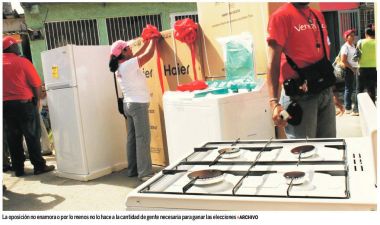
That we know Chavismo used all sorts of abuses to win on Sunday? Of course, see picture above, but they will be even more abusive in a Presidential race, because what is at stake is the future of the revolution. They would pull off all of the stops, as they know that Chavez’ absence is a weakness, even if there will be some sympathy vote.

The opposition should have also held primaries in every single State, rather than leaving certain candidates out of “respect” for their regional leaderships. Most of those guys lost, like the Salas’ in Carabobo or Perez Vivas in Tachira. In contrast, Chavismo removed some of the tired leaderships in certain states and even if they were replaced by Chavez’ hand picked cronies, they won.

To me the main factors that explain Sunday’s results were abstention and abuse of power. Abstention, because for the first time in a while, our militant voters stayed away. And I don’t need to remind everyone of the myriad of abuse of power incidents that were seen in the last month, including the press conference on Sunday and Chavez’ son in laws two appearances over the weekend telling us what is father in law wanted from the electorate. Curious that once the elections were over, there have no more calls to pray for Chávez, nor more masses held in his behalf. End of the charade once the votes were in!

About the only silver lining I have found is the abstention for Chavismo. It was higher than in any electoral event, save for the Constitutional referendum in 2007, which the opposition managed to win. This despite the heavy vote buying and all of the electoral tricks. Which only goes to prove that it is the opposition voters that need to be mobilized and motivated and not blamed for the defeat. In a scenario with no Chávez, Chavismo will no longer be able to feel comfortable going into any elections.

And in the end, as I have been saying, it may just be for the better. Let Chavismo deal with the economic adjustment necessary because of years of economic mismanagement. It will make the contrast between Chavismo with Chávez and without Chávez even stronger.

A small silver lining is the results in Bolivar State. Andres Velasquez is a fighter and will go as far as he can to demand his rights. He will probably lose his appeal in the end, but he should go ahead and publish all of the actas on the Internet for the world to see. And leaders from other states should go and support him.

And so we wait for Jan. 10th. (or Jan 5th.?) While regional leaders tell us Chavez is very sick, our own leaders tell us everything is under control and respiratory infections are controlled in hours in another miracle of the Cuban medicine that did Chavez in. Maduro says Chavez is improving day by day, while Diosdado suggests that Jan. 10th. can be postponed. Sure, so can the whole Constitution. Maybe it would be easier to just get rid of it and do whatever they want all the time. At least there would be no uncertainties.