Archive for the 'Uncategorized' Category

While Hugo Chavez expropriates housing projects his own remain abandoned

November 9, 2010

As the Chavez administration takes over middle class apartment buildings in order to score points with the Venezuelan middle class, the truth is that it has failed to complete ots won projects, such as the picture above of a development in Vargas State, which sits abandoned, buildings already crumbing, despite the sign that hails “Welcome to anew project by the Bolivarian revolution”

The problem is that this project is part of the Vargas Plan 2005, an ambitious development plan for Vargas State, the most pro-Chavez one in the Nation, which was suppose to build some 13,000 apartments for the residents of that State. Only 230 of them have been completed.

This is the same Government that took over apartment complexes that were almost finished as a way of promoting its won image among the middle class. Sadly, they have been partially successful. Because there have indeed been abuses by the private construction sector, some induced by the ban of selling apartments indexed to inflation, but in the end the truth is the Government does even worse than the private sector. not only has the Government not completed these projects in Vargas, losing money and leaving them abandoned, but there are many others all over the place in the same condition. Because in the end the Government has become such a central part of all activities, that it is also failing at being a regulator. Thus, in the end it “intervenes”, “expropriates” and “takes over”, where it should be imposing penalties and regulating.

But it is all a matter of style. “Intervening” sounds threatening and ominous, exactly the image wants to convey. At the same time it sound bold and powerful, exactly what the Government wants the middle class to think. But in the end, it is all a war of words. In six months, the building projects will remain abandoned, forgotten in the same foggy cloud where most bold Chavista projects lie.

But perversely, many will keep a positive image of all these announcements. The image of a Government that cares for the people. A Government ready to step in and defend their rights. Unfortunately, their rights are being trampled once again when they are led to believe this has any meaning in their future.

In the end, it is actually the opposite. The private sector is more efficient than the Government despite all of its problems. But now that it feels and is threatened, it will simply stop building and investing which goes precisely against the goals of all middle class Venezuelans to own their own home.

The perverse thing is that it works in the end. These actions do give the Government popularity despite their overall negative effect. Proving once again, how populism can be successful even after a decade of failures.

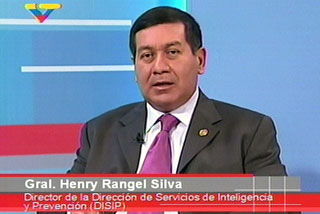
For the record and the record books: Complete unconstitutional statement by General Henri Rangel Silva

November 8, 2010

Just for the historical record (and the record books!) I wanted to make sure to include the full text of what General Henri Rangel Silva said today. General Rangel Silva’s statement is unconstitutional and represents a true threat given that he is the General in charge of “Plan Republica” The military plan that protects people and votes on election day. General Rangel Silva should be immediately removed and jailed for what he said.

“The National Armed Forces has no half way loyalties but full ones towards the people, one life project and one Commander in Chief. We are married to this national project,” said the head of the Strategic Operational Command  (CEO), General Henry Rangel Silva, who says that in a hypothetical opposition government starting in 2012 and any attempt to dismantle the military sector would have a reaction from both the military and the people who would feel that they are taking something away from them.

In an interview with Ultimas Noticias, Rangel Silva insisted that the sectors that oppose President Hugo Chavez continue their attacks against the armed forces and some of its leaders. “For many, there are some military leaders who are not convenient to them and they (say) they have to be out of the way,” he said.

“The attacks are on the agenda of the opposition. The Armed Forces element has historically been used to somehow topple governments … They act supported by third countries and that affects nationalism. The hypothesis (of an opposition government) is difficult, it would be selling the country, that’s not going to be accepted by the population, nor the Armed Forces, nor least of all by the people”he said.

The Venezuelan Armed Forces would not accept an opposition Government

November 8, 2010

General Henri Rangel Silva Chief of the Operational Strategic Command said in Ultimas Noticias the following:

The hypothesis (of an opposition Government) would be difficult to sell to the country (??), that would not be accepted by the population, the Armed Forces and least of all the people”

Democracy is clearly meaningless to the General.

Chavez’ foreign advisors ignore the country’s reality and economics

November 7, 2010

The Chavez “revolution” has attracted all sorts of frustrated Marxists who had been looking for an occupation ever since the Soviet Union fell apart. The ironic thing is that few of them have even bothered to learn much about Venezuela, Venezuelans and our idiosyncrasies. Even worse, their economic ignorance, both in general and about Venezuela, is so incredible that they help magnify with their advise, the ignorance of Chavez and his cohorts.

The latest such case has been Adam Woods. In a document published here in Spanish, entitled “Where is the Venezuelan Revolution Going?” Woods spews out a bunch of statements which simply demonstrate he knows little about economics, Venezuela and is just another theorist of revolutions. I like more Heinz Dieterich, who I also disagree with, but is more realistic and is more candid and honest about what he thinks about the revolution, even if I disagree with him.

Woods’ document has some remarkable statements which simply show his ignorance about history or economics, I don’t think you can give him much credit for understanding Venezuela, his quotes are all from very light weight sources and in itself the content he links to, has little credibility, but he shows it without criticism.

First, Woods concentrates on the “victory” on Sept. 26th. by Chavez. Had it been a victory we would have heard celebrations that night. But for Chavez, the only acceptable objective was a majority of the votes and a super majority in the Assembly. Neither one was achieved. But Woods sides with the revisionist opinion that it was a victory for Chavismo, despite the fact that it took two days for Hugo himself to sell us down that road. He then goes on to say that many lower middle class people have been “cheated” by the opposition, I suggest Mr. Woods looks at eleven years of Chavismo with constant attacks on the middle class, its values and its standard of living, to understand who truly has cheated who.

He then goes on to say that the solution is to nationalize the banks, the large capitals and the basic “levers” of the economy as a way of convincing the middles class that Chavez is on their side.

Where has Mr. Woods been all these years?

The nationalizations of PDVSA, large estates, cement companies, Guayana companies, etc. have yielded little for the Government or for the middle class. In fact, in each case, it is the middle class that has lost jobs, contracts and even a life. And they have seen little out of these nationalizations, as Mr. Woods think will come out of new ones.

For every middle class worker who loses a job or is affected by nationalizations, there is an extended family that is affected. We are still Catholic Mr. Woods!

Because Mr. Woods even dares to entitle a chapter of his document with the pompous title “The Nature of Venezuela’s economy” but then proceeds to show he has no clue what he is talking about.

He starts by citing the fact that the balance between the private and public economy has not changed since Chavez took over. But this is not because Chavez has been meek about destroying the pubic sector, but because even under these dire circumstances, the private sector has managed to create value, which Chavez has yet to figure out how to do. Piece of cake for the private sector which has lots 65% of its industrial companies. Easy to say, but a tragedy on itself.

And just to prove a point, Mr. Woods throws in this pearl of a statement:

“The superiority of a planned and nationalized economy was proven by the colossal success of the Soviet Union…”

Hello? Should I just stop here? Is this guy serious?

Because Mr. Woods then goes on to say that “the opposition  uses shortages to undermine the revolution”

Maybe he has not heard about Pudreval and how the Government has tried to control imports and production, with the result that the more it controls, the more it has to import. The more shortages there are.

And in one of the most laughable paragraphs, Mr. Woods dare blame inflation in Venezuela on “food inflation worldwide”, ignoring not only that inflation around the world is very low, but also that monetary management by Giordani, Merentes, Leon et al. has been abyssmal, with M2 increasing by a factor of four while international reserves have remained constant in the last six years. Perhaps Mr. Woods should read the works of a guy named Friedman who happened to say: “Inflation is a monetary phenomenom”. How right he was!

He then goes on to hail the nationalization of Agroisleña, one of the biggest missteps and errors of the Chavez administration. Agroisleña was such a complex business that I suspect it is harder to run it than Polar. Because the company was not just about agricultural supplies, it was about financing, technology, credit, advise. And we find out less than one month after its nationalization that sales in some regions are down to 20% of what they were, financing is canceled and no seeds or sophisticated products are coming into the country as credit lines have been canceled.

A roaring success. Mr, Woods would lead you to think, except that farmers need the financing, the technology and the seeds, but Mr. Woods probably has never visited a Venezuelan farm. And they need it now, not in three months. It’s all about crops…

And then he focuses on banks. quoting one of the local financial rags, Mr. Woods says: ” 91.2% of banks earnings come from commissions”

Jeez, that’s like saying that 100% of Apple’s earnings come from Macs, the rest is just useless. Forget iPhones, Ipads and all that junk.

Anyone that knows anything about Venezuela’s financial sector (Mr. Woods clearly not included) knows that most of the earnings of the banking system come from buying Government paper at high interest rates and paying low interest rates to depositors. The interest on the Government paper happens to be tax free.

Why doesn’t the Government eliminate the tax free nature of the securities?

Simple Watson or is it Woods? Because if they were not tax free, nobody would buy them and the Government would not be able to finance itself at interests rates which are below inflation.

So, Mr. Woods, the whole racket is a vicious circle. Banks generate revenues in many ways, that their commission revenues are almost equal to their earnings is really irrelevant. What matters is that the Chavez Government during the biggest windfall the country has ever seen, needed to issue these tax free securities to keep going. Eliminate them, and banks would be forced to lend, but Hugo would have no money to spend.

And speaking of lending, Mr. Woods argues that nationalizing the whole banking system would “give the middle class easy access to cheap credit”.

Sorry Mr. Woods. As this post a few days ago shows, Government banks, have never been very efficient about giving out credit. Of the top twenty banks, three of the four owned by the Government are last in loans and Banco de Venezuela, which you say “strengthens the Government position” is weaker and weaker as days go by, going from the top five in intermediation to almost the last four positions.

And let’s not talk about all the new banking regulations, such as the fact that when you charge something on your credit card, they have to send you an email or a and SMS. You see, only private banks are complying with this. And don’t ask Banco Bolivariano to even come close. If you go there with a check from a different agency, they can’t pay, the “system” is not ready. It ahs not been for months, this in a country where all banks (private ones, that is) pay a check on the spot)

But they are revolutionary banks, they are accountable to nobody. And nobody asks.

The point Mr. Woods, is that you seem to have very little idea about the idiosyncrasies of the average Venezuelan. First of all, you may not know this, but we have a shortage of well trained people in almost all fields. Second, under Chavez, we have lost all checks and balances, which means corruption is rampant and nobody is checking. Third, when inflation is 30%, it is difficult to be able to reward and promote those that do their jobs right, so that everyone is just trying to survive and the sense of entitlement and reward are simply lost.

But more importantly, those that are put in charge of all of these nationalized enterprises are simply put there because of their loyalty. They haven n understanding, knowledge or interest in what they are being handed out, other than what is the angle they can take advantage of to make some money. Typically, they are former or active military, accustomed to give orders, rather than talking or arguing what is best.

Thus, all your “suggestions” and contributions to the “debate” are simply useless, because they are theoretical elucrubations, which simply ignore our local reality.

And the revolution will be worse because of it!

A Brave Woman and Supreme Court Justice Speaks Out

November 4, 2010

Few people dare say in Venezuela what they think, least of all if they are civil servants. One exception is Justice of the Supreme Court Blanca Marmol de Leon. Justice Marmol has not only been outspoken when needed, but has also expressed the dissenting voice in many decisions which were clearly biased by the influence (and power) of the Government on Court members.

Thus, kudos to Justice Marmol for her statements today. In any other country what she is saying would create an upheaval, generate investigations and the like. In Venezuela, they are just part of every day life. Another lonely voice making accusations that show what a farce this Government is.

Here are the highlights:

“The independence of Judges is lost, they are not autonmous. They are scared because they can be fired or jailed”

“The Judicial Power is threatened. Judges are afraid and in a country where judges are afradid, citizens can not sleep well”

“The Venezuelan Supreme Court favors the policies of the Government”

In Venezuela, Supreme Court Justices last for twelve years or until retirement age. The Chavez administration wants to retire eight (out of 32) before January, so the current National Assembly selects and elects them. Legal? Yes! But it certainly violates the will and mandate of the people, as Justices need two thirds of the votes to be elected.

A brave woman indeed!

(Disclaimer: While I have never met Justice Marmol, I do know her husband, a fellow physicist)

Venezuelan Government Banks are stingy with loans

November 3, 2010

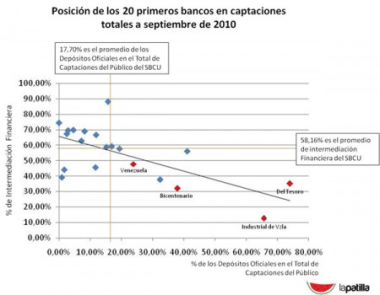
One of the arguments, which we know is false, for taking over and nationalizing institutions is that they are not socially responsible, productive, etc.. You have all heard the reasons. But the Government has turned out to be a terrible manager. This graph from today’s La Patilla (Which BTW is getting better and better except for the girl pictures):

shows how stingy Government banks are at lending. You can see in the y-axis, the percentage of intermediation (loans to deposits) of the top twenty banks in the system and in the x-axis the percentage of official, Government deposits.

As you can see, three of the four Government banks which are in the top twenty category by deposits are the worst ones in lending. And the fourth one is Banco de Venezuela whose intermediation ratio has been deteriorating significantly since it was taken over by the Government a year and four months ago. At this rate it will join the other three.

This shows what a waste of money and effort it has been to make these banks grow and absorb others and/or buy them. The private sector is and has always been more efficient at doing its job and this graph simply proves it.

Supreme Rip-Off by Teodoro Petkoff

October 19, 2010
.
Supreme Rip-Off by Teodoro Petkoff in Tal Cual

The moribund National Assembly, by order, obviously, of Chacumbele is planning to appoint a new group of judges of the Supreme Court, based on the announced retirement of eleven of their current holders in March, and the appointment of 32 alternates, which so far has never been regulated. This is a serious political attack against the Republic.

Political, because the issue is not merely legal. From a purely formal or legal, Parliament would be empowered to make such designations, but it happens that the issue is not formal. Anyone would understand that elected a new National Assembly and with the old one having just over two more months, the prudent thing, which would make any government other than the Chacumbele (purely democratic, whatever its sign), would reflect the spirit of a national electoral decision that created a new political balance in both the country and in the National Assembly and the Supreme Court matter should be referred to the new Parliament. But, unfortunately for the country and its institutions, we have to deal with a government that is completely devoid of scruples, ready to rivet his control over the Supreme Court without having to go through the process of discussion and voting in a legislature where it will not have  2/ 3 of the members which would be necessary to move the roller over in order to remove the eleven judges and elect of their replacements.
.

The whole nomination process has been carried out in tricky fashion. The reprinting of the Supreme Court Act a few days ago, “due to a Copy error” introduced a change in the current text, in the most brazen and abusive manner. The time for the nomination process, which in the original text was set as “not less than thirty days”, now in the “reprint” appears as “no more” than a month. This sneaky trick favors “Express” applications, already decided by the Miraflores Palace, and makes it difficult for those who are not from the ruling party. From there on, everything has progressed according to plan to fill the chacumbelian Supreme Court with figures which are quite subdued, with no danger that some judges will have, as has happened in some cases, a certain spirit of independence and decency. Chacumbele, who now will not have an Assembly like that is dying, then wants to replace it with one which is an armored in chacumbelian fashion.  The  “new” eleven Judges and 32 alternates to be “elected” will be those who  Chacumbele will personally select from the herd of its advocates. Everything is so opaque, it is not known of the existence of a scale, the principles are not known, the time to exercise opposition is insignificant. The Assembly quickly, will please Chacumbele.

A question arises: Will this Colossal rip-off to the Republic pass under the table?

Way cool! Mario Vargas Llosa gets Literature Prize

October 7, 2010

Don’t have to say much, exciting and fun that he got it, have been reading him since La Casa Verde came out, too many years ago.

Venezuela’s Destructive Spiral by Veneconomy

October 5, 2010


As I said last night, others know more than me about Agroisleña. I quoted Daniel’s article last night, I leave you today by this excellent and detailed article from Veneconomy that tells you how this nationalization is a total disaster for Venezuela.

Destructive Spiral by Venconomy

The decree officially announcing the expropriation of Agroisleña was published in Gaceta Oficial on Monday, as ordered by the President in a nationwide networked broadcast last Sunday when he said “Agroisleña is expropriated; come to me, I’ve got the winning hand,” the phrase with which he seals all his revolutionary death blows.

This lapidary phrase puts an end to an agro-industrial company that has operated for more than 52 years in Venezuela to become its biggest supplier of inputs for the agricultural sector.

This expropriation of Agroisleña will have far greater consequences than any of the hundreds of expropriations already carried out by this confiscator government.

Agroisleña is a company with Spanish capital that has 90% of Venezuela’s agricultural market and covers a wide range of agricultural activities, among them supplying 70% of the sector’s agricultural chemicals; supplying seeds, in particular for the cultivation of 80% of the vegetables in the Andes, Lara, and Guárico; the supply of farm machinery and equipment; technical consulting services for farmers; and storage services in eight silos belonging to the company. In addition, it finances 90% of the inputs it supplies.

Equally important is the fact that Agroisleña has stood as direct guarantor to some 18,000 domestic producers engaged in producing a wide range of products that are of fundamental importance for Venezuela’s food security. In this cycle alone, it backed the planting of 235,000 hectares of cereal and oil seed crops. It is currently carrying out a special program with some 3,000 agricultural producers, for whom it is standing guarantor for the harvesting of 800,000 tons of a variety of crops, including corn, rice, and sorghum.

It should be remembered that Venezuelan banks are being forced by the present administration to allocate 21% of their loan portfolio to agriculture. Agroisleña has facilitated those loans and has been an ally of small producers by standing as their guarantor, which gives them access to credit that they would have found it difficult to obtain otherwise.

What will happen to those loans now? Who will stand as guarantor? Will this be yet another blow for the banks?

Another sad fact is that the expropriation of Agroisleña will result in a large number of these producers being left up in the air. Who will now stand as their guarantor? A government that has been proved to be in default?

Apart from the perverse effects that this measure will have for these producers, there are the impacts it will have on the country’s already shrunken productive capacity. There are reasons for thinking that the future holds more acute shortages, higher unemployment, and greater dependence on imports.

The government, exasperated by its defeat at the polls and seeking to achieve total control of the productive sector, is once again fueling its destructive spiral to continue swelling the company cemetery with industries that were once in full production.

This is a hold up

Bandera Roja, La Masacre de Cantaura and last Sunday’s Elections in Venezuela

October 3, 2010

Explaining what has happened in Venezuela in the last decade can sometimes be quite a task. People talk about the “opposition” as if it were a homogeneous group with a common ideology. Besides the social-democrats, social christians and socialists, people always stare at me when I describe Bandera Roja, a Marxist/socialist organization that is part of Venezuela’s opposition and a member of the Mesa de Unidad (MUD) which fielded unified candidates in Sunday’s election.

Bandera Roja began as a Maoist guerrilla group. They were in fact, the last guerrilla group to abandon the armed fight and become a political party in 1992, to become the extreme far left in Venezuela. Despite this, Bandera Roja never backed Hugo Chavez, arguing he was no socialist or marxist, but an opportunist whose only project is his own self-promotion.

In 1982, what was then the Alejandro Silva front of Bandera Roja (picture above), held a meeting in a farm in Cantaura, inviting students that were simpathetic to the movement, many of whom were unarmed. The military somehow found out about it and started a military operation which began by bombing from airplanes in order to disperse those on the ground. As they dispersed, they were met by military ground forces which proceeded to capture many of those present. Reportedly, most were originally captured alive, but were later found dead.

The case was revived during the last few years, as Venezuela’s General Prosecutor’s office exhumed the bodies and began an investigation of the massacre in which a total of 23 people died.

In early September, Human Rights organization Provea, denounced the fact that one of those being investigated, was retired General Roger Cordero Lara, one of the leaders of the massacre, who piloted one of the Broncos that led the attack. Provea asked Chavez’ party PSUV to withdraw the candidacy in order to stop the impunity on these cases.

Last Sunday, Roger Cordero Lara was elected as a Deputy for Circuit 2 of Guarico State under the PSUV party and now has immunity from Prosecution, unless the National Assembly and the Venezuelan Supreme Court removes it. This led Proeva to send this letter to Hugo Chavez and his party, noting the incoherence of backing Cordero Lara, as well as the precedent of impunity that this constitutes. Chavista groups have also raised their voices to protest, to no avail.

In the case of the Cantaura massacre, much like in other similar cases, military courts exonerated those involved, including General Cordero Lara in the Cantaura case, but the General Prosecutor has reopened the cases with the Cantaura case, being opened at the request of Hugo Chavez, but has yet to rule on any of them, which Provea suggests is due to the fact that many of those exonerated are pro-Chavez retired high ranking military like Cordero Lara. So much for the caring revolution!

But given that Chavez and PSUV did nothing when they could remove him as a candidate, it is highly unlikely that they would go through the complicated process of removing Cordero Lara’s immunity and impunity on the case will continue to prevail.

So much for the revolution…