Archive for the 'Venezuela' Category

Chavez’ Ever Morphing Petrorinoco Investment Instrument

September 6, 2012

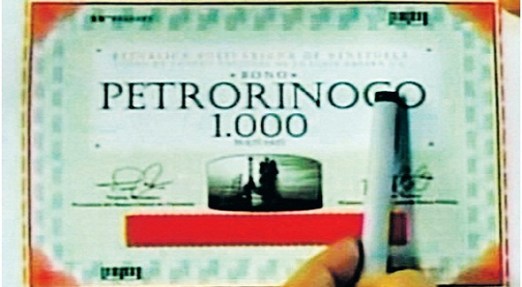
Remember the Petrorinoco bonds that Chavez said would be used to pay Bs. 40 billion in debt the Government has with public sector workers? Above is the picture of the “bond” Chavez showed in national TV (That’s his hand). However after handing out less than Bs. 1 billion and after failing to issue an official gazette with the conditions of the “bond”, not much was heard again and the electoral promise of handing out billions seemed to die away.

Another failed promise of the fake revolution?

Well, we still don’t know. We now hear from another non-financial expert of the Cabinet (Chavez is the other one) Minister of Higher Education Yadira Córdova that the “bonds” are not going to be quite bonds.

According to Mrs. Córdova (or is it Dr. Córdova?) the investment instrument to be used in paying the public workers can be better defined as “A system or certificate of payment with defined financial characteristics” and that they will have a trust backing it.

To clarify the ever morphing financial instrument, whose main purpose seems to try to obtain votes, Dr./Mrs. Córdova added: “The subject of severance pay is complicated and you can not generate an obligation without it being in the budget”

At this point, you are all lost, so is she. This is not an “obligation”. This is the law, which the Government has bypassed for 14 years, while the private sector can’t miss a payment because the Government raises hell. But the Chavernment is the Chavernment and they are in a world where the rule of law can be suspended at their will. But even worse, is the fact that a bond is precisely that, a promise of payment with a financial instrument, backed by the Government, a trust or whatever. Chavez’ Government did it before and they were called Vebonos.

In closing, the Minister put the nail in the coffin by saying: “There is not a definite date for payment of the labor debt”

Oh Yadira, public workers know that, they haven’t been paid in fourteen years, do you think they believe you one month before the election that you will pay this time?

In the end, using Hugo’s words, the Petrorinoco, is simply part of the show. And as an infamous aspiring little Dictator of Venezuela once said: “The show must go on”

And it does…

VENEZUELAN FACEBOOK WARRIORS: “Optimism rises for Venezuelan bloggers” by Virginia Lampke

September 5, 2012

Faithful reader and internet friend Virginia asked me to allow her to contribute her thoughts to my blog. Enjoy!

I started blogging on the social networks, along with hundreds of other bloggers, sparked from my heartache for my homeland, Venezuela.  At less than 40 days until one of the most important elections of Venezuela’s history; I pause to reflect on all of the people, who every day thru the aid of platforms like Facebook, have helped fight the communist regime of Hugo Chavez.

Throughout the past years, we have released videos, articles, and posters that document the failure of the Chavez regime.   In the past thirteen years that Chavez has ruled as a dictatorial tyrant, he has turned Venezuela into a country with one of the worst crime rates in South America. Venezuela has also witnessed one of the highest inflation rates in Latin America, a huge external debt, a rampant housing deficit, and other socio-economic problems which include high unemployment, poor public services, and food shortages. But, despite the adversity, we have held true to our struggle for freedom of expression which is on the verge of being extinguished in Venezuela.

Just as social networks contributed largely to the Arab Spring movement, our blogging contributions have been equally important to opposing the Chavez regime.  This was witnessed in the success of the opposition primary elections in February 2012. The winning candidate, a young lawyer Henrique Capriles Radonski, received 62.2% of the vote.  The campaign for the presidency of Venezuela began on July 1 2012. A relentless Capriles Radonski has already toured more than 200 towns in less than 2 months of campaigning.   Each rally has brought together thousands of Venezuelans in favor of his pragmatic proposals.  Based on the outpouring of support for Capriles, there is no doubt that the Venezuelan people are looking for a change.  Our efforts thru Facebook have definitely impacted and have helped to ignite the courage of the Venezuelans and to create a matrix of positive public opinion against the dictator.

I feel, without a doubt, that most people, who have been active contributors on the social networks, have personally affected the fight to end the Chavez regime. We all, through our never ending blogging for the freedom of our Venezuelan people, have helped to turn the tides toward a more just and democratic government.

Some of our blogging community is living out of our native country Venezuela, but we are united by our spirit of freedom and democracy.   This spirit is being reborn and carried forward by the heart of our candidate Henrique Capriles, and also by the hands of our Facebook bloggers.

We have personally tried to make known the reasons why Hugo Chavez is a threat to the Venezuelan people and to world peace.  We have talked untiringly on such issues as Chavez’s alleged relations with The Revolutionary Armed Forces of Colombia (FARC), the closure of the Venezuelan Consulate in Miami due to the alleged plan of a cyber-attack to the U.S., the shipment of Diesel to Syria’s Assad government, the building of drones with Iran’s help, and the German newspaper report that alleges Iran was building a mid-range missile launch site on the Paraguana Peninsula in Venezuela.

We are aware, that there is fear for a considerable part of the Venezuelan population, of losing some of their government welfare benefits obtained by the social programs called “Missions”.  Capriles has stated that he will continue to improve these projects because they constitute an “achievement of the people”. There is also a fear in the public sector by pro-Chavez supporters that if Capriles wins the election, they may lose their jobs.  Capriles, being sensitive to this fear, has further re-assured the public by saying that he will not lay off anyone due to their political allegiance.

It is remarkable that Capriles has never lost an election.  This was witnessed when he ran for various offices in Venezuela such as congressman, mayor, and governor.  His success in being elected as president of Venezuela is expected by all.  This especially holds true for those who have created a fraternity and a force through their social networks and in sharing their dreams and ideals of democracy and freedom for our homeland.

In closing, I feel that our social networking thru platforms like Facebook, have helped to ignite the passion of the Venezuelan population. The neighborhoods, once controlled by the Chavez propaganda machine, are becoming more and more supportive of Capriles.  We expect a historical turn out by the voting populous at the October 7, 2012 election and a triumphant victory by Henrique Capriles.  If it is necessary, we will defend our historical vote by any diplomatic and peaceful means necessary in order to see that justice and liberty prevail. In the meantime, we urge all of the political bloggers, to continue to be steadfast in their crusade against the tyrannical Chavez regime and to keep the opposition candle burning.

Virginia Lampke is a political blogger and human rights activist.  She is a native of Maracaibo, Venezuela, and subsequently became a United States Citizen residing in Seattle, Washington.  She continues her crusade to raise awareness of the socio-economic inequalities and political oppression in her native Venezuela.
It Takes A Week For The Venezuelan Government To Confirm An Old Report Of A Massacre

September 2, 2012

I have known about the possible massacre of a tribe of Yanomami indians for at least two weeks. The report was that some Brazilian gold diggers, or “garimpeiros” had killed 80 indians. A reader (VJ) even noted that in Chavismo circles, the garimpeiros were said to be all work of the US Government and its mercenaries to destabilize Chavez. But what is truly appalling, is to have the Minister of Defense say that he sort of had heard about it, but is not sure, but by next week, he should have confirmation. Because it is now that they sent someone to check it out. It takes the Venezuelan Government one week (plus whatever time has elapsed already) to learn about its citizens being massacred. Some Minister of “Defense”

Then comes the threats, if it is found to be false, he will take legal measures against those that claimed this was true.

And I ask: What if it is found to be true? Will he assume responsibility and resign?

Can he sue all the other liars in Government for us?

The Show Must Go On: So Says Chavez Of His Fake Revolution

September 1, 2012

I know, I know, Juan and Quico showed it, Daniel showed it, why bother?

Simple, it is another goodt example of the fake revolution. It confirms Chavez “The show mus go on” expression. It is all a show, greenhouses with huge signs in front. Chavez calling the land golden. Saying “This is socialism”. Inaugurating it on national TV. Saying this is how you build a revolution from the ground up:

Inside, nothing, dirt and overgrown bushes, no production, no greens, no corn, no pimentos.

Like the revolution, all fake.

The show must go on! Because that is all Chavez knows how to do, perform a show!

Venezuelan Governmentt Spins On Amuay Disaster, Evidence Mounts Of Insufficient Maintenance

August 30, 2012

Although the Government is trying to convince Venezuelans that the Amuay disaster is something normal and has little to do with bad management or bad maintenance, evidence seems to show the opposite and is mounting fast. The leak of the report by the refinery’s underwriter is quite damming, it makes for great reading for geeky types. (Yes, like me!)

I will not bore you with the details, but I will note that the report says on page 8, that while US$1 billion was budgeted for maintenance, only US$314 million was actually spent. Less than US$ 2 billion was spent in the last four years. So, when Asdrubal Chavez boasts that US$ 4 billion were spent on maintenance in the same period, he clearly is talking about how much was budgeted, not spent (Aren’t you glad he is in charge of he electric network now? Just kidding!)

Part of the problem is that Bariven, the PDVSA affiliate in charge of imports, is now in charge of all the food imports of PDVAL, thus it’s just in time ability of yesteryear is no longer there. The result, even if maintenance needs to be done, there are no materials for it. Somewhere else in the report i t says that materials procurement now takes 60 weeks. Yes, over one year for imported materials and only, yes only 30 weeks for local materials. Sounds like a dysfunctional company to me.

The report also says that the target of PDVSA was to have 80% of the maintenance be preventive and 20% corrective. However, the report concludes that it ended up being 69% corrective, 31% preventive.

The report says that major maintenance suffers delays of one to two years, while routine maintenance had a low in 2009, it has no evidence that this was corrected, other than it was “reported” to management, which probably was out campaigning.

These people should be fired!

The report says that fire pump testing has not been performed yearly as required (page 14) and describes fires and explosions that are anything but “normal”

But Chavistas seem now convince that the sinking of the Adan Pearl is “normal”, that the Cavim weapon factory exploding is “normal”, that Conviasa’s six accidents in four years are “normal”, that half a billion dollars stolen from PDVSA’s pension funds is “normal”, or $800,000 in bills in  suitcase is also “normal” and that daily blackouts all over the country are “normal”.

What is not “normal” is how this people think a country should be run.

Another Chavez “Cadena” Rudely Interrupted

August 28, 2012

So Chavez in Amuay was going on and on about the Fatherland and the Motherland. About the he Doctors and the She Doctors. About the he nurses and the she nurses, when all of a sudden:

his nationwide TV address was interrupted by VTV.

Are we watching these “cadenas” live? Or are they inserting a delay just in case? What happened? Why the rude interruption?

Another Terrible Tragedy Due To Chavista Mismanagement

August 26, 2012

During the last two weeks, there have been three events in Venezuela which demonstrate the basic incompetence of the Chavez Government. First, the Cupira bridge fell down, despite earlier warnings that it needed maintenance. Then, there was yet another tragedy at a Venezuelan jail, this time the Yare prison, which left 20 people dead. Finally, in the early hours of Saturday, an explosion rocked the Amuay refinery in Falcon State, leaving at least 39 dead and 89 injured.

The Government has tried to evade responsibility in all three cases. Without an investigation, the Head of the refinery complex was already saying that deferred maintenance had nothing to do with the worst accident in PDVSA’s history. A temerary statement to say the least. There may be no record of maintenance for Cupira, there is not even an annual report for the newly created Ministry of Prisons, but PDVSA’s Memoria y Cuenta, which you can find here, tells the full story of delayed maintenance and increased accidents and shut downs.

As an example, the Paraguana Refinery Complex is composed of Amuay and Cardon. According to the Memoir, Amuay was supposed to be shutdown nine times in 2011 (page 371):

But seven of them were postponed until 2012 for lack of parts. Thus, not only there was no maintenance, but there was no planning for it either, as the parts and materials necessary were not purchased ahead of time.

Cardon is even worse, there were thirteen scheduled stops for maintenance:

ALL OF THEM were postponed for 2012. That is not what maintenance is supposed to be about. It is the tragedy of Chavista mismanagement.

In fact, if we go back to Amuay and look at the ten plants it is composed of, these are the days of programmed (42 days) and un-programmed (639 days or 64 per plant on average)

What this shows is the failure of the Chavista model. You can’t fire 20,000 people because you disagree with them. You can’t hire people on the basis of loyalty. You can’t have someone be The Minister of Energy and Oil and the President of PDVSA and Head political honcho at PSUV and have him be at all of Chavez’ speeches and rallies and hope that PDVSA and/or the Ministry will run well. You can’t give away ambulances to Bolivia and not have any near one of biggest industrial complexes where they may be needed. You cant’ have all your Ministers involved with the day to day of the Presidential campaign. And so on.

In fact, you can’t put politics and ideology above all. The sad truth is that all of the political leaders of Chavsimo have been involved in the last two months with the campaign and nothing else. The Ministers are all at political meetings and get involved with he most detailed planning. Nothing is being done to run the country. Announcements are made that are only meant to gain votes, but decisions are being postponed until after the election. A campaign they can fund, micro-manage and over manage. A country? Sorry, that is not the priority.

Meanwhile the strategy is deny and minimize, while the outgoing-Presidente-saliente either can’t appear on camera live or has been advised not to do so.

It would seem irrational for the voters not to react to all this. A horrible tragedy has developed in front of their eyes and the same man who claims to “love” the people and appears on TV for the most trivial events is still in hiding. The country is falling apart, piece by piece due to Chavista mismanagement, but it is nobody’s responsibility. Even medical supplies for the injured are limited, they are probably sitting on a ship outside the Puerto Cabello port now under Cuban management.

It’s all part of the same tragedy.

Protecting The Votes in Venezuela Part III: The Opposition Has To Defend The Votes Everywhere

August 22, 2012

The picture above shows why the opposition needs to have witnesses in more electoral centers that it has done in the past. In the plot, voters are divided in seven groups of equal size, roughly 2.5 million voters per group, going from polling places where the opposition wins 80% to 20% on the left, to where Chavismo wins 76%-24% on the right. The vertical bars show the vote difference between the two sides in each of these seven blocks.

Note that as we go from left to right, abstention increases, going from 27% where the opposition is strong and increasing steadily to 39% in block six, but then surprisingly going down in block seven. Curiously (not shown), the number of null votes, also increases from left to right, but magically also decreases in the last block, which comprises some of the poorer areas of Venezuela. We also note that the poll stations on the right block on the extreme right, tend to be small, one or two mesas at most and in isolated locations. The opposition had almost no witnesses in these polling stations in the Parliamentary elections.

The conclusion that the Comando Venezuela has reached, is that the trend of higher abstention and lower null votes in block seven on the right, simply reflects the fact that we had no presence. If you extrapolate the trend of higher abstention the more pro-Chavista the area is, you would have expected abstention to come in at 42%, a full 6% points above what was obtained. We are talking about 150,000 votes that should not have been there.

The hypothesis is that these votes were not cast by voters, but by members of the polling stations, once no more voters were in line to vote and in the absence of opposition witnesses.

In fact, the same trends seen in the graph above have been used to identify ¨critical¨voting centers in blocks five and six on the right, where there exist anomalies in either abstention or a low number of null votes. These critical centers are the subject of special attention in the upcoming Presidential election and could make the difference in the outcome.

Now, I definitely don’t want to go into the details of what is being planned, but essentially, the objective is to have witnesses everywhere uniformly. In the past, political parties were assigned this task and typically they would fill the “easy” centers first. This time, all centers are considered alike, regardless of location and size and witnesses have to be found uniformly for them. However, “critical” centers have been identified as a way of checking that the plan is working. That is, a number of checks are defined for these witnesses. Things as simple as, do they answer the phone? Have they been trained? and the like. Then, every week, random auditing is made of the witnesses and these parameters are quantified and compared between centers using not only the “critical” versus non-critical parameter, but also geography, socio-economic background and the like.

What I was shown, is that these audit numbers, seven weeks before the elections, differ little for each of the blocks shown in the chart above or even if you look at it differently, using geography or other parameters. This implies, that the witness coverage will be the same or equivalent whether a center has on mesa, is located in a city or in an isolated region. This should be key in the upcoming election, as it would wipe out or significantly reduce the possibility of fake votes, as it is suspected there were in the past.

In the opinion of the people in Comando Venezuela, this issue is more important than any of the others. If the opposition can have witnesses present in all these polling stations, we can prevent thousands of non-existing votes from being cast, far more than errors or fake ID’s in the Electoral Registry could ever generate.

Could there be problems? Of course, no plan is infallible. The military via the Plan Republica could interfere. Some witnesses may be threatened or scared away. But vote protection should be orders of magnitude better than it was in 2010. And as I always tell people who are worried: We did win that election in terms of the number of votes, even if gerrymandering gave the victory to Chavez.

Chavez’ Nationwide Address Interrupted, As Guayana Workers Protest

August 20, 2012

Tonight, Chavez nationwide address was interrupted when Guayana workers broke into the stage and started protesting. Chavez tried to go into the Hornest Nest, but it did not work well. Guayana workers are tired of promises. Is this a turning point in the campaign?

And this was the preamble to the protest: Mr. President, we haven’t had a collective contract for three years. And one more thing…!

Protecting The Votes in Venezuela Part II: Insuring the Integrity Of The Voting System

August 20, 2012

The Comando Venezuela will have to work with the same voting system used in the previous four elections. This system has been audited extensively and there is no proof that via this system any votes have been modified since the 2005 election. The only part that is different in this election, is that a new fingerprint software has been introduced, which implies that there will be extensive checks in this new part of the system.

The voting system process is like this:

The voter shows his or her ID card and register the fingerprint. If it is that in the database (which is local) the President of the “Mesa” unblocks the voting machine and the voter can cast the vote. Should this fail, the voter fills out a form and registers a new fingerprint. Thus, one of the audits that will be performed is that of the quality of the fingerprint database to insure that it is uniform across the country in both geographic and socio-economic terms. This are checks on the fingerprints which have international standards of quality.

The Comando Venezuela knows that the only purpose of the fingerprint system is to intimidate, it will thus audit and check the system to insure that voters can cast their vote with confidence that it will be secret.

The vote itself only contains information about the vote, it has no information about the voter and it is all encrypted. When the vote is stored in the machine, it goes into a temporary memory:

Each time a new vote comes into this temporary memory, another is moved at random to the permanent file with the record of the votes. Thus, theer is no sequencing in the memory. The national ID number (cedula) also goes into the machine, also into five memories and one is moved at random, to record that this voter already cast the vote and can not do it again. The two registers and files are separate and they are both encrypted. Recall that the opposition did not participate in the Parliamentary elections in 2005, precisely because the tests showed that there was some sequencing which was later corrected.

Once all of the votes are cast, the machine prints the total tally, with enough copies for all of the witnesses at each “Mesa”. After this printing has taken place and only after, the machine is connected to the telephone line and the results transmitted to the CNE. At the CNE, all political parties have representation in the totaling room. This has been the case since 2005. (Note that 2004 is not included)

After all of the mesas in one center close, 54% will be audited at random. That is, 54% will be counted by hand and insure that the manual count agrees with the machine count.

Thus, if we have witnesses at all Centers and Tables, it is very unlikely that the vote is not secret and/or that the vote can be changed. In fact, there is no evidence that any vote cast by a voter has been changed since 2005 or that the machine count has been altered after the vote was completed.

However, we need witnesses everywhere, as we need to insure that the votes are truly cast in each mesa and center by real people. In part 3, I will describe what the problem is and why the Comando Venezuela has made of this the centerpiece of its strategy to protect our votes.