Archive for the 'Venezuela' Category

What autocrats do in the name of the “people”

September 21, 2011

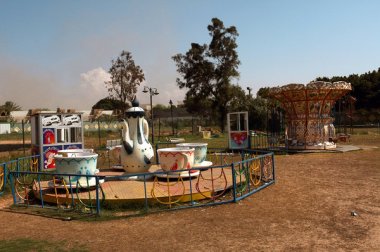
I will break my rule not to talk about other countries to show you this picture in Libyia taken within Gaddafi’s compound, which has me mesmerized.

That is what autocrats do in the name of the “revolution” and the “people”.

Does it get more ridiculous than that in Barinas?

The Not So Diplomatic Russian Ambassador to Venezuela

September 19, 2011

Today, Tal Cual carries a letter his newspaper received from the Russian Ambassador to Venezuela which is as undiplomatic in all respects as one could possibly think. The letter shows Ambassador Zaemskiv must have gone to the same School of Diplomacy most Chavista diplomats have gone to, showing that Mr. Zaemskiy is not on top of his job, he does not even know the details of what he is complaining about, but at the same time he is trying to defend Russian technology, by blaming five helicopter crashes on the ability of the Venezuelan military to fly them. He seems to forget, his Government had a responsibility for technology transfer.

As Petkoff details in his reply to the Ambassador’s letter, his newspaper wrote an article saying that five Russian helicopters, four Mi-17 helicopters and an Mi-26 helicopter had crashed in the last four years. Well, the Ambassador felt somewhat insulted by this, writing to say that it was only three, but if you check Venezuelan papers you will see that the original article was indeed correct. In Russian, and using independent sources from Tal Cual: один, два, три and  четыре for the Mi 17 and один for the Mi 26, and not three Mi 17’s like the Ambassador wants us to believe , but a total of five magnificent Russian machines, that just crashed.

In his last sentence the Ambassador talks about saving Venezuelan lives with these machines. Well, Mr. Ambassador, each of these wonderful crappy things you make in Russia and sell to Venezuela is worth like US$ 15 million: Do you know how many lives could have been saved with those US$ 75 million (It is a little more, but I did not bother to find out how much the Mi 26 is worth)

So, save your crappy sob, sob for another day or your бабушка (babushka).

As Petkoff notes, he is being called a liar in no uncertain terms, based on just the number of crashes, which the Ambassador had wrong, something which I think was not something a diplomat does in foreign soil, even if it is to defend Russian technology and he had the details right. He might be better of just saying nothing. Don’t insult your host, even if your are mad. But after this faux pas, Ambassador Zaemskiv compounds his lack of manners and diplomacy by saying:

“After each accident, a detailed investigation was performed composed of both Venezuelan and Russian military (my comment: No guarantee right there!)…the results of these investigation accepted by both sides is that there were no irregularities in these reliable machines”

Read: The accidents were due to the unreliable Venezuelans, they could not run the trinkets we sold them.

Which may be true, but maybe, just maybe, the people were not trained well, the whole thing was rushed, badly implemented, badly sold. It’s the sale that matters in Russian capitalism. In its rush to make the sale, Russia sold Venezuela helicopters that Venezuela did not have the trained personnel to fly. But hey Mr. Zaemskiv, if they crash, maybe we will buy more! Nice for Russian capitalism, exploiting dumb militaristic Venezuelan socialism, no?

The truth is that his words would be a scandal anywhere except in Stebanish country. Chavez and the Venezuelan military love buying expensive, useless toys, wasting money on things they can’t run, but feel happy about having. Ambassador  Zaemskiv pretty much says so: they sold us crap that we can’t handle, and he seems quite happy about it.

Whether the machines are good or not is irrelevant, here is a picture:

the truth is Ambassador Zaemskiv, that your country sold us crap. That your country has been irresponsibly selling crap to Chavez and making deals to take advantage of Chavez is well know. If the machines were “fine” and “reliable” like you say, the helicopter providers (you!) were not, they did not provide the training, nor the manuals, nor the know-how, nor the technology transfer required when you sell such a sophisticated machine.

And yes, these equally irresponsible Venezuelans on the other side buying your Russian crap, without training, manuals and with the same irresponsible attitude that you have.

And I can’t help to wonder, who collected the “comision” (отдача) in this deal. Do you Ambassador Zaemskiv know? You must, you seem very defensive in your letter.

And please Ambassador, you can use the comments section if you want to, we would love to hear from you!

(And yes, Petkoff may have also gone overboard calling the Ambassador a communist and used to lying, but I guess he has a right to rant too!)

The Venezuelan Electoral Board is Responsible for Executing the CIDH’s decision

September 18, 2011

While I had been assuming that it was now up to the Venezuelan Supreme Court to decide on the Leopoldo Lopez case, after reading the decision by the CIDH, it turns out that this does not seem to be the case. I am no lawyer, but I read the whole document to understand what was argued and ruled. My conclusion, given my limited legal understanding and abilities, is that the Court is ordering both the State in general and the Consejo Nacional Electoral specifically to obey the Court. In page 83 of the Acrobat document (you can find both formats here), the Court says:

  1. El Estado, a través de los órganos competentes, y particularmente del Consejo Nacional Electoral (CNE), debe asegurar que las sanciones de inhabilitación no constituyan impedimento para la postulación del señor López Mendoza en el evento de que desee inscribirse como candidato en procesos electorales a celebrarse con posterioridad a la emisión de la presente Sentencia, en los términos del párrafo 217 del presente Fallo.

That is: The State, via the relevant organizations, and in particular the Consejo Nacional Electoral, must insure that the disqualification does not become an impediment for Mr. Lopez Mendoza in the event that he wishes to register as a candidate in electoral processes after the issuing of the current sentence.

Thus, the members of the Electoral Board (CNE) would be personally responsible for the continued violation of Lopez’ rights as well as for failing to obey the Court’s mandate. Each one of them individually.

Given the uncertainty about Chavez’ health and the fact that these people will personally feel the pressure, the case and the decision,  become even more interesting than I thought. Chavez may want them to vote one way, but they have their future to consider…

Smoke and Mirrors in the Chavez Revolution: Oil and Research

September 14, 2011

Hugo is so full of it. Today:

“Science and Technology are fundamental to obtain independence, that is the way, I am telling all of you..”

From PDVSA’s 2010 financials (page 14, point g)): During the years 2010, 2009 and 2008, the amounts recognized for this conecpt were US$ 188 million, US$ 276 million and US$ 555 million

Ummm… Research and Development in the most important industry in the country, and it is down 66% in three years and that is “the fundamental way to obtain independence”?

Someone should have told Ramirez…the President of PDVSA…Oh, well!! That’s why he needs another twelve years…

Oh yeah! And on the back of that budget, he plans to triple oil production in eight years…Of course, if you check the website of PDVSA it says 5.8 million by next year (Hat tip @garciabanchs) I guess the smoke comes from whatever they have been smoking…

The Mystery of the Changes for the Venezuelan Elections

September 13, 2011

Ever since Chavez became ill, rumors began suggesting that the Venezuelan Presidential elections were going to be earlier than they were supposed to be, in order to help Chavismo. Presidential elections have usually been in early December in Venezuela and the rumors had always been in that they would take place in March 2012, a full nine months before expectations. How this was supposed to help Chavez was never too clear for me. People suggested that by then Chavez would be elected and his “successor” would be the VP and if something happened to him the VP would take over…

Except that the law does not say that. The Constitution (Art. 233) says that if the President is not able to continue within the first four years of his Presidency, Presidential elections have to take place within thirty days. Thus, this would seem to go against Chavismo remaining in power, as if Chavez had no successor, imagine holding elections within thirty days of him being able to continue with an opposition candidate that recently ran against Chavez, against whomever Chavismo chooses within a very short period of time. (This Article is absurd anyway, the Constitution (Art. 67) also says that candidates have to be elected by in internal elections of the parties. Imagine the President dying or disabled and within thirty days holding primaries and then holding the Presidential election. Ridiculous!)

The only reason to hold the elections earlier that would favor Chavez, in my mind, would be to limit the continued deterioration of the country and his popularity. The argument that holding the election in March would hurt the opposition because its primaries would be in February did not have much credibility in my book, the opposition could easily hold them earlier.Time would be short, but I have always thought that time works against the opposition not in its favor, given the fact that it has limited financing compared to the essentially unlimited financing and resources of the Government for its candidate. Imagine months of a daily campaign by the Government media against a single opposition candidate.

But that there was something to the desire to hold the Presidential election earlier in time was proven by the fact that it will take place on October 7th., an unusual date historically, which is also problematic given that voting takes place in schools, with high schools scheduled to start (They wouldn’t!) a week earlier.

There was no explanation for the earlier date, the choice is a mystery in my mind. The only possible justification was that they wanted to hold the elections for President, Governors and Mayors on three separate dates. But why they would want to do that is also a mystery to me. I agree that they can not all be on the same date, too complicated, too many choices for voters. But it certainly seems to work against Chavismo to hold the Presidential and Gubernatorial elections. on different dates.

Let me explain:

Chavez can win or lose on October 7th. In either case, if Gubernatorial elections were held on the same day, he would carry the same number of Chavista candidates for Governor on his coattails. But if he loses, his followers will be on a disarray before the December elections and they will likely get fewer Governorships. If he wins, I don’t think it will increased dramatically the number of Governorships the Government Chavismo while Chavista ones depend on the funding and power from Caracas and the Big Man.

But there is more. By holding the Presidential elections in October and Governors separately in December, opposition Governors will continue to hold their jobs until that election and will campaign for the candidate (and use their treasuries!) for the campaign. If they had to run their own individual campaigns separately, the opposition would be more dispersed, less unified, as regional leaders would be thinking about themselves first, the MUD candidate second.

So, what gives?

I just don’t know. It is a mystery. In fact, the whole thing even seems logical, if you wanted to separate the three elections, this is what makes sense. Maybe you could have tweaked it to have the Presidential election the third week in September to interfere less with the school year. But this is just about right.

I still believe that the best scenario for Chavze, whether ill or well, was to have a long period between the opposition primary in February and the Presidential election. If he was well, more time to go around the country destroying his opponent. If he was ill, more time to recover from the eight to ten chemotherapy treatments he is certainly to have in total in the next few months and then capaign and destroy the opposition candidate. If he was gravely ill, more time would also allow him to anoint his successor and help him be liked as much as possible, by having lots of time. But shortening it? Just did not (and does not) seem to make much sense.

As far as I can tell, the only advantage of advancing the date, is that there will be more time between the Presidential election and the day the new President takes over. More time to burn documents, erase hard drives and get rid of the evidence.

That’s about all I can think of.

Someone is Actually NOT Running for President of Venezuela!

September 13, 2011

I haven’t written much about the candidates for the simple reason that there are too many in my opinion and I don’t want to waste useless words on some of them. In the end I think there will only be two. But there seems to be something programmed in the DNA of some Venezuelan men that makes them want to run, even when they have been out of view for years and have become irrelevant politically.

Thus, kudos to Andres Velazquez and Causa R for announcing that they will back Henrique Capriles Radonski. Clearly, Velazquez was the clear leader of Causa R, but his day in the sun is past and his health limits his ambitions. He had a good run in 1993, but has been unable to win an election since, despite trying. He can bring a lot to the Capriles camp, few people know Guayana and the union movement like Velazquez. Velazquez must be impressed with Capriles’ ideas on the union movement to back him.

There is an element of surprise in the announcement, I would have thought a left-wing group like Causa R had more affinity with Pablo Perez and UNT, but go figure, on the same day Gerardo Blyde became Pablo Perez’ campaign manager.

With the announcement I now know two Venezuelan men not running (Guess the other one!), let’s hope other would-be candidates take the hint, that if Velazquez is not running, they should not do it either…

The Fonden Papers Part VII: Some musings (a rant?) and observations!

September 10, 2011

I had a colleague, who will remain nameless, who left Venezuela almost three decades ago for a job in a multilateral organization. Years later, I found him again, working for a foundation. Miguel, he said, “I have the best job in the world, I read proposals from the best scientists in the world, I recommend to the Board the best ones, and they mostly go with my opinion.I basically decide how a few billion dollars are spent in the most exciting areas of of research in biology”

The story comes to mind, because according to the Fonden website, US$ 40 billion ( I have subtracted the missing US$ 29 billion or so) are decided by a “Directorio: (Board), composed of two people: Jorge Giordani and the Executive Secretary, someone named Claudia Garcia Guillen, whose CV is empty in the Fonden pages, and I have been unable to find much about her in google.com.

My friend would (or should) be envious!

Thus, mhewas wrong, there was a better job, imagine having the power or the ability to influence how million and billions of dollars are spent, even if you know little about the field, and steer Venezuela’s “development” with the money.

Except, that I am not sure about how these projects were approved. Was it Giordani who had the last word? Or was it Hugo himself? In the end, after reading all of the projects (I would take a test on my knowledge!) the whole thing makes little sense, when you look at the details of all the projects.

Let’s look at the biggest headache of Chavez Government in the last few years: The Electric problem. The root of all problems was Guri dam. The lack of maintenance forced the Government to stop almost half the turbines. This meant halting almost 50% of the main contributor to the country’s power generator. But, as you can see in row 113 of the spreadsheet, a scant US$ 64 milliom was assigned to this problem.

What gives?

There are 300-plus projects and this one does not even rate being in the top 80. They spent over 500 million dollars in at least 12 projects, US$ 100 million in at least 65 projects and Guri, barely got US$ 64 million.

But then, if you are distributing money right and left in the millions, why do you even bother to write down, consider or even give US$ 2,783 to overhauling the “Recrational Los Lagos El Encanto” Park (row 28). For God’s sake, give them US$ 3,000 out of petty cash and don’t even ask for receipts!

Remember, Fonden was supposed to be spent in foreign currency. All dollars. But you have things like liquidating INAM (row 134), the National Institute for Minors, which I am sure only required local currency.

But there are many like that. Take row 139, US$ 33 million to indemnify people who lost their homes in Lake Valencia, you certainly can’t justify paying them in foreign currency, no?

Or row 274, US$ 74 million to buy homes in the “secondary market” for those that lost their homes in the floods in Caracas. Did these people really get paid in US$ dollars. If not, how did Fonden exchange the money. Did they go to the central Bank and say: “Hey, remember the dollars you used to create Bolivars when PDVSA gave them to you and then you gave to me? Well, I want Bolivars for them now. Get it? If they did that, it would be giving someone Bolivars twice for the same dollars! Talk about being irresponsible!

How about row 230? 42 million dollars to build housing in the city of Caracas. Sounds good, no? Except the organization in charge of execution of the project is none other than the Ministry of Culture.

Hello! I know the Minister of Culture was an architect, but what does culture have to do with building housing?

I could go on and on, like 100 plus million on building ten new universities (Really, how crummy can they be?). Or the Metrocaribe Mariche, which received US$ 49 million (row 119), but can anyone near Mariche tell me if anything has been built? Or all the money invested in agriculture, what happened to it?

The point is that Fonden has been like a petty cash fund on steroids, used without planning, even random in topics and amounts. It is as if the revolution has no priorities, just throw money at stuff, hope something works.

But nothing seems to work.

And it all goes back to the same man, Jorge Giordani, the non-economist, obscure academic in charge of the economy for ten of the last twelve years. In charge of continued and soaring inflation. In charge of this boondoggle of a development fund, called Fonden, where money has been misspent, wasted, some US$ 29 billion somehow missing, and where the word “result”, “priority”, “evaluation” and the like seem to be absent from consideration.

And thus, I promise with this musing (or rant!) I will stop writing about Fonden unless new information becomes available. It should be a scandal, it should be a source of outrage. It is for me. We are talking US$ 25,000 for each person in Venezuela, spent without impact, without control and without accountability. To say nothing of how much of this money has been sent to Cuba.

Enough said!
Venezuela: Yes, They Really Said That!

September 8, 2011

-Central Bank President Merentes: “Almost all sectors of the economy grew, with the exception of construction.”

Must be the effect of that great plan called Mision Vivienda…Priorities always seem to screw up the sector chosen under Chavez.

Former everything Minister for Chavez Jesse Chacon: “We have to continue with Chavez, mejor malo conocido, que bueno por conocer (Better the bad one you know than a good one to get to know)”

Glad to see him acknowledging Chavez is bad, but he is simply sooo bad, he needs to leave…

Minister for Electricity and former guerrilla leader Ali Rodriguez: “People have a right to express their disgust and disagreement, but these (the protests) are criminal activities that inevitably lead to the use of force”

You have to love that coming from former guerrilla commander “Faust”, who spent thirty years shooting people and was apparently the last guerrilla member to give up in 1983, years after the guerrilla movement was dead in Venezuela.

Hugo Chavez himself: “We neglected the electrical sector”

Nooo! Wasn’t it El Niño? Or was it La Niña? Wasn’t it a boycott by the opposition? Ah! You did nothing for twelve years, you finally got it!

Hugo, in the end, you have neglected Venezuela…

Minister Ali Rodriguez (again): “Logic says that gasoline and energy prices have to be increased”

Yes Ali, after twelve years this seems “logical”, but logic is not Hugo’s Government’s strength, irrationality seems more like it. It was him that stopped the last scheduled gasoline price increase under Caldera in 1998 and froze Electric rates 8 years ago. Thus, he will keep gasoline and electricity prices where they are until he leaves, whether in 2012 or 2030. That’s his logic!

And speaking of price increases, user of Movistar complained about the company’s rate increases and Indepabis quickly responded freezing the company’s rates and starting an investigation and sanctioning them. Well, with 30% inflation and the fact that the company does not receive as much foreign currency as Movilnet and now no price increase, then users should get ready to have deteriorating service. In Movilnet, that is guaranteed due to the lack of investment, nothing like insuring your future is bleak due to stupidity! (Disclosure: I am not a Movistar subscriber!)

The Fonden Papers Part VI: More information, the numbers still don’t add up!

September 7, 2011

As I noted in the next to last post, there is now more information on the website of Fonden on the details of the projects funded. After spending a day looking at “tools” that would allow me to manipulate the data, I gave up. So, I began doing the task by brute force, I went to “Todos Los Proyectos” above and copied project by project into an Excel spreadsheet, hoping to find some of the “missing” US$ 29 billion or so. You can find the Excel spreadsheet here.

The quick conclusion?

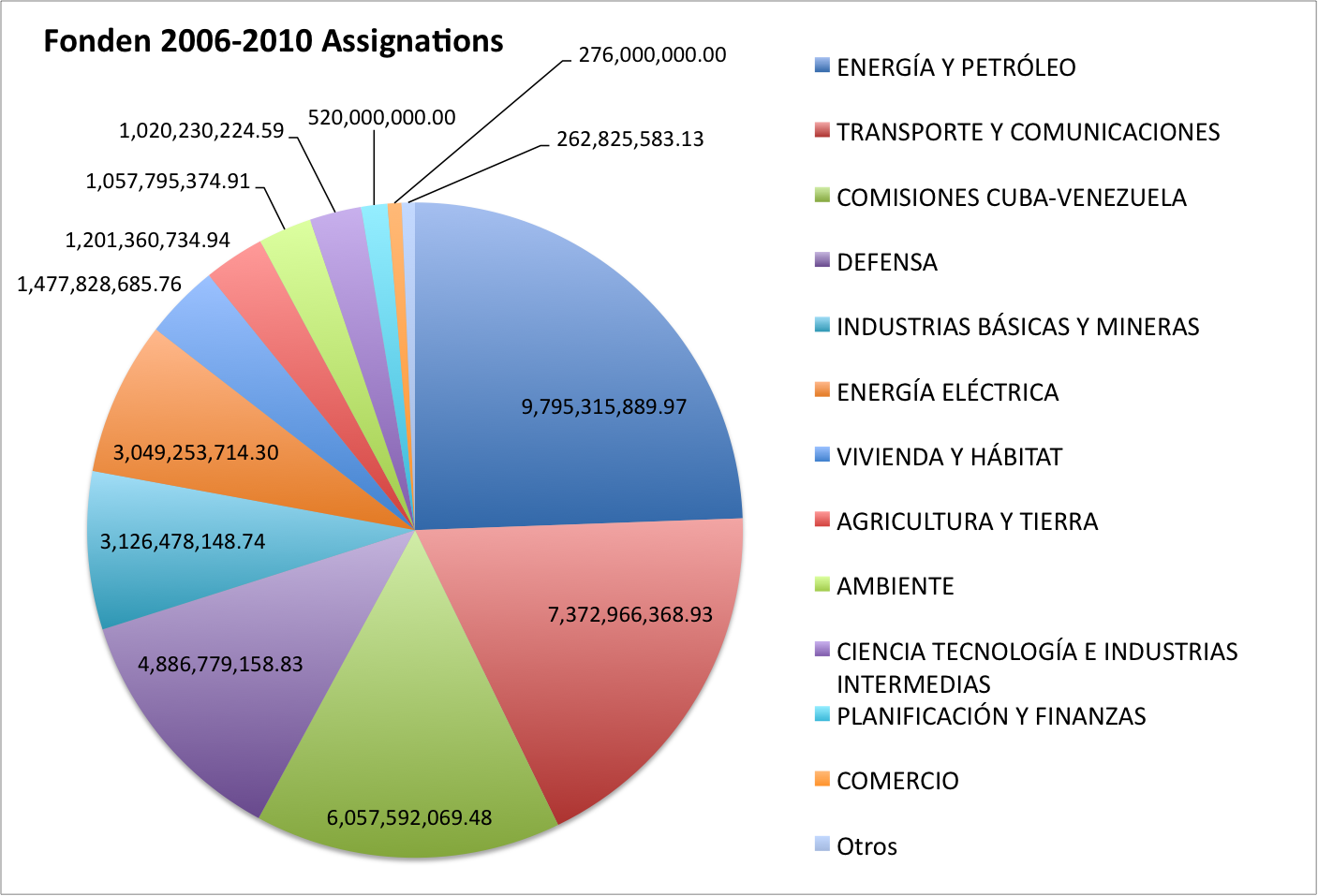
All of the projects added up to September 6th. 2011 on the webpage of Fonden add up to only US$ 27.22 billion, far from the US$ 69 billion of the earlier report to the National Assembly.

The difference?

Projects of the Ministry of Defense and Cuba are not described at all in the Fonden webpage (On purpose, I imagine). Thus, if we add the US$ 4.88 billion from Defense and the US$ 6.06 billion from Cuban projects, we reach the total of:

US$ 38.158 billion, some US$ 30 billion short (Still!) of the US$ 69 billion the fund has received and the total provided by the Finance Ministry to the National Assembly.

Thus, all the work did not yield much, except that by doing it brute force, I read every single project in the website in detail and will have more to say about them later. For now, we still have some US$ 29 billion “Unaccounted for” based on the information provided to the National Assembly, as well as combining the projects in the Fonden website on Sept. 6th. 2011 plus those missing from it in the report to the Assembly.

Small change for the revolution…

Did Venezuela “give” Gambia US$ 22 million for its Electric Network? Well, no, but yes…

September 7, 2011

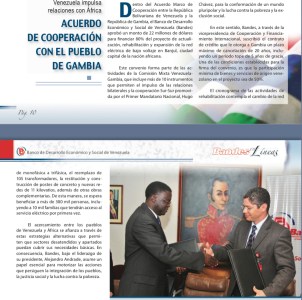
When people are having problems with their own electricity, protests in Margarita Island come to mind, it does not sit well to hear that Venezuela gave US$ 22 million to Gambia for its electric network. In my opinion, Gambia may actually be one of the few countries that may deserve such a gift, Haiti being another one that comes to mind, but it is indeed somewhat typical of this wishy-washy Government that even when they are doing good, they want to protect their image.

Thus yesterday, the Vice-Minister for Foreign Relations said this was false, despite the press conference in Gambia by the guy in charge of electrification in that country. My friend @Naldoxx contacted me yesterday and showed me documents (part of which has since been published by la patilla!) of which you can see the portion of the funding above. In no uncertain terms, it says that Venezuela’s Bandes has lent that country the money for the project.

Thus, in terms of half truths, the Vice Minister is right, Bandes lent the money to the Gambian Government, it is not a gift, just a loan, but in the end, I suspect it is the same, somehow Venezuela does not collect in most of these loans, least of all from Gambia, a country that will likely have to roll over the loan over and over.

So, it is false Venezuela gave Gambia the money, it was Bandes, and it was a loan, not a gift, OK?

Note Added: And my friend @Naldoxx sends me a link to the Bandes magazine, simply priceless (page 10-11):