Archive for the 'Venezuela' Category

Chavez’ New Look: More Than Just a Bald Head

August 2, 2011

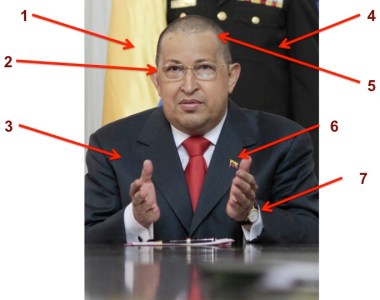
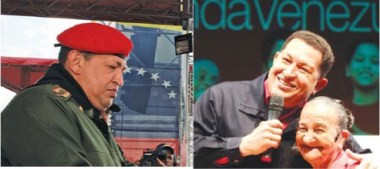
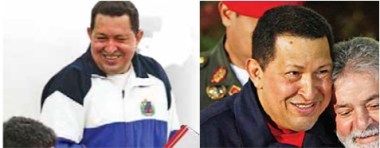
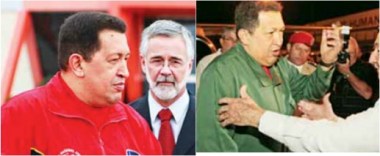
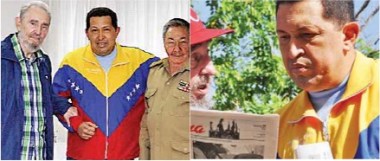
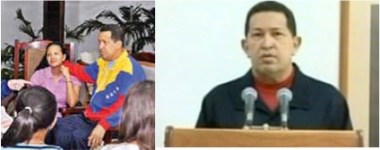
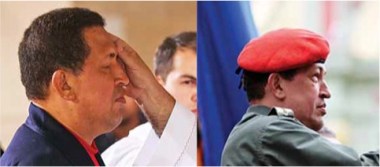
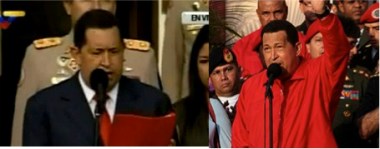
So, everyone looked at Chavez’ bald head when he talked about his “New Look”, but everything about Chavez’ image is carefully calculated and designed. From left to right:

1) Flag behind him, not always present.

2) Glasses, more likely due to the chemotherapy, which means he used to wear contact lenses for vanity reasons, but now can’t.

3) Nice, businessman-like new suit. Gone is the red shirt, only the red tie remains true to form.

4) Well appointed guard behind him, making him look Presidential.

5) Bald head, some spots begin to show up, particularly on the right side of the head. Cut before it becomes noticeable.

6) Little Venezuelan flag substitutes jackets and other implements.

7) Nice gold non-socialist Patek Phillipe watch, model 5119J, retails for close to $20,000 but you can get it for about 15K if you are a careful shopper. I wonder who coughed up the money for this present. And where did the Panerai go?

So, we are back to the soft, serious image. The lovable Hugo, I just wonder how long it will last. We have seen “new” looks before.

Is Hugo Chavez’ Behavior What One Would Expect Up To Now?

August 1, 2011

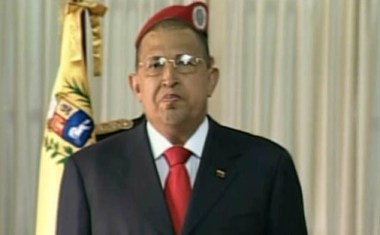
(Nice overlap between Chavez’ “New” bold look and the red beret on the guard behind him)

Having just finished reading the book “Leaders and their Followers in a dangerous world-The Psychology of Political Behavior” by Jerrold M. Post, I can’t help but attempt to analyze and extrapolate what I read to the recent behavior of Hugo Chavez after his recent illness.

First, the way in which the illness has been handled conforms to expectations:

“There is a premium on concealing illness, or, if this is not possible, on minimizing the perception of the severity of the impairment…this need to preserve the image of health may cause leaders to avoid comprehensive diagnostic evaluation and treatment altogether or to undergo inadequate treatment secretly”

Well, Chavez was and clearly is a textbook example of this. From the time of his “knee” ailment, to taking him to Cuba later, he avoided a comprehensive evaluation and tried to have treatment in secret, however, things got complicated. There was and there continue to be attempts to conceal the illness and its severely. Curiously, it is Chavez that seems to reveal the most about what he has, nobody else says or reveals much and when they do, like Izarra, Rangel or that famous PSUV press conference, they are usually lying. It is Chavez verbal incontinence that has told us some, but not all of the details of the illness. In fact, today, amazingly, we still don’t have a formal announcement of what the President has, other than he has cancer and we don’t even know where.

Second, how narcissistic leaders (and the book clearly defines him as one) react to a terminal illness may vary, but based on the book, it would seem from that he should be intensifying his acts, seeking the immortality through what he does, personality traits become more intense now that his life may end sooner than he thought:

“The specter of the end of his life may ignite a terminal explosion in a frantic last ditch attempt to ensure immortality”

I really don’t think we have seen this (yet?) in Chavez. He has actually been perhaps even more subdued, even removing some of the symbols of his Presidency, like changing “Patria, Socialsimo o Muerte”, saying it is not normal to wear red shirts all the time and that he does not want to have the word socialist attached to everything. Perhaps we have to wait for this to surface. But he may be misjudging what he is doing. Many of these symbols are entrenched in the population and changing signals on them is simply confusing for people accustomed to a unified discourse and signalling from Chavez and his Government. Acting hasrhly is one signature of the behavior an this may or not be a consequence of this.

What is clear from the book is that these type of leaders and narcissistic personalities tend to go into denial, refusing to accept that they will relinquish power, which may explain the surprise trips that Chavez has made every time that he has been under treatment in Cuba. Historically, when an autocrat has a  severe illness, those that surround him want greater participation, but the autocrat refuses to yield. He wants control and power, he does not want to lose that. They tend to make decisions, particularly tough ones, too late or in a rush. They lose the control and premeditation that they usually exhibit in their plotting and acts.They act rashly and make mistakes, they tend to engage in a new relationship with subordinates, where they listen even less to advise.

Thus, from what I learned in the book, it is hard to reach a conclusion, but we don’t know all that is happening.

Going forward, I was struck by this sentence in the book:

“Dreams of glory are responsible for some of civilizations greatest achivements, but the intemperate reactions of aging and ailing leaders to the ebbing of their power and the frustrated dreams of their youth have been responsible for some of history’s most tragic excesses”

Let’s hope this does not apply in our case.

Next: in the reading list:”When illness Strike the Leader: The Dilemma of the Captive King” by Robins and Post.

Another Day, Another Bond Issued, this time by the Republic of Venezuela

July 26, 2011

With oil at almost US$ 100 per barrel, the insatiable revolution announced today the largest bond issue in its history at US$ 4.2 billion (It increases the total debt issued by the Republic by 14%), with a coupon of 11.95%, maturing in 2031, but with amortizations (partial payments of one third) ion 2029 and 2030. The total cost in interest will be over US$ 9.5 billion over the life of the bond.The bond will only be sold locally in exchange for Bolivars, but will only trade in foreign currency like has become the norm in the last few years.

The bond is being used by the Government mostly to supply dollars to importers as a number of items or showing scarcity due to the difficulty of obtaining foreign currency from the exchange control office CADIVI. But part of it will be for capital flight as investors and companies simply buy the bonds to obtain dollars with Bolivars at a cheap rate.

This bond “should” yield around 13% in the international markets, which would require it to trade at around 90%, something which will not happen initially as most buyers sell the bonds immediately flooding the market with bonds and pushing the price down.Today the bond was trading in the informal market at 83%, still high in my mind, where it yields 14.4%. If you can sell it there you would have paid Bs. 4.3 for each US$ and received 83 cents (83%), which implies that each dollar would cost you Bs. 5.18 (4.3/0.83). In the worst case scenario of a price of 76%, the equivalent would be Bs. 5.65, this is very cheap and irrational, but that is what the Government is doing.

Thus, it is a good deal to buy the bonds locally and if the “when and if” drops some, it will also be worth it to buy in foreign currency. The Government is giving away money for the sake of preserving an artificial foreign exchange system. Take it if you can. At the current 83% price other bonds with better current yield to maturity may be more interesting for you, unless you want to play Venezuela medium and longer term in the belief that there will be change. In that case, the 2031 may be a better choice than others.

As someone told me yesterday, this is crazy, the worst part is that many Venezuelans rejoice because they will be able to buy this bond. But we will all pay for it one day.

Dreaming of Possible Scenarios For Venezuela in 2012: An imaginary Tale

July 23, 2011

I find it amazing how little written speculation there is about Venezuela’s future. All of the roads to the December 2012 election are routine, normal, ordinary. As if Chavez’ illness had not been an incredible attempt at black swanning us. But given the magnitude of the surprise, I think it is time to be what scientists call “orthogonal”, thinking outside the box. Imagine for one moment it is April 1993, Oswaldo Alvarez Paz just won the primary, he will be the next President of Venezuela, which did not happen, a dark horse called Rafael Caldera came back to the country in July of the same year and took it all. Or think 1998, Irene Saez leading the pack in April of that same year, Hugo Chavez a lone traveler with less than 5% of the preferences, another dark horse that came and won.

In that spirit, seventeen months before, not eight like in those cases, here is my fantasy, trying to really think out of the box, let’s call it:

Henri I, President of Venezuela

As I sit here being sworn in as the next President of Venezuela, hand raised in the Capitol building of Caracas, I can’t help but think of the circumstances that took me here. Who would have ever imagined I would get here in such a convoluted and random way. But I guess that persistence pays off in politics. Three years ago I was dead for Presidential politics in Venezuela, today, I stand here. Amazing!

But to understand how I got here, you have to go back to June 2011, I was trying to fend off corruption charges at the time, working the contacts, when all of a sudden we learned that Hugo had cancer. To this date, we have no idea what he had or has. All we know is that he went on a pilgrimage from Havana to Sao Paulo, looking thinner, saying he was better, cancer free and ready for Patria and Socialismo, but not for muerte. And we believed him.

Meanwhile the LODO association, also known as the MUD, went about its business, selecting a candidate in February 2012. It was a tight race, Maria Corina really poured it on, Viene Maria and Maria Corina Nos Quiere Governar signs seeded Venezuela. Even Chavista outposts in the most remote regions of Venezuela had the signs.

Meanwhile, Leopoldo Lopez tried to jump into the race, but even if the CIDH ruled in his favor, Tibisay from the Electoral Board, the CNE, said CIDH was a four letter word in her dictionary. Thus, Leopoldo was left with his curls ready for the race (get it? crespos hechos). But nothing doing, Tibisay dixit.

Thus, neither the virginal, nor the resuscitated managed to dislodge Henrique Capriles from the front running position he held since late 2010. Thanks to the Government trying to ban him, a positive image in Miranda and a well run campaign, Capriles benefited from the voters desire not to lose, getting 45% of the vote in the six man (or mixed) primary race, as Venezuelans were getting ready to enjoy their Carnival 2012 vacation. The race was now well defined, it would be a Chavez versus Capriles race and the only question was how good the President’s health would be to manage a full court press and campaign against Capriles.

But it was not to be.

As Capriles’ lead versus Chavez began to whither in May 2012, it became clear that Chavez himself was withering in the toxicity of his cancer treatment. It turned out that since March 2012, his closest advisers, including Fidel, Maradona the Chief Babalao and Adan were telling Hugo that he would not be able to campaign. But Hugo was being Hugo and refused to acknowledge the obvious until May. By then Hugo could barely speak for ten minutes at a time in public, was thin and the electorate was doubting his capabilities as a now or future President.

Given that Chavez had led a politically charmed life up to that point, he figured he could listen to his closest electoral advisers, Fidel, Adan and the General, none of which ironically actually believed in elections. But advised they did and it was unanimous, name brother Adan as Candidate, the true Communist in the family, another Chavez, the one that showed you the way, and then, when you recover, you could come back to being President in 2018 and let Adan warm the Presidential chair for you.

Knowing that there was no love lost for Adan Chavez within the PSUV party, I immediately gathered my advisers and within a week announced my candidacy to the Presidency as an alternative and openly welcomed anyone within PSUV to follow me. I told them all: I am the continuity of the revolution, there is no Chavismo without Chavez, but the route towards socialism flows through me. The opposition killed me, accused me, insulted me, but I am used to that, I had a plan.

Within weeks, it was clear that Adan’s candidacy was falling off a cliff at my expense. Capriles and the opposition continued ahead with 40% of the vote intention, I had 30% and Adan was dropping below 15%. It was an amazing turn of events.

By September, Hugo Chavez, fearful of losing it all, decided to have Adan drop out of the race. Adan argued health problems to withdraw and was replaced by then Vice-President Nicolas Maduro, with Jose Vicente moving into that position.

It was simply too late. Maduro gained four points for PSUV the first week, but began dropping soon after that. By the end of October, Maduro had 10%, Capriles had 45% and I had 35%, with 10% undecided. On November 15th. Maduro withdrew from the race with PSUV giving me all their votes. We had a little pop in popularity and on Dec. 2nd. 2012 I was elected by the smallest of margins with 51% of the vote versus 48% for Capriles.

And here I stand being in the podium, my hand raised:

“I, Henri José Falcón Fuentes, swear in front of God and the Fatherland…

I am Henri I, the new leader of the Venezuelan Revolution…

The Fake Latin Americans Idols, All Full Of Chemicals

July 23, 2011

The President of the Venezuelan Supreme Court Thinks We Are Truly Stupid (Maybe she is right!)

July 22, 2011

Luisa Estella Morales is truly a piece of cake. She spews BS like there is no end to it. After the Supreme Court accepted the case to ban leading opposition candidate Herique Capriles on trumped up corruption charges, she swiftly turned around and discarded the case because the accused misrepresented himself when presenting the case as holding a certain position in Chavez’ PSUV case.

Talk about a silly technicality with no legal basis.

But I guess Luisa Estella, who was removed from the bench, not once, but twice, which apparently qualified her to be Chief Justice of the Venezuelan Supreme Court under Chavez, thinks she is on a roll in trying to fool us, and she is trying it once more. Maybe she is right and we are indeed idiots, after all look at what job she holds. Here is the story:

Chavez’ Government approved a Bill imposing a salary cap on public servants. Supreme Court Justices who made at least US$ 7,000 a month, something like 20 times a year, were among those most affected by the decision as their salary would have to roll back to Bs. 12,000. But in their infinite creativity, the Court implemented a food card of Bs. 10,000 for all Justices, around seven times the minimum salary, to complement the “capped” salary of Bs. 12,000.

Except it leaked to the press, not via a leak, or as she calls it, “It was taken to the press in an inaccurate fashion”, but the simple fact that one of the members of the Court (see two posts ago), Blanca Marmol de Leon, rejected the food tickets, because it was undignified and illegal. Marmol de Leon said that this was a “fraud of the law” and it was a way to look for “alternate routes”. Marmol de Leon also said that at least four Justices had rejected the food tickets. I hope we learn who, those guys should stay in the Court, whenever the not so revolutionary “Justices” are swept out of the Court.

And indeed, Luisa Estella confirms, Marmol de Leon’s “alternate route” theory, when she says: “The Court will undertake an extensive review, from a legal point of view”.

Jeez, I thought that was what they did all the time; look at things exhaustively from a legal (and supreme) point of view.

But since she is ready to assume we are stupid, she said: “It is not a bonus, it is not a food ticket, it is for our expense account”

I guess someone has to pay for lunch when they go meet with the party hacks who tell them how to rule and sentence in their cases.

And in closing, she tells that she hopes the “people” will not have an erroneous vision and distorted view of the Justices.

No, we don’t, but we certainly seem that stupid!

Chavez’ Government Shows its Total Lack of Compassion on the Issue of Sick Prisoners

July 19, 2011

Compassion. If there is a single word I would ask from a Government, it is that, compassion. Sounds simple, but a Government that shows compassion, has it easy after that. Everything follows down from it. From being practical, to human rights, to trying to do what it is best for the people, it only takes one word: COMPASSION.

And Chavez, trapped in the labyrinth of his illness, showed he had none, whether he was talking about political prisoners or not. And neither did the General Prosecutor or the President of the Venezuelan Supreme Court.

For Chavez, this was not about responding perhaps to his buddy’s Chomsky request for compassion with another intromission with the judicial power. No, he could have, for example, pardoned those involved, he was pardoned and he had over two hundred deaths on his back, after the ’92 coup. Thus he knows exactly what it means. But pardoning anyone has never been part of his Presidency, he has shown no compassion, for friends and foe alike, even for his daughter’s Godfather. On the contrary, he has shown a remarkable thirst for revenge.

Bur rather than call for expediency in having those ill be given conditional freedom to get treatment, Chavez could have raised hell because under his rule, under the Government he has presided for over twelve years, prisoners, whether political or not, should be allowed to seek medical treatment. Because, even when this is allowed, a member of the Venezuelan Supreme Court tells us, that there are no resources to provide the transportation. So, prisoners are stuck in revolutionary hell, they are usually not allowed to seek treatment, and if they are, there are no resources to guarantee safe transport for them. Thus, the choice is simple, let them sink in the hell of their prison and the hell of their illnes and the which Venezuela has become.

Because clearly, if there is no compassion from the “leader”, there will be nothing from those below.

Like the General Prosecutor, who “proposes” to create a “commission” to analyze what benefits may or not be given to prisoners (Did she really say “political prisoners”, how political incorrect can she be?). How long will this “commission” take to analyze? How long will they take to decide?

Contrast that with the speed and resources devoted to treating, curing and saving a single patient, their own demi-God and benefactor: Hugo Chavez Frias.

Where was this person been since she became General Prosecutor three years ago? Did she even know this was a problem, or did she simply not care? Is she proud of the disastrous prison system that she presides over, as the person in control of who gets accused or not?

No, she simply lacks compassion…

The same way that the President of the Venezuelan Supreme Court dares to say she is “reviewing” the files of those prisoners who are sick, because the Dictator, or her Dictator, Hugo Chavez asked?

As President of the Court, she should understand what system she presides over and ask for both Justice and compassion for all Venezuelans. But she was too busy, approving for herself and buddies in the Court, some six to seven times the minimum salary in monthly food tickets to bypass Chavez’ law which caps salaries at all levels of Government. These salaried revolutionaries are certainly a piece of work, worried about their rich bellies, but not about the revolution and the moral ideals iclaims to stand for.

And finally we ask, since we talk about compassion and the protection of the people. Where the hell is the “People’s Ombudsman”?  This position was created precisely to have an independent body that would watch out for the average Venezuelan. To ask that their rights be respected, including all of those rights contemplated in the Bolivarian Constitution of 2000. This is Chavez’ creation, where is she?

I have no idea, but I know she does not have the most basic belief and instinct she needs in her job: Compassion.

The problem with the Chavista revolution  is that while all of its wishes, deeds and resources are being overwhelmingly directed to the preservation of their leaders’ health, the revolution has been shown, once again, to not have the most basic elements of compassion to lead Venezuelans anywhere.

And they still don’t get it…

The guy who could become the President of Venezuela

July 18, 2011

Just think, this guy is next in line to become the next President of Venezuela…Seriously…Imagine a “cadena” with him…

The evolution of Hugo Chavez’ health via photographs

July 16, 2011

When I first wrote on May 29th. that Chaves did not really have a knee problem, I did this, because someone who has always provided me with good information called me to tell me he had something worse, without being specific. This person said that a few people knew about it, but nobody dared say anything, so I wrote a somewhat sarcastic post on the subject. Little did I know how fast things would move in the next month…

But we still don’t know what Chavez has and when was it that they realized he was sick. To attempt to shed some light on this, I have gone back and looked at Chavez’s pictures using one of his rags as the main source (Correo del Orinoco, Eva’s rag) and have added some more pics chronologically, including pictures from the videos to get an idea of the evolution of Chavez’ face and body until today.

One can clearly see the evolution in his weight and face, but it is not always clear, in fact, I think some picrures puported to be from the day before, were older. But I will let you be the judge.

However, I should note a funny statistic. In January, Chavze was on the cover of that newspaper, 16 times, He was only on it 5 times in February, then it jumps to 13 in March, but only 7 in Abril (Easter week?), dropping to 7 in May, 9 in June (seven in the fist nine days) and 10 so far in July. The scant coverage in February and April is suspicious, but he still looked healthy. Recall Alo Presidente was cancelled half the time between January 1st and April 30th.

Chavez was on the news in early May until May 9th. , then he disappears and reappears with a crutch and the knee story. Note that the crutch disappear once he went to Cuba.

First, let’s set a benchmark, Chavez on Jan. 1st, 24th., 28th. and May 1st, all of which seem to be before they knew what he had.

Note in particular how huge he is on the third picture taken on Apr. 28th.

Then the “knee” problem begins and below you see two pictures, one in an appearance that I can’t pin down the exact date for (on the left), in which he showed up dressed in black and with a crutch. Then, on May 23d. he appeared in the “Balcon del Pueblo” (picture on the right) with a crutch. My take is that he had had a first “procedure” by then in Venezuela, maybe just a biopsy or radiation, but he already looks thinner than above, but it is not clear cut.

Then he shows up on June 1st. (Picture form the day before, below on the left) wearing the blue and white track suit and two days later (picture on the right below) he meets with Lula. He looks better, no crutch by then, as he gets ready to go to Ecuador, Brasil and Cuba:

The next picture is on June 9th. in Brazil (left picture below) and the next one arriving in Cuba (right picture below), meeting Raul Castro, on the night of June 9th. to 10th. according to my estimates:

Chavez then really disappears and we see him again in a picture in Gramma published on June 19th. on the right below. He seems thinner and we were shown a video of unspecified date (picture on the right below and the next frame too), where you can see him thinner, particularly his body:

In the picture below, from one of the videos, he is with his daughter and looks thin (on the left). Then, we do not hear from Chavez again for ten days, on June 28th. , when he gives a speech (below on the right), which he read and he was clearly wearing make up.

My suspicion is that the first video we saw was before the second operation, the change is huge between the two pictures above. They made the first video, Chavez got worse and they decided to show it to calm things down, but at the time he was really at his lowest point. The moment he recovered he gave the speech. The only thing that contradicts this is the date of the newspaper, but you all can see the difference.

We then don’t see him for six days, when he arrived in Venezuela and was clearly not as thin, but looked weak (picture on the left below).

The next picture supposedly was taken on July 6th., but my feeling is that it came from the early days in June, before the operations.

On July 10th. we were shown videos or pictures of Chavez watching the soccer game (below on the left) and with his father and mother (below on the right). Again looking better.

The next two pictures are from July 14th and 15th.

Below are the pictures yesterday on Friday July 15th. requesting permission to leave and today where he looks better, but the big shirt hides how much weight he has lost if you compare with the first four pictures above.

From these, it is my take that they did something to him in Caracas before he left for Ecuador, Brazil and Cuba, around May 9th. They hid this behind his supposed “knee” problem, but knew he had to go elsewhere and left for Cuba, via the other two countries to hide the problem. In Cuba, he underwent two operations. The pictures with the Castro brothers i after the first one and then the videos and his first are after the second one. He has said that he was in intensive care, clearly this was after the second operation, between the 19th. and the 29th.

The mystery is why two operations and why intensive care after the second one. Either he got an infection after the first one, or they found during the first procedure much more than they could deal with without being prepared for it.

What do you think?

Hugo Chavez announces he chooses to be treated in Cuba over Brazil

July 15, 2011

This afternoon, President Hugo Chavez announced that he will be going to Cuba to receive chemotherapy for the cancer that affects him. This is a surprising decision that reportedly goes against the wishes of his daughters. It was our understanding that the doctors from the Syrian Lebanese Hospital in Brazil were not clear on what precise treatment to follow, while the Cuban had already made a decision when he left that island.

It is unclear what tipped the decision. From a technical point of view Chavez would be better off in Brazil, Venezuela or a country like Canada, the quality and size of cancer treatments in these three countries is considered to be much more advanced than that of Cuba, even if in Cuba, he could be taken care off by doctors of other nationalities. It is likely that in the end ideology tipped the decision Cuba’s way. I am sure that Fidel Castro and Chavez’ brother Adan put a lot of pressure on the Cuban choice. An isolated Chavez in Havana is much more under control than one in Sao Paulo in a private hospital. Those that have the most to lose, will now control the day to day life of the Venezuelan President and, indirectly, over the country.

Chavez gave hints of the severity of his illness when he said he underwent two “complex” operations in Havana, which contradicts his earlier stories of a single well defined tumor the size of a baseball earlier this week. He also said he had given “ample” details about these operations, which contradicts reality. We still have no idea what type of cancer the Venezuelan President has.

Chavez apparently will not  leave Vice-President Jaua in charge when he leaves tomorrow. This and the fact that he is going to Cuba bodes badly for the possibility that there will be a smooth transition with or without Chavez. The Cubans will control what is said, who says it and when it is said. Their favorite and trusted successor Adan is with them. This could hide the truth in the same way it has been hidden for weeks and leaves the country unattended and without a President or under the hands and control of a foreign State that has the most to lose if Chavez were to be defeated in 2012 or is too ill to continue being the President of Venezuela.

In the end, Chavez’s fate may be sealed by the same factors that have made his Presidency so impractical and ineffective. He may have taken a decision to be treated in Cuba, based on ideology and emotions, rather than on the facts and on the capability and preparation of those that will treat him.

In the end, we may never learn the truth…