Archive for the 'Venezuela' Category

Lina Ron, revolutionary icon, dead at 51

March 6, 2011

Lina Ron, a controversial and iconic figure of the Chavez revolution is dead at 51 from a heart attack. Ron was one of those revolutionary figures that was hard to comprehend to many Venezuelans. Born in an oil industry family at the same time as Venezuela’s IVth. Republic democracy, Ron was even more “in your face” and provocative that Chavez himself. She first surfaced in 2001, leading a group that burned the US flag after the Sep. 11th. attacks.

Ron and her supporters had a total disregard for the law. She once rescued her husband from a police station where he was being held. She coordinated and participated in a number of attacks on TV station Globovision, as well as on Cardinal’s Urosa’s official home when he was still Archbishop. She always threatened with violence, not only to defend Chavez’ revolution, but to support it if it ever were to lose an election. After the last violent Globovision attack, she was ordered jailed by Chavez, only to be quietly freed a couple of months later.

She seemed like a very authentic revolutionary, but was accused of being funded by the Government to buy weapons and motorcycles. Her obviously fake blond hair was copied by admirers and seemed to some to be inconsistent with her revolutionary stance. It was copied at Carnival and in revolutionary circles. I will never forget taking a reporter around Caracas on election day and finding a large group of Ron look-alikes, with absurdly long blond wigs, dancing and signing in the middle of the street in downtown Caracas.

She was a true anarchist in a Government that uses anarchy, and used her, for its own goals, but always blames it on others. She founded a political party and only a few weeks ago said if Chavez lost the election in 2011 there would be “plomo” (lead, shooting, violence) She was a leader on her own right, even if many of us still have a hard time understanding how she came to be what she was in the Venezuela that we thought we knew.

PDVSA, its Pension Funds and the SEC freezing a US Investment Fund

March 1, 2011

This post dedicated to Setty. My friend, if this stuff was fiction, nobody would believe it…

I will not bore you with the details, Setty has done an outstanding job in covering (and uncovering!) them, but basically a fund in the US, a very capitalistic hedge-like fund, is halted from operations by the SEC. It turns out that 90% of the money in the fund is money from PDVSA’s employee pensions funds. Then, it turns out that the fund was involved in illegal foreign exchange operations. But with whose money?  PDVSA or the PDVSA pension funds? And when the investment funds are stopped from functioning, two private companies in which the funds invested (the very reason for the SEC intervening) need money that was coming to them, but the money is trapped in the funds.

Who comes to the rescue?

None other than PDVSA, who is willing to “help” on demand, just like that

So, what gives?

The funds are managed by a Venezuelan, Francisco Illaramendi, who acted as an adviser to PDVSA in the past. But these days, he seems to be a vehicle for PDVSA acting. Except that initially PDVSA was hiding behind its pension funds. Or so it seems.

This leads me to ask a simple question: Who was PDVSA acting for, the funds or PDVSA? Who made money from the deals, PDVSA or its employee funds? Why did the funds invest in a company developing small nuclear reactors? Was Illaramendi simply acting on PDVSA’s orders? How was he being paid? (Other than getting US$ 482 million into his funds)

The funny (not funny ha, ha, just weird) thing is that Minister Ramirez said last week in the National Assembly that PDVSA had nothing to do with the managing of the funds. Union workers and pensioners say they have seen no information on how the funds are managed for years, ever since PDVSA’s Treasury Depratment took over its management.

And Ramirez looked very uncomfortable answering these questions. And he should. What the funds/or PDVSA/or Illaramendi were doing was simply illegal in Venezuela and the details of the flow of money could be even more illegal.

But nobody knows. Nobody answers, nobody says anything. Nobody questions it. The Comptroller is nowhere to be seen. Ditto the Prosecutor.

But this memo from the fund’s lawyer shown by Setty is simply priceless, almost as good as a suitcase with $800,000 in cash, opened at customs in a Buenos Aires airport.

It reads:

“As MKG has indicated, in order for STLF (Short Term Liquidity Fund) to conduct Venezuelan currency transactions in the permuta market, it must furnish its own Bolivars…”

Except the permuta market has been illegal since May, so what the hell is this lawyer talking about?

but then, this same memo, dated Jan. 04th. of this year says:

“MKG has stated that the Bolivar providers need to be paid, in no small part to assure that they will be willing participants to future transactions requiring Bolivars”

This says, we have been involved in transactions which are illegal in Venezuela and need to pay our counterparties in order to keep participating in them.

And PDVSA was right in the middle of things. And this is all managed from PDVSA’s Treasury Department and PDVSA’s pension fund contributed 90% of the money to the investment fund.

Not clear enough for you? How about:

“STLF purchased Bolivars from non-US participants at an agreed exchange rate, to be paid at this point in the transactions”

Jeez, last year in May, the Chavez Government shut down 46 brokers and jailed people who were doing legal transactions and banned currency exchange transactions and these guys are doing them now, with PDVSA money to boot?

As far as I know, the only country that trades and accepts Bolivars is Venezuela, where any of these transactions is illegal. Where do these Bolivars flow? In Belaruss? Or Zimbawe? Or is it Lybia? I bet it is more likely to be in Caracas.

And PDVSA is in the middle of all this?

No wonder Ramirez and Giordani talked openly about lowering the parallel market! They are apparently running it!

The revolution never ceases to amaze me!

(P.S. And don’t forget, these same funds invested US$ 1.15 billion dollars in the PDVSA 2017 bond earlier this year. Add it up: US$ 1.15 billion plus 482 billion is 1.632 billion. How much money do these funds have? Is this the revolutionary idea of “diversification”?)

Lonely at the top for Hugo Chavez

March 1, 2011

Griping About the Students Hunger Strike

February 28, 2011


I did not write much about the hunger strike by the students. I was in the middle of moving, thus I had many distractions. By now, the hunger strike is over, the Government capitulated and it was supposed to be a victory by the opposition.

Well, not to me.

The reason is that I think countries can only function under the rule of law and the student’s victory required bypassing the rule of law. If we complain because Chavez and his Government do what they want with the judicial system, having them bypass the rule of law in order to satisfy the demands of the students leaves a bitter taste in my mouth.

When in hours after the agreement, the Prosecutors office released the elected Deputy in order to comply with the agrement with the students, the rule of law was bypasssed. The “victory” ratified what we say, there is no judicial independence, Chavez and his Government, not Judges, decide who goes to jail, who stays in jail and who is freed.

This can’t be good going forward. We are accepting the autocracy.

And since I am on the subject of the hunger strike by the students, I found the behavior of the pro-Chavez students, holding a barbecue right in front of where the striking students were, absolutely disrespectful and tasteless. I hope the balding student that led the barbecue display is removed from the The Government’s payroll or PSUV’s payroll. Next time, at least find some real students.

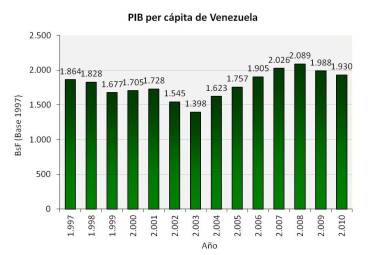
Despite the oil windfall GDP per capita is only up 3.5% over the last twelve years in Venezuela

February 27, 2011

And from the website algodeeconomia.com, a very simple graph; using BCV data, GDP per capita in constant Bs. , since 1998. Over half a trillion dollars in oil income and all you can show for it is an improvement of 3.5% in twelve years. It is not even worth calculating how much that is per year: Tiny.

The mystery of Giordani’s 18% Debt/GDP ratio

February 26, 2011

Everyone was a little puzzled by Minister of Finance and Planning Jorge Giordani emphatically saying that Venezuela still has a low debt to GDP ratio of 18.6% and that it has actually improved in the last few years.

This one is only one of many puzzling things he said, he also suggested this Government inherited high inflation from its predecessors, ignoring the fact that not only have 12 years elapsed since then, but the “structural” and “inertial” factors invoked by Giordani to cause the current 27% inflation, were apparently absent when during his tenure as Minister of Planning in 2002, inflation was 12.2% for the full year, the remainder 15% then has to come from other sources, related to the irresponsible printing of money by the Venezuelan Government. The money supply has increased by a factor of 15 (Yes, 1,500%) since 2003. So much for structural or inertial.

Structurally Incompetent perhaps.

But going back to the Debt/GDP ratio and Giordani’s 18.6%, let’s look at some simple numbers:

1) Venezuela’s GDP in 2010 was estimated to be around US$ 355 billion, before the January devaluation. Since the currency was devalued from Bs. 2.6 to Bs. 4.3, this says that Venezuela’s GDP in foreign currency opened the year 2011 at US$ 233 billion.

2) Venezuela’s total debt as of Dec. 2010 was composed of two parts: 1) Bonds outstanding in the amount of US$ 31.1 billion (my calculation) and US$ 5.6 billion in debt with multilateral organizations. bilateral organizations and banks. This gives a total of US$ 36.7 (31.1+5.6) billion for the Republic’s debt, ignoring debt held by Government companies.

If this is all Minister Giordani was talking about, then the ratio is 21.3% (36.7/172.3), using the current “official” exchange rate.

But given the relationship between the Government and PDVSA, one can not separate the two. Thus, we need to take into account PDVSA’s debt:

3) PDVSA’s debt as of today, after the issuing of the PDVSA 2022 bond and ignoring (for now) other debt held by the company, amounts to US$ 20.5 billion.

Thus, between the two PDVSA and the Republic, Venezuela’s debt is US$ 57.22 billion.

But, whether you use last year’s number (which yields 20%) or this years number, which yields 24%, you still can’t get 18%.

But it gets better. First of all, Giordani has this unconventional interpretation that the US$ 20 billion borrowed from the Chinese is not debt.

Huh?

Imagine you borrow money from someone and agree that you will pay for it working for them, it may not be debt, but you are a slave, or not?

Same here, PDVSA has to ship oil to pay for the US$ 20 billion, we Venezuelans own PDVSA, and we have to pump oil to pay that, we are the slaves. It’s pure debt.

But let’s agree with Jorge for a while. Venezuela owes only US$ 57.22 billion, except that PDVSA, besides its bonds has liabilities in long term debt of about US$ 4 billion more, which is owed to banks. (We are ignoring employee liabilities, just straight debt)

Thus, the total debt is US$ 61.22 billion or 26%% of GDP

But wait, is the true exchange rate Bs. 4.3 per US$?

Or is it the SITME rate of Bs. 5.3 per US$. If we use the SITME rate, GDP goes down to US$ 189 billion, so that Debt to GDP goes up to a Debt/GDP ratio of 44%.

And yes, if you let the Bs. float, the equilibrium rate would be more like Bs. 6.5 per US$, thus GDP would drop, this time to US$ 113 billion, which would mean Debt/GDP ratio would go up to 33%. But if you add the 20 billion Chinese loan, then it goes up to 71.7%, which is quite high, very high. In fact, The Economist has taken notice.

And God forbid, the World Bank rules against Venezuelan in arbitration.

From all this, the only thing that is clear is that Giordani’s value is simply wrong. In fact, for a man that likes to talk about equations (Deputes are apparently scared of them) which are simply algebraic sums of factors like the Gini Index, throwing that mysterious 18.6% number out is simply irresponsible. He is simply ignorant or a big liar.

Take your pick.

What is clear is that “the man in charge” is either full of hot air, or has no clue, neither of which is encouraging for those of us concerned about the future of the country.

Thank You All From The Devil

February 24, 2011

I am still here. It is not that I will blog less, it has simply been a complicated week as I moved, I have many stories to tell from what was  going on in Venezuela this week, but energy levels are low, after full days of many errands and lots of work.

But I could not pass up the opportunity to thank everyone. My post explaining that I was leaving arose more from the need to be fair to all of you in disclosing my departure, rather than from explaining what or why I was doing it. But I really did not expect the outpouring of good wishes, compliments and cariño that I felt. I admit that I was touched, overwhelmed and humbled by all of you. I consider my blog a labor of love towards my country and I can see that it has generated lots of equally lovable feelings from my readers.

Thank you.

I also wanted to tell in that post a little bit more about who I am. I had tried unsuccessfully to hide who I was as much as possible over the years, some details got out slowly, but with my departure I felt I could tell you a little more about myself. I am still surprised by how many people thought when I meet them that the Devil was young  (no such luck!), lived outside Venezuela (Now I do!) and was an economist (Only an amateur one)

Discussing with various friends the strong reaction to my post, there were over hundred comments and some blog posts by friends Daniel, Alek, Kepler, Instapundit took note and even Nadox in Codigo Venezuela, there seems to be two reasons for the emotional reaction coming from two different poles: Those that have already left, identify themselves with the difficulties and conflicts of my decision, those that are considering leaving, wonder if they should leave too or whether they will one day have to do the same.

I don’t know if the above interpretation is correct, but there clearly was a strong resonance with my farewell post. I liked Daniel’s title “The good Devil moves out of Venezuela”.  I also loved the title of Naldoxx’s post “Even the devil is leaving Venezuela”, he called me a sort of handyman of life, which I take as a very nice compliment. And even if some are worried by the fact that he published my picture, don’t worry, it is a 29 years old picture, all my hair is white by now. And I don’t do low temperature experiments any more.

You can be sure I will make the best of my departure. Despite everything, life is good and beautiful and I have many, many plans. And that includes to keep writing and interpreting Venezuela as well as I can.

Thank You again!

The Devil Does Not Live Here Anymore

February 21, 2011

Thirty three years ago I came back to Venezuela fresh from a Ph.D. in Physics from well-known US University. It was an exciting time, Venezuela was moving forward, we all felt we were ready to take the country to the next stage of development, you could get research funding and lots of people were either leaving to study abroad or coming back with degrees in many fields. The first few years were exciting, things went well, I came back to Venezuela to work in a lab which already had good equipment and I was able to get more, got grants in Venezuela and abroad, my career took off. I also helped start an engineering research institute.

Then came “El Viernes Negro” (Black Friday), when the country’s economy had its first large devaluation in decades. This was February 18th. 1983. Within months the Venezuelan currency had lost almost 60% of its value, things got more difficult. It was a sign of things to come.

Things began to oscillate a lot. There were good years and bad years. Not much new funding. I was working in a field that required ever more sophisticated equipment, lots of running expenses. It was hard to stay at the edge, but I gave it my best try for quite a while.

Then politics got in the way. Technical employees where I worked began demanding the same perks as researchers, without being willing to assume all of the duties and responsibilities. Then there was a tough strike and I decided I had to either leave the country to do Physics or switch fields. Staying in the country, where my extended family resided, was important to me. I stayed. I was then consulting for a small local broker on how to construct indexes for markets, they had actually started by offering me a job. I decided to give it a try, see how things developed, maybe there would be improvements at the Institute where I had worked since I was 18 years old. It was downhill at that place from there, by now the revolution has insured that what was once one of the top scientific institutes in Latin America, has slid down into an irreversible path to complete mediocrity.

The new job went well. There were ups and downs, but the ups were always exhilarating, I learned so much new stuff along the way. We did lots of things, all of them quite well and with professionalism. Then last year Chavez decided to blame someone for his economic mismanagement and targeted one of the companies of the group that I worked for. It was the equivalent of our “farm” being illegally taken over by the Government.

It was time to go.

Thus, this weekend I moved with my family to another country. I will go back periodically for work reasons, but my main residence will be elsewhere. There were two main reasons for this tough decision, one that came from the mind, not the heart: Crime and the absence of the rule of law. I stared at both of these in the face and it is something I don’t wish on anyone. You feel like you are not playing on a level field. If the crooks don’t get you, the other “crooks” will and you have no way to defend yourself. There are no instances, no appeals, you have no rights. Time to leave.

And so it goes…it’s called self-preservation.

The blog will continue. I started this eight and a half years ago and will continue to document the absurdity of it all, as long as it continues. I think Quico, Alex, Daniel and I have played an important role over the years in telling the story of Chavez outside the country. That job is mostly done. But as blogs have lost some sex appeal, there are lots of stories still to tell about what is going in Venezuela, which can not be Tweeted or Facebooked. Clearly, not being on the ground will deny me some of the insights one gets from being there. But I will go back regularly and hope to compensate partially with it. I hope to sustain the quality, if I don’t, let me know (In private, of course 🙂 )

So, the Devil will continue to be around. I won many battles in my dear Venezuela during the last three decades, but I lost the overall war. Time to move on with some sorrow.

But, in the end…

Semper diabolus vincit

Hugo: Tell me who your friends are…

February 20, 2011

From La Patilla, this magnificent collage of Hugo and his Lybian buddy. As the saying goes: “Dime con quien andas y te dire quien eres”. (Tell me who your friends are and I will tell you who you are)

Chavez Becomes Blameless on Wasteful Gasoline Use in Venezuela. His Solution: Rationing!

February 15, 2011

Yesterday, I sincerely could not believe the Dictator when he started talking and pontificating about the problem with cheap gasoline in Venezuela. “You are filling your tank with the cheapest gasoline in the world” said the President, speaking with his scolding tone, as if saying “you bad guys have been doing this behind my back”. Then, as if his inauguration was just last week, rather than twelve years ago, Chavez told us in his pedagogical tone, that the Government subsidizes 90% of the price of gasoline, a topic we have covered many times.

Wow! When did he find this out?

Because for twelve years, Hugo Chavez has done very little to change the price of gasoline. In fact, he forced Former President Rafael Caldera in 1997 NOT to increase the price of gasoline to take advantage of that populist stance.

In 2000, his cronies at PDVSA cancelled the natural gas car program for vehicles, which was rapidly expanding and they have now tried to revive without much success (Surprise!)

And it was Chavez himself in Alo presidente the fact that he had not built major roads, because that would only attract more people to cities.

And it was also Chavez who sent oil and gasoline to Iran, London, Petrocaribe, Cuba, Argentina, Central America and Uruguay, the latter a country with a much higher standard of living than Venezuela.

But rather than eliminate these subsidies and/or increase the prce of gasoline, Chavez solution is very simple:

Gasoline rationing. The Government will force us to consume in 2011 100,000 barrels less a day than in 2010.

What’s next? Rationing sand? Because after all, we have had water and electricity rationing, food shortages and now gasoline rationing, all once abundant in Venezuela.

But it is the paradox of Venezuela, Chavez, the revolution and gasoline. After twelve years of inaction, he puts his angelic and pedagogic face and blames us for his incompetence. Even managing to scold us. We should feel guilty. But not him. Like the cartoon above, Chavez is well meaning, generous and smart.

It is the Venezuelan people who are simply very dumb, to continue to put up with Chavez’ charade. The “Yo no fui” parade of his own incompetence.