Archive for the 'Venezuela' Category

Venezuelan ONG’s ask Government to stop persecuting them

September 7, 2010

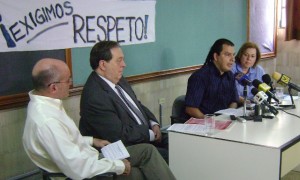
Over 100 Venezuelan ONG’s and thirteen international ones, including what I think are the leading Human Rights ONG’s in the country, Provea and COFAVIC, held a press conference and issued a communique today asking that the Venezuelan Government stop persecuting them and rejecting legal decisions that attempt to take away legitimacy and criminalize the rights of the people to participate in public matters. Among the activites of the Government denounced and documented by the group were the systematic disqualification of the media, the opening of trials and judicial processes, intimidation via public threats and the jailing of members.

Liliana Ortega who leads COFAVIC, which has spent twenty years defending the rights of those that died in the Caracazo in 1989 said:”A fundamental condition of a democratic state is to utilize dialogue as a strategy of persuation and conviction, but in Venezuela exchanges and the search for a consensus has been prohibited and satanized. When a State does not make its positions flexible, does not back out of its positions, nor does it search for solutions that satisfy everyone, what it puts in evidence is that the authoritarian model gains more and more space as a form of governing”

The spokesman for Provea said the attacks look to erode the autonomy of social organizations and stop independent controls as well as the true exercize of of the rights contained in the Constitution. According to Provea, the reaction of the Prosecutor to more protests has been to criminalize and bring to trial protesters with the complicity of the People’s Ombudsman (Defender in Spanish).

The organizations present ask public powers to revert the campaign to damage their prestige and to help increase the possibilities so that people can exercize their rights. They also ratified their right to receive help from international groups like Amnesty International, Social Watch and Greenpeace that fight for democracy, protection of the environment and the elimination of injustices.

The communique concludes by asking the Venezuelan Government to:

1.- Take necessary measures to stop the threats agasint the ONG’s and human right ddefenders that live on the country.

2.- To respect constitutional guarantees and international instruments that protect our right to free association and participation in public matters, as well as international cooperation, freedom of speech and the right to work.

3.- Immediately comply with all of the precuatelary and provisional measures given put by the interamerican ssystem, to human rights defenders and start exhaustive and independent  investigations over the matters denounced in order to prevent that impunity prevails and similar situations of agression and persecution agsint human righst defenders may multiply.

4.- Open communication channels with the organizations of civil society to look for a joint search for the paths that will make a reality the full validity of human rights and the exercize of democratic freedoms in Venezuela.

I am glad this gathering and press conference took place. The groups that participated, their long time record and reputation should be sufficient to raise the attention of international groups that know them and who will understand the seriousness of the situation these human rights organizations face today in Venezuela under Hugo Chavez.
Deja Vu on economic predictions by Venezuelan Government Officials

September 6, 2010

Yesterday, Minister of Finance and Planning Giordani came out of whatever hiding place his spends his time at and gave us his economic predictions for the remainder of the year. Giordani, who is not an economist, loves to predict and has made some famour ones in his lifetime, like:

-The North Korean economy is healthy, which he said in 1994, right before that country’s famous famine.

-We are going to have to take off investors off our backs with our hats. Sais in 2000, nobody has seen the hat or the investors since then.

-We will have single digit inflation. Said in 2000 and 2001, we are still waiting.

-Our piggy bank is full. Said in 2001, the “piggy bank, called FIEM was empy by February od 2002.

Despite this, here comes Giordani again, Planning Minister for eight out of Chavez’ eleven years, telling us that the economy will grow by the end of the year and that inflation will be less than 30%.

Geez, I guess we should be grateful, the whole world relishes in having single digit inflation and Giordani is telling us, as if it were an achievement, that inflation will be less than 30% for the year and that in August, typically a seasonally low month, it will be between 1 and 2%. How ungrateful can we be at his accomplishments.

And then he says that by the end of the year GDP will be positive, as if this were an incredible achievement. The whole world came out of of the recession lafter the 2008 financial crisis and Venezuela is still showing negative numbers. These are GDP numbers for the last six quarters

-2.6%, -4.6%, -5.8%, -3.3%, -5.2% and the latest -1.9%

And most economists don’t believe the last number, the underlying figures are simply inconsistent. But maybe they can get to positive by fudging the numbers and convincing us they are true.

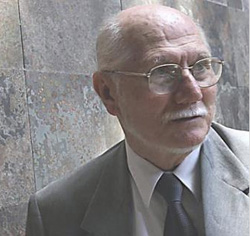
Because all of these predictions are not new. last year, after only one quarter of economic contraction, the guy laughing at the top, right, Nelson Merentes also had his predictions right about this time of the year, but last year. Merentes, who is a Mathematician, with no economic training or experience either told us boldly on August 31st. 2009, that GDP would actually be positive for 2009, barely positive at 0.2%, but positive. Instead, the year came in at 3.3%, showing what a horrific prediction he made and how clueless he was.

Eventually the Venezuelan economy will grow, at some point you can’t contract any more. But I suspect it will not happen this year. Last year, when Merentes was predicting growth, the Government had about US$ 20 billion in parallel funds like Fonden and it issued about US$ 11 billion in PDVSA and sovereign debt in the second half of 2009.

In contrast, this year, the funds have about US$ 7 billion and we have seen issuance of US$ 4 billion so far in the second half of 2010, but I doubt we will see more than a total of US$ 7 billion. That’s US$ 13 billion dollars less, that gets barely compensated by higher oil prices.

Given that the problem is foreign currency, that means that the Government does not have the tools to make this economy grow until the first quarter of 2011.

Why then?

Easy, the electric crisis played a big role in the contraction of 1Q10, it is hard to expect that it can get as bad as then once again, but with these guys you never know.

Meanwhile, so called “economists” funded by the Venezuelan Government, publish papers and are quoted in the international press, telling glowing tales about the Venezuelan economy in the remainder of the year. Unfortunately for them, they still fail to understand how the Venezuelan economy really works under Chavez, the role of the parallel funds and how the Government has not been able to increase spending before the election, simply because it has no money. And even if the economy managed to eke out a gain of 0.1%, there will be another forced devaluation in early 2011 and the predictions will have to become more of the same:

“In 2011 we are going to have the economy grow and inflation will surely come in under 30%”

You would think even Chavez would get tired of this same old song.

Like Yogi Berra said, this is like Deja Vu all over again.

A Novel Interpretation of the Right to Life in Revolutionary Venezuela

September 6, 2010

Venezuela’s Constitution is pretty clear, the Right to Life is the most fundamental of all civil rights guaranteed by the Constitution approved by the current Government in 2000 and ratified in a referendum.

Article 43 of that document is quite explicit and clear:

Artículo 43. El derecho a la vida es inviolable. Ninguna ley podrá establecer la pena de muerte, ni autoridad alguna aplicarla. El Estado protegerá la vida de las personas que se encuentren privadas de su libertad, prestando el servicio militar o civil, o sometidas a su autoridad en cualquier otra forma.

which translates something like: “The right to life can not be violated. No law can establish the death penalty, nor authority apply it. The State will protect the life of persons in prison, in military service or subject to its authority in any other fashion.”

But this right has apparently suffered a reinterpretation under the tutelage of General Antonio Benavides, head of National Guard’s CORE 5, infamous for saying he was against, “drinks, partying and sex”

General Benavides said yesterday that crime is indeed a problem and that the Government is fighting against it, but that crime and homicide statistics “are inflated”. According to this General, who is in charge of security in the Central part of the country: “We see those statistics as inflated and a large number of bodies that get to the morgue in Bello Monte, it is important to note that those that die in confrontation with the police should not be included, that is not a homicide, that is the death of a criminal that confronted the police…because a criminal faces jail or being underground, because the latter is the final destiny of all criminals”

There you have it, in XXIst. Century Socialism, under the Dictatorship of Hugo Chavez, Article 43 has now a new interpretation and criminals should be shot at and killed, with no right to life. Police and National Guard are apparently not encouraged to protect the life of anyone they arbitrarily, and in their own opinion, decide is a criminal. Thus, there is now a death penalty in Venezuela and it applies to crimes from robbery and up.

So, be careful, don’t act suspicious, don’t approach a cop, don’t go out at night. Not only can the police kill you for nothing, but you will not even be counted as a homicide victim.

These are the leaders of the compassionate revolution.

In Venezuela, for anything to eat, there is the “Good Life” card, priceless

September 4, 2010

Hugo Chavez could sell a used car to even Richard Nixon, as he has been doing for the last eleven years. And now he is back at it with the most populist and dishonest campaign offer, the “Good Life” credit card, a credit card to buy food on credit in Government-owned supermarkets.

The offer is somewhat surreal, as Chavez is implicit admitting that after eleven years in power most employed Venezuelan can’t make ends meet and their money is insufficient even to buy all of the staples to feed themselves.

But the worst part is that Chavez seldom mentions one condition to get this new card: You have to be in the Government’s payroll. But most people don’t get this fine point. They think this is another Government giveaway of which they may be beneficiaries. Another morsel that will never reach them. Another gift from the Government that will captivate them, but which they will never see, like many other promises for the simple fact that they are not even supposed to get it.

And despite this, by now Chavez has become like a salesman for Banco de Venezuela, talking abut a commercial product of a Government bank all the time, somehow failing to note at all that that you need to be a Government employee to be a beneficiary. And if you are in a Government or private payroll, even if you make minimum salary, you surely can get a credit card anyway. And it helps, until you max the credit line out of it.

And I am definitely in favor of Government owned banks increasing lending to Government employees, their lending record falls consistently below that of private banks, but the first order of business will be to change the laws, as it is currently forbidden by the consumer protection law, for banks to issue credi or debit card that can only be used in certain establishments.

But there is something very perverse about offering a credit card so that people can buy food. It is an acknowledgment that after eleven years, even employed people, which represents a privileged group in Venezuela, don’t make enough to eat well or to earn sufficiently to pay for their food. Eleven long years that happened to include the biggest oil windfall in the country’s history. But the boom is over and the Government can’t afford to give away things any more, so now it wants to lend to them to eat and masking it as a campaign promise. By the time voters realize this will not be aimed at them, the upcoming elections will be past and another empty promise will have dazzled voters.

In other countries, banks actually target this particular group, people in payrolls, as they represent a very safe group to lend to, after all, their salary has to go through the payroll account first every month, allowing banks to deduct payment when workers are late in paying. And obviously, the President of a country never gets involved in offering these products in Government banks or are so dishonest to sell it as a giveaway for all, when it is only aimed at a single group, not to the population at large.

But this is Chavez and by now the card is a card “for the people” to “alleviate poverty”, all details left in the noise and an incredibly incompetent opposition has once again failed to counter act. Even if it could do a good job, it has meager resources to put up a good fight.

Chavez knows that offering something for nothing works well in Venezuela. This time, he is offering nothing for nothing and the people are likely to buy the promise. Someday they will get fed up with it, but it seems like they will buy it once again this time.

Imagine the ads:

“For anything to eat, there is the “Good Life” card”

“For anything else, you are screwed”

Priceless…

Barrio Adentro, Corazón Afuera by Yoani Sanchez

September 1, 2010

I thought it would be fitting to repost here Yoani Sanchez’ post entitled “Barrio Adentro, Corazon Afuera” or loosely translated “Inside the Barrio, with the heart outside) for those that may have missed it, it circulated widely in Spanish.

Barrio Adentro, Corazon Afuera by Yoani Sanchez

“You must turn in your passport!” So they told him on arriving in Caracas, to prevent him from making it to the border and deserting. In the same airport they read him the rules: “You cannot say that you are Cuban, you can’t walk down the street in your medical clothes, and it’s best to avoid interacting with Venezuelans.” Days later he understood that his mission was a political one, because more than curing some heart problem or lung infection, he was supposed to examine consciences, probe voting intentions.

In Venezuela he also came across the corruption of some of those leading the Barrio Adentro Project.  The “shrewd ones” here become the “scoundrels” there, grabbing power, influence, money, and even pressuring the female doctors and nurses who travel alone to become their concubines. They placed him together with six colleagues in a cramped room and warned them that if they were to die — victims of all the violence out there — they would be listed as deserters. But it didn’t depress him. At the end of the day he was only 28 and this was his first time escaping from parental protection, the extreme apathy of his neighborhood, and the shortages in the hospital where he worked.

A month after arriving, they gave him an identity card, telling him that with it he could vote in the upcoming elections. At a quick meeting someone spoke about the hard blow it would be to Cuba to lose such an important ally in Latin America. “You are soldiers of the fatherland,” they shouted at them, and as such, “you must guarantee that the red tide prevails at the polls.”

The days when he thought he would save lives or relieve suffering are long gone. He just wants to go home, return to the protection of his family, tell his friends the truth, but for now he can’t. Beforehand, he must stand in line at the polls, show his support for the Venezuelan Socialist Party, hit the screen with his thumb as a sign of agreement. He counts the days until the last Sunday in September, thinking that after that he can go home.

Franklin Brito’s death: A more humane society in Venezuela without compassion?

August 31, 2010

When I heard about Franklin Brito’s death last night, I decided to follow one of my basic rules: Don’t blog on your emotions. Thus, I just sort of reported it, without much commentary and detail, I had written about Mr. Brito’s story before, his death was a surprising and incredible end to a truly horrific tale of the misery of politicians and how they place their personal ambition above all, even in the face of human tragedy.

Franklin Brito’s  death is a failure not only of Venezuela’s Government, but also of the multilateral organizations which are funded and financed to protect human rights across the region, but are incredibly incompetent and inefficient in achieving these goals. From Orlando Contreras Zapata to Franklin Brito, they are just a simple failure. Money ill spent on paying the salaries of ambitious politicians or beaurocratic bon vivants in the name of the people of the Americas.

There is little to be said that has not been said beyond the internal outrage we all feel inside. But throughout the day, I have been utterly amazed at a single fact: How a revolution that claims to want to create a better, more humane society, has shown no compassion for Mr. Brito.

There is no humanity in the Government or a political system that has spent the day blaming Mr. Brito for his own death. There is no compassion in saying Mr. Brito was not in his right mind and this led to his death, without looking at how he got to the point that he got. There is no compassion in trying to use legalese to say why Mr. Brito was right or wrong in his claims against the Venezuelan State.

And it is totally despicable to suggest that Mr. Brito’s death was planned to occur before the election, some writers in Aporrea even giving it the name the “Britazo” or Government officials suggesting that Mr. Brito was used by the opposition.

Because in the end it was the Government that kidnapped Mr. Brito against his own will and that of his family and held him in a military hospital until he passed away. Supposedly this kidnapping was done to protect his life, a claim that now sounds absolutely empty given his tragic death under the watch and supervision of this heartless Government. It would have been more dignified for him to die when and where he wanted.

What does this Government mean when they talk about a more humane society? Is that a society that allows 20,000 homicides a year, a three fold jump in this crime during Chavez’ Government? Or is that a society where the police and National Guard can attack and violate the human rights of the opposition just because they oppose Hugo Chavez? Or where it is better to lie than to accept that health and nutrition indices have deteriorated because the beaurocrats don’t want to tell Chavez about it?

Compassion is caring about all this, as well as caring for all of the citizens of Venezuela, whether pro or against Chavez. Compassion is caring for the man in the picture below and his dead kid, two more nameless Venezuelans caught in the indolence of this Government in the face of a human tragedy that they seem to care very little for:

No society can be called humane, without compassion. No society can be thought of being more humane, when politics and Chavez’ whims are placed above the most basic rights of Venezuelan citizens.

Franklin Brito dies

August 30, 2010

Franklin Brito, who went on a hunger strike to defend his property, was later kidnapped by the Government to hide his truth and never received an answer, died today of a heart attack at the Military Hospital where he had been held against his will.

The revolution that claims to be “humane” now has a tragic victim of its lack of scruples and humanity.

Will anyone ever be held accountable for his death?

May he rest in peace.

How the poor in Venezuela are the largest victims of homicides

August 29, 2010

After writing this post about how homicides affects the poor most, with only one figure, I added another one showing absolute levels for the incidence of homicides across all social strata at the request of some readers. I had made a mistake, so I reposted the corrected figure. But sine not everyone caught that figure and because the fuiure is so important I thought I would show it again.

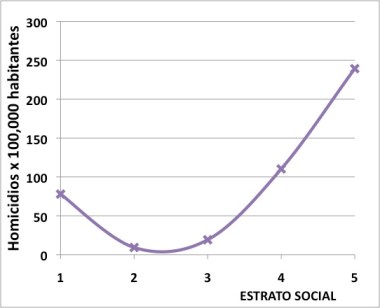
This is the absolute rate of homicides derived from the INE report per 100,000 people in each of the social strata, where 1 is the top and 5 is the bottom:

This data has been derived from the INE report, which is a poll, not precise crime statistics. INE derives the data from the poll and reaches the conclusion that in Venezuela there were 21,132 homicides in 2009, which somehow gets adjusted down to 19,113 homicides.

In order to calculate what is the rate of homicides per 100,000 people, we need to know how many people there are in Venezuela. Since I can’t find that number in the INE report, I look elsewhere in the INE website and find that for 2009 the projection was 28.8 million inhabitants, which gives 66 homicides per 100,000 inhabitants in 2009.

The chart above was obtained from a Table on page 70, where INE calculates the number of homicides per social strata based on its poll. However, the number of people is based on the sample size of the poll which is 1.8 million, not 28.8 million, so I had to correct for this factor to obtain the chart above.

The numbers are clearly horrific for the poor, the bottom strata of the population, as defined by INE, is the victim of 239 homicides per 100,000 people, almost four times larger than the national average. Those in the next lowest level have 110 homicides per 100,000 inhabitants, almost twice the national average. Curiously, the rich have more homicides per 100,000 inhabitants than the national average at 77. It seems you want to live in the middle class and lower middle class areas where in strata 2 and 3, the rates of homicides are a developed-country-like 9 and 19 homicides per 100,000 inhabitants respectively.

Even more surprising, according to the INE report (page 68) not all homicides get reported, despite the legal requirement that a person dying a violent death has to be autopsied. Clearly, people know the implications of their relatives having to go to the morgue and simply avoid it, likely by asking or bribing the medical doctor that certifies the death, not to specify that it was a violent one. For homicides, INE concludes, 15.% of homicides don’t get reported, which goes up to 36% for sexual abuse, 68% for robbery and 38% for kidnapping. Which shows the lack of trust and confidence Venezuelans have for the police.

Not a pretty picture…

Chavez flips-flop on Hospital funding, but will it help him?

August 28, 2010

(The opposition once again in the Assembly? That would be terrible! Discussions, disagreements, no more “Amen” to what the President says. There would be DEMOCRACY!)

When Hugo Chavez said three days ago that he was withdrawing funding from a Hospital in an opposition municipality, because it would be a “strategic error” and he would not approve funding “so that half the money could be stolen”, it was typical Chavez speaking from his gut.

What was atypical, is that Chavez has always been very careful about such gaffes near elections. Moreover, the statement showed multiple errors, not only was the hospital not run by the municipality led by Primero Justicia’s Carlos Ocariz, but Petare, where the hospital is located may be run by an opposition Mayor, but is a poor barrio, full of Chavistas who voted for Ocariz because of the incompetence of the previous Chavista Mayor and the poor candidate fielded by Chavismo.

In some sense Petare is a microcosm of the choices Chavistas face in the upcoming parliamentary election: Do you follow voting for Chavez, despite the fact that things seem to be getting worse, or do you give a chance to the opposition to show whether they can do a better job?

But the amazing thing is that Chavez seems to have lost the propaganda magic touch he has always exhibited and the hospital gaffe is one more example of Chavez spending all his time being defensive, rather than setting the agenda for the headlines.

Tonight Chavez flip-flopped on the hospital issue approving the funding, saying he had a “small doubt”, but after three days in the headlines, it was clear that this was not just a matter of checking some fact, but a clear act of discrimination and disdain towards the opposition and the poor people of Petare.

And once again Chavez had to back track and try to deflect criticism in a manner which is unusual for him. And the opposition once again took advantage of the issue, grabbing headlines because of the sheer stupidity of the action, as well as holding a clean up day for the hospital today, that sent a clear counter message to the neighbors of Petare.

The question is what has changed in Chavez’ propaganda machine? With 28 days to go to the election, it was only today that Chavez began campaigning, as he was in Cuba on the first day electoral activities were allowed, despite the fact that numbers do not favor him and the opposition, with some luck, has been able to dominate the headlines for the last two months.

And in each case, from Pudreval to crime and now the hospital, Chavez’ reaction has been weak and quite insufficient for an electorate that is still waiting for results after eleven years with little progress in their personal lives.

This flip-flop will not help Chavez, as the blatant lie given by him for the change will also dominate the news for a couple of more days, until another issue takes over. It would have been better for the Vice-President or someone else to say the funding had been approved without explanation. As it stands, he only made it worse.

The Venezuelan Poor Are the Overwhelming Victims of Homicides

August 27, 2010

In Spanish here

When Alek Boyd sent me the link for the INE report on crime this morning, I wished that I did not have to work, so I could read it and analyze it. It raises a number of questions about definitions, some of which are difficult to understand. For example, I am not sure how they define the number of total homicides, there seems to be two definitions.

But it is very clear from the report, who in Venezuela suffers the most from the rampant crime that Chavismo has refused to fight. You guessed it: The poor!

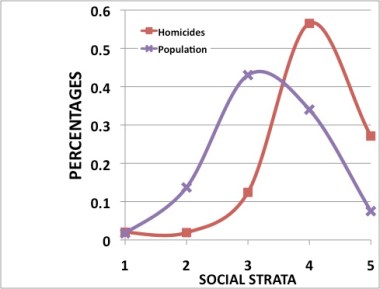
This is shown in the graph above. The purple line is the percentage of the population that is in each social strata according to the INE (National Institute for Statistics) report. The reddish line indicates the percentage of homicides that occurs in each strata. As you can see, the lowest strata of the population (5) represent 7.52% of the population, but nevertheless are the victims of 27.12% of all homicides. Similarly, those in the next lowest (4) strata, represent 34.02 of the population, but are the victims of 56.52% of all homicides.

In contrast those in levels 2 and 3 are best off, they are 43.04% and 13.7% of the population respectively, but only suffer from 12.4% and 1.91% of the homicides in the country. Those at the top don’t have it so good, they are 1.72% of the population, but are victims of 2.02% of  all homicides. This may indicate that those in what INE classifies as the top strata, either are victims of their own geography or victims of their life style, maybe showing off too much, driving fancy cars and the like.

But clearly, you don’t want to be in strata 4 or 5, which comprise 41.54% of the population, but are victims of 83.64% of all homicides in the country.

You definitely don’t want to be poor in Venezuela, but that is precisely where Chavez’ supporters are.

And who defends them from this?

For those that want to see it per  inhabitants in each strata, of course it is worse for the poorest (However, I think there is an additional normalization factor, the number of homicides is absolute, the population in each strata is not, the conversion factor seems to be 28.8 million/1.82 million (INE population in study)~52 times smaller, that is each number has to be divided by 52, :