Archive for the 'Venezuela' Category

Filho de Puta by Teodoro Petkoff

March 15, 2010

Filho de puta by Teodoro Petkoff in Tal Cual

When Lula won the election in Brazil there was a great stop book with the title O Filho do Brasil, which means son of Brazil. More recently, and based on that book, there was a movie with the same title and the same theme: the career of the kid from the Brazilian Northeast, who from the misery became the president of his country, through years of hard struggle and sacrifice especially during the time of military dictatorships.

But when this amateur reporter hears him these days philosophizing about “justice” on Cuban and Cuban political prisoners, what I feel like telling him, is that he is indeed, a filho de puta (a son of a bitch). I care little that he has had a great presidency, his popularity is enormous, which has combined the macroeconomic sense Cardoso with his own social sensitivity, to significantly improve the plight of their poorer compatriots.

I give a damn that he is part of a modern left, very different from this scam, supposedly leftist, that Chacumbele has installed here.

What he said about political prisoners in Cuba, comparing them with ordinary criminals, prisoners in Brazilian jails, is despicable and inexcusable, it makes me lose all the respect I had for him. You can share or not the ultimate resort of a hunger strike, but what can not be done and Lula did, is to trash the immense sacrifice of those who, faced with a dictatorship like Cuba, almost resort to suicide to assert their rights. Because a hunger strike in Cuba is to face the real danger of a brave death. It’s like having done a hunger strike in Hitler’s time. If Lula does not have the moral and political courage to claim a civilized and humane behavior of the Cuban government, which would be appropriate, as a decent and self- respected left should, he could have at least had the shame of staying silent.

Some thoughts on the Venezuelan National Assembly elections in September

March 14, 2010

I have written very little about the upcoming National Assembly elections. There are a number of reasons for this. While I do support whatever slate comes out of the “Mesa de Unidad” process and fortunately in my district candidates will be elected in a primary, it does not mean that it gets me very excited.

I know the opposition is so heterogeneous that it is not easy to get it to agree on everything, but at the same time, except for the fact that it is a lot more democratic than the non-democratic Government that presides over Venezuela, there are few parties there that are to my liking. If any.

I just know that the opposition candidates are better prepared and qualified than those ready to be anointed by Hugo Chavez as his deaf-dumb Deputies. But as you all know, I am in full agreement with Leopoldo Lopez in that ALL candidates should have been chosen in a primary. I just don’t like the “cappuccino” politicians that have been chosen, just because…even if they will be orders of magnitude better than the alternative.

I would have really liked to hear some nutty opposition candidate campaigning on the back of the proposal to eliminate the Venezuela’s military, double the education budget and a plan to provide real, good health care for all.  We need new and real ideas, not to out-Chavez Hugo.

Then there is the question of how much we should get in September. I really would hate for the opposition to win. And it is irresponsible to sell the concept that we are likely to win. While it is true that between now and September the opposition will gain even further, it is not and easy battle not only because of the way the electoral districts have been redesigned, but because the Government will have more resources. Thus, to get a majority, the opposition may need to win in 55-60% of all the votes.

But I personally don’t think we want to win.

First of all, if the opposition wins, Chavez will spend the next three years blaming the opposition fro not being able to deal and handle the crisis that is already here. I have yet to meet a single economist that thinks the Venezuelan economy will grow in the next three years unless oil goes above US$ 100, which seems unlikely.

But more importantly, I think that an opposition with between 40% and 50% of all the Deputies will make life Hell for an autocrat that is not used to even talking to his own people. Seventy opposition Deputies are going to make life very difficult for Hugo, they will be interviewed going in ad out of the Congress building, they will have the right to speak, they will question and denounce. Not only is Chavismo not used to this, but things are such a mess that they will be unable to defend much.

And then there is the ultimate reason while we don’t want to have a majority. Chavez can always make the National Assembly irrelevant by bypassing it and leaning on his parallel structures to channel money to the communal power, making the National Assembly simply irrelevant.

Just some thoughts for all those asking what I think: Let’s have a plural National Assembly, let Chavistas cook themselves in their own salsa between 2010 and 2012 and let the opposition make lots of noise in the process. Who knows, we may even have a new leader emerge from all this. But let’s not get ahead of ourselves of what we can do and expect to do.

Venezuela’s Chavez: Internet should be regulated

March 14, 2010

I don’t think I need to comment much on this Associated Press report, it says it all, coming soon to a website near you:

Venezuela’s Chavez: Internet should be regulated

Venezuelan President Hugo Chavez called for regulation of the Internet on Saturday while demanding authorities crack down on a critical news Web site that he accused of spreading false information.

In a televised speech, Chavez said: “The Internet can’t be something free where anything can be done and said. No, every country has to impose its rules and regulations,” Chavez said.

He singled out the Venezuelan news site Noticiero Digital, saying it had posted false information that some of his close allies had been killed.

Chavez called for Venezuela’s attorney general to take action immediately against the Web site. “This is a crime,” he said of the site’s reports.

There was no immediate reaction from the Web site, which is a popular outlet for critical news and commentary in Venezuela.

Chavez has regularly clashed with critical broadcasters and newspapers. One anti-Chavez channel, Radio Caracas Television, was forced to move to cable in 2007 after the president refused to renew its license. In January, cable and satellite TV providers also stopped transmitting that channel under government orders after it defied regulations requiring it to televise some of Chavez’s speeches.

Referring to satellite TV channels, Chavez said, “It can’t be that they transmit whatever they want poisoning the minds of many people — regulation, regulation, the laws!”

The last anti-Chavez channel on the open airwaves, Globovision, faces multiple investigations by government regulators for alleged violations of broadcast regulations.

Chavez called for authorities to take action against Globovision, saying one recent panelist on the channel “has the nerve to say that Chavez, the president of this country, supports drug trafficking and also has the nerve to say there is evidence that here in Venezuela … a bunch of courses have been given to terrorists from ETA and the FARC.”

“That’s very serious. That can’t be permitted,” Chavez said. “I can’t put anyone in jail. There are the branches of government that should act, and the people themselves have to act.”

The interview that Chavez mentioned came during tensions between Spain and Venezuela after a Spanish judge said he has evidence of Venezuelan government links to the Basque separatist group ETA and the leftist Revolutionary Armed Forces of Colombia, or FARC — both of which are classified as terrorist organizations by the European Union and the United States.

Chavez’s government testily denied having links to the two groups, and the two countries have since tried to ease tensions with a joint statement pledging to work together against ETA.

The world without guilt of Venezuelan Minister Jorge Giordani

March 12, 2010

While I had always believed that Minister of Finance and Planning Jorge Giordani was quite ignorant, I have never believed he was intellectually dishonest…

Until today.

For eleven years, Giordani has been in and out of the Chavez Government spending eight of the eleven years at the Ministry of Planning (As Minister!). From there, he did things like cancel the hydroelectric power plants of the Alto Caroni, because ideologically he was against them. But he not only failed to replace them, but he made no long term plan for the electric sector and managed to get rid of those that did that work well in Venezuela.

Giordani, en Electrical Engineer by training in his Bachelors degree, later got a Ph.D. in Planning, where he concentrated in Urban Planning, not in Economics, like many think he did and he began working on the Orinoco-Apure axis concept, a harebrained idea by which the population of Venezuela would be moved to the banks of the Orinoco river, because the water is there. Giordani clearly never has lived in the heat of those same banks, where 35-40C is a normal temperature. When he became Minister of Planning in 1998, the Government assigned a billion dollar budget to that project, but somehow we never heard about that anymore. Wasted? Down the drain? Robbed? We have no idea. Money that could ahve been used in improving the lot of many Venezuelans was thrown down the Orinoco drain.

Giordani also spent the first three years of the Chavez Government gloating over the savings in the macroeconomic savings fund FIEM,  until his buddy Merentes, then Minister of Finance, spent it all in six months(nobody has ever figured out what he spent it on) and the maxi devaluation of February 2002 (well before the April 2002 events) took place.

Throughout it all, Giordani has maintained an image of being honest, both materially and intellectually, even if somewhat limited in his ideas and conceptions about the world. And of course, he has never accepted any criticism, he lives in a world without guilt.

This image was valid until today, in my own opinion. Let me explain…

Because today, Giordani either showed how ignorant he is or what a remarkable liar he is (or both) when he said that the “mutuos” created an inflationary “avalanche” in 2007 and 2008.

Jeez, recall that the mutuos were eliminated at the end of January, when it was discovered that the “bolibourgeois” bankers had used “Mutuos” to rip-off bank depositors. Mutuos were a sort of repo, where brokers could received deposits from the public, in exchange for a yield and the re-lending of the security to the broker, who could lend it back to another investor. In this way some brokers became like small banks, lending 15-30 times their equity. Then the bolibourgeois financeers discovered that they could use them to buy banks with the depositors money and the ignorance and lack of supervision led to the failure of many banks and later many brokers who were intervened by the Government’s Comisión Nacional de Valores.

Of course, through all this, the regulators were nowhere to be seen, as they seemed to be concerned with enriching themselves rather than with regulating. In fact, of the three heads of the Comision Nacional de Valores during Chavez, one is in jail, another is being looked for by Interpol and the third one was in the Board of one of the brokers intervened! That is an incredible indictment of the Government, if there ever will be one.

And whose fault was all this? Nobody’s apparently…

Because today, Giordani dared to suggest that it was the Mutuos that created this “avalanche” of inflation, due to speculation with them in 2007 and 2008 (Why not in 2009?). And, oh yeah! now that the mutuos are over, things should get better. Sure Jorge! Tell me a story about Buck Rogers now!

Where do I start? Mutuos were never more than 5-6% of all of the monetary liquidity in the country (M2). So, how could it possibly be that such a small amount of money could create the “speculation” required to yield a 30% level of inflation for the whole country?

It is simply impossible, which Giordani should either know, and if he doesn’t, he is quite ignorant, and if he does know it, he is lying through his teeth. But he lives in his peculiar world, where he is never responsible for his decisions.

But whether it is one (ignorance) or the other (lying) or a combination or both, it is simply remarkable that a member of the country’s Cabinet, who has been on the Board of the Central Bank (now illegally holding that post, by the way) for practically ten of the eleven years of the Chavez administration, that he would try to skirt his own personal responsibility in the 700% inflation since Chavez took over the Presidency of this poor (in the Biblical sense) country.

Giordani’s whole press conference, curiously available only to pro-Government reporters, has no logic or substance, other than, as usual in this irresponsible Government, to blame others for their ignorance and incompetence.

Because when Hugo Chavez became President, monetary liquidity was about Bs. 10 billion and international reserves were about US$ 15 billion. That is, there were about Bs. 0.75 in circulation for each US$ in international reserves. The free exchange rate was about Bs. 0.600 per US$.

Today, eleven years after, international reserves stand at US$ 30 billion, only double that of 1998 thanks to the biggest oil boom in history. But monetary liquidity (M2) stands today at Bs. 235 billion, a full 23 (twenty three) times higher than in 1998. (Yes!, 2,300% higher, veintre tres veces más!)

Who printed all those Bolivar bills?

Giordani was present practically all of the time at the Central Bank. Nobody else was as responsible for this.

Well, reserves double, but Bolivars go up by  a factor of 23, what do you get?

Easy, we now have Bs. 7.83 for each US$ in international reserves. And thus, we have lots of inflation, lots more Bs. chasing the same goods, the country is less productive today than it was then.

And where is the parallel swap rate?

At Bs. 6.9 per US$

Funny, in 1998, the exchange rate was Bs. o.6 in practice versus Bs. 0.75 “mathematically” or a ratio of 0.8 between the two.

Today, eleven years later and after so much printing the ratio is Bs. 6.9 in pratice versus Bs. 7.85 “mathematically”, which gives you 0.88, not that different given that the swap market fluctuates so much.

But Giordani blames the “mutuos” rather than trying to find the irresponsible monetary policy he has presided over in the last 11 years.

Ignorance, dishonesty or both?

You be the judge

An update on what is happening at Guri dam

March 11, 2010

Well, I have good news and bad news. The good news, is that the model that I presented the other day is doing ok so far, it was predicting for yesterday a height of the water level at Guri dam of 253.25 meters and the reported level in the Opsis website is 253.16 meters. This is not bad, given that I used data up to February 15th., thus, after 14 days, the error is only 9 centimeters, which tracks the model quite well. Cross your fingers.

Except the bad news is that this is more complicated that it may have seemed at first sight.

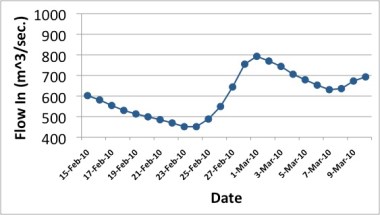
First of all, it has been raining! That is definitely good news. Here is a plot of the water flow into the Guri dam:

as you can see, the flow almost doubled after February 25th. as the rain brought in more water for a few days, going from around 400 cubic meters per sec. to 800. Then the flow dropped again to around 600 m^3/sec. and on March 8th. it rained again and water inflows levels are around 700 m^3/sec.

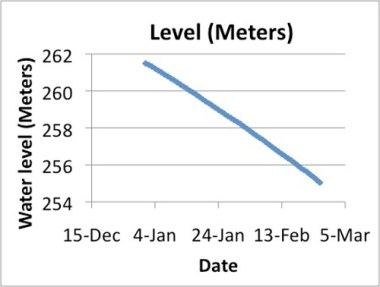
The bad news is, that despite the fact that water inflows are higher than in all of February, the water level is still dropping, as seen below in the the plot of the Height above sea level of the water:

As can be seen, the water level keeps dropping. We have had more rain and more water, but the rate at which the level has been dropping seems to be continuing.

How come?

Easy, as the water into the dam has increased, the flow out through the turbines that produces the electricity has also been increased as can be seen in the next chart:

As you can see, as the rain has provided more water, the dam has been used more and the flow out has increased. In fact, it seems to be increasing daily as if the people running it are controlling it accordingly.

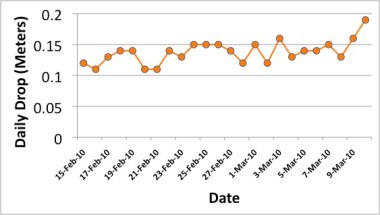
This implies, that despite the rain the daily drop in height has not slowed down, in fact, it has increased:

almost reaching 20 centimeters daily.

Thus, I am not sure why it is dropping faster, it would seem as if more water is being allowed to flow to produce more electricity, but the rate of increase in the flow out does not seem to be as large as to justify the faster drop in the height. It may be that because it is much hotter and there is a less surface area to the lake, there is much more evaporation or the shape is playing a role.

Comments are welcome, particularly by the experts, who may enlighten us on dam management!

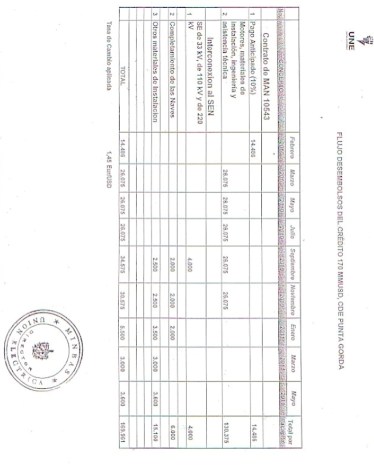
While Venezuelans are coerced to use less electricity than in 2009 due to the lack of investment, Chávez lends Cuba US$ 170 million to build a power plant there

March 9, 2010

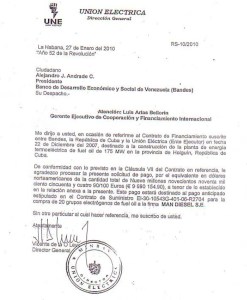
While Venezuelans are coerced, penalized and threatened if they use as much electricity as last year, which is only due to the Government’s incompetence and lack of investment, Chávez lends (???) Cuba US$ 170 million to build a plant in the province of Holguin which will have 175 MW of power and will be interconnected to Cuba’s power grid

Above, letter to Alejandro Andrade, President of Venezuela’s development bank Bandes asking for a 10 million euro payment as part of the “loan” for the power plant in Holguin

Letter with wire instructions for the payment of 10 million euros

Schedule of payments for the year 2010 for building the power plant in Holguin

(Hat tip DR!)

Some clarifications on the post of when the Guri dam will reach the critical level

March 8, 2010

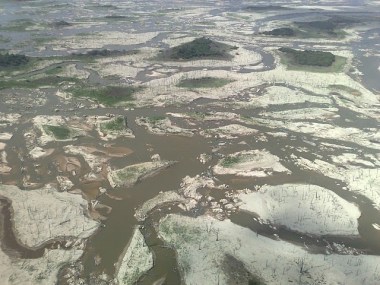
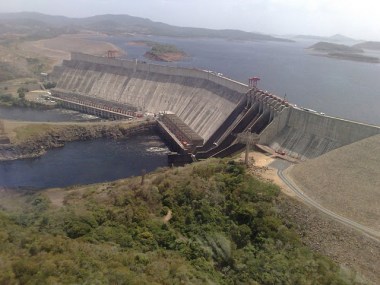
(Picture of a section of the Guri dam a few days ago)

(I still have no Internet at home, rather than answering the comments, here are some clarifications on yesterday’s post)

1- What is the critical level?

Strictky speaking is 240 meters, but it is likely to be higher. Flow may have to be restricted and you have to worry about other technical problems, so a better number may be 244-245 meters, which will occur around May 10th. if it does not rain.

2.-What is the correct question to ask?

I think it is the critical level, not when is that the water stops dropping. The reason is that if it starts raining and the daily drop rate falls from 15 centimeters to 7-8 centimeters, you push the day the level gets critical 50-100 days into the future. Historically, by the end of June, the water flow has always been above 4,000 m**3/s, thus if the rains slow down the rate thirty days, the probability is extremely high that a positive equilibrium (More flow in than out) will be reached.

3.- What about the conical shape of the dam?

The shape of the dam should be or is  in the linear fit to the historical data. How fast the water drops is a function of inflows, the shape of the dam, evaporation and height. I don’t pretend or intend to model of those, I simply note that so far the fit is extremely good. I will keep monitoring it.

4.-This is not a severe drought year due to El Niño

While this is not a great year, there have been worse. The current outflow and inflows into the dam are above the worst ones historically for the same date. El Niño is a complex phenomenon, this is not the strongest one either, nor the longest running as noted in this post in January. El Niño is simply a convenient political excuse.

5.- What about the turbines?

I have not had recent information about how many turbines are online or not. This is a separate issue. My understanding is that one can not be repaired. Another has been fixed. That leaves seven off line, last time I heard.

I was a little more optimsitic when I wrote the post that I am now. It looks like assuming “240 meters” was the wrong thing to do, it seems to be higher, thsu it is going to be quite close. However, it may not last long. My worry is that if Guri is shutdown, blackouts will affect the oil industry, supplies, communications. It could be really bad for a few days. On the positive side, there have been some rains down there, inflows have moved up to 700 m**3/sec.

This slide show of Guri about ten ago days tell you the whole story.

An attempt to answer the question of whether the critical level of the Guri dam will be reached

March 6, 2010

Recent Picture of the Guri dam

All week, I (we) have been worrying about whether the Guri dam will or not reach the “critical” level of 240 meters above sea level at which point it will have to be shut down. In El Nacional there was an article on Friday in which one person talked about simulations and another gave a very definite date of something like April 4th.

This post is an attempt to answer that question. I start by looking at a graph I already published once:

This is the historical behavior of the flow of Rio Caroni that feeds Guri. As you can see, the minimim historical flow, shown in the green line, had a low around May 10th. Thus, unless this year represents a minimum in historical flow, this should be the worst possible scenario we may expect.

As usual, friend Moses came to the rescue yesterday linking to this post in Noticiero Digital which has a table of the level of Guri day by day since January 1st. This is how the water level has dropped so far this year and until Feb. 25th.

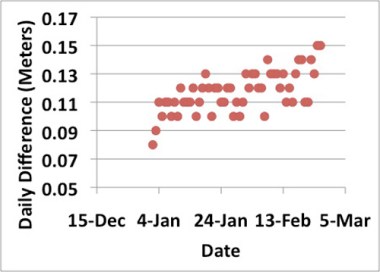
You can see that the daily drop is accelerating, which I noted yesterday because in January the daily drop was 8 or 9 centimeters and Chavez quoted 14 centimeters in February. Thus, because of a number of factors, conical shape, lower water inflow, lower levels, the change in not linear, the water drops faster as the days go by.

Instead of lloking at the level, it is better to look at the daily change as a function of time:

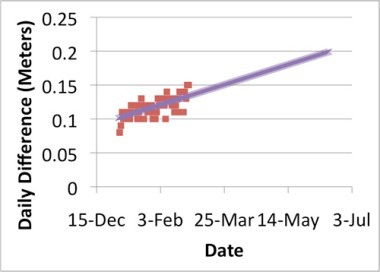
as you can see, there is a lot of scatter in the plot, due mostly to the fact that the data only has two significant digits. I did a fit to it and it looks quite good with a simple linear fit, the water level dropping accelerating its drop by about 0.594 mm. per day, that is it takes about 16 days to add  a centimeter to the daily drop.

This is the the data for the first two months of the year extrapolated all the way to June 16th.:

As you can see, the fit is pretty good and looks linear. In any case we can monitor in the upcoming days whether the model predicts the correct level day after a day and adjust accordingly.

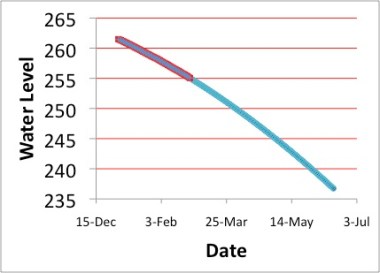
Of course, I can now extrapolate using the model what would be the level into the future and how the date compares to the May 10th. cut off of the first graph above. Using the model, I get:

The plot above shows the orignal data in red below the water level data in blue generated by the model. The crossing of the 240 mts. level (I am not sure the exact number) takes place on May 29th. two weeks after the historical minimum. To give you an idea, I only used data up to the 25th. of February and today, the OPSIS page says that the level is at 254.20 and my model says 254.22, not bad at all, it does not seem to be accelerating or changing.

Given that May 10th. is the historical minimum for the water flow and the model says May 29th. it seems quite unlikely that Guri will have to shut down.

Comments are welcome.

A rant about how little happened in Venezuela this week, but what a week!

March 5, 2010

(I order you to stop!)

Sometimes, living in Venezuela can be a very bizarre experience. As you probably noticed, I have not posted much most of this week. A lot happened, but how many times can you write about Chavez-Farc-ETA? Or how many times can you write about the electric crisis? Or the economy shrinking? Or the Government’s lies? Or Chavez going in Cadena?

It does get boring, but at the same time it has become our every day life. I spent part of the week considering various scenarios if Guri should collapse. We don’t know if it will, but the probability that it happens is finite and significant. While Chavez talks about 100 days for the critical level to be reached, because there are 14 cms. to go and 14 mts. to that level on January 12th. the Government said the level was dropping by 9 cms. daily. Thus, it is not a linear phenomenon, like Moses discussed in the comments at the time. In fact, today El Nacional is talking about days in which the level dropped by 16 cms. this week.

Yes, it may rain before May, but reality is that this planning is not virtual it is quite real and absurd at the same time. But while planning for work is complete, I have not planned for my home. I do have a couple of UPS’s around that may last a couple of hours each, but when you meet someone that knows about electrical networks and he tells you that he installed a power plant in his home two years ago, the term “inside information” truly acquires a new meaning in your life.

And while Quico still has the stomach not only to watch Chavez, but even Tweet about it, I don’t. Chavez is clearly campaigning for something while the country falls apart. But he is definitely as cynical as can be. First, he announces that a tiny power plant will now be used to power the town of Guanta. The plant was part of Cemex’ nationalized cement plant. From there, he goes to Barinas, where he has the guts to go and visit CAEEZ, a monument to the corruption and incompetence of the Chavze Government. But hey! The CAEEZ project included a small power plant which uses residues from sugar cane processing, so he can’t help but show it, even if CAEZZ is such a symbol of the economic and production failure of Chavez’ whatever-you-want-to-call-it project.

And if that was not enough, he announces the nationalization of Turboven. But wait! Wasn’t Turboven nationalized three years ago?

Well, yes, the whole of Venezuela’s power generation industry was nationalized three years ago, but after an initial letter to Turboven, nobody followed it up. EDC was nationalized, Electricidad de Puerto Cabello was Nationalized, the Government overpaid for Seneca, Margarita’s electric company. But in an incompetent and inefficient Government, everyone forgot about Turboven. Until yesterday…

So yesterday’s Cadena was about an irrelevant power plant, a symbol of the Chavze Government corruption and incompetence and and after thought…That is how little Chavez has to show for eleven years of bread and circus.

Very little.

And then, the Central Bank, after a three week hiatus comes back and sells US$ 50 million in zero coupon bonds to bring the swap rate down. It moved down all right, from Bs. x.9 to Bs. x.8 per dollar, while the Central Bank sold dollars at Bs. 4.8 per dollar, if you got any. Is this policy? You could have fooled me. Giving away dollars is perverse and inmoral, but what else is new. As Chavez said ” We can’t bring down the swap rate down in one week, it takes months to do it”

Yes Hugo, but since you announced that you were bringing it down to Bs. 4.3 per dollar, all it has done is move up and it flirted with Bs. 7 per $ this week. In fact, the joke is that CADIVI is not functioning, because at Bs. 4.3 plus commission to get your dollars, it is almost the same as going to the swap market, without the paperwork.

And in closing this rant, I have a message to those that say or think the Government has so much money to spend ahead of the September elections: While it is true, in theory, it is not quite right. The Government devalued from Bs. 2.15 to Bs. 2.6 and Bs. 4.3. PDVSA, the only supplier of foreign currency for all practical purposes, will have to exchange 70% of its dollars at Bs. 4.3 and the rest at Bs. 2.6.

But it so happens, that last year, the parallel swap market was heavily intervened by both the Government and PDVSA at levels above Bs. 5 per US$, so while PDVSA and the Government will have “more”, it will not be a huge amount given that PDVSA and the Government sold some US$ 13-15 billion above Bs. 5 per US$.

Moreover, there is a huge difference between selling into the swap market and selling to the Central Bank at Bs. 4.3 per US$. When PDVSA sells US$ to the swp market, it absorbs Bs. that are already in existence. When it sells them to the Central Bank, the Central Bank “creates” Bolivars, which go into the monetary base and are inflationary unless the monetary authority sterilizes them, which it has not done very efficiently in recent years.

Finally, I have bad news and good news. The good news is that the Constitutional Hall of the Venezuelan Supreme Court reinstated the Mayor of the Sucre municipality in Zulia State. Don’t interpret too much into this, it was so absurd and irrelevant that it was reversed. Naming the Mayor that lost the election was simply stupid. The bad news is that economists think that 2010 will be better than 2011, unless oil prices shoot up, which nobody thinks they will.

And thus, I end my rant, nothing happened this week in Hugolandia, but what a week!

Venezuela’s Final GDP numbers for 2009 not pretty

March 3, 2010

The Venezuelan Central Bank released final numbers for the Venezuelan GDP and they were worse than the original estimates by the monetary authority with the contraction reaching 3.3% for the year and the final number for the fourth quarter of 2009 reaching -5.8%, even worse than the original estimate of -4.9%.

The Central Bank explained away these numbers saying that they were the result of lower oil prices and the world crisis. Well, if this were true, then the fourth quarter showuld have been the best one of the year and not the worst one,  as world economies recovered and the price of oil in the fourt quarter of 2009 was higher tahn in the other three quarters.

Oil GDP in the fourth quarter dropped 10.2%, while the non oil sector contracted 4%. The private sector contracted by 7% as manufacturing was down dramatically Autmobile was down -18%, furniture -46%, metals -46%, Transportation -17%. The only positive sectors were all Government-related: Communications +10.5%, Electricity (????) and water +5.5 and public services (+2.8%)

If you add devaluation and the electricity crisis to these numbers going forward it does not look very pretty.