Archive for the 'Venezuela' Category

Still thinking about that electricity problem in Venezuela…

January 7, 2010

Well, I continue to try to understand the electricity problem. I want to know both qualitatively and quantitatively how big the problem is. Thus, another post on the subject and thanks to those that really participated in the comments in helping understand whether the rules made sense or not and how much in deep s… we are or may be in the near future. I will summarize some of what I have learned.

First of all there is clearly a big problem, which can be illustrated with this pictures of the Uribante river where the dam is, which compares the same location in November 2008 and October 2009.
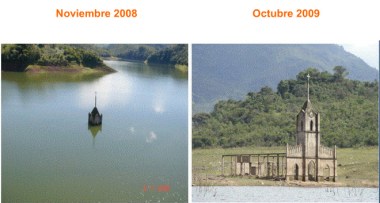
A picture is clearly worth 10,000 words as you can see the water level is very bad shape.

While graphic, the problem is that Uribante is almost a footnote in Venezuela’s power generation picture, since Guri, the dam in the Guayana region generates 63% of the electricity in the country. Unfortunately, in the Corpoelec report where the pictures above were taken from, those of Guri are not as dramatic as the picture above, for a very simple reason: The level of water at Guri, while low, is not at a historically low level, as this graph shows:
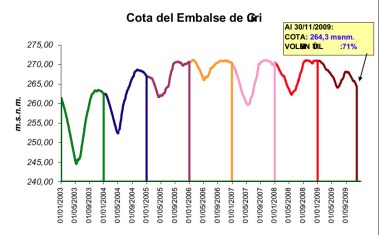
each vertical line indicates the height of the water level on January 1st of each year. As you can see, the level is at 264 meters above sea level. In both 2003 and 2004, the level was found to be lower on Jan. 1st than it is today. Thus, at first glance one would think that given that this crisis seems to be playing out to be much more dramatic than in 2003 and 2004, this is not justified.

But it is, because in 2003 and 2004 the Rio Caroni that feeds the Guri dam was not running at such a low level as it is running today as shown in the next graph:
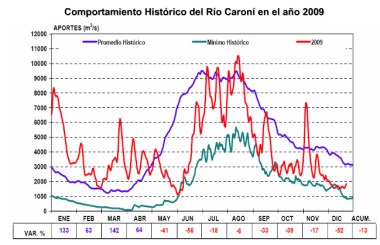
This is a plot of the day by day flow of the Caroni river (in red) during 2009 where it is compared to the worst flow recorded in history (in green)  and the historical average (in purple). As you can see the water flow is 50% of the historical maximum at this time of the year and very close to the historical minimum. And this is precisely the problem, the dam is not filling as fast as usually is which means that if you keep using it at full capacity, the wtaer level will drop to critical levels much faster tahn it did in 2003 and 2004.

And yes, you can blame El Niño for that, but this is not an unusual phenomenon either, it comes and goes in periodic cycles. But since you can not longer blame the previous Government (even if it was tried) you might as well assume the usual “don’t blame me” attitude of the Chavista Government.

But in the end, El Niño is not the real problem either. The real problem is that demand since 2004 has grown by ~40%, as can be seen in the next graph:

And what is the reason for this growth? Well, the main reason was the oil boom, which led to a spending and consumption boom, but there is also a factor of the lack of any incentives to save energy or electricity. Not only have rates been frozen for 7 years, but 32% of residential homes steal their electricity and many Government offices and institutions do not pay Corpoelec or pay with considerable delay.

But nothing was done about the rates. In fact it was the Government’s policy to keep them low. And like Petkoff says in the previous post, this growth which originated in the oil boom, was not accompanied by the investments that could have been made using part of the funds from the oil boom.

But it was worse that this. When Chavez got to power in 1998, there were two large power plants under constructions that were supposed to be finished before 2003 and three hydroelectric plants planned for the Alto Caroni region. Of these only one was completed in 2007 (four years late). One is scheduled for 2011-2012 and the three hydroelectric plants were replaced by about two dozen fuel plants of which only two or three have been built and only two are fully operational. Remarkably, those ineffective Governments of the much maligned IVth. Republic planned sufficiently ahead in the 70’s, 80’s and 90’s such that there was always over capacity.

Not any more…

Through lack of investment and planning and despite Giordani, as noted by someone in the comments, having a Bachelors in Electrical Engineering and spending eight of Chavez’ eleven years as Planning Minister, the whole field was mismanaged and it is fully and completely this Government’s fault that the country faces this crisis.

But it is interesting to look at some other numbers which tell us a lot of about the industrial and electrical power infrastructure of the country.

First of all, the following graph shows the power produced by Edelca (mostly Guri) and how it is used:
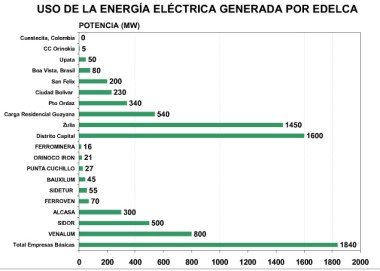
The last line is truly amazing, it represents the electricity consumption of all of the basic industries in the Guayana region, they use 1,840 MW of power, more than all of Caracas or all of Zulia State. In fact, it is more, because the cities of San Felix and Pto. Ordaz are fully devoted to those basic industries and they use another 540 MW, so that the combined consumption of the Guayana Industrial Complex reaches 2,380 MW in total. (Edelca generates a total of 9,780 MW and Guri 6,200 MW)

Which is why the focus of the savings program is in this region. The Government plans to cut production of Aluminum and Steel, chopping off 500 MW of power, cut off supply to Brazil (60 MW), install an additional 35 million energy savings lightbulbs (200 MW), increase thermoelectric generation (adds 100 MW) and finally, reduce electricity demand at shopping centers (20 MW)

The last number is what is ridiculous. The misguided policies proposed by the Government, only to be withdrawn when the outcry forced them to, represented barely 2% of all of the savings and cuts proposed. As I have suggested elsewhere in this blog, this improvised decree could have been replaced with forcing shopping centers to cut 10-20% of the energy usage in November 2009, by policies chosen by them under the penalty of paying four or five times the going rate in any excess of the power used above the targets.

You can bet that shopping centers would have happily complied, choosing what to do so as to maximize business, jobs and convenience to their customers.

But stupid Big Brother thinks he knows it all, while the opposite has been shown to be the case in this field.

Finally, the presentation by Corpoelec has ince again over optimistic projections like saying Planta Centro will be up to 400 MW by next month. Sure…I also understand that Guri is below performance due to a number of turbines being off line.

There are other topics that are interesting in all this, such as whether the Guayana complex makes sense, why the Chavez Government decided to buy Sidor, the economic impact of these plants running at half capacity while the Government pays everyone’s salary. But for now, I think this post is long enough and I am sure you agree.
The Electric Comedy by Teodoro Petkoff

January 7, 2010

The Electric Comedy by Teodoro Petkoff in Tal Cual

That’s the way they have ruled for eleven years.

Pure improvisation. Shooting arrows without knowing where they are going to fall.

Groping. Blindly trying to hit the piñata. Measures that defy common sense, and then have to rectify in haste. The comedy they performed with the shopping centers has been one for the record books. Forwrads and backwards. They provoked the   power shortfall by sheer incompetence and now not even know how to manage forced rationing which is the inevitable consequence. The arguments justify themselves are not even cynical because of their absolute stupidity. First it was the person responsible for planning, Giordani, who had no other idea but blame previous governments for the lack of investment in the sector. When hey realized that after eleven years (ie, two governments of the their predecessors plus the fifth of another one),  one had to laugh at the excuse of  “previous administrations” , then they changed to “El Niño”. Now global warming is responsible, the summer drought, the declining water mass of the Guri dam.

Nonsense. The simple truth is that the country has experienced the infinite inability of Chacumbele and his government team.

Any planner except for Giordani and  any president other than Chavez knows that if the population grows, demand for electricity grows and therefore it becomes necessary to invest permamnently  and continuously to ensure that power generation will always be ahead of population growth.

Nobody with half a brain would not realize that after five consecutive years of the oil boom, with an economic policy that encouraged excess imports and with it the growth of trade and construction that accompanies it, should have contributed as an additional reason to pay attention to investment in the electric sector. The worst thing is they can not even argue the lack of resources. There was excess of funds.

But the inability and ineffectiveness of the government of Hugo Chávez are unbeatable. Not even years of frequent power outages throughout the interior of the country managed to sensitize the herd of useless bureaucrats who govern us.

They did none of the things they had to.

Giordani ruled that hydroelectric capacity had reached its limit and backed down dfrom the construction of four dams on the Upper Caroni. Of the 29 power plants, which  had to be operationalsince 2007, only five have been built , of which two are still inoperable and three are operating at one third of its capacity. Out of sheer laziness Planta Centro was allowed to collapse and nationalized  Electricidad de Caracas suspended its investment plan. Of the investment in transmission lines  only a quarter of the budget has been executed that would have financed work thats houdl ahve been completed in 2007. Under these conditions of a gap in alternate generation gap, Guri is overused and therefore its level falls beyond what a dry summer would cause. We come then to El Niño and other similar trifles. The government is to blame and nobody else. The country will not forgive him.

Do you know which way this country is going?

January 7, 2010

El Nacional page C-5:

The Government electric corporation will install a 50 MW turbogenerator to guarantee electricity for the Caribbean Baseball series in February

El Nacional page C-3:

Simón Bolívar University suspends suscriptions to scientific journals in 2010 due to budget cuts.

The development model is clear: Pan y Circo!

Thinking aloud: Do the electricty restrictions in shopping centers make any sense?

January 4, 2010

The more I talk to people, the more I am convinced that the recently announced measures to shut down Malls and shopping centers make little sense. I wished I knew more about the subject to talk with some authority, but maybe readers can point out the flaws in my thinking:

1) From what I have been able to read on the web, electricity usage goes up in the morning, reaches a plateau/peak around 11-11:30 AM and starts dropping after 7 PM. Thus, the restrictions seem to be attacking the slower periods of the day, not the peak periods. Since most power is hydroelectric, it can’t be shut down completely, so you want to concentrate on the peaks.

2) Except for the savings associated with the one hour shutdown of the stores from 10 AM to 11 AM, the morning shut down will simply make life harder for those that work in offices within malls. Given that food places will be shut down, people will find the nearest bakery, cafe or whatever. These places will consume more power to make the additional bread/pastry/coffee, there will be some savings on air conditioning and lights, but not in the electricity used to make the products. Since parking lots will still be open for office worlers and the like, there will be no saving in lighting. Banks, drugstores and the like in Malls will force people to go elsewhere, but the air conditioning in the banks will not be shut down. Sure, lights will be out, so what.

3) Restaurants and movie theaters will now be shut down, but this will happen at the hours that electricity usage in the country drops sharply, just after 8PM-8:30 PM. Does this really produce savings?

4) The crisis should hopefully ease by the time the next rainy season comes around. If a Mall or shopping center buys an electric plant, it will be in place by the time the crisis eases, thus it will only be useful for the next crisis, which will come anyway, but it is a wasteful investment.

5) What is and isn’t a shopping center? The definition is not clear so that merchants are applying it uniformly: they are all shutting down when more than a couple of businesses or stores is housed in the same building, whether strip mall or shopping center. This is in the end extremely discriminatory, as stand alone restaurants, bars, discos, drugstores and whatevers will benefit from the excess new clientele without having done much to get it. This will make some people rich, but will drive others to bankruptcy.

6) This will have an important economic impact. My office is at a Mall where restaurants will not even bother to open at night, movie theaters will cut hours and cab drivers plan to eliminate one shift. This implies less economic activity and things looked bad before this silly measures. Like the ostrich, the Minister of Electricity “rejects this possibility” which only goes to show the stupidity of the revolution and its revolutionaries. They reject capitalism and seem to promote a strategy of less for everyone. This is absolutely stupid. Of course, the Chavez-filled National Assembly rather than look at all these real problems will look into whether Colombia is or not creating Chavez “False Positive” chimera.

This is no democracy, this is a pantomime of what a country is supposed to be.

New Year’s in Plaza Altamira

January 1, 2010

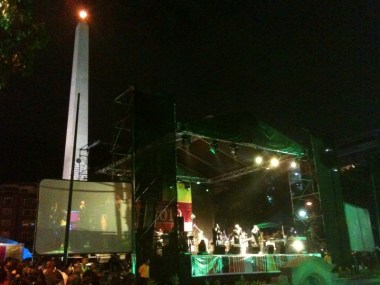
Waited for the New Year in Plaza Altamira with my wife, good music, awesome fireworks overhead and people in good spirits. Above you can see the stage as a group played gaitas before the New Year and the iconic obelisk of the square.

Happy New Year!

December 31, 2009

The best to everyone in 2010 and that all your New Year Wishes become reality

Thanks for reading!

New electricty rationing to lower quality of life for the younger generation

December 31, 2009

Talking to young people at work, I was confronted with the reality of the impact on them of the shutdown of shopping centers and malls  at 9 PM daily, which begins tomorrow. They are all dismayed, sad, mad and surprised that their quality of life is going to deteriorate further overnight.

Given the crime rate, malls have become refuges for young people to go to bars, restaurants or simply to the movies. But with no power to shopping centers after 9 PM, you can rule out bars and movies and most restaurants may not even bother to open given the hours that Venezuelans like to eat at.

The impact on movie going will be particularly strong, as stand alone movie theaters have disappeared in the last decade, as malls installed fancy theaters with more comfortable chairs, reserved and assigned tickets and other amenities.

While some malls may install their own power generators, the process of importing and installing them may take more than a year so that it will be a while before this normalizes.

I guess this will make Caracas a more socialist city, as people will go home earlier and bar and restaurants that are housed in single units, will benefit from the new decree.

As with so many things, this translates into fewer jobs, less economic activity, but it will probably pale with the impact that the electricity savings measures will have in the steel and aluminum industries of Guayana. There, workers will be sent home with pay, so that the already large losses of the CVG (Corporación Venezolana de Guayana) will widen.

Meanwhile Chávez said we are closing the year on good footing, as the economy stagnates and there are new and further problems ahead. Not exactly a cheerful way to the end the year. He must be seeing something I am not, or he may be blind to the problems.

But to the younger generation, he is a nightmare that will not go away.

Highlights of Hugo Chavez’ wisdom in 2009

December 31, 2009

-“We have to fight regional caudillismos. It hurts a lot, they surround themselves with inconditionals and create personal projects over the hopes of the people”

-“We have to return safety to the streets! It is a life of death commitment!”

-“They (the opposition) are inundated by hate, while we continue with our love. The Kingdom of the heavens on Earth is Socialism”

-“If the opposition reaches power there will be war, that is why we have to guarantee the continuity of the revolutionary process”

-“Starting today the Cuban flag will wave in the Panteón, because Cuba is part of this Nation. We are ready to die fighting for Cuba”

-“If it were not for the attacks. the lies and the exagerations about the errors of the Governmnet, we would have 80% popularity”

-“Why do there have to be potholes in the streets if we export asphalt”

-“In the face of the poisounous message of Gobovision, Prosecutor, President of the Supreme Court, fulfill your obligations and if not, resign!”

Add your own in the comments, I will move it up to the post if it is good.

Rafael Caldera passes away, leaving a mixed legacy

December 28, 2009

Rafael Caldera, Venezuelan President for two periods (69-73, 94-99) died on Christmas day. Anything you say about him can be controversial. He was a love him/hate him type of personality, because as is characteristic of so many Venezuelan political leaders, his ambition drove him and he put that above everything, as demonstrated that after being the leader of the so called “right” in Venezuela for over 40 years, he became the candidate of the “left” in 1994, when he was elected for his second term.

A lot has been said in the last few days and, I must say, I have disagreed with a lot of it, which is in part the reason for this post. But in any case, how can a blog about Venezuela not have at least some discussion of Caldera and his life?

Let me start by saying very clearly that I never liked the guy. He was simply too arrogant and his belief that he knew everything is what eventually led him to make many mistakes. In fact, I think that his second term arose from this arrogance. He thought he could be the savior, even worse, he thought he was the only possible savior. Thus his failure. But I am getting ahead of myself in describing my view of the man. So, I will mostly talk about what I disagree with in the evaluation of Caldera’s legacy.

Caldera ran for President six times. Everyone said he was a Democrat, but he never promoted internal democracy in his social-christian party, but this is a characteristic of Venezuela’s limited democracy, parties are formed to promote the messiah who founded it. In 1987, Caldera realized that he would lose to Eduardo Fernandez in the party’s convention, so he stepped aside. In 1994 he realized that he would lose again at the party’s convention, thus he left his party when he saw the possibility of becoming the candidate of a large fraction of the country’s left. As easy as that, a founder of our democracy, but not a full democrat at heart.

Caldera first term in office was not that bad. World conditions were tough, Congress was controlled by the opposition, but in general Caldera had a Cabinet of professionals which managed to execute well and impose a vision of development, which continued the work of Betancourt and Leoni on the infrastructure side, together with appeasement internally and integration of the country internationally by reapproachment to the radical countries that AD had broken relations with.

Had Caldera set aside his ambition to be reelected, history would have judged him well. But Caldera, a masterful speaker, could not stand aside, and as soon as the required two terms went by after his first Presidential term, he ran again. And he won the nomination pushing aside the younger generation of his party. But he lost. He lost, because he was the candidate for the party in office, his own party COPEI, after the disastrous Luis Herrera Presidency. But he was never that popular anyway (He won his first and second terms with only 30% of the vote) and lost.

And then…he tried to run again against his arch enemy Carlos Andres Perez, but Eduardo Fernandez had been grinding around the country supporting his party leaders and Caldera stepped aside. Fernandez lost badly agaisnt CAP, he was not as charismatic as Carlos Andres Perez and everyone wanted CAP’s first term to return.

And then comes Caldera’s most controversial moments. First, on the day of the 92 coup, he did not back it, but justified it. Curiously, Eduardo Fernandez went to join Carlos Andres Perez at the TV station where he had fled, in order to defend democracy. That was the end of Fernandez’ political career.

Even if Fernandez tried again to be candidate in the next election in 1994, he opened the party to too much democracy, allowing non-members to vote in a primary, except that surprisingly, people chose Oswaldo Alvarez Paz, the Governor of Zulia and not him. Caldera did not even try to participate, he was outside the country. He returned two months later and announced he would be the candidate of a coalition of left wing parties, including MAS (Socialists), PCV (Communists), MEP and URD, creating the Convergencia party. He won thanks to these parties, the people from COPEI who voted for him and those that thought Caldera represented their dissatisfaction with the way the country was going. And it was that speech in 1992 that gained him that reputation and was key in his win. In some sense he was the first beneficiary of the coup. Caldera really thought he could be the one to run the country peaceful for five years, even if he only got 30% of the vote.

I really don’t assign much importance to Caldera pardoning Chavez. It was the natural thing for him to do, the continuation of his “pacification” policies of his first term. They worked in the late 60’s, it is typical to think that the same trick will work twice. It back lashed, but I think every other candidate would have done the same and if Chavez had not been pardoned, another group of military leaders would have overthrown the Government and freed Chavez anyway. Chavez would have gotten to the top by elections or by force anyway.

Caldera’s second term reflected his arrogance. While there was going to be a financial crisis created in the years before him, the whole crisis unraveled when he decided to remove the President of the Central Bank. The whole crisis was mismanaged, taking the currency from around Bs. 50 per dollar to Bs. 120 in a couple of months, as people fled the currency and Caldera threatened to nationalize the banking system. He then established exchange controls, and monthly inflation reached an annualized 120% level in January 1995 which led him to overhaul his Cabinet and bring in Petkoff. Petkoff tried to reform things completing the privatization of CANTV, changing severance pay, opening the oil sector and reforming the local pension system, which was never implemented. It was a completely different second part to the Caldera Government. But then, oil prices collapsed and people felt it hard and the perception of the Government was that it was simply terrible. Chavez came and won.

The rest, as they say is history.

This is my very brief personal view of what Caldera meant to Venezuela, emphasizing the parts that I disagree with that I have read about the last few days. He did participate in establishing the country’s basic modern democracy, but he failed to see the need for opening the political process to younger generations. Perhaps if Caldera had been elected in 1989, the opposition would have swallowed better the same reforms that Carlos Andres Perez enacted but is not given recognition for. Governors were elected thanks to these and a new generation of young politicians was supposed to come from that. Caldera stopped their development, Chavez crushed it.

(OK, take it apart)

How much does the Chavez Government have left in the parallel funds?

December 27, 2009

Today’s El Nacional (A-6, by subscription) has an article about Ecoanalitica’s calculation of how much the Chavez administration had in the parallel funds in October 2009, as well as how much money the Government has available in both Bolivars and US dollars in various accounts. The article compares this to what was available a year earlier.

This is, of course, a lot of guesswork on the part of Ecoanalitica, as there are no periodic reports on how much is available, but this is interesting, because it shows whether the Government can really manage to hold the swap rate down.

According to the report, neither Bandes, nor Banco del Tesoro, nor the National Treasury have any foreign currency, a total  drop of US$ 10.1 billion from a year earlier. The rest in US$ is as follows:

Fonden            US$ 4.8 billion (down from US$ 9.3 billion)

Chinese Fund US$ 4.5 billion (same as the previous year)

PDVSA             US$ 0.3 billion (down from US$ 0.9 billion the previous year)

Thus, there is a total drop in these funds and PDVSA of US$ 10.2 billion, for a combined drop of US$ 20.3 billion. This does not mean that the Government spent this amount, it actually spent much more from the funds in 2009, because Fonden received US$ 12 billion from the so called “excess” international reserves in 2009, the Chinese added to the Fund some US$ 4 billion and PDVSA and the Republic issued US$ 11.3 billion in debt during the year. Thus, between all these the Government drew down like US$ 40.6 billion from the funds and new debt (plus however many billions PDVSA generated that were also spent)

Which means that for 2010, the inventory of financial weapons is significantly reduced for the Government to be able to keep the swap rate down as it will like. First of all, it will not be able to give Fonden US$ 12 billion like it did in January, but more like US$ 6 billion. Second the Chinese fund is not money freely available to intervene in the swap market. Finally, under current conditions, it will be difficult for the country or PDVSA to go back to issue new debt in the first few months of the year. On top of it US$ 1.5 billion come due in August 2010, when the Venezuela 2010 bond matures.

Additionally, not all the money left in Fonden can necessarily be used, as some of it may be in investments or money already committed but not spent. We assume all of it can be used.

Then, the Government needs to spend around US 3.4 billion a month to sustain the current level of economic activity and maintain the swap rate down. Average oil prices will likely be higher in 2010, which should help the Government. This means that things will be tight, as in more or less three months, the Government will run down what is available in Fonden now plus the US$ 6 billion it is likely to transfer to Fonden in January. (Yes, higher oil prices help, but it is not a huge difference) A very limited arsenal indeed to keep the swap rate down unless there is spike in oil prices.

In Bolivars, the Government has around US$ 31.5 billion, the largest fraction coming from official deposits of the Government in the banking system. Since this calculation is for the end of October, some of those deposits have been wiped out by the banking crisis, but in any case these funds can’t be used to fight the swap rate and their magnitude is roughly equal to that of a year earlier.

Given that economic activity has contracted significantly and that despite all the efforts the swap rate rose in 2009, it is difficult to envision that it will not rise in 2010. In fact, these numbers suggest that it may rise sharply in the first half of 2010.

The Government has two choices. The first one is to devalue the official rate, which will alleviate some of the pressure from the swap rate as consumption of imported items goes down, or to cut down sharply on dollar expenses, like travel allowances and the like. Of course, the optimum solution would be a combination of both.

I would tend to believe that the Government will devalue, except that Chavez has refused to do so in the last three years. But give it four months and unless something unexpected happens in oil markets, reality will simply force him to do it. Politically in fact, the sooner he does it the better as the inflationary impact will slow down as the November elections arrive.